
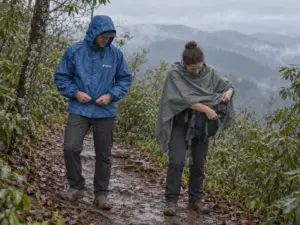
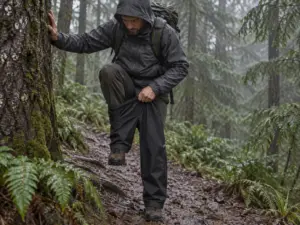



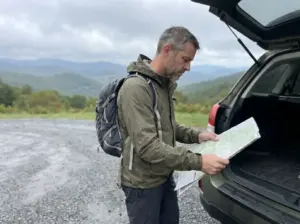
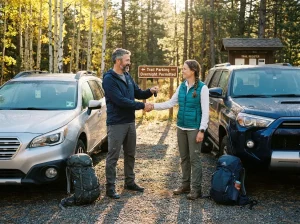


The text message came at 6:47 AM on a Saturday: “Hey, are we still going? My friend wants to come too. Also, where do we park?” I was standing in the trailhead lot with three people I’d never met, a WhatsApp thread with 23 unread messages, and zero signed waivers. That was Hike #1.
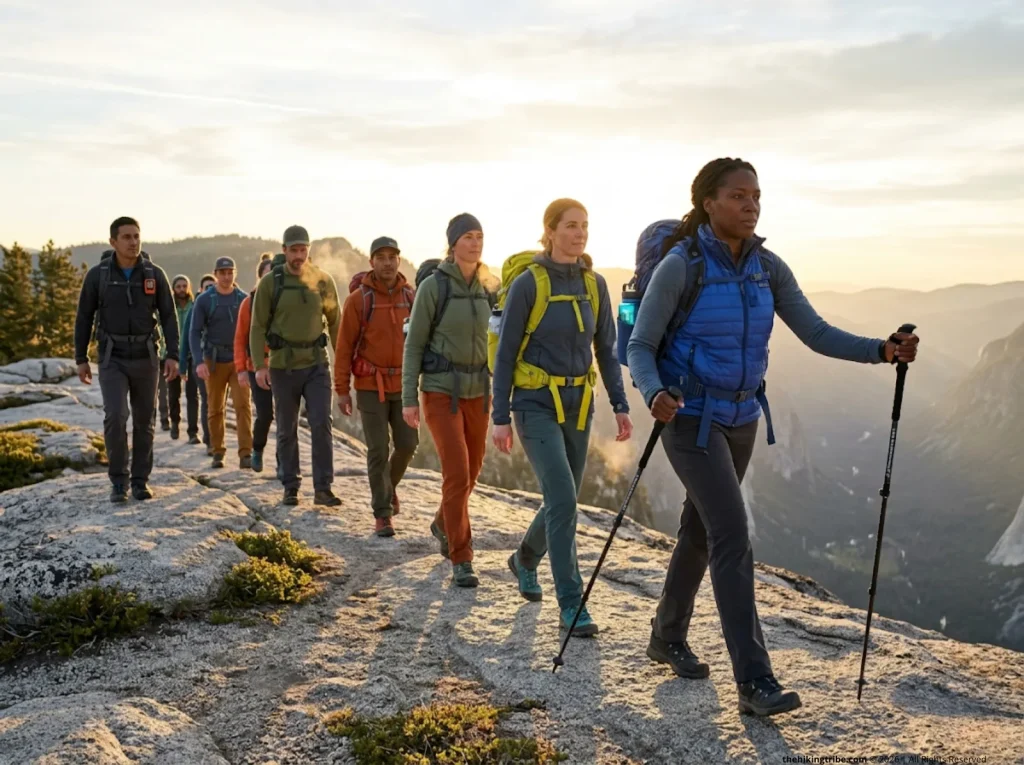
By Hike #50, I had a system that moved 15 strangers through Class 2 terrain and back to their cars without a single incident report. The difference wasn’t luck. It was structure and the willingness to treat starting a hiking club like what it actually is: managing risk for people who trust you with their safety.
⚡ Quick Answer: Starting a local hiking group requires three things before anyone laces up: a signed liability waiver, a Lead-Sweep leadership hierarchy, and a digital platform strategy that separates recruiting from day-of logistics. Build your administrative foundation first, train a co-leader using the Wingman System, and invest in a leader’s redundancy kit that goes beyond the standard 10 Essentials. Structure before spontaneity is what separates groups that survive past six months from those that quietly dissolve after three awkward outings.
The Foundation You Build Before Anyone Laces Up
Defining Your Group’s Identity and Mission
Before you post a single event on Meetup.com or drop a link in a Facebook group, answer one question: who is this for? Decide whether your group targets Naturalist-level beginners, intermediate Tourist hikers, or advanced Climber-grade scramblers. Trying to serve all three at once is how you end up with a pace mismatch at 8,000 feet and a participant who didn’t know “moderate” meant 2,500 feet of elevation gain.
Write a Group Charter. Put it in a shared doc. Cover hike frequency, difficulty range, cancellation policies, and behavioral expectations. Spell out your stance on dogs, children, photography stops, and pace flexibility before the first trailhead disagreement forces a decision for you. The American Hiking Society’s guide to starting a hiking club recommends formalizing as a 501(c)(3) non-profit to shield individual leaders from personal liability and shift fiscal responsibilities from person to organization.
Pro tip: The groups that survive past Year 1 are the ones that name themselves. A name creates identity. Identity creates loyalty. “Saturday Hikers” gets forgotten; “The Ridge Runners” gets remembered.
Liability Waivers and Insurance That Actually Protect You
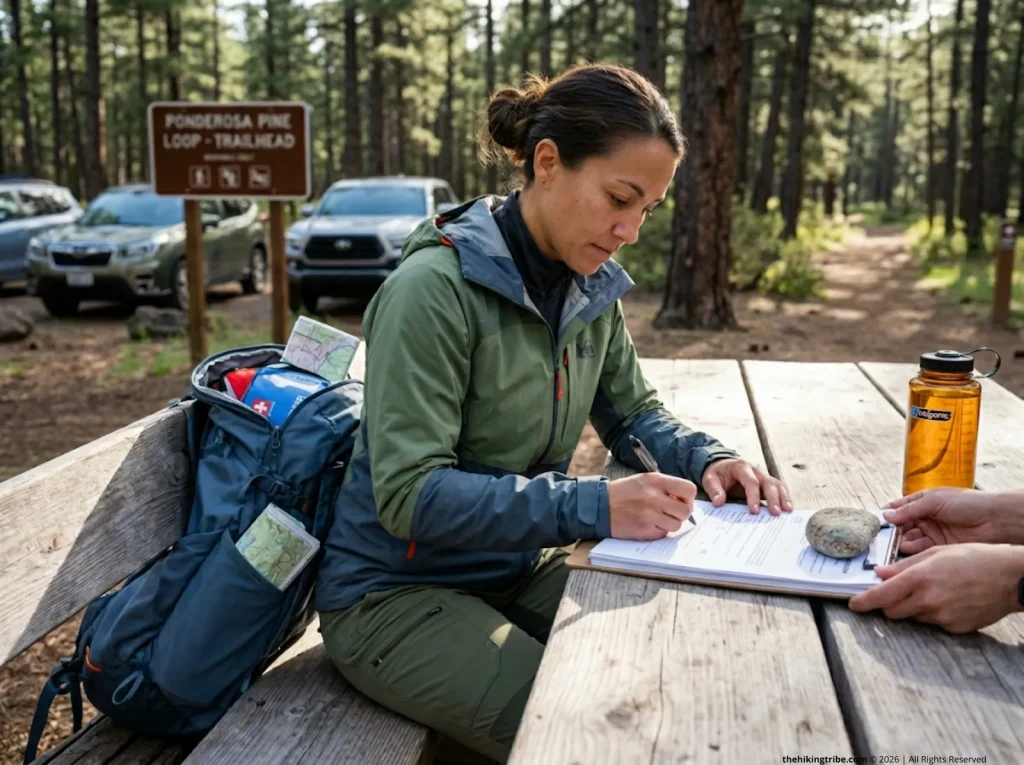
You need a signed Assumption of Risk and Release Form from every participant, every time. This document must state that participants understand the hazards inherent in hiking, including unforeseen risks that could result in serious injury or lasting harm. Maintain a Trip Roster documenting attendance, emergency contacts, and physical readiness. This paper trail is your legal defense if something goes wrong.
Hiking group insurance costs less than you’d expect. General liability starts at approximately $315/year and bonding coverage at $83/year through providers like RVNA. Consider Directors & Officers (D&O) insurance for board member protection and Accident Medical coverage for participant injuries.
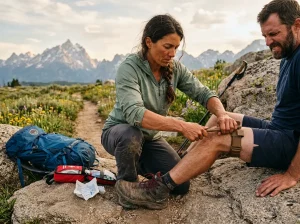
Every leader should also build competence in wilderness first aid fundamentals that every group leader needs. A waiver protects you legally. Medical training protects everybody physically.
Choosing Your Digital Platform (Without Losing Your Sanity)
No single platform does all three jobs well: recruiting new members, building community, and handling day-of logistics. After testing every option available, I run a hybrid stack.
Meetup.com offers the strongest discovery for new members and automated calendaring, but costs roughly $380/year and recent price increases are driving migrations. Facebook Groups provide profile transparency for pre-screening members, but algorithm changes limit post reach and create privacy concerns. WhatsApp works for real-time coordination with small, established groups, but lacks public discovery. The admin becomes the de facto guide for all logistics, and that burns people out fast. Heylo is gaining traction as a free-for-leaders alternative with built-in payment collection, though it has lower discovery traffic.
Pro tip: Run Meetup for recruitment, Facebook for community engagement and member vetting, WhatsApp for day-of logistics. Community organizers on Reddit confirm that leaving Meetup often results in a loss of new blood, even if the platform frustrates you.
The Lead-Sweep System: Military-Grade Safety for Weekend Hikers
The Lead: Navigation, Pace, and Authority
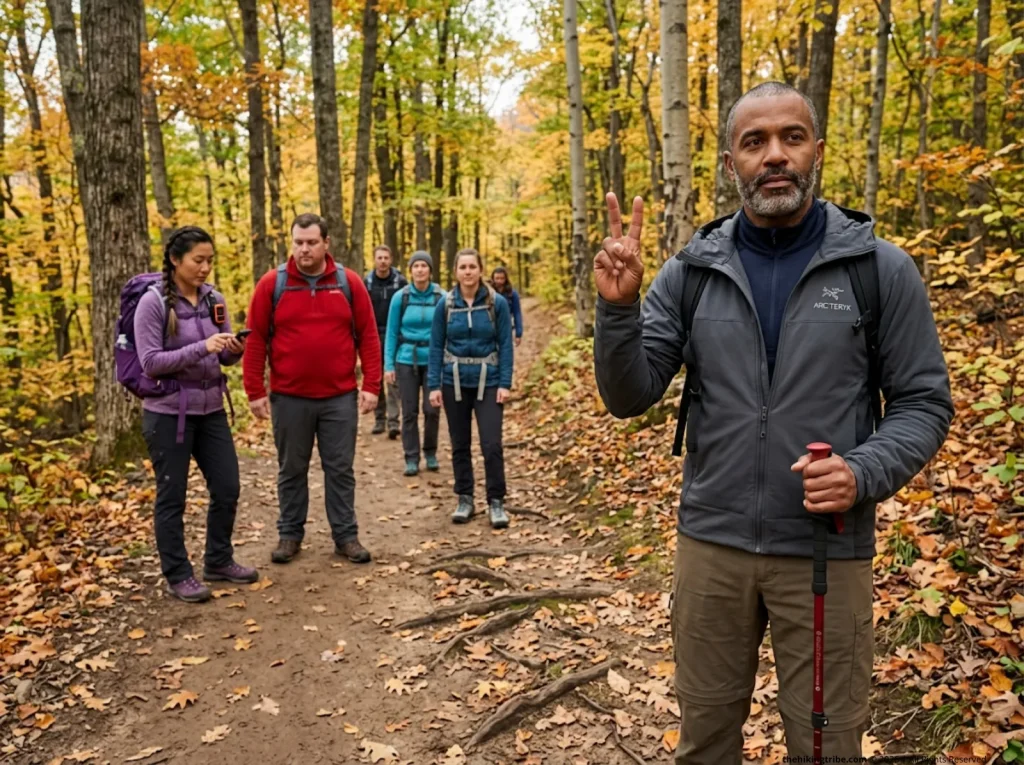
The Lead hikes at the front and serves as the primary navigator. Their authority includes route selection, pace management, and equipment verification. The Lead can deny participation to any hiker who isn’t properly equipped. Non-negotiable.
Verify trail accessibility and trailhead parking within one month of each hike. Showing up to a gated access road with 12 people destroys credibility. Set pace by the group’s skill level, not the fastest person in it.
Pro tip: On your scouting trip, count switchbacks and note where cell signal drops. This intel becomes your day-of briefing and instantly establishes authority without needing to say a word about your experience.
The Sweep: The Most Underrated Role in the Group
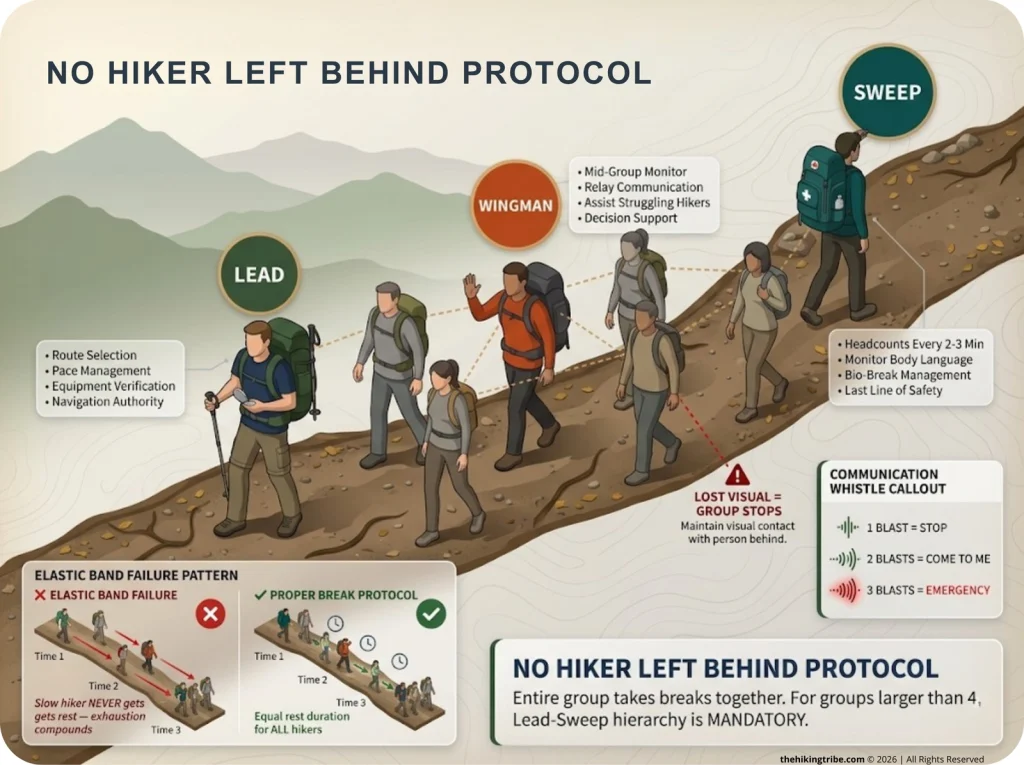
The Sweep hikes at the rear and is the second-in-command. Primary duties: headcounts every 2-3 minutes, monitoring body language for heat exhaustion or dehydration, and bio-break management.
The Sweep studies faces, not just pace. Glazed eyes, stumbling, excessive quietness—these are brewing problems detected through observation, not conversation.
Here’s where most amateur leaders fail: the Elastic Band effect. They wait for the slowest hiker to catch up, then immediately resume hiking. This denies the straggler any rest. Proper technique gives the slower hiker the same duration of rest as those at the front. Vetting hiking partners for safety and compatibility before trail day prevents many of these problems.
The “No Hiker Left Behind” Protocol
This protocol dictates that the entire group takes breaks together. It is the single most important rule for group cohesion and safety. For groups larger than four, a formal Lead-Sweep hierarchy is mandatory—The Mountaineers’ hiking leaders guide has been the gold standard for this structure for decades.
Implement a daisy-chain accountability system: every person is responsible for maintaining visual contact with the person behind them. If anyone loses sight of the person behind, the group stops. Establish a clear whistle signal system: one blast means stop, two blasts means come to me, three blasts means emergency.
The Wingman System: Why Solo Leadership Fails
The Three Pillars: Check Six, Break Right, Lose Sight Lose Flight
The Wingman System originated in Roman cavalry tactics and was refined by the U.S. Air Force’s definition of Wingman leadership. In hiking, it provides redundant decision-making so no single person holds all the cards when fatigue or weather clouds judgment.
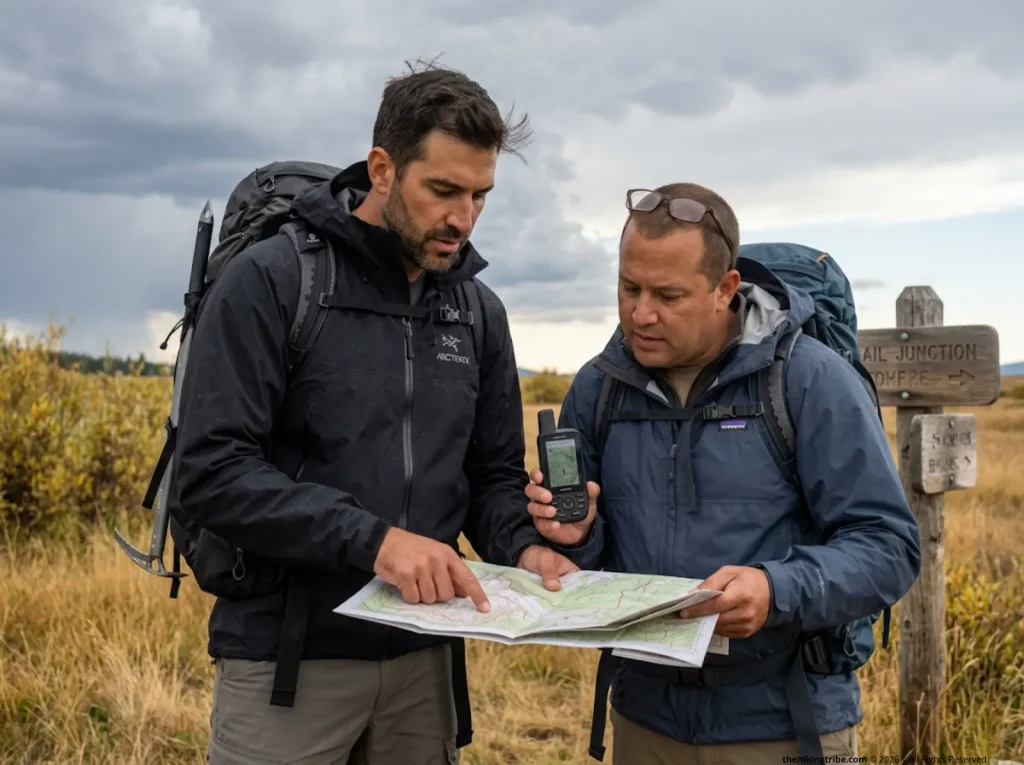
Check Six: constantly monitoring the group’s vulnerable rear and identifying blind spots before they become emergencies. Break Right: giving and receiving brutally honest feedback in real-time. Courage over comfort. Lose Sight, Lose Flight: if leaders lose visual contact with each other, the hike stops. No exceptions.
Building Your Co-Leader Pipeline
Solo leadership is a survival strategy. Operating with a wingman is a winning strategy. Never lead groups larger than six without a trained co-leader.
Identify promising co-leaders from your regulars. Look for situational awareness, calm under pressure, and willingness to hike at the back. Run a shadow program: aspiring co-leaders hike three trips as Sweep before leading independently. Philmont Scout Ranch uses a similar Crew Leader training progression. The safety vetting protocols for women’s hiking groups add screening rigor that benefits all group structures.
The Leader’s Kit: What You Carry That Nobody Else Does
Beyond the 10 Essentials: The Redundancy Loadout
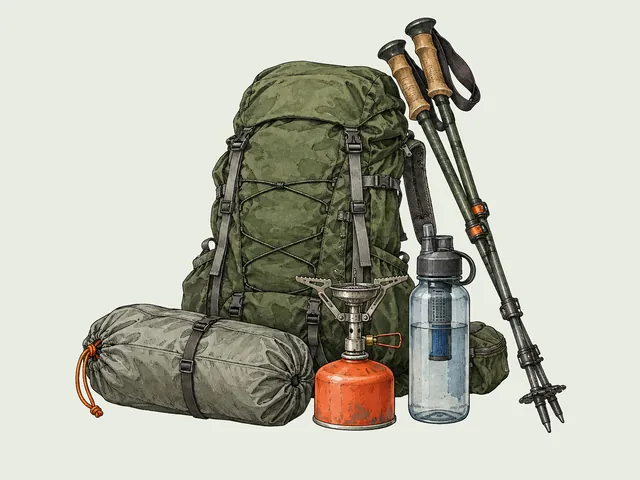
A leader’s pack must carry system redundancy for the group, not just personal survival gear. The standard 10 Essentials every hiker should carry are for participants. Leaders need a different kit.
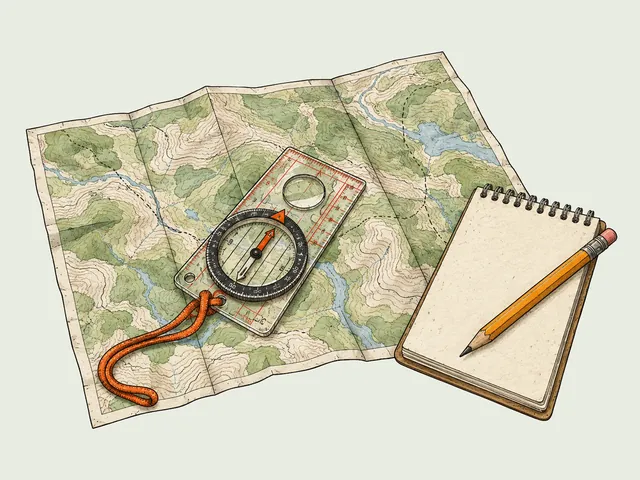
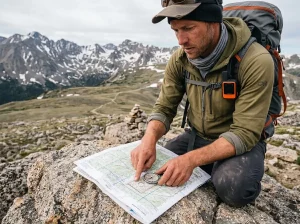
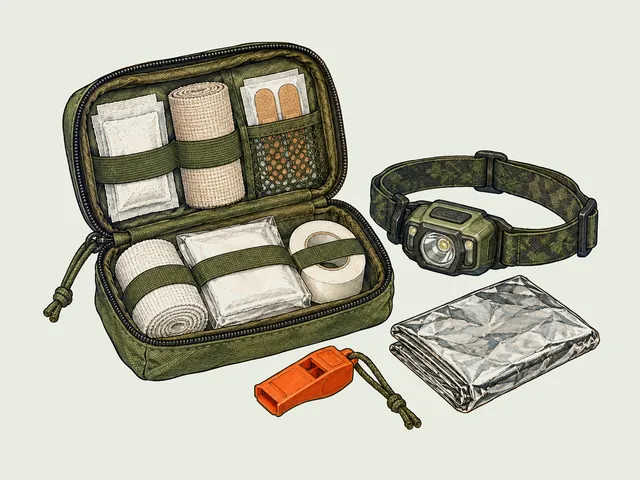
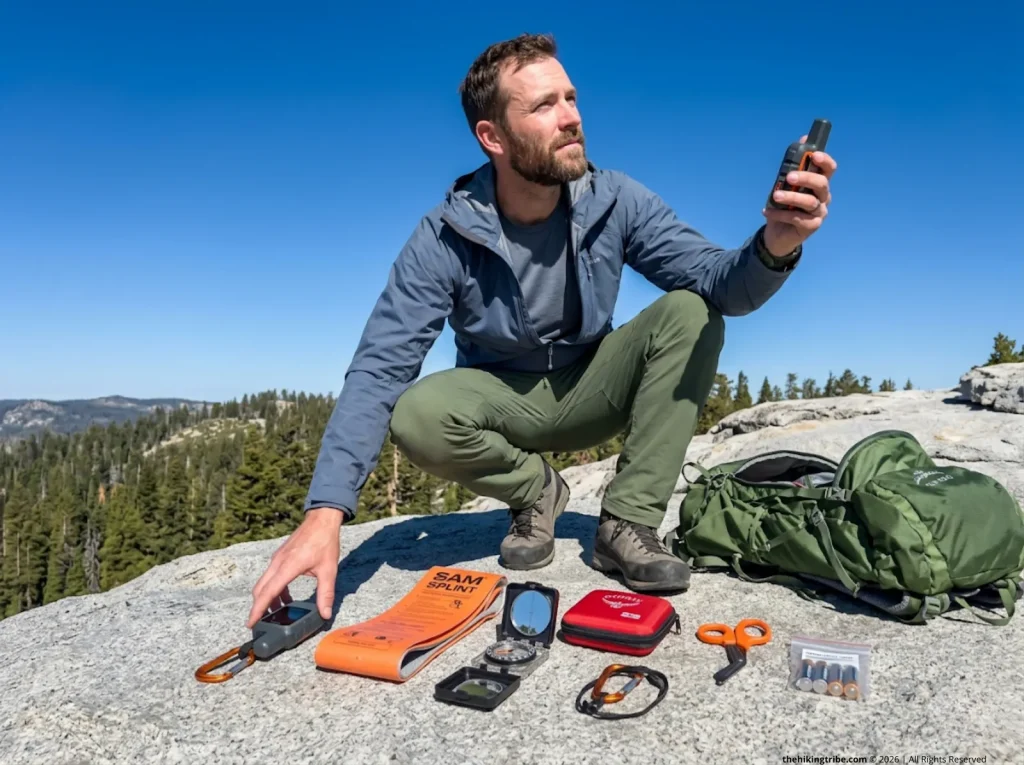
Navigation: A sighting mirror compass that doubles as a signaling device for helicopters and rescuers. Communication: A PLB (Personal Locator Beacon) or satellite messenger. These work where cell phones fail, using GPS to alert emergency personnel. Medical: SAM splints for limb immobilization, a CPR Microshield mask with a one-way valve, and paramedic shears for cutting away clothing to treat injuries. Shelter: An emergency bivy or tarp that enables the group to safely spend an unplanned night outside if an injury prevents evacuation. Illumination: Extra lithium AA batteries—33% lighter than alkaline and functional down to -40°F.
Leaders also carry what I call Wing-Giver items: extra water and calorie-dense, no-cook snacks like meat sticks and crackers. Participants frequently underestimate their sugar and salt requirements, leading to metabolic meltdowns that compromise decision-making on the trail.
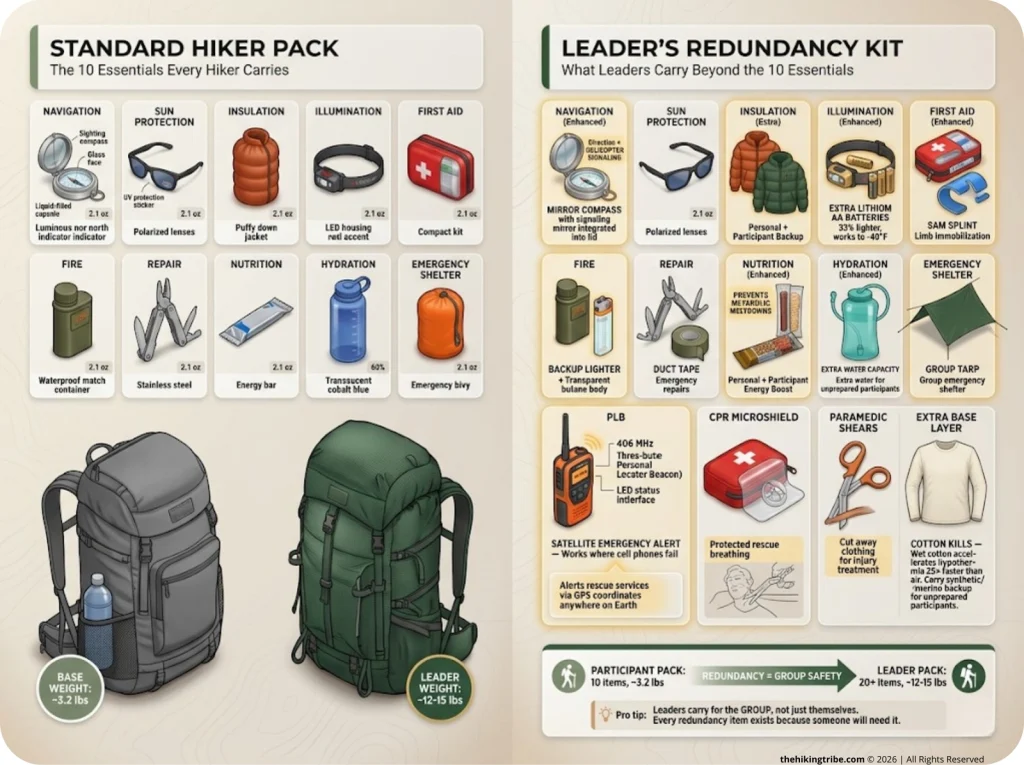
Pro tip: Wet cotton is a hypothermia accelerator. It traps moisture and pulls away body heat 25 times faster than air. Carry an extra synthetic or merino base layer in your pack for the participant who inevitably shows up in a cotton hoodie.
The Risk Assessment Matrix You Should Run Before Every Hike
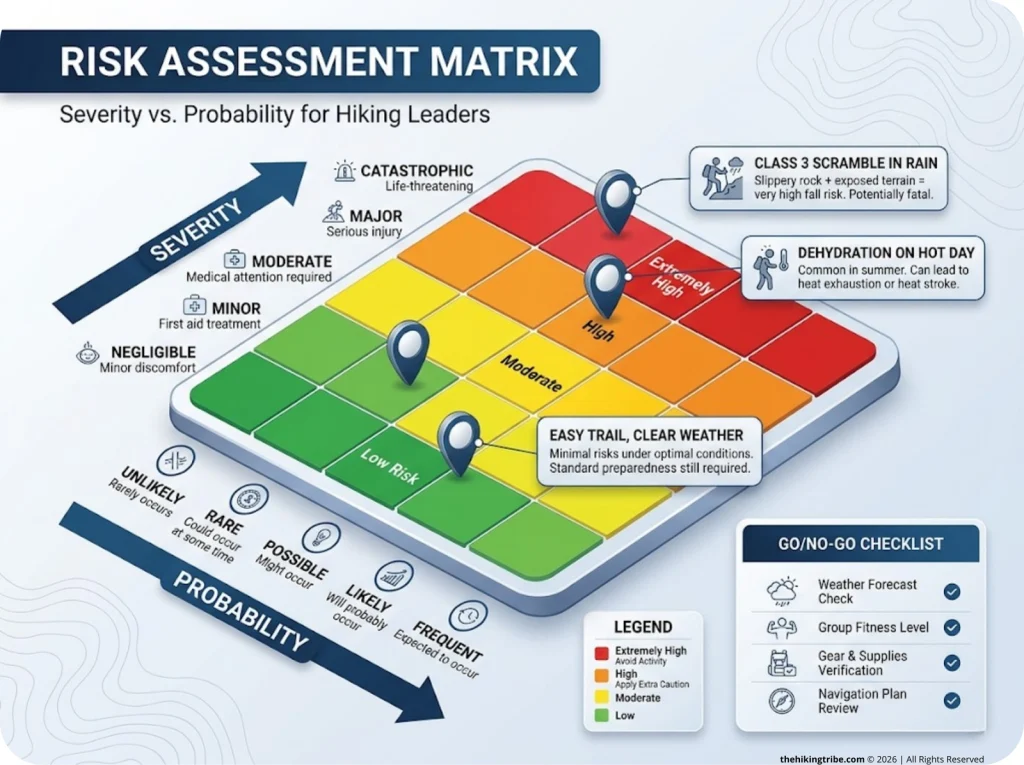
Run a Severity vs. Probability matrix before every outing. University of Michigan’s risk assessment matrix framework provides the institutional backbone for this approach. A Class 3 scramble during a rainstorm rates as Catastrophic/Likely—an Extremely High Risk rating that demands cancellation. Rain adds approximately +3 decimals to the Yosemite Decimal System difficulty of any trail.
Professional guides use a Big Picture approach: “The mountain will still be here next year; today is not the day.” Implement a Go/No-Go checklist covering weather forecast, group fitness, gear adequacy, and daylight hours. If any category scores red, the hike is canceled.
Recruiting, Screening, and Keeping Your People
The Vetting Process That Prevents Trail-Day Disasters
Platform-based vetting starts with Facebook profile transparency. Community forums consistently report fears of being stuck “halfway up a mountain with some creep who sounded OK in the WhatsApp.” That fear is valid, and addressing it is your job.
Implement a First Hike Questionnaire covering fitness level (self-reported miles per week), gear owned, medical conditions, and emergency contacts. This screens for preparation, not exclusion. Then run a probation hike—a short, easy introductory trail where you can assess a new member’s fitness claims, attitude toward safety protocols, and trail etiquette in a low-stakes environment.
Set clear group size limits. Many wilderness areas cap day groups at 25 and overnight groups at 10. If your group exceeds 10, it must travel and camp as independent sub-groups per Leave No Trace guidelines. These aren’t suggestions from park rangers. They’re regulations with fines attached.
The biggest red flag during pre-screening members isn’t fitness level. It’s resistance to following established protocols. A slow hiker who listens is infinitely safer than a fast hiker who ignores the Lead. Trust your gut on this one.
The Post-Hike Social: Your #1 Retention Tool
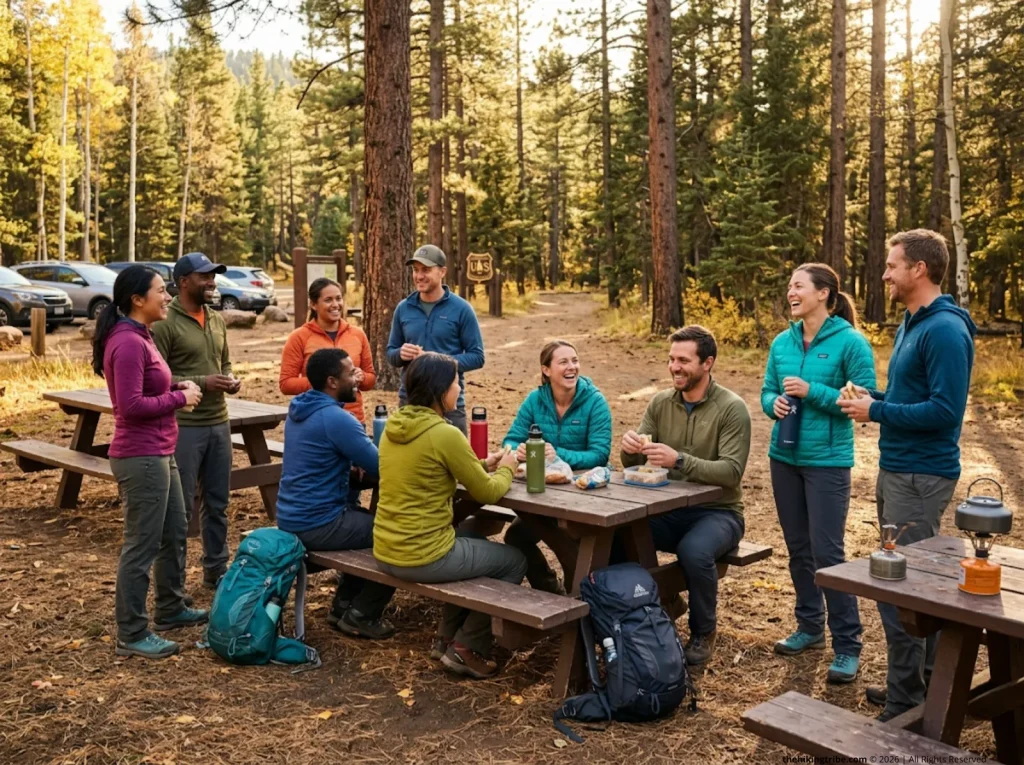
Reddit community posts consistently identify the post-hike hangout as the primary driver of community retention. Without a social ritual, the group remains a series of one-off events. A picnic at the trailhead. A diner down the road. Something that turns strangers into friends.
The Digital De-load matters here too: limiting phone use during the hike forces situational awareness and genuine relationship-building. The National Park Service’s hiking etiquette guidelines note that electronic noise disrupts both visitor peace and wildlife communication. Create a Post-Hike Handout covering the flora, fauna, and geology encountered. Between hikes, virtual hiking communities that serious hikers actually use keep the conversation alive.
Ethics, Inclusion, and Leaving the Trail Better Than You Found It
Leave No Trace for Groups Larger Than Six
Large groups have a disproportionate impact on natural resources. Leave No Trace guidelines for groups from the Appalachian Trail Conservancy go beyond the standard seven principles with group-specific protocols that every organizer should know.
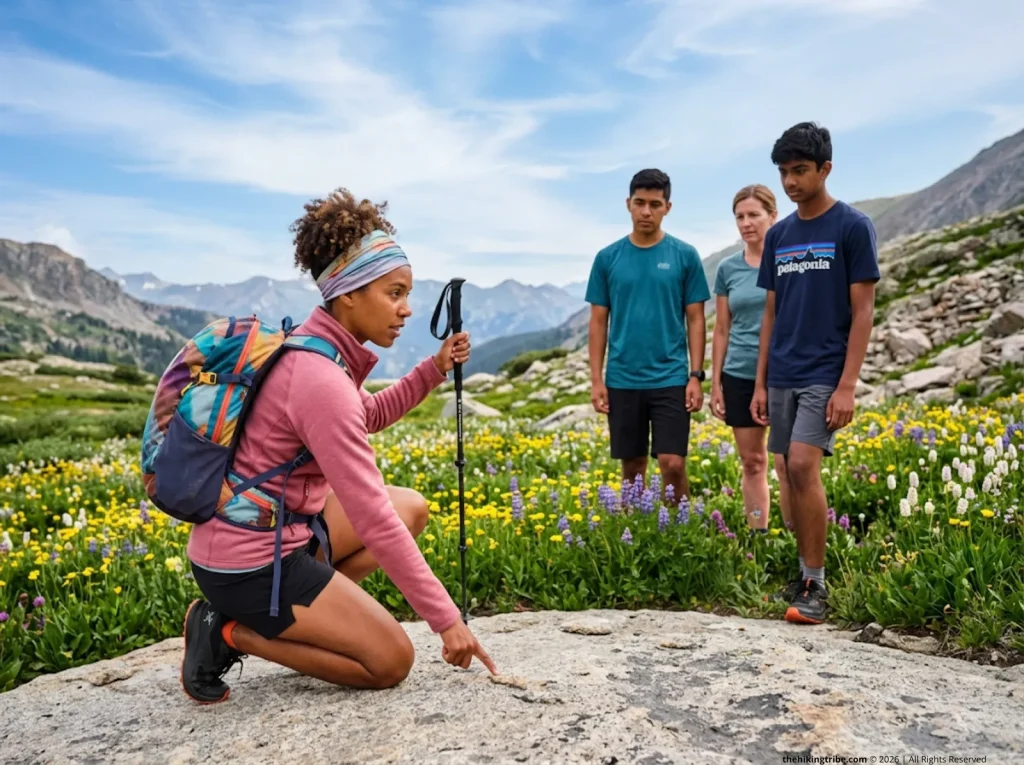
Groups should gather only on durable surfaces—rock, gravel, dry grass—for breaks to prevent crushing vegetation. On popular trails, this means pre-scouting break spots during your route planning reconnaissance. Leaders must bring trowels for the group and educate everyone on proper cathole technique: 6-8 inches deep, 200 feet from water sources.
Sweat-pace transparency means honestly communicating the difficulty and pace expectations before the hike starts. Nobody should discover mid-hike that they’re in over their head. That’s a leadership failure, not a fitness failure.
Pro tip: Carry a dedicated microtrash bag and do a 5-minute sweep of the trailhead parking area before you leave. It sets the tone for your group’s culture from the first minute.
Building Cultures Where “Unlikely Hikers” Belong
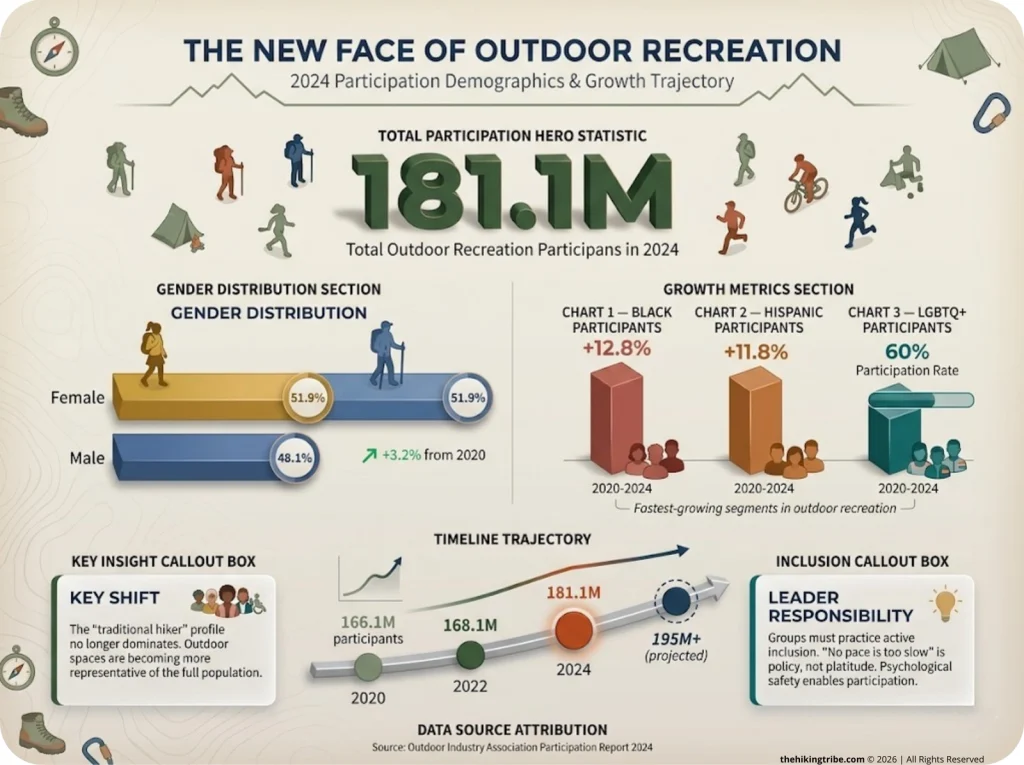
The Unlikely Hikers movement, led by Jenny Bruso, emphasizes that outdoor spaces were historically structured in ways that weren’t inclusive. Female participation reached 51.9% in 2023. Growth is concentrated among Black participants (+12.8%), Hispanic participants (+11.8%), and LGBTQ+ communities (60% participation rate). With 181.1 million people recreating outdoors, the old hiker profile no longer dominates.
Leaders must practice active microaggression awareness. Is anyone being left out of conversation? Is anyone talked over during rest stops? “No pace is too slow” is a policy, not a platitude.
Psychological safety, pioneered by Amy Edmondson, means reducing the cost of speaking up. If a participant feels it’s emotionally expensive to admit they’re tired or scared, they stay silent until something goes wrong. Leaders must proactively ask for feedback and share their own uncertainties. Groups looking to go deeper on this topic will find practical starting points in diversity in the outdoors and inclusive gear resources.
Conclusion
Three things separate a group that lasts from one that fades after a few awkward Saturday mornings.
Structure before spontaneity. A signed waiver, a scouted trail, and a Lead-Sweep hierarchy aren’t bureaucratic overhead. They’re the reason Hike #50 goes as smoothly as Hike #1.
Redundancy saves lives. The Wingman System ensures that no single person holds all the decision-making power when fatigue, weather, or injury clouds judgment. Solo leadership is a survival strategy. Operating with a wingman is the winning strategy.
Community is built after the trail ends. The post-hike social and the Digital De-load during the hike are what transform a series of walks into a tribe. The trail provides the setting. You provide the systems.
Pick one system from this guide—the Lead-Sweep protocol, the vetting questionnaire, or the Go/No-Go checklist—and implement it on your very next group outing. The trail will teach you the rest.
FAQ
How many people is the ideal group size for a hiking group?
Six to twelve hikers is the sweet spot. Fewer than six limits the social dynamic that drives retention. More than twelve makes it nearly impossible for a single Lead-Sweep pair to maintain visual and verbal contact on technical terrain. If your group regularly exceeds 12, split into sub-groups with independent leadership.
Do I need insurance to start a hiking group?
For casual groups, a signed liability waiver is the minimum legal protection. If your group collects dues, organizes events on public land requiring permits, or incorporates as a non-profit, general liability insurance starting around $315/year is strongly recommended. Directors & Officers coverage adds protection for anyone in a formal leadership role.
How do I handle a hiker who is too slow for the group?
The Sweep stays with the slower hiker while the Lead brings the group to a designated rest point. The critical mistake is the Elastic Band effect—letting the slow hiker catch up and then immediately resuming. Give the straggler equal rest time before moving again. If pace mismatches are chronic, offer the participant a more appropriate difficulty tier in your group’s schedule.
What’s the best platform to organize a hiking group?
No single platform does everything well. Use Meetup for discovery and recruiting new members, Facebook Groups for community engagement and member vetting, and WhatsApp or Signal for day-of real-time coordination. Heylo is gaining traction as a free alternative with built-in payment collection for groups that charge dues.
How do I deal with bad weather on a scheduled group hike?
Run a Go or No-Go checklist 24 hours before the hike. Evaluate weather forecast, trail conditions, group experience level, and available daylight. If any category scores red, cancel without apology. Inclement weather adds approximately three difficulty grades to any trail. The mountain will still be here next year. Today is not the day.
I've spent more than a decade researching hiking gear and trail technique. I read the specs, the forum threads and the long-term reviews, and every pick here comes with what it gets wrong.
End of the trail
You read every mile of this one. Here's where the trail goes next.