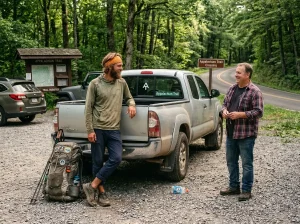
















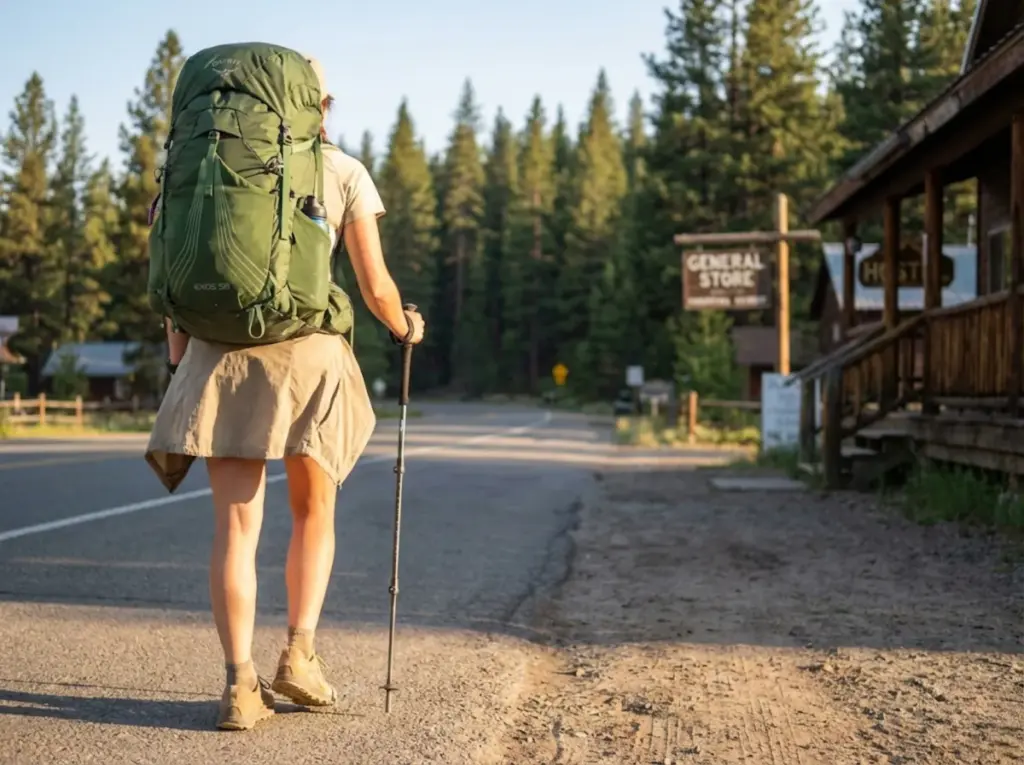
You told yourself it would be a quick stop. Grab a shower, resupply, maybe a real meal. That was yesterday morning. Now it’s 2 PM on day two, you’re sitting in a hostel common room watching trail videos instead of making trail miles, and your credit card has taken more hits than your quads on a 4,000-foot descent. The town vortex swallowed you again.
After years of field-testing resupply strategies on the Pacific Crest Trail, Appalachian Trail, and Continental Divide Trail—and after studying the protocols of record-setters like Heather “Anish” Anderson and Liz “Snorkel” Thomas—I’ve found that the difference between hikers who finish and hikers who quit often comes down to one tactical decision: how they handle town stops.
This article breaks down the nero day—the “near-zero” mileage strategy that keeps your trail legs fresh, your budget intact, and your motivation locked in. You’ll learn the exact protocols for a half-day nero town stop that gets everything done without burning a full calendar day.
⚡ Quick Answer: A nero day (short for “near zero”) means hiking fewer miles than your daily average—usually under 10 to 15—to handle a town resupply in a 4-to-6-hour window. By camping outside town the night before and arriving early, you skip overnight lodging costs, keep your legs conditioned through active recovery, and avoid the psychological trap of the town vortex. Budget savings over a full zero day run 60 to 80 percent per stop.
What a Nero Day Actually Means (And Why the Definition Keeps Shifting)

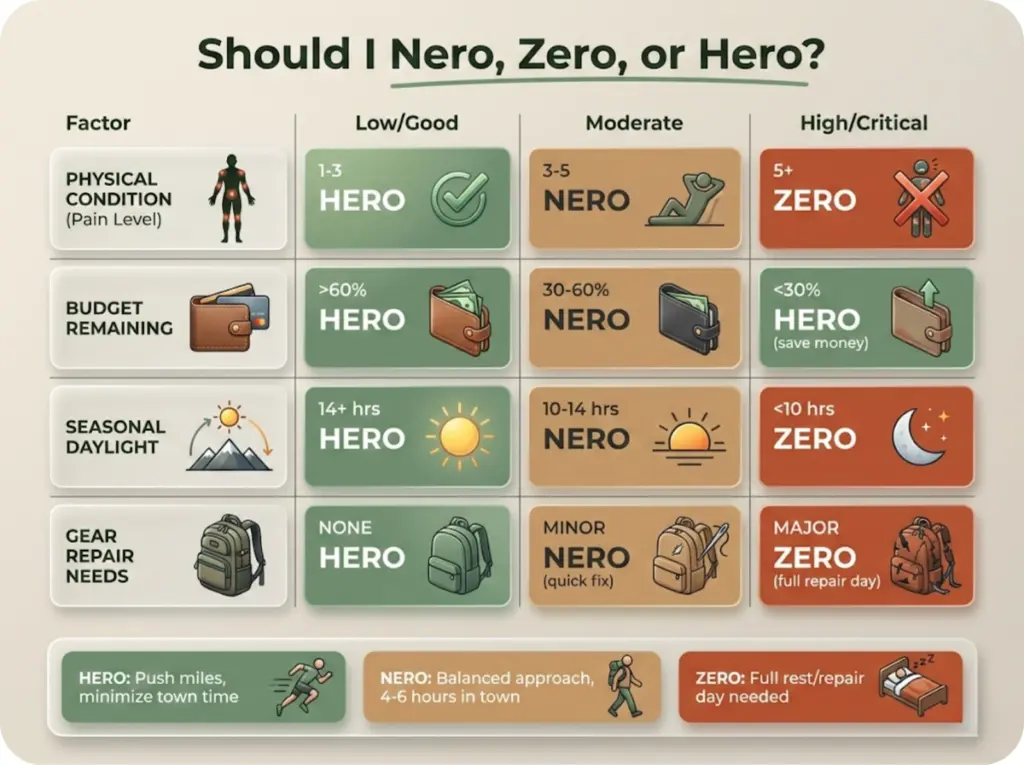
The Zero-Nero-Hero Spectrum
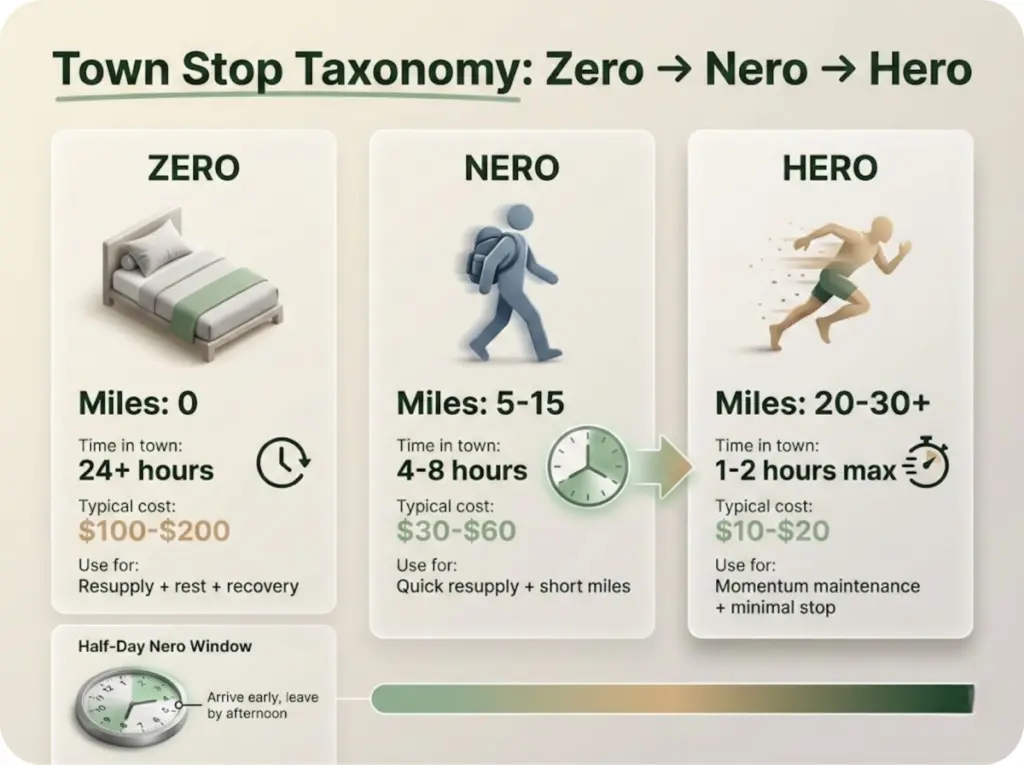
Before you can use neros strategically, you need to understand where they sit in the full taxonomy of thru-hiking rest states. A zero day means exactly what it sounds like—zero trail miles, full shutdown, usually in a town or hostel. A nero day is the opposite end of the coin: you log miles, just fewer than your average. And a hero day means you blaze into a resupply point and blaze right back out without spending a night.
The mileage threshold for a nero is personal. If you’re a power hiker averaging 30+ miles on the Pacific Crest Trail, a 15-mile day counts. If you’re averaging 15, a nero might be 5 to 8 miles. The word itself is a contraction of “near zero,” and it showed up in thru-hiking lingo alongside terms like tramily, hiker box, and trail magic. There’s also the trail zero—a rest day spent in the backcountry rather than town—which eliminates lodging costs entirely.
If you’re still building your framework for when to push and when to rest, this connects directly to planning zero days and recovery stops on a thru-hike.
Why “Half-Day Nero” Is the Better Frame
Most hikers define neros by miles. That’s the wrong metric. The real number that matters is time—specifically, how many hours you spend off trail. A half-day nero uses a 4-to-8-hour window to handle all town logistics: laundry, resupply, charging, maybe a real meal.
This temporal framing shifts your thinking from “how far did I walk” to “how long did I stop.” And that second number is what actually controls your budget, your momentum, and your likelihood of finishing. The morning arrival protocol—enter town by 8 or 9 AM, exit by early afternoon—is the gold standard used by veteran thru-hikers like Liz Thomas, who completed over 20 long-distance trails using this exact approach.
No other strategy gives you this combination of budget optimization and forward progress.
When the Community Gets It Wrong
The most common mistake? Treating every town stop as a zero by default. First-time AT or PCT hikers burn 3 to 5 zero days in their first month, losing 15 to 25 trail miles per zero and spending $100 to $200 each time. That’s $500 to $1,000 gone before you’ve found your rhythm.
Another trap: neroing too late. Walking into town at 4 PM when the post office and outfitter are closed forces an unplanned zero the next day. And once you’ve slept in a real bed with air conditioning and unlimited food, the return to mud, rain, and a 3,000-foot climb feels twice as hard. That’s the town vortex at work—and it’s taken more thru-hike attempts than any mountain pass.
Your Body on a Nero: The Active Recovery Advantage

Why Moving Beats Sitting
Here’s what most hikers don’t realize: a nero day isn’t just a compromise between rest and progress. It’s actually better for your body than a full zero.
Those 5 to 8 miles you walk during a nero function as active recovery—low-intensity movement that pumps blood through damaged muscle fibers and flushes out the metabolic waste your body has been stacking up over weeks of 20+ mile days. Your muscles are riddled with microtears after weeks of continuous walking. Light movement delivers oxygen and nutrients to those tissues more effectively than lying in a hostel bed all day ever could.
The ACE-sponsored research on active vs. passive recovery confirms this: exercising at roughly 55 to 60 percent of heart-rate reserve preserves endurance and power output better than complete rest. Those easy nero miles actually prepare your body for tomorrow’s 25-mile push better than a full day in bed.
The Stiffness Trap of Zero Days
Going from 12+ hours of daily movement to 24 hours of total inactivity triggers a nasty rebound. Joints stiffen. Connective tissue tightens. And the overuse injuries you’ve been managing—plantar fasciitis, Achilles tendonitis, IT band flare-ups—often punch back harder after a full zero because everything locked up overnight.
Dr. Morgan Brosnihan of Blaze Physio recommends the 10% Rule of Return: for every day you take completely off, reduce your first day back by 10 percent of your average mileage. Take 3 days off for shin splints? Your first day back should be at 70 percent of your normal pace. The nero eliminates this problem entirely because you never fully stop.
Pro tip: Use town time for isometrics—4×30-second wall sits can reduce patella tendon pain for up to 45 minutes, making your exit from town smoother. Pack a cork massage ball and roll out your feet and calves while your laundry runs.
Using the Nero as a Diagnostic Window
Low-mileage days give you something no hero day ever will: the mental space to focus on your body. IT band barking? Experiment with a wider gait. Overpronation? Focus on a narrower step with big toe push-off. Without the pressure of a 25-mile deadline, you can actually feel what’s happening in your stride and make adjustments before a niggle becomes a trail-ender.
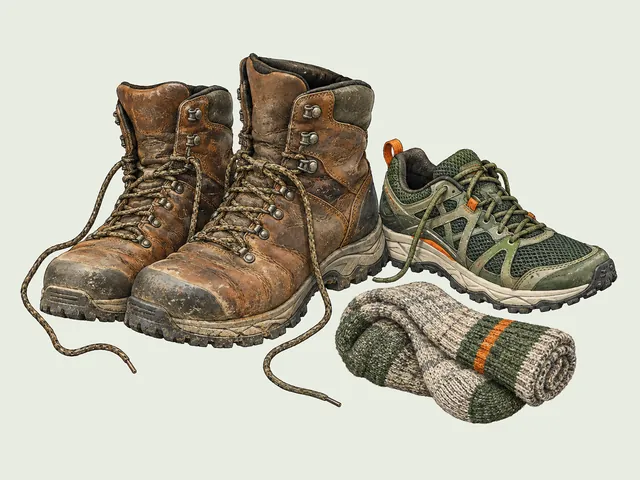
This is also the right window to assess your footwear. If arch pain is building or your insoles have gone flat after 300 miles, a nero gives you the time to source replacements. Choosing the right insoles for trail endurance can mean the difference between a manageable niggle and a trip-ending injury.
The Real Reason You’re Broke on Trail: Town Stop Economics
The Numbers That Should Scare You
The average Pacific Crest Trail thru-hike cost hit $10,149 in 2024—nearly double what it cost a decade ago. The Appalachian Trail averages $7,602, a 16 percent jump since 2016 even after adjusting for inflation. And the biggest variable isn’t gear, which has seen only modest increases. It’s town stops.
A standard zero day in a trail town typically runs: $100 to $200 for a hotel (or $25 to $50 for a hostel), two to three restaurant meals at $20 to $40 each, $50 to $150 in resupply groceries, plus laundry, transport, and the inevitable “I deserve this” beer tab. Liz Thomas estimates a minimum of $100 per town stop, and modern data suggests most hikers blow past that—especially when hiker hunger takes the wheel.
The Nero Math: 60-80% Savings
By camping outside town the night before and doing an in-and-out town stop during a 4-to-6-hour window, you eliminate the single biggest cost: overnight lodging. A nero stop costs roughly $30 to $60—resupply plus one meal plus laundry—compared to $150 to $250+ for a full zero with hotel and multiple restaurant sits.
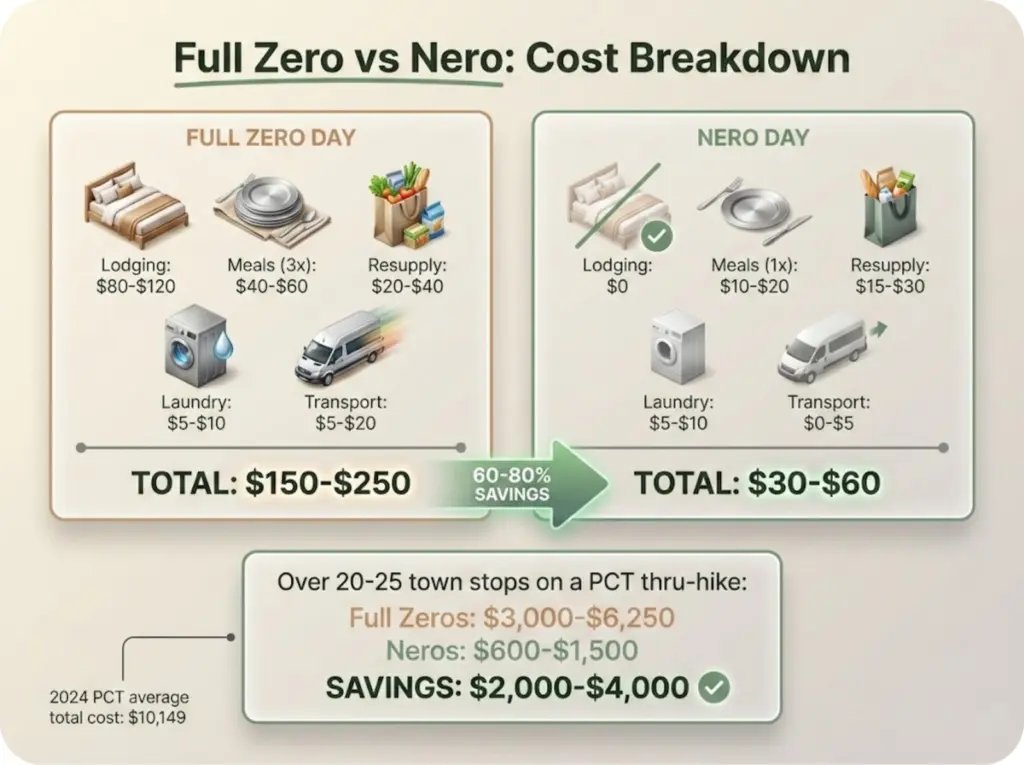
Run that math over a 5-month PCT hike with 20 to 25 town stops. The difference between full zeros and nero-style stops can save $2,000 to $4,000. That’s enough to fund an extra month on trail or serve as an emergency reserve when your Sawyer filter cracks in the middle of the Sierra. If you’re weighing whether to send mail drops vs buying food on trail, the nero strategy directly reduces how much time—and money—each resupply window costs.
The 6-Hour Town Stop: A Step-by-Step Protocol
Night Before: The Nero-In Setup
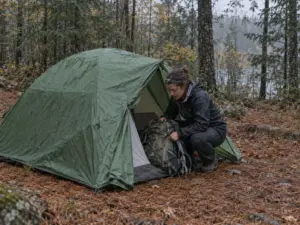
Your nero starts the night before, not the morning of. Camp approximately 5 miles from the trailhead or town crossing. This gives you an easy, flat-effort morning hike to arrive by 8 or 9 AM.
While you’re in your tent, write your grocery list. This one habit prevents what experienced thru-hikers call “hallucinatory hunger shopping”—walking into a store after burning 4,000 calories and buying triple what you need because your stomach is doing the thinking. Also charge your devices overnight using your fast-charging battery bank so you arrive in town with maximum power to recharge the bank itself.
Morning Arrival: The Chore Sprint
Enter town by 8 or 9 AM to hit services during peak operating hours. This is critical—especially for post offices that close early and outfitters that keep limited weekend hours.
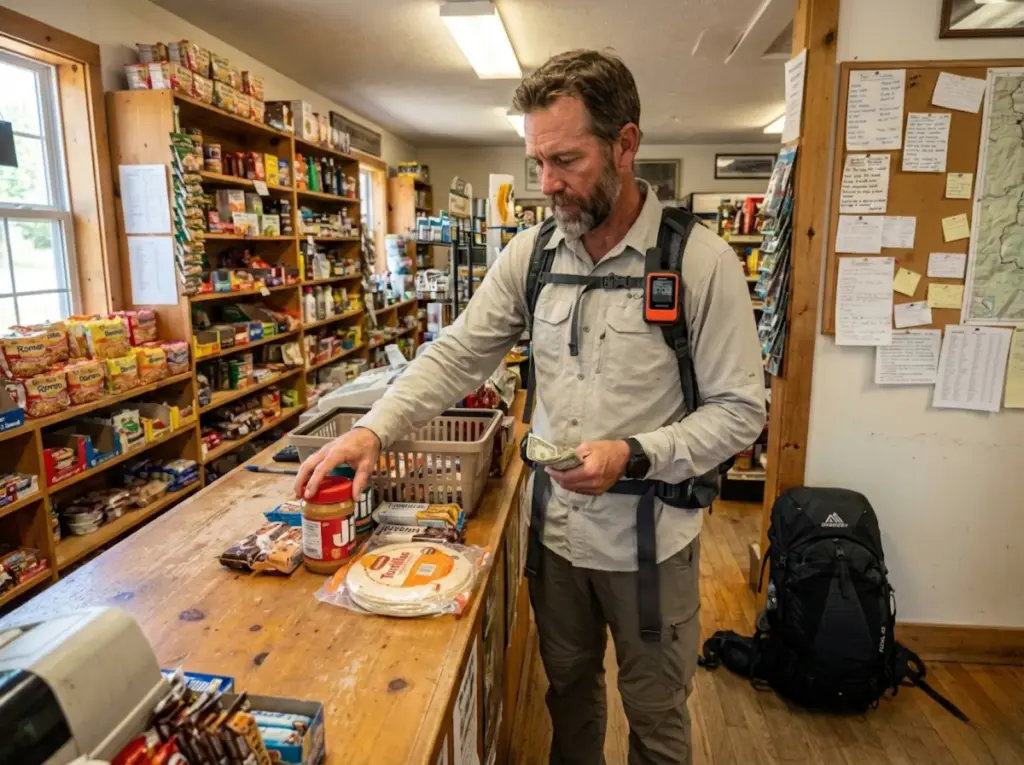
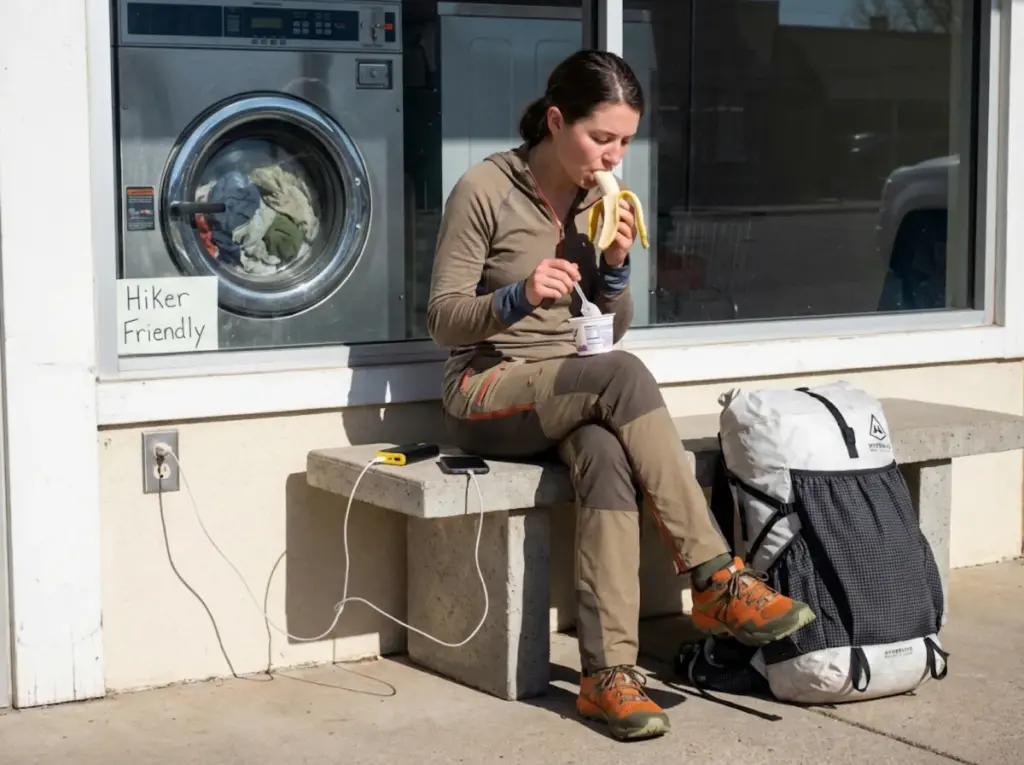
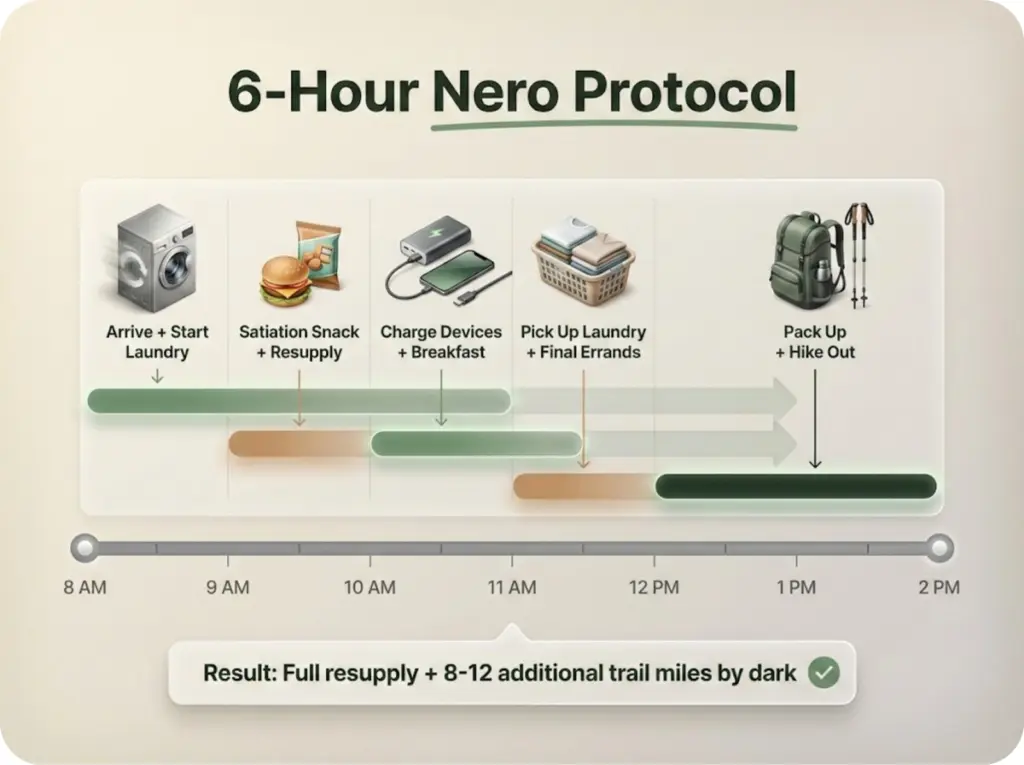
Priority one: start laundry immediately. Commercial washers and dryers take about 90 minutes. Drop your clothes and walk away to tackle everything else. Priority two: eat a “satiation snack” before grocery shopping. A quart of yogurt, a banana, chocolate milk—something cheap and filling. About 80 percent of hikers arrive in town dehydrated, mistaking thirst for hunger. Drinking a liter of electrolyte-rich fluid before shopping can save $20 to $40 in unnecessary food purchases. Priority three: resupply groceries from your pre-made list. Focus on fresh fats (avocados, cheese), micronutrients (fresh fruit to eat on the spot), and calorie-dense staples.
Pro tip: Eat your fresh produce—spinach, berries, oranges—right there in town. These items add weight and spoil fast. Get the vitamins now and pack only shelf-stable calories for the trail.
The Power Charge Protocol
The hidden time sink in every town stop is electronics. Your Garmin inReach, phone running FarOut, and headlamp batteries all need juice. A 30W+ PD (Power Delivery) charger fills a 10,000 mAh bank in under 3 hours. A standard 5W phone charger? Eight hours or more.
Liz Thomas recommends seeking high-voltage outlets used for vending machines outside supermarkets—these often charge faster and are less occupied than hostel outlets. Top picks for the speed-nero: the Nitecore NB10000 Gen 3 (5.3 oz, best weight-to-capacity ratio) or the Anker 733 with its integrated 65W wall charger—the undisputed nero king for fast town stops. For keeping those devices alive between resupplies, here’s a deeper look at optimizing GPS battery life between town stops.
Afternoon Exit: Back on Trail
Collect laundry. Fill water bottles. Grab your charged battery bank. Hike out by 1 or 2 PM. Log another 8 to 12 miles before dark. You’ve just completed a full resupply and still put meaningful trail miles on the board.
For those who want the psychological benefit of a real bed, there’s the nero-in/nero-out variation: arrive in town at 4 PM, sleep in a hostel, handle all chores the next day, and hike out by noon. This gives you a bed without losing a full calendar day—both days still contribute trail progress.
Escaping the Town Vortex: The Psychology of the Nero

How the Vortex Pulls You In
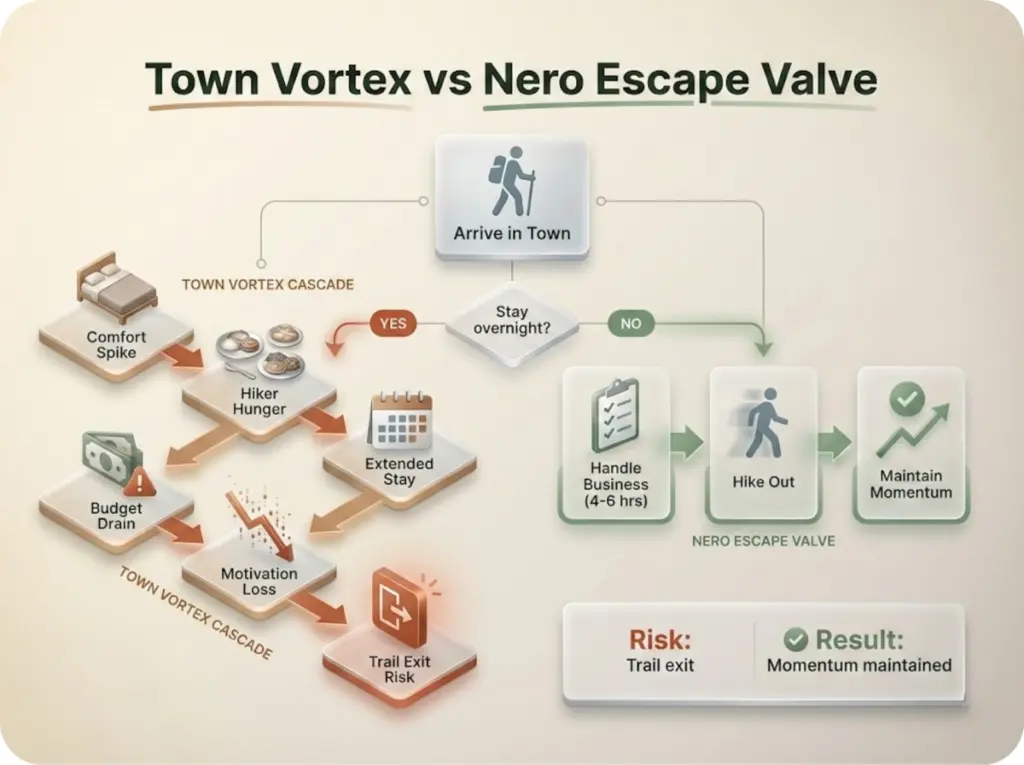
The town vortex operates on a simple principle: the longer you sit in climate-controlled comfort with unlimited food, the more terrifying the return to rain, cold, and vertical gain becomes. That first hour in town feels like heaven. By hour twelve, the trail feels like punishment.
Hiker hunger compounds the trap. Your body is burning 4,000 to 6,000 calories per day on trail, and in town the urge to keep eating extends your stay long after you’ve met your resupply and rest goals. The tramily dynamic makes it worse—if your trail family takes a “group zero,” social pressure keeps you planted even when your legs and timeline say go. And boredom is an underestimated quitting factor. Once you’re in trail shape and the novelty fades, the daily routine of walk-eat-sleep can feel monotonous. Town provides a sensory spike that makes the simplicity of trail life feel unbearable by contrast.
Up to 75 to 80 percent of AT thru-hike attempts end in failure. And trail exits don’t usually happen on a mountain pass. They happen in town, after day three of “just one more zero.”
The Nero as a Psychological Pressure Valve
By logging even 5 to 10 miles on a nero, you maintain your identity as a mover rather than a consumer. This subtle mental shift prevents the dissociation from trail life that often precedes quitting. Heather “Anish” Anderson’s record-setting paces weren’t achieved by hiking faster—she simply didn’t stop. Her neros rarely exceeded 6 hours in town, and she used that time for what she calls “brain dumping”—journaling and recording audio to process the emotional toll of the trail before it stacked up.
The nero is a pressure valve, not a shutdown button. You get the shower, the meal, and the resupply without ever fully disconnecting from who you are on trail. If you want to build that resilience before your first mile, start with a 4-week mental preparation protocol for thru-hiking.
Pro tip: Set a leave-town alarm on your phone. Pick a hard departure time (1 PM, 2 PM) and treat it like a flight you can’t miss. The vortex loses its grip once your pack is on your back and you’re moving.
When the Nero Doesn’t Work: Seasonal Limits and Forced Zeros
The Daylight Squeeze
The nero protocol works beautifully in summer when you have 14 to 16 hours of daylight to play with. Take 4 hours in town and you’ve still got a full afternoon and evening to stack miles. But in early spring or late fall—March through April, October through November—daylight drops to 10 or 11 hours, and the math gets tight.
A 30-mile day in those conditions already requires 12 to 14 hours of moving time, often including night hiking. A 4-hour town stop in spring effectively consumes 30 to 40 percent of available daylight. If you’re pushing for a sub-100 day pace on the AT, that nero becomes a high-risk play. You have to weigh whether the resupply benefit outweighs the mileage cost—and sometimes it doesn’t.
Winter Conditions and Access Failures
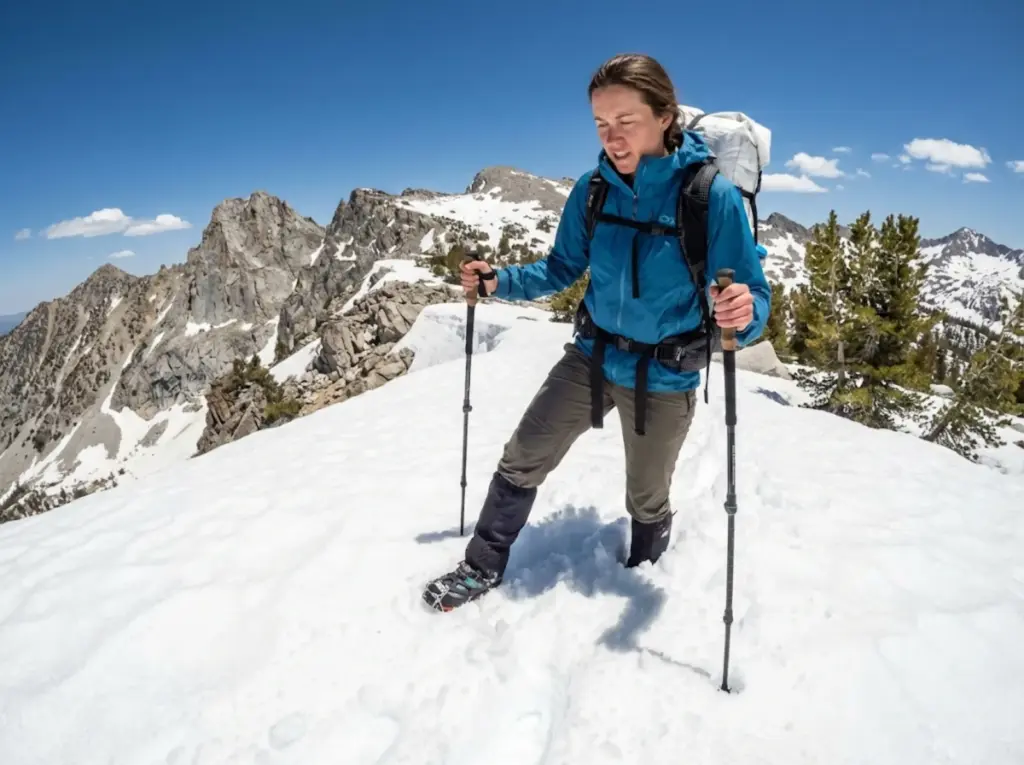
Winter conditions in the High Sierra Nevada or the Presidential Range turn neros into full-day ordeals. Post-holing through deep snow drops your speed to 1 to 2 miles per hour, turning what would be a 5-mile approach into a grueling half-day slog. For PCT hikers, “Ray Day” (June 15th) marks the traditional target for entering the Sierra in a high-snow year. Go earlier and you’re looking at 10+ days of food carries because secondary access roads are unplowed and trail town services—lodges, ranches, small stores—are closed for the season.
When a nero is physically impossible, the decision shifts: take the full zero, protect your body, and plan a hero day when conditions improve. For more on handling deep snow conditions, check out the risks and gear for post-holing.
The Pacific Crest Trail Association’s resupply strategy guide covers seasonal access windows for Sierra resupply points—essential reading if you’re planning a nero-heavy approach through that section.
Conclusion
The nero day is your most powerful tool for controlling budget, maintaining trail legs, and escaping the town vortex. Frame it by time—4 to 6 hours—not just mileage. A tight nero window forces you to act with purpose rather than drift into another unplanned zero.
Active recovery during a nero keeps your body in better condition for the next day than a full zero on a hostel couch. Your joints stay lubricated, your muscles stay flushed, and you skip the stiffness trap that makes the first mile back on trail feel like the hardest mile of your life.
Plan your town logistics before you arrive. Camp 5 miles out. Make your grocery list in camp. Hit town at 8 AM. The hikers who finish the Appalachian Trail, Pacific Crest Trail, and Continental Divide Trail are the ones who treat town stops like pit stops, not vacations.
Next time you see a trail town on the horizon, set your alarm. Get in early, handle business, and walk back into the woods while the sun is still high. Your legs, your wallet, and your chances of reaching the terminus will thank you.
FAQ
What is the difference between a nero day and a zero day?
A nero day (short for near zero) involves hiking a reduced number of miles—typically under 10 to 15—usually to handle a town resupply. A zero day means logging zero trail miles for the entire day, often spent resting in a hotel or hostel. Neros maintain your forward momentum and cost significantly less because you avoid overnight lodging—roughly $30 to $60 per stop versus $150 to $250+ for a full zero.
How many nero days should I plan for a PCT or AT thru-hike?
Most successful thru-hikers average one town stop every 3 to 5 days, but the split between neros and zeros depends on your pace and budget. Budget-conscious hikers on a shoestring budget aim for 80 percent neros and only take full zeros for gear repairs, injuries, or severe weather. Planning 20 to 25 nero-style stops over a 5-month PCT hike is a solid baseline.
Can a nero day actually help with plantar fasciitis on trail?
Yes. Active recovery during a nero—low-intensity walking of 5 to 8 miles—keeps the plantar fascia stretched and lubricated, which often reduces pain better than complete rest. Use town time for isometric exercises like wall sits and foot rolling with a cork ball to manage inflammation before it becomes trail-ending.
What should I prioritize during a short town stop?
Laundry first—it runs while you do everything else. Then a satiation snack before grocery shopping to prevent overspending from hiker hunger. Charge your fast-charging battery bank on the fastest outlet available, pick up resupply, and get back on trail. The key is running tasks in parallel, not one at a time.
Is the nero-in or nero-out strategy worth the hostel cost?
It depends on your budget and mental state. The nero-in or nero-out gives you a real bed and shower—hike in at 4 PM, handle chores the next morning, hike out by noon—while keeping both calendar days productive. It costs more than a pure nero but far less than a double-zero, and it delivers a stronger psychological reset for hikers approaching burnout.

I've spent more than a decade researching hiking gear and trail technique. I read the specs, the forum threads and the long-term reviews, and every pick here comes with what it gets wrong.
End of the trail
You read every mile of this one. Here's where the trail goes next.