In this article
The story that keeps surfacing from people who drive out in July is always the same: they came for an ice cave and found cold, wet rock. That gap between the name and the reality is worth closing before you burn a Saturday on the drive, because Sam’s Point Ice Cave is a genuinely strange piece of geology, just not the one the name puts in your head. The crevices sit inside the Ellenville Fault under the ridge of the Shawangunk Mountains, carry a federal landmark designation, and hold a year-round chill that has nothing to do with whether ice is visible that day. Here are the seven things that decide whether the trip works.
Getting In Is the Hard Part, Not the Hike
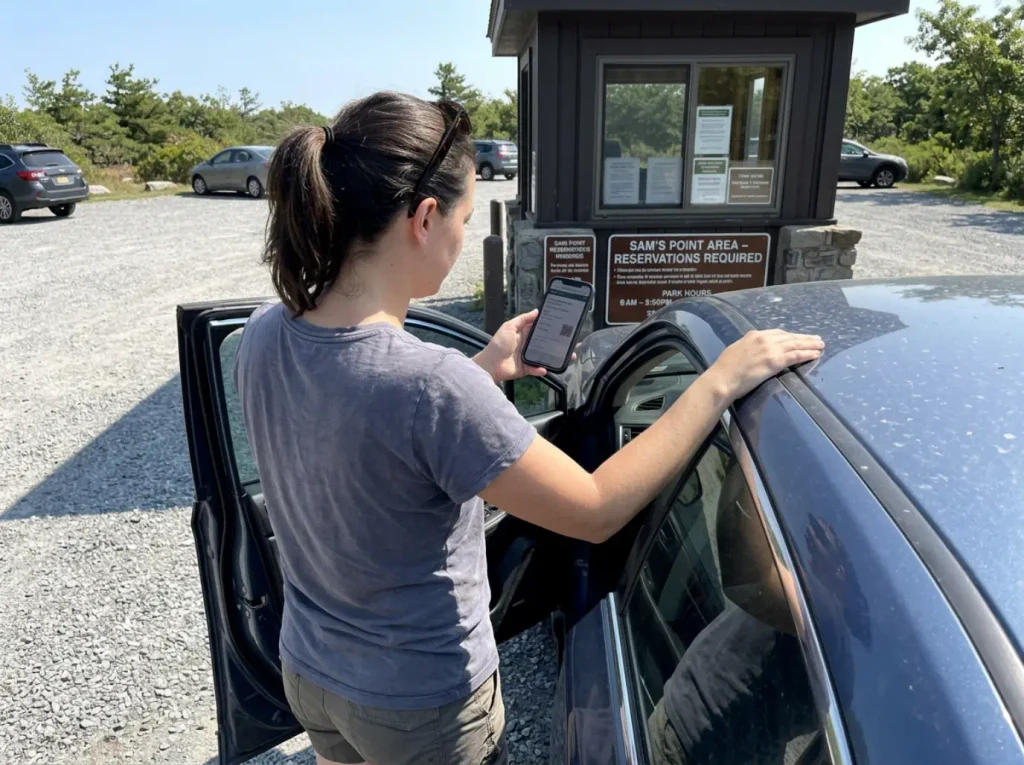
Everybody plans the hike. Nobody plans the parking lot. The gate is where this trip actually falls apart, and it falls apart on a technicality most visitors never read before they leave the house.
Weekends and Holidays Need a Reservation. Weekdays Don’t.
Here’s the piece that saves the most grief: the parking reservation requirement applies only to weekends and holidays between April 15 and November 15. There is no such thing as a weekday reservation here because a weekday needs none. A Tuesday in June, you drive up, pay at the gate, park.
For weekends and holidays inside that window, you book your parking reservation through ReserveAmerica. Seventy permits per session, a morning session running 9am to 2pm and an afternoon session from 2pm to close, bookable up to 14 days ahead. Same-day still works: cutoff is 8am for morning, 1pm for afternoon.
The Arrival Window Is Enforced
This is the one that turns people away. A morning reservation is not a permission slip for the whole morning. You have to physically arrive between 9 and 11am, and showing up at 12:30 with a valid booking on your phone can still send you back down the mountain. Treat the window as the reservation.
If your schedule has any flex in it at all, go on a weekday before roughly 10:30am. No booking, no window to miss, and the lot reliably has open spots. Regulars treat this as the default and only deal with ReserveAmerica when a weekend is the only option.
The $10 Gate Fee and What the Lot Is Like
The $10 vehicle entrance fee is collected at the gate whether or not you reserved, and gate hours run 9am to 8pm with seasonal variation. The entrance sits above Cragsmoor NY, up the hill from Ellenville NY, and the climb to it is steep enough that your map app will underestimate the drive.
One thing to sort out in advance: this is not the Minnewaska gate. Minnewaska has three separate areas with their own entrances, and Sam’s Point sits at the far southern end of the ridge above Cragsmoor. Navigating to Minnewaska State Park Preserve can drop you at the Route 44/55 entrance, 25 minutes from where you want to be.
The Ice Caves Trail Is a Real Hike Before It’s a Cave
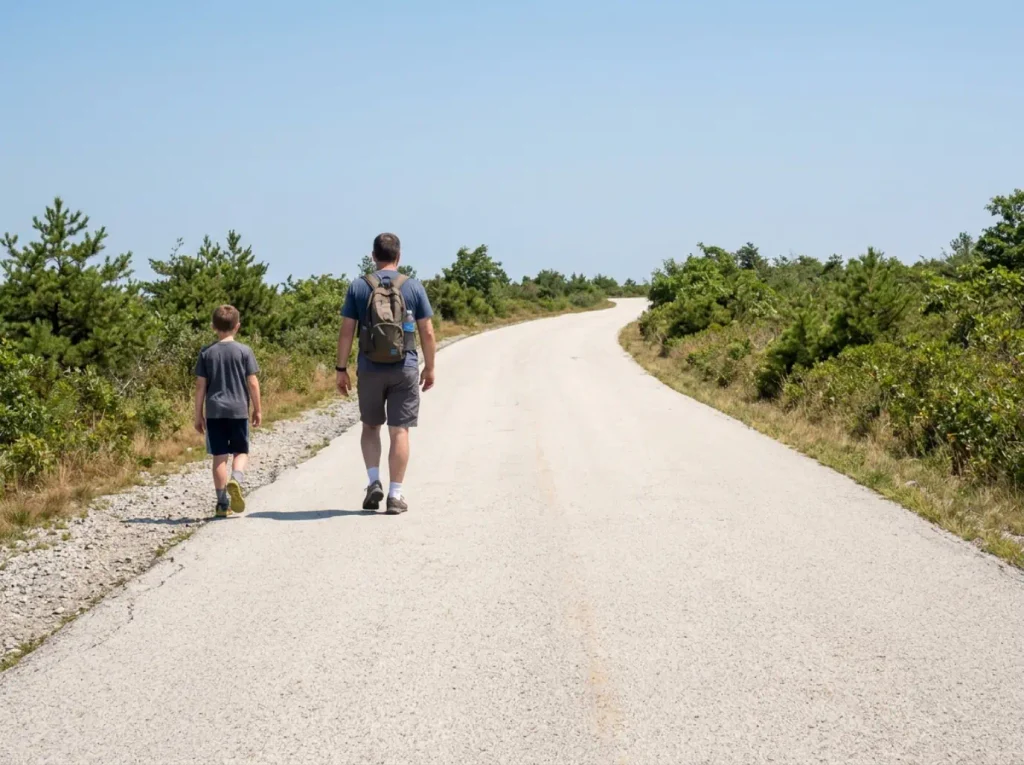
The name makes people picture a cave mouth near the parking lot. There’s a sustained uphill road walk first, and knowing that changes what you bring and who you bring.
The Numbers: 3.3 Miles, ~530 Feet, an Hour and a Half to Two
The crevice loop itself is only about half a mile. The full round trip from the visitor center parking area out to the loop and back runs roughly 3.3 miles with around 530 feet of elevation gain, moving time of 1.5 to 2 hours, rated Easy to Moderate.
That rating is fair, but two words compress a lot, and it’s worth knowing how a trail’s official difficulty rating compares to how it actually feels before promising an eight-year-old a short walk. The climbing is steady rather than steep, spread across the approach instead of stacked into one wall. That’s what makes it manageable for a mixed group and what makes people underestimate it.
What the Approach Actually Walks Like
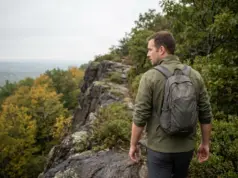
You walk the Loop Road, sometimes called Ice Caves Road, a paved and gravel track climbing the ridge that NY hikers just call the Gunks. Smooth underfoot, completely sun-exposed. That second part matters beyond sunburn: the heat you build walking up is what makes the crevice air hit the way it does. The road runs near the rim in places, so keep kids off the edge where the cliffs drop away on the west side.
The vegetation is dwarf pine barrens, pitch pine and chestnut oak growing low and scrubby out of thin soil over rock. Globally rare in this form, and the reason there’s no shade on the approach. Nothing up here grows tall enough to stand under.
What the Crevice Loop Is Actually Like
This is the part people came to read, and it’s the part every competitor reduces to a bullet list. So here’s what it’s actually like to step off a sunbaked road into a crack in the ridge.
The Temperature Drop Hits Immediately
It’s abrupt. Not a gradual cooling, but a wall you walk through. Cold air is denser than warm air, so it sinks into the deep vertical narrow crevices and stays trapped, holding the loop near 55°F while the sun-exposed road you just left bakes in full summer heat.
Your skin registers it before your brain does. Bare arms go to goosebumps in about ten steps, and if you’ve been sweating it has real teeth. People describe walking into a refrigerator. That’s not embellishment, it’s accurate.
Ducking, Squeezing, and Two Short Ladders
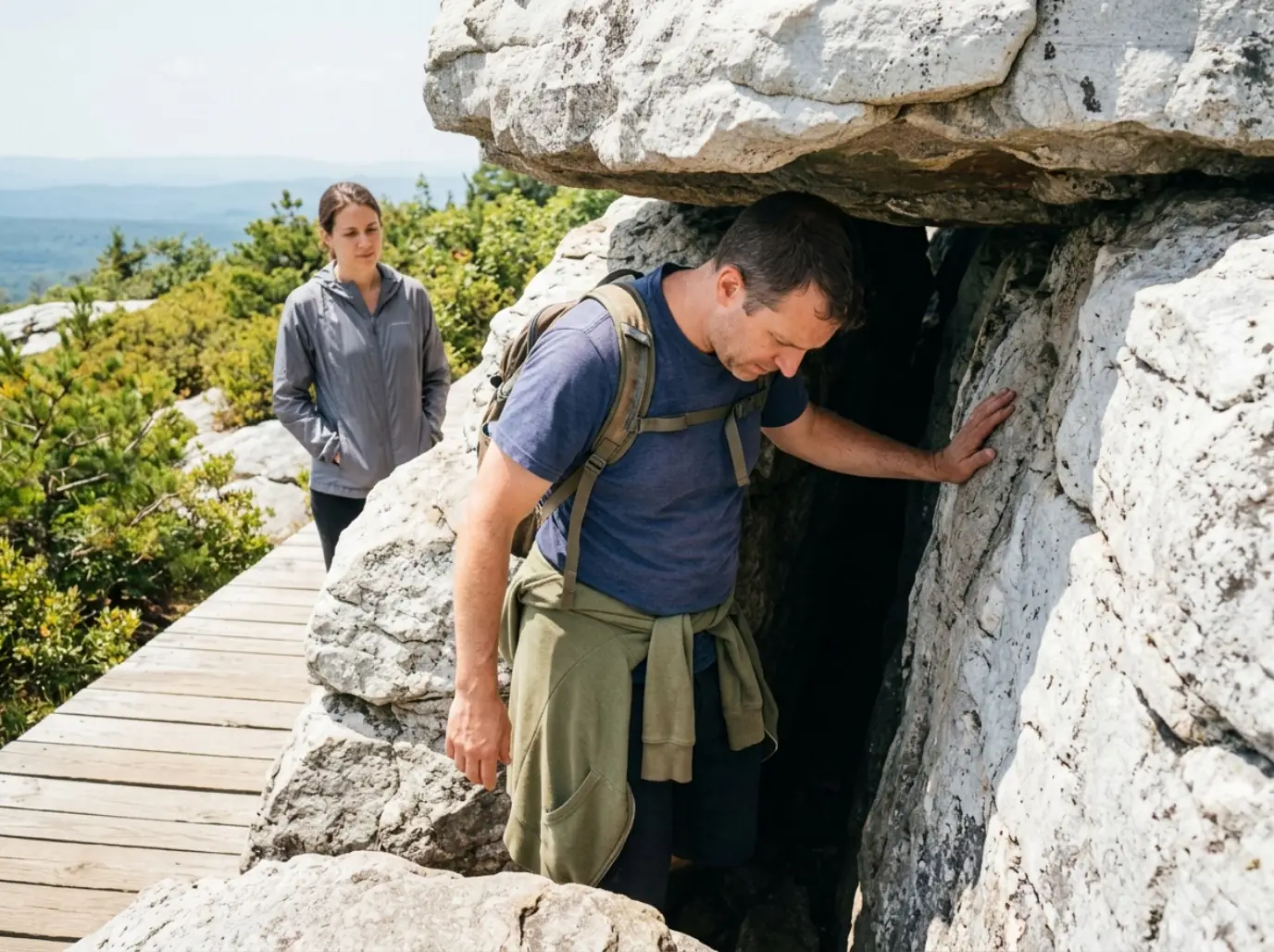
The loop threads between and under the conglomerate blocks. You’ll duck beneath low rock ceilings, turn sideways through a couple of pinches, and cross boardwalks laid over the uneven floor. Two short ladders, roughly six or seven rungs each, with railings where they’re needed.
The passages open and close: sky overhead, then a tunnel, then sky again. If you like this terrain, the same conglomerate crevices show up at Mohonk’s Lemon Squeeze a few miles up the ridge, tighter and more committing.
Since the 1990s the interior has been restored to bare natural rock. Ladders, railings and lights are the only additions, with no permanent wiring anywhere.
The Lights Are Solar, and They’re Not Instant
The sensor-activated lights are solar-powered and trip as you approach, illuminating the section ahead. Clever engineering for a cave with no electrical service.
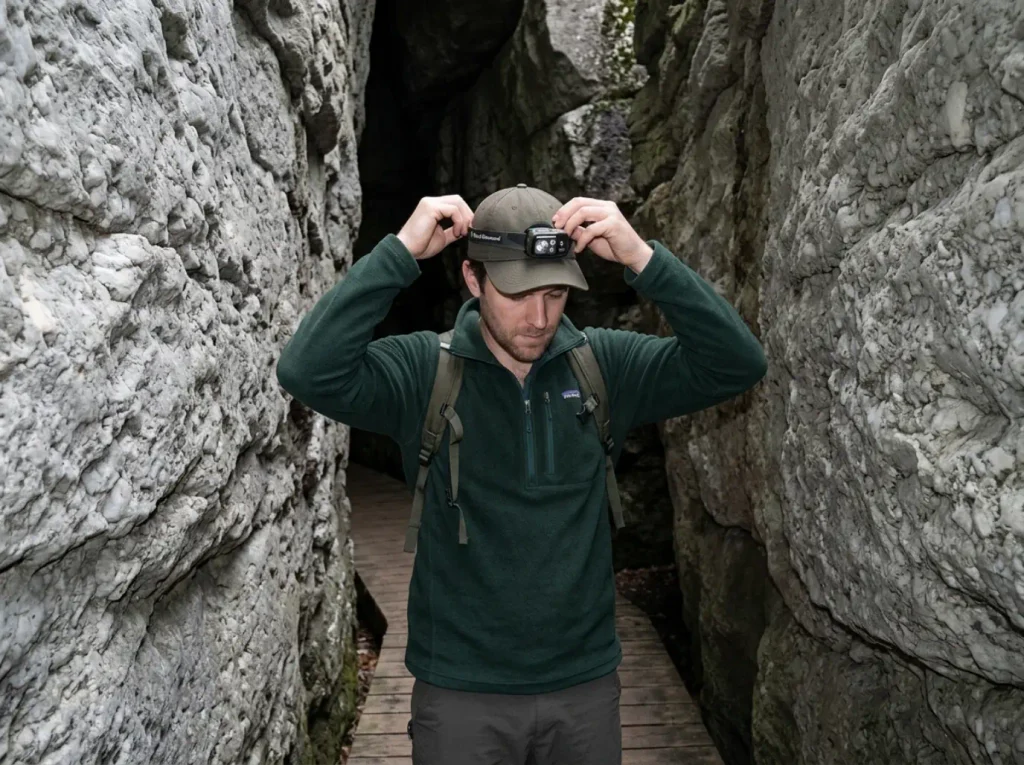
The catch, which hikers mention consistently, is the transition. There’s sometimes a beat between entering a dark pocket and the light responding, and in a few corners it doesn’t fully register you. Never more than a moment standing in the dark on uneven rock, but that’s the moment a light in your hand earns its place.
Your phone flashlight covers this. Genuinely. Most people walk the whole loop with nothing else and never feel underequipped.
The one real argument for a headlamp is the ladder, where you want both hands on the rungs. If you already own one, the Black Diamond Spot 400 Headlamp is the straightforward version, 400 lumens and dimmable so you’re not blinding whoever’s coming the other way in a four-foot corridor. Buying one for this hike alone is overkill, and I’d tell a friend the same thing.
Whether There’s Actually Ice in There
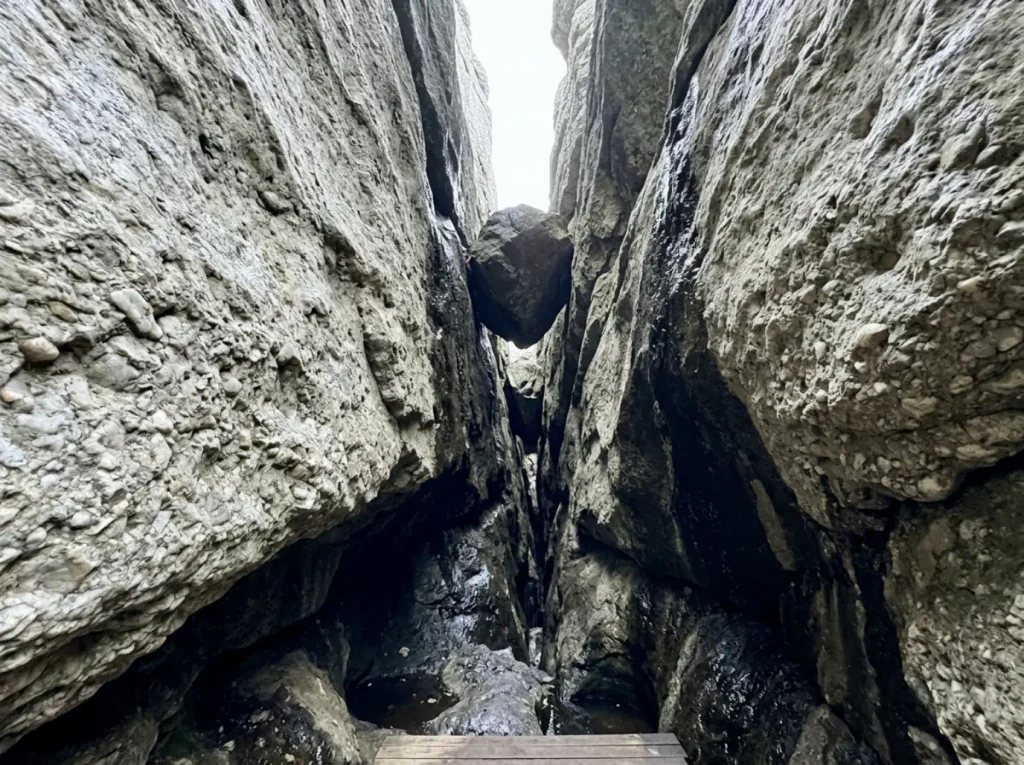
This is the thing a friend would tell you before you drove two hours, and almost nobody leads with it. So let’s be direct about it.
Winter and Early Spring Is When the Ice Is Real
Ice and snow build up in the crevices through winter, and in the deepest shaded pockets some of it survives into summer, protected by geometry rather than temperature. That’s the honest window: winter and early spring for reliable, visible ice.
What Summer Actually Looks Like
By mid-to-late summer, visible ice is often gone or reduced to remnants tucked where you won’t spot them. What you get instead is cold, damp, dark rock, water seeping and dripping, and air like a walk-in cooler.
That’s still a good hike. It’s just not what the name promised, and the visitors who leave disappointed are the ones nobody told.
Why the Caves Stay Cold Anyway
The seasonal ice comes and goes. The cold doesn’t. These are deep vertical fractures, not the wide horizontal chambers people picture, so cold air sinks in, warm air can’t displace it from below, and the cracks work as natural cold traps year-round.
The geology behind that shape earned its 1967 National Natural Landmark designation. This is the Ellenville Fault, the largest known exposed fault system in the country. The caves formed during the Pleistocene when tectonic folding pulled the quartz conglomerate apart along joints already in the rock. No water carved them, which is why they’re tight vertical cracks rather than rounded limestone rooms, and why the rock is hard pebbly stuff that feels nothing like cave limestone under your hand.
Look into the standing pools in the crevice floors instead of stepping past them. They hold Allegheny cave amphipods, blind and unpigmented crustaceans that are among the only animals known to survive being frozen solid. A Marist College biologist has been netting them out of these pools for two decades. You need to stop and let your eyes adjust, but they’re there.
What to Wear and What to Carry
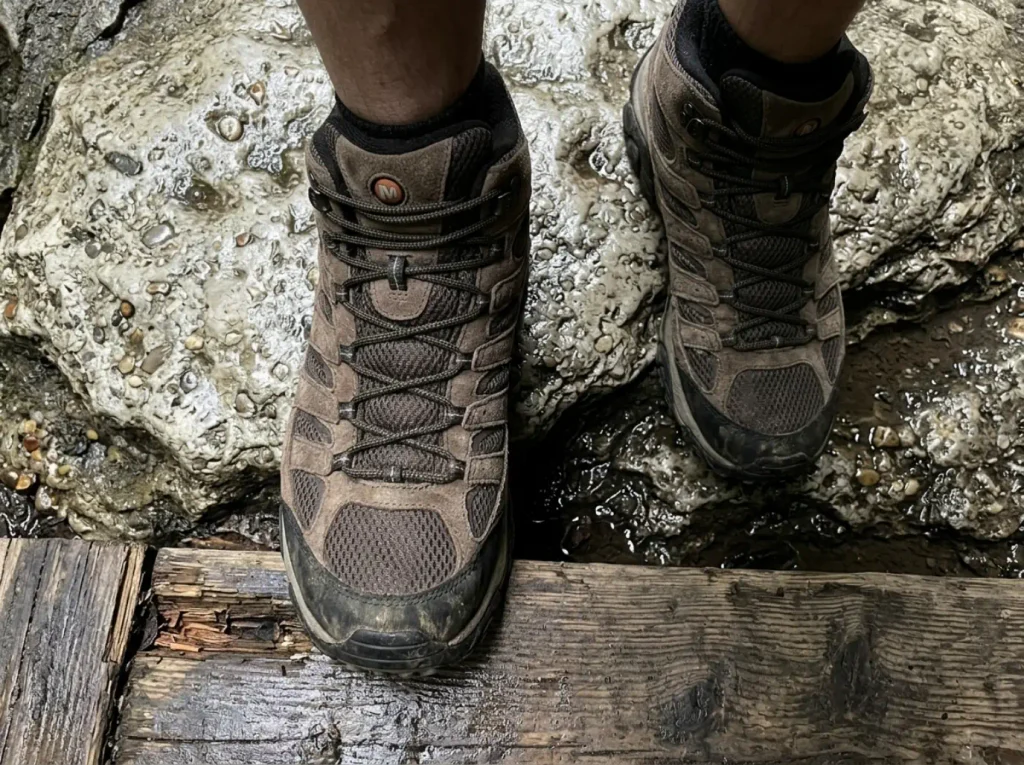
Every competitor says “wear appropriate footwear” and stops. That’s not advice, it’s a disclaimer. Here’s what actually matters on this specific trail, and just as usefully, what doesn’t.
Footing Is the Real Hazard, Not the Ladders
People fixate on the ladders. The ladders are six rungs and have railings. What actually puts hikers on the ground is wet, uneven conglomerate underfoot and the transitions where boardwalk meets rock meets ladder base.
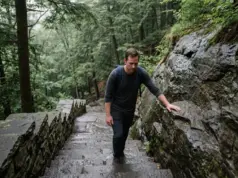
That rock never dries out, and worn-smooth tread finds nothing to bite. Sandals are the classic mistake, along with sneakers that went bald two summers ago. The same footing problem shows up on the Kaaterskill Falls stairs a county over, for the same reason.
Grip and ankle support earn their keep more than anything technical. A mid-cut waterproof boot like the Merrell Moab 3 Mid Waterproof (men’s · women’s) covers the wet-rock case with a Vibram outsole and enough collar height to keep an ankle honest on a tilted block.
That said, any broken-in trail shoe with tread left on it works fine. This is boardwalk, gravel and rock. Nobody is scrambling.
Bring a Layer, Even in August
Carry a light layer on a 90°F day. Packing a fleece in a summer parking lot feels ridiculous and stops feeling ridiculous ten seconds into the crevices. The drop is roughly thirty degrees, arrives instantly, and lands on skin already damp from the climb. The approach needs the opposite: water and sun protection, since the pine barrens give you nothing to hide under.
Put the layer on before you enter the crevices, not after you start shivering in them. You arrive at the loop warm and damp from a sun-exposed climb, and a fleece pulled over already-cold skin takes a long time to fix what a fleece pulled on thirty seconds earlier would have prevented.
What You Can Leave at Home
This is not a caving trip and nobody says so plainly enough. No helmet, knee pads, caving suit, rope or lighting rig. There’s no crawling, nothing you squeeze into that you can’t back out of, and no navigation on a marked loop with sky overhead at intervals.
Ordinary trail shoes, a layer, water, and the flashlight already in your pocket. That’s the honest list.
One rule does catch people out: there are no trash cans anywhere in the preserve. Carry-in, carry-out is mandatory, so bring a bag for wrappers before you need one. Drones and smoking or vaping are prohibited park-wide, which the official Sam’s Point Area park page spells out alongside the leash rule.
Kids, Dogs, and Anyone Nervous About Tight Spaces
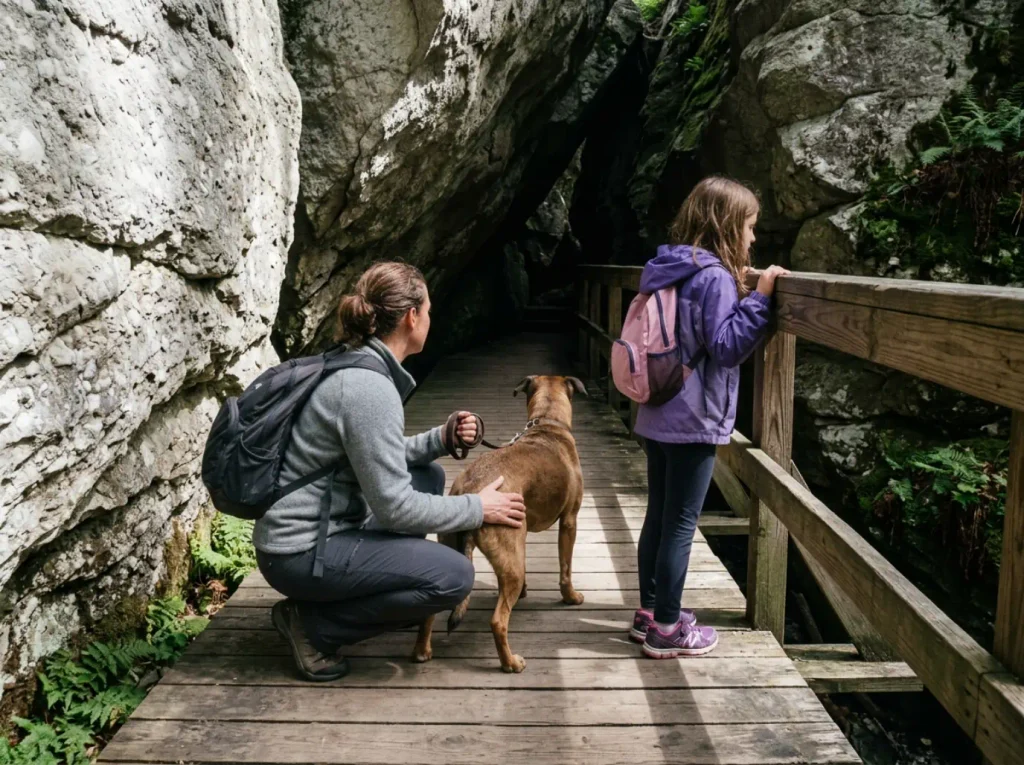
The question isn’t whether the trail is hard. It’s whether the eight-year-old and the dog make it through the ladders.
Kids Do Fine Here
The approach is a steady non-technical uphill on a smooth road, about the friendliest terrain a kid can climb 530 feet on. The loop is the fun part: ducking, squeezing and climbing rungs sells better to a nine-year-old than any overlook you’ll ever drive them to.
The evidence isn’t a rating, it’s the traffic. Kids’ camp groups get taken through the crevice loop routinely, which is the difference between technically permitted and actually done. Prepare a small child for two things and you’re set: it gets briefly dark, and a couple of ceilings are low enough that adults duck.
Dogs Are Allowed. The Ladders Are the Catch.
You’ll find posts claiming otherwise, so here’s the official rule: leashed dogs are permitted throughout Sam’s Point Area, including the Ice Caves Trail itself, on a leash no longer than six feet, under control, with waste packed out.
The practical obstacle is the ladders. A dog can’t climb rungs, so somebody is lifting, and small to medium dogs get hoisted without much drama. Be honest in the parking lot about whether you can lift yours up six rungs in a confined space with people waiting behind you. Better to decide there than halfway around.
If Tight, Dark Spaces Make You Uneasy
Straight answer instead of reassurance: the passages are narrow, some ceilings are low, and a few stretches have genuinely poor light. If that combination bothers you, it will bother you here.
What makes it workable is scale. The loop is half a mile, the enclosed sections come in short bursts rather than one committed passage, and there are open gaps with sky between the crevices. You’re never far from being out of it. Most people who call themselves mildly claustrophobic walk it fine; people with a real phobia sometimes turn around, which is a fine outcome on a trail this short.
If your group isn’t right for the ladders at all, a quieter Hudson Valley option with easier terrain for a mixed group beats pushing someone through a passage they don’t want to be in.
When to Go, and What to Add On
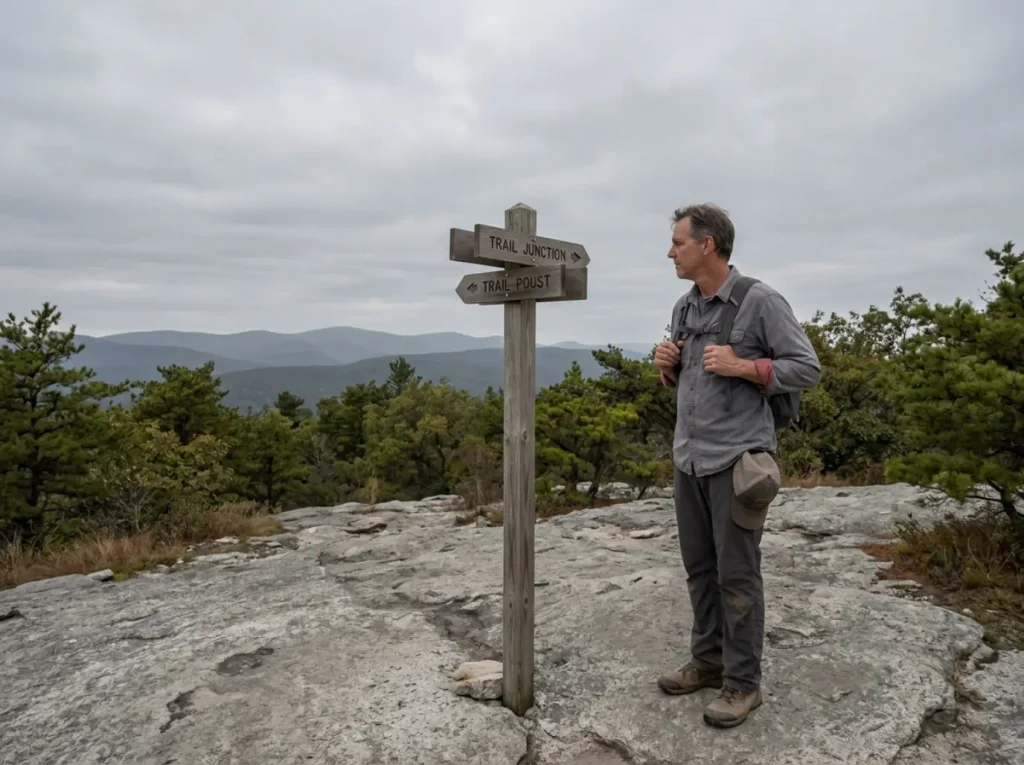
Once you know the ice is seasonal and the reservation system has a weekday loophole, picking the day gets simple.
Picking the Season for What You Want to See
Winter or early spring for actual ice. Summer for the refrigerator effect, which is its own kind of good on a brutal August afternoon. Fall for ridge color with the caves still cold.
There’s a bonus in the calendar: the reservation requirement only runs April 15 to November 15, so a winter visit sidesteps booking entirely. Check gate hours and road conditions first, since both shift with the season.
Picking the Day and the Hour
Weekday morning before roughly 10:30am. That’s the whole strategy. No reservation, open lot, cool air on the exposed approach, and the crevices to yourself before the afternoon groups arrive.
If You Want a Longer Day Out of the Drive
The Ice Caves loop is a half-day at most, and you drove a long way for it. The same parking area opens onto Sam’s Point Overlook, Lake Maratanza and High Point, and Verkeerder Kill Falls is the usual add-on from the same trailhead for anyone with legs left. For how those pieces fit into a full day, our full guide to the Sam’s Point Area covers the ground this article leaves alone.
The Short Version
Go on a weekday and the entire reservation problem evaporates. No booking, no arrival window, no gate anxiety.
The ice is a winter thing. The cold is year-round. Know which one you’re driving out for and the trip delivers either way.
Ordinary trail shoes and the flashlight in your pocket cover this. It’s a walk with two ladders, not a caving expedition, and anyone telling you to gear up for it is selling something.
Pick a weekday morning, pack a layer you won’t need until the moment you step into the crevice, and go see what a fault line looks like from the inside.
Frequently Asked Questions
01Is there actually ice in the Sam’s Point Ice Caves?
In winter and early spring, yes. Ice builds up in the crevices and some survives into early summer in the deepest shaded pockets. By mid-to-late summer visible ice is usually gone, though the caves stay near 55°F year-round because cold air sinks in and stays trapped.
02Do you need a reservation to hike the Sam’s Point Ice Cave trail?
Only on weekends and holidays between April 15 and November 15. Weekday visits need no reservation at all, just the $10 vehicle fee at the gate. If you book a weekend morning session, you have to arrive between 9 and 11am or you can be turned away.
03How long does the Ice Caves Trail take?
Plan on 1.5 to 2 hours of moving time for the 3.3-mile round trip from the parking area, including the half-mile crevice loop itself. With drive time and the gate, it works out to a comfortable half-day rather than a quick stop.
04Are dogs allowed in the Sam’s Point Ice Caves?
Yes. Leashed dogs on a leash no longer than six feet are permitted throughout Sam’s Point Area, including the Ice Caves Trail, and you pack the waste out. The two short ladders inside the loop are the real obstacle, since small and medium dogs usually need to be lifted through them.
05Is the Ice Caves Trail good for kids?
It is one of the better family hikes in the Shawangunks. The approach is a steady but non-technical uphill walk, and kids camp groups get taken through the crevice loop routinely. The two short ladders and a few low ceilings are the only things to prepare a small child for.
Risk Disclaimer: Hiking, trekking, backpacking, and all related outdoor activities involve inherent
risks which may result in serious injury, illness, or death. The information provided on The Hiking Tribe is for
educational and informational purposes only. While we strive for accuracy, information on trails, gear, techniques,
and safety is not a substitute for your own best judgment and thorough preparation. Trail conditions, weather, and
other environmental factors change rapidly and may differ from what is described on this site. Always check with
official sources like park services for the most current alerts and conditions. Never undertake a hike beyond your
abilities and always be prepared for the unexpected. By using this website, you agree that you are solely
responsible for your own safety. Any reliance you place on our content is strictly at your own risk, and you assume
all liability for your actions and decisions in the outdoors. The Hiking Tribe and its authors will not be held
liable for any injury, damage, or loss sustained in connection with the use of the information herein.
Affiliate Disclosure: We are a participant in the Amazon Services LLC Associates Program, an
affiliate advertising program designed to provide a means for us to earn advertising fees by advertising and linking
to Amazon.com. As an Amazon Associate, we earn from qualifying purchases. We are also an official affiliate partner
of Black Diamond Equipment via the AvantLink network. If you click on a Black Diamond affiliate link and make a
purchase, we may earn a commission at no additional cost to you. We also participate in other affiliate programs and
may receive a commission on products purchased through our links. Additional terms are found in the terms of
service.