In this article
Most hikers reach for boots because somebody, somewhere, told them ankles need protecting on trail. That advice is older than the research that quietly took it apart. The people who log the most trail miles in North America already voted with their feet, and it wasn’t for boots. Here’s what low-cut actually means, the real tradeoffs around weight, water, and ankles in the hiking shoes vs boots debate, when a boot still earns its place, and which pair fits the way you hike. If you’re not even sure low-cut is your category yet, start with the wider boots-shoes-sandals decision and circle back.
Here’s how the three collar heights stack up before we get into the why.
| Feature | Low-Cut Shoe | Mid-Cut Boot | High-Cut Boot |
|---|---|---|---|
| Weight | Lightest | Middle | Heaviest |
| Ankle collar | Below the ankle | Just above ankle | Up the lower shin |
| Breathability | Best, dries fast | Moderate | Warmest, slow to dry |
| Waterproofing | Optional membrane | Usually sealed | Fully sealed |
| Best for | Day hikes to thru-hikes under ~30 lb | Mixed loads, rougher trail | Heavy loads, snow, technical ground |
What “Low-Cut” Actually Means (and How It Differs from Mid and High)

Everyone says hiking shoes and hiking boots like the line between them is obvious. It isn’t. The collar height is the whole distinction, and it’s the thing people fixate on for all the wrong reasons.
Low-Cut vs Mid-Cut vs High-Cut at a Glance
A low-cut shoe has a collar that sits below the ankle bone. A mid-cut boot wraps just above it. A high-cut boot climbs up the lower shin. That’s the only structural difference in the silhouette. Everything else, the outsole, the midsole, the upper materials, can be identical between a “shoe” and a “boot” from the same line. If you want to see exactly how mid-cut and ankle-high boots really compare, the gap is smaller than the marketing suggests.
The collar height is what you see first, so people assume it’s what matters most. Hold that thought. The section on ankle support takes it apart with actual data.

Where Trail Runners Fit In
Trail runners are the lightest branch of the low-cut family. Same low collar, but built like a running shoe: soft, flexible, fast-drying, and made to move. They sit at one end of a spectrum that runs all the way to burly, stiff low-cut hikers. A low-cut shoe isn’t automatically flimsier than a boot, and approach shoes are their own low-cut category built for grippy, technical ground.
The Spec People Confuse With Support
Here’s the mistake that drives half the bad boot advice out there: people conflate the ankle collar with torsional rigidity, the sole’s resistance to twisting side to side. Those are two completely different specs. A low-cut shoe with a stiff sole platform can support your foot better than a soft boot with a tall collar. Grab any shoe and try to wring it out like a towel. That resistance is what actually holds your foot stable on uneven ground.
The Weight Game — Why Lighter Feet Change the Whole Hike
The “a pound on your feet equals five on your back” line gets repeated so often it sounds made up. It isn’t. It’s measured, and it’s the most underrated reason low-cut wins for most people.
What the Research Actually Measured
US Army research on energy expenditure found that carrying weight on your feet costs roughly 4.5 to 6.2 times more energy than carrying the same weight on your torso. That’s where the five-to-one rule comes from. It’s metabolic, not folklore, and it’s the root of foot fatigue on long days. Your legs are a pendulum, and every ounce at the far end of that swing costs you real effort, thousands of times a day.
The math gets concrete fast. A shoe that’s about 300 grams lighter per foot saves you the leg-energy equivalent of hauling roughly 1.5 kilograms, more than three pounds, that you’d otherwise carry all day. The lightest waterproof membrane low-cuts, like the Vasque Breeze LT Low GTX (men’s · women’s) with its lighter Vibram Lite Base outsole, are where you feel that difference most.
What 300 Grams Per Foot Feels Like at Mile 12
You won’t feel the weight difference at mile two. You’ll feel it at mile twelve. The energy cost compounds over distance, so a shoe that felt “about the same” in the store parking lot turns into a real gap in how fresh your legs are by late afternoon. The thing hikers notice first when they switch from a heavy waterproof mid boot to a low-cut shoe is simple: their legs ache less at the end of a long day.
Weigh your current boots on a kitchen scale, then weigh a low-cut you’re eyeing. If the shoe saves 250 grams or more per foot, that’s your single biggest comfort upgrade for the money, no training required.
Breathability vs Waterproofing — What You Actually Give Up
People buy waterproof by reflex, then wonder why their feet are swampy on a hot climb. A waterproof membrane is a tradeoff, not a free upgrade.
When Waterproof Helps (and When It Cooks Your Feet)
A Gore-Tex membrane seals water out, but the same layer that blocks water also slows heat and vapor from escaping. That’s great in cold, wet conditions and miserable on a hot, dry climb. Low-cut mesh uppers breathe better and dry faster, which is exactly why Gore-Tex shoes can still feel wet inside when the sweat can’t get out. Match the build to the trip: sealed for cold and snowmelt, breathable for heat.
The Bucket Effect Nobody Warns You About
Here’s the failure mode boot buyers don’t see coming. Water gets into a tall waterproof boot over the collar, then can’t drain back out. Hikers call it the bucket effect, and a sealed boot that floods once stays flooded for the rest of the day. A low-cut shoe that gets wet drains and dries in a fraction of the time. On a route with repeated crossings where you’re going to get wet anyway, a fast-draining low-cut can keep your feet drier over a full day than a “waterproof” boot that trapped one bad splash. For hikers who still want a sealed shoe, there are waterproof options that actually fit women’s feet worth a look.
The Ankle-Support Myth, Settled
This is the fear that sells more boots than any other. It’s also the one that holds up worst under actual research.
What the 2014 Study Found
The assumption is intuitive: a tall collar physically braces your ankle against a roll. Widely repeated, and not what the data shows. In a 2014 study in the Journal of Foot and Ankle Research, researchers measured how fast the ankle-stabilizing muscles fired in high-top versus low-top shoes. The high-tops actually delayed the firing of the peroneal muscles, the very ones that catch a roll before it becomes an ankle sprain. A stiff collar can make your stabilizers react slower, not faster. The brace you thought was protecting you may be dulling the reflex that actually does.
Torsional Rigidity Is the Spec That Matters
What genuinely drives ankle stability is torsional rigidity, that side-to-side sole stiffness again, not the height of the collar. A low-cut shoe with a stiff platform gives you a stable base on uneven ground without wrapping your ankle at all. If you want more structure under a heavier load without going up to a boot, a stiffer, more supportive low-cut like the La Sportiva Spire GTX (men’s · women’s) with its GTX Surround build gives you the platform without the collar.
Who Actually Still Needs the Collar
The collar isn’t useless. Under a heavy pack or on genuinely technical terrain, a higher cut adds real support, and hikers with weak ankles or a history of bad ankle injuries are a legitimate exception. If your real issue is arch support for flat feet, collar height won’t fix it either way. Ankle strength is also trainable. Transitioning to low-cut gradually on easy trails beats switching cold on a big trip, and knowing how to treat a rolled ankle on trail matters more than the shoe you rolled it in. For most hikers with healthy ankles on non-technical trail, a stiff-soled low-cut matches or beats a soft-soled boot on stability. That’s the full breakdown of the ankle-support myth if you want to go deeper.
Coming from boots? Don’t make your first low-cut hike a loaded overnighter. Do a few short day hikes on easy terrain first. Your ankle stabilizers need a couple of weeks to wake up after years inside a stiff collar.
When Low-Cut Is the Right Call — Terrain and Pack Weight
Low-cut isn’t the answer for literally everything. The honest version has a line where a boot starts earning its weight, and it comes down to load and terrain, not the ankle collar.
The ~30-Pound Line
The rule of thumb from gear-lab testing is simple: under about 30 pounds of total pack weight on moderate or groomed trail, a low-cut shoe is fine for most healthy-ankled hikers. Day hikes, fast overnights, and well-graded trails all fall on the low-cut side of the line. For most people, one solid all-rounder covers the whole range.
All-Around Pick

If you carry heavier and want a shoe with backpacking chops, there are low-cut shoes built for backpacking loads that hold up under more weight than a trail runner.
Terrain That Still Says Boot
Above roughly 30 pounds, or on off-trail talus, early-season snow, and technical scrambly ground, the extra platform stiffness of a boot starts to pay off. It’s rarely the ankle that pushes experienced hikers back to a boot. It’s a loaded pack punishing a soft midsole on rough ground. For scrambly, class 3 terrain, approach shoes for technical ground split the difference, and if you hike a lot of mud, deep lugs for muddy, steep terrain matter more than collar height.
Why Thru-Hikers Ditched Their Boots
If boots were truly safer over big miles, the folks doing 2,000-plus miles a year would live in them. They don’t. And that’s the loudest data point in the whole debate.
What the Thru-Hiker Surveys Show
The 2025 Appalachian Trail Thru-Hiker Survey is blunt: 77% of hikers start the AT in trail runners, and 87% or more are in trail runners by the end. Earlier data showed over 90% finishing in trail runners and under 5% in boots. This isn’t a fringe crowd. It’s the mainstream of long-distance hiker culture, the people grinding out the AT, PCT, and CDT, and they moved away from boots on purpose.
It’s not just adoption, it’s satisfaction. In the survey data, 88% of hikers who started in trail runners were satisfied with the choice, versus 72% of those who started in boots. And the durability worry doesn’t hold up: thru-hikers average about four pairs of footwear per thru-hike, roughly one pair every 520 miles, regardless of whether they wear low-cut shoes or boots. Low-cut isn’t secretly more fragile at real mileage.
Why Long-Distance Feet Prefer Low-Cut
Feet swell on long trails, sometimes a full size over weeks of daily miles. A low-cut shoe gives that swelling room and drains fast when you soak it. The Altra Lone Peak, a zero-drop low-cut trail runner, has been the single most popular AT shoe every year since 2017, worn by roughly one in five hikers in 2025. The weight savings compound over an entire trail, which is why the ultralight crowd treats footwear as the first place to cut grams, the same math from the weight section playing out across two thousand miles. If you’re weighing the lightest options, here’s how speed-hiking shoes and trail runners compare. For high-mileage comfort without going full minimalist, a max-cushion low-cut like the HOKA Anacapa 2 Low GTX (men’s · women’s) is the pick.
Sizing, Lacing, and Blisters on Low-Cut Shoes
Most “these shoes gave me blisters” complaints are really fit and lacing mistakes. They show up worse in a low-cut because it flexes more at the ankle than a boot does.
Why You Size Up Half a Size
Your feet swell over a day on trail, and you’re adding a hiking sock on top of that. Buy low-cuts about half a size larger than your street-shoe size. This single fix kills most black-toenail and downhill toe-jam complaints, and it’s the most repeated fit tip across every gear reviewer for a reason. Knowing when and how much to size up is the difference between a shoe that fits at the trailhead and one that fits at mile ten. Wide-footed hikers can start with wide-fit low-cut options for women.
The most forgiving low-cut to nail a fit in on your first try is the Merrell Moab 3 (men’s · women’s). Wide, roomy, and budget-friendly, it’s the easiest shoe on this list to get right without a fitting session.
Heel-Lock Lacing, Step by Step
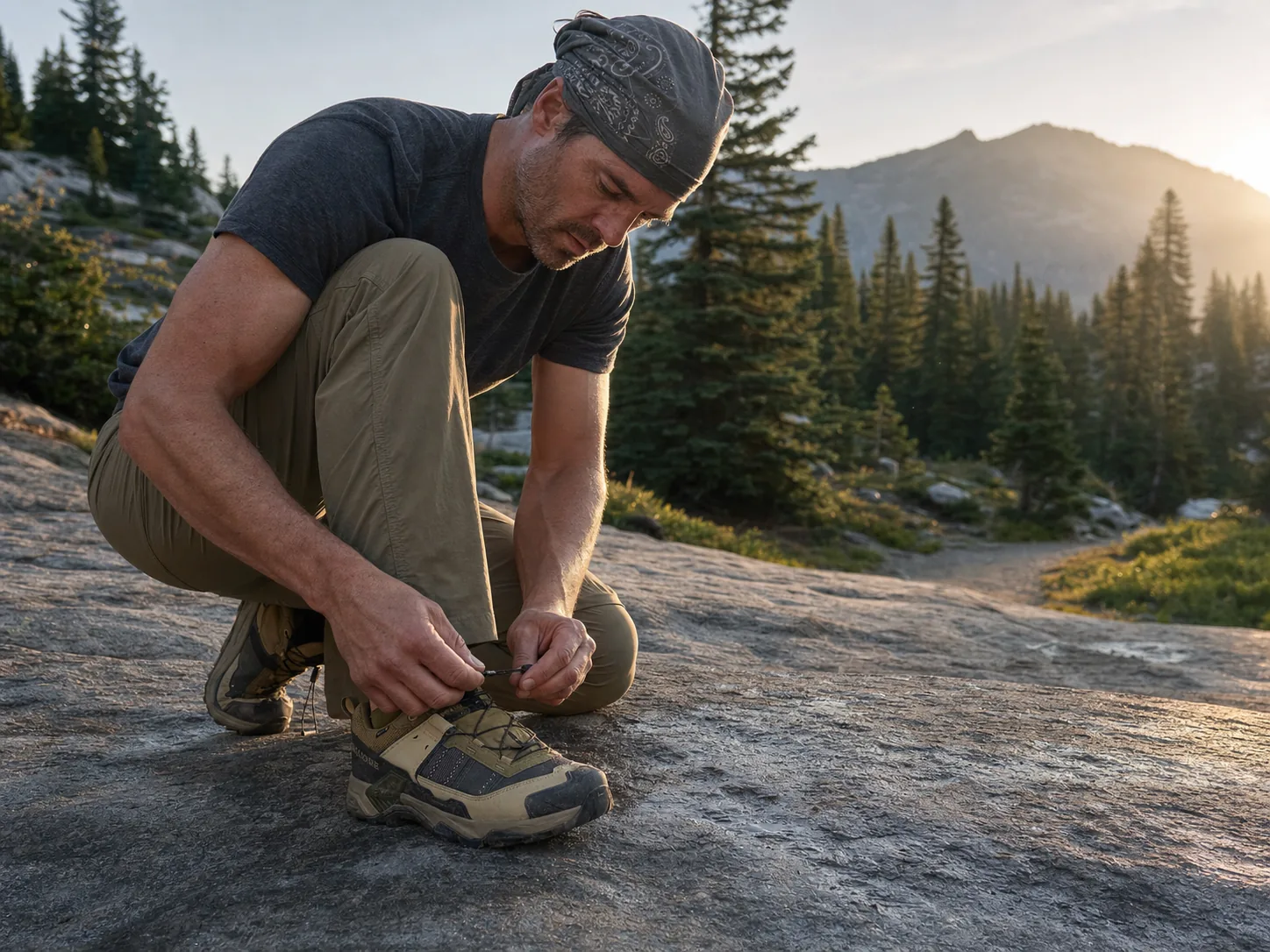
Heel-lock lacing, also called the runner’s loop, locks your heel in place and stops the slip that fakes people into thinking they need a stiffer boot. Here’s the move:
- Lace normally up to the second-from-top eyelet on each side
- Instead of crossing over, run each lace straight up into the top eyelet on the same side, making a small loop
- Cross each lace over and thread it through the opposite loop
- Pull down and tight, then tie as usual
That downward cinch pulls your heel back into the pocket and holds it there on descents.
Breaking In Without Getting Blisters
Break new low-cuts in on a couple of short walks before a big day. A low-cut’s ankle flex surfaces hot spots that a boot would have splinted, so you want to find them at home, not at mile eight. A liner sock under your hiking sock beats one thick sock for friction control, and break-in time varies by material more than most people expect. Toe-jam on descents is almost always a sizing and lacing problem, not a bad shoe.
Try shoes on in the afternoon, not the morning. Your feet are already slightly swollen by then, closer to their trail size. A shoe that fits perfectly at 8 a.m. can feel a half-size too small by the time you’re grinding uphill.
Debris, Gaiters, and Wet Crossings — the Low-Cut Weak Spots
Time for the honest part. A low collar has real downsides, and pretending otherwise would make this just another gear infomercial. The good news is the fixes are cheap.
Keeping Grit Out
The most legitimate low-cut complaint is simple: an open collar lets scree, sand, trail grit, and light snow drop straight into the shoe. It’s annoying, and it’s real. The fix isn’t a $200 boot, it’s a pair of trail gaiters that close the gap for a fraction of a boot’s weight. Low trail gaiters weigh almost nothing and solve the single biggest reason people wrongly blame their low-cut shoes.
Wet Crossings and Grip on Slick Rock
Wet crossings cut both ways. A low-cut drains and dries fast, but on a deep crossing water comes straight in, so plan to get wet and pick a fast-drying build, which is how drainage shoes handle repeated crossings. Grip on slick rock is more about the outsole than the collar. The lug pattern clears mud and bites into soft ground, while the rubber compound handles slick rock, and a soft, sticky compound outgrips a hard one every time, and which rubber compounds actually grip wet rock matters more than whether you’re in a shoe or a boot. A solid all-rounder that handles messy trails is the Oboz Sawtooth X Low (men’s · women’s), with real debris protection and B-DRY waterproofing at a fair price.
On a hot day with a stream crossing, stop fighting it. Walk straight through in your low-cuts, let them drain on the far side, and keep moving. Your feet are dry again in twenty minutes. A boot that shipped water stays a swamp for hours.
What’s Worth Paying For — Budget vs Premium, Honestly
Here’s the part the brand-owned buying guides can’t write: where the money actually buys you something, and where you’re just paying for a logo.
What Actually Earns the Money
Two upgrades are worth paying for. First, a quality outsole compound like Vibram Megagrip, because grip on wet rock is a real safety and confidence difference you feel on every slick step. Second, a genuine waterproof membrane, but only if your trips actually need it. Cold, wet, and snowmelt hikes justify it. Hot, dry trails don’t, and you’re better off with breathable mesh and waterproof low-cut picks ranked by terrain only when the terrain calls for it. Where premium genuinely earns its keep is a structured platform for heavy loads, like the La Sportiva Spire, and max cushion for high mileage, like the HOKA Anacapa. Those are real use cases, not hype.
Where You’re Just Paying for a Logo
Past a solid outsole and a good fit, the returns drop off fast. Marginal cushioning “upgrades,” premium colorways, and brand-name markups don’t make you a better hiker or your feet happier. The budget floor still performs: a Merrell Moab 3 or Oboz Sawtooth X delivers the core waterproof low-cut spec for the least money. The rule that beats every spec sheet is this: fit beats brand, every time. The best shoe on paper that doesn’t fit your foot is the wrong shoe.
Conclusion
The ankle-collar fear that sells boots doesn’t survive the research. For most healthy-ankled hikers on non-technical trail, a stiff-soled low-cut matches a boot for stability and saves your legs real energy every mile. The people logging the most miles already switched, and they’re more satisfied for it. Boots still win a real but narrow case: heavy loads, technical ground, and early-season snow.
Before your next hike, try the half-size-up and heel-lock lacing trick on a pair you already own, and feel the difference on the descent. Then decide what to buy.
Frequently Asked Questions
01Are low-cut hiking shoes good for backpacking?
Yes, for loads under about 30 pounds on moderate terrain, and the thru-hiking community proves it, with most Appalachian Trail hikers finishing in low-cut trail runners. Above 30 pounds or on technical ground, a stiffer platform starts to earn its place.
02Do low-cut hiking shoes give enough ankle support?
For most hikers with healthy ankles, yes. A 2014 biomechanics study found high collars can actually slow the muscles that catch a roll. Real stability comes from the sole torsional stiffness, not collar height, though past ankle injuries are a genuine exception.
03Are low-cut hiking shoes waterproof?
Some are. Models with a Gore-Tex or B-DRY membrane seal out water, but that same membrane breathes less and dries slower. For hot trips or repeated crossings, a breathable shoe that drains fast often keeps feet drier over a full day.
04Should I size up in low-cut hiking shoes?
About half a size, yes. Your feet swell over a day on trail and you are adding a hiking sock, so street-shoe sizing is the number-one cause of black toenails and toe-jam on descents.
05When should I wear boots instead of low-cut shoes?
When you are carrying a heavy multiday load, traveling technical or off-trail terrain, or hiking through early-season snow. In those cases the stiffer platform and higher collar earn their weight. For everything else, low-cut usually wins.
Risk Disclaimer: Hiking, trekking, backpacking, and all related outdoor activities involve inherent
risks which may result in serious injury, illness, or death. The information provided on The Hiking Tribe is for
educational and informational purposes only. While we strive for accuracy, information on trails, gear, techniques,
and safety is not a substitute for your own best judgment and thorough preparation. Trail conditions, weather, and
other environmental factors change rapidly and may differ from what is described on this site. Always check with
official sources like park services for the most current alerts and conditions. Never undertake a hike beyond your
abilities and always be prepared for the unexpected. By using this website, you agree that you are solely
responsible for your own safety. Any reliance you place on our content is strictly at your own risk, and you assume
all liability for your actions and decisions in the outdoors. The Hiking Tribe and its authors will not be held
liable for any injury, damage, or loss sustained in connection with the use of the information herein.
Affiliate Disclosure: We are a participant in the Amazon Services LLC Associates Program, an
affiliate advertising program designed to provide a means for us to earn advertising fees by advertising and linking
to Amazon.com. As an Amazon Associate, we earn from qualifying purchases. We are also an official affiliate partner
of Black Diamond Equipment via the AvantLink network. If you click on a Black Diamond affiliate link and make a
purchase, we may earn a commission at no additional cost to you. We also participate in other affiliate programs and
may receive a commission on products purchased through our links. Additional terms are found in the terms of
service.