
In this article
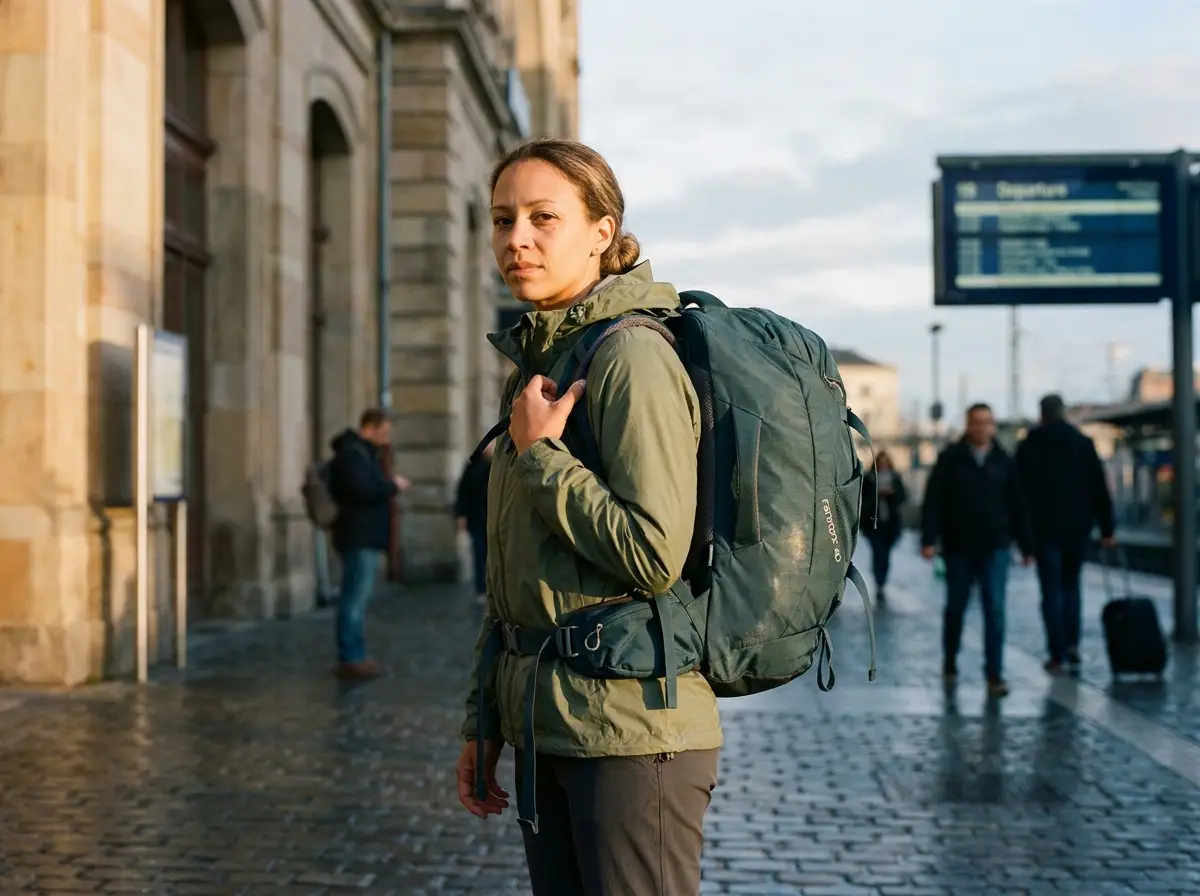
Most “best travel backpack” lists quietly pretend a travel pack and a backpacking pack are the same animal. They are not, and buying the wrong one is why a bag that packed beautifully in your living room rides like a brick the moment you walk the last mile to the hostel. Ask anyone who’s done the one-bag thing for a few trips: the spec that decides everything isn’t liters, it’s whether the hip belt does real work once the bag gets heavy. This roundup names the packs that genuinely fly AND hike, filters out the direct-to-consumer darlings you can’t actually buy on Amazon, and tells you which one matches how you really travel.
Here’s how the top picks stack up at a glance before we get into the why.
| Pack | Best For | Capacity | Real Load-Carrying Harness |
|---|---|---|---|
| Osprey Farpoint 40 | Best overall hybrid | 40L | Yes |
| Cotopaxi Allpa 35L | Best organization | 35L | No (token belt) |
| Osprey Sojourn Porter 46L | Best for outdoor travel | 46L | Yes |
| Hynes Eagle 40L | Best budget | 40L expandable | No |
| Timbuk2 Never Check 27.5L | Best personal item | 27.5L | No |
Travel Pack vs Backpacking Pack and What You Actually Need
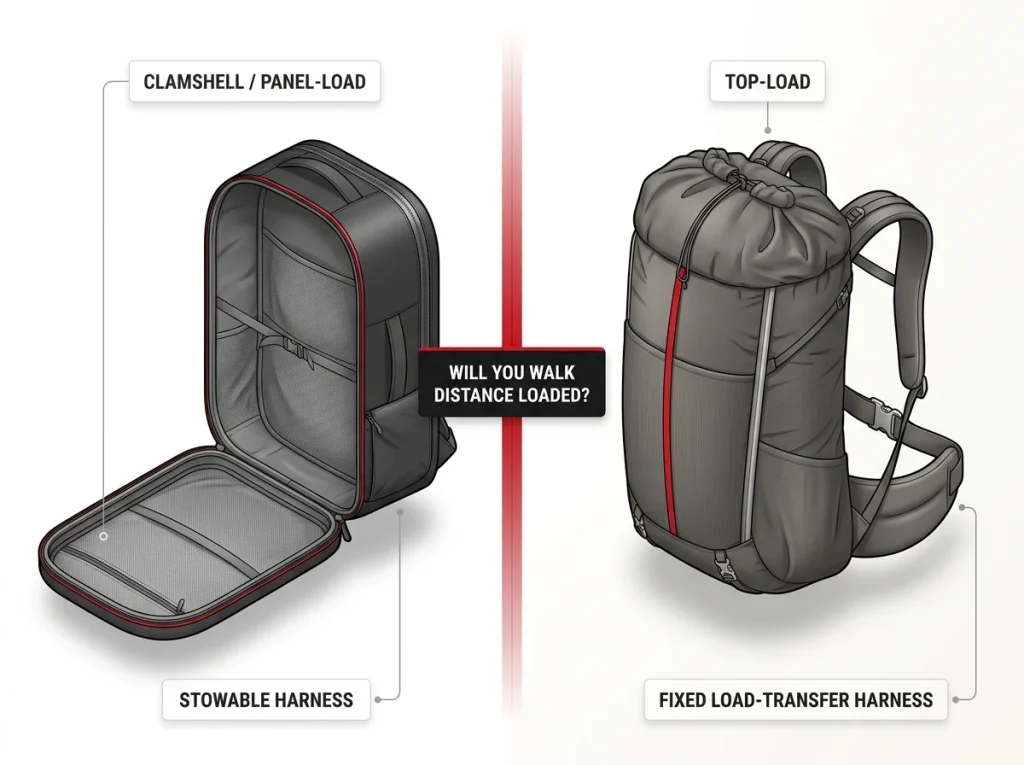
Before you buy anything, answer one question: are you going to walk distance with this thing loaded, or just carry it from the terminal to a taxi? Your honest answer decides which half of this list you should even be reading. Get it wrong and no amount of clever organization saves you.
The clamshell travel pack
A travel backpack is a panel-loader. It opens flat like a suitcase, the shoulder straps tuck away behind a zippered flap, and it’s built to slide into an overhead bin and behave at security. That clamshell layout is genuinely better for living out of a bag, because you can see everything at once instead of digging down a top-loading tube. The catch is the suspension. Most of these packs carry a soft, token hip belt that looks the part and does almost nothing once the bag gets heavy.
The real backpacking pack
A true multi-day backpacking pack is the opposite trade. It puts the weight on your hips through a real frame and harness, which is the whole point when you’re moving for hours. But it top-loads, the harness is fixed and always exposed, and it packs terribly for a flight. The same grey zone shows up between a daypack and a backpacking pack, and the fix is the same: match the bag to the job, not to the marketing. If you want the deeper buying logic that sits under this whole category, our guide on how to choose a hiking backpack without wasting money lays out the fit-first framework these picks are built on.
The genuine hybrid and the decision axis
A few packs honestly do both passably. They carry a real stowable harness that transfers load and then zips away clean for the flight. In this field that short list is basically the Osprey Farpoint 40 and the Sojourn Porter 46L. Everything else is a clamshell with a comfort belt, and that’s fine for the right traveler.
So here’s the decision axis, the whole article in one line. Will you walk distance with it loaded? Yes, then you want a harness pack. No, then you want a clamshell one-bagger and you should spend your money on organization, durability, or security instead. The classic mistake is the 10-mile-from-the-hostel test: the clamshell that packed beautifully now rides like a brick on your shoulders because nothing is carrying the load on your hips.
One more filter before the picks, and it’s the one most lists skip. The bags that get ranked number one almost everywhere, the Peak Design Travel, the Aer Travel Pack, Tortuga, the Patagonia Black Hole MLC, are direct-to-consumer brands that don’t sell on Amazon at a fair price. If you shop Amazon, you end up on a third-party reseller paying a markup for the same bag. Every pick below is genuinely carry-on compliant AND actually available on Amazon, which knocks out half the usual canon on purpose.
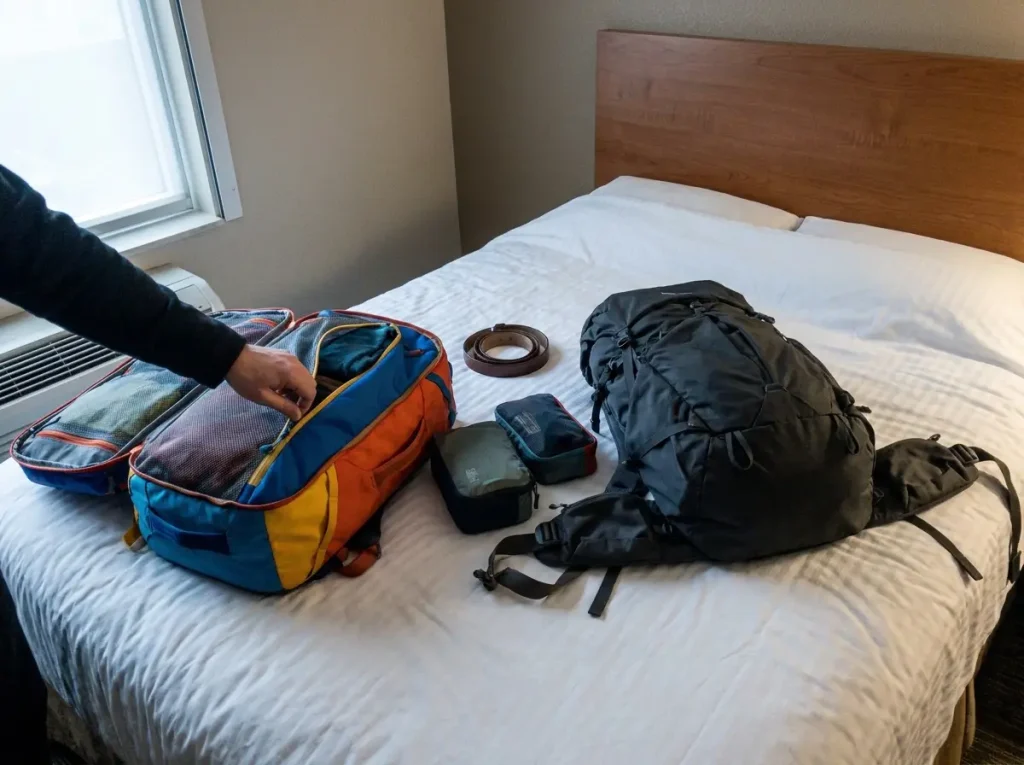
Packing cubes turn a single-compartment harness pack into an organized one for about fifteen dollars. If you already cube your clothes, you don’t have to pay extra for a bag with built-in dividers. Buy the suspension you need and add the organization yourself.
Best Travel Backpacking Packs With a Real Harness
These are the picks for anyone who answered yes, I’ll walk distance loaded. They earn their keep on the climb from the train station, not just in the overhead bin.
Best Overall — Osprey Farpoint 40 and Fairview 40
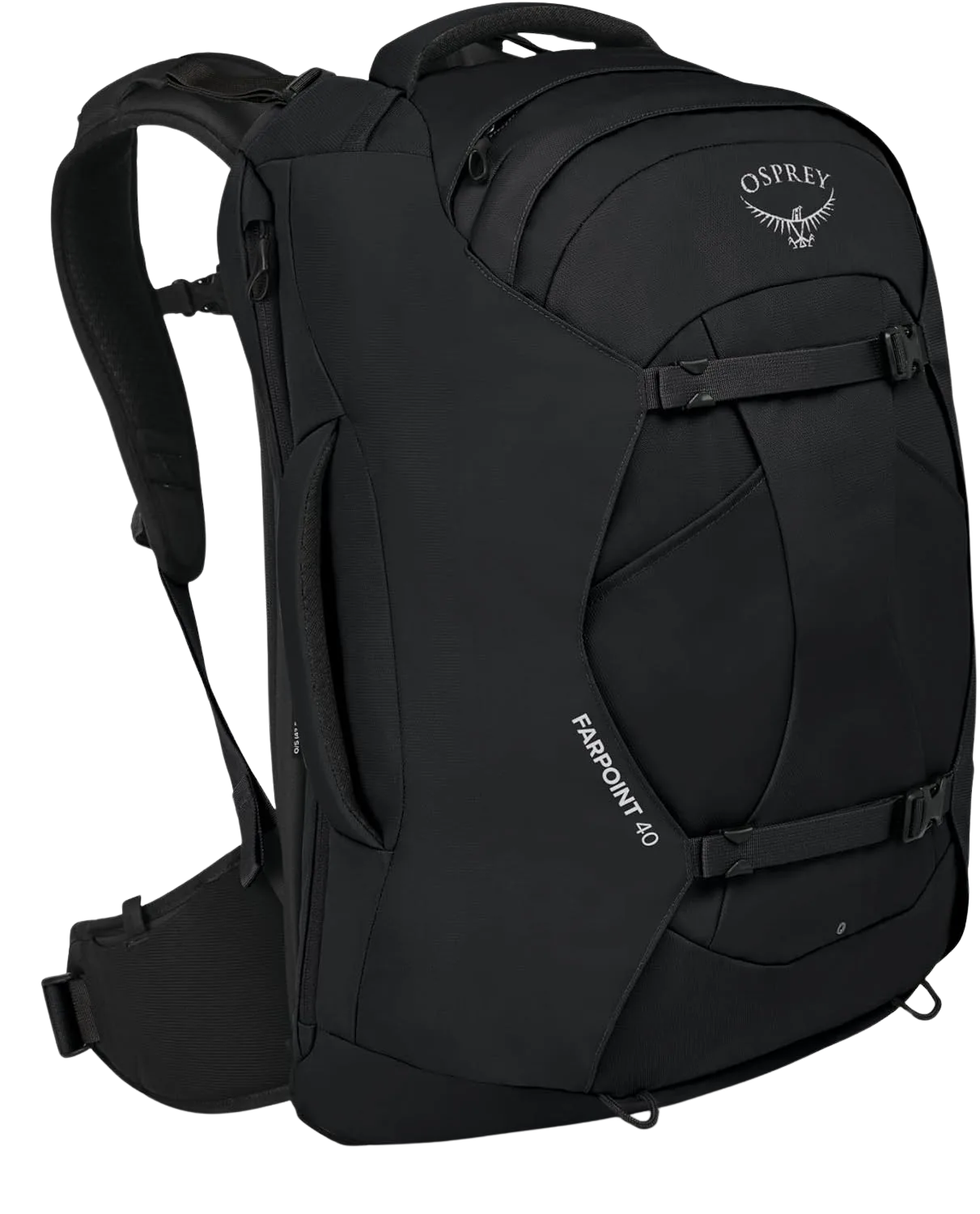
If you only look at one pack here, make it this one. The Farpoint 40 hits a sweet spot almost nothing else reaches: it packs flat through a wraparound zipper, holds 40 liters of one-week load, and carries a genuine adjustable harness with a hip belt that bears weight instead of just hugging you. When you’re done walking, the whole back panel and belt tuck behind a zippered flap so nothing snags on a baggage belt. The 450D shell isn’t the toughest fabric in this roundup, but it shrugs off normal travel abuse and keeps the weight reasonable.
The women’s Fairview 40 isn’t a marketing variant. The harness is built on a shorter torso range and the shoulder straps and hip belt are shaped differently, which matters more than people expect once a pack is loaded. If you’re between fits, our breakdown of women’s-specific pack fit explains why the geometry, not the size label, is what stops a pack from digging in. Either way, this is the pack I’d hand a first-time one-bagger who isn’t sure yet whether they’ll hike with it.
Best for Outdoor Travel — Osprey Sojourn Porter 46L
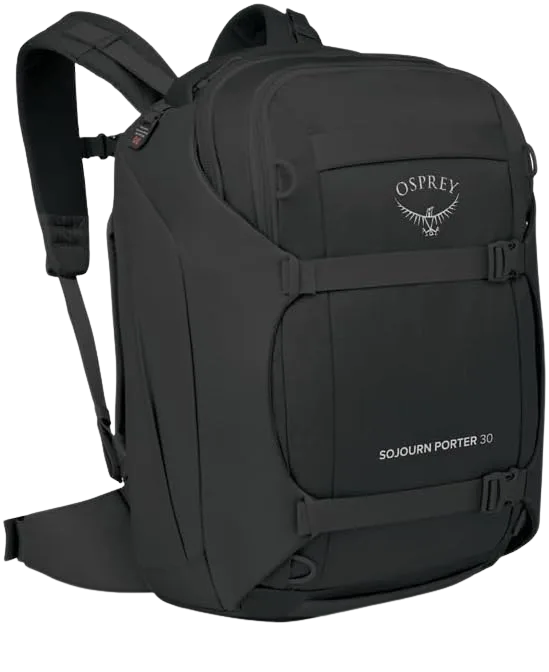
Pick the Sojourn over the Farpoint when your trips lean toward the outdoors and you actually want the extra six liters. The compression system is the difference. A travel pack stuffed loosely sways when you walk, and that sway is what wrecks your shoulders over a long day. The WingJacket cinches the load flat and high so the pack moves with you. The honest catch is the volume. At 46 liters it sits right at the line where strict carriers start measuring hard, so if you mostly fly budget European routes, the Farpoint or a 35L is the safer bet.
Best Clamshell Organizers and Specialty Picks
Once you’ve accepted you’re a clamshell traveler, the choice stops being about the harness and starts being about how you pack, how rough your luggage gets handled, and where you’re sleeping. These four each win a specific use case.
Best Organization — Cotopaxi Allpa 35L
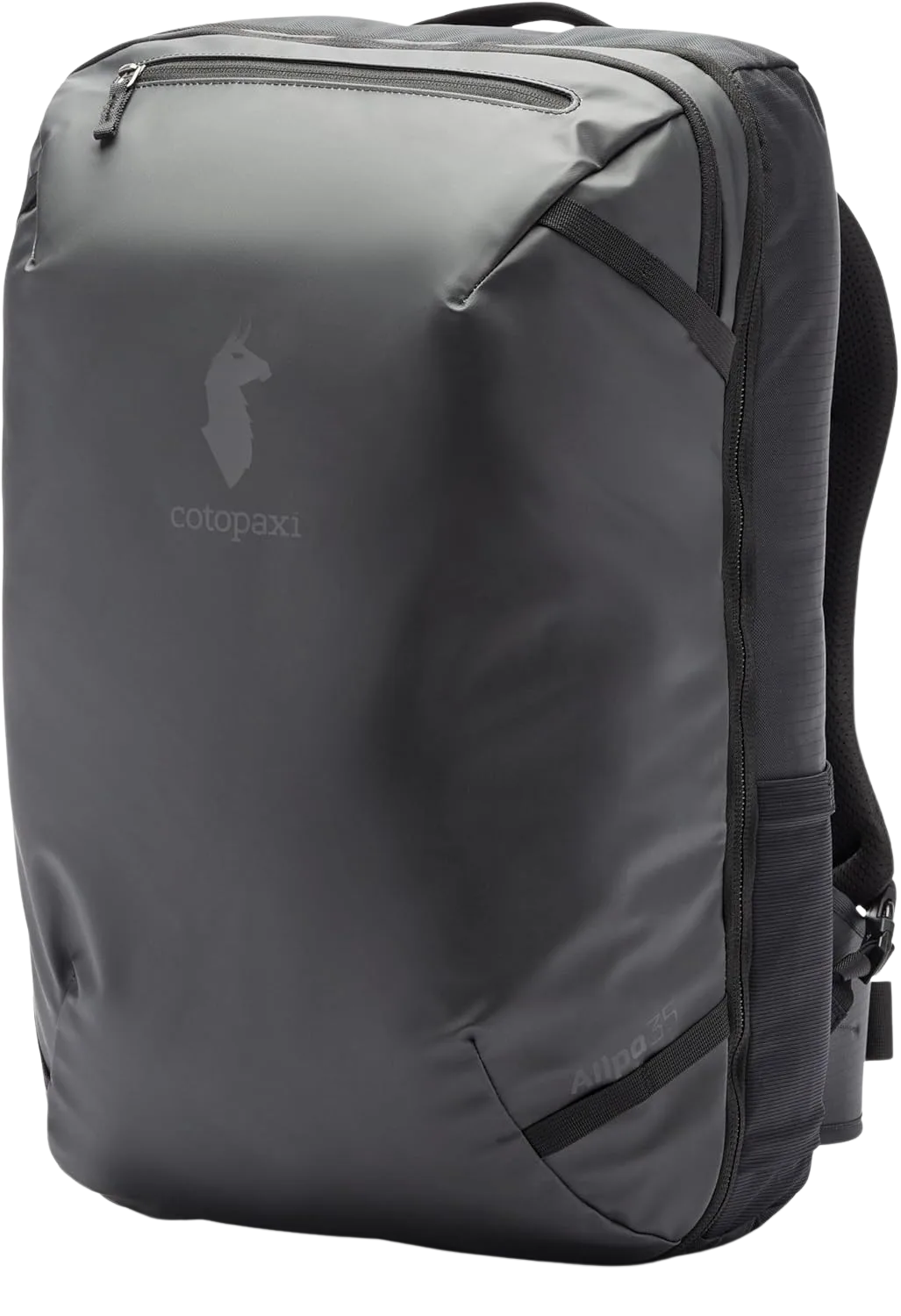
The Allpa is what you buy when you hate digging. Its clamshell splits into two mesh-covered halves so you can pack like a dresser and actually find things three countries later. The 35-liter size is a quiet advantage too, because it slips under the strictest carry-on rules where a stuffed 40 gets a second look. You pay for all of it in weight, roughly a pound over the Farpoint, and the hip belt is comfort padding rather than real load transfer. For a traveler who packs heavy with structure and never walks far, that’s an easy trade.
Best Convertible — Thule Subterra 2 Convertible 40L
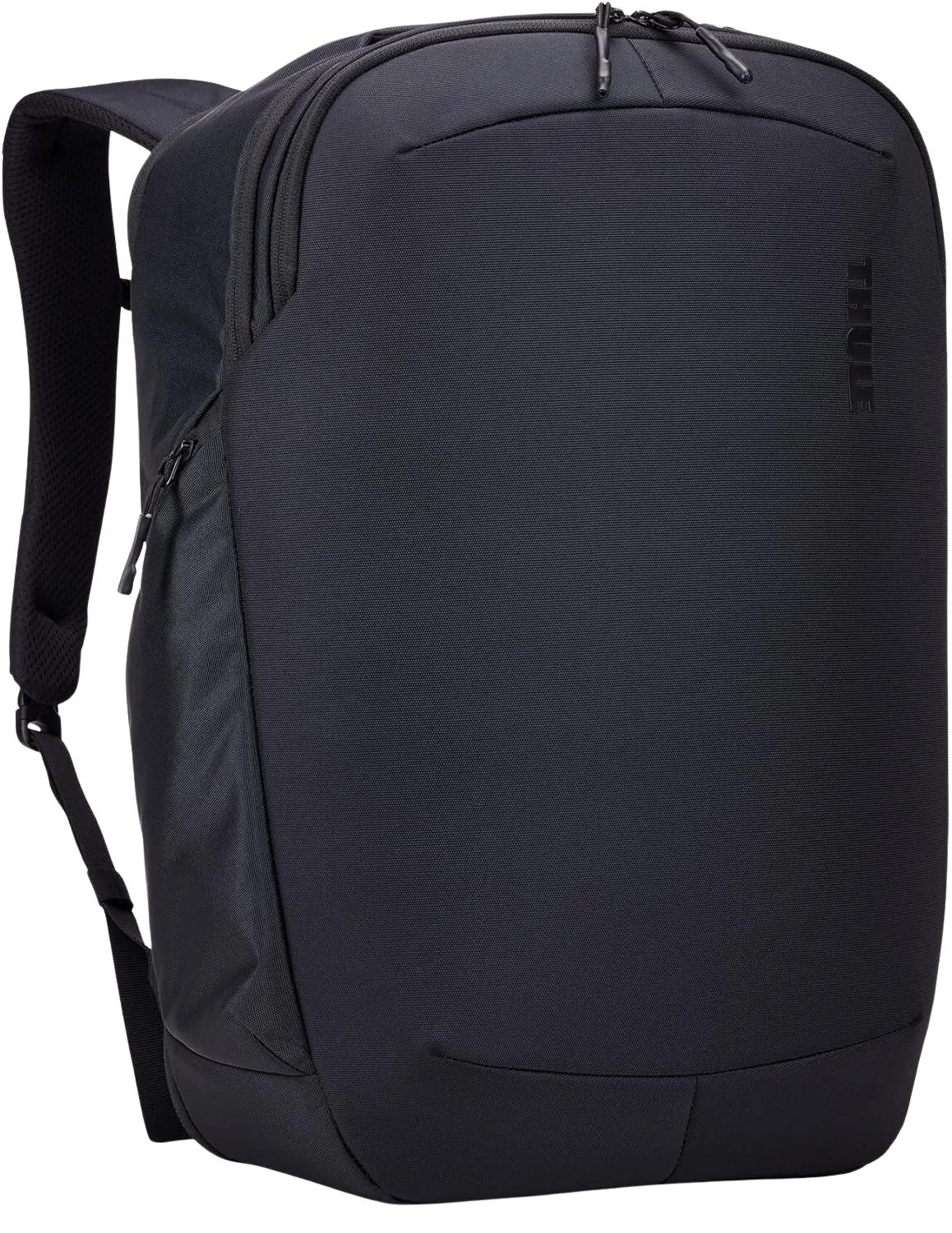
The Subterra 2 is the one bag that doesn’t make you look like you’re heading to a trailhead when you walk into a client meeting. The detachable attaché is the real trick, because it lets you leave the big pack at the hotel and carry just the laptop and notebook to the office. The 800D nylon is a step tougher than the Farpoint’s shell, and the fold-flat divider keeps clothes and work gear from blending into one pile. It’s not a hiking bag, and it doesn’t pretend to be.
Best Durability — Topo Designs Global Travel Bag 40L
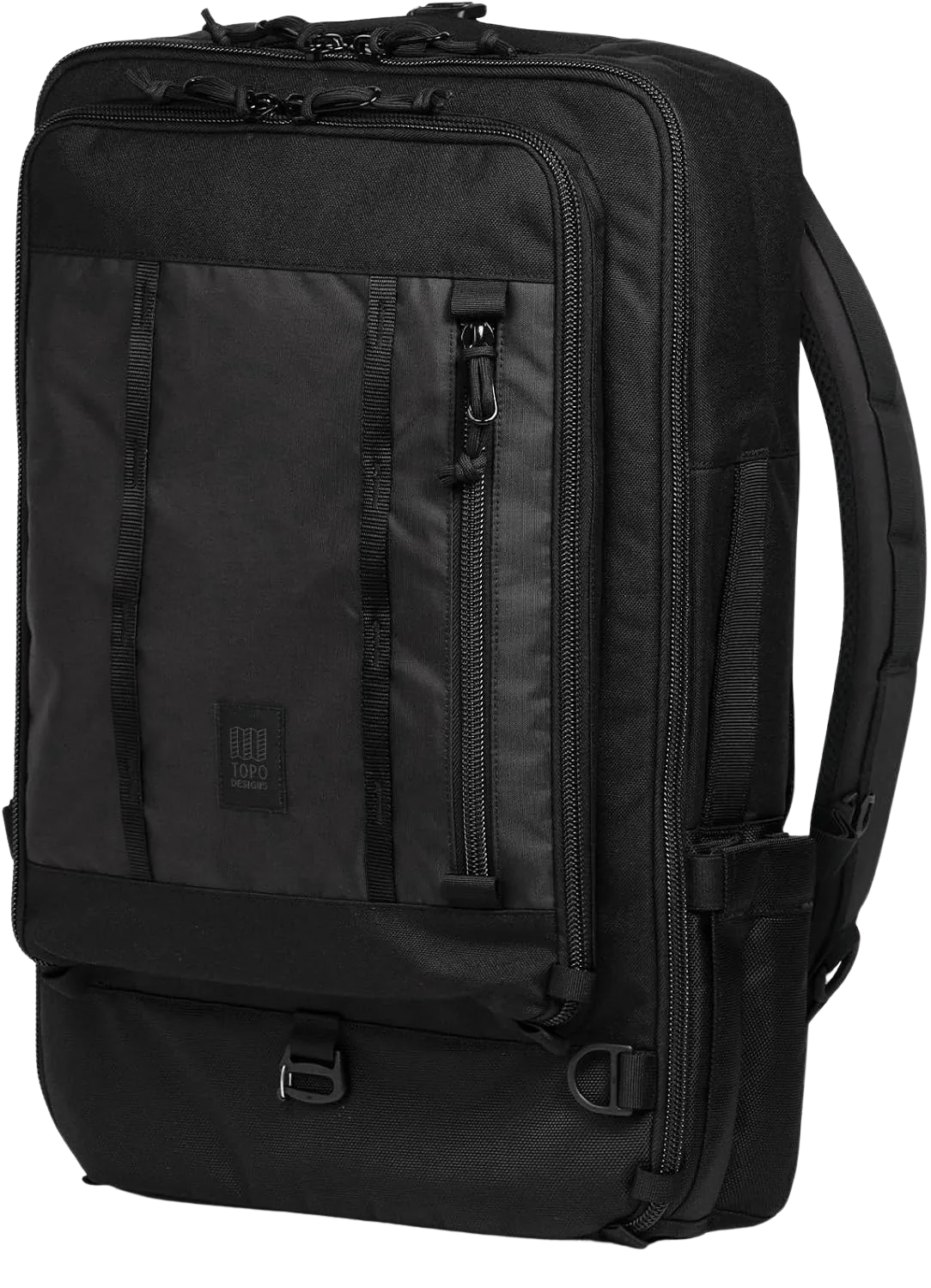
If your bag tends to come off the carousel looking like it lost a fight, the Topo Global is the answer. That 1000D and 1680D rating is denier, the thread-count shorthand for how tough a fabric is, and ballistic nylon at that weight is the same family that survives years of abuse on the toughest packs. It outlasts the lighter ripstop and Cordura shells most travel bags use, and Topo’s lifetime warranty means a blown seam isn’t your problem. You feel the weight penalty when you lift it empty, and a real load-transferring harness still isn’t part of the deal. But for durability per dollar, nothing else here touches it.
Best Anti-Theft — Pacsafe Venturesafe EXP45
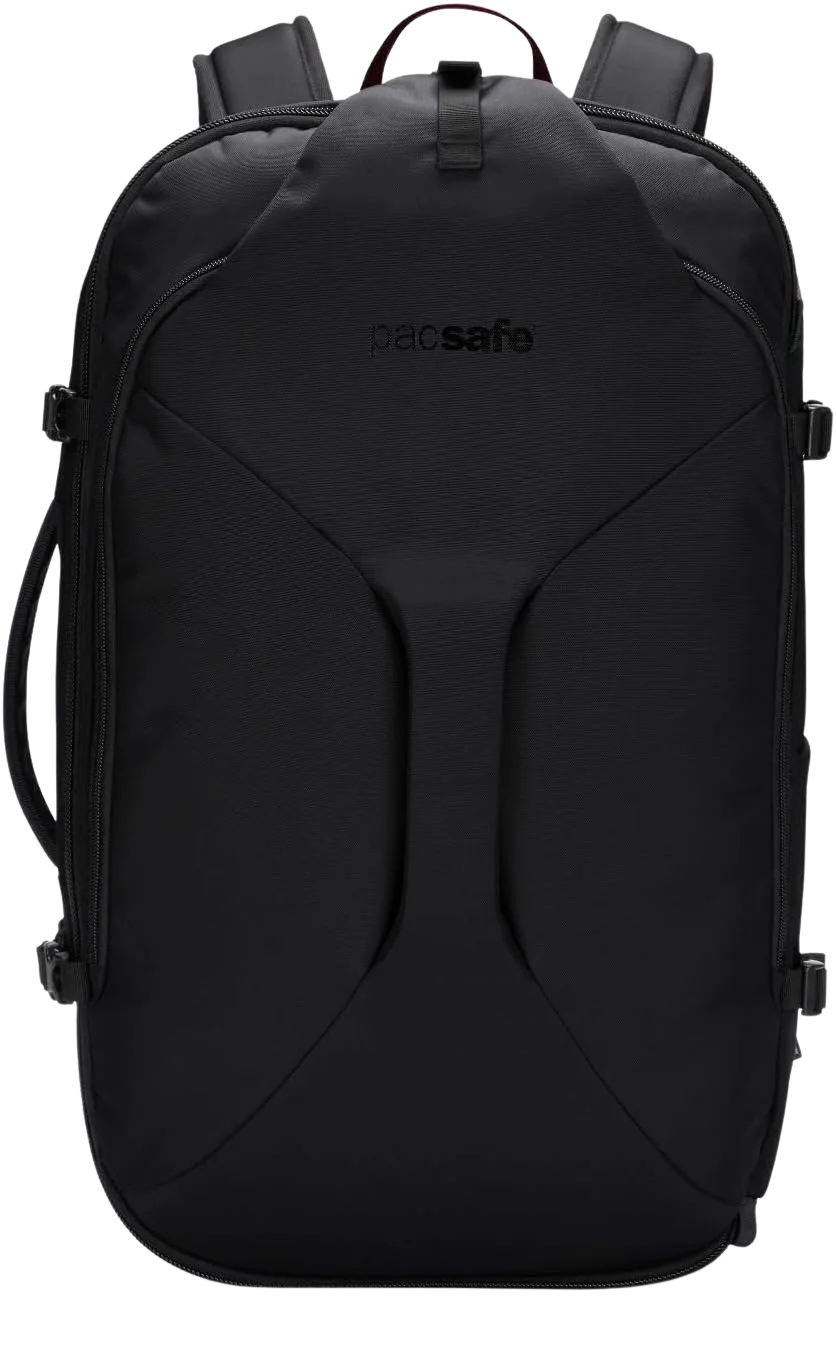
The Venturesafe is for the traveler whose itinerary involves crowded markets, night buses, and shared dorm rooms. The eXomesh is a flexible stainless mesh built into the fabric, so a thief with a blade gets nowhere fast, the locking zippers turn the bag into something you can actually leave on a hostel bunk, and an RFID-blocking pocket keeps your cards from being skimmed in a crowd. None of that is free. The security hardware makes the pack stiffer and heavier than a comparable plain bag, and you don’t need any of it on a hotel-to-conference trip. Match it to where you’re going, not to fear.
Best Budget Travel Backpacking Packs and What You Give Up
This isn’t gear snobbery. It’s a straight answer to “can I just grab the cheap one?” Sometimes the cheap one is genuinely the right call. Here’s exactly who it’s for and where it cuts corners.
Best Budget — Hynes Eagle Travel Backpack 40L
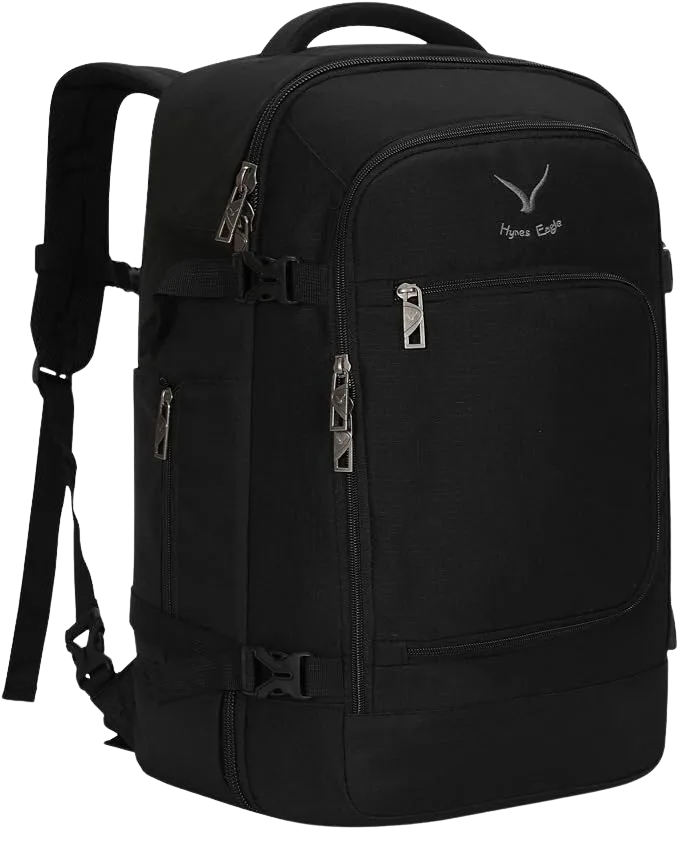
The Hynes Eagle proves you don’t need to spend big to get a working carry-on. It nails the fundamentals: a flat-opening clamshell, true 40-liter volume, and a size that boards without an argument. What you give up shows up over time. The zippers are the first failure point on any budget pack, the strap padding is thinner, and the hip belt is decoration. Those zipper and buckle failures are exactly the signs that tell you a pack is done, so expect a shorter lifespan. For three or four trips a year, it’s a smart buy, not a compromise.
Best Value Budget — MATEIN Carry On Backpack 40L
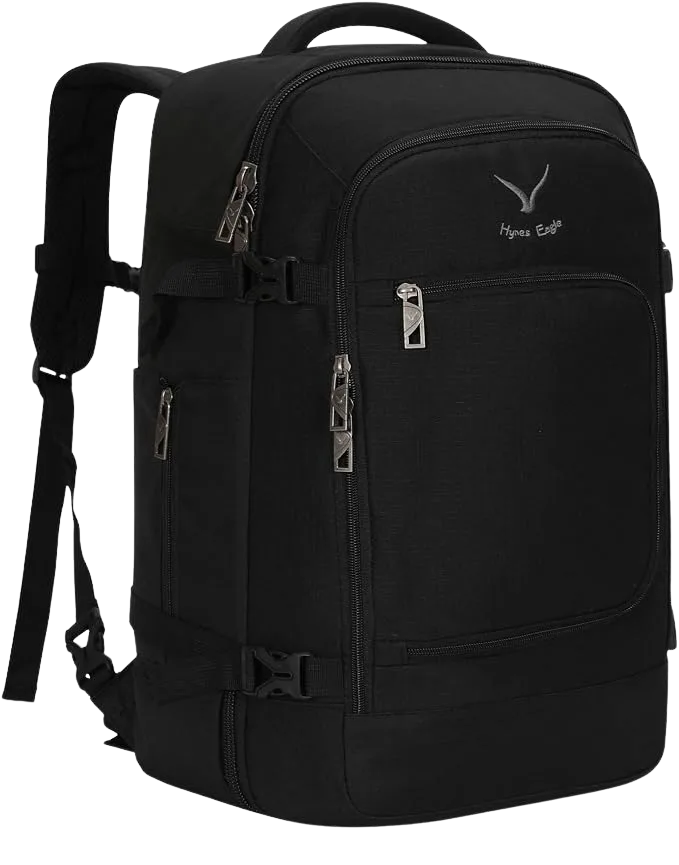
The MATEIN does everything the Hynes does and adds an expansion zipper, which is the feature you’ll quietly appreciate on the flight home when the souvenirs don’t fit. Its organization is a notch better, with more structured pockets that keep a one-bag setup from collapsing into chaos. The trade-offs are identical to any sub-$50 pack: lighter-duty zippers, modest strap padding, and no real load transfer. If you’re choosing between the two budget picks, the expandable MATEIN is the one I’d point most people toward.
Carry-On Rules That Actually Decide If Your Bag Flies

Here’s the moment every one-bagger dreads. Your bag fits the sizer empty, but stuffed it won’t drop into the bin frame on a regional jet, and now you’re doing the walk back to gate-check while everyone watches. Almost all of that is avoidable once you understand what the rules really are.
The rule is the floor, the bin is the ceiling
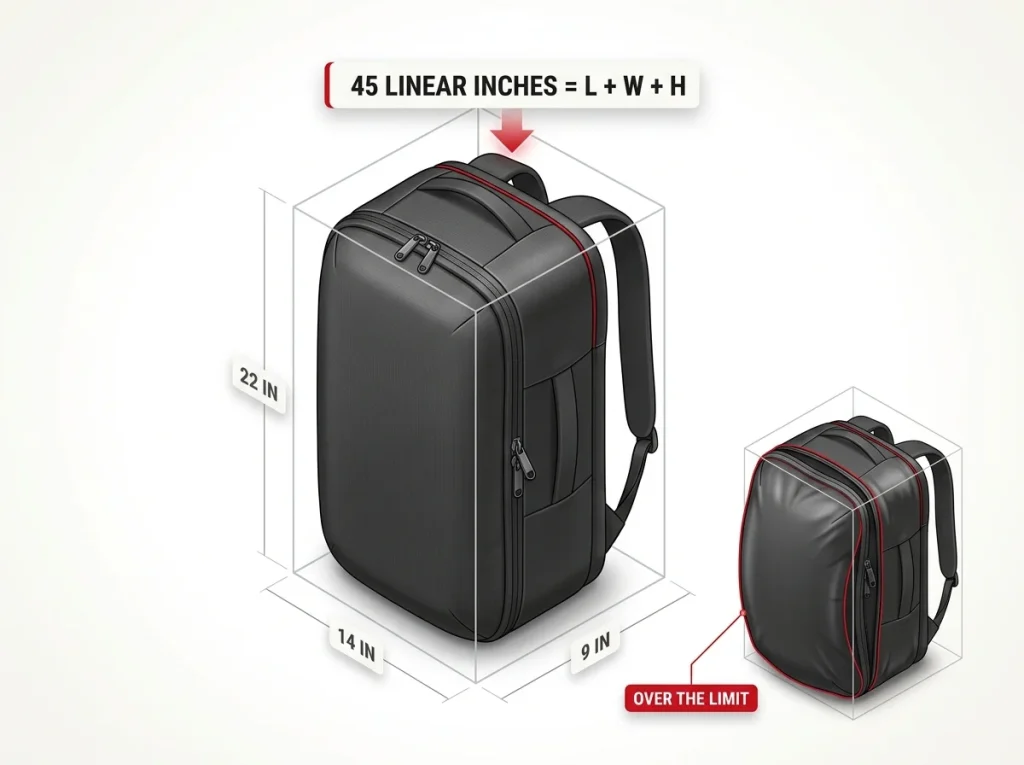
The universal carry-on floor is 45 linear inches, which is length plus width plus height, usually written as the IATA-recommended 22 by 14 by 9 inches. The number that actually flies, though, is whatever fits the overhead bin in front of you, and regional jets have noticeably smaller bins. A “carry-on approved” 40-liter pack can still get gate-checked on a small plane. The fix is simple and almost nobody does it: measure your loaded pack, not the empty spec-sheet shape, because a stuffed bag bulges past flush.
Weight stops you before volume does
This one catches travelers off guard. Many European, Asian, and budget carriers now cap free carry-on weight at around 7 kilograms, which is roughly 15 pounds, down from 10 kg a few years ago. A stuffed 40-liter pack clears 15 pounds without trying, so on those airlines you’ll pay a fee or check the bag no matter how well it fits the sizer. Shaving the pack’s own empty weight matters here, which is one reason a lighter shell or even an ultralight backpack can buy you headroom under the cap.
Security layout that gets you through fast
Your pocket plan decides how smooth security goes. Liquids follow the TSA’s 3-1-1 liquids rule: containers of 3.4 ounces or less, all in one quart-size bag. Laptops larger than a phone come out into their own bin at older checkpoints, per TSA’s electronics-screening guidance for laptops, unless the airport has the newer scanners. A bag that lets you reach both without unpacking the main compartment is what makes a pack genuinely TSA-friendly, the difference between a ten-second stop and holding up the line.
Keep your liquids bag and laptop in an outside-access pocket, not buried in the main compartment. You’ll clear the belt without dumping your whole pack into a gray bin, and you’ll never be the person blocking the line while you repack on the floor.
How to Size It and 35L vs 40L vs 45L
Liters are the number everyone shops by and the number that means the least until you tie it to your trip and your airline. Here’s how the three common sizes actually behave.
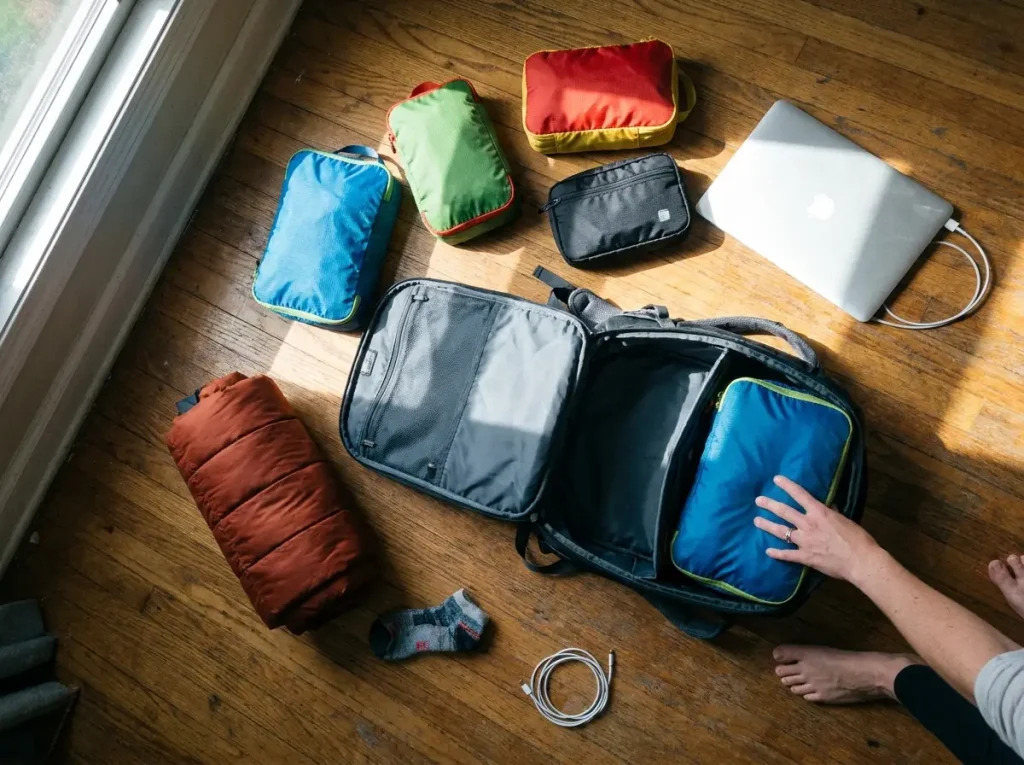
The 35, 40, and 45 sweet spots
A 40-liter bag at 22 by 14 by 9 inches works out to roughly 45 liters of real usable volume, and that gap between the advertised liters and the true volume you can actually fill is worth watching on clamshells, where dividers eat space. Still, 40L is the genuine one-week sweet spot: clothes, electronics, and toiletries with room to close it. Drop to 35 liters and you’re packing tight but moving fast through every gate. Go to 45 and you’ve got the ceiling, great when you pack light, a gate-check gamble when you stuff it. If you want the longer logic on matching volume to trip length, our breakdown of how pack volume in liters maps to trip length carries it past the travel context.
Size down on purpose for strict carriers
There’s a counterintuitive move here. On strict or budget European carriers, the 35-liter pack is the smarter buy precisely because it’s smaller. It clears the sizer without scrutiny, and because it physically holds less, it keeps you under that 7-kilogram weight cap almost by accident. The Cotopaxi Allpa earned its spot partly for this reason. A traveler who only flies major U.S. routes can size up; a traveler on Ryanair and easyJet should size down.
Don’t forget the personal item
For short trips, or as the companion bag to a main pack, the under-seat personal item does more than people think. The Timbuk2 Never Check Expandable 27.5L (check it on Amazon) is a clean example: it fits under the seat as a personal item, then expands into a capable weekender when you need the extra room for a weekend trip. If you’re trying to figure out what a sub-30-liter bag really holds, our look at what a sub-30-liter daypack really holds breaks down the trade-offs at that size.
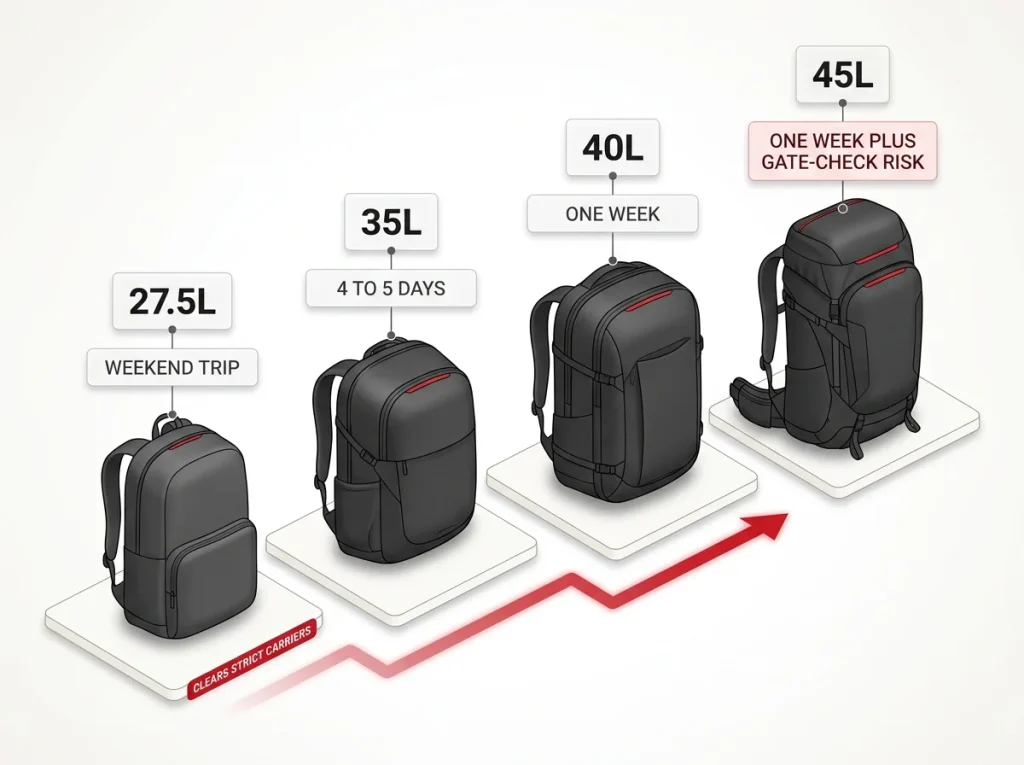
For strict or budget European carriers, size down to 35 liters on purpose. It clears the sizer and keeps you under the 7-kilogram weight cap without you having to think about it. A smaller bag you can’t overstuff is its own kind of insurance.
The Harness Truth and When Suspension Actually Matters
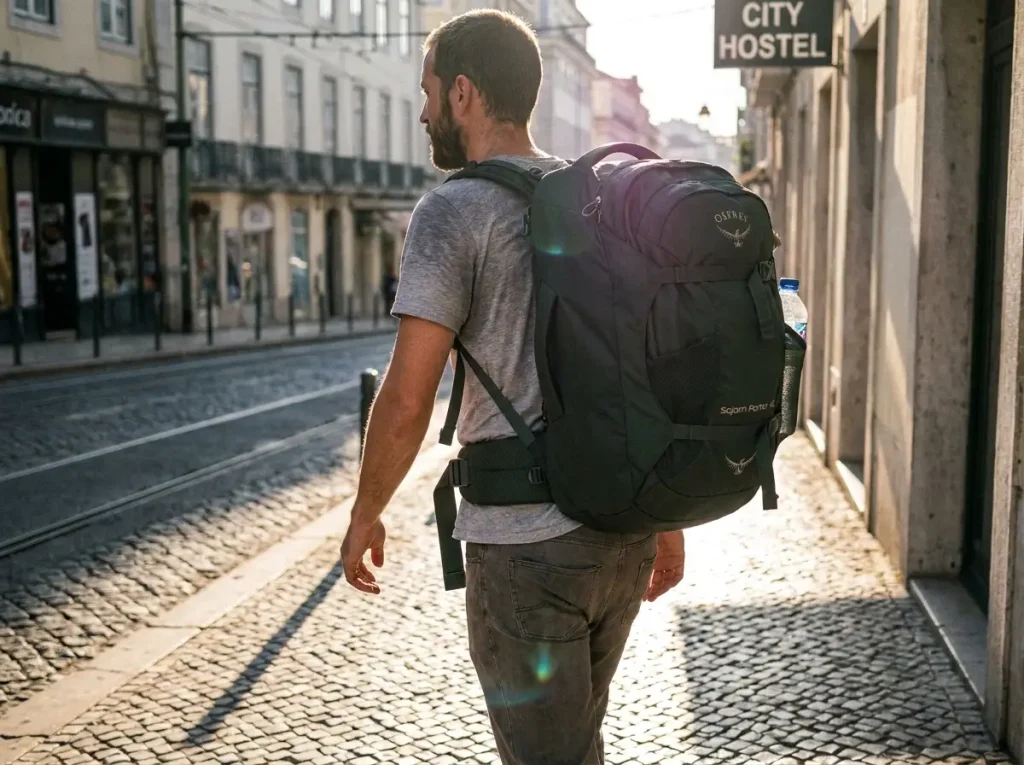
This is the honest version nobody selling you a pack says out loud: most travel-pack hip belts are decoration. And that’s completely fine, as long as you know what you’re loading.
The 25-pound threshold
Most travel packs ship a token hip belt that stops transferring real load past about 25 pounds. Below that weight, a soft comfort belt is genuinely all you need, and a clamshell with a padded waist strap will feel fine. Above it, you need a real system: an internal frame to give the load something to ride on, a hip belt sized to your torso length so it sits on your hip bones, and a sternum strap to keep the shoulder straps from splaying. A thin strip of foam can’t do any of that. That 25-pound line is the same one that separates framed from frameless packs, because it’s the point where load needs a structure to ride on. It’s not a marketing number, it’s where your body starts to notice.
Which packs actually carry
In this field, the packs with a real load-transferring harness are the Osprey Farpoint 40 and the Sojourn Porter 46L, full stop. Everything else here, the Allpa, the Topo, the Thule, and both budget picks, runs a decorative-to-moderate belt that’s fine under 25 pounds and overwhelmed above it. Understanding how a suspension system actually moves load to your hips makes the difference obvious once you’ve felt it. A loaded clamshell with no working belt sits high on your shoulders and traps heat against your back, and you’ll know within the first mile.
Don’t overpay for what you won’t load
Here’s the part that saves you money. If you never load past 25 pounds, you do not need a hiking harness on your travel bag, and paying for one is paying for weight and bulk you won’t use. The Allpa, the Topo, and the budget packs exist for exactly this traveler. Buy the harness only if you’ll actually walk distance with the bag heavy. Match the pack to the load, not to the spec sheet.
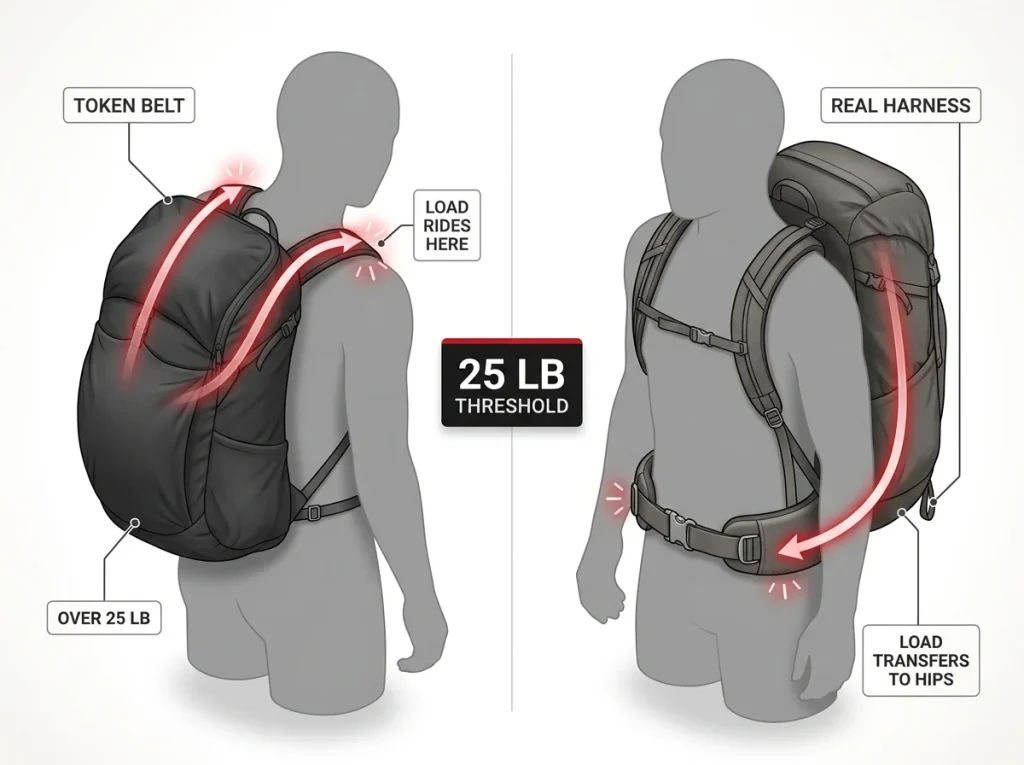
A real load-transferring harness only earns its weight past about 25 pounds. Under that, a comfy travel pack with a token belt is genuinely fine. Don’t overpay for suspension you’ll never actually load, and don’t under-buy if you know you’ll walk with it heavy.
Conclusion
Three things carry this whole decision. First, answer the harness question before you shop: will you walk distance with the bag loaded, or not? That single answer sends you to one half of this list or the other. Second, buy for your loaded, expanded dimensions and your strictest airline, never for the advertised liters on the tag. Third, the right premium pick is the one that matches how you actually travel, not the one ranked number one on a list that can’t even sell you the bag.
Before you buy anything, go measure the bag you already own, loaded, against 45 linear inches. Half the time you’ll find you already have the right size and just need to pack it smarter.
Frequently Asked Questions
01Is a 40L backpack enough for backpacking travel?
Yes, 40 liters is the genuine one-week sweet spot for travel, holding clothes, electronics, and toiletries while staying carry-on legal. It’s plenty for one-bag trips but tight for true wilderness backpacking, where you also carry shelter, sleep gear, and food.
02Is a 40L backpack a carry-on and will it fit the overhead bin?
Usually yes on major carriers, since a 40L pack fits the 45-linear-inch limit. But the overhead bin is the real ceiling, and a stuffed bag on a small regional jet can still get gate-checked. Measure it loaded, not empty.
03Can you use a backpacking pack as a travel pack?
You can, but it packs poorly for flights. A true backpacking pack top-loads and has a fixed, exposed harness that snags on baggage belts. A hybrid like the Osprey Farpoint 40 gives you a real harness that stows away, which is the better both-worlds answer.
04Should I get a backpack or a suitcase for travel?
Choose a backpack if your route has stairs, cobblestones, or long walks between stops, since wheels struggle there. Choose a suitcase for smooth airports and hotels where you never carry the load far. A clamshell travel pack gives you suitcase-style packing with backpack mobility.
05What is the best travel backpack for the money?
For occasional travelers, the expandable MATEIN 40L delivers a flight-legal clamshell with solid organization at a fraction of premium prices. You trade away zipper durability and real load transfer, but for three or four trips a year it’s genuinely enough.
Risk Disclaimer: Hiking, trekking, backpacking, and all related outdoor activities involve inherent
risks which may result in serious injury, illness, or death. The information provided on The Hiking Tribe is for
educational and informational purposes only. While we strive for accuracy, information on trails, gear, techniques,
and safety is not a substitute for your own best judgment and thorough preparation. Trail conditions, weather, and
other environmental factors change rapidly and may differ from what is described on this site. Always check with
official sources like park services for the most current alerts and conditions. Never undertake a hike beyond your
abilities and always be prepared for the unexpected. By using this website, you agree that you are solely
responsible for your own safety. Any reliance you place on our content is strictly at your own risk, and you assume
all liability for your actions and decisions in the outdoors. The Hiking Tribe and its authors will not be held
liable for any injury, damage, or loss sustained in connection with the use of the information herein.
Affiliate Disclosure: We are a participant in the Amazon Services LLC Associates Program, an
affiliate advertising program designed to provide a means for us to earn advertising fees by advertising and linking
to Amazon.com. As an Amazon Associate, we earn from qualifying purchases. We are also an official affiliate partner
of Black Diamond Equipment via the AvantLink network. If you click on a Black Diamond affiliate link and make a
purchase, we may earn a commission at no additional cost to you. We also participate in other affiliate programs and
may receive a commission on products purchased through our links. Additional terms are found in the terms of
service.