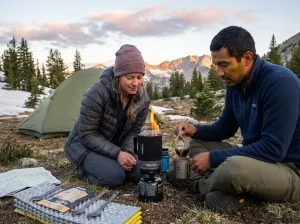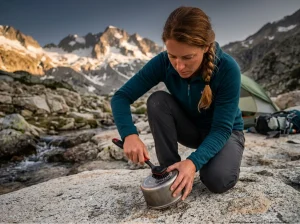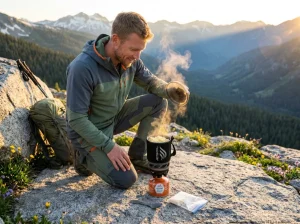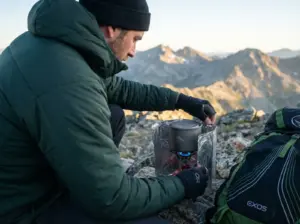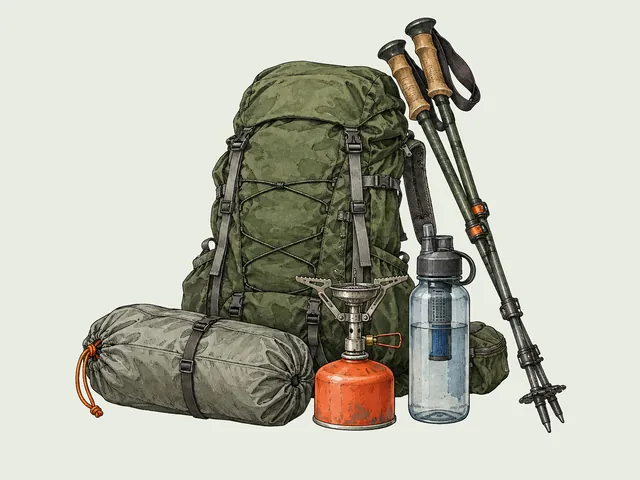
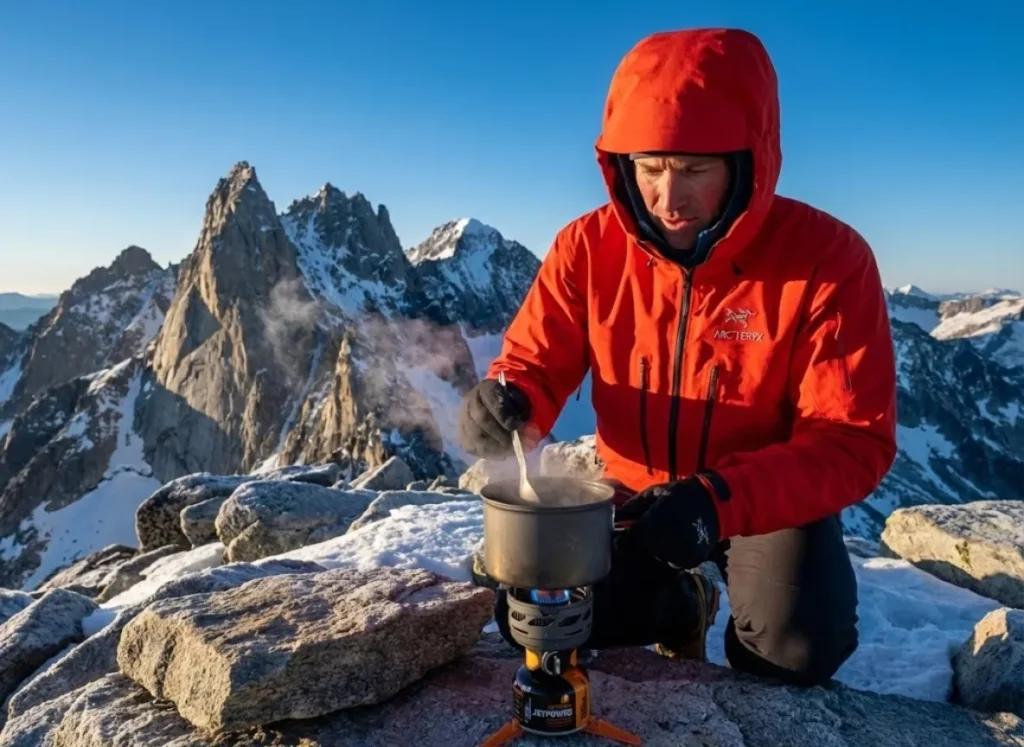
The wind on the Continental Divide screams at 40mph, stripping the heat from your canister stove faster than the burner can generate it. You watch the water bubble, assuming it’s ready, only to find your meal crunchy and your fuel gauge empty an hour later.
This isn’t a failure of gear; it is a failure of physics and thermodynamics.
In my two decades of guiding mountaineering expeditions and teaching wilderness survival, I’ve watched countless students blame their stoves for undercooked pasta at 10,000 ft (3,000m). They don’t realize that the rules have shifted under their feet. Mastering these high-altitude culinary arts requires looking past the “boil” and understanding the invisible mechanics of thin air.
In this guide, we will break down the atmospheric deficit that alters boiling points, the chemistry of Isopro fuel in freezing temps, and the field-tested passive cooking techniques that can cut your fuel weight in half.
The Physics of Thin Air: Why Intuition Fails
What happens to water pressure as we climb?
As you ascend from sea level, atmospheric pressure drops, allowing water to transition from liquid to gas with significantly less thermal energy. This means your water boils at lower temperatures, creating a deceptive visual cue that often leads to undercooked food.
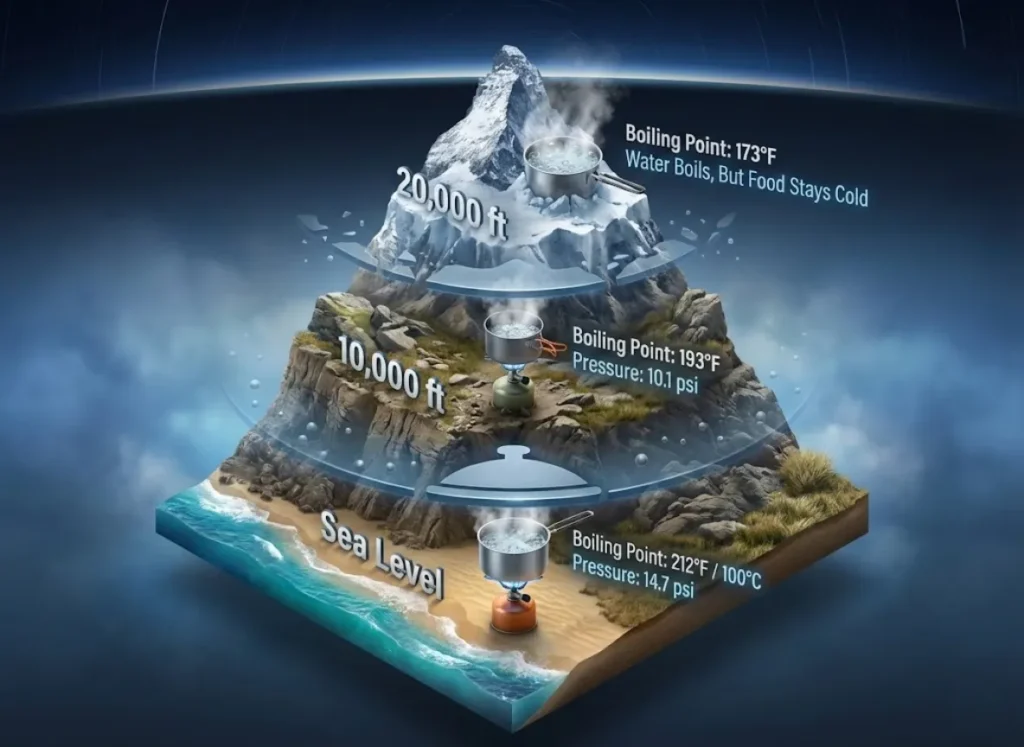
At sea level, the atmosphere exerts roughly 14.7 psi (1 bar or 29.92 inches of mercury) on the surface of your water. Think of this as a heavy “lid” keeping the molecules in liquid form. You need substantial heat (212°F / 100°C) to overcome that pressure and create steam.
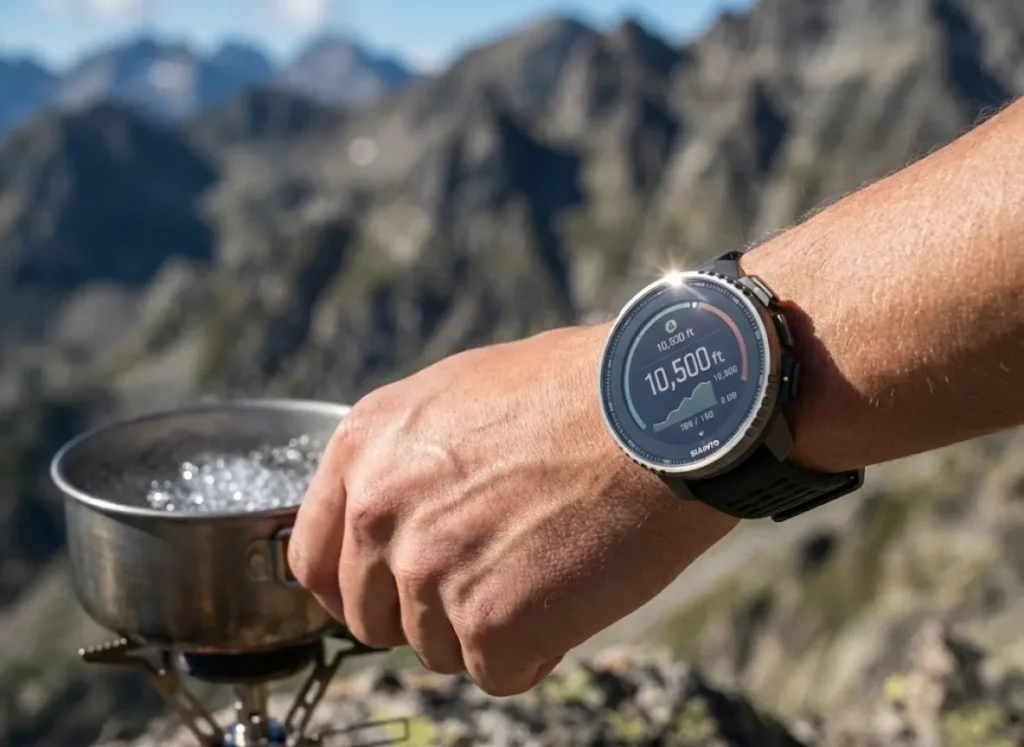
As we climb, that column of air shortens and thins. By the time you reach 10,000 ft in the Colorado Rockies, pressure drops to roughly 10.1 psi. With the “lid” looser, water molecules escape into vapor much easier.
This creates a predictable “Boiling Point Decay” roughly equivalent to a 1 degree F drop per 500ft. While you might expect a hot meal, water at 10,000 feet boils at roughly 193°F (89.8°C). If you push to 20,000 feet, it bubbles at a tepid 173°F (78°C).
The danger lies in relying on your eyes. A rolling boil at altitude indicates a phase change, not a specific cooking temperature. If you turn off the gas the moment you see bubbles, you are likely leaving pathogens alive and pasta hard.
Whether you are hiking at 3,000 ft (900m) or in the High Sierras at 7,500 ft (2,300m), the principle remains. Just as you must adapt your pace when understanding the science of altitude sickness, you must adapt your cooking time adjustment to the lower pressure environment.
If you don’t account for this temperature cap, you risk bacterial survival. Standard safe cooking adjustments for high altitudes usually mandate significantly longer heating times to compensate for the lower maximum temperature.
The Hydrocarbon Paradox: Cooking vs. Heating
Why does food take longer to cook if water boils faster?
Food takes longer to cook at altitude because the maximum temperature of liquid water is physically capped by the lower boiling point. Since chemical reactions slow down at lower temperatures, you must apply heat for a longer duration to achieve the same result.
Cooking is fundamentally a chemical process—specifically rehydration of grains and protein breakdown. The rate of these reactions is governed by the Arrhenius equation. Generally, for every 10°C drop in temperature, the reaction rate gets cut in half.
This creates a frustrating paradox for the hungry hiker. Your water boils faster (saving fuel initially), but your food cooks slower (draining fuel rapidly).
To cook rice at 10,000 feet (193°F) effectively, you might need 25% more cooking time or up to 2.0x the standard duration compared to sea level. The “Sensible Heat” required to reach a boil is lower, but the “Latent Heat” phase—the simmering—becomes a massive energy sink.
Without a strategy, this extended simmer time destroys fuel efficiency. When calculating your fuel load with the Trail Nutrition Matrix, you must factor in this “altitude tax,” or you risk carrying dead weight in the form of uncooked food.
How does cold weather induce “Canister Fade”?
Canister fade occurs when the propane in your fuel blend burns off first, or when ambient temperatures drop below the vapor pressure threshold of the remaining butane. This causes the stove’s internal pressure to collapse.
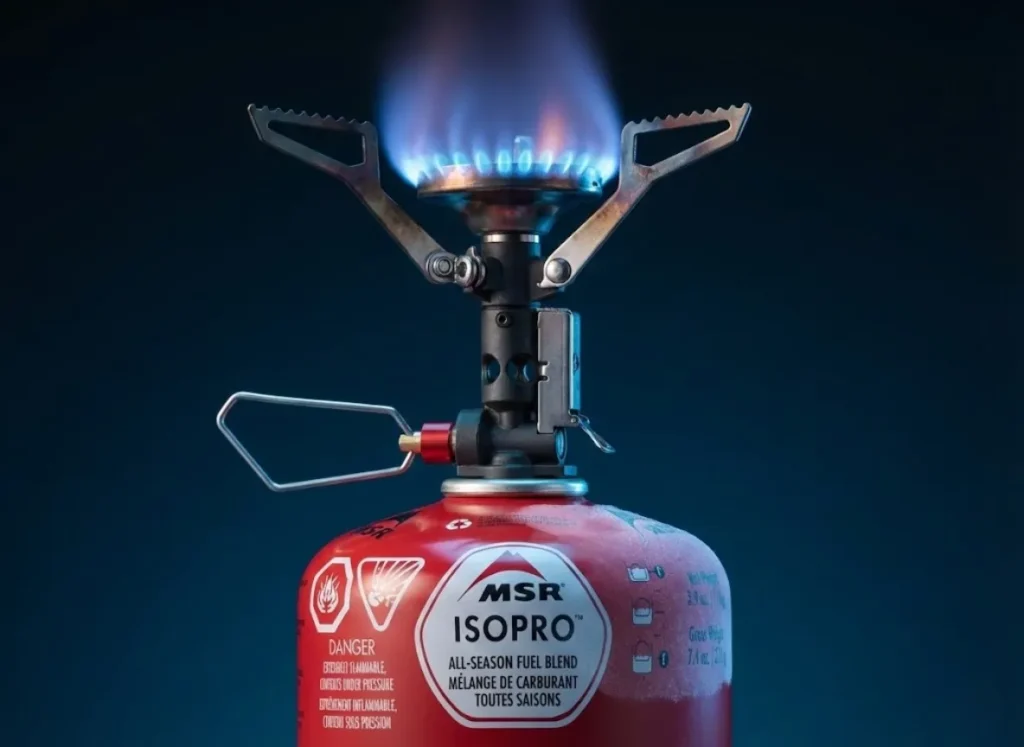
Canister stoves rarely use pure fuel; they use a cocktail of Propane (high pressure) and Isobutane/N-Butane. Propane is the hero, boiling at -44°F. N-Butane is the weak link, refusing to vaporize below 31°F.
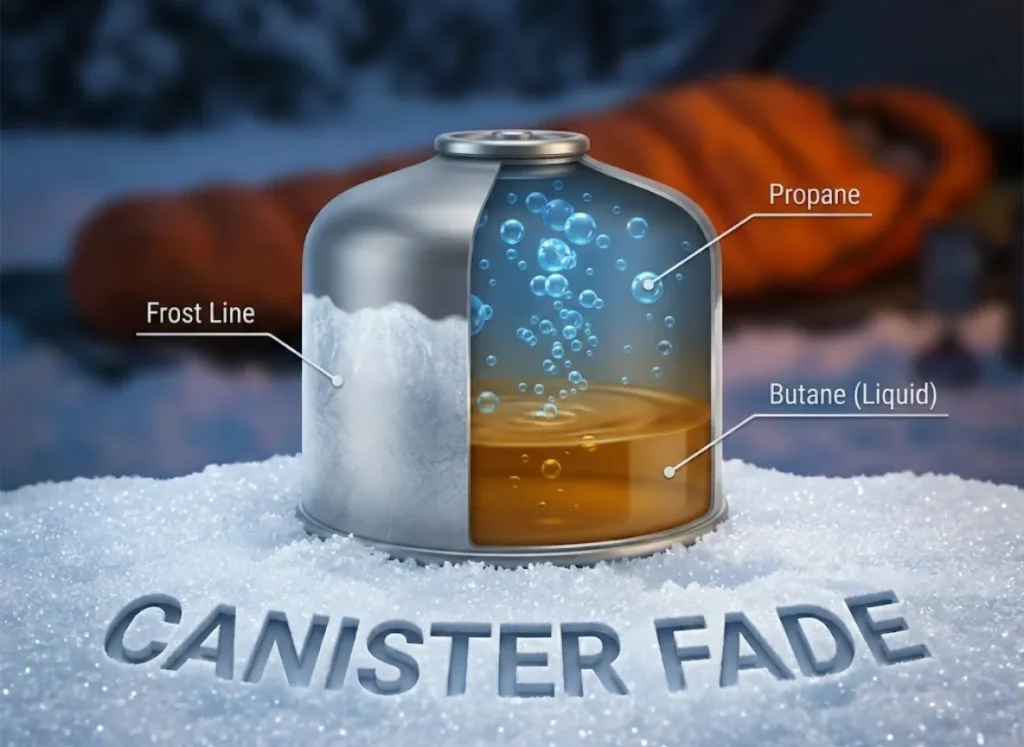
In the cold, a phenomenon called fractional distillation occurs. The Propane burns off first because it has a higher vapor pressure. You might be left with a canister that sounds half-full when shaken, but contains only liquid N-Butane that sits sluggishly in the bottom, refusing to turn into gas.
Pro-Tip: Keep your fuel canister warm before use. Sleep with it in your sleeping bag or keep it inside your jacket pocket while setting up camp. A warm canister maintains higher internal pressure, ensuring a strong flame even in freezing ambient air.
To combat this, gear selection is critical. Regulated stoves or inverted canister systems force liquid fuel to the burner, maintaining pressure better than standard upright stoves. For extreme cold (below 15°F), liquid-fuel stoves like the MSR XGK EX remain the gold standard, as discussed when analyzing trail-ready LP camp stoves.
However, even the best stove struggles if you are melting snow due to ambient heat loss. For reliable pathogen destruction in these conditions, referencing CDC guidelines on water disinfection highlights why maintaining a strong boil—or switching to chemical/mechanical treatment—is vital when fuel is scarce.
The Efficiency Revolution: Passive Cooking & Safety
Is a rolling boil actually necessary for safe water?
No. Pasteurization is a function of heat and time, not just boiling. Water temperatures above 149°F (65°C) kill enteric pathogens like Giardia, Cryptosporidium, and Salmonella efficiently. This means a rolling boil at high altitude is technically “overkill” for safety.
The 3-minute boil rule is a simplified guideline designed to be foolproof, recommended by agencies like the WHO and CDC for general travelers. It works because if the water is boiling, it is definitely hot enough to handle threats like Botulism spores or viruses. However, it is energetically expensive.
According to data on Giardia inactivation temperature thresholds, pathogens die rapidly once water exceeds 160°F. Since water at 10,000 feet boils at 193°F, simply reaching the onset of bubbles provides a massive safety buffer.
You can save significant fuel by using a WAPI (Water Pasteurization Indicator) or an instant-read food thermometer. This small tube contains a wax that melts at 149°F, signaling the water is safe to drink. Stopping here saves the massive energy required to bridge the gap from 150°F to a rolling boil.
Of course, if you prefer not to use heat for safety at all, choosing a water filter or purifier that protects against viruses is the most fuel-efficient method of all.
How does the “Cozy Method” reduce fuel weight?
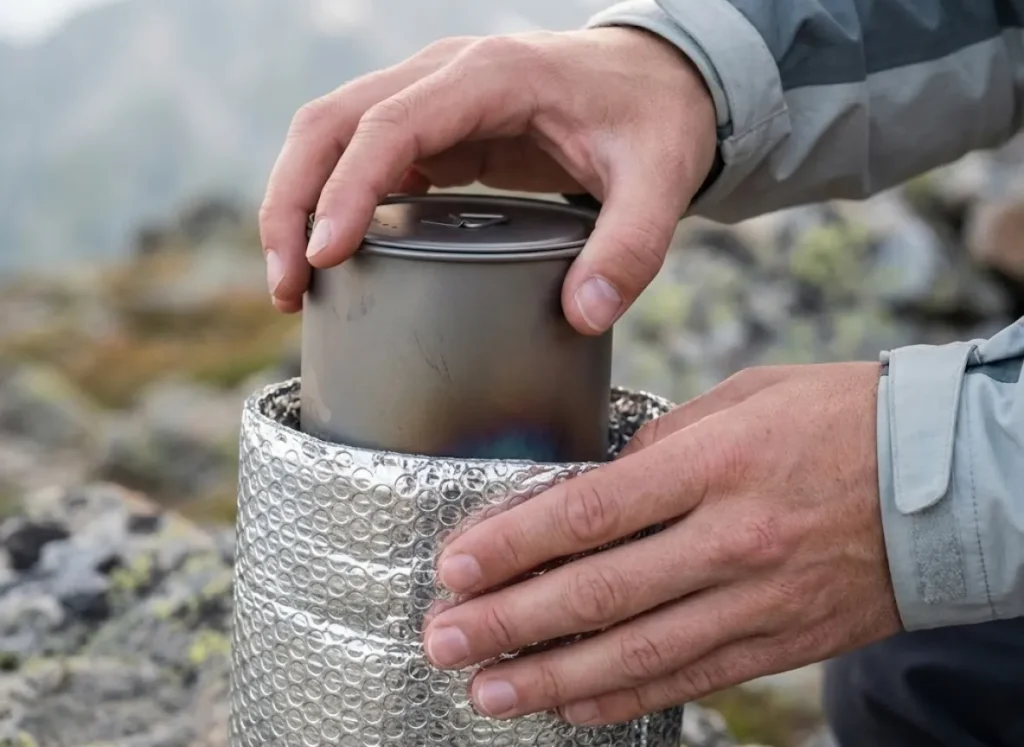
The “Cozy Method” utilizes thermal retention to continue cooking food after the stove is turned off. By placing your pot in an insulated sleeve, you trap the heat. This allows the food to hydrate and cook using passive rehydration without consuming additional fuel.
The process is simple:
- Bring water to a boil.
- Add your food (ideal for Just-add-hot-water Mountain House meals or bulk pasta).
- Boil for 60 seconds to ensure the pot and contents are up to temp.
- Turn off the stove and immediately place the pot into a Reflectix or foam cozy.
In a cozy, water that starts at 200°F might only drop to 180°F over 20 minutes. This stays well within the cooking range for rice, quinoa, and pasta.
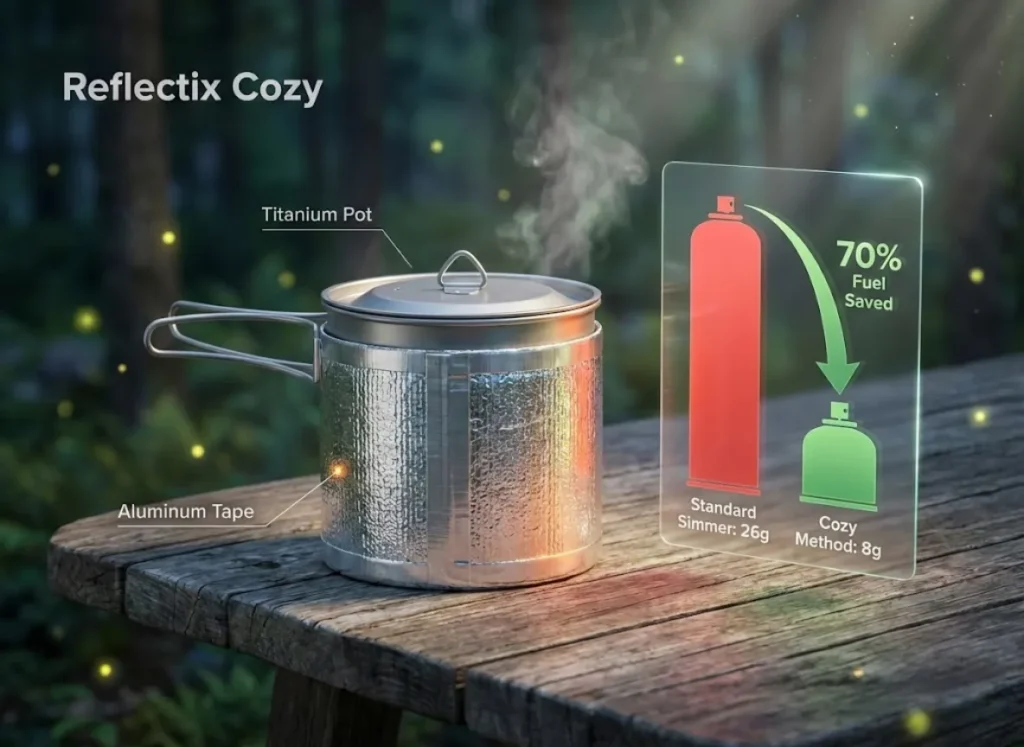
Let’s look at the “Rice Test” calculation based on gram-weight estimates:
- Standard Simmer: 3 mins boil + 20 mins simmer = ~26g fuel.
- Passive Cozy: 3 mins boil + 1 min active cook + 20 mins rest = ~8g fuel.
This represents a nearly 70% reduction in fuel consumption. For hikers interested in even more radical efficiency, mastering cold soaking recipes eliminates the stove entirely. However, the cozy cooking method offers a happy medium: a hot meal with minimal fuel cost.
Pro-Tip: If cooking dense foods like brown rice or beans at altitude, soak them in your water bottle for 30–60 minutes before you start cooking. This softens the outer shell and reduces the thermal energy needed to cook the center.
Final Thoughts
Cooking at altitude is a negotiation with physics. The air is thinner, the water is cooler, and the fuel is temperamental.
By accepting that water boils at roughly 193°F at 10,000 feet, you can adjust your cooking methods accordingly. By understanding canister fade, you can keep your fuel warm and functional. And by embracing passive cooking with a simple pot cozy, you can cut your fuel consumption by nearly 70%, lightening your pack and ensuring you never end a day with crunch rice and a sputtering stove.
Before your next ascent, test your system. Boil a liter of water, measure the temperature, and try a “cozy cook” meal in the safety of your kitchen.
FAQ – Frequently Asked Questions about Efficient Elevation Cooking
Does water boil faster at high altitude?
Yes, water boils faster because the lower atmospheric pressure requires less heat energy to turn liquid into vapor. However, because the water is physically cooler at the boiling point, it is less effective at cooking food.
Is boiling water at 10,000 feet safe to drink?
Yes, absolutely. Water boils at approximately 193°F (90°C) at 10,000 feet, which is significantly higher than the 149°F (65°C) required to kill common pathogens like Giardia and E. coli.
How much extra fuel should I carry for high-altitude hiking?
A good rule of thumb is to calculate your sea-level fuel needs and multiply by 1.5x for summer alpine trips, or 2.5x if you are melting snow for water.
Why does my canister stove sputter in the cold?
This is usually due to the propane burning off first (fractional distillation) or the ambient temperature dropping below the vaporization point of the butane fuel, causing the pressure inside the canister to plummet.
I've spent more than a decade researching hiking gear and trail technique. I read the specs, the forum threads and the long-term reviews, and every pick here comes with what it gets wrong.
End of the trail
You read every mile of this one. Here's where the trail goes next.