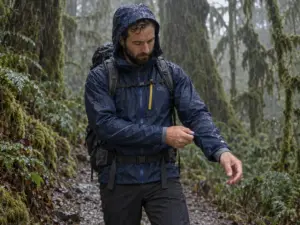
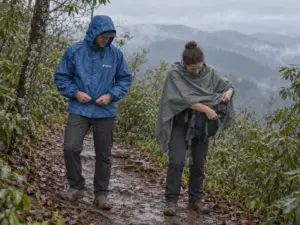
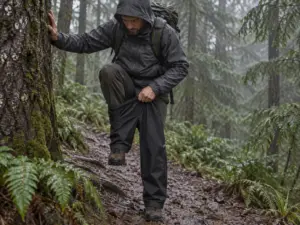

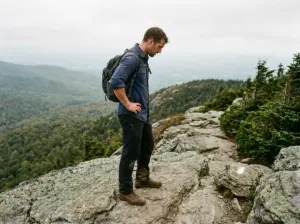
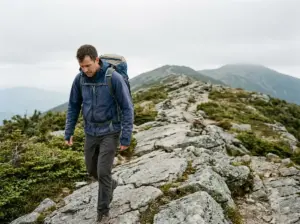

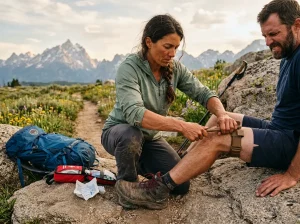
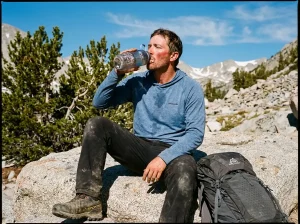
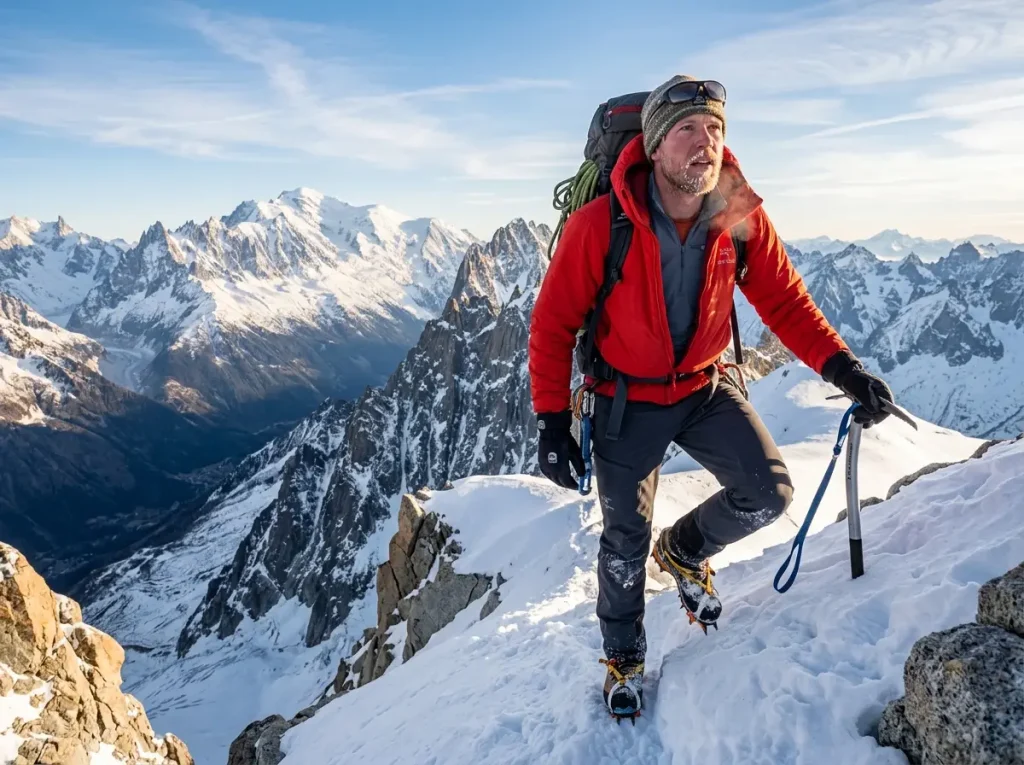
You stopped on the col to refuel. Twenty minutes — not even long. But by the time you shouldered the pack again, the back of your base layer was soaked through and already going cold. You had a $400 Gore-Tex hardshell on. Bone dry on the outside. Wet enough inside to start shivering at 38°F air. That’s not hypothermia folklore — that’s what happens when a 0 CFM membrane meets a body generating serious metabolic heat at 11,000 feet.
Most people buying winter pants think the question is how much rain they can handle. The right question is how much sweat.
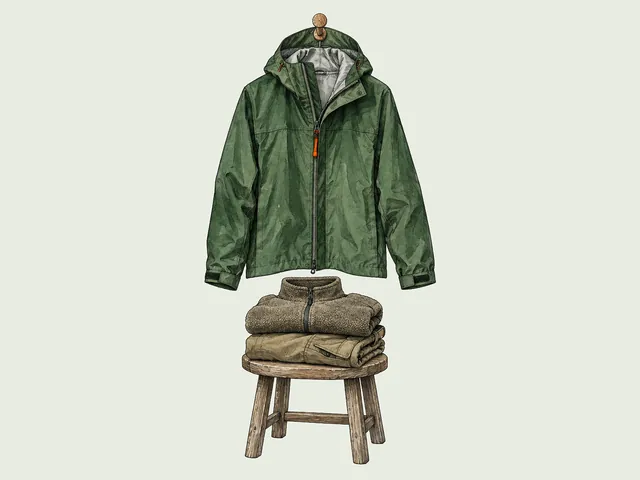
⚡ Quick Answer: For high-output winter hiking — snowshoeing, peak bagging, steep ascents — a softshell with 1–5 CFM air permeability outperforms a hardshell in real conditions. Hardshells block external moisture but trap internal condensation, leading to the “flash-off effect” when you stop moving. Use a technical softshell like the OR Cirque III or Arc’teryx Gamma AR on the way up, and carry a 3L hardshell in your pack as a life-safety emergency layer. The hybrid approach is how technical mountaineers actually dress.
The Physics of Winter Moisture — Why Your Biggest Enemy Isn’t the Snow
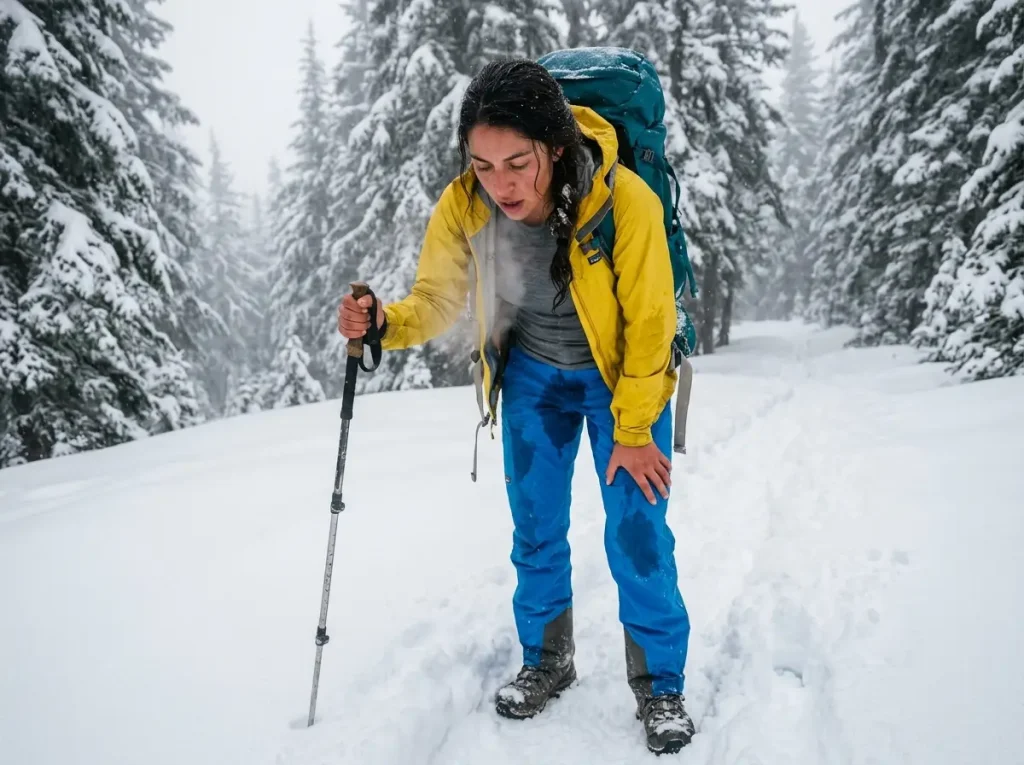
Here’s the thing guides don’t say out loud: the precipitation isn’t what gets people into trouble. It’s their own sweat.
Your body loses heat through four mechanisms — conduction, convection, radiation, and evaporation. On a winter ascent, all four are running at the same time. Conduction matters most when you’re kneeling in snow or sitting on a wet rock; wet fabric pulls heat away from your body 25 times faster than dry air. Convection is what wind does — it strips the warm boundary layer from your legs every second you’re on an exposed ridge. And evaporation? That’s the one that catches people off guard.
When you’re pushing hard in snowshoes or post-holing through wet snow, your metabolic rate jumps 40–80% compared to summer terrain on the same gradient. Your body produces proportionally more sweat. That vapor has to go somewhere. If your shell blocks it, it condenses into liquid on the cold interior surface — and then you’re not sweating anymore, you’re just wet. The phase change that was supposed to cool you has already happened inside the garment, and now you’ve got a wet base layer and no way to dry it out while you’re still moving.
According to CDC cold weather hypothermia prevention guidelines, hypothermia can occur at temperatures well above freezing when a person is wet — even from their own perspiration. That’s not a fringe scenario. That’s Tuesday on most technical winter routes.
Pro tip: Train yourself to notice the flush of warmth that comes just before you start sweating hard. That 30-second window is when you should vent or de-layer. Preemptive venting keeps the base layer dry. Reactive layer removal happens after the damage is already done.
The metric most people track — MVTR (Moisture Vapor Transmission Rate) — measures how much vapor can push through a square meter of fabric in a lab. The number that actually matters on a climb is CFM (Cubic Feet per Minute), which measures real air movement through the fabric. As this metric relates to how CFM ratings determine real-world hypothermia protection, a hardshell typically clocks in at 0 CFM. A softshell with 1–5 CFM lets just enough air move to prevent the internal microclimate from hitting 100% relative humidity — the point where vapor diffusion stops entirely, regardless of what the MVTR label says.
Once that internal humidity hits 100%, the membrane becomes functionally useless. It doesn’t matter how impressive the lab number is. You’re carrying a sealed nylon bag against your legs, and your own sweat is building up inside it.
Hardshell Architecture — What It Protects Against (And What It Can’t Solve)
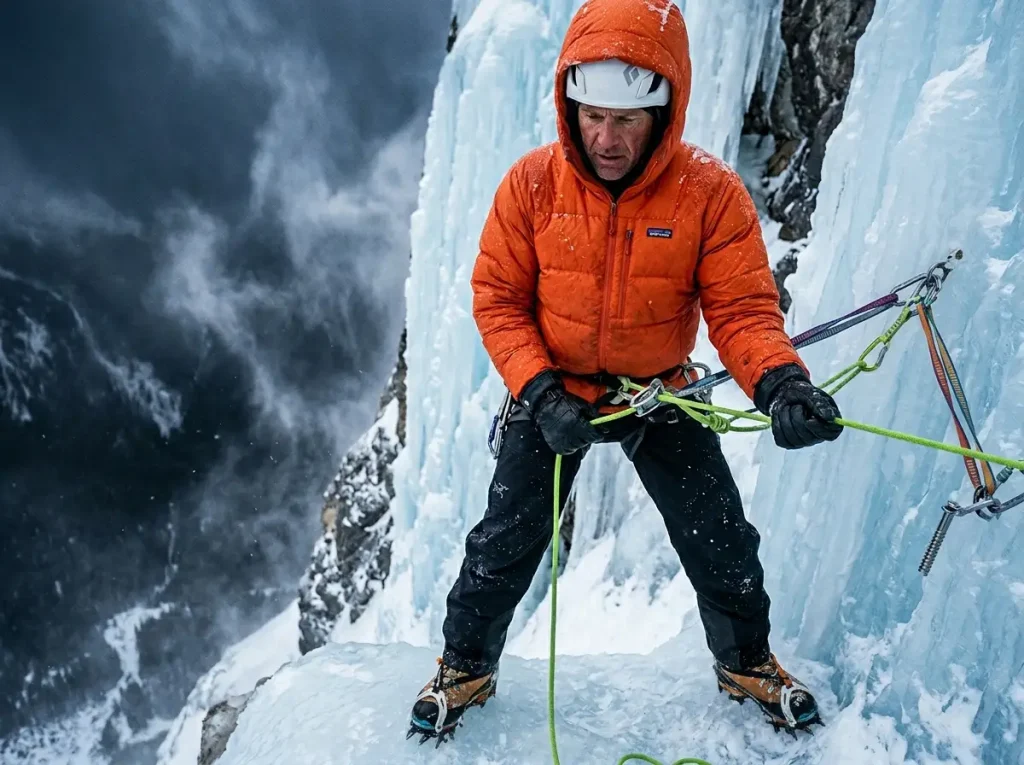
Hardshell membranes work exactly the way the marketing says — in low-output conditions. The ePTFE pore structure in Gore-Tex, eVENT, and Pertex Shield creates openings roughly 20,000 times smaller than a water droplet but 700 times larger than a water vapor molecule. In theory, rain stays out, vapor gets out. In practice, the system has a throughput problem under exertion.
Three-layer construction is the only configuration worth considering for serious winter backcountry travel. The membrane is sandwiched between a durable face fabric and a functional backer — Gore-Tex C-Knit on premium pants, jersey knit on others. This protects the membrane from body oils and internal friction, which is why 3L pants outlast 2.5L by several seasons under real use. 2.5L builds (membrane bonded to face fabric, sprayed inner coating) go sticky against skin when you’re generating heat, and the coating degrades faster. 2L pants with loose mesh liners belong on ski hills, not technical terrain.
DWR failure is the hidden failure mode nobody talks about at the trailhead. When the Durable Water Repellent coating degrades — from friction, dirt, or just accumulated use — the face fabric wets out. Water saturates the outer layer. At that point, the membrane can’t breathe from either direction. With 0 CFM underneath, you now have a sealed nylon bag against your legs. The research on how Gore-Tex and eVent membranes differ in real-world vapor transfer makes clear that membrane performance is entirely dependent on DWR integrity.
In the post-PFAS transition, this matters more than it used to. PFAS-free DWR — now industry standard due to EU regulation and voluntary brand commitments — has measurably lower durability. Nikwax TX.Direct and Grangers Performance Repel Plus can restore it, but only on a clean garment, and only if you’re doing it every 10–15 days of use. Follow the PFAS-free DWR maintenance schedule that keeps your shell actually waterproof or accept that your $450 hardshell will become a vapor trap faster than you expect.
When a hardshell is genuinely the right call: wet snow above 28°F, freezing rain, static ridge traverses with sustained wind but low physical output, or belaying. Those are the conditions where waterproofness overtakes moisture management as the dominant variable.
Pro tip: Check for full-length thigh vents before you buy any hardshell for winter use. A 10-inch vent is cosmetic. A hip-to-knee vent is the only mechanical option that produces real airflow when your diffusion rate is overwhelmed.
Softshell Engineering — How Air Permeability Solves the Vapor Crisis
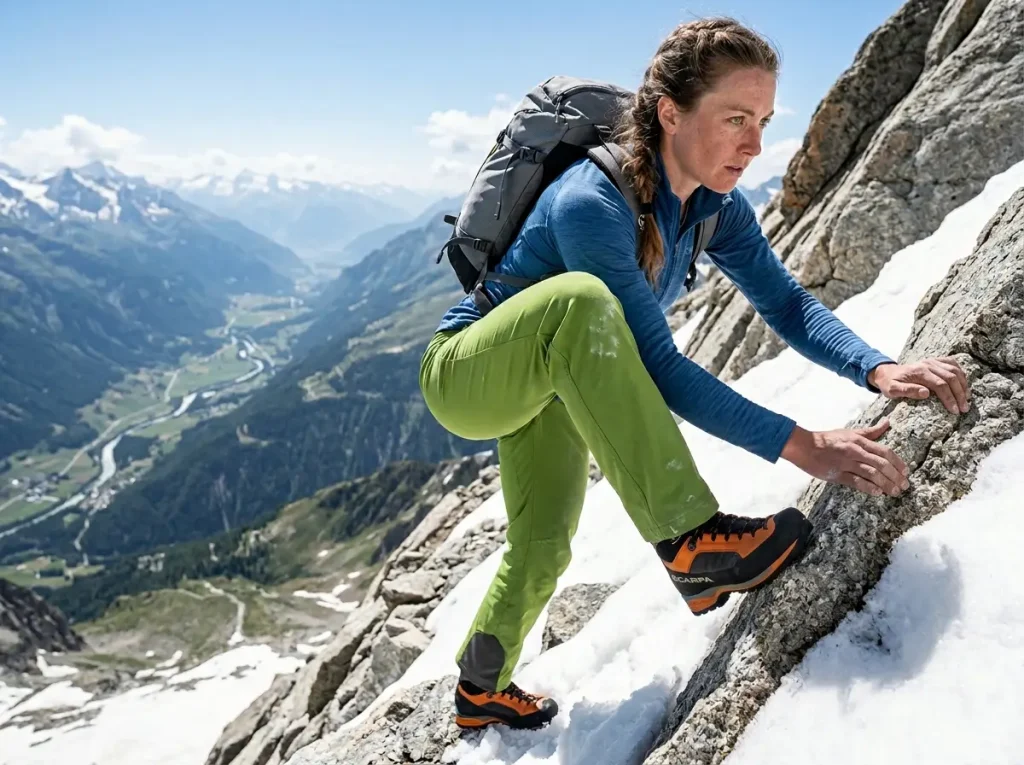
Softshells are not lesser hardshells. That framing misses the point entirely. They solve a different problem through a different mechanism — convective heat loss managed deliberately, rather than membrane diffusion fighting metabolic output.
High-performance softshells use a double-weave construction. The outer face is smooth and dense, providing wind resistance and low CFM. The inner face is lofted and textured, maximizing surface area for wicking. The result is a two-phase moisture strategy: the inner face pulls vapor away from the base layer, and the air that passes through the outer fabric carries it out convectively. This keeps your base layer drier under sustained exertion than any 0 CFM membrane can manage.
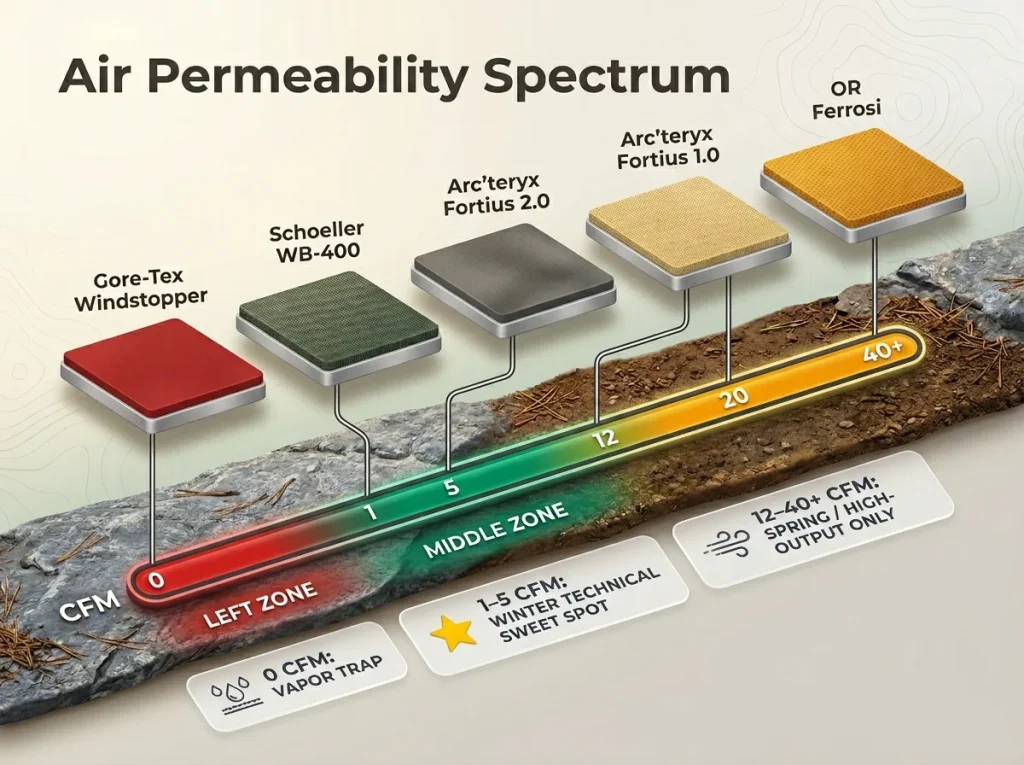
The CFM spectrum is where the decisions get technical. Gore-Tex Windstopper-integrated softshells sit at 0 CFM — full wind protection, zero convective cooling. Good for belaying, borderline for moving. Schoeller WB-400 at 1–3 CFM is the winter technical sweet spot: functionally windproof at hiking pace, allows just enough air movement to prevent microclimate saturation. The Arc’teryx Fortius 2.0 (used in the Gamma MX and AR) estimates 5–10 CFM — versatile range that works across most winter conditions. Fortius 1.0 in the Gamma SL (12–20 CFM) is spring hiking territory and will wet out in 15 minutes of sustained rain. The OR Ferrosi at ~40 CFM is a shoulder-season approach pant, not a winter summit option.
For temperatures in the 10–30°F range, 1–5 CFM is the target. As confirmed by National Park Service hypothermia prevention and treatment protocol, staying dry is the primary protection against hypothermia — and for active hikers, air permeability is the mechanism that makes that happen. Below 10°F with ridge wind speeds, even a 5 CFM fabric may run cold; that’s when you layer a lightweight hardshell over the softshell for the exposed sections.
The Appalachian Mountain Club’s advice in their winter moisture management protocol lines up with field reality: you can’t stop sweating in winter, so your system has to handle it. A softshell with real CFM data is the answer. If a brand doesn’t publish CFM, assume it’s zero. See how CFM was the deciding factor in our breathable softshell jacket test for field-tested comparisons across major brands.
4-way stretch (elastane blends) is the other piece hardshells can’t match on technical terrain. Full range of motion for high-step scrambling, crampon placement, and the wide snowshoe stride. In a stiff hardshell shell, you feel it on the first steep pitch. In a double-weave softshell, you don’t.
The Flash-Off Effect — The Hidden Physiology Behind “Clammy Chill”
This is the piece most gear content skips. It’s also the piece that matters most for safety.
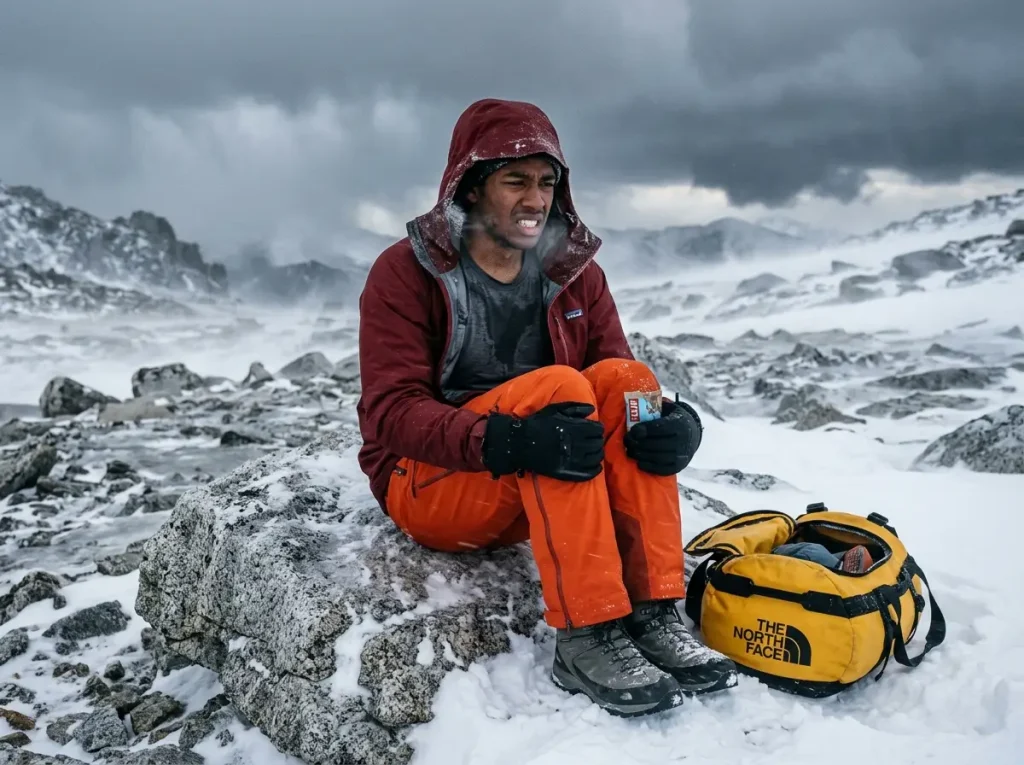
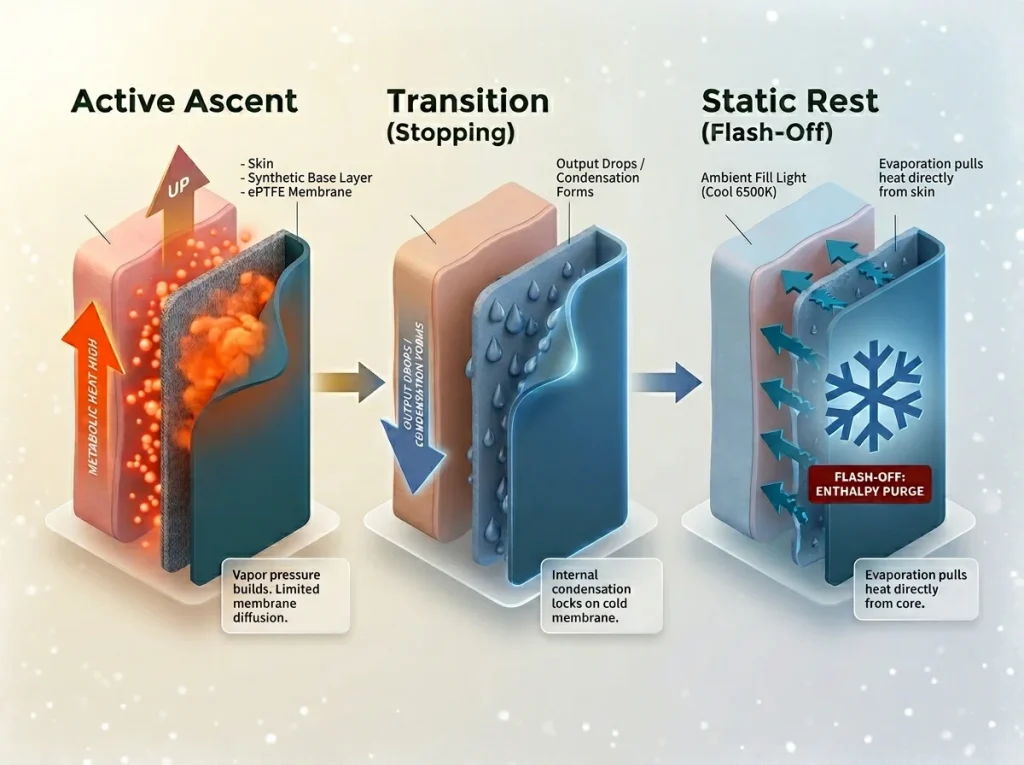
During a hard ascent in a hardshell, vapor production exceeds the membrane’s diffusion rate. Moisture builds up inside the garment. So far, you’re warm, you’re moving, and you don’t notice. Then you stop at the summit plateau. Metabolic heat production drops suddenly. The vapor pressure inside drops with it. And the condensed moisture — now liquid — starts evaporating directly against your skin.
The energy required for that phase change comes from your core. Even sitting still, your body is losing thermal energy to evaporate liquid trapped inside a 0 CFM shell. Research using infrared microscopy shows that wicking and evaporation can drop fabric-contact temperatures by more than 10°C within minutes of stopping. Wet fabric conducts heat 25 times more efficiently than air. You’ve built a direct conductive pipeline from your core to the cold through your own gear.
This is the flash-off effect. Not a gear failure. Not a freak weather event. Once condensation forms on the cold inner surface of the membrane, it can’t re-vaporize through the pores — it’s locked in as liquid. The “clammy chill” starts within minutes of stopping, and it precedes moderate hypothermia if you’re already depleted or underfueled.
The three-phase pattern in any hardshell-heavy winter day: high ascent (vapor builds, you feel fine), transition (stopped, condensation forms fast), static rest (flash-off begins, body cools against its own sweat). Each phase needs a different response — and you need to predict the transition before it happens, not after. Read about field treatment protocol when flash-off leads to hypothermia symptoms before you need it.
Pro tip: Carry a mid-insulation layer and put it on at the peak of exertion — when you’re still warm — not after you’ve stopped. It needs to be in place before the flash-off phase begins. Synthetic fills work better than down here because they retain some insulation even if damp.
Field recognition is simple but easy to miss when you’re tired. First sign: “clammy” feel against skin at a rest stop. Moderate warning: shivering starts 10–15 minutes after stopping. Critical sign: shivering stops and fumbling hands begin — you can’t work the buckle on your sternum strap. That’s mild hypothermia, not cold fingers. Act on it immediately. The fumble test doesn’t lie.
Advanced Layering — The Hybrid System That Solves the Trade-Off
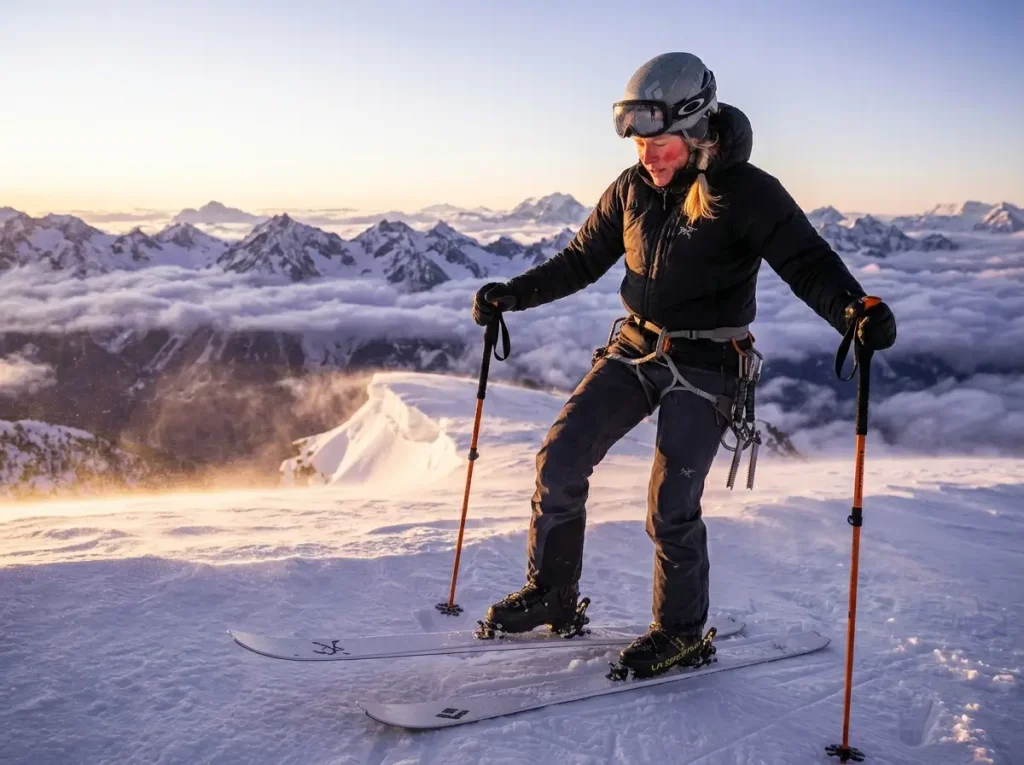
The best technical mountaineers don’t choose between softshell and hardshell. They carry both and deploy each where its physics work.
Softshell on the ascent — CFM manages the vapor management crisis, stretch handles the terrain, base layer stays dry. Hardshell in the pack — life-safety emergency layer for the summit plateau, an unexpected squall, or a wind-driven precipitation event at altitude. The hardshell is not your primary layer. It’s the piece that converts your system from active moisture management to static survival mode when conditions deteriorate fast.
Base layer interaction is the foundation everything else depends on. Synthetic (polyester/polypropylene) offers the best wicking rate and fastest drying — the right call when output will be sustained and high. Merino wool has a wider comfort range, stays warmer when wet, and handles multi-day use without smell, but it’s slower to dry and degrades faster under the friction of a fleece-lined softshell backer. Avoid merino under fleece-lined softshells like the Gamma MX class — the friction accelerates wear significantly. Fishnet/mesh construction is the specialist option: maintains air pockets against skin even when outer layers are damp, prevents cold-fabric contact feel, and allows more efficient vapor transport on extreme temperature-range days.
See how base layer fit affects wicking performance under softshell pants — snug-to-skin contact directly impacts wicking efficiency, and there’s a fit range where performance drops off sharply.
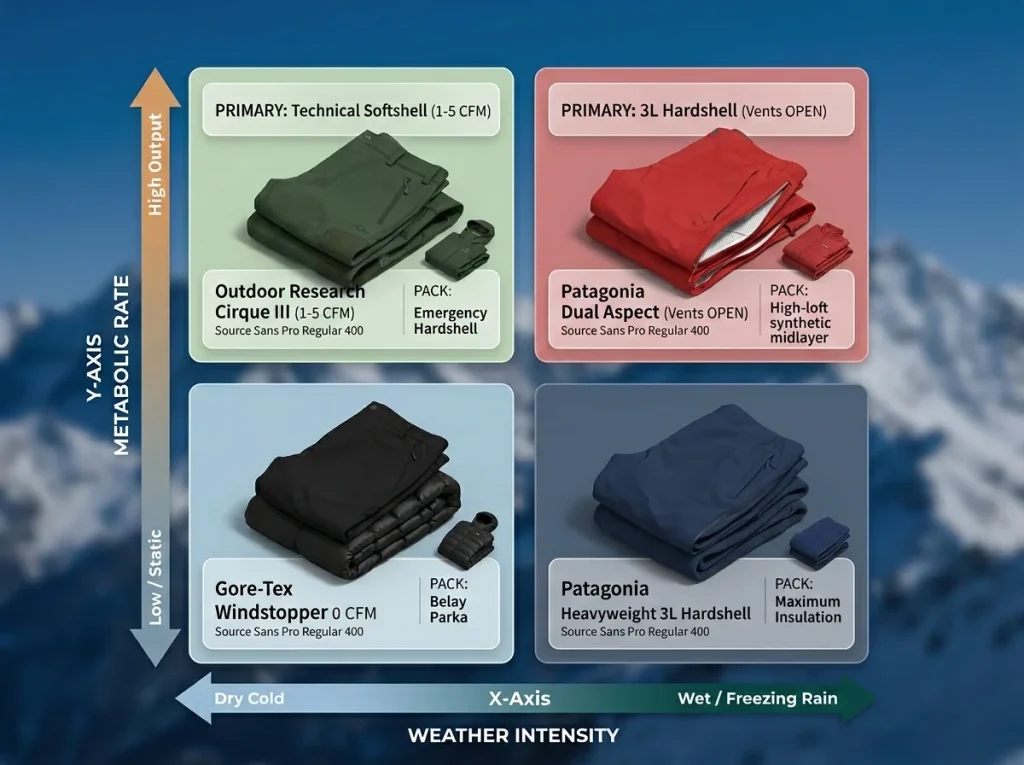
The condition-specific deployment:
Cold and dry (-10°C to 0°C): softshell primary, belay parka in pack. Wet and variable (near freezing): hardshell primary with vents open as wide as you can stand, synthetic puffy in pack. High winter below -10°C: heavy softshell primary, hardshell and parka both in pack, actively manage vent openings throughout the day.
One critical sizing note: when buying a hardshell to layer over a softshell, size up. It needs to go over the softshell without restricting movement — a fit test you should do in the store before you need it at 12,000 feet. For a broader decision framework across all four seasons, the 4-D Framework for matching hiking pants to activity type extends this logic across every condition you’ll face.
Gear Deep-Dive — The Technical Pants That Survive the Physics Test
Specs matter here because the physics you’re designing around are specific.
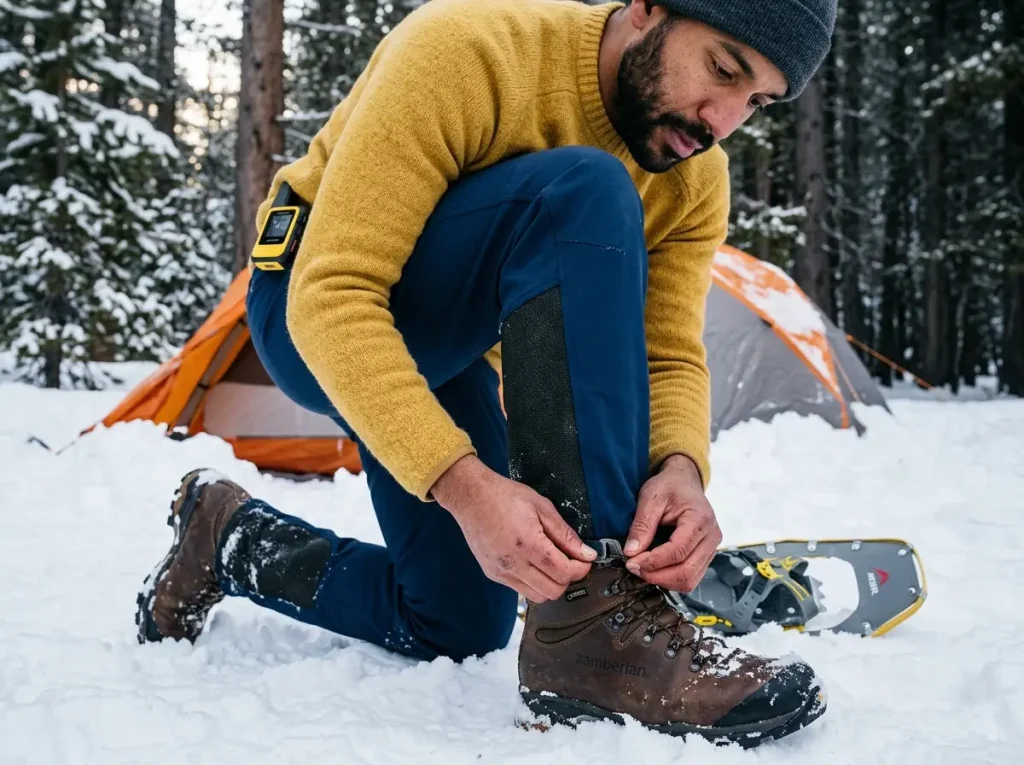
OR Cirque III (softshell): 90D stretch double weave, 50% nylon/43% poly/7% spandex, 700g, Kevlar scuff guard (85% nylon, 15% Kevlar), beacon pocket with clip, boot lace hook, ActiveTemp waistband. The weight is not a liability — it’s thermal buffer and abrasion armor. The Kevlar scuff guard at the ankle isn’t cosmetic; crampons will shred standard softshell fabric in a season without it. The beacon pocket is non-negotiable for backcountry avalanche terrain — a beacon in your chest layer is inaccessible under a loaded pack. Cut is wider in hip and thigh (alpine fit) — runs larger than Gamma pants, which matters if you’re trying them on and comparing.
Arc’teryx Gamma AR (softshell): Fortius 2.0, unlined double weave. The versatility choice. Manages moisture through variable base layers rather than built-in warmth. Narrower cut than the Cirque III; sits closer to the leg on technical terrain.
Arc’teryx Gamma MX (softshell): Fortius 2.0 with 233gsm fleece backer. Warmer than the AR, but the fleece backer takes 4–6 hours to dry versus 1–2 hours for unlined softshell. In a multi-day wet context, that drying time difference matters a lot. Plan for it.
Arc’teryx Gamma SL (softshell): Fortius 1.0. Spring and warm-summer conditions only. Wets out in 15 minutes of sustained rain. Not a winter solution.
Patagonia Triolet (hardshell): 3L Gore-Tex, 75D polyester, 550g. The bombproof choice for extended wet conditions or ice climbing. Heavy for a reason.
Patagonia Dual Aspect (hardshell): 3L H2No, 30D nylon, 450g. Technical fit with mobility prioritized, full thigh vents — the only hardshell configuration that produces meaningful mechanical cooling on a hard ascent. Check when water-resistant pants are sufficient and when waterproof membranes are required if you’re still unsure which category your planned conditions fall into.
Arc’teryx Beta AR (hardshell): Gore-Tex Pro, crampon patches, gold-standard durability for alpinism. The Gore-Tex Pro face fabric lasts longer under sustained friction than standard Gore-Tex — worth the price premium if you’re running crampons regularly, marginal return for trail hiking.
On the 3L vs. 2.5L debate for hardshells: 3L wins on multi-season durability. The $100–200 premium amortizes over 3–5 years of technical use. 2.5L membranes begin to separate from internal friction after 2–3 seasons of heavy use. For occasional users, 2.5L is adequate. For people who spend real time in real conditions, it’s a false economy.
According to New York DEC winter hiking safety protocols, inappropriate gear for conditions is one of the most common factors in winter hiking incidents. The Dual Aspect thigh vent length is the field example of why this matters — full-length ventilation is the only option that produces actual airflow during a hard ascent.
Conclusion
Three things to take away from this.
First: your biggest winter threat is sweat, not snow. The vapor management crisis — internal condensation and flash-off — determines whether your shell system keeps you functional. Design your layering around metabolic output first, weather protection second.
Second: CFM is the metric that matters more than MVTR for active hikers. A softshell with 1–5 CFM beats a lab-rated hardshell in a real winter ascent because it moves vapor convectively before it can condense. If a brand doesn’t publish CFM data, assume zero and treat it accordingly.
Third: the hybrid system is not a compromise — it’s the correct answer. Softshell for the ascent, hardshell as the safety layer in the pack. That’s how technical mountaineers actually dress. Each tool deployed where its physics work.
Next time you pack for a winter ascent, do this test at the trailhead: squeeze the back of your base layer waistband before you’ve even started moving. If it’s damp, your system is already compromised. Rebuild from the inside out — dry base layer, CFM-appropriate softshell, hardshell in the pack. That sequence is the difference between a productive summit day and a hypothermic slog back to the car.
FAQ
Can you wear softshell pants in the rain?
Yes — for light rain and brief showers, most quality softshells with DWR coating resist penetration for 15–30 minutes. For sustained precipitation above 28°F or driving rain, a 3L hardshell with fresh DWR is the right tool. The softshell pants in the rain question always comes down to duration and intensity: a passing squall on an otherwise dry day is different from a four-hour approach in steady freezing rain.
Are hardshell pants warm?
Hardshell pants are not inherently warm. They are a wind and waterproofness barrier, not insulation. The warmth you feel in a hardshell comes from the air trapped inside the system — base layer, any midlayer — not from the shell fabric itself. Most hardshells are thin nylon with almost no thermal value. For warmth, add insulation underneath. Don’t rely on the shell for heat you need on the inside.
Do I need long johns under softshell pants?
Below 25°F or in sustained wind, yes — a fitted synthetic or merino base layer adds critical insulation between skin and softshell. Above 25°F during high-output activities in calm conditions, many technical hikers run softshell without a thermal base layer to maximize CFM-driven moisture management. The test: if you feel cold fabric against skin within 10 minutes of stopping, add a base layer.
What is better for deep snow — hardshell or softshell?
For snowshoeing or peak bagging through dry powder below 20°F, a technical softshell with crampon reinforcement panels is superior — high-output demands maximum CFM, and dry powder doesn’t saturate fabric the way wet snow does. For post-holing through wet, heavy spring snow near freezing, a 3L hardshell with thigh vents is correct — the external liquid threat outweighs the internal vapor management advantage.
How often do I need to re-proof my hardshell pants?
With PFAS-free DWR now standard, plan on re-proofing every 10–15 days of use or whenever the bead test shows darkening of the face fabric. Wash first with Nikwax Tech Wash or Grangers Performance Wash, then apply DWR treatment and heat-activate in a tumble dryer on low. A hardshell with failed DWR is a 0 CFM vapor barrier. Re-proofing is a safety protocol, not optional maintenance.

I've spent more than a decade researching hiking gear and trail technique. I read the specs, the forum threads and the long-term reviews, and every pick here comes with what it gets wrong.
End of the trail
You read every mile of this one. Here's where the trail goes next.