In this article
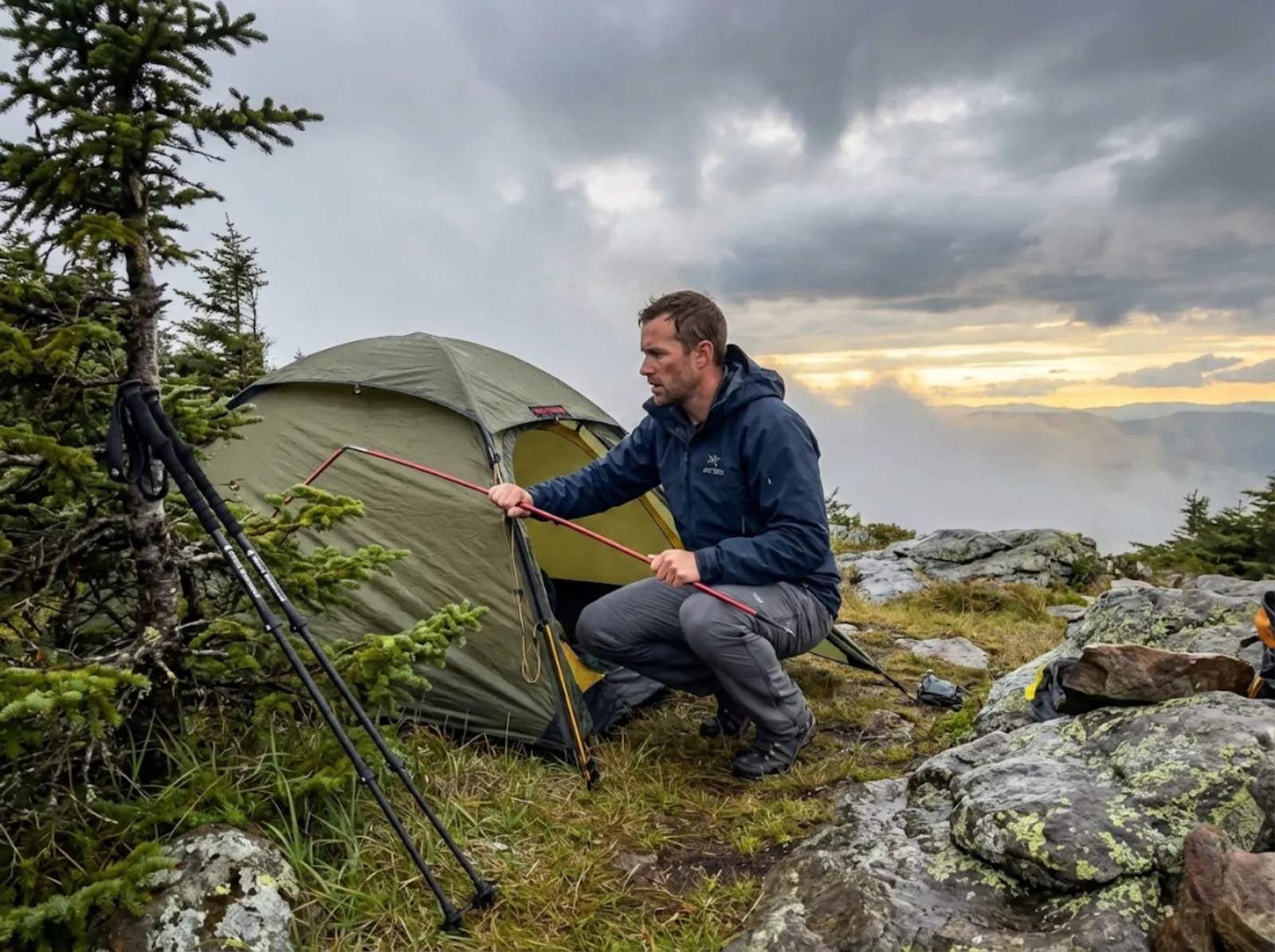
The gust hit at 2:14 AM. I know because I checked my watch while holding the ridgepole with both hands, rain hammering the flysheet sideways, water pooling under my sleeping pad. By morning, everything I owned was damp, my tent had a permanent bend in the main pole, and I was standing in a meadow wondering how a “20% chance of showers” turned into a full-blown disaster.
That night changed how I select campsites and set up shelter — permanently. After two decades of backcountry trips, I’d gotten lazy about the fundamentals. What followed was a complete overhaul of my campsite selection process, my wind rain protection strategy, and the way I think about anchoring, drainage, and terrain.
This article breaks down why camps fail in weather conditions most hikers underestimate, then walks through the exact site-selection techniques, anchoring methods, and gear changes that turned a recurring problem into a system I trust.
⚡ Quick Answer: Wind pressure quadruples every time wind speed doubles, which means a tent that feels rock-solid at 10 mph can fold at 30 mph with zero warning. The fix isn’t buying a stronger tent — it’s picking the right spot on the slope (middle third, not valley or ridge), using every guy-out point your tent has, matching your stakes to the soil type, and keeping your footprint tucked inside the drip line. Position and method beat gear upgrades every time.
Why Wind Wrecks Camps (The Physics Most Hikers Ignore)
The Force Doubles, Then Doubles Again
Most hikers think of wind as a linear thing. Twice the speed, twice the push. That’s wrong, and that wrong assumption is why tents collapse.
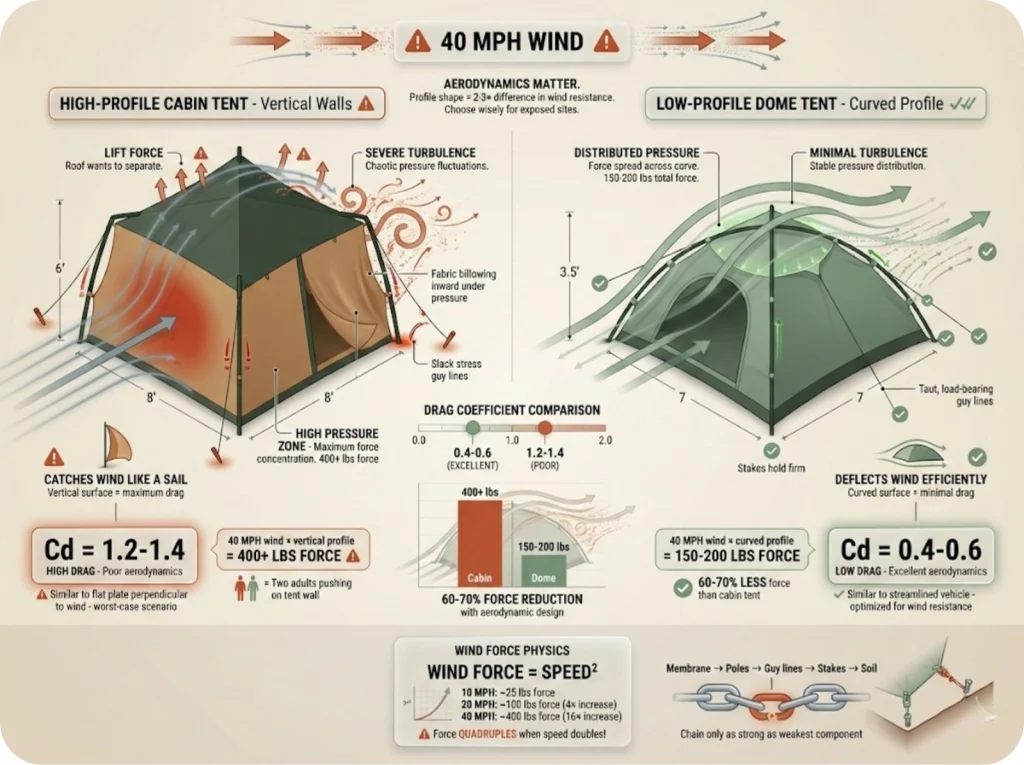
Wind resistance works on a squared relationship with speed. Double the wind speed, and the force against your tent quadruples. A 10 mph breeze pushes roughly 25 pounds of lateral force against a standard tent surface. Bump that to 40 mph — not unusual on an exposed ridge — and you’re looking at over 400 pounds of force trying to flatten your shelter. That’s the weight of two adults leaning on your 3-season tent.
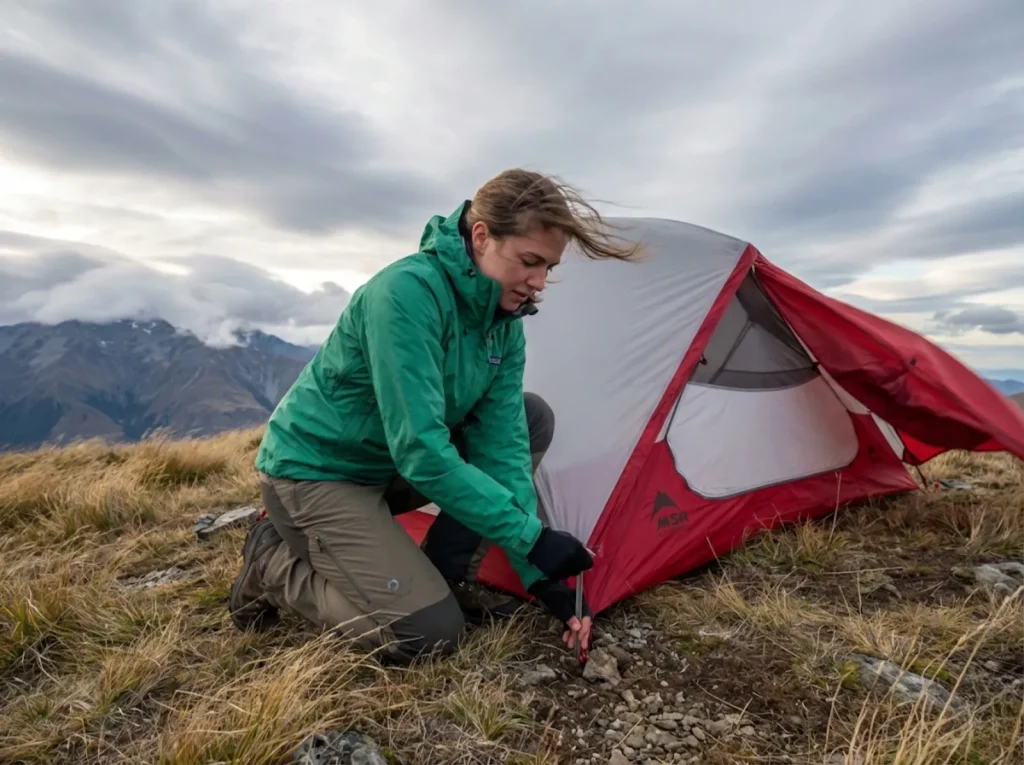
The structural load path runs from membrane to poles to guylines to stakes to soil. One weak link collapses the chain. An untensioned guy line transfers zero load. A shallow stake in sandy soil pulls out before the pole can flex. The tent doesn’t fail all at once — the weakest component goes first, and the rest follows in seconds. The National Weather Service wind-force reference data confirms that even moderate gusts can exceed the design limits of tents pitched without full guying.
Pro tip: Most people never use their mid-panel guy-out points. Those secondary attachment points are the difference between a tent that flexes and one that folds.
Why Shape Beats Strength
A freestanding tent with steep, flat walls catches wind like a sail. Vortices form along the roofline, creating extreme uplift that gets under the fly and lifts the whole structure. I watched it happen in real time during a Sierra windstorm that snapped two fiberglass tent poles at their joints on my old cabin-style 4-person tent.
Low-profile tents with small, shallow panels deflect wind instead of catching it. Tent orientation matters as much as tent design — the narrowest, lowest end should always face into the prevailing wind. Pole-sleeve attachments outperform clip systems in sustained gusts because more contact area means less flutter and better load distribution across the frame.
I switched to a low-profile 2-person tunnel after that Sierra trip. Same campsite, completely different outcome. Understanding the structural differences between 3-season and 4-season tents is what finally pushed me to make the swap.
Rain Doesn’t Leak Through Fabric — It Pushes Through
Hydrostatic Head: The Number That Actually Matters
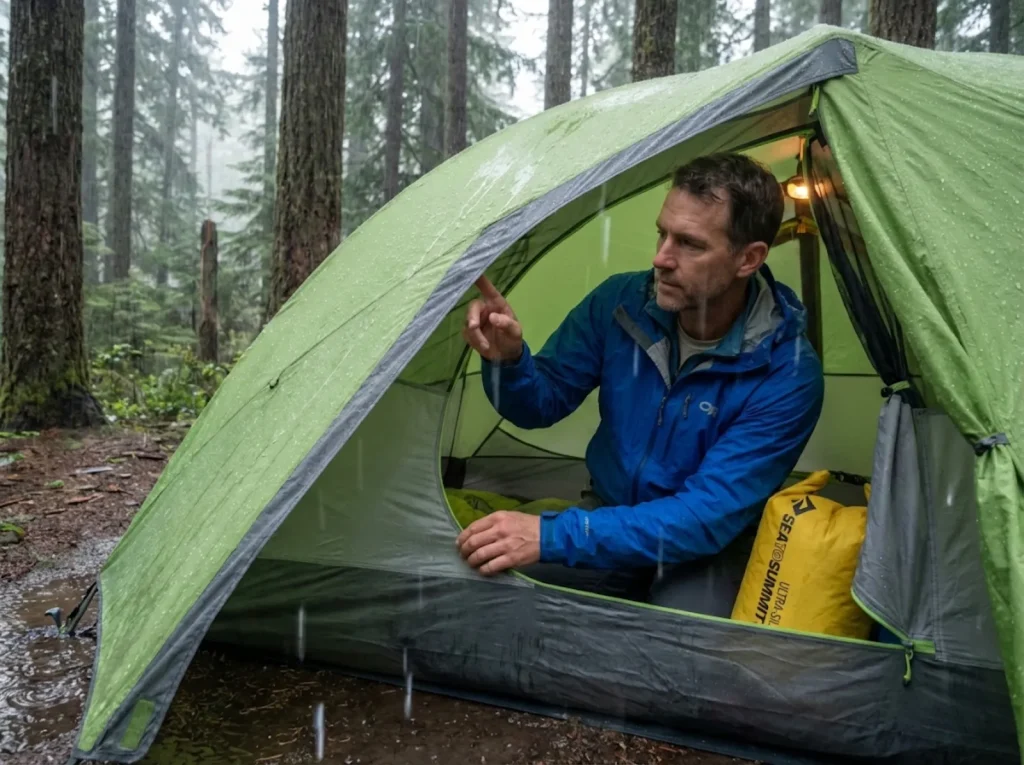
Your tent’s waterproof rating is measured in hydrostatic head — the height of a water column (in millimeters) the fabric can resist before three drops push through. A 3-season tent typically rates between 2,000 and 3,000 mm on the fly. Sounds solid. But that number is tested under static conditions — no wind, no body weight, no accumulation.
Wind-driven rain adds real force against the fabric. In a sustained 35 mph storm, droplets hit with enough energy to push through fabrics that pass every calm-weather test. That “misting” on the inside of your fly during a hard blow isn’t condensation — it’s rain pushing through the weave.
The tent floor needs a much higher rating — 5,000 to 10,000 mm — because your body weight creates pressure against the ground. Sitting pushes roughly three times harder than standing rain from above. If your groundsheet is only rated at 3,000 mm, you’re sleeping on a sponge. Understanding how pack weight puts pressure on waterproof ratings will change how you evaluate your next tent purchase.
Pro tip: Check your fly rating, but check your floor rating too. That’s where most leaks actually happen.
Rainfall Intensity: Light Drizzle vs. Tent Killer
The NWS rainfall intensity classifications break rain into brackets: light under 2.5 mm per hour, moderate between 2.5 and 7.5 mm, heavy between 7.6 and 50 mm, and violent above 50 mm per hour. Each bracket demands a different protection strategy.
Cumulative moderate rain over 24 hours can be just as destructive as a violent cloudburst if your site drainage is poor. And seam failures happen before fabric failures — factory-taped seams degrade over time, and the seam-sealing process that actually extends waterproof life by two to three seasons is worth an hour of your time before each season.
Site Selection: Reading Terrain Before You Pitch
Cold Air Pools Where You’d Least Expect It
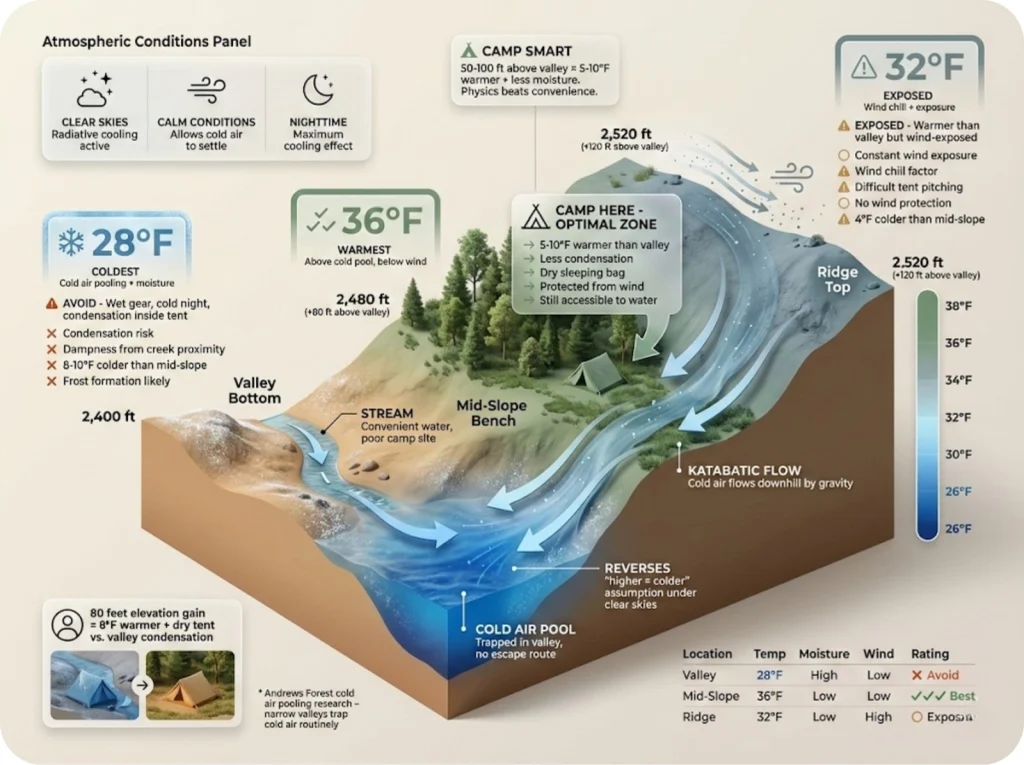
Under clear skies, cold air flows downhill by gravity — a process called katabatic flow — and pools in valleys, basins, and streambeds. Data from the Andrews Forest cold air pooling research program confirmed that narrow valleys trap cold air routinely, not occasionally.
I once camped right next to a creek because the ground was flat and the water was convenient. By morning, the inside of my tent was dripping with condensation, my bag was damp, and the temperature was easily 8 degrees colder than the bench 80 feet upslope. Cold air pooling at the valley floor created a temperature gradient that reversed the “higher equals colder” assumption.
Camping 50 to 100 feet above a valley floor can mean 5 to 10 degrees warmer overnight and significantly less moisture inside your shelter.
The “Middle Third” Rule for Wind Protection
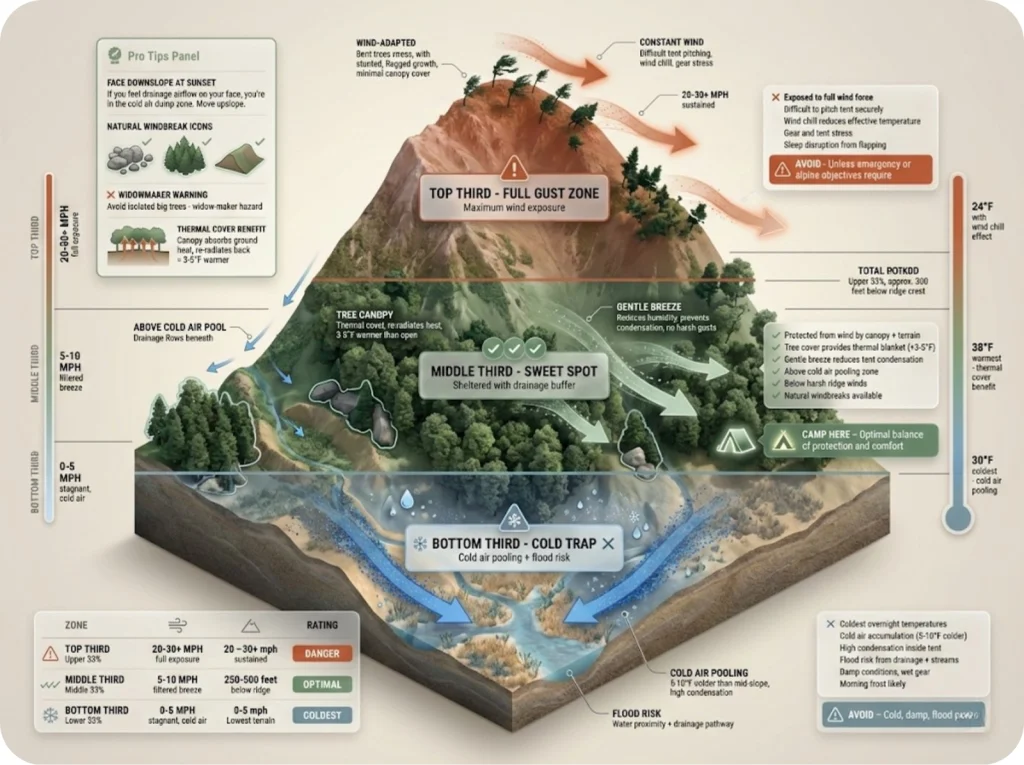
Ridgetops give you maximum wind exposure. Valley bottoms hand you cold air pooling plus flood risk. The sweet spot — the place I pitch every time now — is the middle third of a long slope.
Thick tree canopy acts as a thermal cover at night. It absorbs heat from the ground and re-radiates it back, slowing cooling by 3 to 5 degrees compared to open meadows. But you want some gentle breeze through camp to reduce humidity and prevent the physics behind tent condensation from turning your sleeping bag into a wet rag.
Use dense trees, boulder fields, or earthen berms as natural windbreaks. Avoid isolated big trees — they’re widowmaker territory.
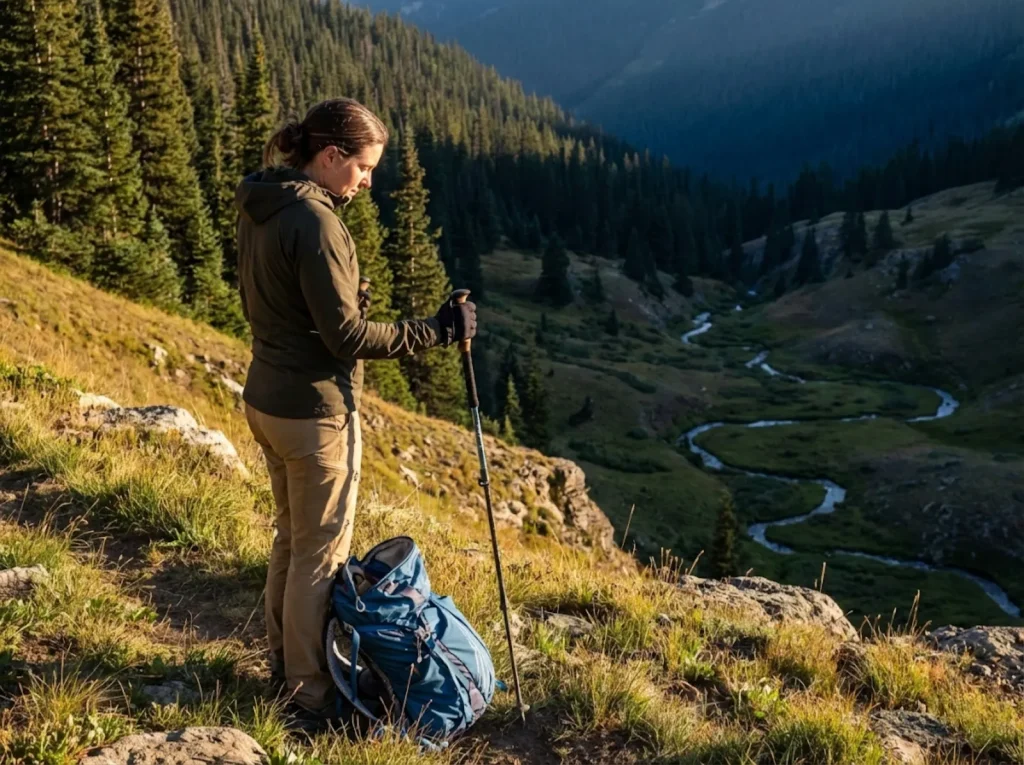
Pro tip: Face downslope when evaluating a campsite. If you can feel drainage airflow on your face at sunset, cold air is already moving and you’re standing in the dump zone.
Danger Overhead: Scanning for Widowmakers
A hazard tree has a structural defect and a target — you and your tent. Visual inspection is your first line of defense, according to the US Forest Service hazard tree guidance.
Red flags: V-shaped branch unions (weaker than U-shaped), fungi or mushrooms on the trunk or root flare (internal rot), deep longitudinal cracks, and soil heaving at the base. Dead branches suspended in the canopy — widowmakers — fall without warning, including on calm nights.
Rule of thumb: if a tree shows these symptoms, move your camp outside a radius of roughly 1.5 times the tree’s height. Five minutes of looking up saves a lot of trouble at 3 AM.
Anchoring That Holds: Soil, Stakes, and the Physics of Pull-Out
Match Your Stakes to Your Soil
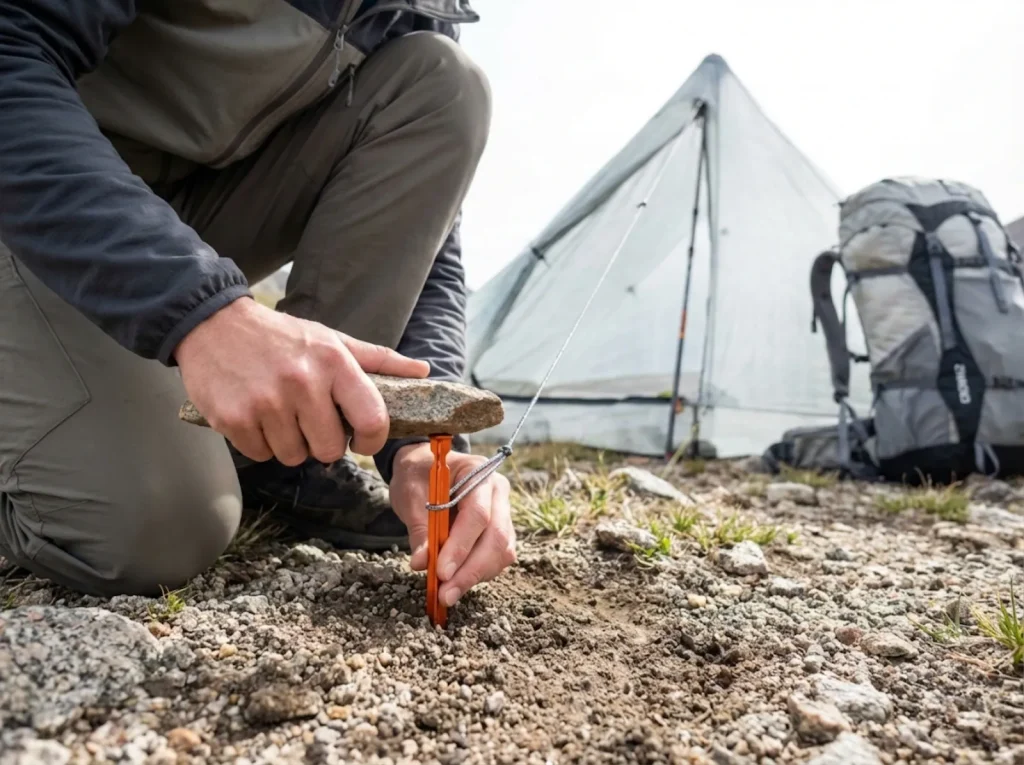
Soil type determines holding power more than stake design. Clay holds well because it coheres. Loam is moderate but weakens dramatically when wet. Sand and gravel rely on friction alone and offer the least resistance.
A standard 9-inch aluminum skewer in loam holds 50 to 60 pounds. A 24-inch steel stake at full depth holds 500 pounds. Length is leverage — deeper stakes reach denser, more compact soil layers. Y-stakes like the MSR Groundhog outperform round pegs because their wider shape grabs more soil with each inch of depth.
Moisture is the silent enemy. High-quality tent stakes “creep” in saturated ground as the soil loosens and starts behaving like mud. If rain is forecast, use longer stakes and check them before bed.
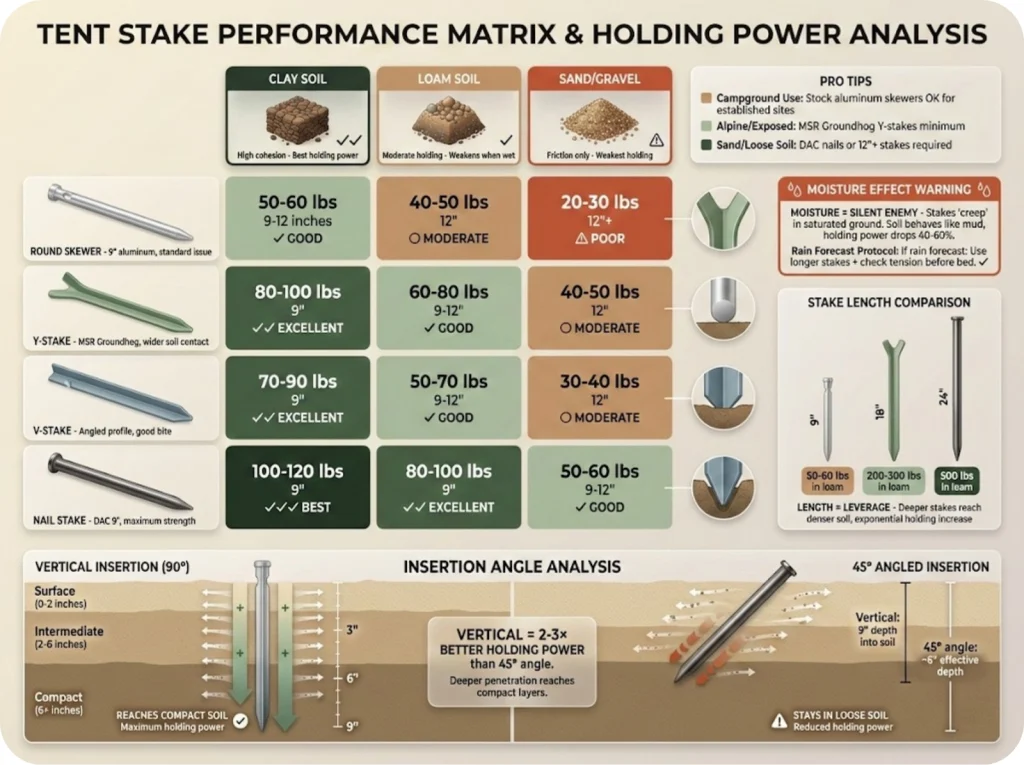
Pro tip: Stock aluminum skewers are fine for established campgrounds. But for exposed alpine or sandy soil, MSR Groundhog Y-stakes or DAC 9-inch nails are the minimum I’d carry.
Vertical vs. Angled: The Insertion Debate
Traditional wisdom says 45 degrees away from the tent. But vertical insertion often provides greater holding power because the stake reaches deeper into more compact soil. The key is that the guy line tension angle should be roughly perpendicular to the stake shaft.
In pure sandy soil where nothing holds, use the deadman anchor technique for sandy soil — bury the stake horizontally at 12-plus inches depth. It works in snow too.
I watched a tent blow across a meadow in Montana with all stakes still in the ground — just not tensioned. The guy lines were there for show. Always tension every line to remove slack. An untensioned line transfers zero load, and the tent poles absorb everything alone.
What I Changed After Camp Failure (Gear and Method Fixes)
Fabric: Why Silpoly Beats Silnylon in Rain
Silnylon absorbs water and stretches when wet, producing a saggy pitch that allows fly-to-inner contact. That contact point becomes a condensation highway straight onto your gear. Silpoly — silicone-coated polyester — stays taut in a downpour because polyester doesn’t absorb moisture.
For most backpackers doing ultralight backpacking on a budget, silpoly hits the sweet spot: lighter than silnylon when wet, dimensionally stable, and available at reasonable prices. If you’re comparing long-term value, the lifetime cost and repair comparison of silnylon, silpoly, and Dyneema shows why the upfront cost difference disappears over three seasons.
Guyline Setup: The Configuration Nobody Uses
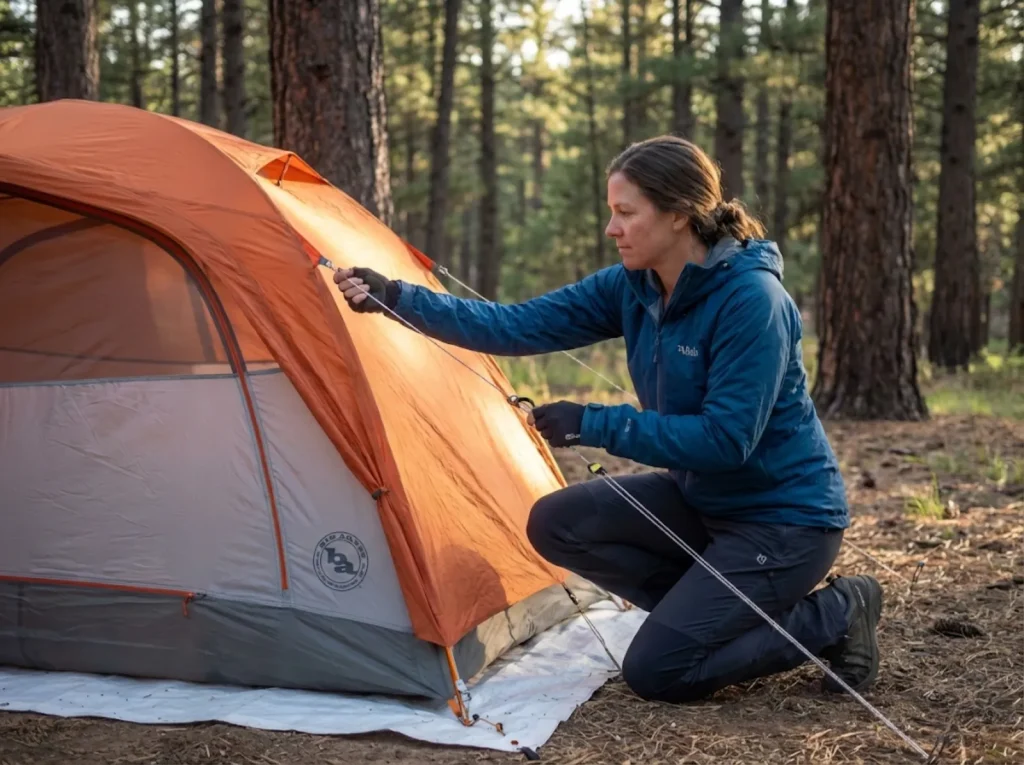
Most tents ship with four corner guylines. Most also have six to eight mid-panel guy-out points that users ignore completely. Using those secondary points provides critical lateral support during gusts — it distributes load across the entire frame instead of concentrating it at the apex and tent corners.
Use ALL guy-out points in exposed conditions. The extra five minutes of campsite setup prevents the 3 AM emergency restaking. Reflective guyline cord reduces tripping risk and lets you visually check guy line tension at night with a headlamp sweep.
The Bathtub Floor Fix
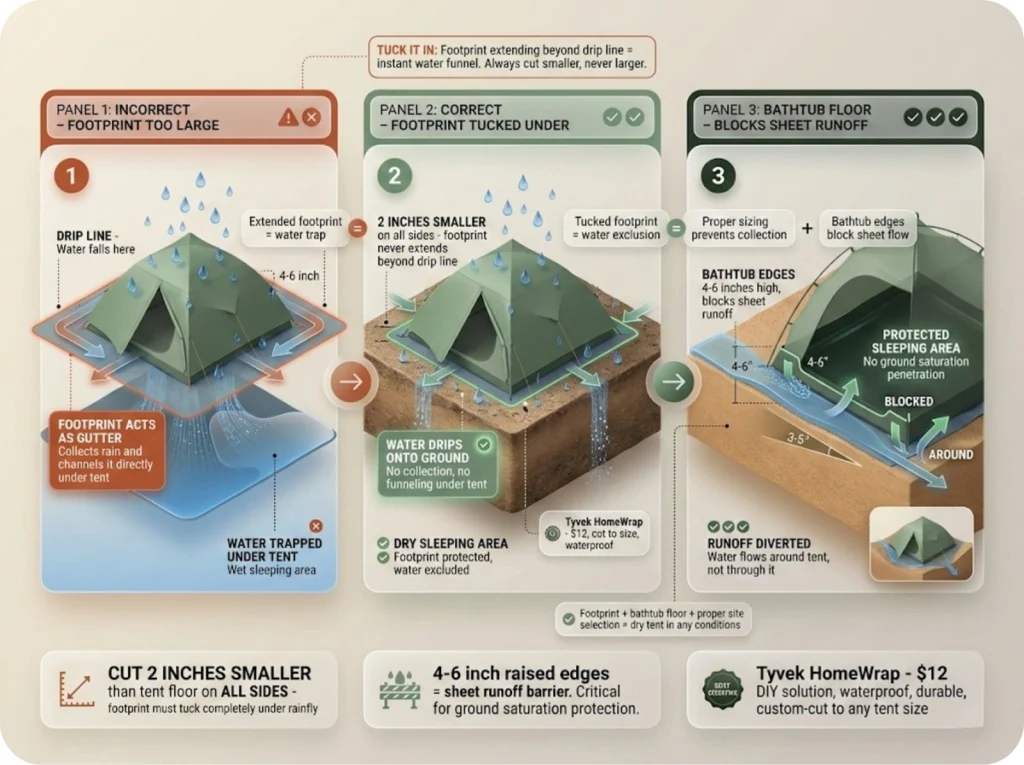
Ground saturation is the other tent killer. Pitching in a depression to escape wind often places the tent right in the drainage funnel. A bathtub-floor footprint with edges rising four to six inches blocks sheet runoff from entering the sleeping area.
The ground tarp must tuck entirely under the rainfly — if it extends beyond the drip line, it collects rain like a gutter and channels water directly under the tent. I spent $12 on Tyvek HomeWrap, cut it two inches smaller than my tent floor on every side, and haven’t had a wet tent since.
Keeping your wet gear dry doesn’t stop at the tent. Understanding why a pack liner matters more than a rain cover closes the last gap in your rain defense system.
Leave No Trace While Protecting Your Camp
Durable Surfaces: Found, Not Made
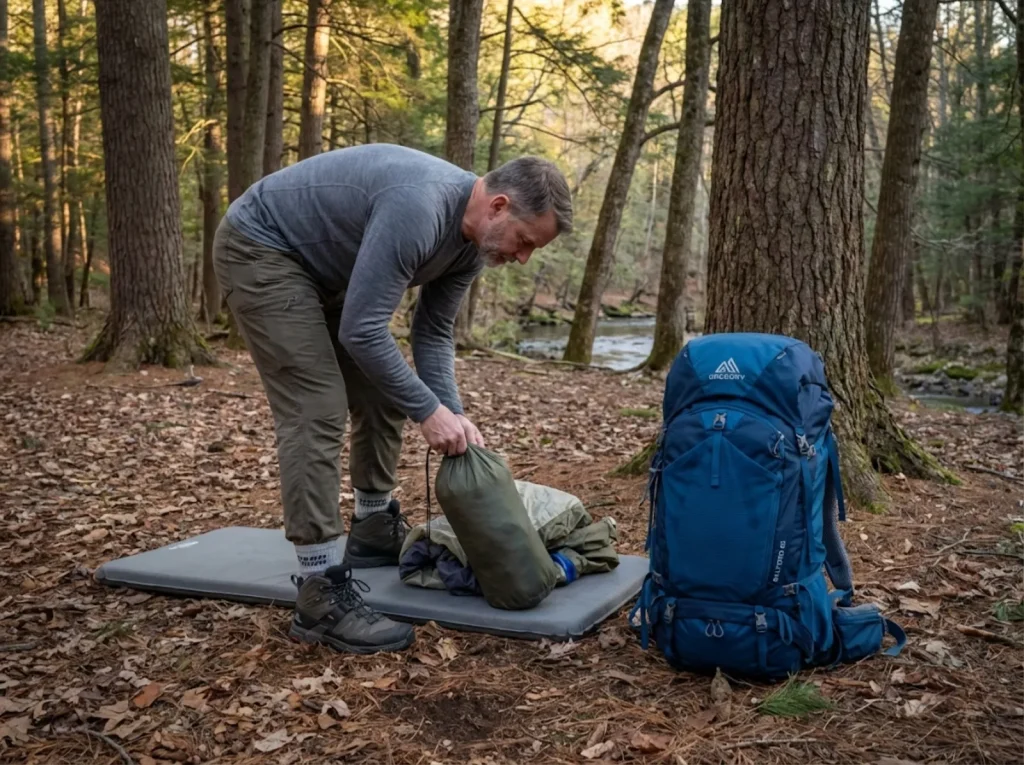
“Good campsites are found, not made.” That principle from the NPS Leave No Trace Seven Principles is the starting point for every campsite selection decision.
Acceptable durable surfaces include rock, gravel, dry grass, and established sites. Digging trenches around tents is both unnecessary — a proper footprint eliminates the need — and ecologically damaging. It breaks root systems and creates erosion channels that persist for years. Organic litter like dead leaves and pine needles cushions trampling and reduces rain erosion on exposed ground. Leave No Trace means leaving it in place.
For a deeper look at responsible backcountry practices, the full LNT gear and ethics field guide covers everything from campfire management to waste disposal.
The 200-Foot Water Rule (And Why It Matters More in Rain)
Camp at least 200 feet from water sources to protect riparian zones and allow wildlife access. In rainy conditions, water proximity increases humidity, intensifies condensation inside the tent, and attracts scavenger animals to nearby food prep sites.
Flash-flood risk near streambeds rises dramatically during heavy rain — water levels can jump feet in minutes. The 200-foot buffer isn’t just an ethics guideline. It’s a safety margin that also gives you a drier, warmer, quieter night.
Pro tip: Walk 200 paces from the creek, look upslope, and you’ll usually find a bench that’s dry, warmer, and quieter. That’s your spot.
What I’d Tell You Before Your Next Trip
Three things changed everything after that 2 AM disaster.
First, position beats gear. A low-profile tent oriented correctly on the middle third of a slope outperforms an expensive tent pitched carelessly in a gully. Second, anchor the complete load path. Stakes, guylines, and fabric all need to be tensioned so wind force transfers to the ground — one slack line means the poles absorb everything. Third, read the terrain, not just the weather forecasts. Cold air pooling, drainage patterns, and overhead hazard trees matter as much as what the weather apps say.
Next time you arrive at a campsite, take 10 minutes before you unclip a single buckle. Walk the area. Face downslope. Feel the air. Look up. Those 10 minutes will save you from a 2 AM lesson you don’t want to repeat.
FAQ
How much wind can a backpacking tent actually handle?
Most 3-season tents handle sustained winds of 25 to 35 mph with proper guying. Wind pressure quadruples when speed doubles, so a 40 mph gust delivers four times the force of a 20 mph breeze. Using all guy-out points and pitching low-profile into the wind extends that range.
What hydrostatic head rating do I need for camping in heavy rain?
For three-season backpacking in regions with regular rain, aim for a fly rated at 2,000 to 3,000 mm and a floor at 5,000 mm or higher. Wind-driven rain pushes water through lower-rated fabrics, and body weight on the floor creates additional pressure that static lab tests don’t account for.
Should I camp in a valley for wind protection or on a ridge?
Neither extreme. Valley bottoms collect cold air — 5 to 10 degrees colder — and flood easily. Ridgetops face full wind exposure. The optimal position is the middle third of a long slope, sheltered from large-scale winds but above cold air drainage flows.
Do I really need to use all my tent’s guy-out points?
In calm weather, corner tent stakes are enough. In moderate-to-strong wind, skipping mid-panel guy-out points concentrates all force on the tent poles and corner attachments — the two weakest links. Using every attachment point distributes load and prevents pole deformation.
What’s the best tent stake for soft or sandy soil?
Y-stakes like the MSR Groundhog outperform round pegs because they maximize soil contact area. In pure sand, switch to a deadman anchor — bury the stake horizontally at 12-plus inches. Longer stakes in any soil type reach denser layers and hold significantly more force.
Risk Disclaimer: Hiking, trekking, backpacking, and all related outdoor activities involve inherent
risks which may result in serious injury, illness, or death. The information provided on The Hiking Tribe is for
educational and informational purposes only. While we strive for accuracy, information on trails, gear, techniques,
and safety is not a substitute for your own best judgment and thorough preparation. Trail conditions, weather, and
other environmental factors change rapidly and may differ from what is described on this site. Always check with
official sources like park services for the most current alerts and conditions. Never undertake a hike beyond your
abilities and always be prepared for the unexpected. By using this website, you agree that you are solely
responsible for your own safety. Any reliance you place on our content is strictly at your own risk, and you assume
all liability for your actions and decisions in the outdoors. The Hiking Tribe and its authors will not be held
liable for any injury, damage, or loss sustained in connection with the use of the information herein.
Affiliate Disclosure: We are a participant in the Amazon Services LLC Associates Program, an
affiliate advertising program designed to provide a means for us to earn advertising fees by advertising and linking
to Amazon.com. As an Amazon Associate, we earn from qualifying purchases. We are also an official affiliate partner
of Black Diamond Equipment via the AvantLink network. If you click on a Black Diamond affiliate link and make a
purchase, we may earn a commission at no additional cost to you. We also participate in other affiliate programs and
may receive a commission on products purchased through our links. Additional terms are found in the terms of
service.