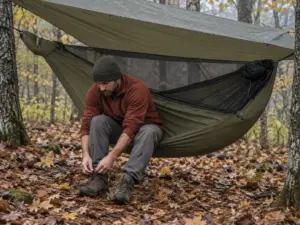
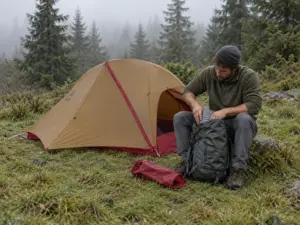
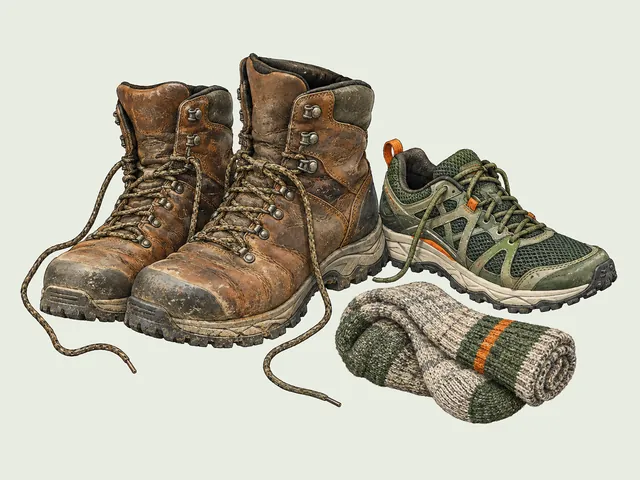
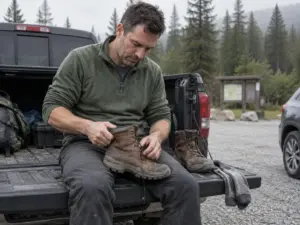

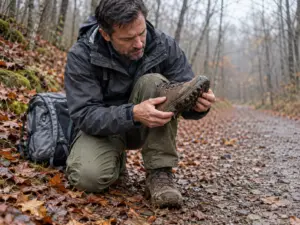





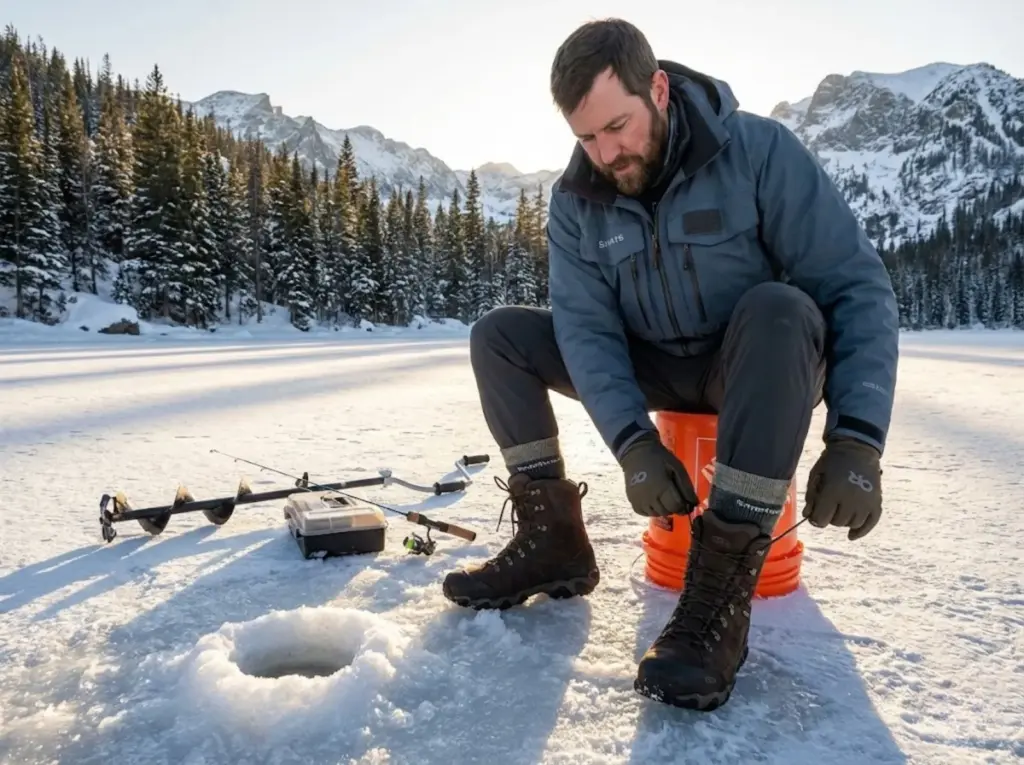
The wind hit 15 mph right as I sat down to jig. Two hours in, my toes went numb inside the same 200g insulation hiking boots that had felt too warm on the three-mile snowshoe approach. By hour four, I was packing up—not because the walleye stopped biting, but because I couldn’t feel my feet.
After fifteen years of winter trekking and a solid decade chasing fish through the ice, I’ve made this mistake more times than I want to admit. And I’ve watched dozens of buddies make it too. The problem isn’t bad boots. It’s a fundamental misunderstanding of what “warm” actually means when your body shifts from moving to sitting.
This piece breaks down exactly why your go-to winter hiking boots fail on frozen lakes, gives you a decision framework based on how far you hike to the hole, and recommends crossover boots that genuinely handle both activities—backed by field data, not marketing copy.
⚡ Quick Answer: Yes, winter hiking boots can work for ice fishing, but only if they pack at least 400g insulation, stand 8 inches or taller, and pair with a moisture management strategy like a vapor barrier liner or dry sock swap. Below 400g, your feet will go numb within 90 minutes of sitting. The key variable isn’t the boot—it’s how far you hike to fish.
Why “Warm Enough for Hiking” Fails on the Ice
The Metabolic Heat Gap Between Moving and Sitting
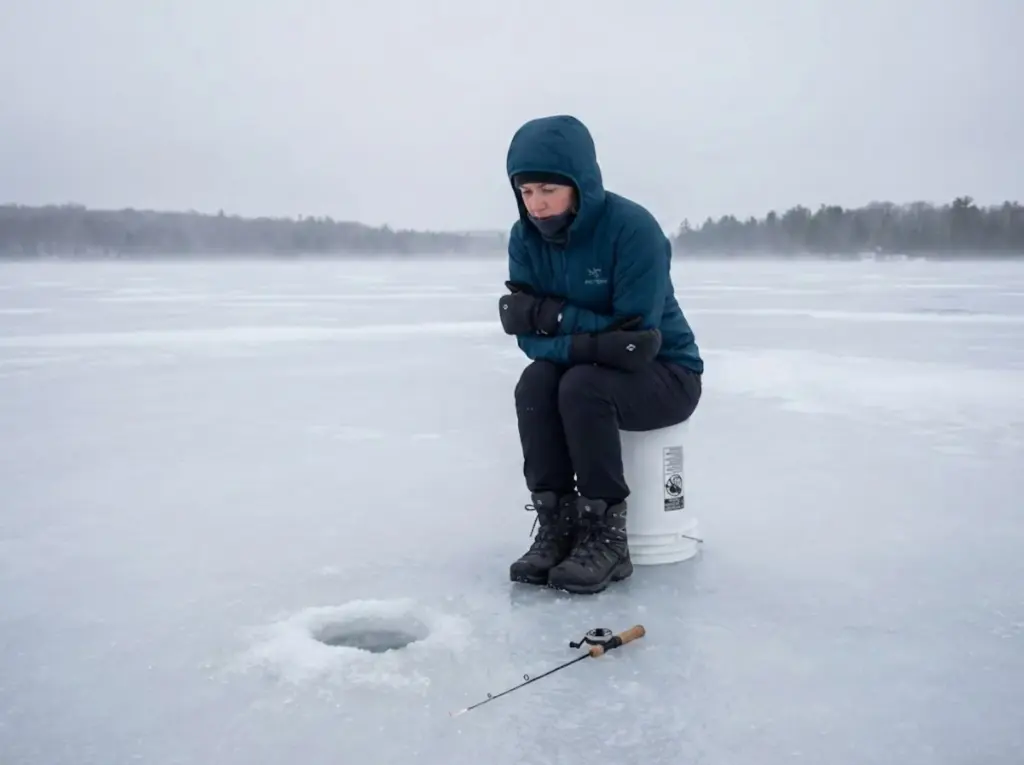
Here’s the thing most gear guides won’t tell you: your body is the furnace, not your boot. During a steep climb, your muscles crank out heat at five to eight times your resting rate. That excess warmth floods into your socks, your insulation, your entire boot system. You feel toasty. Sometimes too toasty.
Then you sit on a bucket.
Your engine drops to idle. Blood retreats from your fingers and toes as your body clamps down to protect core temperature—a response called peripheral vasoconstriction. That 200g insulation boot that felt like an oven on the trail? It’s now a thin shell around a cooling foot with almost zero internal heat to trap.
This is the metabolic activity differential that separates stationary cold from active cold, and it’s why mastering winter layering before you step onto the ice matters just as much below the ankles as above them. Research on thermoregulatory responses during prolonged cold exposure confirms that once movement stops, peripheral blood flow drops fast—and feet are the first casualties.
Pro tip: If you’re sweating on the approach, you’ve already lost the insulation battle. Strip a layer before the first switchback, not after. Arriving at the ice dry and cool beats arriving wet and warm every time.
The Conductive Heat Sink You’re Standing On
Snow is actually a decent insulator—all those trapped air pockets slow heat transfer. Ice is the opposite. Solid ice conducts warmth away from your footbed with brutal efficiency. A thin hiking boot midsole designed for “trail feel” becomes a direct pipeline for heat loss when you’re standing on a frozen lake for hours.
This is exactly why serious ice fishing boots feature aerogel insoles—a material that’s over 95% air with almost no ability to conduct heat. The Korkers Polar Vortex 1200 uses this technology to block the cold path without adding bulk. Standard EVA midsoles compress over time and lose their insulating air pockets, so swapping in fresh insoles engineered for thermal insulation can restore a surprising amount of lost warmth.
Why Temperature Ratings on Packaging Lie
That “rated to −40°F” stamp on the box? It’s meaningless without context. There’s no standardized test for boot temperature ratings. No ISO mandate. No consistent methodology across brands.
Three different thresholds exist, and manufacturers rarely specify which one they’re advertising: comfort rating (sustained warmth), survival rating (prevents frostbite but you’ll be miserable), and material failure rating (when adhesives crack). Baffin’s famous −148°F rating on the Titan refers to when the materials themselves break down—not when your feet stay comfortable.
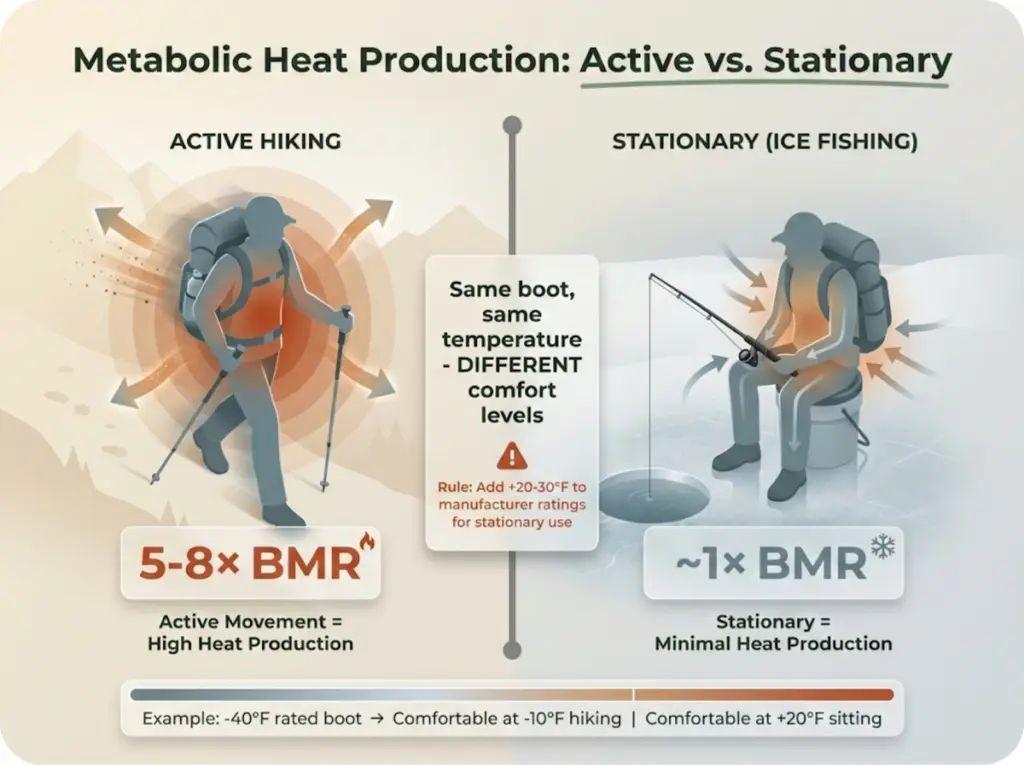
Rule of thumb: add 20 to 30 degrees to any manufacturer’s temperature rating for a realistic “sitting-on-the-ice” comfort number. A boot rated to −40°F might keep you comfortable at −10°F while hiking, but you’ll be hurting at 20°F if you’re sitting still.
Boot Categories Decoded—What Actually Crosses Over
Pac Boots—Maximum Warmth, Minimum Mobility
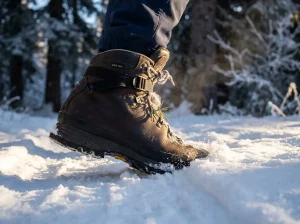
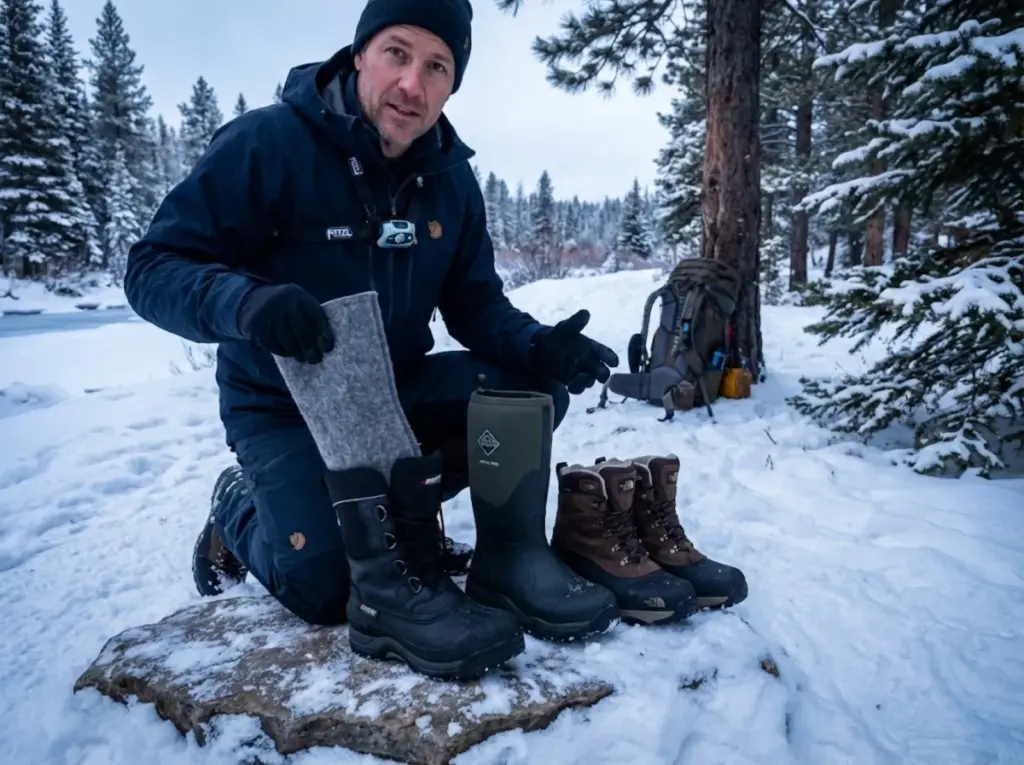
Pac boots are the heavyweights of winter footwear: a thick rubber shell on the bottom, leather or nylon upper, and beefy removable liners made from layered felt or foam. The Baffin Impact tips the scale at 7.5 pounds per pair. Using the backpacker’s 5:1 rule—one pound on the feet equals five on the back—that’s like strapping an extra 27 pounds to your frame compared to a 2-pound light hiker.
Those removable liners are gold for multi-day trips since you can pull them out to dry overnight. But the massive toe box barely fits into snowshoe binding straps on models like the MSR Lightning Ascent, and the weight alone destroys any hope of covering real trail distance. If you’re driving or sledging straight to your fishing spot, Pac boots are perfect. If you’re hiking in? Not a chance. Check snowshoe bindings and boot compatibility before you commit.
Insulated Rubber/Neoprene—Slush-Proof but Sweat Traps
Vulcanized rubber boots mean 100% waterproof. No seams to fail, no membrane to wet out under the pressure of standing in slush all day. That’s the strength. The fatal flaw? Zero breathability.
During the hike-in, sweat vapor has nowhere to go. It saturates the insulation from within—and wet insulation conducts heat away from your foot roughly 25 times faster than dry insulation. You arrive at the ice with boots that are already compromised. Models like the Muck Boot Arctic Pro with Vibram Arctic Grip outsoles handle wet ice beautifully, but they’re built for short walks, not long approaches where non-breathable membranes trap sweat.
400g+ Insulated Hikers—The Crossover Sweet Spot
The 400g insulation threshold is where crossover viability actually begins. Boots like the Oboz Bridger 10” (3.2 pounds, 400g Thinsulate, TPU chassis) and The North Face Chilkat V 400 deliver genuine trail performance with enough stationary warmth to handle mid-season ice down to about 20°F.
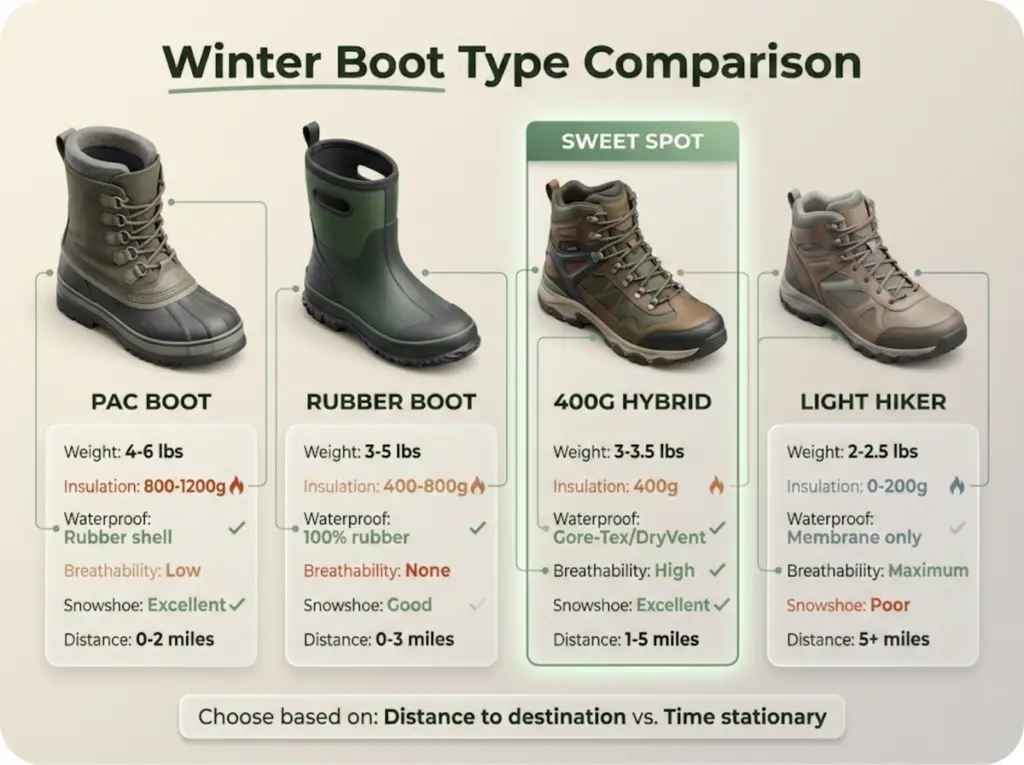
The key advantage: waterproof membrane technology like Gore-Tex or DryVent lets sweat escape during the hike, preserving insulation loft for the sedentary phase. The trade-off is honest—these boots won’t keep your feet warm below 15°F for extended sit-down sessions without supplemental help from a VBL system or aerogel insoles. But for the hike-in scenario of one to five miles in moderate winter conditions, they’re the sweet spot. Understanding the anatomy of an insulated hiking boot helps you evaluate where that 400g number actually sits in the structure.
The Sweat Paradox—And How to Beat It
Why Your Own Sweat Is the Real Enemy
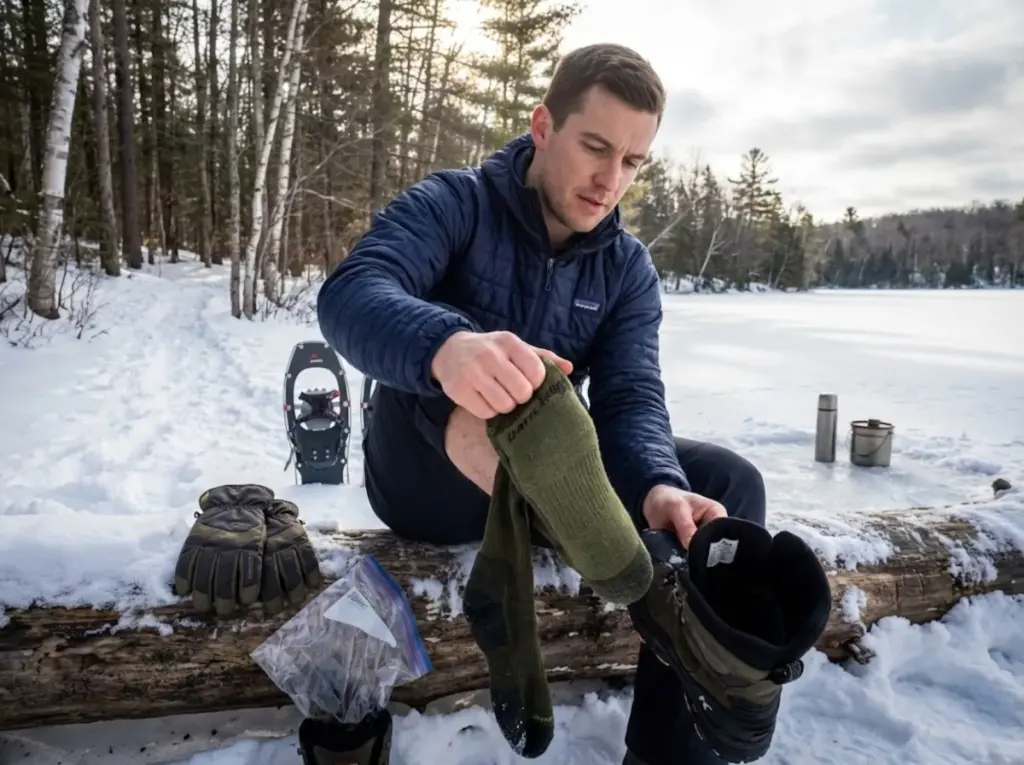
Here’s the uncomfortable truth: the biggest threat to your feet on the ice isn’t the cold. It’s your own moisture. As sweat evaporates from your skin, it pulls heat with it. Inside a boot, that vapor travels outward until it hits the dew point somewhere in the insulation and condenses back into liquid water.
That liquid water conducts heat away from your foot 25 times faster than dry material. Your insulation is dead. Even the best breathable membranes struggle in extreme cold—ice crystals can form inside the Gore-Tex layer itself, choking off vapor transmission. Over a multi-hour approach, every boot accumulates measurable moisture. The question is what you do about it.
The Vapor Barrier Liner Protocol
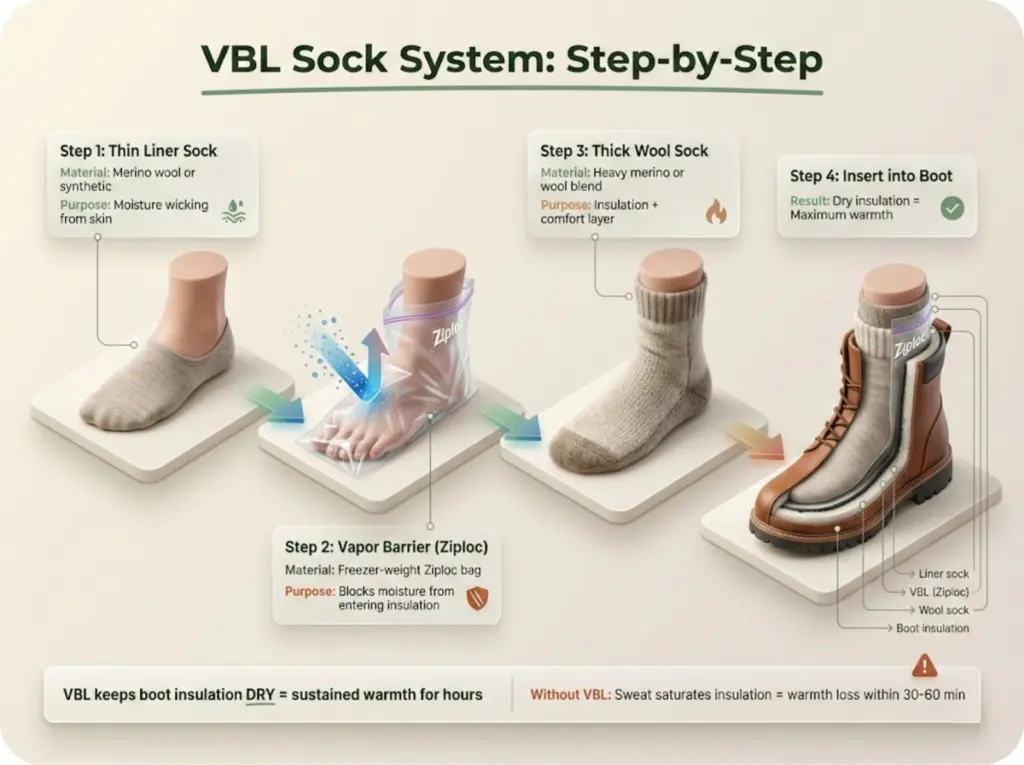
A vapor barrier liner is a non-breathable layer worn over a thin liner sock but under your insulating sock. Think of it as a wetsuit for your foot. It traps all moisture at the skin level so sweat never reaches your boot’s insulation.
The clever part: once the air against your skin hits 100% humidity, your sweat glands throttle back production. Your foot reaches an equilibrium where it’s slightly damp at the skin but bone-dry everywhere else. Andrew Skurka’s analysis of vapor barrier theory for cold-weather footwear breaks down how this works in detail.
For practical implementation: thin CoolMax liner sock, then the VBL (even a gallon-size Ziploc works), then a thick wool sock, then boot.
Pro tip: I carry two gallon-size Ziplocs in my vest pocket. They weigh nothing, cost nothing, and wrapping my socked feet before the approach has kept my insulation bone-dry through a 5-mile hike followed by 6 hours on Lake Erie. It’s the cheapest performance upgrade in all of winter sport.
The Sock Swap Strategy (No VBL Required)
If VBLs feel too clammy for your taste, the sock swap is simpler. Carry a dry pair of thick wool socks in a sealed bag. When you reach the fishing spot, peel off the damp hiking socks and pull on the dry pair before you sit down. Tuck the damp socks inside your jacket—body heat keeps them from freezing, and they’ll be partially dry for the hike out.
This method is easier but less effective, since it doesn’t address moisture already trapped in the boot insulation. Pair it with aftermarket aerogel insoles to add a thermal break and compensate. The principles behind the double sock system for blister prevention apply here too—managing friction and moisture at the skin level is half the battle.
The Hike-In Decision Framework—Distance Dictates Your Boot
Zero-Mile Scenario (Drive-On or Sled Access)
If you’re rolling your gear sled across a plowed ice road or parking 50 yards from the hole, warmth is the only variable that matters. No weight penalty concerns. No sweat management protocols. Grab the heaviest Pac boots you own—the Baffin Impact, the Titan, the Muck Boot Arctic Pro. Pour all your decision energy into insulation grams, calf circumference, and easy on-off for shelter transitions.
The Minnesota DNR’s ice safety guidelines are worth reviewing before any outing—good boot choice means nothing if the ice isn’t thick enough to hold you.
One-to-Three Mile Scenario (Backcountry Lake)
This is the crossover zone where your boot choice genuinely makes or breaks the day. You need enough insulation for hours of sitting but enough mobility for a real hike through deep snow. The Oboz Bridger 10″ and TNF Chilkat V 400 were built for exactly this scenario.
Critical factor: snowshoe binding compatibility. Your boot must fit universal bindings without pinching or sliding—test this before the trip, not at the trailhead. And sweat management protocols become mandatory for sessions longer than three hours. Whether you go VBL or sock swap, plan for it. Check our snowshoeing gear and technique guide for pairing advice.
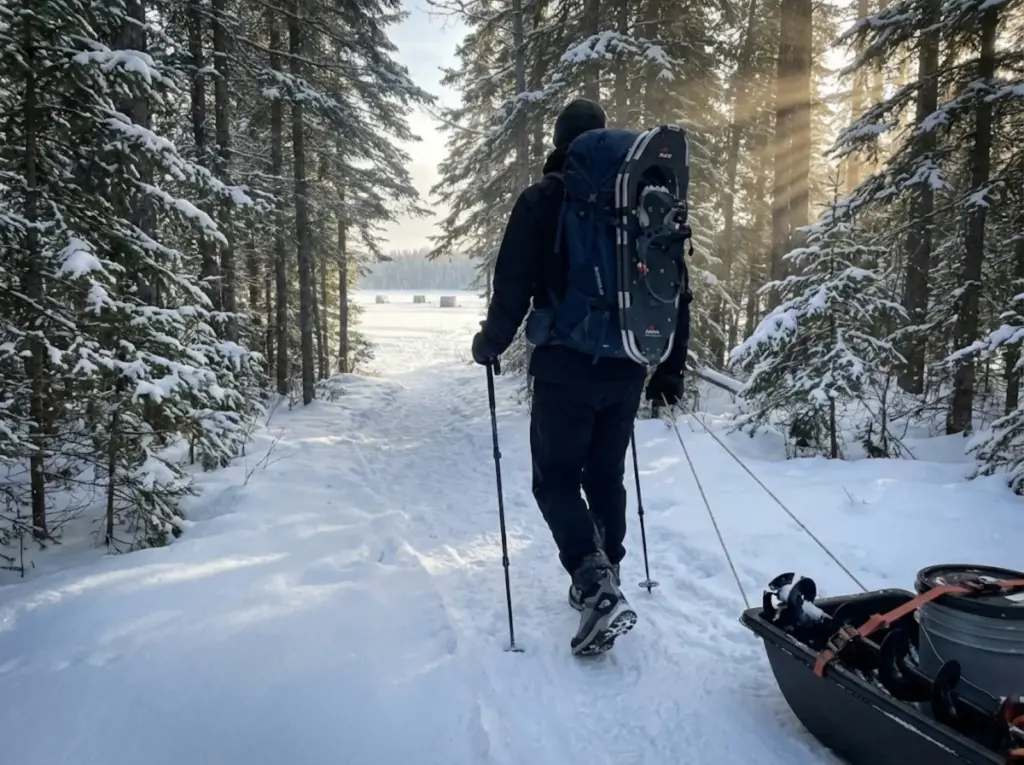
Three-Plus Mile Scenario (Mountain or Wilderness Access)
At this distance, every ounce matters. The 5:1 rule means a 4.8-pound Muck Boot costs you 14 pounds of effective pack weight versus a 2-pound Salomon. Mobility and sweat management outweigh absolute stationary warmth—you’ll be moving for 60 to 80 percent of the trip.
The smart play: standard winter hiking boots in the 200–400g range paired with a VBL system and aftermarket aerogel insoles. You’ll sacrifice some sitting comfort, but you’ll actually make it to the lake without destroying your calves. And if you’re breaking trail through unbroken snow, the energy cost of post-holing makes boot weight even more critical.
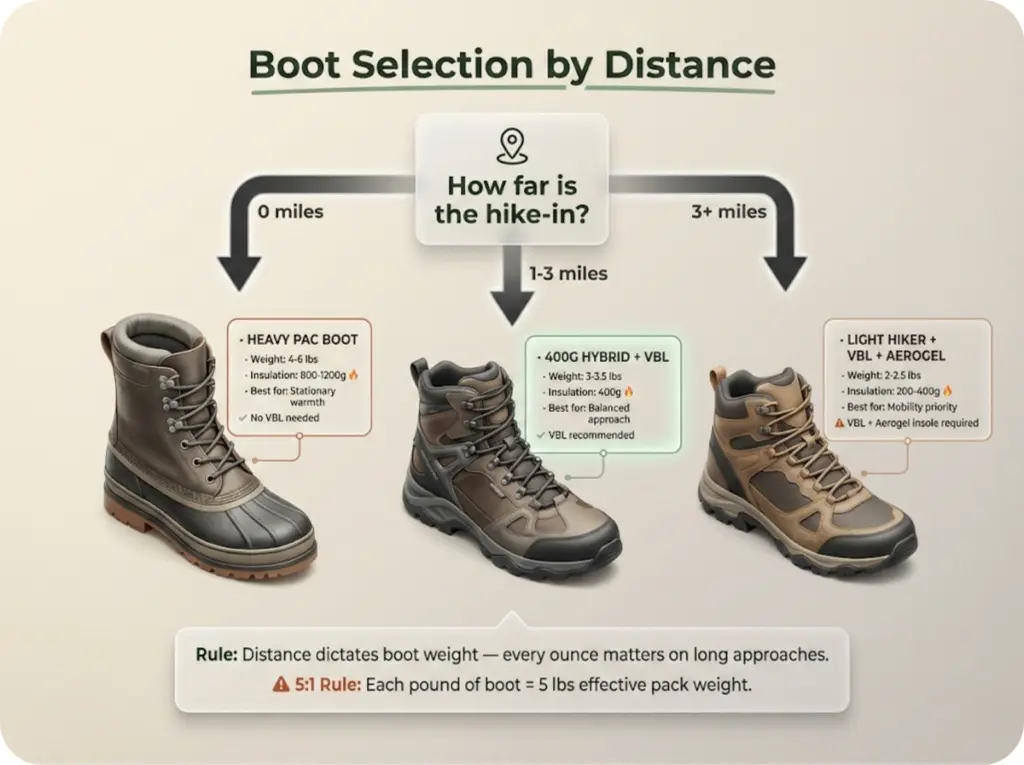
Pro tip: On a 6-mile approach to a frozen alpine lake in the Uintas, I wore 200g Salomons with a Ziploc VBL. Four hours of jigging later, my feet were cool but functional. The guy in Baffins turned back after 2 miles because his calves were screaming. Distance dictates.
Traction on the Ice—Lugs Won’t Save You
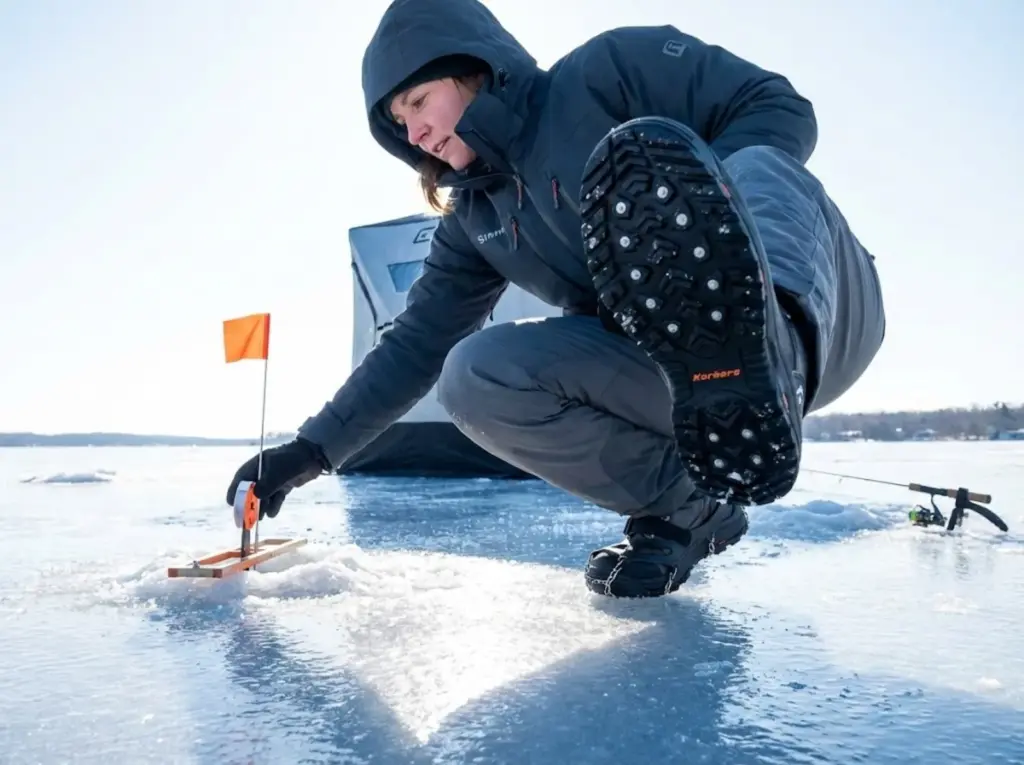
Integrated Swappable Soles (Korkers OmniTrax)
The Korkers OmniTrax sole system lets you swap between SnowTrac rubber lugs for trails and IceTrac plates with 32 carbide cleats for glare ice. The process takes about 60 seconds with gloves on—a real advantage when your fingers are already stiffening. The studs sit flush in a rigid platform, delivering consistent traction without the flex-point failures of strap-on devices. Replacement plates run $40–60 per pair, which is the trade-off for that versatility.
Microspikes and Yaktrax—When They Work and When They Fail
Kahtoola MICROspikes use stainless steel chains and hardened spikes that bite into packed ice reliably. They handle moderate slopes and frozen trail sections well, though they can shift under heavy torque—like when you’re cranking an auger. Yaktrax coils are budget-friendly but inadequate for true glare ice. They’re sidewalk tools dressed up as winter gear.
Both systems add 8 to 14 ounces of weight and the metal chains can conduct cold into the boot upper if they ride high enough. A gaiter buffers that contact. For a deep comparison, see our full microspikes vs. crampons breakdown.
The Deep-Lug Myth on Frozen Lakes
Deep rubber lugs provide excellent grip on soft or muddy terrain because they physically interlock with the surface. Frozen lake surfaces are too hard and smooth for lugs to engage—there’s nothing to bite into. Even Vibram Megagrip compounds lose grip on wet ice where a surface water film kills friction.
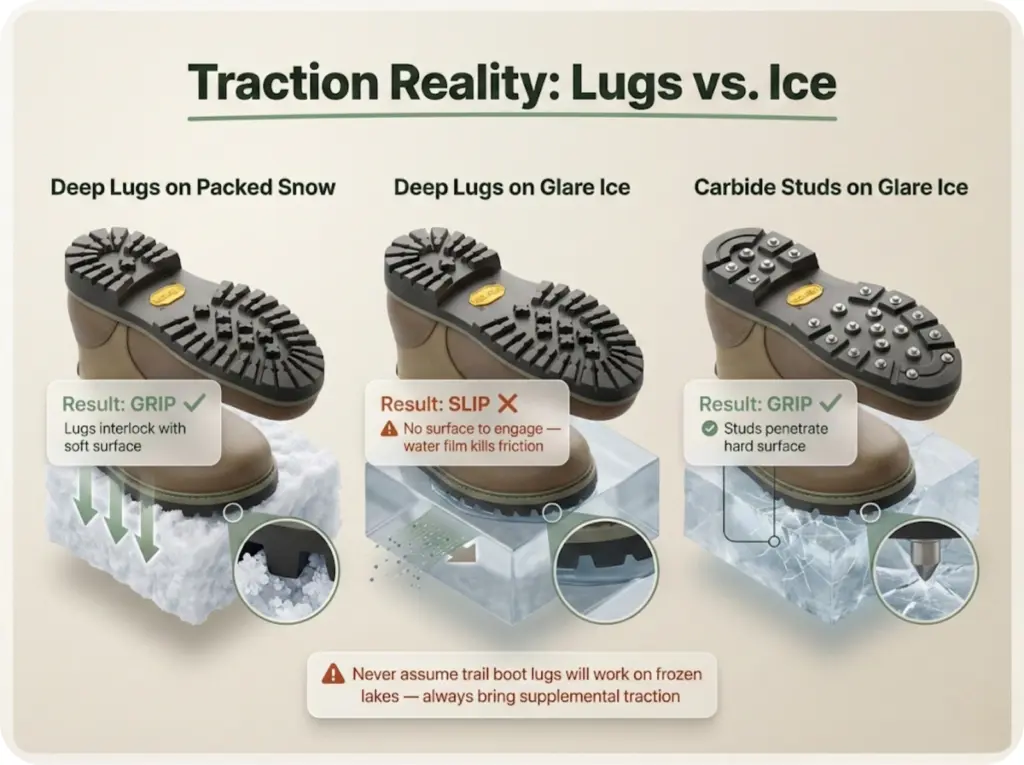
Only rubber compounds specifically engineered for wet ice—like Vibram Arctic Grip—maintain adequate contact. Never assume your trail boot’s outsole will keep you upright on the lake. Always bring supplemental traction, period. The data on how different rubber compounds perform on wet surfaces makes this point clearly.
Five Boots That Genuinely Do Both (Field-Tested Picks)
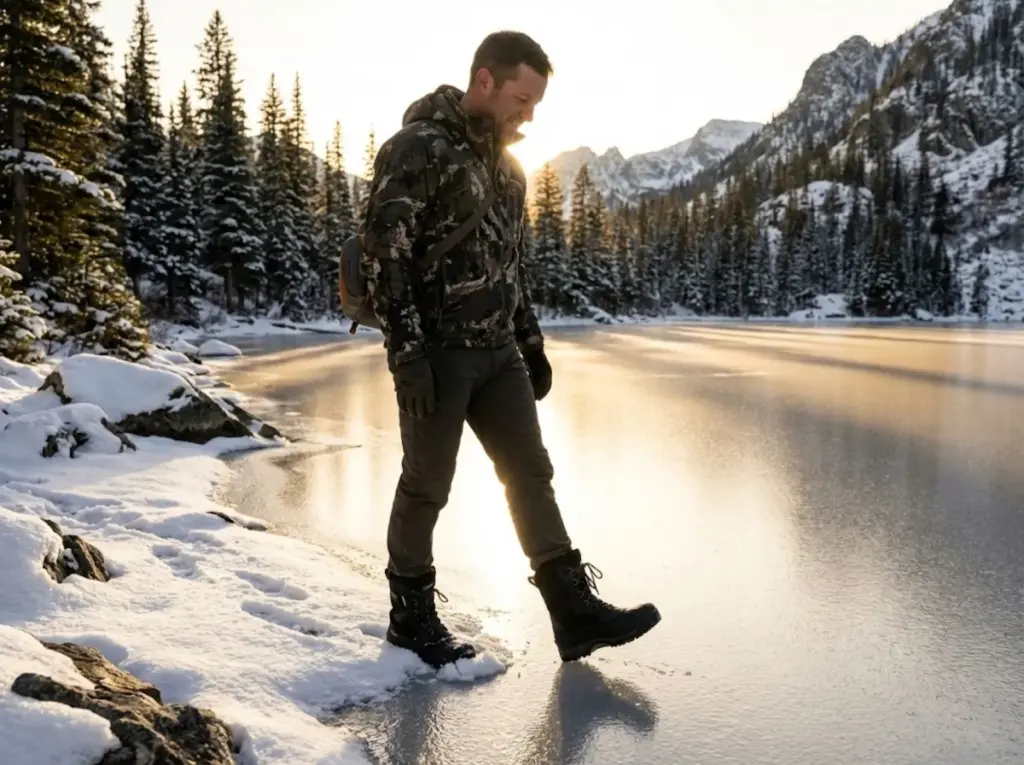
Korkers Polar Vortex 1200—The All-Terrain Specialist
The warmest hikeable boot on the market. 1200g Thinsulate combined with an aerogel frost barrier footbed means serious stationary warmth. The OmniTrax interchangeable soles let you swap trail lugs for 32-stud carbide on the fly, and the BOA fit system replaces laces entirely—adjust with gloves on, no fumbling. At 4.5 pounds per pair, it’s manageable for one-to-three mile approaches but too heavy for extended backcountry travel. Best for serious cold below 0°F.
Oboz Bridger 10″ Insulated—The Technical Hiker’s Pick
400g Thinsulate with a thermal-reflective insole strikes the crossover sweet spot. The TPU chassis and heel counter deliver the best ankle support in the category—this is a real trail boot with ice fishing capability bolted on. Compatible with nearly all snowshoe bindings and gaiters thanks to a proper heel ledge and toe D-ring. At 3.2 pounds per pair, the 5:1 rule puts this at only 6 pounds of effective penalty. Best for one-to-five mile approaches in 20°F to 0°F.
The North Face Chilkat V 400—Lightweight Crossover
400g Heatseeker Eco insulation in a package that moves and feels like a standard hiking boot. The Surface CTRL rubber outsole handles winter trail conditions and the 2.8-pound weight makes it the lightest true crossover option. The trade-off: an 8-inch shaft is shorter than competitors, so plan on gaiters for deep powder protection when snow gets above ankle depth. Best for three-plus mile approaches in moderate cold.
Muck Boot Arctic Ice—The Slush King
100% vulcanized rubber waterproofing with 8mm neoprene insulation and Vibram Arctic Grip outsole for wet-ice traction that few boots can match. The 15-inch shaft provides wader-like protection against spring slush and deep snow. Zero breathability means this is strictly a short-walk boot—never hike more than a mile in these. Best for drive-on ice fishing in slushy conditions or late-season trips where meltwater is the main threat.
Baffin Snow Monster—The Extreme Weather Option
The removable liner system uses Baffin’s B-Tek Heat hollow-fiber insulation with a material threshold rated to −40°F (realistic comfort closer to −10°F). The D-ring lacing system provides a hiking-oriented fit that Pac boots can’t match, and the nylon locking snow collar seals out powder without a separate gaiter. At 5.2 pounds per pair, it’s a reasonable middle ground between Pac bulk and hiker agility. Best for zero-to-two mile approaches in extreme cold below −10°F—think Minnesota, Wisconsin, northern Canada.
Conclusion
Three things to carry out of this piece:
The 400g threshold is your crossover line. Below it, winter hiking boots can’t sustain stationary warmth. Above 800g insulation, you’re hauling dead weight on the trail. The sweet spot sits right at 400g for most hike-in scenarios.
Distance determines your boot, not brand loyalty. Zero miles equals maximum insulation. One to three miles equals a 400g hybrid with sweat management. Three-plus miles means light hikers with a VBL and aerogel insoles. Match the boot to the approach, not the other way around.
Manage your sweat or lose your warmth. The vapor barrier protocol or a dry sock swap is the difference between fishing for six hours and bailing after 90 minutes. A $2 Ziploc bag is the most effective crossover technology money can buy.
Next time you plan a winter day that starts on the trail and ends on the ice, grab a gallon-size Ziploc, a spare pair of dry wool socks, and your 400g hikers. You’ve got everything you need.
FAQ
Can you wear regular hiking boots for ice fishing?
Yes, if they pack at least 400g insulation, an 8-inch or taller shaft, and compatibility with clip-on traction devices like microspikes. Below that threshold, expect numb toes within 90 minutes of sitting. Always supplement with a VBL or dry sock swap for sessions over three hours.
How many grams of Thinsulate do I need for ice fishing?
For stationary ice fishing with no movement, 800g insulation to 1200g is ideal. For crossover use with a hike-in, 400g is the minimum that works, provided you manage moisture and add an aerogel insole for a thermal break. Remember that manufacturer temperature ratings assume active movement—add 20–30°F for sitting conditions.
Are Muck boots good for ice fishing?
Muck Boot Arctic Pro boots are excellent for wet-ice and slush conditions thanks to 100% vulcanized rubber waterproofing and Vibram Arctic Grip outsoles. The catch: they trap internal sweat with zero breathability, making them a poor choice for hikes longer than one mile. Best for drive-on or short-walk scenarios.
What’s the warmest boot you can still hike in?
The Korkers Polar Vortex 1200 with 1200g Thinsulate and an aerogel footbed is the warmest boot that still retains enough hiking DNA for moderate approaches of one to three miles. At 4.5 pounds per pair, it’s a significant weight penalty. For longer hikes, drop to the Oboz Bridger 10 at 400g and 3.2 pounds, then add a VBL.
Do you need waterproof boots for ice fishing?
Yes. Standing on ice creates meltwater from body heat and pressure. Drilling and jigging splash water. Walking through slush is unavoidable. Vulcanized rubber construction like Muck Boot and Korkers outperforms waterproof membrane technology like Gore-Tex in slush-heavy environments because there are no seams to fail.

I've spent more than a decade researching hiking gear and trail technique. I read the specs, the forum threads and the long-term reviews, and every pick here comes with what it gets wrong.
End of the trail
You read every mile of this one. Here's where the trail goes next.