In this article
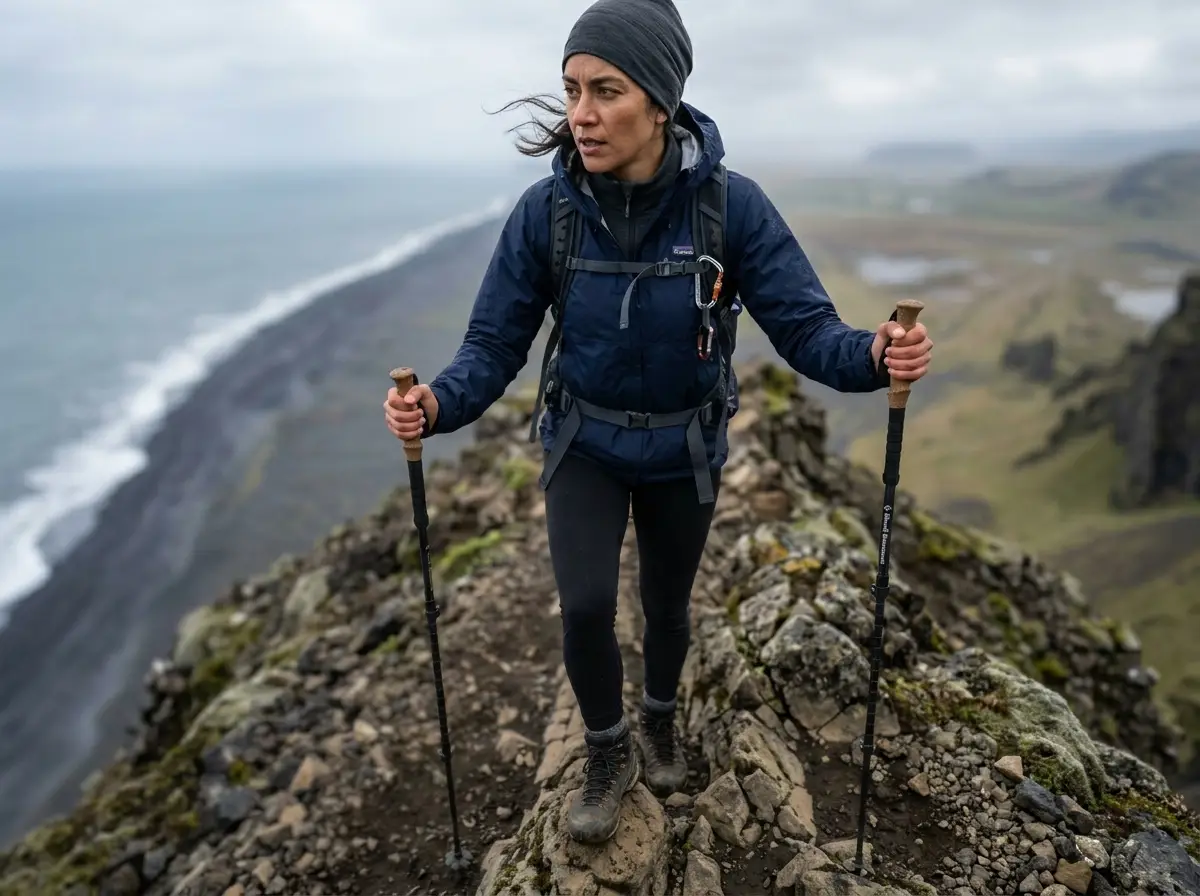
The ridge was barely a meter wide. On my left, a 123-meter freefall into Múlagljúfur Canyon. On my right, the North Atlantic grinding against black sand a thousand feet below. The wind hit 18 m/s — not enough to knock you over, but enough to make every step a negotiation. No railing. No trail marker. Just a line of boot-compressed moss pointing toward a viewpoint that 99% of Ring Road drivers never see from their windshields.
The famous stuff — Seljalandsfoss, the Jökulsárlón parking lot, the Skógafoss gravel pullout — exists for people on a schedule. If you have the right gear and read terrain instead of Google Maps, Route 1 opens into something else entirely. This guide covers those stops. Not the boardwalk version.
⚡ Quick Answer: The best hikes on Iceland’s Ring Road that avoid the tourist crowds are Múlagljúfur Canyon (5.8 km, 440m gain), Glymur (7.5 km loop, two river crossings), the Fimmvörðuháls traverse (25–30 km), Stuðlagil East Bank (6 km round trip), and Kristínartindar inside Skaftafell (17.9 km). All require proper waterproofing, trekking poles, and an honest gear audit before you leave Reykjavik. None of them have safety nets for unprepared hikers.
The Physics of Icelandic Terrain (Why This Is Not a Normal Hike)
Iceland sits on the Mid-Atlantic Ridge. The two tectonic plates underneath it spread apart at 2 cm per year, and the terrain reflects that — raw, geologically young, and structurally nothing like what you’d find in continental Europe or North America. The rock types you’re walking on matter: tholeiitic basalt, rhyolite, and palagonite each behave differently underfoot, and most hikers don’t think about this until they’re already sliding.
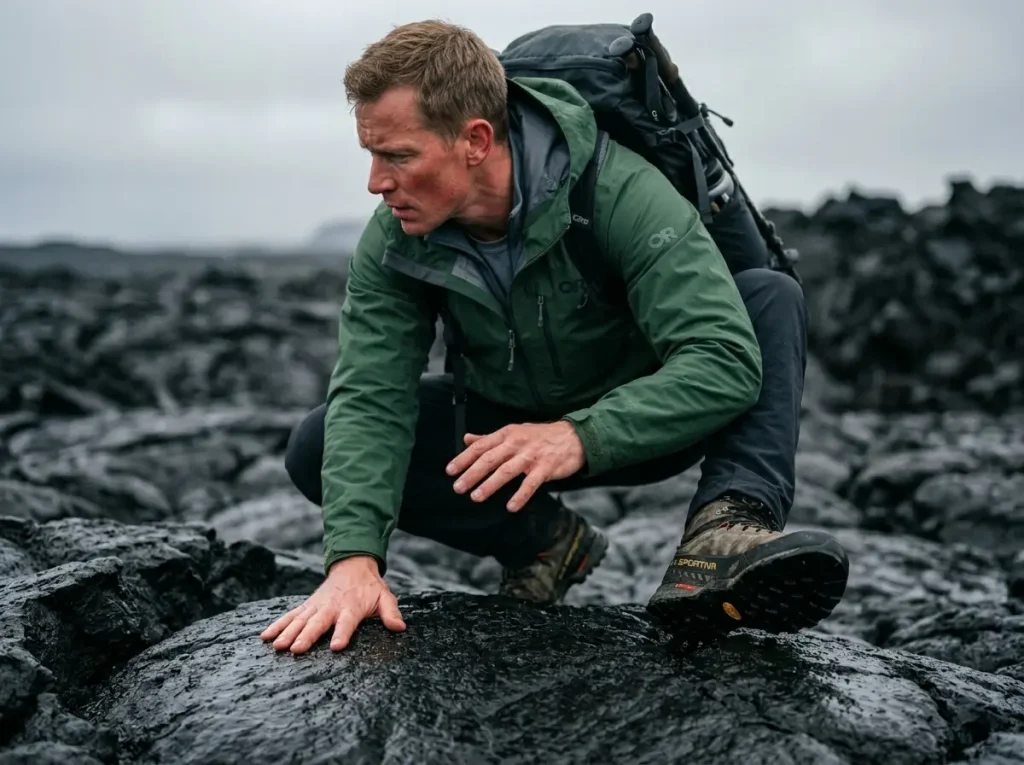
Dry basalt has solid grip. Wet basalt — polished by glacial rivers — approaches near-zero grip. The USGS definitions of Icelandic basalt formations and volcanic fissures lay this out in detail, but the practical version is simpler: treat every wet black rock like it’s glazed tile. Because it is.
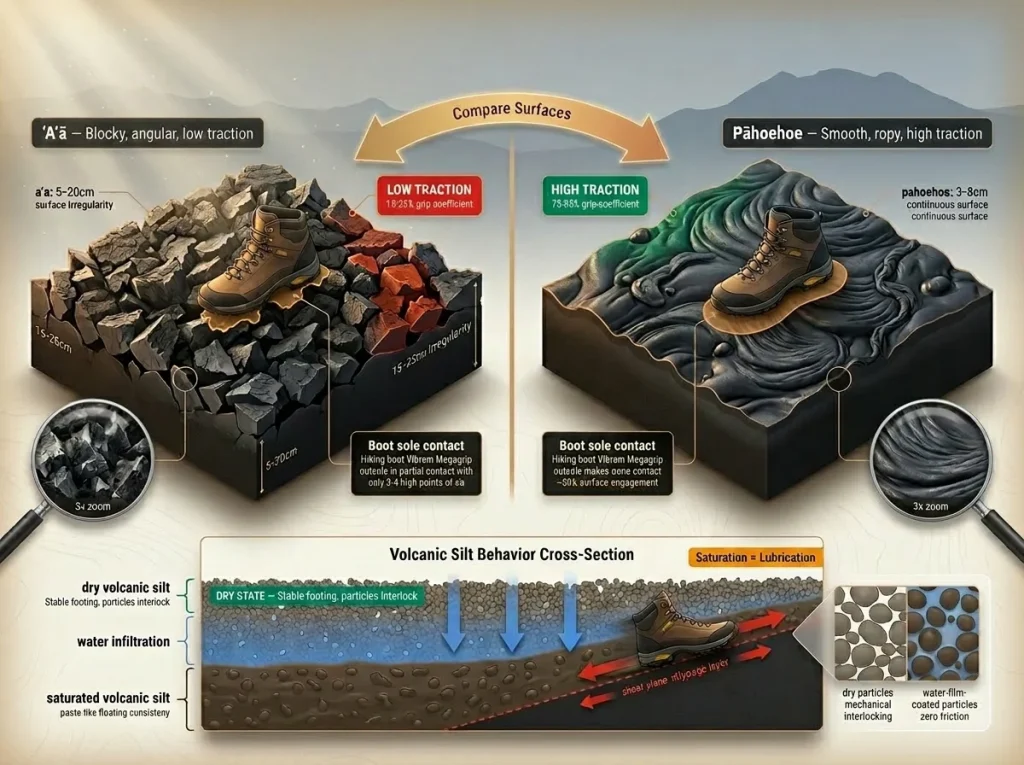
Volcanic silt is the other problem. Fine tephra from volcanic erosion lacks organic binding matter — the stuff that makes regular soil hold together. When saturated, it acts just like a slippery paste sitting on top of the underlying basalt. There is zero structural hold. This is why paying attention to which rubber compound actually grips wet volcanic rock matters before you ever book your flights.
Basalt vs. Rhyolite — Reading Rock Type Before You Step
The visual ID is simpler than it sounds. Basalt is dark gray to near-black, dense, and smooth on polished surfaces. Rhyolite shows pink, white, or green banding — lighter in color and more porous, which means it holds some rougher texture even when wet. That slight roughness is the difference between keeping your footing and sliding out.
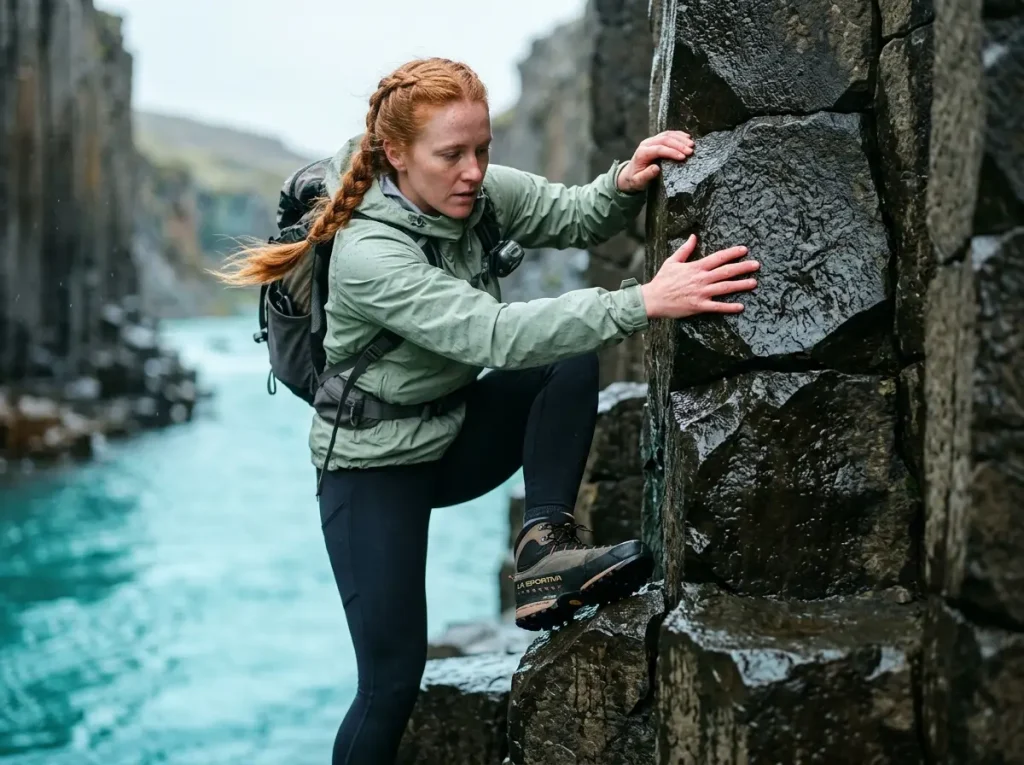
At Stuðlagil Canyon, every hexagonal column is polished wet basalt. Step on those surfaces like you’re stepping on ice. The tap test helps: knock your boot sole against the rock edge before putting weight on it. If it rings hollow, it’s a thin flake over empty air. Don’t trust it.
Pro-Tip: On any wet basalt section, lead with your heel and keep your center of gravity back. Your instinct is to lean forward on a slope. That’s the wrong instinct on Iceland’s rock.
Wind Speed and the Go/No-Go Matrix
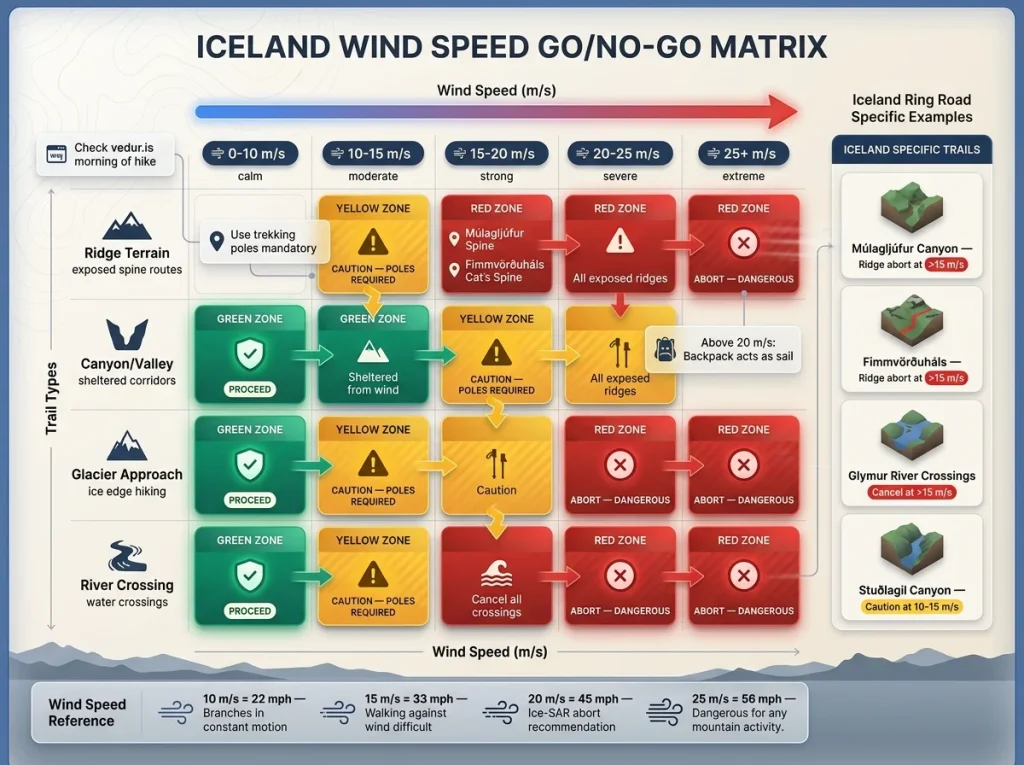
Below 10 m/s, you hike normally. Between 10 and 15 m/s, poles are mandatory on any ridge terrain — specifically Múlagljúfur’s spine section and Fimmvörðuháls’ Cat’s Spine. From 15 to 20 m/s, cancel any exposed ridge objective. Above 20 m/s, ICE-SAR recommends postponing all mountain objectives, and they’re not being cautious — at that speed, your backpack catches the wind like a sail, and keeping your balance on a narrow ridge becomes nearly impossible.
Check vedur.is the morning of every hike. Regional variance between coastal and highland weather stations runs 30% or more. What the Vík forecast says has little to do with conditions at 800 meters above it in the mountains.
The rock and the wind are fixed variables on the Ring Road, but the water introduces a chaotic third element. Understanding how the weather affects the rock is useless if you misread the timing of the rivers that cut through the terrain.
Glacial Hydraulics and the Afternoon Rule
Glacial meltwater is opaque. You cannot judge depth or bottom composition by looking at it. What you can predict is timing: solar-driven melt cycles mean river levels at 7:00 AM may be 40–60% lower than at 4:00 PM. A crossing that’s knee-deep at dawn can hit thigh-depth by mid-afternoon.
This applies directly to Glymur’s upper crossing and every Fimmvörðuháls river approach. The morning rule isn’t a suggestion — it dictates every decision involving glacial rivers on this route.
Southern Corridor — The Hydraulic Gateways (South Iceland)
Most Ring Road itineraries start here. Most hikers stop at the Skógafoss base and call it done. The actual technical route starts at the 527-step staircase — 140 meters of gain in the first 1.5 km — and continues into a completely different experience.
The Waterfall Way is 15.2 km round trip along the Skógá River, past 26 distinct waterfalls. At km 2, the well-maintained trail ends and you’re on volcanic silt and mud. That’s where knowing why a 3-layer hardshell is non-negotiable on Icelandic passes becomes a real conversation instead of a marketing pitch. The rain here blows sideways. A standard rain jacket completely fails under sustained wind-driven storms — the membrane cannot hold back the force of the rain driven by winds above 12 m/s.
Skógafoss Waterfall Way — The Technical Route Past the Staircase
Most hikers stop at the viewing platform atop the 527 steps. That’s where the Waterfall Way begins, not where it ends. Surface transitions happen fast at km 2 — you go from a well-maintained trail straight into volcanic silt and mud. A sticky rubber sole paired with a deep lug is the correct setup here to stop you from sliding sideways on the muddy slopes overlooking the Skógá gorge. Trekking poles are not optional past km 3, where canyon edge exposure starts.
Navigation note: 26 waterfalls sounds like easy orientation. It isn’t. Visual distraction is a real navigation hazard on this route. If the trail becomes hard to follow after km 5, you’ve drifted. Retrace to the last clear cairn rather than pushing forward on assumption.
Fimmvörðuháls — Cat’s Spine to Þórsmörk
The full traverse is 25–30 km with 1,100m gain between Eyjafjallajökull and Mýrdalsjökull — including the volcanic ash fields from the 2010 eruption, which is terrain that hasn’t fully settled yet.
The Kattarhryggur (Cat’s Spine) ridgeline is the crux: steep ravines on both sides, loose ash, and wind funneling directly through the pass.
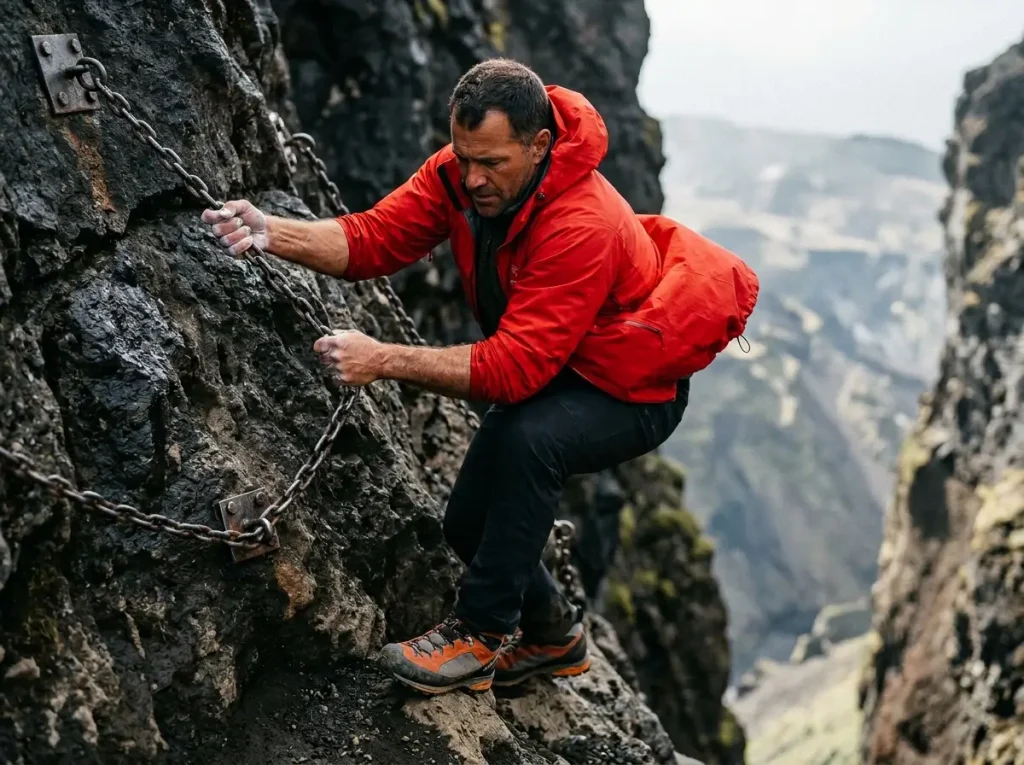
I gripped the Fimmvörðuháls chain in full winter gloves during a 12 m/s gust, and I could feel the metal vibrating straight through the insulation. It’s not technical rock climbing, but when you’re clinging to rock over a 300-meter ravine, mid-ridge is the wrong place to discover you have a fear of heights.
Ten-point crampons or microspikes are mandatory until late July. Check SafeTravel.is the actual morning of departure — not the night before. Pre-arrange return transport from Þórsmörk; the only early exit is the Baldvinsskáli hut at km 19.
Pro-Tip: On the fixed chain section, tough gloves matter regardless of how warm your hands are. Bare skin on a metal chain at walking pace creates a serious risk of tearing your skin over repeated hand placements. The chain is not optional on the descent into Þórsmörk — it’s the only way down.
Southeast Corridor — The Vatnajökull Frontier
The Vatnajökull ice cap covers 14% of Iceland’s entire landmass. The ice is up to 950 meters thick in places. That massive scale dictates the water flow and geology of every single hike in the southeast. Glacial floods have repeatedly washed away bridges and roads here, which is why an understanding of the risk assessment of mass-movement-triggered glacial lake outburst floods (GLOFs) shapes how you should plan trips differently than on the South Coast.
Múlagljúfur Canyon — Accessing Iceland’s Best-Kept Secret
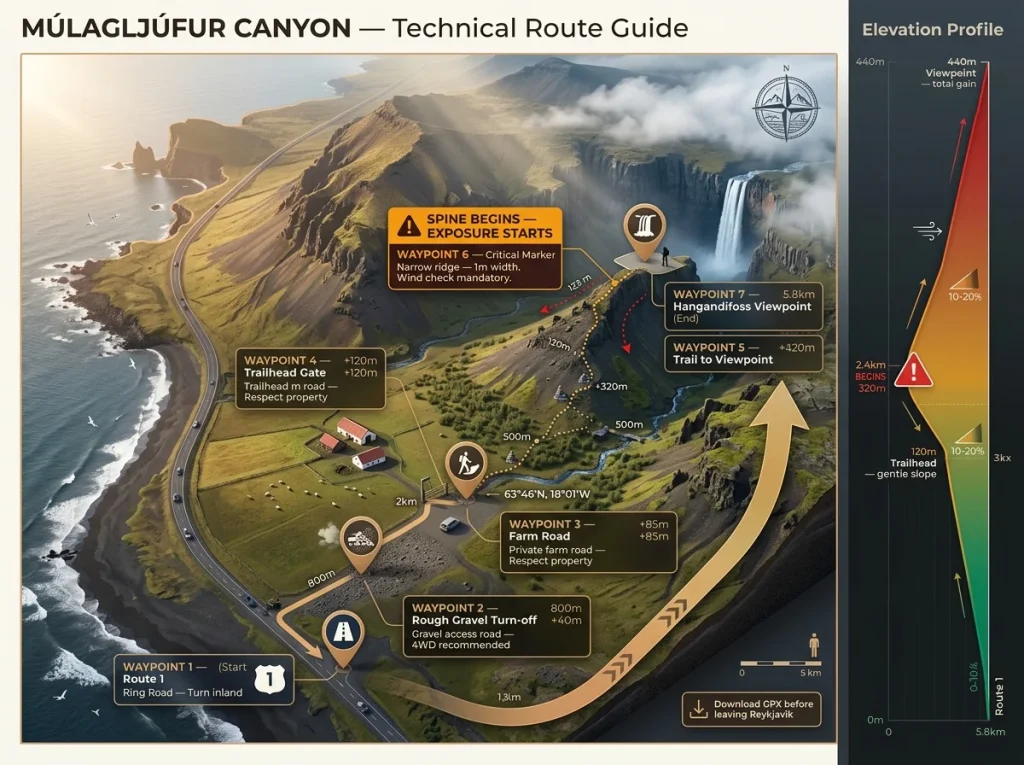
The trailhead is just a gravel pull-off, 5 km west of Fjallsárlón. Single gate. No sign. The first 2 km run through farmland on a faint dirt track. If you mess this up, you’re trespassing. Phone maps will not get you here reliably — download the GPX file before you leave Reykjavik, and save the trailhead coordinates offline: 63°46’N, 18°01’W.
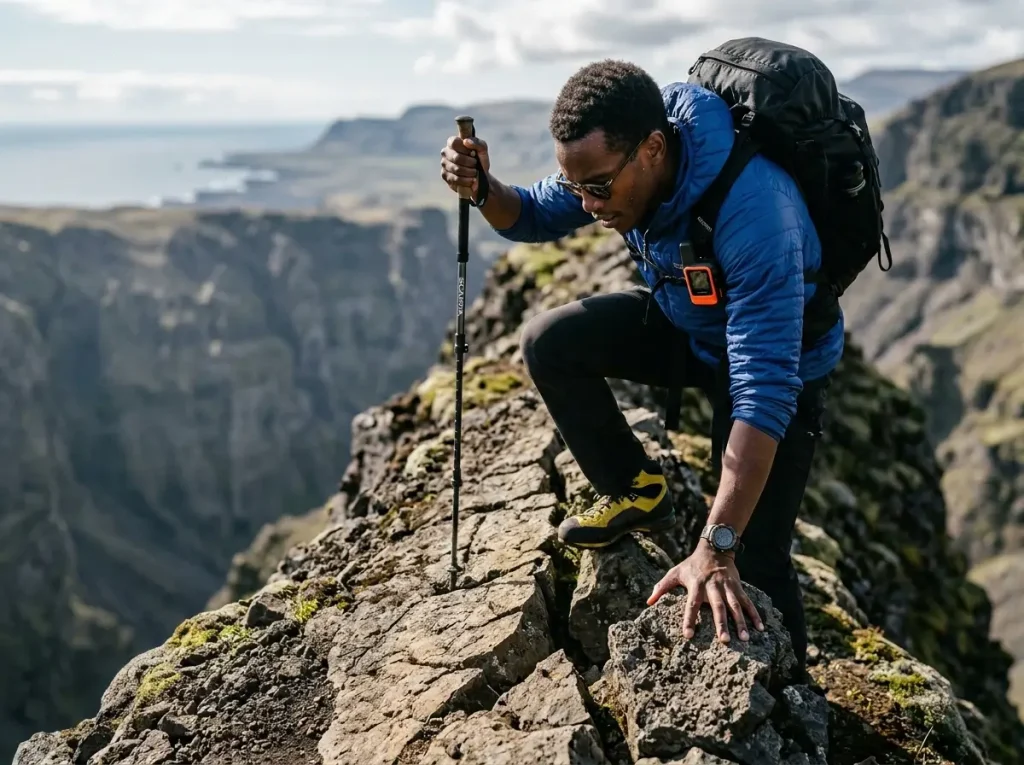
The hike is 5.8 km round trip with 440m of gain. That sounds moderate, but the spine section, which begins around km 2.4, tells a different story. You’re walking on loose basaltic scree and moss-covered rock on a path narrow enough that two people need to pass each other carefully. Hangandifoss drops 123 meters directly below the endpoint. There is absolutely no protection from the wind — if conditions are kicking over 15 m/s when you hit the open ridgeline, abort the hike.
The 360-degree Atlantic coast view doesn’t reveal itself until you’re at the very top. You won’t know if the view is clear or completely fogged in until you arrive. That’s just the deal you make with the mountain.
Kristínartindar — The Alpine Benchmark of Skaftafell
Access this via the Skaftafell Visitor Center and make sure to register your route with the staff. The first 6 km run through simple birch scrub, but this accessibility will completely mislead you about the terrain ahead. The summit push involves over 2 km of unstable scree where every single foot placement requires a deliberate decision.
Route S4 is officially closed from March through June. During this time, the thawing ground turns into a slurry of shifting rock and water. It is impassable and highly hazardous, and search teams will not authorize rescues in this zone outside the open season. The shoulder season closures and thaw-based trail hazards rules apply directly to this mountain. July and August are your reliable window, and even then, afternoon mountain storms are common. Turn around if visibility drops below 5 km — you are hiking 17.9 km to see the Vatnajökull ice cap and the Öræfi glacier tongue. There’s no point in finishing the climb if you can’t even see the ice.
Eastfjords — The Basalt Labyrinth
East Iceland sees roughly 70% less traffic than the South Coast during peak season. That fact alone makes it worth prioritizing. Stuðlagil Canyon is the centerpiece here — but the side of the river you hike dictates exactly what kind of trip you have.
The West Bank platform (Grund) is the one in every social media photo. You walk down a staircase, stand on a platform, and leave. The East Bank is a true 6 km round trip hike along the Jökla River, featuring no formal trail markers, active route-finding on unmarked riverbanks, and a rough scramble section to access the bottom of the gorge.
Pro-Tip: Use the NOAA magnetic declination calculator for high-latitude compass calibration before navigating anywhere in the Eastfjords. Magnetic declination here runs 11°–13° West. On a 10 km route in low visibility, an uncorrected compass will push you nearly 2 km off course through lateral drift.
Stuðlagil East Bank — The Technical Access Route
The East Bank trailhead approaches from Route 923 via the Klaustursel farm road. A 4WD vehicle is heavily recommended; 2WD is sometimes possible in dry conditions but never guaranteed. The route follows the Jökla’s east bank entirely lacking any formal trail markers. You are navigating by reading the riverbank terrain.
Accessing the actual riverbed to stand among the hexagonal columns requires a 3–4 meter scramble. Maintain three points of contact at all times. The columns are polished smooth by the glacial river — dense, hard basalt with almost zero grip when wet. Assisting ropes are occasionally present where the trail drops down, but they frequently wash away. Assume they will not be there.
The absolute best time to hike this is from late July to mid-September. That is when the river runs lower, exposing the full height of the columns.
Navigation in the Eastfjords — Declination Is Not Optional
Set a hard catching feature before leaving any trailhead in this region. Route 1 runs perpendicular to most Eastfjords routes — if you lose your bearings, descending perpendicular to your approach almost guarantees you will hit the coastal highway.
On your GPS unit, verify the WMM 2025 model is loaded. Older firmwares default to outdated models and accumulate enough error over distance to matter on a heavy fog day in the fjords. Thick ocean fog in the Eastfjords frequently rolls in silently without rain to warn you. When the air turns totally gray and flat, your GPS becomes your primary survival tool.
West Iceland — The Glymur Crossing Laboratory
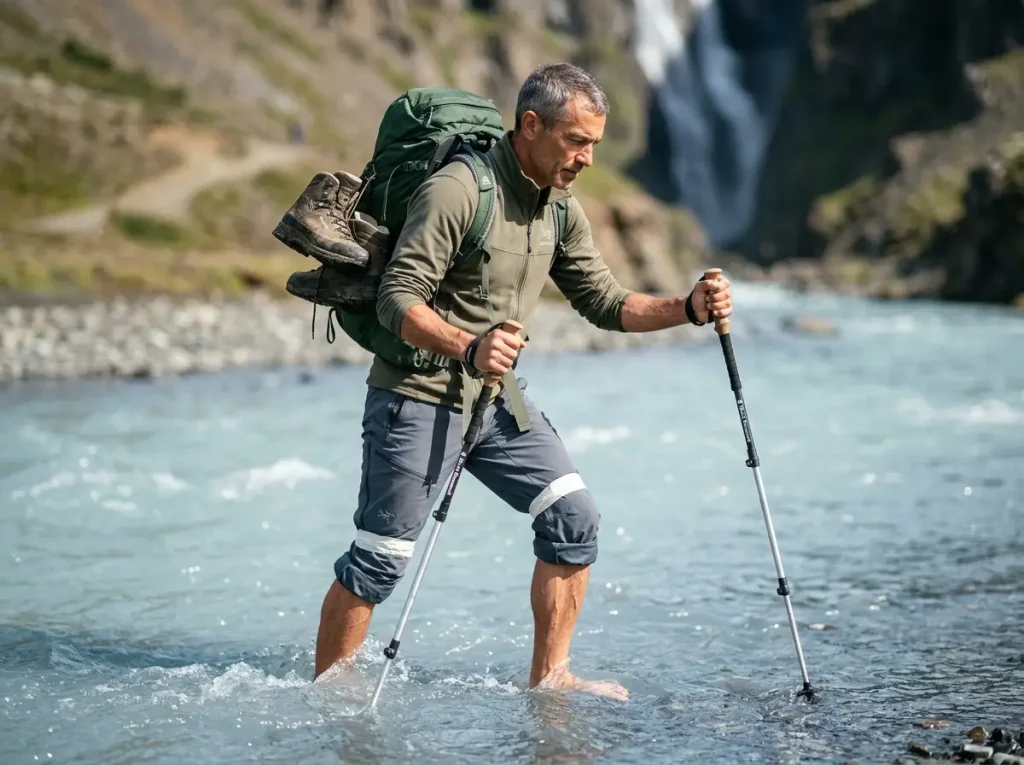
Most hiking apps label Glymur as a “moderate” trail. That label is doing a massive amount of heavy lifting. The 7.5 km loop features 425m of elevation gain and requires two mandatory river crossings of the Botnsá River. One of them always demands a barefoot wade, and the other might have a log bridge — depending entirely on when you show up.
Iceland’s second-tallest waterfall at 198 meters is the payoff. But the route makes you earn every step.
The Lower Botnsá Crossing — Log, Cave, or Wade?
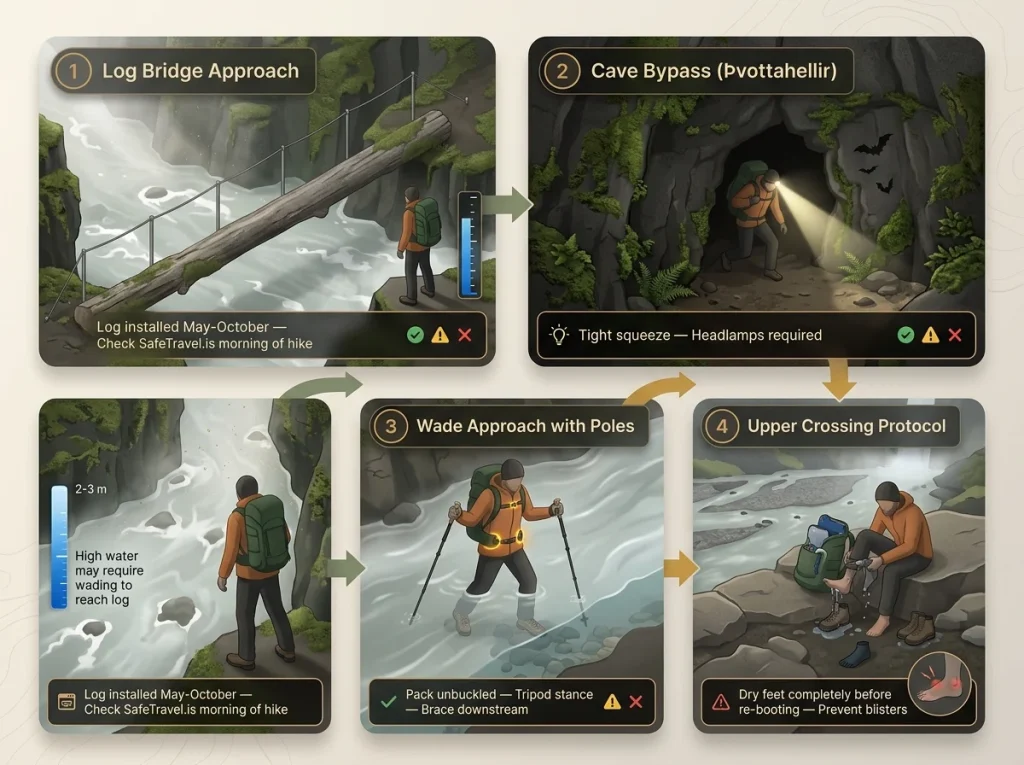
From May to October, ICE-SAR field teams install a log bridge with an overhead safety cable. But check the SafeTravel.is log placement updates and river hazard protocols the actual morning of your hike. That log status can change overnight if heavy spring floods hit the canyon.
Even when the log is firmly in place, high water levels frequently require hikers to wade 4–5 meters just to reach the start of the wood. The log doesn’t eliminate the river crossing; it just manages the deepest part.
The cave bypass (Þvottahellir) offers a dry alternative when water levels allow. It’s a tight squeeze, heavily reliant on headlamps, and getting a fully loaded 40L pack through it usually means turning sideways. If the log is gone, you’re wading the main channel. Apply the depth-velocity rule: if the water sits above thigh depth at the widest point, abort the crossing.
For the full methodology on staying upright, the breakdown on physics-based river crossing protocols that work in glacial water covers what you need — specifically the pack-unbuckling rule and how to properly brace with trekking poles.
The Upper Crossing and Waterfall Viewpoint Protocol
The upper crossing is a mandatory wade. There is no infrastructure and no dry bypass. Pull your boots off and dry your feet completely on the far bank before putting your socks back on. Hiking in damp socks degrades into miserable blister conditions within an hour on the steep 3-hour descent. Neoprene toe socks make a massive difference at water temperatures of 1–4°C, which is standard for the peak season.
I waded the upper Botnsá crossing in late May when the water was hovering right around 2°C. Even at knee depth, the current force was strong enough that I had to heavily brace with two trekking poles angled downstream. The pair of hikers behind me tried to cross with one pole each—halfway across, one of them went down hard on their knee. The river here isn’t rapids-fast, but it is entirely relentless.
Always cross at the widest, shallowest point of the braided gravel bar, even if it forces you to walk an extra 100 meters upriver. If the water hits your thighs in the middle of the river, the viewpoint is inaccessible that day. Once across, stay back at least 3 meters from the edge. There is no railing, it’s a 198-meter vertical drop, and winds blow hard off the glacier.
Pro-Tip: Monitor SafeTravel.is daily starting in late May to be among the first hikers to cross the moment the Botnsá log is laid down. Getting to Glymur early in the season when the crowds are zero and a dusting of snow remains is worth hitting refresh on your browser.
Gear Science for the Icelandic Ring Road
Iceland’s rain is heavily wind-driven — meaning it blows completely horizontal, easily defeating both umbrellas and typical rain hood designs. The only things that matter out here are the protective membrane between your body and the storm, and the rubber separating your feet from the sliding ground.
Basic 2.5-layer shells fail rapidly when sustained 15+ m/s winds drive rain completely through them. Your actual baseline should be a 20,000mm waterproof rating paired with excellent breathability. A quick look into what waterproof ratings actually mean for Icelandic conditions will tell you exactly why checking your gear specs is critical before landing.
The 3-Layer Shell as Non-Negotiable Safety Equipment
A high-end rain jacket is not a comfort item on an Icelandic trail — it is your primary defense line against hypothermia in a high-wind, 100% humidity environment. Wearing cotton base layers is the fastest way to end up sitting in a rescue vehicle on the South Coast. Cotton traps moisture and instantly loses all its insulation value, and rapid-onset hypothermia in freezing wind does not take very long.
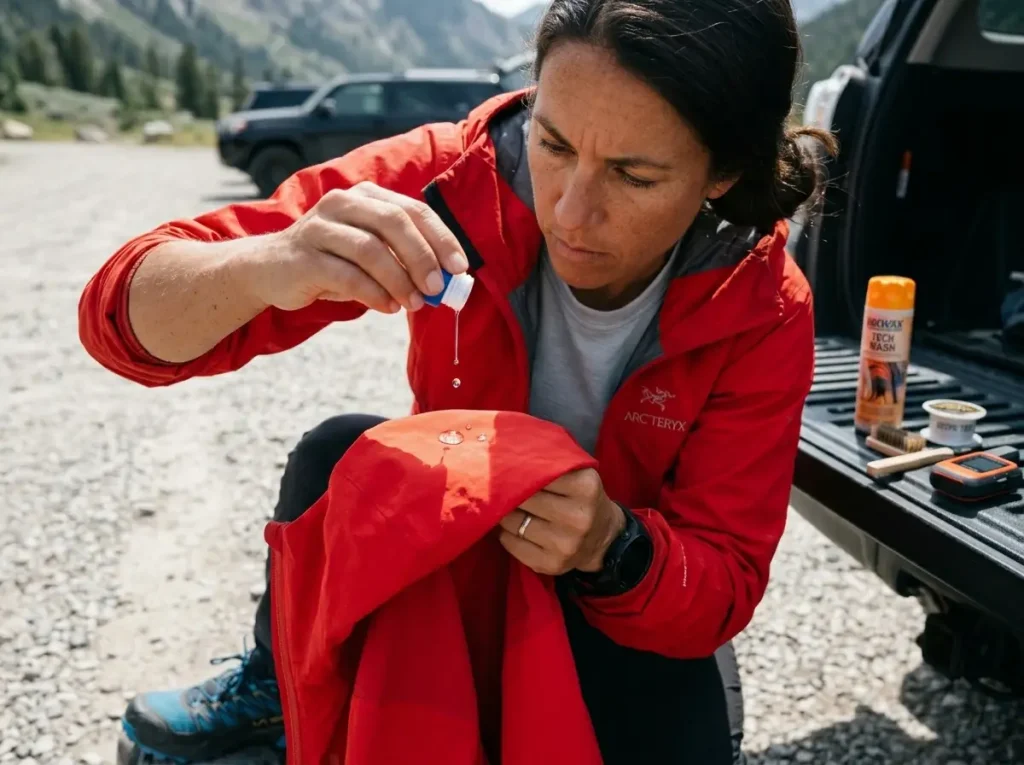
Your layering system needs to be simple: a moisture-wicking merino or synthetic base, a fleece or down mid-layer, and a reliable 3-layer shell over everything. Run the water bead test on your shell in the sink before you pack it. If the water absorbs into the fabric rather than bouncing off, immediately wash it and apply a heavy DWR treatment like Nikwax. Excellent shells like the Arc’teryx Beta SL or the Patagonia Torrentshell consistently handle these harsh environments.
Footwear Selection — Sole Chemistry vs. Lug Depth
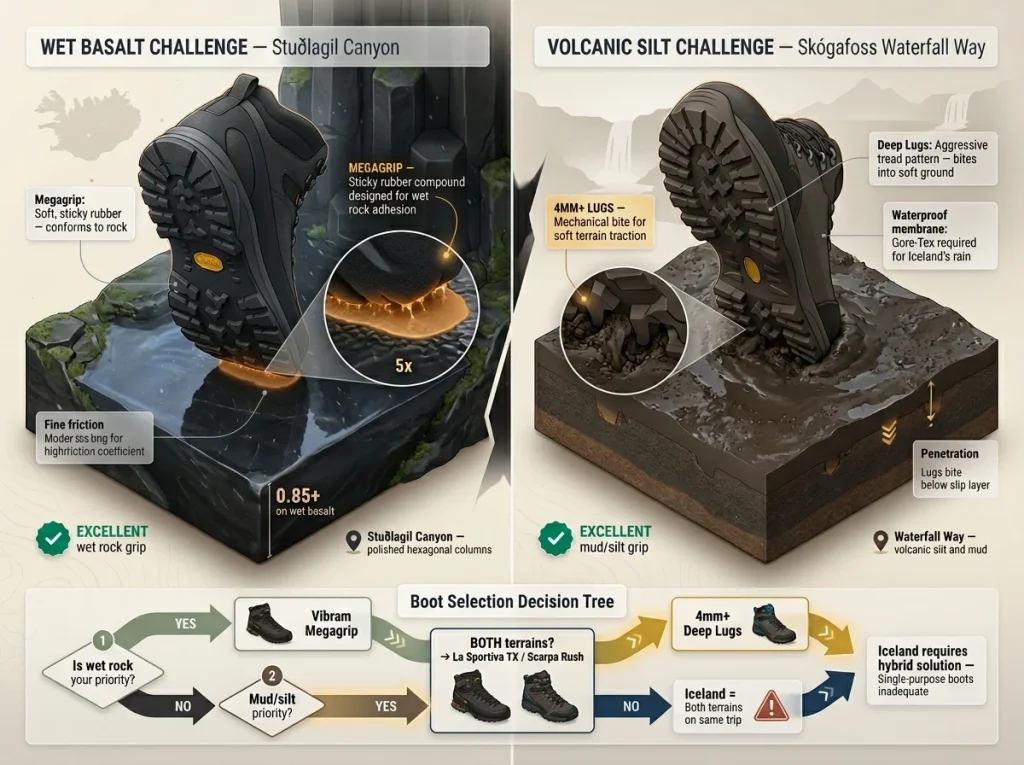
You are dealing with two entirely separate footwear problems: wet rock grip (basalt at Stuðlagil) and wet soil traction (volcanic silt on the Waterfall Way). Different terrain problems are rarely solved by the same boot.
Vibram Megagrip is built specifically for wet rock using a sticky, energy-absorbing rubber — you want this compound for Stuðlagil and any glacier approaches. However, deep-lug outsoles (4mm+) handle volcanic silt by physically biting down into the mud. The problem is that a boot with massive lugs might use a tough, hard rubber that completely fails to stick on wet basalt. The sweet spot is Megagrip combined with a deep 4mm lug tread, such as the La Sportiva TX series or the Scarpa Rush family. Iceland’s relentless rain will defeat any external waterproof spray within two hours; an internal Gore-Tex membrane is fully required.
Rain shells and rubber outsoles handle the baseline reality of Icelandic weather, but shoulder-season trips introduce hard ice and compacted snow. Your boots are only as good as the steel you can attach to them when the elevation increases.
Traction Devices and the Boot-Crampon Compatibility Rule
Standard crampons require stiff mountaineering boots with a welt cut into the heel. The majority of trail runners do not fit this profile. Microspikes — specifically the 10-point, 3/8″ stainless steel models — work perfectly with most standard hiking boots and provide exactly what you need for Fimmvörðuháls in the spring.
Lightweight coiled traction devices simply do not work on Icelandic volcanic slopes. They snag on abrasive rock and offer zero grip when things get steep. Always verify the current snowpack levels via SafeTravel.is the morning you depart.
Conclusion
Three brutal realities govern every good outcome on Iceland’s Ring Road trails. First: the locations truly worth reaching are the ones without a welcome sign — Múlagljúfur’s hidden gravel gate, the Stuðlagil East Bank farm road, or the unmarked pull-off for Fimmvörðuháls. The difficulty of accessing them is exactly what acts as the filter. Second: Iceland’s terrain plays by entirely different rules than continental Europe or North America. Saturated volcanic silt, glass-smooth basalt columns, and horizontal driving rain demand gear choices based on hardcore material performance, not colorful marketing brands. Third: the morning rule dictates every interaction with glacial water — crossings are categorically safer in early daylight, and no summit selfie justifies ignoring that hard line.
Before you fly into Keflavík, download Gaia GPS with the offline Iceland topo layer loaded, run the sink test on your rain shell, and set active browser alerts for SafeTravel.is. One solid hour of technical preparation at home is the definitive gap between a great expedition and a costly evacuation.
FAQ
Is it easy to hike in Iceland?
Iceland’s trails range from easy wooden boardwalks to demanding technical rock scrambles. The physical terrain is only half the picture. Wind-driven rain, massive visibility drops, and fast glacier-fed rivers can flip a seemingly moderate trail into a survival situation within thirty minutes. The required technical readiness simply exceeds what average travelers pack for.
Do I need a guide for Iceland hikes?
For the South Coast waterfalls and Stuðlagil Canyon, you do not need a guide if you carry proper gear and know how to read the weather. For the Fimmvörðuháls traverse, Kristínartindar passes, and any hike near glacial edges, hiring a certified local guide is a smart call unless you already possess deep alpine multi-day experience. Actual glacier walking always requires a guide — you cannot spot the hidden crevasse hazards without formal training.
What is the best month for hiking in Iceland?
July and August offer maximum trail access, zero snow on the Ring Road approaches, and fully installed river logs. June works well but commonly requires microspikes at higher elevations. September thins out the crowds but brings much shorter daylight hours and a sharp rise in aggressive autumn storms. Avoid technical Ring Road mountain hikes completely from October to May unless you are an experienced winter mountaineer.
Can you hike the Ring Road itself?
Route 1 is a two-lane paved asphalt highway moving cars at high speeds. Hiking the Ring Road actually refers to hiking the technical trails located off its numerous stops — like Skógafoss, Múlagljúfur, or Glymur — not walking alongside the asphalt. You use a sturdy vehicle to access each distinct day-hike objective.
Do I need a 4WD for Ring Road hiking trailheads?
You can reach most Ring Road spots in a 2WD vehicle, including Skógafoss, Glymur, and the busy Stuðlagil West Bank. However, the Múlagljúfur rough gravel approach strongly favors high-clearance 4WD vehicles. Escaping the crowds at Stuðlagil’s East Bank via Route 923 absolutely requires 4WD or a very high stance. By law, any mountain track stretching into the Highlands strictly mandates a 4WD vehicle.
Risk Disclaimer: Hiking, trekking, backpacking, and all related outdoor activities involve inherent
risks which may result in serious injury, illness, or death. The information provided on The Hiking Tribe is for
educational and informational purposes only. While we strive for accuracy, information on trails, gear, techniques,
and safety is not a substitute for your own best judgment and thorough preparation. Trail conditions, weather, and
other environmental factors change rapidly and may differ from what is described on this site. Always check with
official sources like park services for the most current alerts and conditions. Never undertake a hike beyond your
abilities and always be prepared for the unexpected. By using this website, you agree that you are solely
responsible for your own safety. Any reliance you place on our content is strictly at your own risk, and you assume
all liability for your actions and decisions in the outdoors. The Hiking Tribe and its authors will not be held
liable for any injury, damage, or loss sustained in connection with the use of the information herein.
Affiliate Disclosure: We are a participant in the Amazon Services LLC Associates Program, an
affiliate advertising program designed to provide a means for us to earn advertising fees by advertising and linking
to Amazon.com. As an Amazon Associate, we earn from qualifying purchases. We are also an official affiliate partner
of Black Diamond Equipment via the AvantLink network. If you click on a Black Diamond affiliate link and make a
purchase, we may earn a commission at no additional cost to you. We also participate in other affiliate programs and
may receive a commission on products purchased through our links. Additional terms are found in the terms of
service.