In this article
You took a CPR class at work. You practiced on a manikin on a clean floor under fluorescent lights, with an instructor counting for you and an AED simulator beeping on cue. You felt prepared.
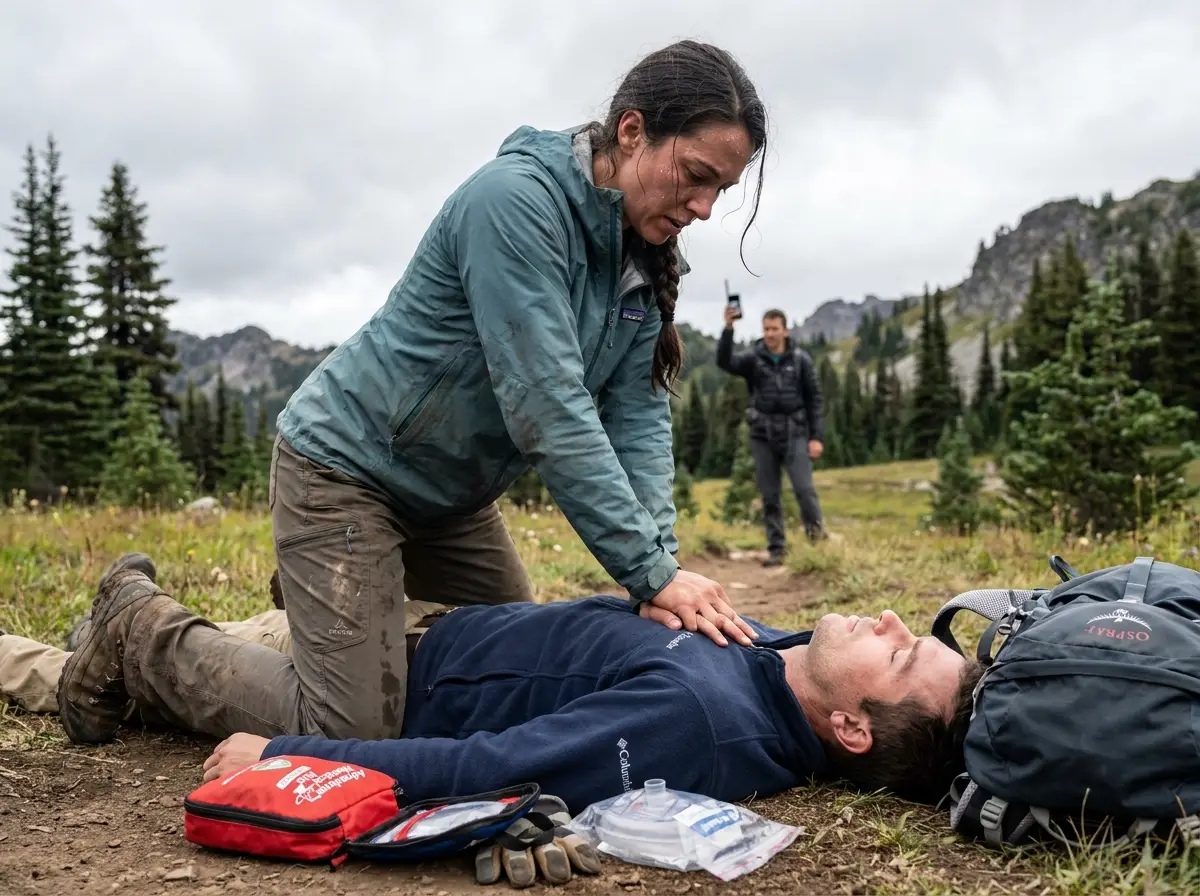
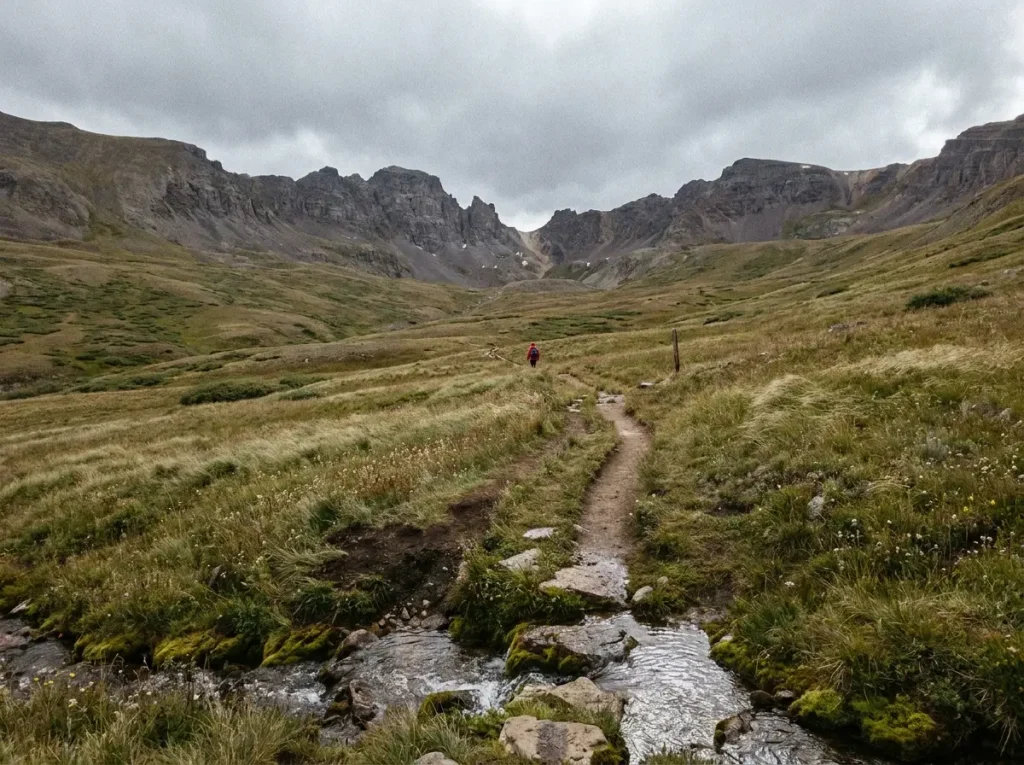
Then someone in your hiking group collapsed on a rocky switchback at 9,000 feet, an hour from the trailhead, with no cell signal and no flat surface in sight. Everything you learned in that classroom evaporated in about five seconds.
I’ve been through wilderness first aid training twice. The biggest thing both courses taught me was how little standard CPR class prepares you for reality. Here’s what’s different, what your classroom instructor never mentioned, and how to bridge the gap before you need it.
Quick Answer: Standard CPR training fails in the backcountry because of these key differences:
- No flat, firm surface — you’re compressing on dirt, rock, or slope
- No EMS arriving in minutes — you ARE the help for 30+ minutes
- Rescuer fatigue hits in 2 minutes but you may need to compress for 30
- Hypothermia changes the rules completely — compressions can be harmful
- The decision to stop CPR falls on YOU, not a paramedic
What Makes Wilderness CPR Different
The CPR technique itself — hand position, compression depth, rate — is the same whether you’re in a hospital or on a mountain pass. What changes is everything around it.
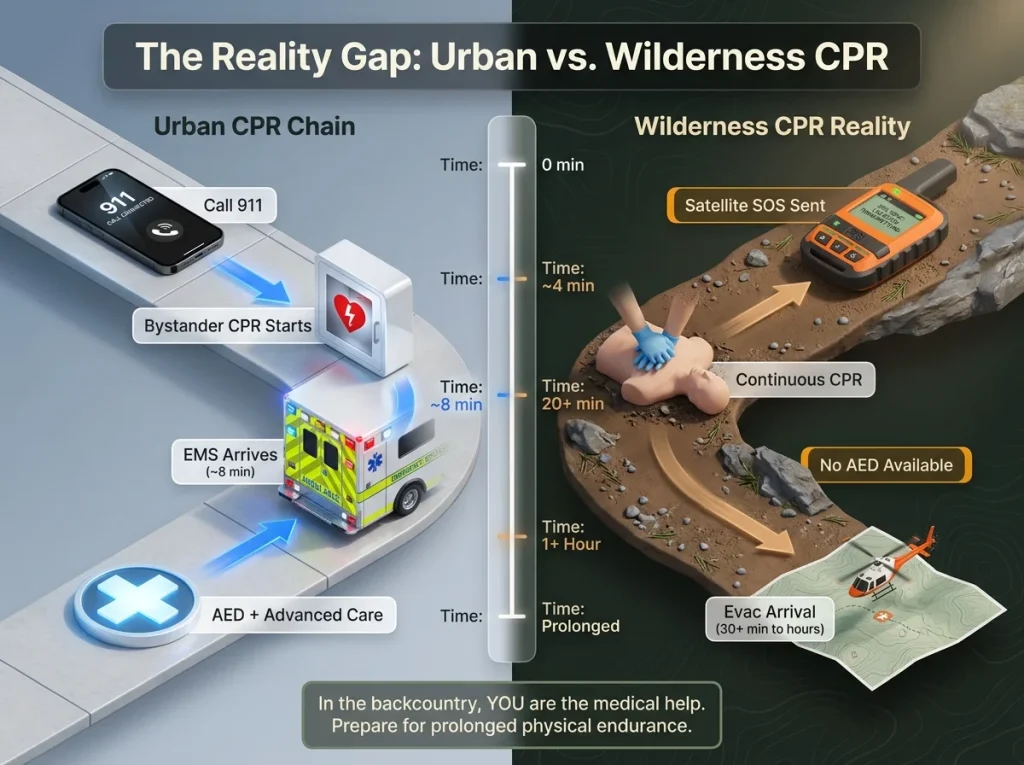
In an urban setting, your job is to keep someone alive for 8 to 12 minutes until an ambulance arrives with a defibrillator and drugs. In the backcountry, you might be the only medical resource for an hour or more. That time difference changes every decision you make.
The Time Problem
Standard CPR training assumes help is coming fast. The American Heart Association designs its protocols around the urban chain of survival: someone calls 911, bystander CPR starts, EMS arrives with an AED and advanced cardiac life support. The average urban EMS response time is 7-10 minutes.
On a trail 5 miles from a trailhead with no cell service, that chain breaks at step one. Your satellite messenger SOS takes 5-15 minutes to reach a dispatch center. The helicopter — if one is available — takes 30-90 minutes to arrive. Ground rescue could take hours.
That means YOU are providing CPR for 30 minutes or more, not 8. That changes everything about fatigue management, team coordination, and the decision to stop.
The Surface Problem
Every CPR class uses a firm, flat floor. Effective chest compressions require a rigid surface behind the patient — your force needs to compress the chest, not push the patient into soft ground.
On a trail, you might be dealing with a slope, loose dirt, gravel, snow, or a narrow ledge. Finding and preparing an adequate surface is a step your classroom instructor never mentioned, and it needs to happen before the first compression.
The Equipment Gap
An AED increases cardiac arrest survival by roughly 50% compared to CPR alone. Your chance of survival drops about 10% for every minute defibrillation is delayed. On a trail, you almost certainly don’t have an AED. That’s not a reason to skip CPR — compressions alone keep oxygenated circulation going — but it means you need realistic expectations about outcomes.
For a broader look at wilderness first aid that actually works in the backcountry, the patient assessment system is the framework everything else hangs on.
Scene Assessment Before You Touch the Patient
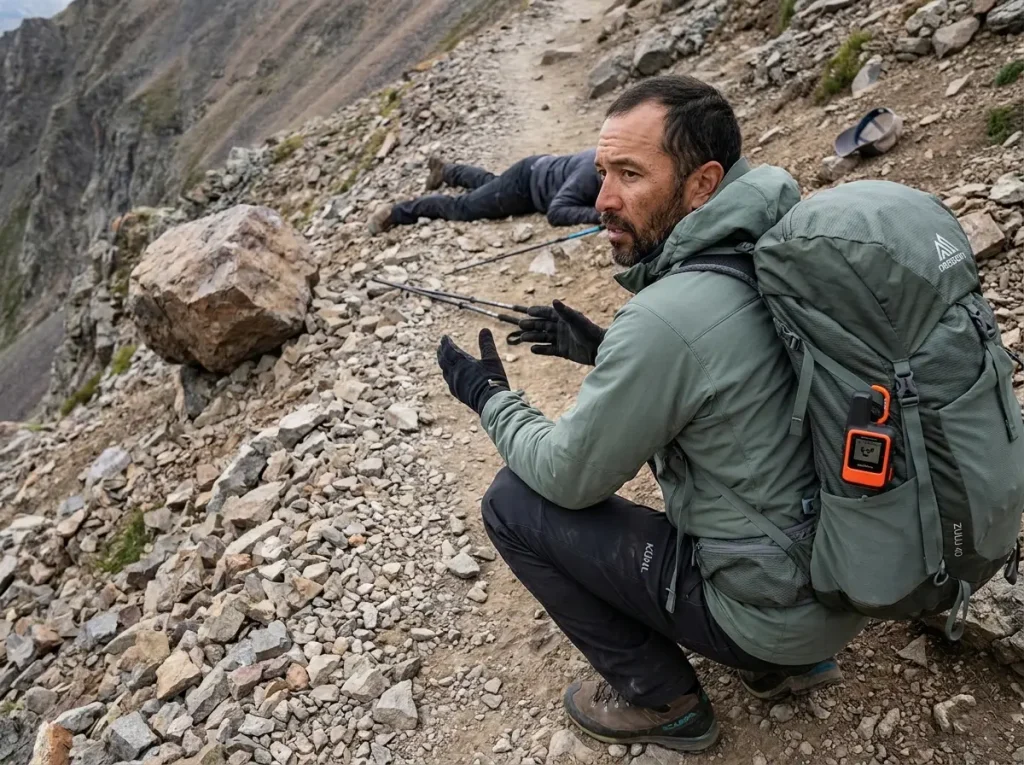
Your first instinct when someone collapses is to rush over and start doing something. Fight that instinct. Scene assessment comes before patient contact, always.
Check for Ongoing Hazards
The thing that hurt the patient can hurt you. Rockfall, lightning exposure, unstable terrain, moving water — scan the scene for 10 seconds before approaching. A second patient doesn’t help anyone.
If the scene isn’t safe, make it safe first. Move loose rocks. If you’re on an exposed ridge during a thunderstorm, you need to move the patient to lower ground before starting CPR — compressions on a ridgeline during lightning is two victims waiting to happen.
The Tap-and-Shout Method
Once the scene is clear, assess responsiveness. Tap the patient’s shoulders firmly and shout: “Are you okay? Can you hear me?” Do this from both sides. An unresponsive person who is still breathing normally does NOT need CPR — they need the recovery position and monitoring.
If the person is unresponsive and not breathing (or only gasping — agonal breaths look like irregular gulps, not normal breathing), that’s your trigger for CPR.
Activate Your Emergency Plan
Before starting compressions, get your emergency signal moving. If you’re in a group, assign one person to operate the satellite messenger or hike to cell range while you work. If you’re solo, send the SOS first, note your GPS coordinates, THEN start CPR. Those 30 seconds of signaling could cut rescue time by hours.
Pro tip: Program your satellite messenger’s SOS message template before every trip with your planned route and number of people. When you press that button under stress, you want the message to send useful information automatically.
If you carry a PLB, knowing the difference between emergency whistles and personal locator beacons matters before the emergency happens, not during it.
Chest Compressions on a Backcountry Surface
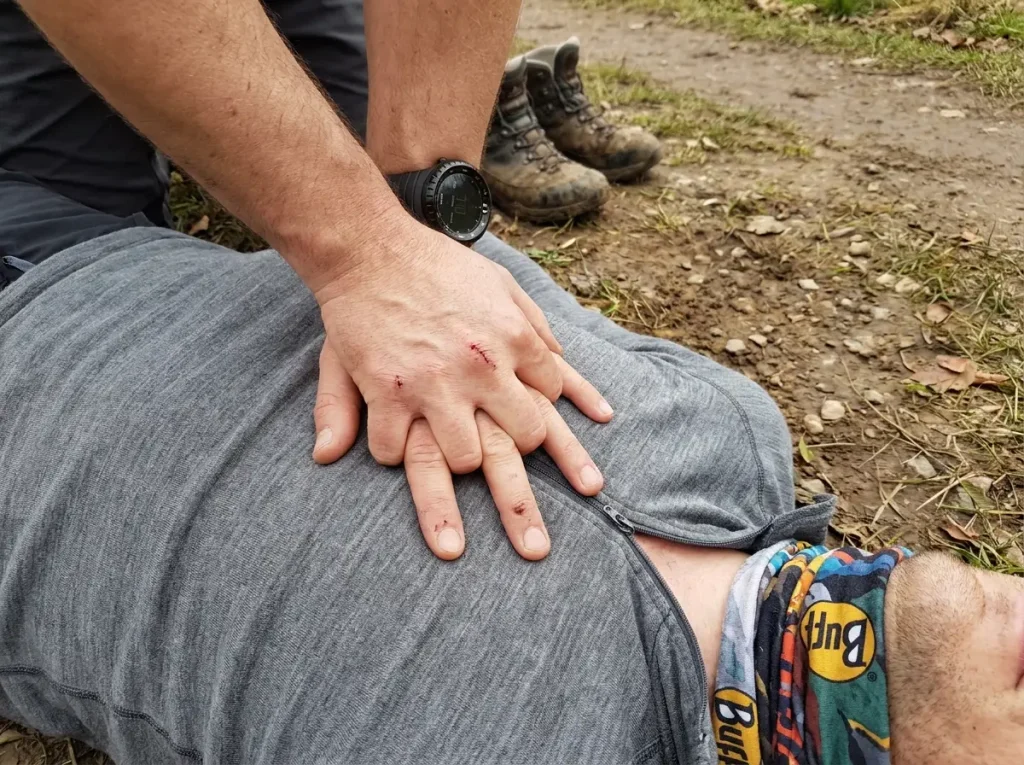
This is where classroom training and field reality diverge hardest. The technique is the same — the execution environment is completely different.
Finding and Preparing Your Surface
Before the first compression, you need a surface that’s as flat and firm as possible. In the backcountry, “possible” is the key word — you’re optimizing, not perfecting.
Clear rocks and debris from a 3-by-6-foot area. If you’re on a slope, position the patient perpendicular to the fall line with their head slightly uphill — this prevents you from sliding downhill during compressions and keeps circulation directed toward the brain.
On soft ground (deep pine needles, sandy soil), consider placing a pack frame or a flat rock under the patient’s back between the shoulder blades. Compressions into soft ground waste energy — your force pushes the patient into the dirt instead of compressing the chest.
Hand Position and Compression Mechanics
Place the heel of one hand on the center of the patient’s chest, between the nipples. Stack your other hand on top, fingers interlaced and lifted so only the heel contacts the chest.
Lock your elbows. Position your shoulders directly above your hands. Compress straight down — at least two inches deep — using your upper torso weight, not your arm muscles. Arms tire fast. Torso weight is sustainable.
Rate: 100 to 120 compressions per minute. The beat of “Stayin’ Alive” by the Bee Gees is the standard reference. Let the chest fully recoil between compressions — don’t lean on it.
Rescue Breaths vs. Hands-Only CPR
Current AHA guidelines support hands-only CPR (continuous compressions, no rescue breaths) for untrained bystanders and for situations where you lack a barrier device. In the backcountry, hands-only CPR is acceptable and effective, especially if you don’t carry a pocket mask.
If you DO have a pocket mask and are trained, the standard 30:2 ratio (30 compressions, then 2 breaths) is more effective for prolonged resuscitation. After 30 compressions, tilt the head, lift the chin, seal the mask, and deliver two one-second breaths. Watch for chest rise. Then immediately resume compressions.
The critical point: don’t stop compressions for more than 10 seconds to deliver breaths. Interruptions in compressions destroy the pressure you’ve built in the circulatory system. If breaths aren’t working (no chest rise, poor seal), skip them and continue hands-only.
Pro tip: A CPR pocket mask weighs less than 2 ounces and packs flat. Throw one in your first aid kit. It’s the single cheapest piece of gear that could save a life, and it protects you from direct fluid contact.
Managing Rescuer Fatigue in the Backcountry
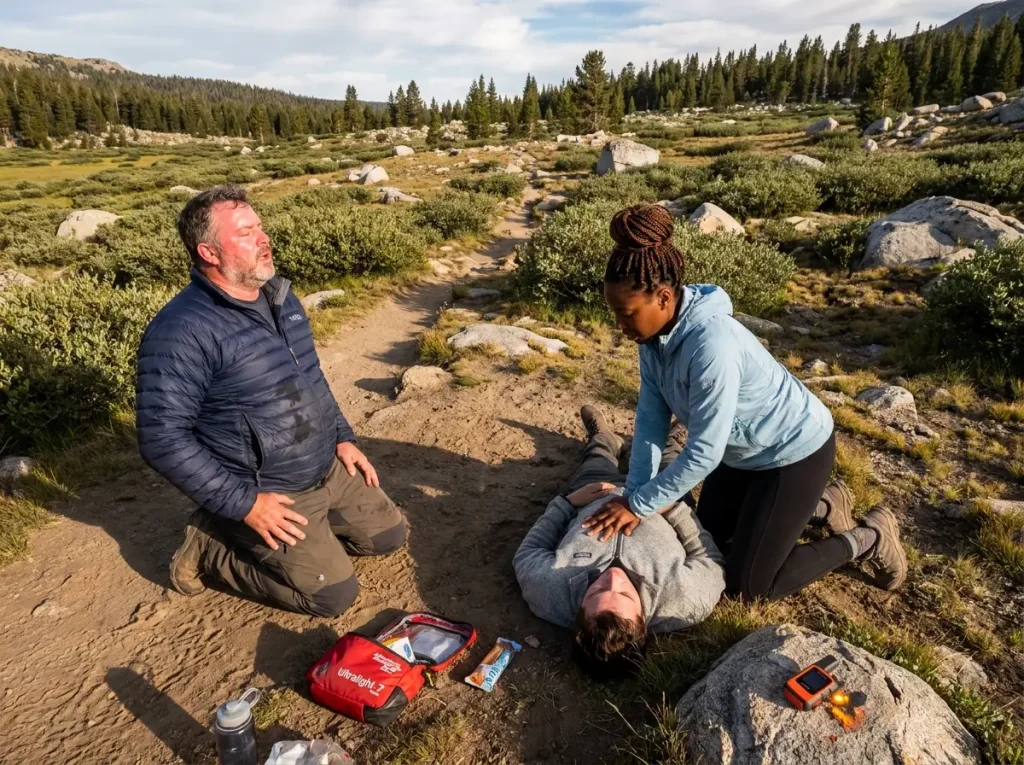
Here’s what your classroom instructor probably mentioned in passing but never made you feel: CPR is physically brutal. Compression quality — proper depth and rate — degrades measurably after just one to two minutes of sustained effort. Research published in PMC shows that compression depth drops and rate increases (too fast, too shallow) as fatigue sets in, even among trained professionals.
In a hospital, there’s a team of people rotating in every two minutes. On a trail, there might be two or three of you. Fatigue management isn’t a footnote — it’s the difference between effective CPR and going through the motions.
The Two-Minute Switch Protocol
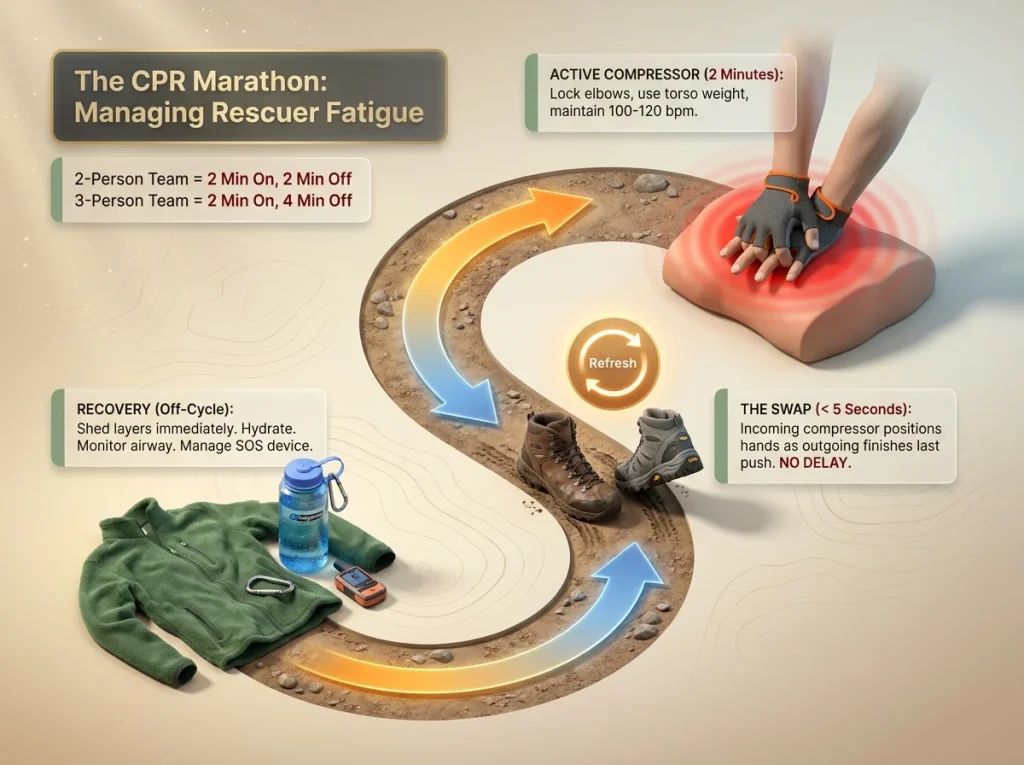
If you have at least two capable rescuers, switch compressors every two minutes. The transition should take less than 5 seconds — the incoming compressor positions their hands while the outgoing compressor finishes the last compression. No pause, no discussion. Practice this before you need it.
If you’re alone, you don’t get to switch. Focus on compression mechanics: locked elbows, shoulders over hands, using your torso weight. Take two normal breaths at each 30-compression pause if you’re doing 30:2 — those breaths are for YOU as much as the patient.
Energy Management for Extended Efforts
Thirty minutes of CPR is a real physical ordeal. Shed layers before you start — you’ll generate enormous heat. Keep water within reach. If you have three rescuers, rotate through: two minutes on, four minutes off. The off-compressor monitors the patient’s airway and manages the emergency signal.
The honest truth: solo CPR in the backcountry for 30 minutes is at the extreme edge of what a fit person can sustain. Your compressions will degrade. That’s not failure — that’s physics. Do the best you can for as long as you can.
Pro tip: Practice CPR compressions on a firm surface at home for 5 straight minutes. Time it. Feel how fast your arms fatigue. That experience will change how seriously you take the two-minute switch protocol.
The Hypothermia Exception
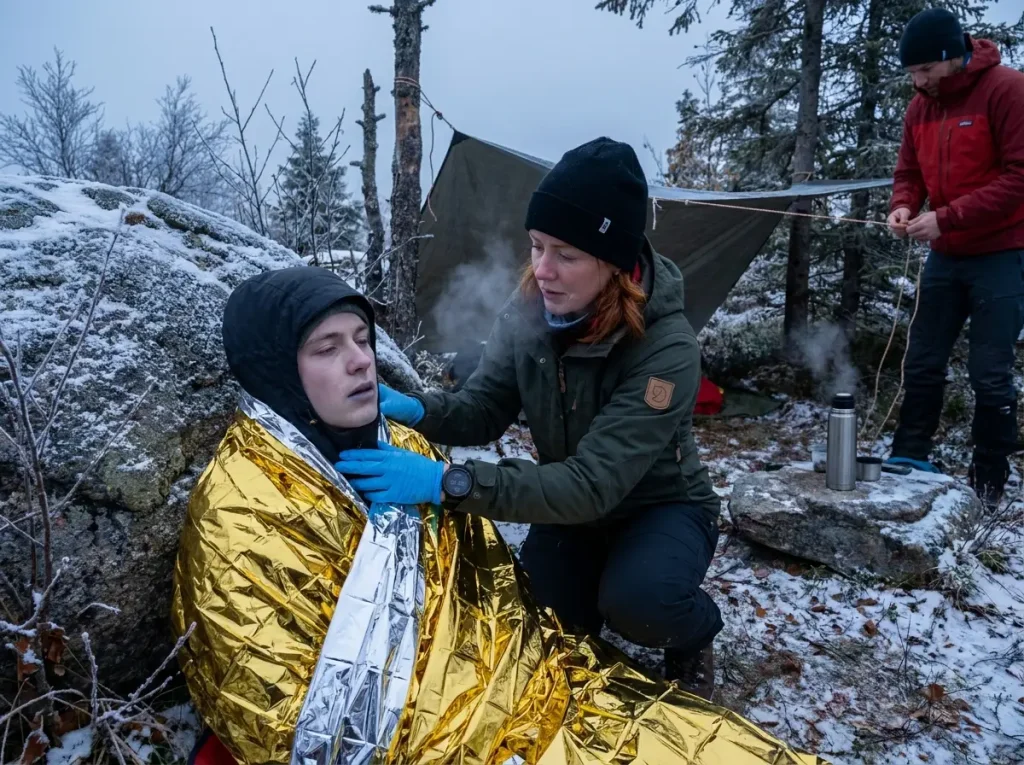
This is the section that could save you from making the worst mistake in wilderness medicine. If you suspect the patient is hypothermic — they were in cold water, exposed to wind and cold for hours, or show signs like intense shivering, confusion, or pale/blue skin — the CPR rules change completely.
Why Standard Compressions Can Be Harmful
A severely hypothermic heart is in a fragile electrical state. The cold slows all cardiac activity, and the heart may be producing a faint, slow heartbeat that’s extremely difficult to detect but still sufficient to maintain minimal circulation. Starting aggressive chest compressions on a heart in this state can trigger ventricular fibrillation — a chaotic, non-functional rhythm — turning a survivable situation into a non-survivable one.
The 60-Second Pulse Check
For suspected hypothermia, check for a pulse at the carotid artery (side of the neck) for a full 60 seconds, not the standard 10 seconds. Cold slows the heart rate so dramatically that a pulse at 20 beats per minute — one beat every 3 seconds — is easy to miss in a quick check.
If you find a pulse, no matter how faint or slow, do NOT start compressions. Focus on preventing further heat loss: remove wet clothing, insulate from the ground, create a wind barrier, and apply gradual passive rewarming. For detailed protocols on how to treat hypothermia on the trail, the rewarming sequence matters as much as the assessment.
If you confirm NO pulse after 60 seconds of careful checking, begin CPR. But keep this in mind: there are well-documented cases of survival after prolonged cold-water immersion — over an hour in some cases. The wilderness medicine guideline is “nobody is confirmed beyond help until they are warm and unresponsive.” That means CPR on a hypothermic patient may need to continue far longer than the standard 30-minute guideline.
Pro tip: Carry a compact emergency bivvy (SOL, AMK) in your first aid kit year-round, not just winter. Hypothermia can happen at 50°F with wind and wet clothing. That $8 bivvy buys you a vapor barrier and wind protection while you assess.
When to Stop CPR in the Wilderness
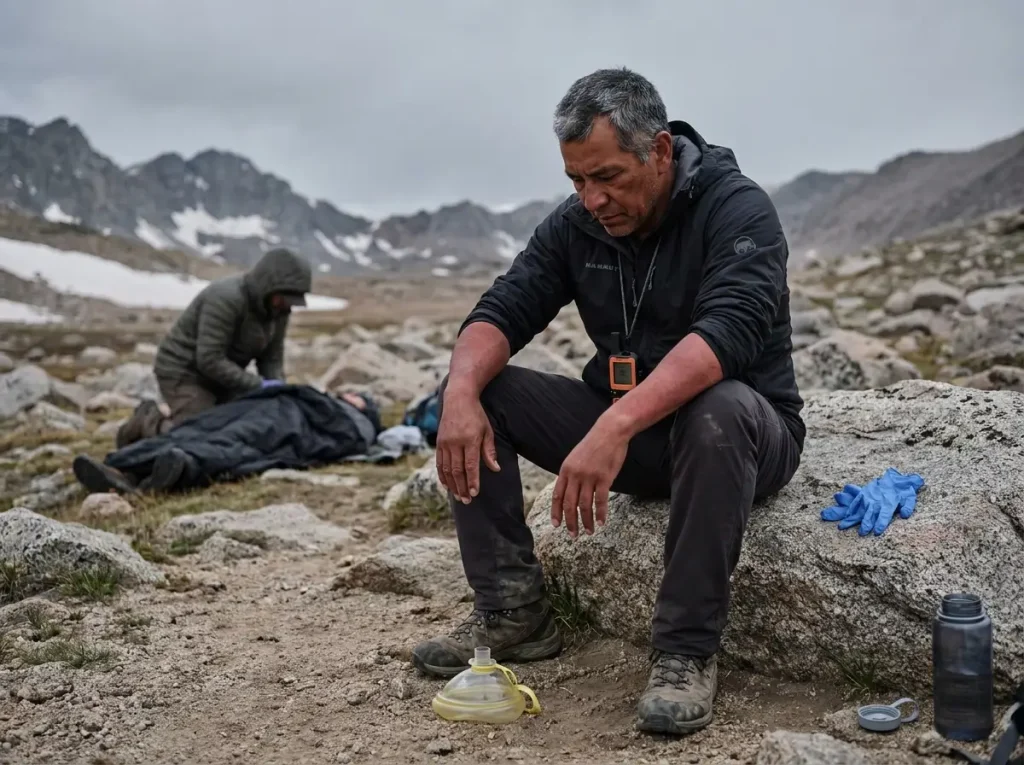
This is the hardest topic in wilderness medicine, and most articles handle it with a single sentence: “stop after 30 minutes.” That’s technically correct and practically useless. The decision to stop CPR on someone you’ve been trying to save is one of the most emotionally difficult things a person can face. You deserve more context than one sentence.
The 30-Minute Guideline
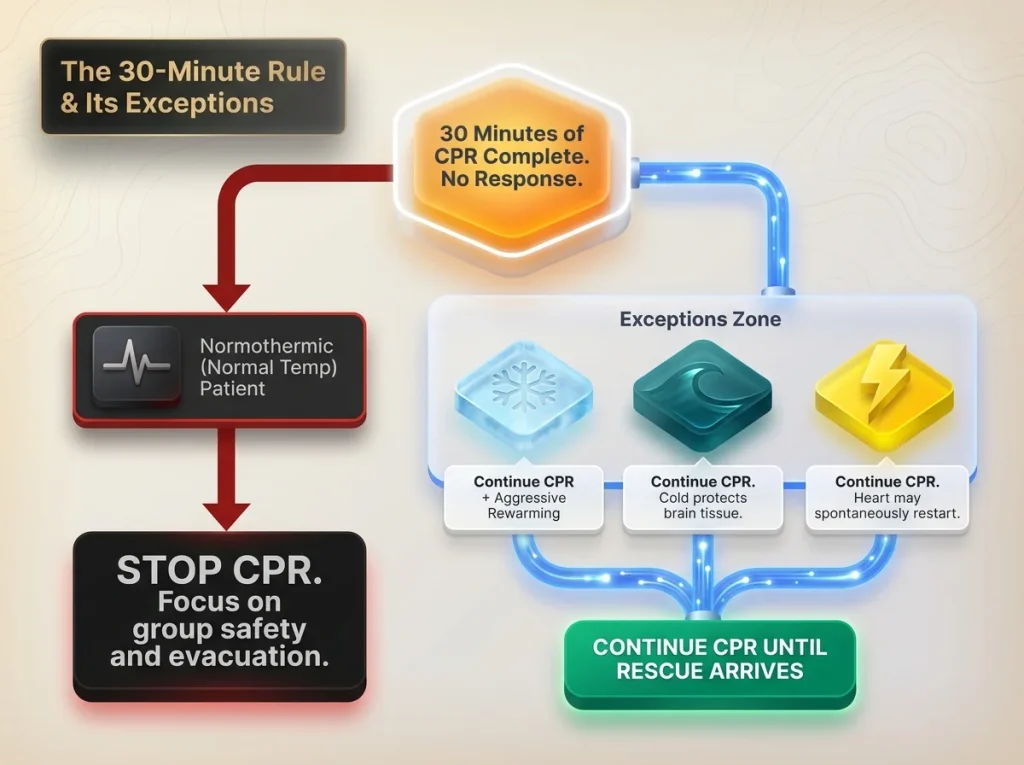
The Wilderness Medical Society and most wilderness first aid curricula recommend ceasing CPR if there is no return of spontaneous circulation after 30 minutes of continuous, high-quality compressions and no reversible cause has been identified.
After 30 minutes without a heartbeat and without defibrillation, the probability of meaningful survival approaches zero in a normothermic (normal core temperature) patient. Continuing beyond this point exhausts rescuers, creates additional risk, and delays evacuation decisions for the rest of the group.
Exceptions to the 30-Minute Rule
Three situations warrant extended CPR:
- Hypothermia — as discussed above, cold patients get extended efforts
- Lightning strikes — cardiac arrest from lightning can respond to prolonged CPR because the heart may restart spontaneously after the electrical disruption clears
- Submersion in cold water — overlaps with hypothermia; cold water protects brain tissue, and revival after long submersion times is documented
In these cases, continue CPR until rescue arrives, if physically possible.
Making the Decision
Nobody teaches this in a CPR class, but it matters. When 30 minutes is up and nothing has changed, you make the call. Announce it to your group: “We’ve done 30 minutes of CPR with no response. I’m going to stop.” Say it clearly. Document the time.
The legal framework protects you. Good Samaritan laws in all 50 US states protect individuals who provide emergency care in good faith. You cannot be held liable for stopping CPR after a reasonable effort in a wilderness setting. You acted. You tried. The biology was against you.
For your group’s safety, the next decisions are about evacuation, reporting, and psychological first aid for the rescuers. Those matter too.
For the broader protocol of signaling for rescue when a mirror and whistle are your only tools, having these skills before the emergency matters.
Building Wilderness CPR Into Your Hiking Preparation
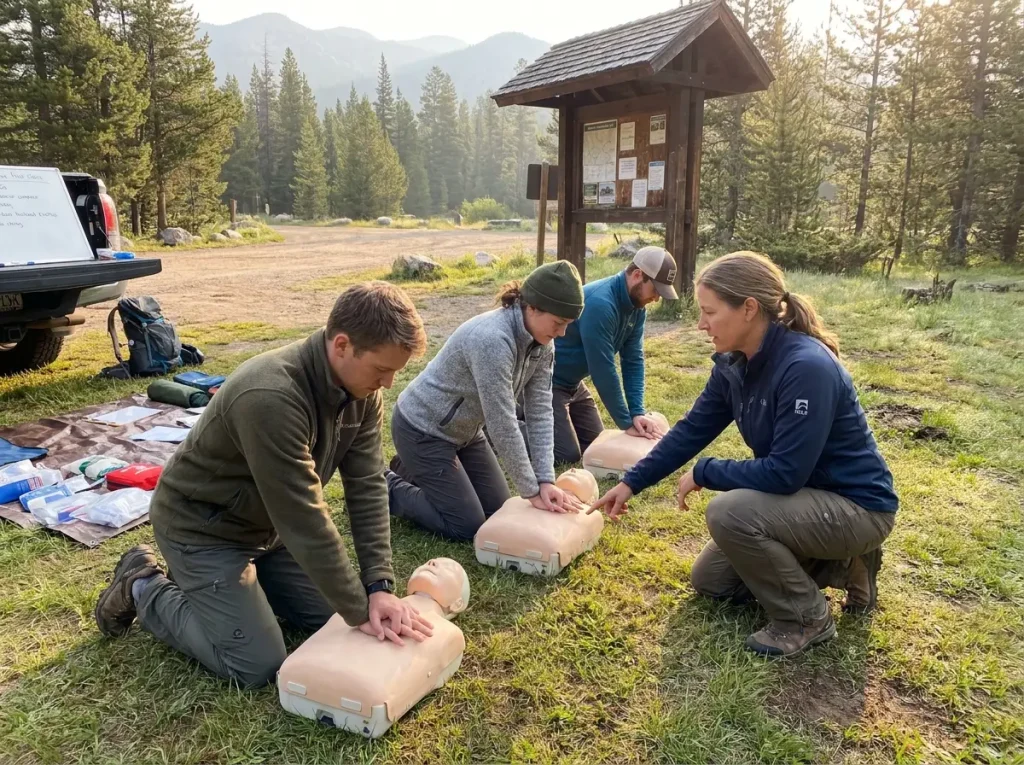
Reading this article is a start. It’s not enough. CPR is a physical skill that degrades without practice, and the wilderness-specific adaptations — surface preparation, fatigue management, hypothermia protocols — require hands-on training to internalize.
Training Options by Commitment Level
A basic CPR/AED certification (American Heart Association or Red Cross, 3-4 hours) gives you the compression and breathing skills. This is the minimum. Every hiker should have this.
A Wilderness First Aid (WFA) course (16 hours, usually a full weekend) covers CPR plus patient assessment, splinting, wound management, evacuation decisions, and scenario-based practice in outdoor settings. This is the level where you start making real decisions under simulated pressure. NOLS Wilderness Medicine and Sierra Rescue are widely respected providers.
A Wilderness First Responder (WFR) course (72-80 hours) is the standard for guides, trip leaders, and anyone who spends serious time in the backcountry. It includes extended patient care, medication administration, and complex evacuation scenarios.
What to Carry in Your First Aid Kit for CPR
Your hiking first aid kit doesn’t need to be a trauma bag. For CPR readiness, add three items that weigh almost nothing:
- CPR pocket mask (~2 oz) — barrier protection + better seal than mouth-to-mouth
- Nitrile gloves (2 pairs) — protection for wound management and CPR
- Compact emergency bivvy (~3 oz) — critical for hypothermia management
These join the satellite messenger or PLB you should already carry on any backcountry trip. If you’re choosing between a PLB and an emergency whistle, the answer in a cardiac arrest scenario is both — the whistle alerts nearby hikers, the PLB calls the helicopter.
Practice That Sticks
Take your CPR skills outside. Practice compressions on a firm outdoor surface — a picnic table, a flat rock, packed dirt. Feel how different it is from a classroom floor. Practice the two-minute switch with a hiking partner. Time yourself doing 5 minutes of solo compressions and notice exactly when your quality drops.
The gap between knowing CPR and being able to perform CPR on a mountain is the same gap between reading about hiking and actually walking the trail. You close it with practice, not with more reading.
Conclusion
Standard CPR training gives you the technique. Wilderness CPR fills in everything around it — the hard surface you have to find, the 30+ minutes you have to sustain, the fatigue that degrades your compressions in two minutes, and the hypothermia exception that flips the protocol entirely.
The decision to stop CPR is yours in the backcountry. Nobody is coming to take over. Understanding the 30-minute guideline, the exceptions for cold and lightning, and the legal protection of Good Samaritan laws means you make that decision from knowledge, not panic.
Take a WFA course. Carry a pocket mask. Practice compressions on real ground. The class you took at work was a starting point. The trail demands more.
Q1 How is wilderness CPR different from regular CPR?
The compression technique is identical — 100-120 per minute, two inches deep, center of chest. The difference is context: no AED, no EMS for 30+ minutes, uneven surfaces, rescuer fatigue management, and decisions about when to stop that fall entirely on you.
Q2 Should you do rescue breaths or just compressions in the wilderness?
Hands-only CPR (compressions without breaths) is effective and recommended if you lack a barrier device. If you carry a CPR pocket mask and are trained, the 30:2 ratio is more effective for prolonged resuscitation. Never pause compressions longer than 10 seconds for breaths.
Q3 How long should you continue CPR if help isn’t coming?
The guideline is 30 minutes of continuous, high-quality compressions with no response. Exceptions: hypothermia, lightning strike, and cold-water submersion all warrant extended CPR because these conditions can protect the heart and brain beyond normal limits.
Q4 Can you do CPR on uneven or sloped ground?
Yes, with preparation. Clear a flat area, position the patient perpendicular to the slope with head slightly uphill, and place a rigid surface (pack frame, flat rock) under the upper back if the ground is soft. Compressions into soft ground waste force.
Q5 What first aid training do hikers need for backcountry emergencies?
At minimum, a CPR or AED certification (3-4 hours). For regular backcountry use, a Wilderness First Aid course (16 hours) adds patient assessment, terrain-adapted CPR, splinting, and evacuation decisions. Serious backcountry travelers should consider a Wilderness First Responder certification (72-80 hours).
Risk Disclaimer: Hiking, trekking, backpacking, and all related outdoor activities involve inherent
risks which may result in serious injury, illness, or death. The information provided on The Hiking Tribe is for
educational and informational purposes only. While we strive for accuracy, information on trails, gear, techniques,
and safety is not a substitute for your own best judgment and thorough preparation. Trail conditions, weather, and
other environmental factors change rapidly and may differ from what is described on this site. Always check with
official sources like park services for the most current alerts and conditions. Never undertake a hike beyond your
abilities and always be prepared for the unexpected. By using this website, you agree that you are solely
responsible for your own safety. Any reliance you place on our content is strictly at your own risk, and you assume
all liability for your actions and decisions in the outdoors. The Hiking Tribe and its authors will not be held
liable for any injury, damage, or loss sustained in connection with the use of the information herein.
Affiliate Disclosure: We are a participant in the Amazon Services LLC Associates Program, an
affiliate advertising program designed to provide a means for us to earn advertising fees by advertising and linking
to Amazon.com. As an Amazon Associate, we earn from qualifying purchases. We are also an official affiliate partner
of Black Diamond Equipment via the AvantLink network. If you click on a Black Diamond affiliate link and make a
purchase, we may earn a commission at no additional cost to you. We also participate in other affiliate programs and
may receive a commission on products purchased through our links. Additional terms are found in the terms of
service.