In this article
I showed up to a July trail in Georgia wearing my “trusty” Gore-Tex boots and a Merino wool shirt — the exact gear my local outfitter had talked me into. By mile four, my feet felt like they were wrapped in wet paper towels, my shirt weighed four extra ounces of absorbed sweat, and I was questioning every purchase I’d ever made. The gear wasn’t broken. I just hadn’t been told the truth about what actually works when the air is too humid to let sweat evaporate. After years of hiking in the Southeast US, the Gulf Coast, and Central America, I’ve figured out exactly where the standard advice falls apart.
⚡ Quick Answer: In hot, humid conditions, skip Gore-Tex boots, 100% Merino wool base layers, cotton in any form, and tight-knit “breathable” fabrics — they all trap moisture when the air is already saturated. But the real fix is replacing wicking with airflow — and that changes almost every item in your pack. Most people make the swap too late, and mile 8 is where they pay for it.
| Hiking Gear Optimization Guide | |||
|---|---|---|---|
| Gear Category | Skip This | Replace With | Why It Fails |
| Footwear | Gore-Tex boots | Mesh trail runners | Membrane traps sweat when outside air is saturated |
| Base Layer | 100% Merino wool | Polyester (structured weave) | Merino absorbs 30–35% of its weight in water |
| Rain Protection | Hardshell rain jacket | Trekking umbrella or poncho | Jacket seals body heat with no exit for sweat vapor |
| Underwear/Liners | Cotton or loose boxers | Synthetic boxer briefs (6–9″ inseam) | Cotton stays wet; loose fabric bunches and chafes |
Why Wicking Fails When the Air Is Already Full of Water
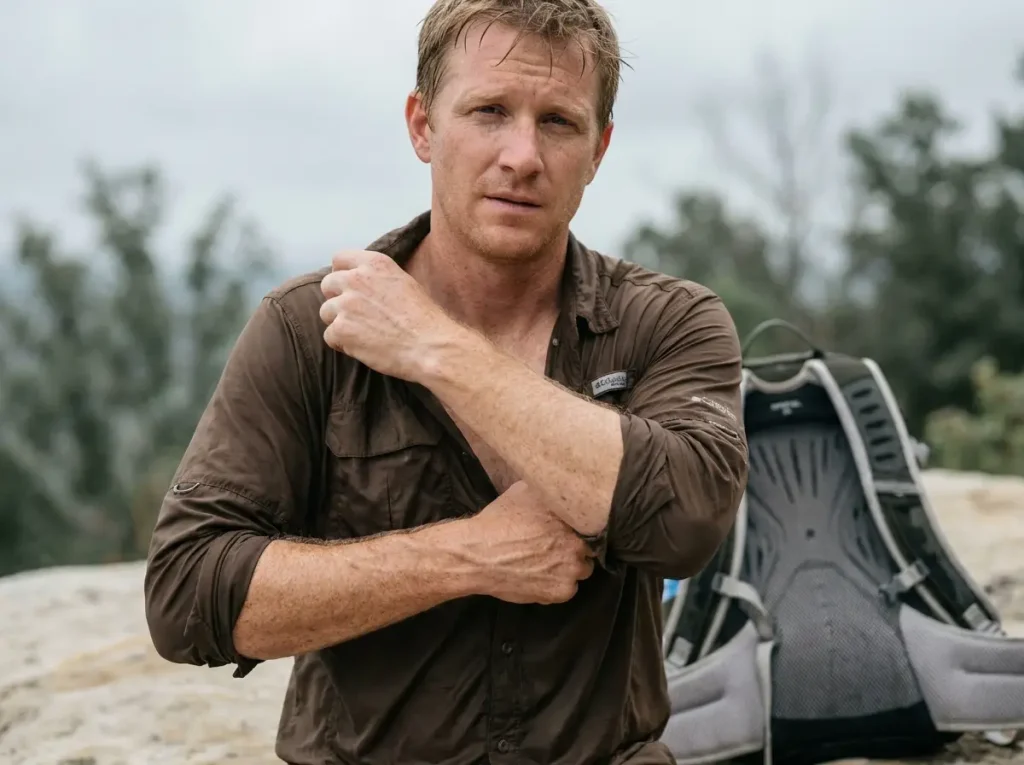
Here’s something your gear store probably didn’t explain: sweating only cools you when that sweat can evaporate. In a dry environment, your body is a machine — sweat hits your skin, vapor launches into the air, and heat leaves with it. In 90% humidity, that process nearly stops. The air is already holding almost all the water it can. There’s nowhere for your sweat to go, so it just sits on your skin, soaks into your shirt, or both.
Think of the air like a sponge that’s already dripping. You can wring your sweat into it all day — it’s not taking any more. This is the relationship between humidity and evaporative cooling efficiency that most gear brands completely sidestep. At 95% humidity, your body can only dump about 20–30 watts of heat through evaporation. In dry air, that number is 300+ watts. The moisture-wicking shirt is doing its job — moving sweat to the fabric surface. But the air isn’t doing its part of the deal. That’s why the most humidity-tested hikers don’t reach for a high-tech wicking tee — they reach for sun hoodies that actually keep you cooler in high heat, which work through fabric structure and airflow, not evaporation.
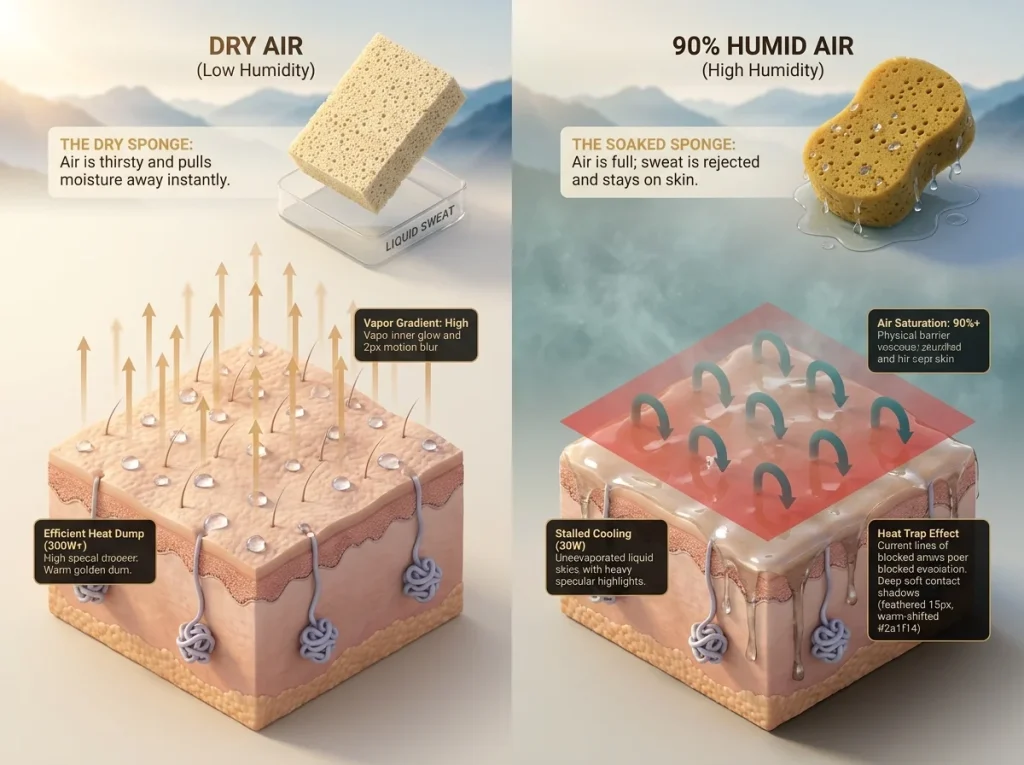
The Sponge Analogy — Why 90% Humidity Breaks the Rules
Every “breathable” fabric rating you’ve ever read — Moisture Vapor Transmission Rate, or MVTR — was tested in a lab. Not in Louisiana in August. Not in the Georgia swamps in July. In a controlled chamber where the air outside the fabric was kept artificially dry. In real humid conditions, that MVTR rating drops toward zero because the gradient it depends on collapses. Your shirt’s “breathable” rating is meaningless when the outside air is just as wet as the inside.
The fix isn’t a more technical fabric. It’s airflow — physical gaps between your skin and the fabric so moving air can carry heat away through convection. That’s why a $22 fishing shirt with a vented back and a loose cut can outperform a $90 Merino tee before you hit mile two.
Pro tip: If your sweat isn’t evaporating, a “better wicking fabric” won’t help. What helps is a looser cut, a structured weave that lifts off your skin, and ventilation that lets a breeze reach you. Look for seersucker or pique textures — they hold the fabric away from your body and create tiny air channels you can actually feel.
Convective Cooling — The Only Cooling That Still Works
When evaporation fails, convective cooling is what saves you. That’s just air moving across your skin and carrying heat away. You feel it as a breeze. The trick is wearing clothing that lets that breeze reach your body — loose fits, open weaves, pit vents, and mesh panels. A tight, flat-knit synthetic shirt wicks well but clings when wet, pressing against your skin and blocking airflow. The best shirt for humid conditions has structure — a weave that holds it slightly away from skin even when damp.
On a humid 85°F day, your body is retaining heat it would normally dump through sweat while the thermometer lies to you. On a dry 95°F day you’re uncomfortable but cooling efficiently. In the swamp at 85°F, you’re cooking inside your own moisture layer — and the numbers don’t warn you. The edge case to watch: hikers who feel manageable at low elevation heat up fast on exposed ridges, where solar radiation stacks on top of the already-broken cooling system.
The Fabric Truth — What to Skip and What to Grab
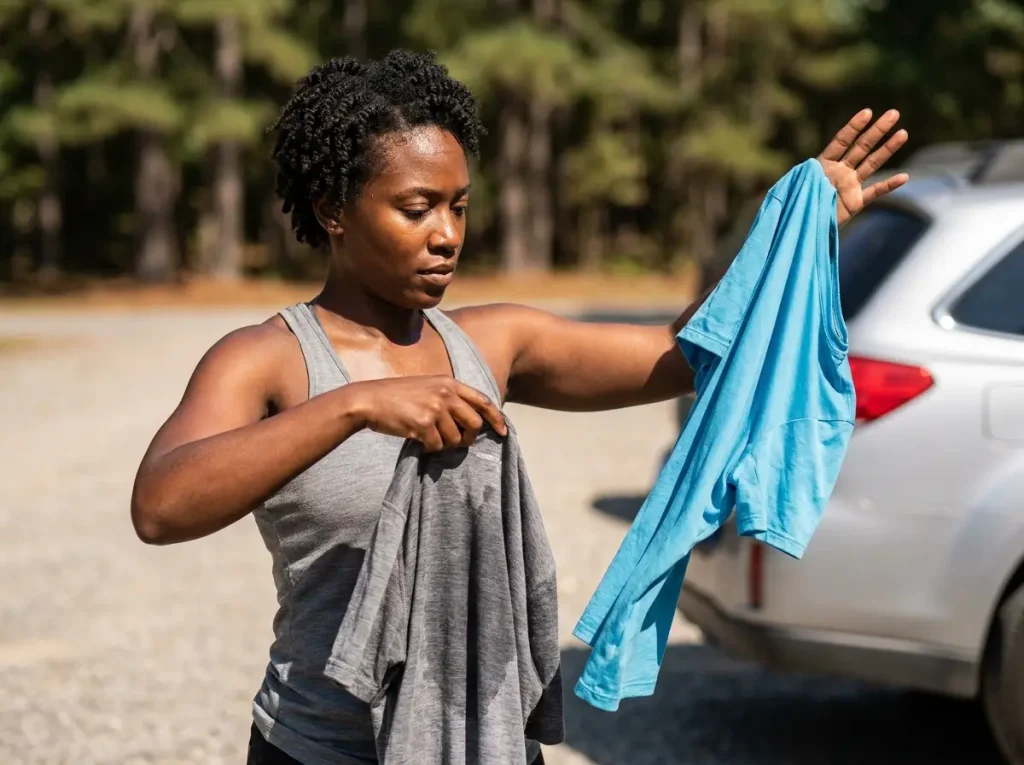
Your gear shop loves Merino. So do most thru-hiker blogs. But here’s what happens when you wear 100% Merino into 90% humidity — it becomes a soggy bath towel strapped to your torso. The same property that makes it great in cold, dry conditions (it holds moisture without feeling wet immediately) turns it into a liability when there’s no evaporation to dry it back out. According to peer-reviewed research on humidity’s effect on evaporative heat loss, cooling efficiency drops to less than a sixth of its dry-air performance in saturated conditions.
A 100% Merino shirt can absorb 30–35% of its weight in water before it even feels damp. In high humidity with no evaporation, that shirt just keeps loading up — gaining up to 5 extra ounces by end of day. A polyester shirt in the same conditions gains less than 0.5 ounces, because polyester is hydrophobic: water sits on the fiber surface and gets pushed away by movement or a breeze rather than soaking in. Polyester also dries 41% faster than 100% Merino in field conditions with moderate airflow.
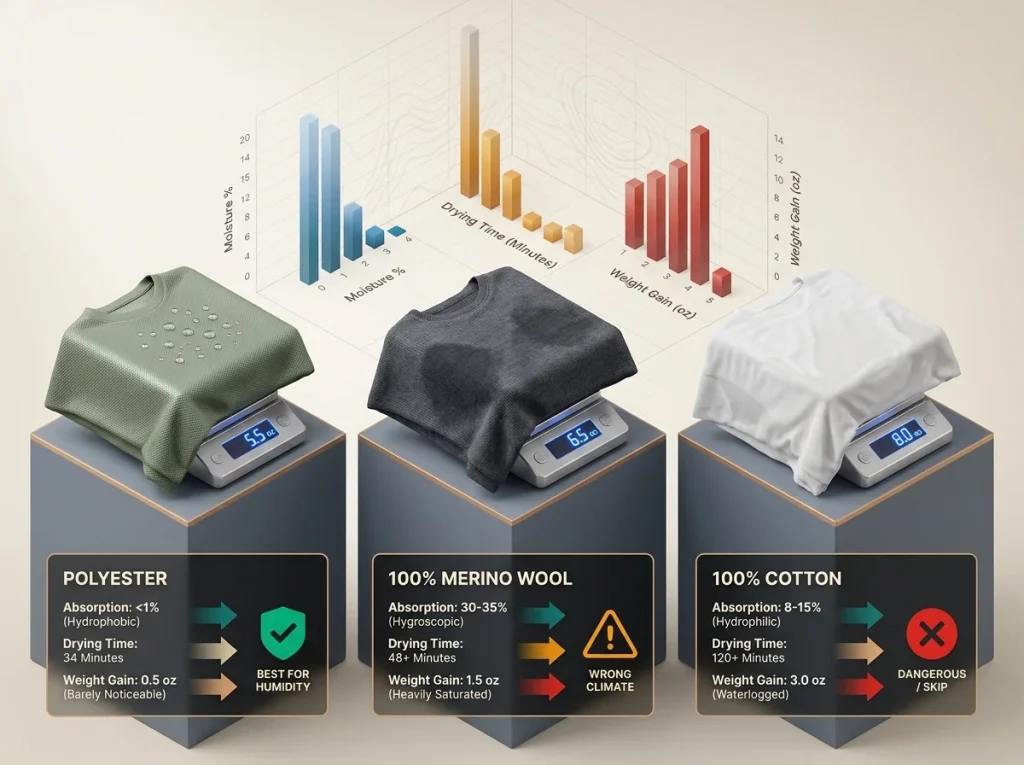
Polyester — The Humidity-Proof Workhorse
Polyester fiber is essentially plastic. Water doesn’t soak in — it sits on the surface, where any breeze or body movement pushes it away. That’s why a budget polyester tee from the athletic section at Target performs better in humidity than a premium Merino. The drying time difference matters most over a long day: polyester comes in around 34 minutes from fully saturated; Merino runs 48+ minutes under the same conditions, often longer in still, humid air.
For humid hiking, the Columbia Silver Ridge and the Patagonia Capilene Cool Daily are both polyester, both structured enough to avoid cling when wet. The weave texture matters too: flat-knit polyester still presses against your skin. Pique or structured weaves lift slightly off the surface, giving you that convective cooling gap even in the swamp.
Merino Wool — Great Shirt, Wrong Climate
Merino’s core problem in humidity is that its fibers actively pull moisture into their core rather than repelling it. That’s why it’s beautifully warm when wet in cold weather. In humid heat, it means the shirt is continuously absorbing sweat and ambient humidity, getting heavier and heavier, with no dry cycle to reset it. I wore a Smartwool Merino 150 on an August hike in North Carolina. By mile 6, the shirt was noticeably heavier than at the start. Switched to a polyester tee the next day and felt the difference within the first hour.
The odor tradeoff is real — polyester smells faster. Solution: Merino/Nylon blends (87/13 ratios) are an acceptable compromise if odor control matters to you, but skip the 100% Merino entirely for anything May through September in the Southeast or Tropics. For the full durability picture beyond humidity, see this field-tested durability breakdown of Merino vs. synthetic base layers.
Skip cotton entirely — it absorbs 8–15% of its weight in water and takes 2+ hours to dry. In humidity, it never fully dries. “Cotton kills” is advice usually aimed at cold-weather hypothermia, but in summer humidity it’s just genuinely miserable and makes every other problem worse: more weight, more chafe, more heat retention.
The Footwear Trap — Why Gore-Tex Boots Are the Biggest Mistake You’ll Make
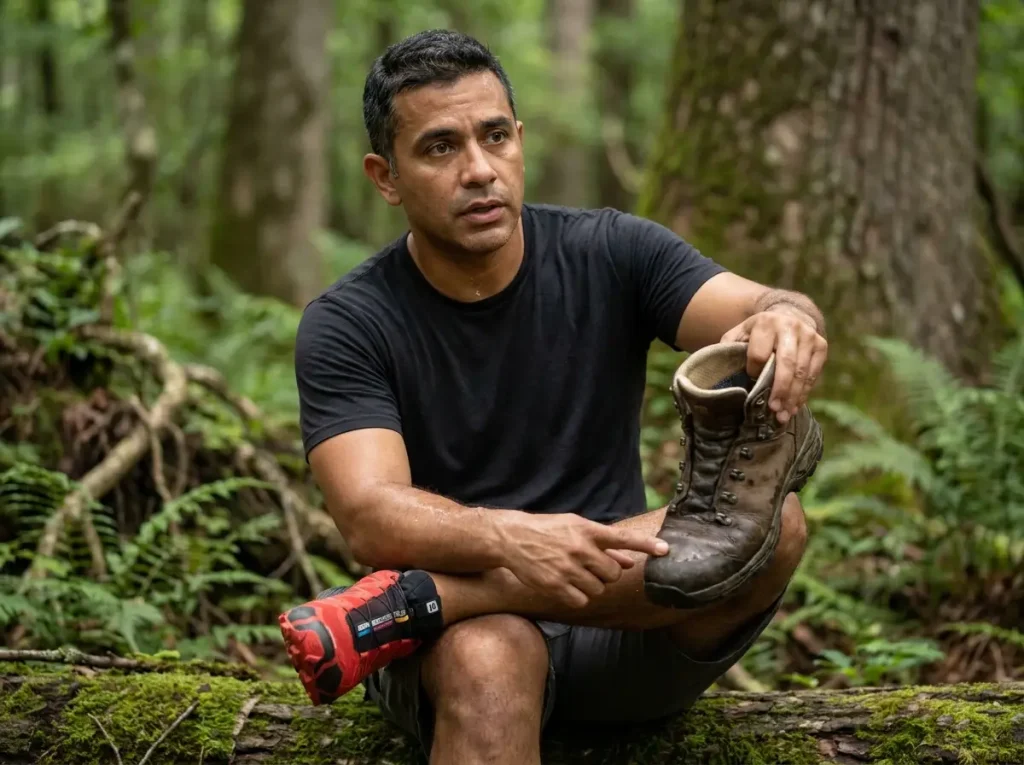
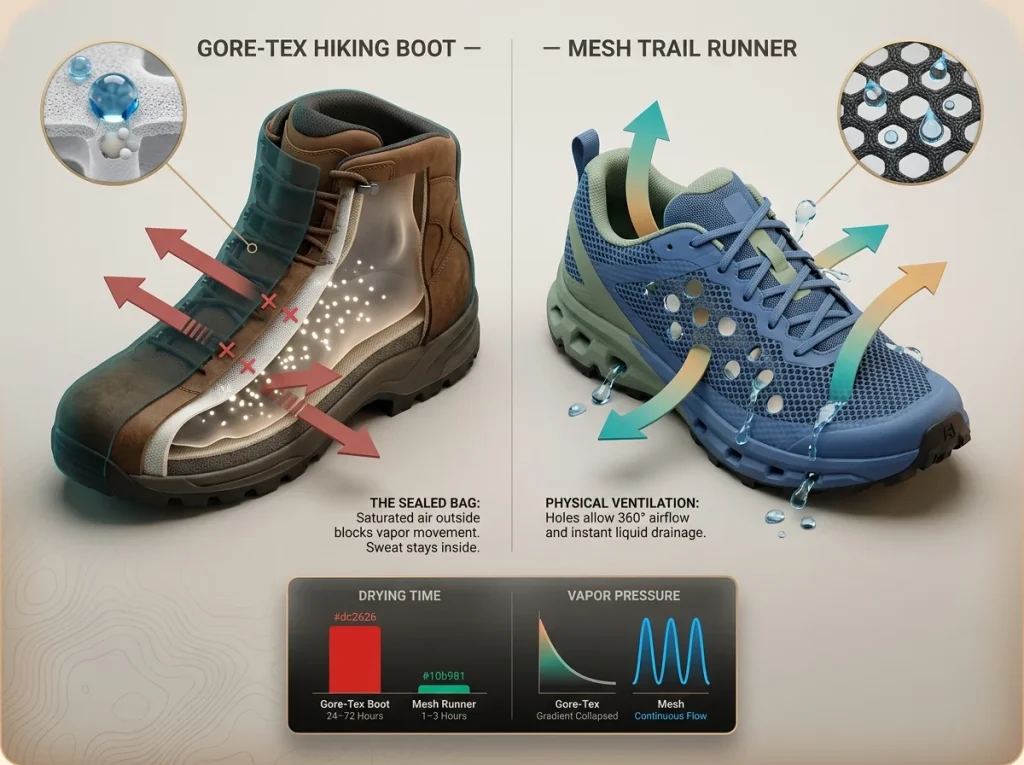
Every gear store will sell you Gore-Tex boots as the “all-conditions” answer. In any other season, maybe. In 90% humidity and summer rain, you’re buying expensive prune-feet technology. Gore-Tex works by vapor pressure gradient — your foot sweat turns to vapor, vapor has higher pressure inside the boot than outside, and it pushes through the membrane’s micro-pores. That system requires the outside air to be significantly drier than inside your boot. In 90% humidity, the outside pressure rises until the gradient collapses, and vapor stops moving. Your boot becomes a sealed bag.
Then rain hits. The moment liquid water saturates the outside of the boot, it creates a physical barrier that blocks the membrane entirely. Now you have the worst of both worlds: a sealed vapor bag with no drainage. Non-waterproof mesh trail runners drain instantly and dry in 1–3 hours. Gore-Tex boots can stay wet for 24–72 hours in humid conditions. The Appalachian Mountain Club has documented why Gore-Tex boots trap moisture inside in wet conditions — the DWR saturation and membrane blocking mechanism is well understood. We’ve also gone deeper on the full trade-off in the Gore-Tex breathability breakdown explained, including what “wet-out” means for your DWR coating.
What to Wear Instead — Mesh Trail Runners and Drainage Designs
Mesh trail runners solve the humidity boot problem with physics rather than chemistry. Physical holes let both liquid and vapor exit freely. They drain while you’re hiking. They dry on foot in direct sun. The “wet shoe” fear that drives people toward waterproof boots ignores the key math: a mesh shoe that gets wet crossing a stream is dry within an hour of hiking. A Gore-Tex boot that gets wet at a stream crossing can stay damp for two days.
Pro tip: If you love your Gore-Tex boots, keep them for fall, spring, and anything below 55°F. Buy a separate pair of mesh trail runners for anything May through September in the Southeast, Appalachians, Pacific Northwest summer, or tropics. The $80 price difference isn’t close to what three days of prune feet on a multi-day trip costs you.
Managing Foot Swelling With Lacing Techniques
Here’s something most gear guides skip: your feet swell in heat. Not a little — up to half a size during a long, hot hike, because heat causes vasodilation and blood pools in your extremities. In a Gore-Tex boot that’s already sealing and not draining, that swelling creates painful pressure hot spots on the instep and along the toe box.
Window Lacing is the fix: skip the middle eyelets over the swollen instep zone to give the top of your foot room. Pair it with a Runner’s Heel Lock — thread the laces through the top eyelet loop to lock the heel back without overtightening the midfoot. If your boots feel tight after mile 3, this is almost always what’s happening. Your foot is expanding. Give it room. If you’re also buying new shoes for humid trails, there’s a separate case for sizing up — how foot swelling in heat affects your ideal boot size.
The Wet-Chafe Cycle — What Nobody Talks About Until Mile 8
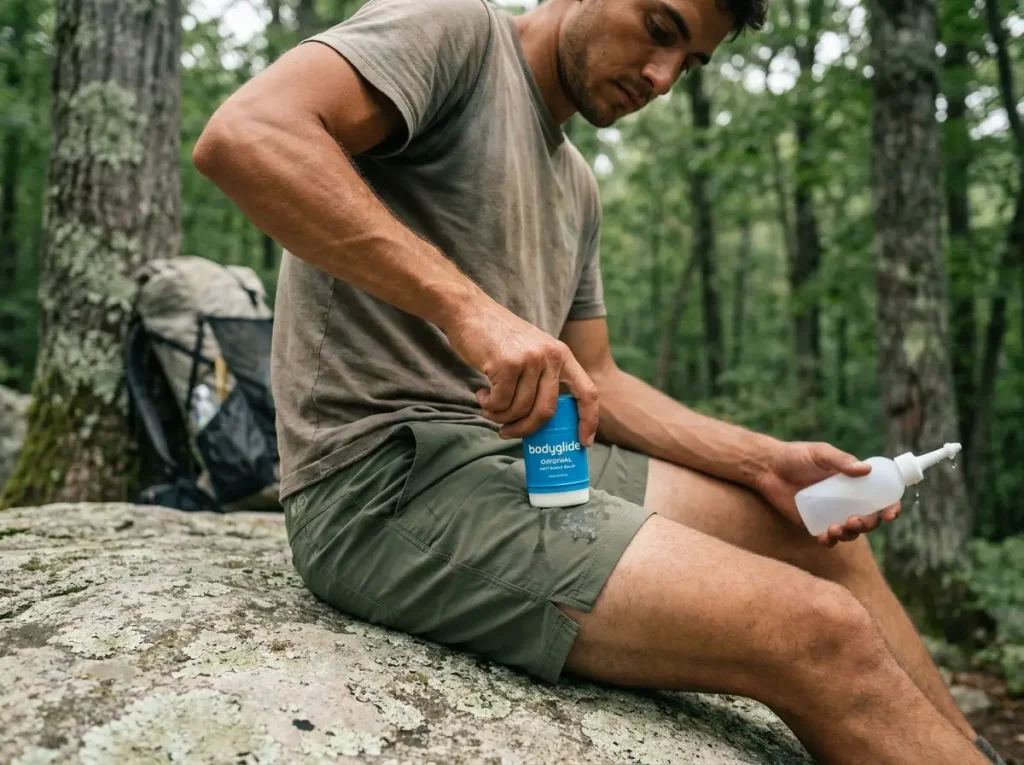
Everyone talks about sunscreen and electrolytes before a hot hike. Nobody talks about the thing that actually ends most humid-weather hikes: what happens to your skin when dried sweat turns abrasive at mile 8.
Humid sweat doesn’t evaporate cleanly — it pools, partially dries in micro-cycles, and leaves concentrated salt crystal deposits on your skin and fabric. Salt crystals are abrasive. Skin that’s been in constant moisture for hours gets macerated — softened and weakened, the same pruning effect you see on your fingers after a long bath. Salt crystals on macerated skin is essentially chemical sandpaper. Think: wet, salty denim rubbed on raw steak for 10 miles. That’s your inner thigh. Per CDC NIOSH guidance on heat-related illness prevention, the skin stress from heat and moisture is a legitimate health factor — not just a discomfort issue.
The AT in Georgia in summer is where I first understood this. I thought chafing was just about wearing the wrong underwear. Turns out it’s salt, timing, and the accumulation of small failures — cotton fabric holding moisture, loose fabric bunching, and not re-applying lubricant after the first few miles burned through the initial coat. On multi-day trips, this compounds fast — thru-hiking hygiene protocols that prevent trail-ending infections covers the full system for back-to-back humid days.
The Skip List for Your Bottom Half
Skip cotton underwear — the “soggy diaper effect” is real and it hits fast. Cotton holds water against skin already dealing with sweat and salt. Skip loose boxers — the fabric bunches and folds, creating constant friction points that skin doesn’t notice until it’s raw. Standard deodorant doesn’t provide mechanical slip protection; it’s built to control odor, not create a lubricating barrier against fabric-on-skin friction.
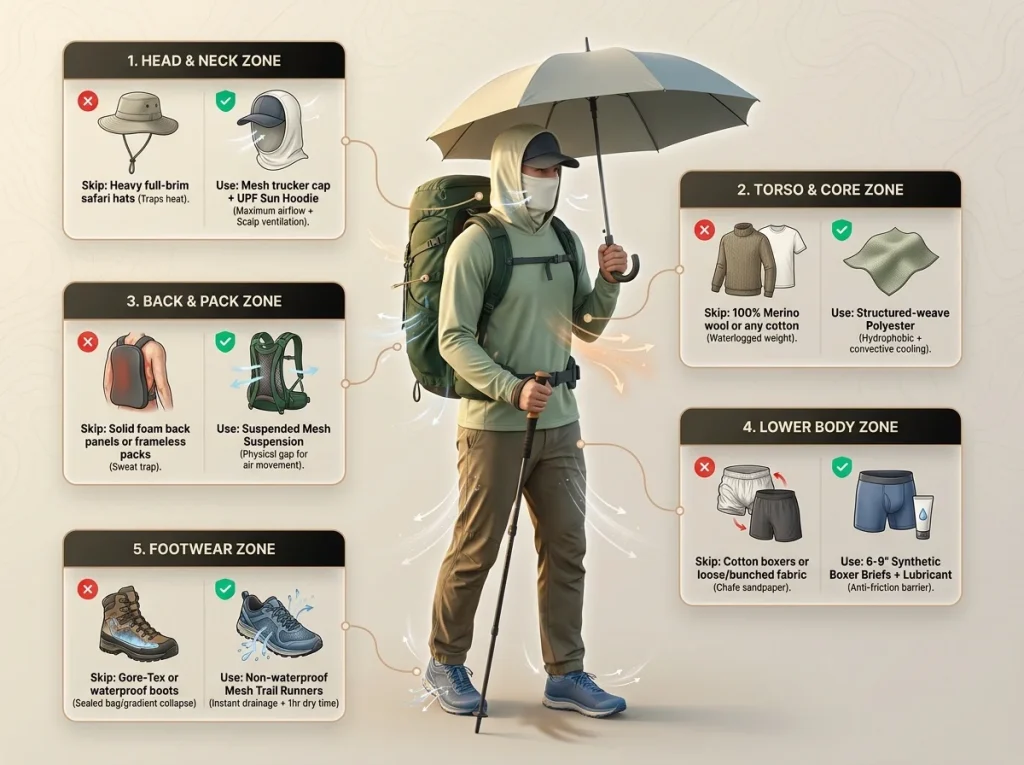
Synthetic compression-style boxer briefs with a 6–9 inch inseam are the answer. The snug fit eliminates fabric bunching, and the inseam length keeps skin from contacting skin on the inner thigh. For bottoms, lightweight roll-up nylon pants can actually be cooler than shorts in direct sun: nylon blocks UV radiation, adds tick and scratch protection, and if the cut is loose enough, allows vertical airflow that shorts don’t provide. The AT thru-hiker community in Georgia and North Carolina has been talking about hiking kilts for years. Sounds ridiculous until you try one. The vertical airflow is something shorts and pants genuinely can’t replicate.
The same salt-and-moisture cycle that causes chafing is behind 80% of humid-weather blisters — how moisture and friction combine to create blisters before you feel them explains the exact intervention window before skin breakdown becomes a hike-ending problem.
The Mid-Hike Salt Management Routine
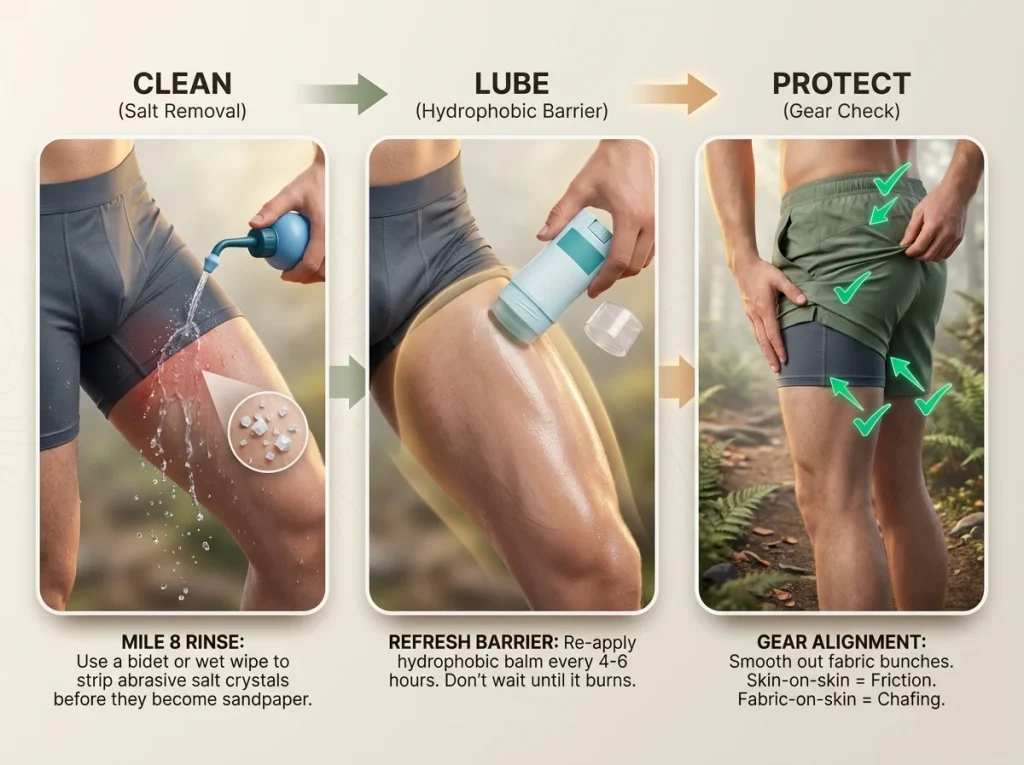
The thru-hiker Clean-Lube-Protect protocol is not complicated — just get it figured out before you need it. Every 4–6 hours on a humid hike, do this: rinse inner thighs and any other friction zones with water, a wet wipe, or a portable bidet bottle to strip the accumulated salt crystals. Then re-apply a hydrophobic balm — BodyGlide or Squirrel’s Nut Butter work better than petroleum jelly because they don’t slick off with water. Then check that underwear legs haven’t bunched up.
The bidet bottle trick comes up in every serious AT discussion about the Southeast section. A portable bidet (cheap, weighs 2 oz) is the best non-gear gear item for humid multi-day hiking. Rinsing salt crystals mid-trail changes the second half of your day in a measurable way.
Pro tip: Apply your anti-chafe balm at the trailhead, not after discomfort starts. By the time you feel chafing, skin breakdown has already begun. Two minutes at the car at the start costs you nothing. Fixing a raw wound at mile 9 costs you the last two miles.
Rain Gear Reality — When Your Jacket Is the Problem
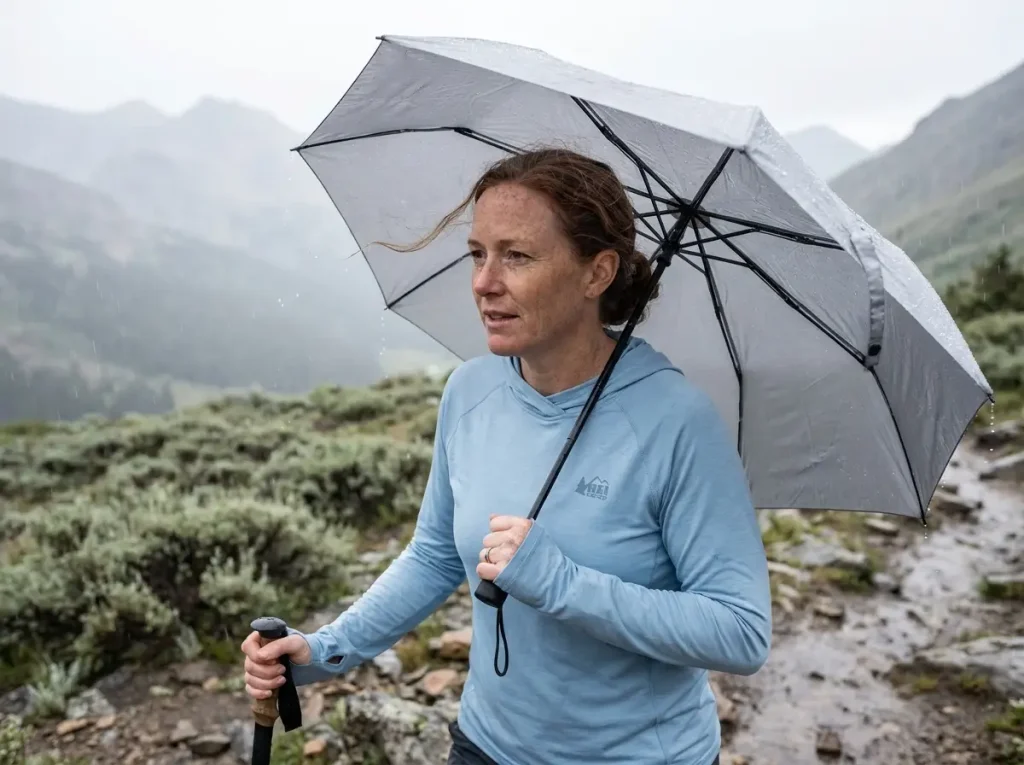
In the swamp, the rain jacket question isn’t “Will it keep me dry?” It’s “Will this jacket make me wetter from my own sweat than the rain was making me from outside?” With most hardshells, in summer humidity, the answer is yes.
A fitted hardshell rain jacket — even premium Gore-Tex Pro — creates a sealed microclimate around your torso when you’re wearing it. In humidity, with evaporation already failing, that sealed space fills with trapped sweat vapor that has nowhere to go. When the DWR coating on the jacket’s outer shell gets saturated (this is “wet-out”), the fabric absorbs rainwater and blocks the membrane. You’re now getting wet from outside rain and generating steam from inside your own body heat. The jacket is collecting rather than deflecting. I once finished a 5-mile rainy loop in a $300 hardshell drier on the outside than the inside.
If you’ve never considered hiking with an umbrella, the trekking umbrella vs. rain jacket debate broken down by conditions makes the strongest case where humidity is the clearest variable.
The Hardshell Problem in Plain Terms
Imagine wearing a plastic bag as a raincoat. Now imagine the plastic bag is technically “breathable” — but only when the air outside is drier than you are. In 90% humidity, that condition never exists. The breathability rating on your Gore-Tex Pro jacket, your eVent jacket, any waterproof-breathable system — all of them require a vapor gradient that disappears in saturated air. You end up wearing a sweat suit with a good logo.
The Trekking Umbrella Case — Unconventional but Right
A trekking umbrella provides 360-degree airflow while blocking rain and sun. Your core stays dry. Your arms stay cool. Nothing seals against your body. Most weigh 8–12 oz — comparable to a light packable rain jacket. The limitation is obvious: exposed ridges in crosswind require one hand and poles have to go away. For trail sections with forest cover and moderate rain, it handles everything a hardshell does — plus eliminating the sweat trap.
The best humid-weather rain setup is combining an umbrella for open stretches with a simple poncho for bushwhacking through wet vegetation. That combination handles 90% of summer rain scenarios better than any hardshell I’ve owned. One practical note: cooling towels are also not the answer above 85% relative humidity. They rely on evaporation, which stalls in saturated air. What actually works is conductive cooling — freeze a half-full SmartWater bottle and carry it against your palm. The palms and soles have specialized vascular structures for heat dump that make them more effective cooling targets than your neck.
Pro tip: Combine an umbrella with a UPF sun hoodie on open stretches and a lightweight poncho for forest creek crossings or dense vegetation. You’ll stay cooler, drier on the inside, and the total system weighs about what a mid-range rain jacket does alone.
The Gear You Don’t Think About — Socks, Packs, and Headwear
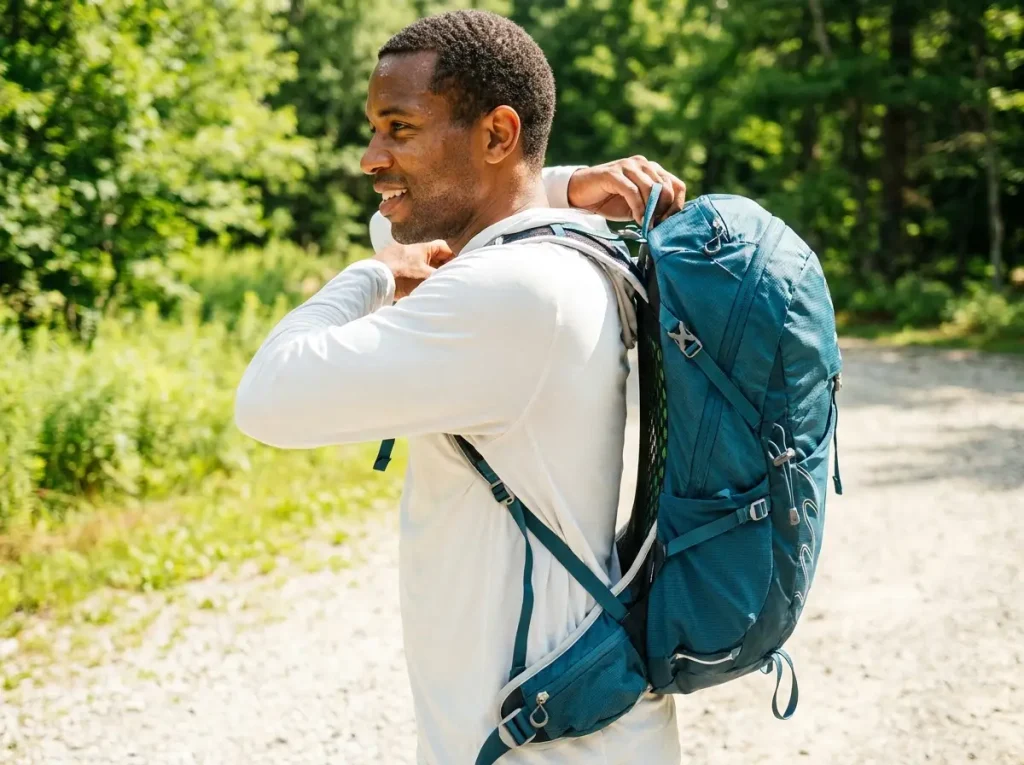
You’ve made the call on boots, base layer, and rain protection. But you might still be sweating into a cotton cap, wearing waterproof socks that trap everything, and carrying a pack with a solid back panel cooking your spine.
Same membrane, same problem — how waterproof socks trap sweat and when that matters explains exactly why waterproof socks that work perfectly in winter become a liability in summer. The Gore-Tex or eVent membrane in waterproof socks requires drier external air to move vapor outward. In summer humidity, sweat accumulates inside the sock with no exit. These are the right socks for a cold, wet fall hike. Wrong for a July trail in Tennessee.
Socks — The Overlooked Humidity Failure
For humid conditions, the right sock is a fast-drying synthetic or a lightweight Merino/synthetic blend. Not a heavy wool sock. Not a waterproof sock. Synthetic liner plus lightweight blend is the choice for any humid summer situation. Prioritize fast-drying — a synthetic sock that dries between rest stops is actively preventing the maceration cycle that leads to blisters. For multi-day trips, the sock rotation strategy that prevents blister buildup on multi-day humid hikes gives you the real protocol: synthetic dries overnight at camp while you’re airing your feet, so you rotate into a dry pair every morning without carrying extra weight.
Pack Design — Your Back Panel Is a Mobile Sauna
A solid foam back panel pressed against a sweat-soaked shirt is a moisture trap with nowhere to drain. The combined heat from your body and the pack compresses the wet shirt against your skin with no airflow. Suspended mesh suspension systems — the “trampoline” back panels on packs like the Osprey Stratos series — create a gap between the pack body and your back that allows convective airflow. The pack stays away from your body. Air moves through. Your shirt doesn’t stay soaked.
The counterintuitive problem: ultralight frameless packs pressed directly against the back can be worse than a heavier framed pack with airflow channels. A frameless pack that saves 6 oz can cost you significantly more sweating on a humid summer trip.
Headwear and Sun Protection — The Airflow vs. Brim Tradeoff
Full-brim safari hats solve the sun problem and create a new one — they restrict airflow around the head and neck, and in high humidity, the trapped heat around the skull can make you hotter overall despite the shade. Mesh-back trucker hats prioritize airflow at the cost of some coverage. The best of both: a mesh trucker cap plus a UPF sun hoodie with a hood covers your ears and neck without trapping heat against your skull. I switched from a $55 wide-brim sun hat to this combination two summers ago. My ear tips got slightly pinker. My overall trail misery dropped noticeably.
When getting these gear choices wrong starts stacking up — wrong footwear, wrong base layer, wrong headwear — core temperature rises faster than people expect. Know the difference between heat exhaustion and heat stroke on trail before your next humid-weather outing.
The Takeaways You’ll Actually Remember
Swap wicking for airflow. In 90% humidity, evaporation fails. That means every piece of gear built around moving moisture to the surface — waterproof boots, Merino wool, tight breathable fabrics — stops doing its job. Mechanical airflow is what survives: loose polyester, mesh trail runners, suspended pack panels, and pit vents. The air has to physically touch your skin for cooling to happen.
The two biggest gear swaps are also the two most expensive items in most people’s kits. Your Gore-Tex boots and your 100% Merino shirt are right for fall, winter, and spring. For summer humid conditions, they’re working against you from the first mile. Make those two swaps and the rest improves automatically.
Your body’s salt output is the slow-moving threat. Applying BodyGlide once at the trailhead isn’t the move. The humid-hiker protocol is mid-hike maintenance: clean the salt off, re-apply lubricant, check that gear hasn’t shifted into friction zones. You feel fine at mile 5. Mile 9 is where the bill arrives.
On your next humid-weather hike, pick one swap from this list — start with the boots or the base layer, whichever you have the wrong version of. You’ll feel the difference before you’ve broken a real sweat.
FAQ
Is cotton okay for hiking in hot, humid weather?
Skip it entirely. Cotton absorbs 8–15% of its weight in water and takes 2+ hours to dry — in high humidity, it never dries at all. A budget polyester tee from any sporting goods rack beats any cotton shirt on every humid-weather metric, and costs less than most Merino base layers.
How do you stay cool while hiking in 90-degree humidity?
Forget cooling towels above 85% relative humidity — they rely on evaporation, which stalls in saturated air. What works: loose, mechanically vented clothing that lets air reach your skin, a trekking umbrella to cut radiant heat overhead, and a half-frozen SmartWater bottle against your palm for conductive cooling. Shade, a controlled pace, and electrolyte hydration are the three levers that actually move core temperature.
Are long sleeves better than short sleeves in humid heat?
Counterintuitively, yes — if the fabric is right. An ultralight polyester long-sleeve with pit vents or a loose cut provides more surface area for whatever evaporation does occur, blocks radiant solar heat, adds UV protection without sunscreen, and protects from insects. A tight, thick long-sleeve is worse than a short sleeve. Loose, thin, structured fabric with a UPF rating — that’s the answer.
How do I prevent heat stroke while hiking in humidity?
Pre-hydrate with electrolytes before you leave — water alone dilutes sodium and raises hyponatremia risk on long hot efforts. On trail, watch for early warning signs: stopping sweating while still moving, a worsening headache, or confusion. At the first serious symptom, stop, shade, and use cold conductive cooling — ice against palms and soles works faster than evaporative cooling in humidity. If symptoms escalate, get to help immediately.
Do Gore-Tex boots have any place in hot-weather hiking?
In high humidity specifically, no. The vapor pressure gradient the membrane requires to function disappears in saturated air, and wet-out blocks the membrane when it rains. Gore-Tex boots are excellent in cool, dry climates where outside air is significantly drier than your boot interior. Keep them for fall, winter, and spring hikes. For any summer humid-climate trail — Southeast US, tropics, Pacific Northwest summer — mesh trail runners are the right tool.
Risk Disclaimer: Hiking, trekking, backpacking, and all related outdoor activities involve inherent
risks which may result in serious injury, illness, or death. The information provided on The Hiking Tribe is for
educational and informational purposes only. While we strive for accuracy, information on trails, gear, techniques,
and safety is not a substitute for your own best judgment and thorough preparation. Trail conditions, weather, and
other environmental factors change rapidly and may differ from what is described on this site. Always check with
official sources like park services for the most current alerts and conditions. Never undertake a hike beyond your
abilities and always be prepared for the unexpected. By using this website, you agree that you are solely
responsible for your own safety. Any reliance you place on our content is strictly at your own risk, and you assume
all liability for your actions and decisions in the outdoors. The Hiking Tribe and its authors will not be held
liable for any injury, damage, or loss sustained in connection with the use of the information herein.
Affiliate Disclosure: We are a participant in the Amazon Services LLC Associates Program, an
affiliate advertising program designed to provide a means for us to earn advertising fees by advertising and linking
to Amazon.com. As an Amazon Associate, we earn from qualifying purchases. We are also an official affiliate partner
of Black Diamond Equipment via the AvantLink network. If you click on a Black Diamond affiliate link and make a
purchase, we may earn a commission at no additional cost to you. We also participate in other affiliate programs and
may receive a commission on products purchased through our links. Additional terms are found in the terms of
service.