In this article
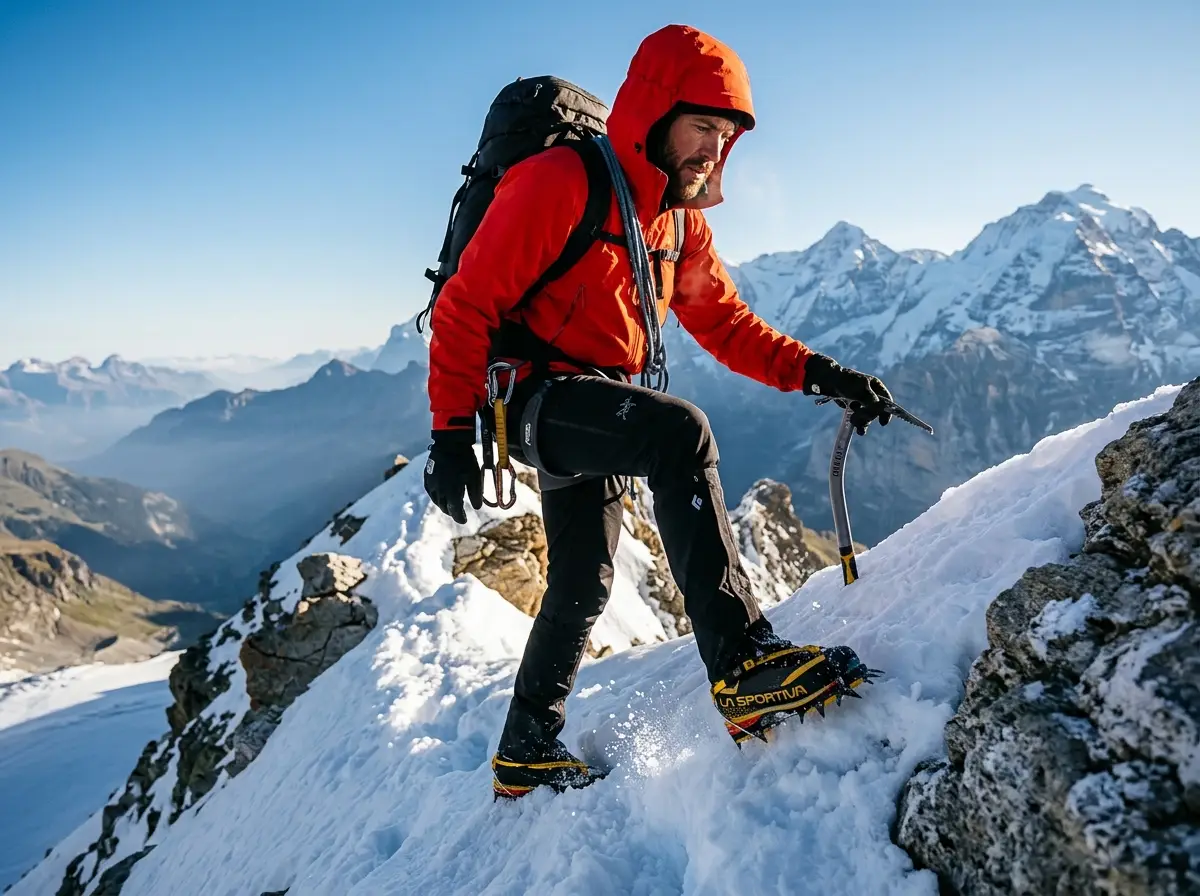
The heel bail snapped open somewhere around 11,200 feet — a soft click that barely registered over the wind. Two seconds later, my crampon rotated forty-five degrees on my B0 hiking boot and the slope decided the rest. One self-arrest and a bruised ego later, I sat staring at what had just nearly ended my day: a flexible sole that had no business being on that couloir, paired with a crampon designed for a stiffer boot. That day ended my confusion about mountaineering boots vs hiking boots. The physics, as it turns out, don’t negotiate.
After seven days of field testing on technical terrain — Class 3 scrambles, glacier approaches, steep snow couloirs — the line between the two categories becomes brutally clear. It is not a comfort line. It is a safety line.
⚡ Quick Answer: A hiking boot (B0 rating) handles Class 1–2 terrain with light snow and microspikes. The moment your objective involves semi-automatic or automatic crampons — or sustained Class 3+ terrain with ice or steep snow — a hiking boot becomes mechanically unsafe. The failure isn’t discomfort; it’s that a flexible sole will eject a crampon mid-step or exhaust your calf muscles before the crux. Match your boot’s B-rating to your terrain class.
| Mountaineering Gear Classification Guide | |||
|---|---|---|---|
| Class | Terrain | Boot | Crampon |
| 1 | Groomed trails | B0 | None / Microspikes |
| 2 | Off-trail, light snow | B0/B1 | C1 Strap-on |
| 3 | Scrambling, glaciers | B1/B2 | C1 or C2 |
| 4 | Steep snow couloirs | B2/B3 | C2 Semi-Auto |
| 5 | Vertical ice, mixed | B3 | C3 Automatic |
The Three Limits of a Hiking Boot
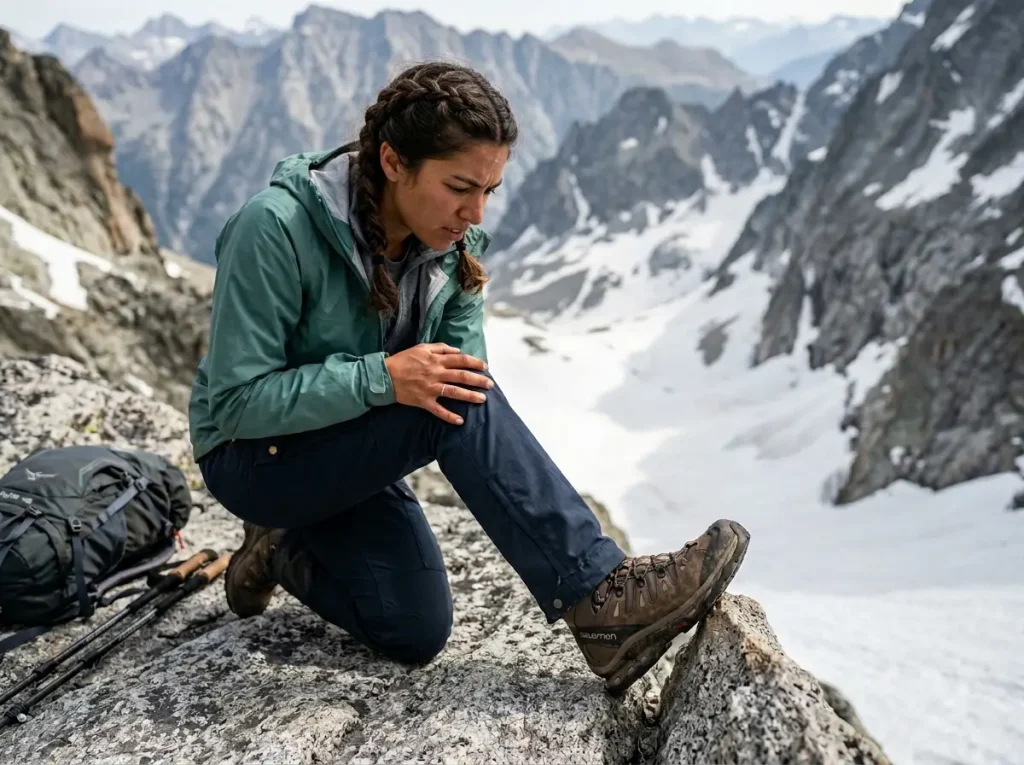
Most hikers assume boot choice is a comfort decision. It is not. A hiking boot fails on technical terrain in three specific ways, and each has an accident history behind it. Understanding these limits is the gear decision that separates a day hike from peak bagging.
The first is the Stiffness Limit. Put a flexible B0 sole on a 40° snow slope and everykick-step forces your calf to contract to hold a position the boot’s structure refuses to maintain. Field data shows roughly 40% more muscle effort in the lower leg when climbing in hiking boots versus stiff mountaineering boots on uneven ground. That’s 40% more work before you even reach the crux.
The second is the Crampon Security Limit. B0 hiking boots have no heel or toe welts — the hardened protrusions that C2 and C3 crampon bindings clip into. Without them, you’re relying on strap tension or boot rigidity that doesn’t exist. The American Alpine Club’s accident analysis of gear-related fall factors lists crampon loss as a documented cause of falls on technical terrain. The failure happens fast. No warning.
The third is Thermal Saturation. Standard hiking boot midsoles bleed heat directly into ice contact. Frostbite onset begins below -4°C (25°F), and the National Park Service notes that 25% of Denali injuries are frostbite-related. That number comes from people who thought their gear was adequate.
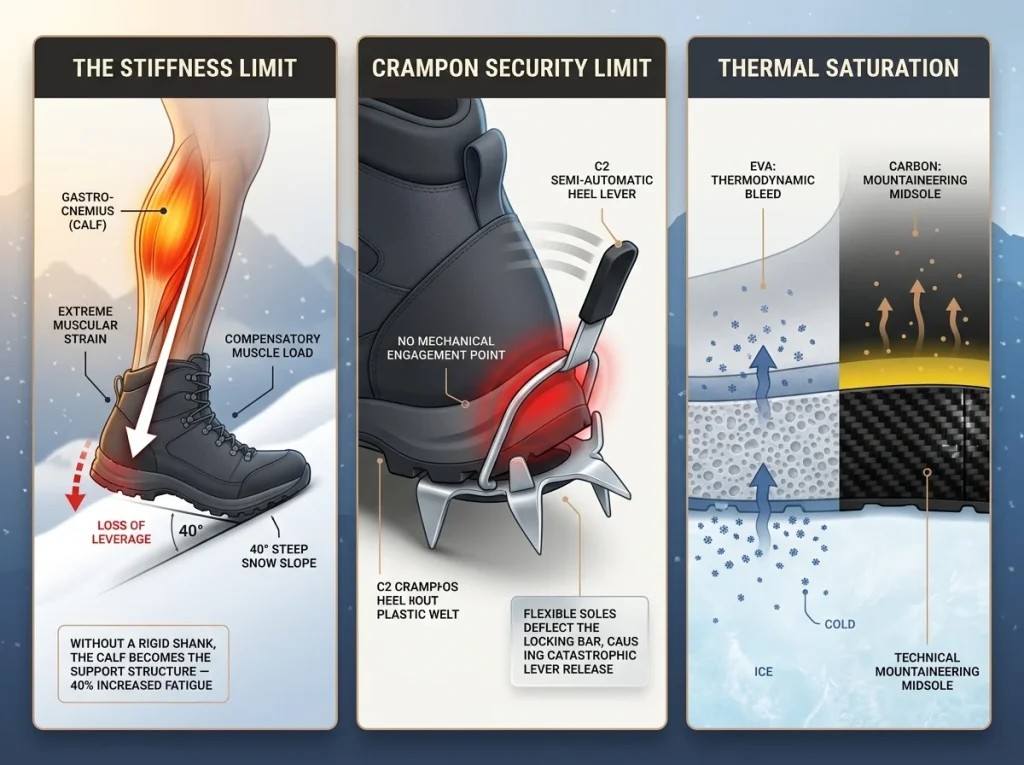
The Stiffness Limit — When Calf Muscles Become the Shank
Your calf doesn’t know it’s supposed to quit. It keeps compensating until proprioception degrades and balance goes with it. On a 40° couloir, that’s when you fall.
A ¾ shank handles mixed trail-and-scramble terrain. A full shank is mandatory for front-pointing on steep ice — the difference between the crampon staying put or rotating under your bodyweight. The lever effect from a rigid shank transfers ground reaction forces through the boot’s structure rather than through muscle contraction. If your calves are burning below Class 3 terrain, your boot is doing the work your shank should be doing. That’s not a fitness problem. It’s a gear problem.
On a multi-day Cascades route, I switched from approach shoes to B2 boots at the glacier threshold. The calf burn that had been building on the firn simply stopped. The shank was taking the load. That’s the lever effect — and once you feel it, you don’t go back.
The Crampon Security Limit — Welts, Toe Bails, and Failure Points
C1 strap-on crampons wrap around the boot body. Functional, least secure. Strap loosening under fatigue is real.
C2 semi-automatic crampons use a heel lever that clips into a dedicated plastic heel welt. If the boot lacks rigidity or lacks the welt entirely, the boot flexes under load and pops the heel lever open mid-step. This is exactly why boot-crampon interfaces are a leading cause of falls on technical terrain — the B-rating system exists to map the safe combinations.
C3 automatic crampons require a toe bail that loops over a steel-reinforced toe welt groove. Any flex in the toe zone will eject the crampon. No warning. Quick field check: install crampons at home, stand on one foot, flex the knee forward. If you see heel lever movement, you’ll feel it on the slope at the worst possible moment.
Thermal Saturation — The Heat Balance Equation
Mountaineering boots use honeycomb or carbon midsoles to create a thermal break between your foot and the ice contact surface. Hiking boots don’t. After a few hours on snow, even a well-insulated hiking boot starts losing that battle.
Thinsulate microfibers trap air without sacrificing technical precision. Ratings run from 200g active to 1000g+ for extreme cold. For the physiology of vasoconstriction and what governs frostbite onset at a deeper level, understand this: over-tightening laces restricts circulation — that’s the accelerant. Field protocol: “lace for the phase.” Loose in the toe box on approach. Tighter only during technical sections.
Pro tip: Loose lacing on the approach isn’t sloppy — it’s how you keep your toes warm when it matters. Tighten only when you hit the technical terrain.
Understanding the B-Rating System (B0 to B3)
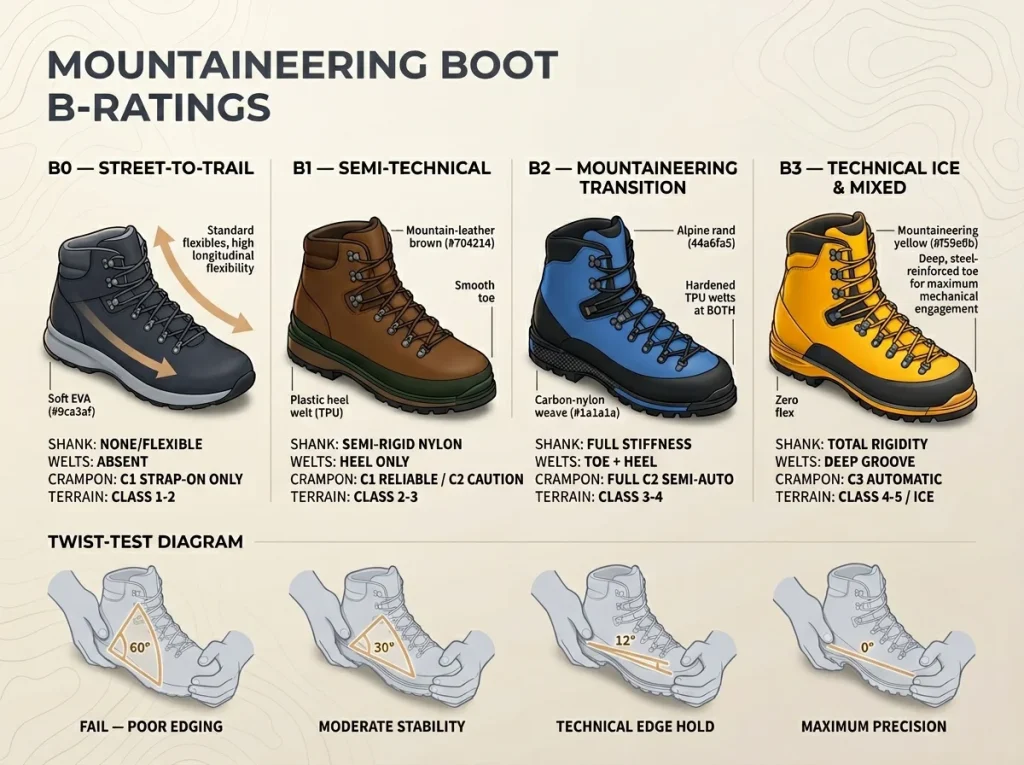
Every boot purchase for technical terrain starts here. The B-rating classifies sole stiffness and crampon welt design together.
B0: Standard flexible hiking boot. No heel or toe welt. Compatible with microspikes and C1 strap-on crampons at best. Class 1–2 terrain only. The Salomon Quest 4, one of the stiffer “technical hiking boots,” measures 106.6% stiffer than average hiking boots — and it still cannot safely accept C2 crampons.
B1: Semi-rigid shank, partial heel welt. Accepts C1 crampons reliably, some C2 with caution — pass the twist test. Class 2–3.
B2: Fully stiff with both toe and heel welts. Full C2 compatibility. Class 3–4. The La Sportiva Aequilibrium ST (2 lb 12.4 oz, $379) is the benchmark — B2 stiffness at near-hiking-boot weight using a carbon-nylon shank weave.
B3: Completely rigid. C3 automatic crampons only. Class 4–5, vertical ice, mixed terrain. The Nepal EVO (4 lb 7.4 oz) is the reference standard. That extra 1 lb 11 oz versus the Aequilibrium ST is a real carry decision on a long approach.
For the full guide to B0–B3 ratings and crampon binding compatibility, start with these four tiers and match them to your terrain class.
Torsional Rigidity — The Hidden Stiffness Metric
Nobody in the competitor content explains this. Everyone measures longitudinal stiffness — forward flex. But torsional rigidity is what determines whether a boot holds an edge on a side-hill traverse.
On hard snow, lateral load tries to roll the boot’s sole away from the slope. A boot that twists under this force will slip — regardless of crampon engagement. The crampon can’t hold an edge the boot is rotating away from.
The twist test: grip forefoot and heel, apply opposing rotational force. B0: 45–90° of flex. B1: 20–35°. B2: 10–15° at most. B3: essentially zero. Any boot that shows more than 15° under hand pressure will show significantly more under bodyweight on a traverse. The PubMed study on boot shaft stiffness and muscular co-contraction confirms that restricting ankle motion changes the entire lower-leg muscle recruitment pattern.
Boot Anatomy That Separates the Categories
Heel and toe welts are hardened plastic or rubber protrusions that mate with C2 and C3 crampon bindings. Hiking boots don’t have them. Without welts, there is no mechanical engagement point — only friction and strap tension.
Shank materials evolved from steel to nylon and carbon fiber. The carbon-nylon weave in the Aequilibrium ST achieves B2 rigidity at dramatically reduced weight — the current standard for transition boots. The rand — the rubber strip wrapping around the upper’s base — protects against rock abrasion. It’s the first thing to wear on technical terrain. Inspect it after every alpine route.
For a deeper read on how midsole composition affects thermal performance and cushioning durability, the anatomy comparison covers material science that matters on multi-day routes. Vibram Mont rubber provides excellent grip on rock and mixed terrain. It wears rapidly on asphalt — a known trade-off.
How Crampons Connect — The Mechanical Interface
The heel lever on a C2 crampon wraps under the heel welt and engages a locking bar. If the welt is absent, or if the boot flexes enough to deflect the bar, the lever releases. Full stop.
The toe bail on a C3 crampon is a steel wire over a toe welt groove. The groove must be present, hardened, and dimensionally compatible. B3 boots certified under EN 893 are the only designs where this is guaranteed. Watch this video from The High Ground — it shows the actual mechanical interface far more clearly than any diagram:
Pro tip: Before any technical objective, install crampons, stand on one foot, flex the knee forward aggressively. If the heel lever moves even slightly, that system is unsafe for the terrain you’re planning.
The Transition Zone — Where the Choice Gets Hazardous
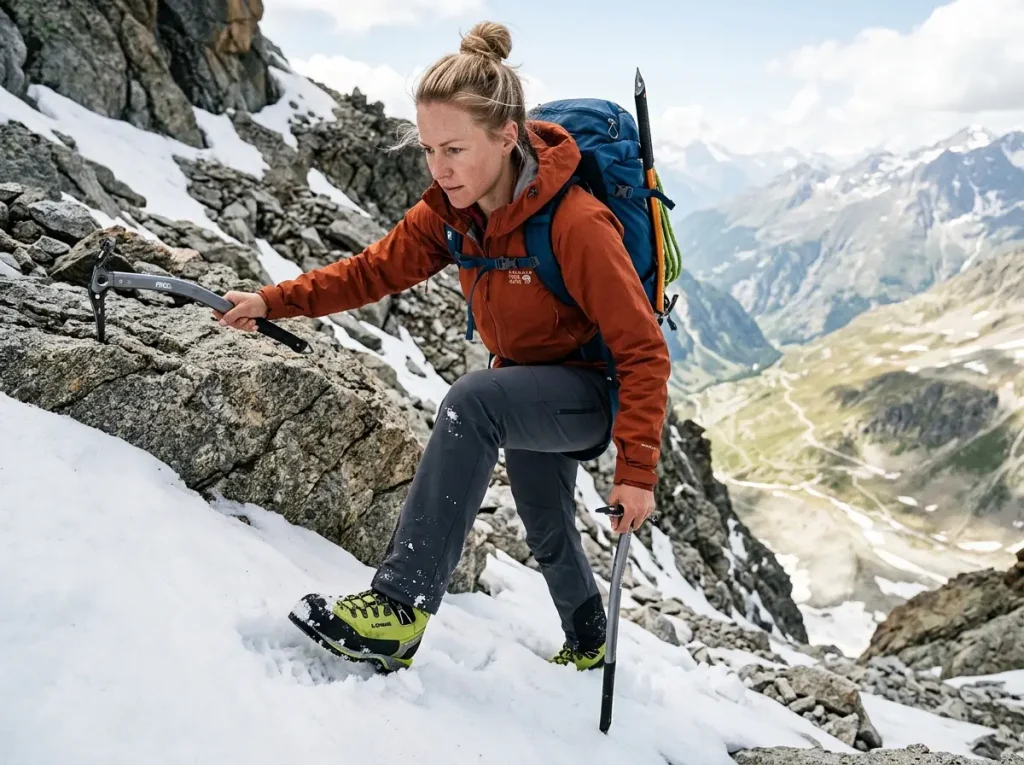
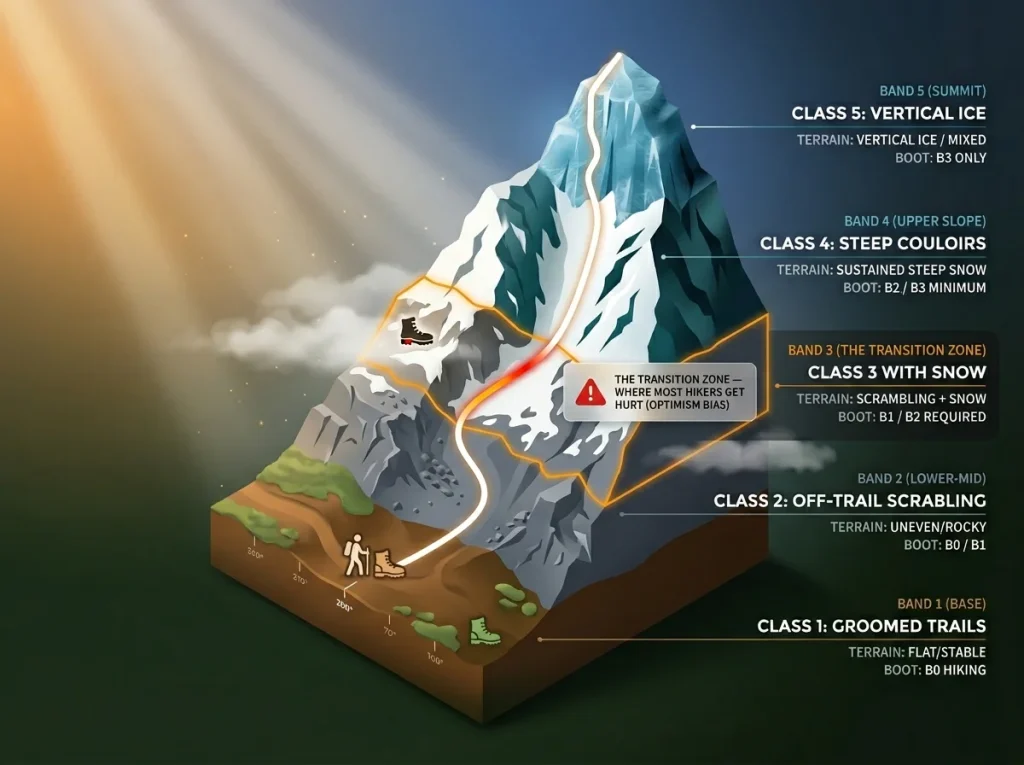
Most accidents don’t happen on obvious vertical ice. They happen where hikers assume their gear is adequate — Class 2–3 terrain with moderate snow and scrambling, where the decision between B0 and B2 feels like a comfort upgrade rather than a safety threshold.
Class 2 off-trail with moderate scree: B0 is functional. Class 3 with scrambling on dry rock: B0 is acceptable; B1 is better. Add snow or ice: B1 minimum, B2 strongly preferred. Any glacier crossing or couloir access: B2 is the minimum safe rating. C2 crampons required.
The full YDS terrain classification system for Class 2, 3, and 4 scrambles maps this. The amber zone — Class 3 with snow — is exactly where progressing adventurers get hurt, per the AAC guide to cold-weather footgear requirements.
I’ve guided groups through the transition zone more times than I can count. The pattern is always the same — people know they’re in the middle ground, and they err toward optimism. “My boots feel solid.” They always do, until the crampon pops on the first steep pitch.
“Bridge Boots” and When to Use Approach Shoes
Modern carbon-nylon construction changed this category. The La Sportiva Aequilibrium ST (2 lb 12.4 oz, $379, B2) is the current benchmark for hikers crossing into Class 3–4. The 3D Flex Evo ankle joint allows approach-day comfort without sacrificing shank rigidity at the technical threshold. The Scarpa Ribelle HD (3 lb 1.0 oz) is worth trying for hikers with wider feet who find La Sportiva’s narrow last too constricting.
Both use sticky technical outsole rubber that degrades on asphalt. Reserve them for trail and above.
On flat trail, a rigid-shank boot forces the knee and hip to compensate for restricted ankle motion. The smart move: trail runners or approach shoes for all Class 1 and easy Class 2 miles. Carry the B2 boots in the pack and transition at the Class 3 threshold. The gear progression from hiking to non-technical mountaineering covers the full transition, including pack weight strategy.
Pro tip: Approach shoes with sticky rubber handle low-angle scrambles well. The moment snow or ice appears, the transition to mountaineering boots is non-negotiable — no rubber compound substitutes for a crampon-compatible sole on frozen terrain.
Boot Fit for Technical Terrain
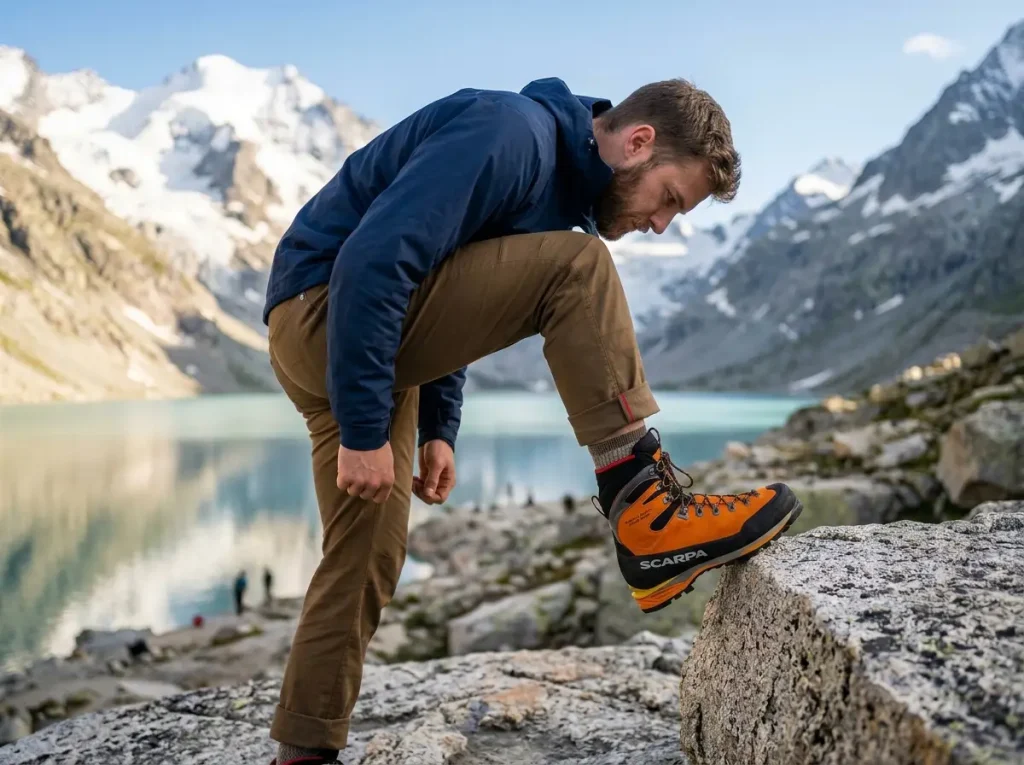
The toe box must allow wiggle movement for circulation. The heel must lock with near-zero lift — even 2–3mm of heel lift during kick-stepping compromises crampon precision and causes raw spots within hours. Last volume matters: narrow-lasted boots (La Sportiva, Scarpa) versus wider options (Mammut, some Salewa). Trying multiple brands is the process. For how peripheral edema affects boot sizing on descent-heavy routes, try boots in the afternoon, with the exact socks you’ll use in the field.
The heel-lock test: stand in unlaced boot, kick heel firmly three times. Lace the boot. Stand on a staircase edge on forefoot only, flex knee forward. The heel should not lift more than 2–3mm. If it floats, the last volume is wrong — try a different model, not a different size.
For sock systems, single-layer Merino wool matched to boot fit is the right protocol. 200g for approach, 400g+ for sustained cold. Double boots with removable liners are the only design that allows liner drying while maintaining a warm outer shell — required for expeditions lasting 7+ days without shelter access.
The Three Things That Actually Matter
Stiffness is a safety metric, not a comfort preference. When your sole flexes on technical terrain, your muscles compensate — and on a 40° couloir, that chain ends in fatigue, crampon ejection, or a fall. The B-rating system classifies this threshold objectively. Use it.
Crampon interface is a systems engineering problem. A C2 crampon on a B0 boot doesn’t work less well — it is a mechanical failure waiting for the right load and the right moment. Your boot and crampon must match the terrain you’re standing on.
The Transition Zone — Class 2–3 terrain — is where most progressing hikers get hurt. Not on obvious ice walls, but on moderate steep ground where they assumed what they had was good enough. If your objective crosses into Class 3, think B1 minimum. If there’s snow or ice, think B2.
Before your next objective involving snow, ice, or sustained steep terrain: apply the twist test, check your crampon ratings against the B/C compatibility matrix, and do the heel-lock test before any boot purchase. Five minutes of pre-trip verification pays better than any single piece of gear you can buy.
FAQ
Can I use hiking boots for mountaineering?
For Class 1–2 terrain with microspikes in light snow, a B0 hiking boot is adequate. Once you need semi-automatic or automatic crampons — or your terrain reaches Class 3+ with sustained ice or steep snow — a hiking boot becomes unsafe. The failure isn’t immediate discomfort; it’s crampon ejection or progressive muscle fatigue that degrades your balance before the crux.
What are B1, B2, and B3 boot ratings?
The B-rating system classifies sole stiffness and crampon welt design. B1 boots are semi-rigid with a partial heel welt — suitable for hiking, light glacier travel, and C1 strap crampons. B2 boots are fully stiff with both welts, compatible with C2 semi-automatic crampons and Class 3 or 4 terrain. B3 boots are completely rigid, designed for C3 automatic crampons and sustained technical ice or mixed climbing.
Are mountaineering boots comfortable for walking?
On flat trail, a rigid B2 or B3 boot requires significantly more muscle effort in the lower leg than a flexible hiking shoe — the ankle’s natural range of motion is blocked, forcing the knee and hip to compensate. Most experienced alpinists use approach shoes for forest miles and transition to mountaineering boots at the technical threshold.
Do I need crampons for hiking boots?
Standard B0 hiking boots can accept C1 strap-on crampons or microspikes for compacted trail ice and moderate snow. They cannot safely accept C2 or C3 crampons because they lack the welts required for the binding mechanisms. For anything steeper than moderate snow travel, even the C1 strap system is at the edge of safe — it’s the least mechanically reliable binding design under dynamic load.
What is the best transition boot for hikers moving into technical terrain?
The La Sportiva Aequilibrium ST ($379, 2 lb 12.4 oz) and the Scarpa Ribelle HD (3 lb 1.0 oz) are the current benchmarks for hikers crossing into Class 3 or 4 terrain. Both achieve B2 stiffness using carbon-nylon shanks at weights competitive with traditional leather hiking boots. They accept C2 crampons reliably and maintain a rocker profile for approach-trail walkability. The durability trade-off: sticky technical outsole rubber degrades on asphalt. Reserve them for trail and above.
Risk Disclaimer: Hiking, trekking, backpacking, and all related outdoor activities involve inherent
risks which may result in serious injury, illness, or death. The information provided on The Hiking Tribe is for
educational and informational purposes only. While we strive for accuracy, information on trails, gear, techniques,
and safety is not a substitute for your own best judgment and thorough preparation. Trail conditions, weather, and
other environmental factors change rapidly and may differ from what is described on this site. Always check with
official sources like park services for the most current alerts and conditions. Never undertake a hike beyond your
abilities and always be prepared for the unexpected. By using this website, you agree that you are solely
responsible for your own safety. Any reliance you place on our content is strictly at your own risk, and you assume
all liability for your actions and decisions in the outdoors. The Hiking Tribe and its authors will not be held
liable for any injury, damage, or loss sustained in connection with the use of the information herein.
Affiliate Disclosure: We are a participant in the Amazon Services LLC Associates Program, an
affiliate advertising program designed to provide a means for us to earn advertising fees by advertising and linking
to Amazon.com. As an Amazon Associate, we earn from qualifying purchases. We are also an official affiliate partner
of Black Diamond Equipment via the AvantLink network. If you click on a Black Diamond affiliate link and make a
purchase, we may earn a commission at no additional cost to you. We also participate in other affiliate programs and
may receive a commission on products purchased through our links. Additional terms are found in the terms of
service.