In this article
My breathing was out of sync with my steps, the 35-pound pack swung like a pendulum, and my brain flashed every catastrophic outcome simultaneously. It wasn’t a grizzly bear or washed-out bridge that stopped me—it was sudden, inexplicable panic. After guiding technical routes for a decade, I can tell you that anxiety in the backcountry is rarely a lack of courage. It is a measurable physical manifestation of sensory failure.
Understanding the unforgiving physics of the trail fundamentally changes how you hike. By implementing redundant technical safety protocols, you can rewire your reactions and strip away the fear of the unknown. Here is exactly how to treat anxiety not as panic, but as actionable data.
| YOSAR Risk Perception vs. Actuarial Reality | ||
|---|---|---|
| Perceived Risk | Actuarial Reality | YOSAR Data Point (2024) |
| Predator Attack | Statistically anomalous | Negligible |
| Getting lost permanently | Navigational oversight | Rising due to phone reliance |
| Slipping off a drop | Footing errors | Most frequent SAR incident |
| Exposure Panic | Poor hydration planning | High incidence of preventable exhaustion |
⚡ Quick Answer: Backcountry anxiety is an involuntary physiological response caused by sensory mismatch, not a mental weakness. You stop the panic loop by relying on structural redundancy, like satellite messengers or mechanical stability drills. By addressing these triggers with grounding techniques and objective risk statistics, you force your brain back into reality.
The Biology of Backcountry Panic: Why Your Brain Misfires
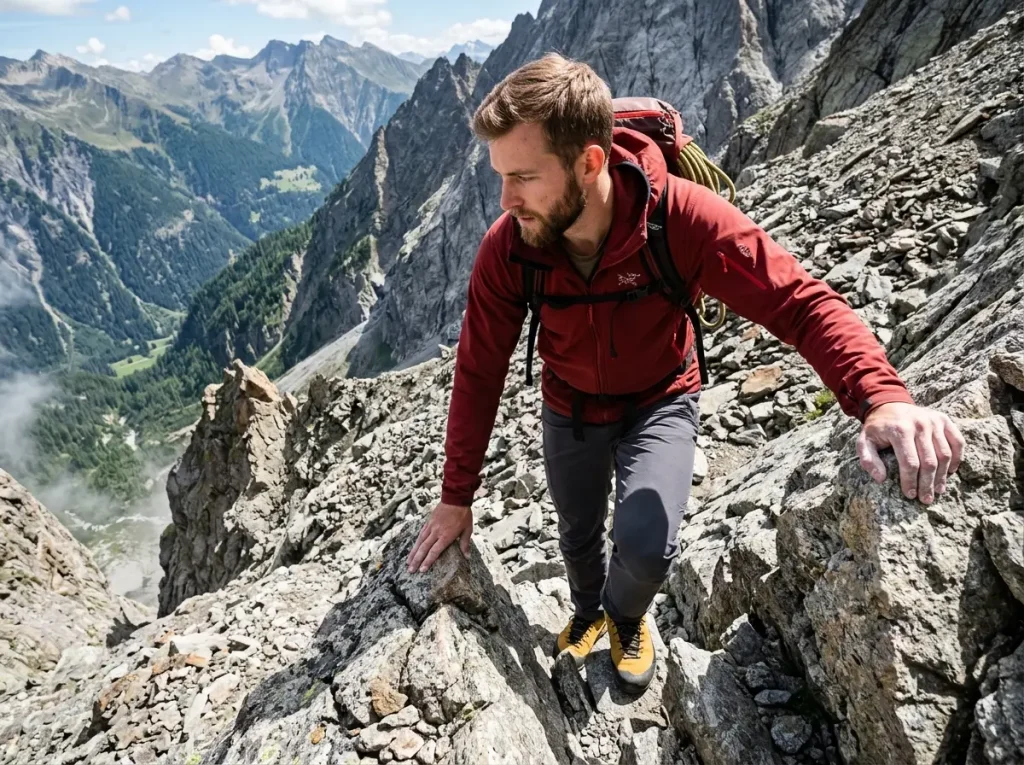
The instinctual fear you feel on a narrow ridgeline is entirely mechanical. Your nervous system triggers a massive response when it senses conflicting environmental data, throwing a wrench into your ability to think.
The Amygdala-Prefrontal Cortex Short Circuit
Your brain’s threat detection hub, the amygdala, reacts instinctually to anything unstable on the trail. Under calm conditions, your prefrontal cortex evaluates the fear, confirms you are safe, and suppresses the response. But the physical strain of rough terrain alters this. High stress physically blocks the communication channels. When this fails, your prefrontal cortex loses its grip.
This biology of fear forces your stress response system to flood your system with cortisol. Your physiological stress response shifts into overdrive. This is disastrous when trying to read a topographic map. High cortisol degrades fine motor skills and induces hypervigilance. You stop seeing a forest and start seeing threats behind every boulder.
Vestibular Mismatch: When Eyes and Ears Disagree
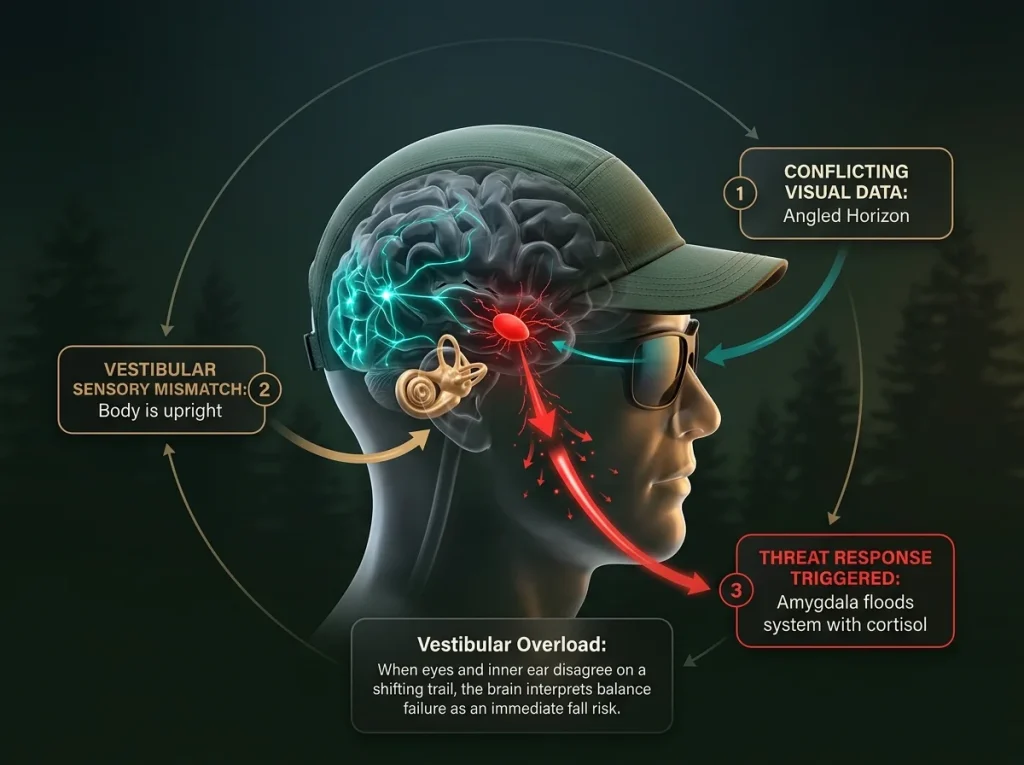
Trail panic often stems from dizziness caused by sensory confusion. The vestibular system in your inner ear tracks balance by integrating signals from your eyes and legs. On shifting talus, your eyes might register an angled horizon while your inner ear senses you are upright.
This conflict creates a vestibular sensory mismatch. The brain has no framework for this, interpreting it as an immediate fall risk. It hits the alarm bells connected to the amygdala. Your heart rate spikes and muscles tense, which makes your balance even worse.
If you spend too much time over-stressed in visually busy environments like deep, flowing water crossings, you trigger chronic sensory overload. Hikers frequently misinterpret this unsteadiness as an intuition that something terrible is about to happen.
Pro-Tip: In my early days, I mistook sensory overload on visually busy ridgelines as a “gut feeling” of a hazard ahead—it was just my inner ear struggling to orient to the horizon. Stop walking, sit down, and focus on one static rock to reset your balance system.
If you are transitioning from foundational hiking to peak bagging, you will cross this threshold of vestibular overload often. Your brain simply needs to learn that an angled horizon does not mean you are falling.
The Physics of Perceived Hazards
Wilderness illusions cause the vast majority of our fear. When you break these perceptions down using hard physics, those ghosts disappear.
Acoustic Refraction: Why the Woods Sound Louder at Night
Every new backpacker lies awake at night, convinced a massive animal is breaking branches right outside. During the day, the forest sounds quiet. Under the cover of total darkness, a mouse sounds like a mountain lion.
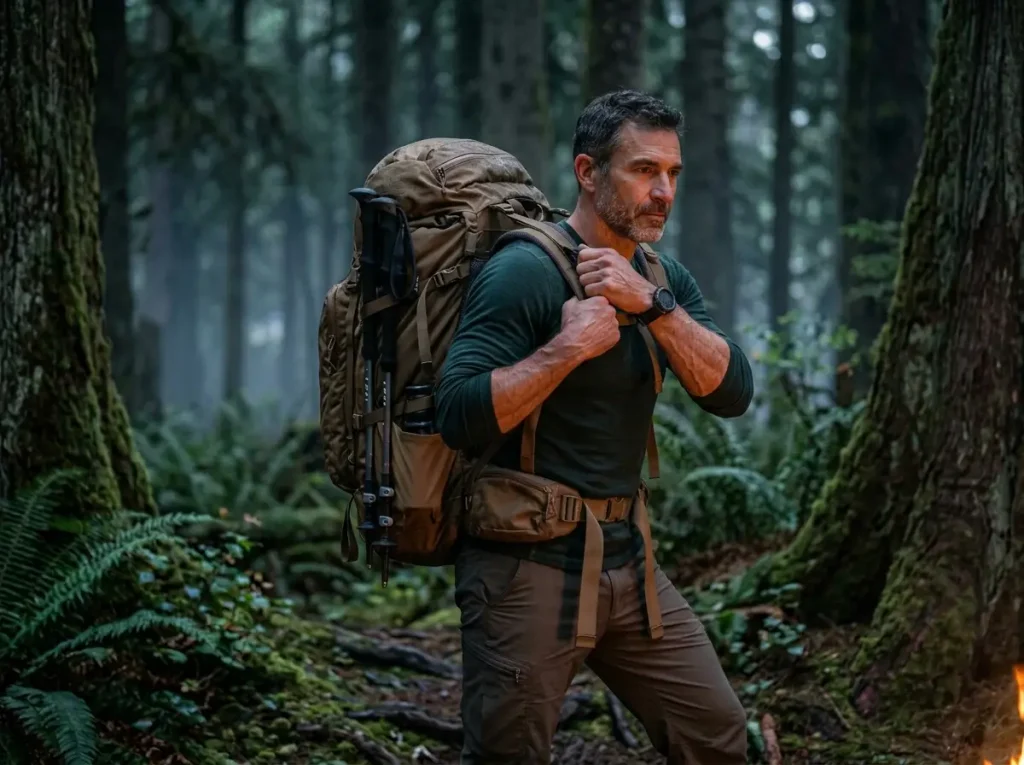
The physics of sound propagation actively warps your hearing due to sound wave bending, or acoustic refraction. Sound waves travel faster in warm air than in cold air. During the day, sound waves bend upward and scatter. At night, the ground cools rapidly, trapping cold air beneath a layer of warmer air. This temperature inversion acts like a lens. Sound waves hit the warmer air, speed up, and bend forcefully downward.
You hear the snapping twig of a squirrel foraging a hundred yards away, but the lensed sound hits your tent so hard you swear the animal is three feet away. Treating every thump as bear attacks is exhausting. Knowing the actual physics is an effective grounding technique. If you still struggle, throw in earplugs for sleep anxiety to silence the physics altogether.
Center of Gravity and Postural Stability
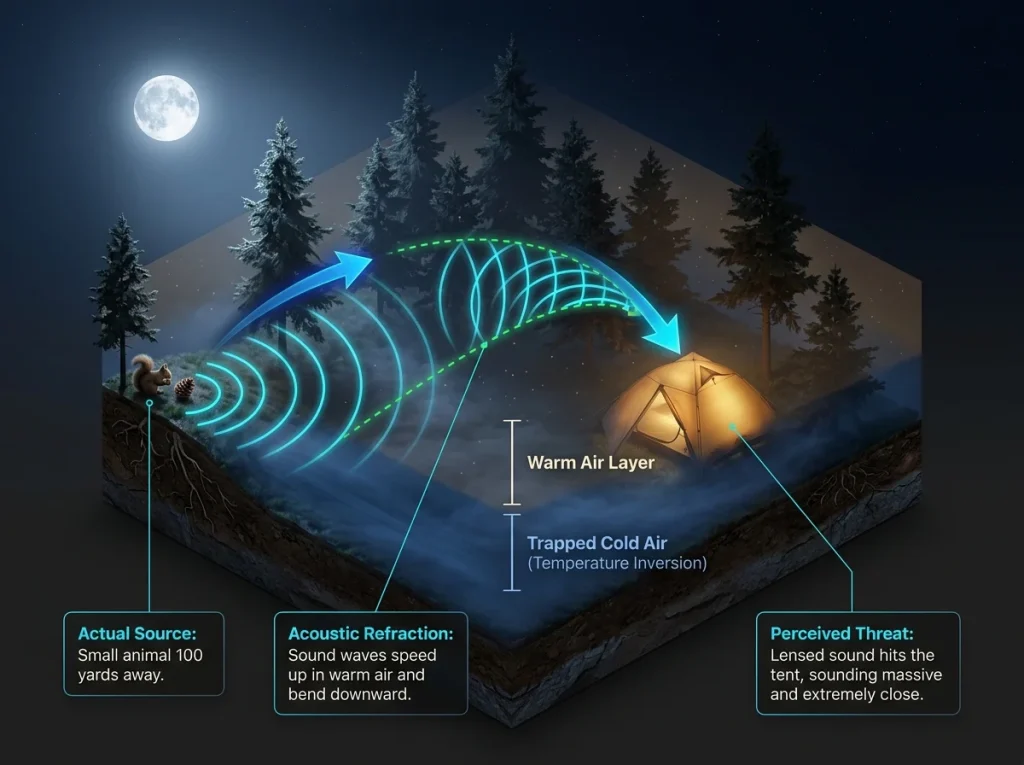
Your balance is dictated by how you pack your gear. You must understand weight distribution for stability to avoid shifting your mechanical load into a liability. A swaying pack pulls you off balance, and your brain correctly flags that physical unsteadiness as a severe hazard.
If you load the heaviest items at the very top or bottom of your bag, you shift the leverage point away from your spine. You have to lean forward just to stop the bag from pulling you backward. This transfers pressure to the front of your feet, spiking your risk of sliding on loose dirt. You can feel a badly packed bag the moment you step up onto a high rock. If you have to fight the downward pull of your own gear, your pack is fighting you. Your hips should bear the load, while your shoulders just keep the frame centered.
You must distribute pack weight to center of gravity accurately. Follow the “Big Three” method. Shove your sleeping bag at the bottom layer. Keep the heavy gear tight against the middle of your spine. Pack rain shells at the very top. If your pack swings laterally, your legs will fatigue, and your inner ear will send panic signals. This vestibular mismatch drains your confidence.
Pro-Tip: Before starting any technical descent, stop and tighten all your compression straps. A fifty-liter bag filled with thirty liters of gear will slosh around hazardously unless you crank the side straps down tight to freeze the internal volume.
Building the Technical Safety Net
Emotional wishful thinking fails when conditions deteriorate. You manage anxiety by establishing mechanical lifelines.
Actuarial Risk vs. Perceived Hazards
Wilderness fear often focuses on the wrong threats. People fixate on cougars, pouring energy into low-probability scenarios. We need to evaluate perceived risk vs technical reality.
Look directly at the National Park Service official mortality data and search and rescue statistics. In 2024, the Yosemite search and rescue teams handled 194 incidents. The primary drivers were lower-extremity injuries from simple slips, and severe dehydration. Backpackers miss turns and snap ankles stepping down onto unstable rocks. These are actuarial risks you can manage.
Your safety framework should target those exact failure points. That means carrying the 10 essentials, adhering to LNT principles, and utilizing sturdy footwear. Your anxiety will plummet when you stop fighting imagined predators and start respecting gravity and hydration.
The “Digital Tether”: Satellite Messengers and SOS
The best tool for destroying backcountry fear is a dedicated communication lifeline. Modern satellite messengers erase the overwhelming possibility of vanishing without a trace.
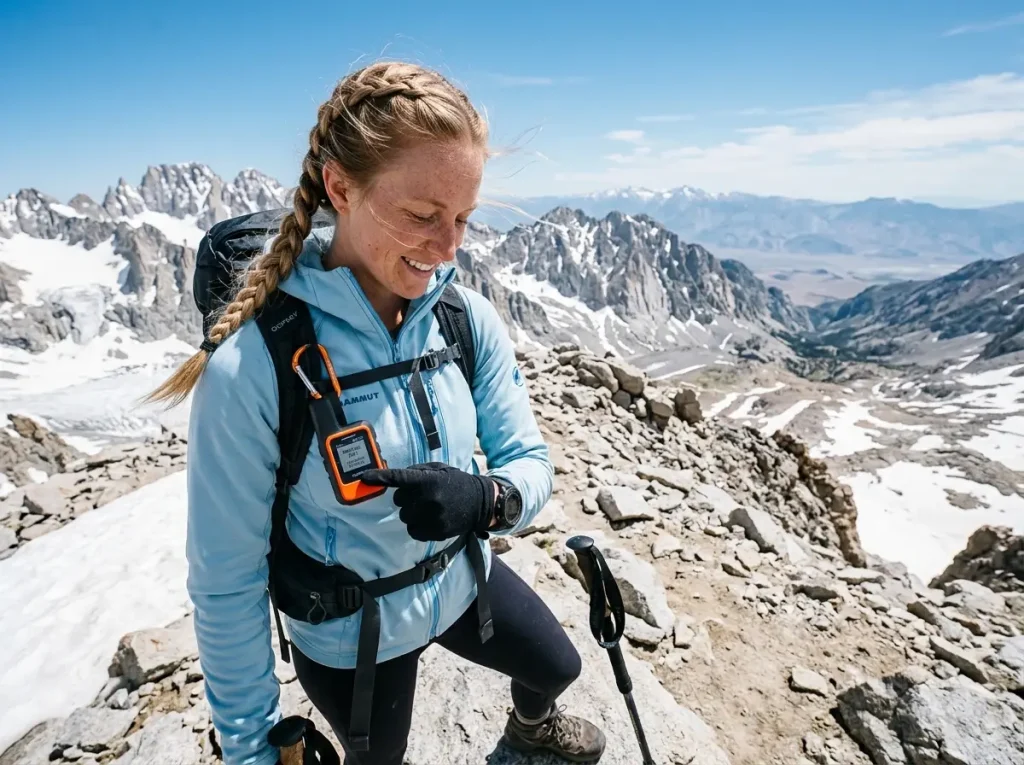
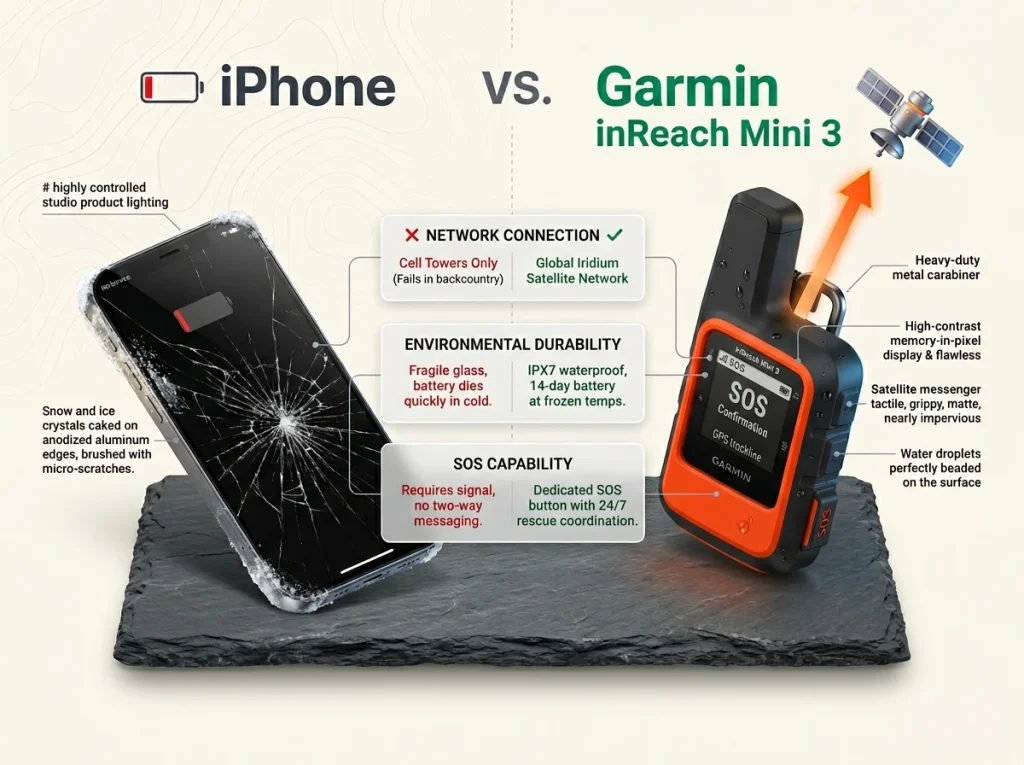
A cell phone running AllTrails or Gaia GPS on airplane mode works until the battery freezes. Relying on fragile glass creates intense psychological pressure. You need an independent unit on the global Iridium network to guarantee a connection basically anywhere. I carry a Garmin inReach purely to silence the mental chatter.
Having two-way messaging works as a psychological anchor. A dedicated device also features standalone navigation that circumvents cell phone failures completely. If your phone stops working while running offline map apps, your inReach can reverse your path and track you back to the trailhead. This provides superior offline navigation fail-safes.
Execute solid trip planning, master weather checking, build the discipline of letting someone know your itinerary, and clip a satellite unit to your shoulder strap. Doing these four things establishes an impenetrable technical safety net.
Conditioning the Vestibular-Emotional Network
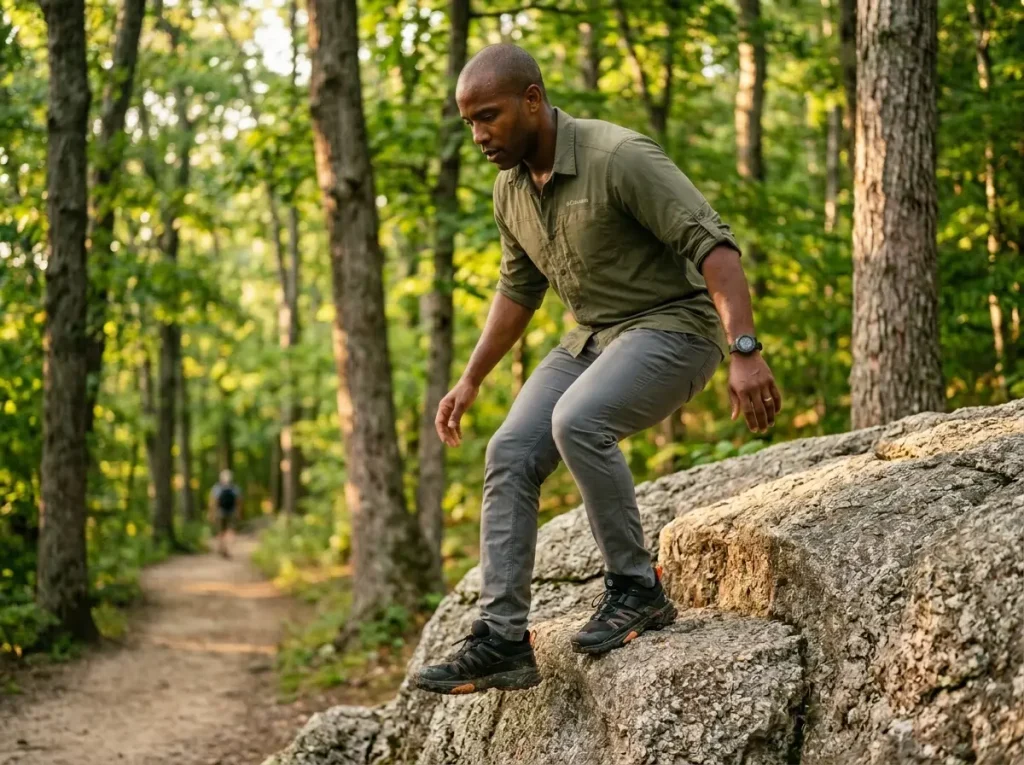
You cannot out-think physical instability. You have to train your form to reject the panic response through mechanical conditioning.
The Psychology of Self-Efficacy
Building mental resilience on the trail means establishing self-efficacy. This is the hard-earned belief that you can handle complex physical problems because you have actually done it before. Confidence requires physical mastery over unfamiliar ground.
Many hikers mistakenly assume that simply hiking more often will cure their fear of heights. That is incorrect. Repetition without targeted training just cements bad habits and leads to training peak fatigue.
There is a clinical linkage between vestibular function and chronic anxiety. By intentionally exposing yourself to unsteadiness in a controlled environment, you rewrite the connection between your balance centers and your amygdala. Small, controlled bursts of green exercise in challenging terrain will drastically lower your baseline cortisol levels over time.
Targeted Proprioceptive Drills for Hikers
You must fortify the stabilizing muscles in your lower legs long before you test them on a talus field. A technical skills training plan stops poor footing from triggering an emotional spiral.
Use balance drills to force your brain to rely on mechanical input rather than visual safety.
First, use closed-eye balance holds. Lift one foot off the floor and close your eyes. You will immediately wobble. Without visual references, you force your brain to listen to your inner ear. This mirrors the sensory deprivation of hiking by headlamp.
Next, execute tandem gait tightrope walks on the floor to tighten up your lateral stability. Practice walking heel-to-toe across a narrow line until your ankles automatically correct slight sideways tilts.
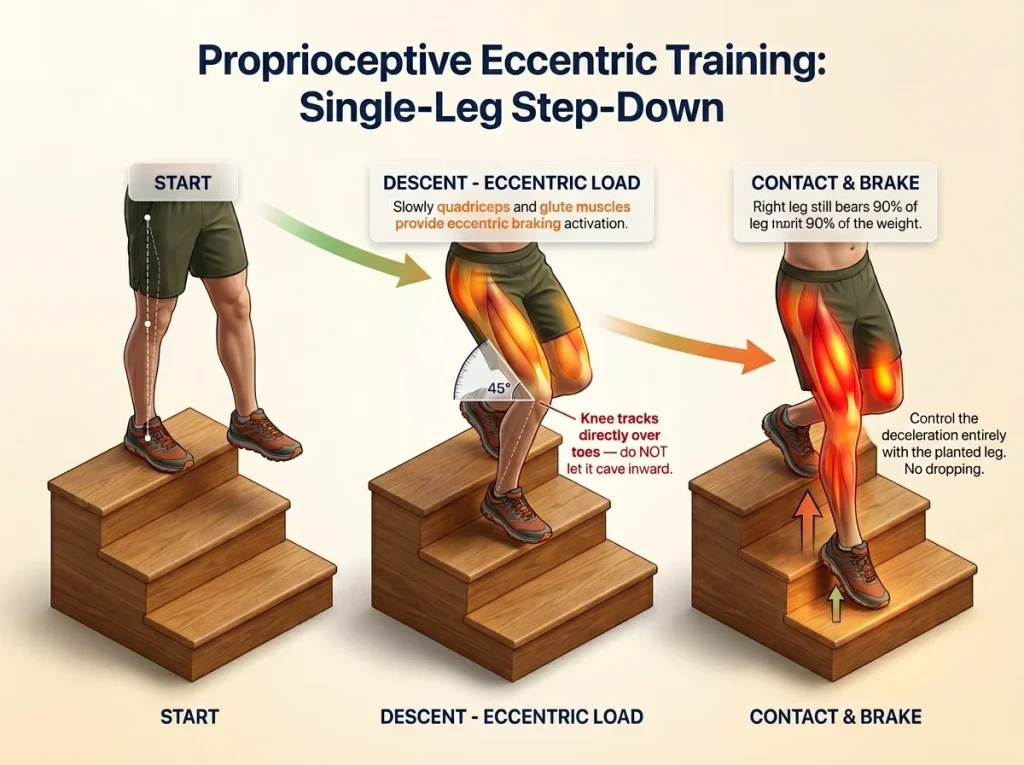
Finally, build eccentric muscle control using single-leg step-downs. Stand on a stair step and slowly lower your suspended heel, using only the planted leg to brake the movement. Crippling trail injuries usually occur on steep downward steps where your leg has to apply aggressive braking force. Practicing this motion isolates the exact muscles you need to decelerate safely.
These repetitive micro-drills serve as a fantastic trail-specific hiking fitness test that prepares you for high consequence environments.
Field Protocols for Interrupting the Panic Loop
When you hit your anxiety threshold, your brain slips into a recursive loop of fear. You need rigid technical gear failure protocols and mental resets to arrest the slide.
The “Control the Controllables” Strategy
Fear catapults you into overwhelming hypothetical futures. These psychological tactics from your own brain are heavily distracting. The immediate tactical fix is dragging your mind violently back into the present moment by forcing it to process physical actions.
When the vertigo hits on a scree slope, halt all movement immediately. Stop walking. Your very first action is to physically sit down on the nearest rock. Lowering your center of gravity provides a massive influx of stability data to your inner ear. This instant physical grounding stops that vestibular tracking error from spiraling out of control.
Next, engage in verbal labeling. State clearly out loud, “I am feeling anxious right now, but I am mechanically safe.” This instructional self-talk deflates the emotional intensity by moving the processing from your reactive amygdala to your logical prefrontal cortex.
Identify two tasks to execute immediately. Grab your water bottle and drink four ounces. Open your map and identify your topographic position. Applying the anxiety-to-action matrix narrows your focus down to hard, controllable data points. Utilizing strict physical safety checklists leaves your brain zero bandwidth to invent fake threats. This is also the exact moment you need to calculate a firm turnaround time. The mountain will still be there tomorrow. Making the logical call to retreat is the ultimate expression of control.
The Physiological Reset: Box Breathing
You cannot order your heart to slow down using logic. You have to bypass cognitive therapy and manipulate your nervous system mechanically.
Perform a box breathing sequence. This is a deliberate form of breathwork designed to directly stimulate the vagus nerve.
- Inhale deeply through your nose, expanding your stomach, for four slow seconds.
- Hold that breath in your lungs for four seconds.
- Exhale smoothly and completely through your mouth for four seconds.
- Hold your lungs empty for four seconds before inhaling again.
Repeat that cycle four full times. Diaphragmatic breathing forces your form completely out of fight-or-flight mode and drops it directly into a parasympathetic state.
Pro-Tip: Treat box breathing like a piece of mandatory gear. If you feel your chest tighten on an exposed ridgeline, do not take another step until you have completed full four-second breathing cycles. Never try to just walk through the panic. Stop, sit down, and manually turn the adrenaline off before making any movement decisions.
Conclusion
True confidence on the trail is never the absence of fear, but the presence of rigorous, redundant systems. Fear stops dictating your hikes the moment you treat it as a mechanical problem to solve. Take these balance drills seriously, invest in the communication technology that guarantees your safety, and recognize how temperature and gravity manipulate your perception. By practicing strong navigation skills, you will always know your exact position on the map. Next time you feel the adrenaline spike on a knife-edge ridge, you will know exactly how to drop your center of mass, reset your breathing, and trust your training. The wilderness rewards preparation over luck every single time.
FAQ
Is it normal to be scared of hiking alone?
Yes, experiencing baseline anxiety while hiking alone is an entirely normal evolutionary response to being isolated. The key is distinguishing between an instinctual amygdala reaction and actual, objective risk. Keep your focus on technical backups like a National Park Service recommended tracking beacon. Following NPS guidelines strips away the stress.
How do you stop being anxious while hiking at night?
You combat nighttime hiking anxiety with knowledge of acoustics and proper illumination, not just willpower. Understanding that a temperature inversion makes all distant sounds seem artificially close strips away the illusion that every snapped twig is an immediate threat waiting in the shadows. Learning these physics principles directly counters the raw adrenaline.
What should an anxious beginner carry to feel safer on the trail?
A dedicated, standalone satellite communicator is by far the most effective piece of gear for reducing wilderness anxiety. Knowing you have an Iridium-connected SOS terminal with two-way messaging works as a psychological digital tether. Quality rain layers from brands like REI Co-op or Hyperlite Mountain Gear, and taking advice from veteran athletes like Caroline Gleich, and experienced publications like Backpacker.com or The Hungry Hiker and The Hiking Tribe or Miss Adventure Pants, provides massive peace of mind against exposure.
Why do I feel dizzy and panicked on steep slopes?
This is called vestibular mismatch, where your eyes and your inner ear balance centers process conflicting data about your orientation. Sitting down to lower your center of gravity and breathing deeply stops this dizzy-anxious cycle dead in its tracks. Always prioritize strict risk mitigation techniques like stopping to rest over pushing through hazardous physical disorientation.
Risk Disclaimer: Hiking, trekking, backpacking, and all related outdoor activities involve inherent
risks which may result in serious injury, illness, or death. The information provided on The Hiking Tribe is for
educational and informational purposes only. While we strive for accuracy, information on trails, gear, techniques,
and safety is not a substitute for your own best judgment and thorough preparation. Trail conditions, weather, and
other environmental factors change rapidly and may differ from what is described on this site. Always check with
official sources like park services for the most current alerts and conditions. Never undertake a hike beyond your
abilities and always be prepared for the unexpected. By using this website, you agree that you are solely
responsible for your own safety. Any reliance you place on our content is strictly at your own risk, and you assume
all liability for your actions and decisions in the outdoors. The Hiking Tribe and its authors will not be held
liable for any injury, damage, or loss sustained in connection with the use of the information herein.
Affiliate Disclosure: We are a participant in the Amazon Services LLC Associates Program, an
affiliate advertising program designed to provide a means for us to earn advertising fees by advertising and linking
to Amazon.com. As an Amazon Associate, we earn from qualifying purchases. We are also an official affiliate partner
of Black Diamond Equipment via the AvantLink network. If you click on a Black Diamond affiliate link and make a
purchase, we may earn a commission at no additional cost to you. We also participate in other affiliate programs and
may receive a commission on products purchased through our links. Additional terms are found in the terms of
service.