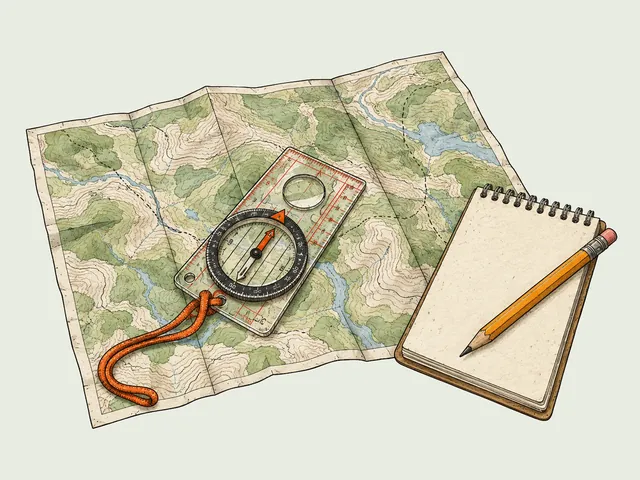
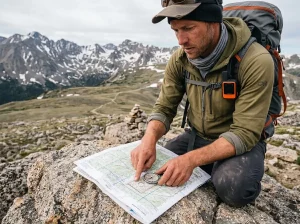
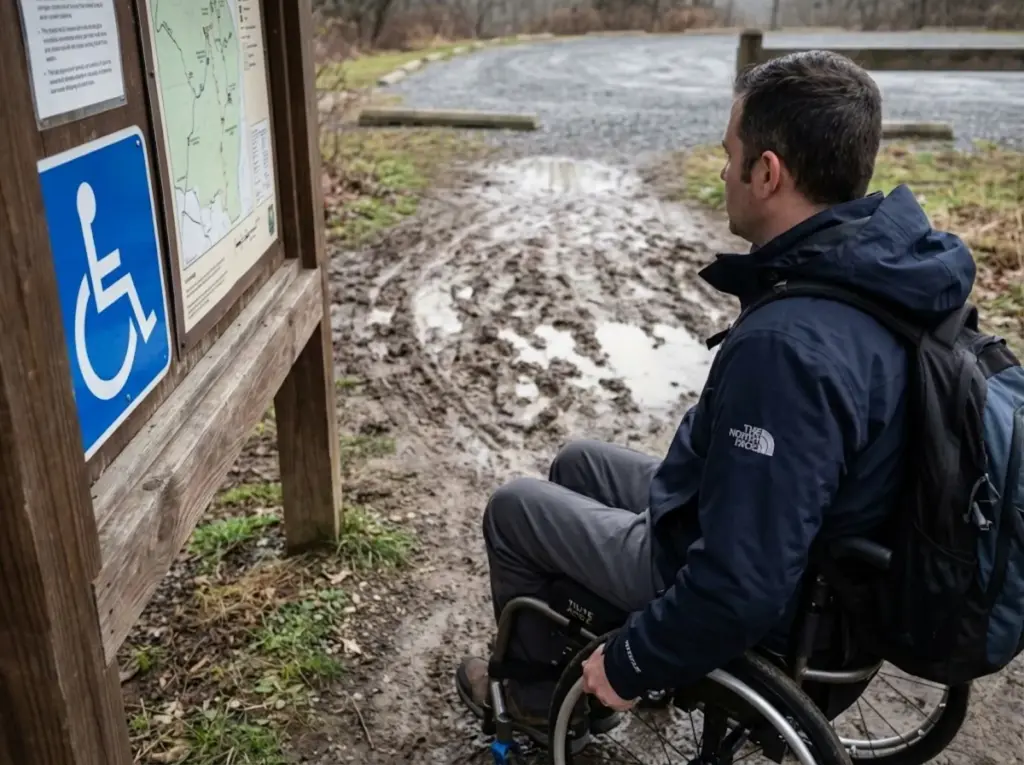
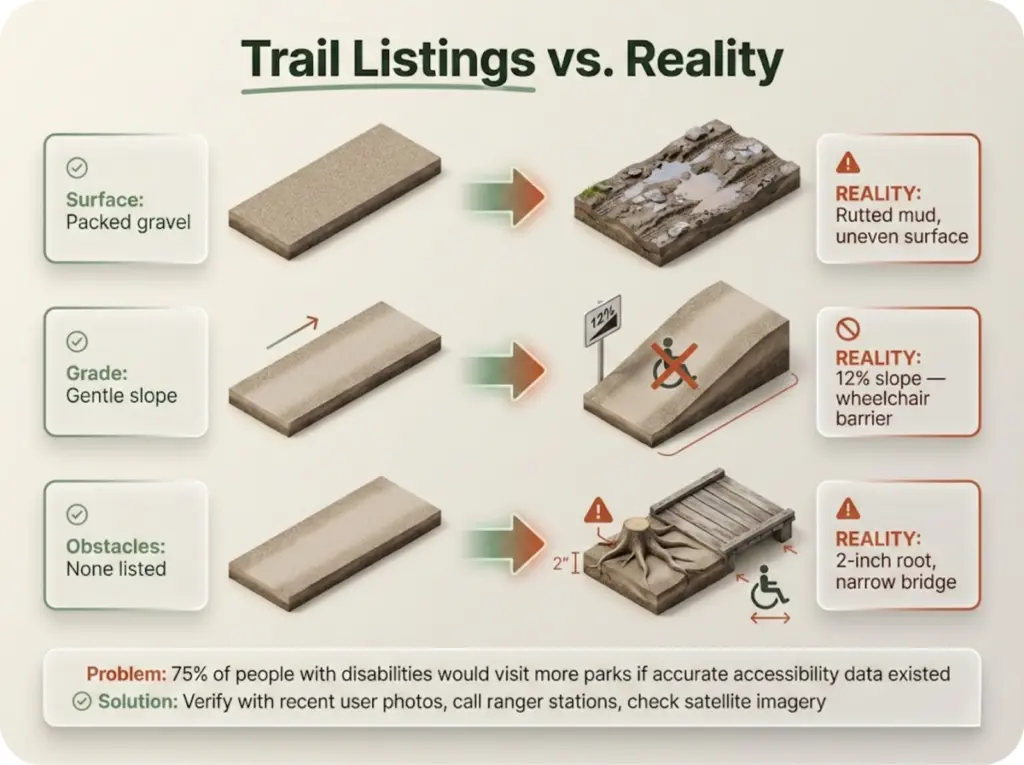
The trail description said “wheelchair accessible.” What it didn’t mention: the packed-gravel surface turned to rutted mud 200 yards past the trailhead, the “accessible” restroom was locked, and the 6% grade marked on the map was closer to 12% where it mattered most. Three hours of planning. Twenty minutes of actual hiking. That’s the reality nobody warns you about.
After years of covering trails, gear, and prep for this site, I’ve talked with enough disabled hikers to know one thing for certain: the mountain isn’t the barrier. The missing information between the parking lot and the first switchback is. This guide breaks down the technical, logistical, and psychological gaps hiding behind every “accessible” label, so you can actually plan a hike that works for your body.
⚡ Quick Answer: Most trails labeled “accessible” fail to meet federal standards for grade, surface firmness, and obstacle height. Before you drive out, call the ranger station and ask three questions: steepest running slope, surface type after rain, and narrowest gate width. Cross-reference the answers with the Disabled Hikers Spoon Rating database. That single phone call will save you more frustration than any app review ever will.
Why “Accessible” Labels Fail Disabled Hikers
The Problem With “Easy, Moderate, Hard”
Standard trail difficulty ratings are built for able-bodied legs. A trail labeled “easy” can hide a 2-inch root obstacle or a short 12.5% grade that stops a manual wheelchair cold. There’s no universal standard across platforms. AllTrails, the NPS app, and your state park website each define “accessible” by different yardsticks, and none of them tell you what actually matters.
The numbers back this up. A 2024 Retrospec/NEEF survey found that 75% of people with disabilities or those over 55 would be more likely to visit a new park if detailed accessibility information were available online. And 59% said local leaders forget their needs when designing outdoor spaces. That’s not a minor complaint. That’s the majority feeling invisible.
The result? Hours of “logistical labor” before every trip, calling ranger stations, scrolling through user reviews, cross-referencing satellite images. Many potential hikers cancel altogether because the uncertainty is exhausting. The lack of objective, standardized trail data is the single biggest barrier to accessible trails, not the slope itself.
Pro tip: Filter AllTrails reviews by “wheelchair” to find user-uploaded photos from the last six months. Recent shots reveal seasonal changes that official trail descriptions never update.
What Real Trail Data Looks Like
So what does useful trail information actually include? The ABAAS (Architectural Barriers Act Accessibility Standards) and FSTAG (Forest Service Trail Accessibility Guidelines) give you hard numbers instead of vague labels. The federal accessibility guidelines for outdoor developed areas spell out the exact criteria that define what “accessible” legally means.
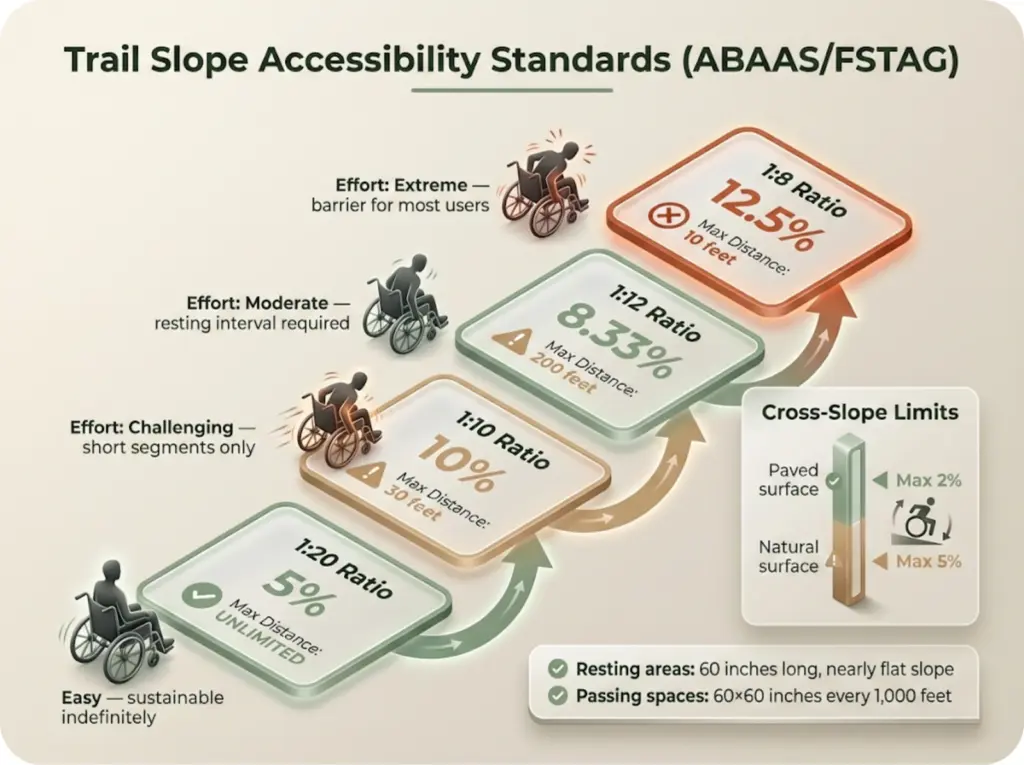
A running slope of 5% (a 1:20 ratio) is safe for unlimited distance. Push that to 8.33% and you get 200 feet max before a resting interval is required. At 10%, you’re down to 30 feet. At 12.5%, just 10 feet. Most “accessible” trails don’t publish these numbers.
Cross-slope is even sneakier. That’s the side-to-side tilt of the path. Anything over 2% on a paved surface or 5% on a natural surface creates a sideways pull that can double the effort for a self-propelling wheelchair user. You won’t find that in any app listing. But you’ll feel it in your shoulders within 50 yards.
Resting areas need to be at least 60 inches long with nearly flat slope. Passing spaces of 60×60 inches are required every 1,000 feet on trails narrower than 60 inches. Without them, two chairs can’t pass safely.
How to Verify a Trail Before You Go
Build a multi-source verification habit. Cross-reference AllTrails user reviews, Google Street View coverage of the trailhead, NPS accessibility pages, and the Disabled Hikers Spoon Rating database. No single source gives you the full picture, so you stack them.
Then pick up the phone. Call the ranger station and ask three specific questions: What’s the steepest grade percentage? What’s the surface type after rain? Are there stairs or gates narrower than 36 inches? Most rangers genuinely want to help. They just don’t know anyone needs this information until you ask.
Surface conditions shift with weather. A “hard-packed” July trail can turn into a mud trap after spring rain. Surface firmness can drop dramatically when saturated, so a trail rated “firm” in summer may fail completely in April. Check photos from the same season you plan to visit, and keep them recent.
When you’re comparing trail apps for accessibility data, pay attention to which ones let users tag wheelchair access in reviews versus which ones rely on park-submitted labels. There’s a big difference.
Decoding Surface Types and What Your Wheels Actually Need
Firmness vs. Stability (They’re Not the Same)
Here’s something most trail descriptions ignore entirely: firmness and stability are two different measurements. A surface can resist your wheel sinking in (firm) but still shift sideways when you turn (unstable). Packed gravel might feel solid rolling straight, then throw you sideways during a pivot.
Researchers at Beneficial Designs developed the Rotational Penetrometer to measure both. They press a caster into the surface, then rotate it 360°. Asphalt scores best on both axes, with minimal displacement. Crushed aggregate performs well too. Engineered wood fiber scores poorly, and dry sand is flat-out impassable for manual wheelchairs.
The variable nobody talks about? Moisture. All surfaces except sand get worse when wet. A trail that earns a passing firmness score in July might displace three times more under a caster in March. That’s why “packed dirt is fine until it rains, and then it’s pottery clay under your wheels,” as one Reddit user put it.
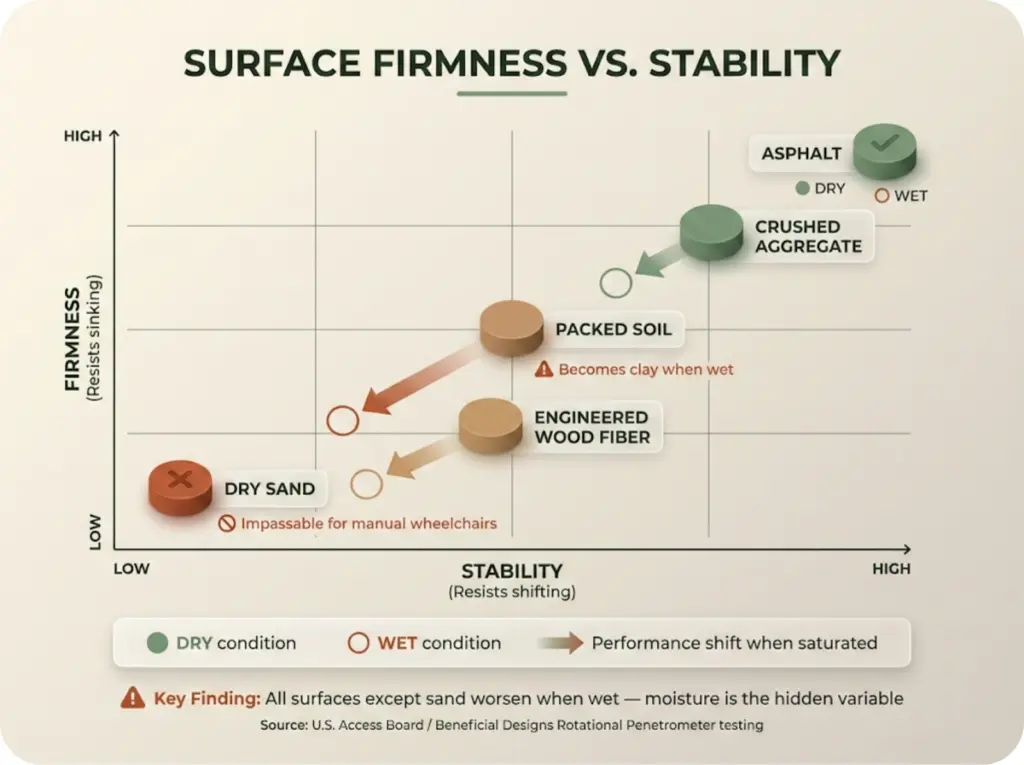
You can find the U.S. Access Board surface testing results for the specific displacement values on each surface type.
Pavement vs. Natural Surfaces — The Real Tradeoff
“Paved” doesn’t automatically mean “accessible.” Cracked asphalt with heaved roots can be worse than well-maintained crushed gravel. Stabilized natural materials, like stone dust combined with resin binders, can meet accessibility thresholds while keeping the trail looking like a trail.
Heat is a hidden variable. Asphalt surfaces can reach temperatures far above ambient air. For wheelchair users with spinal cord injuries who have impaired thermoregulation, that heat radiating up from pavement level can create a genuine safety risk. Natural aggregate surfaces run cooler.
Understanding how trail design choices affect long-term park accessibility helps you predict which park trails are likely to stay passable and which ones will degrade within a season.
Adaptive Gear That Gets You Past the Parking Lot
The Lever-Drive Revolution (GRIT Freedom Chair, Mountain Trike)
The GRIT Freedom Chair 3.0 changed what’s possible for manual wheelchair hikers. MIT-engineered lever-drive systems are 40-50% more efficient than standard push rims. Grip the levers high for torque on inclines, low near the base for speed on flats. At 46 lbs and around $2,995, it fits in a car trunk and can be repaired at any bike shop.
The Mountain Trike runs about $4,800 and adds independent suspension. Both are built for packed dirt, gravel, and moderate slopes up to 15-20%. But here’s what the reviews don’t tell you: the GRIT cannot be propelled in reverse with the levers in place. You have to stash them and push on the tires manually. On a narrow trail with drop-offs, that’s a real problem.
Pro tip: Before buying, rent one through an equipment lending program. The lever reach feels different for everyone, and you won’t know until you try a one-mile loop. Several national parks and state parks now offer lending programs for free.
Powered 4WD Systems (When Muscle Isn’t Enough)
When manual effort isn’t realistic, powered options exist but cost significantly more. The TerrainHopper Overlander 4ZX weighs about 300 lbs and handles 35-degree grades with four independent motors. Price tag: $17,000-$21,000. The Action Trackchair uses tank-like treads and eats through mud and snow, running $15,000-$18,000.
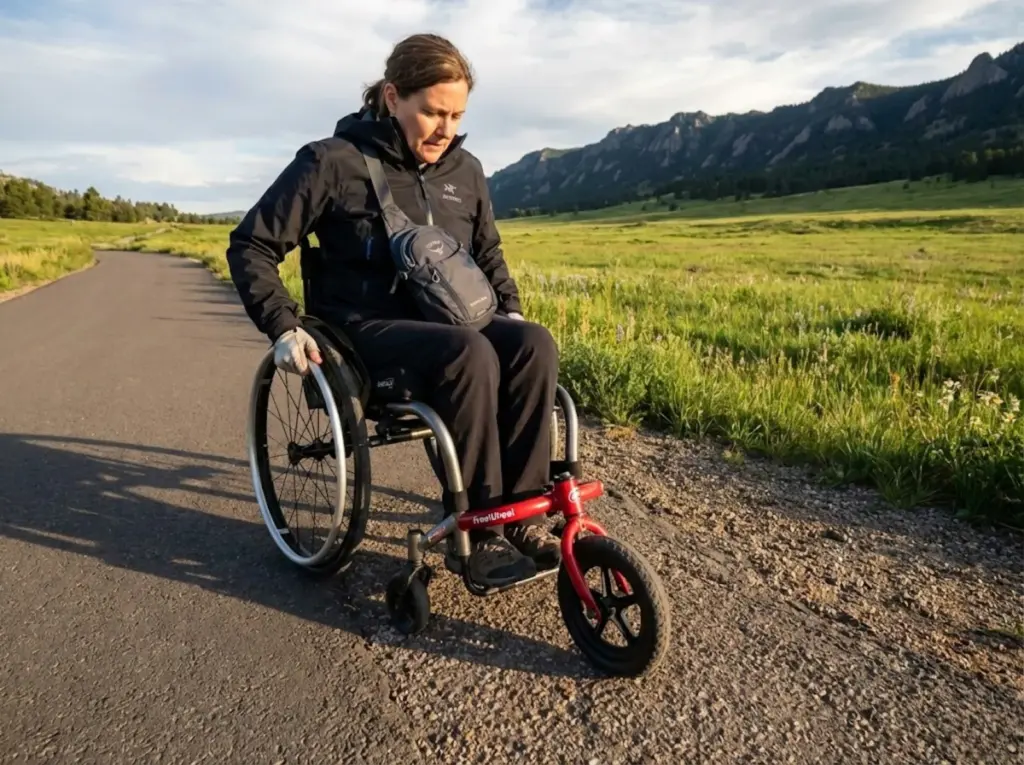
The best bang for your dollar is the FreeWheel Attachment. At $600-$900 and about 5 lbs, it mounts to the front of your daily chair and provides a roughly 300% boost in terrain capability. It’s the entry point for adaptive hiking without buying a second chair.
Medical insurance rarely covers all-terrain wheelchairs. Look into grants from the Christopher & Dana Reeve Foundation and the Craig H. Neilsen Foundation. Equipment lending programs at national parks are another option worth researching.
Footwear and Support Systems for Ambulatory Hikers
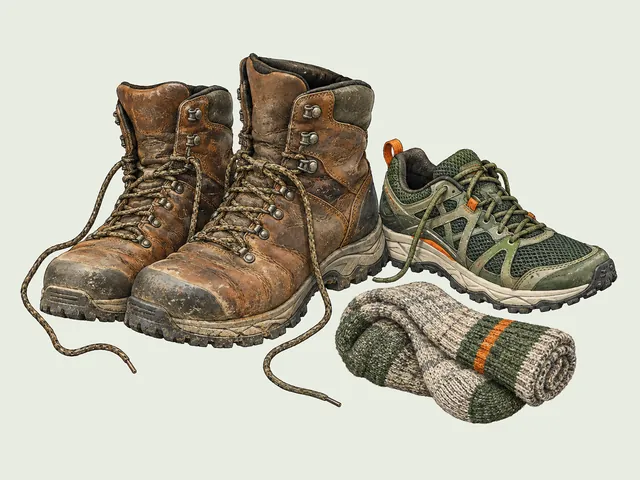
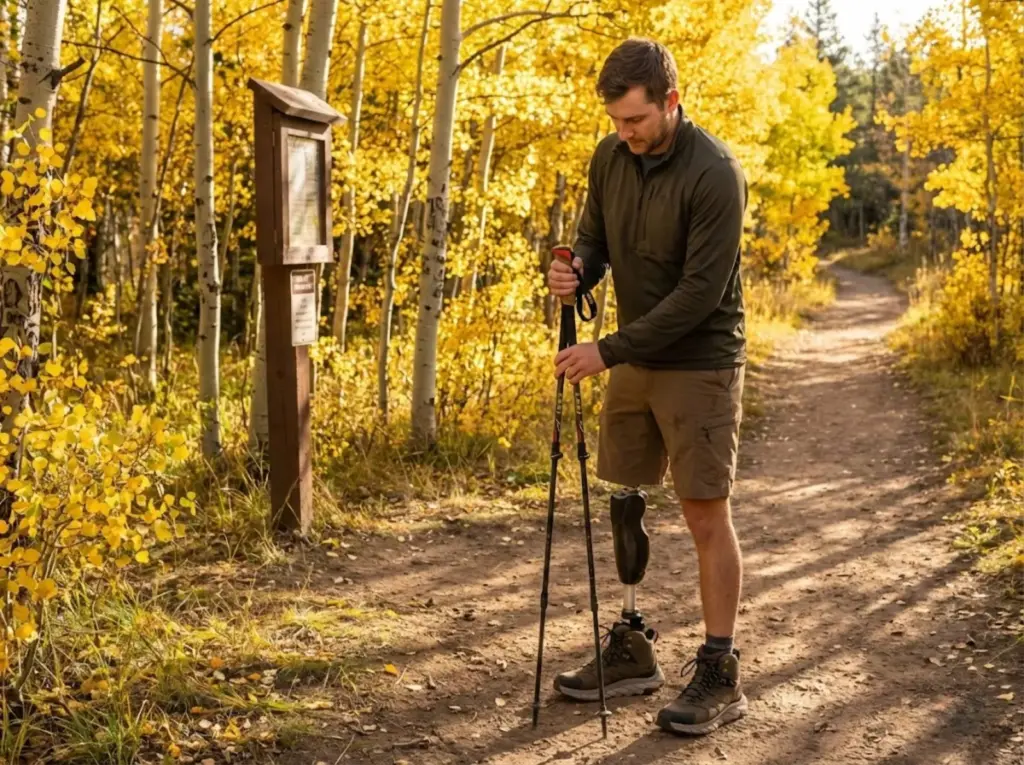
Not every disabled hiker uses a wheelchair. For ambulatory hikers, the adaptive gear conversation is about joint protection and stability. Ankle-height boots prevent subluxations for people with hypermobility conditions like Ehlers-Danlos Syndrome. Hoka One One maximal cushioning reduces impact force on fused spines and arthritic knees.
Trekking poles are mandatory, not optional. They distribute weight away from lower joints and give you two additional balance contact points. Pair them with the biomechanical benefits of trekking poles for setup guidance.
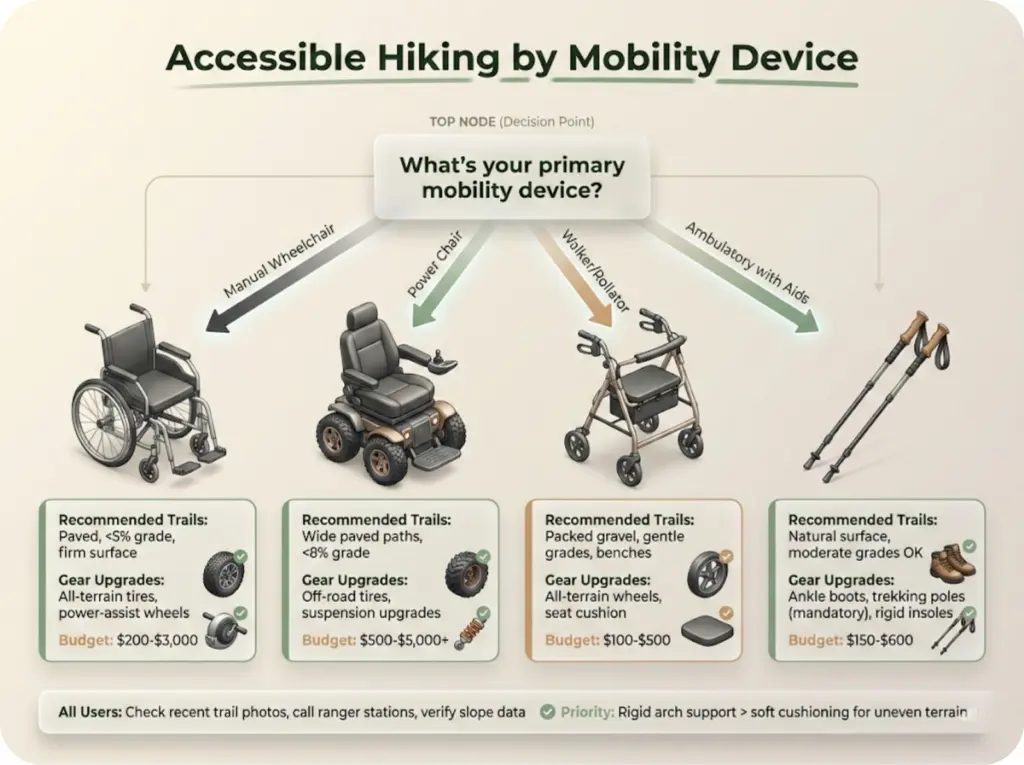
When choosing hiking insoles for plantar fasciitis and arch support, prioritize rigid arch support over soft cushioning. The support matters more than the comfort on uneven ground.
The Spoon Rating System and Why Energy Math Matters

How the Spoon Rating Works
Syren Nagakyrie, the founder of Disabled Hikers, built the Spoon Rating System to replace “easy, moderate, hard” with something that actually reflects how disabled bodies experience a trail. It rates hikes on a 1-5 scale based on energy cost, not just distance.
One Spoon: under 2 miles, flat, paved trail, almost certainly wheelchair accessible. Two Spoons: 1-3 miles, short grades up to 12%, firm unpaved surface. Three Spoons: 2-4 miles, grades up to 20%, firm surface with minimal obstacles. Four Spoons: 3-5 miles, prolonged 10-15% grades, over 500 feet of elevation gain. Five Spoons: 5+ miles, prolonged 15-20% grades, over 1,000 feet of elevation change.
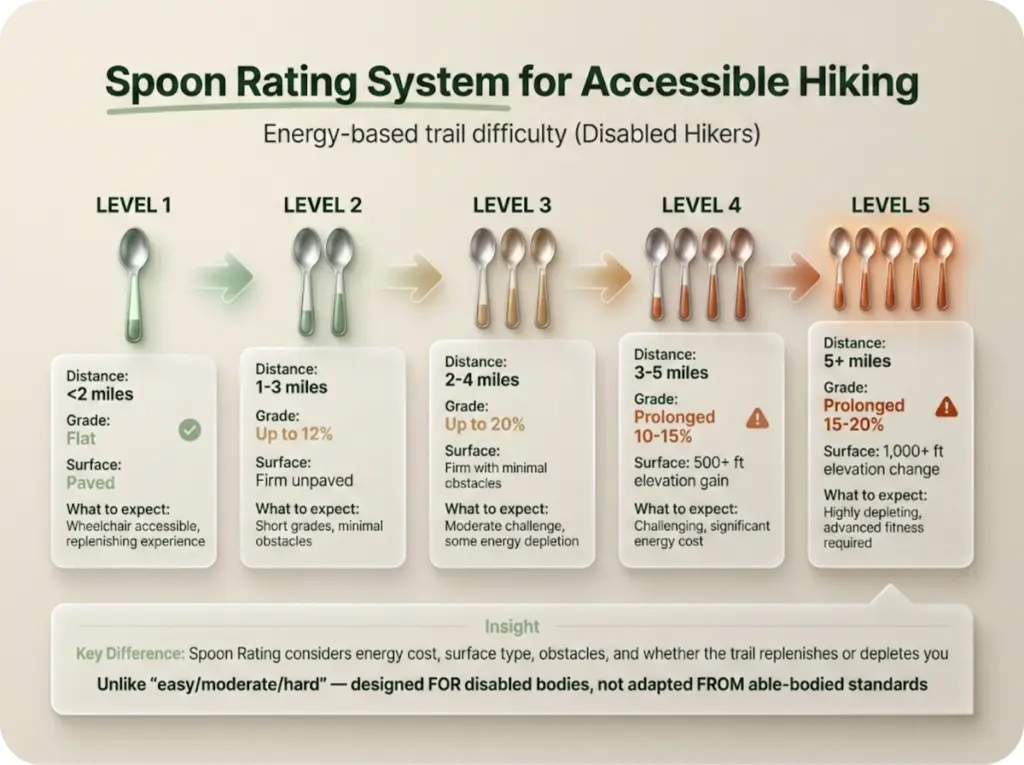
Unlike traditional scales, the Spoon Rating considers surface type, obstacles, and whether the experience replenishes you or depletes you. That last part matters more than people realize.
Energy Debt and Post-Exertional Malaise
Here’s the part that catches people off guard. A hiker with ME/CFS or POTS may finish a Three Spoon hike feeling fine, then spend two or three days in bed from Post-Exertional Malaise. The hike didn’t just use today’s energy. It borrowed from tomorrow and the day after.
The “50% Rule” is the gold standard for managing this: if you can walk 2 km, plan for 1 km. Build 24-48 hours of recovery into your schedule. That’s not laziness. Your body treats the hike as the single productive act for that entire period.
One hiker I spoke with put it simply: “I don’t just plan the hike. I plan the day before for rest and the two days after for recovery. That’s a four-day commitment for a two-mile walk.” That kind of context changes what “short trail” means completely. And it connects directly to managing hiking pace to conserve energy, where matching pace to your energy budget is the whole game.
Recovery Protocols That Actually Help
Electrolyte loading prevents lightheadedness and POTS flares. If you deal with dysautonomia, this isn’t optional. Check our guide on electrolyte strategies for preventing trail crashes for specific products and timing.
Compression socks post-hike help move lactates and reduce that “heavy legs” feeling. Epsom salt baths relax tight muscles and ease joint pain. But watch the NSAIDs. Daily ibuprofen use (“Vitamin I”) can actually delay tissue healing by suppressing your body’s natural inflammatory repair signals. Complex carbs plus protein within one hour post-hike repairs glycogen and muscle fiber.
Pro tip: Start loading electrolytes the night before your hike, not the morning of. If you deal with POTS or dysautonomia, pre-loading gives your body a head start on blood volume regulation.
Safety and Evacuation When You Can’t Walk Out
The SAR Reality for Disabled Hikers
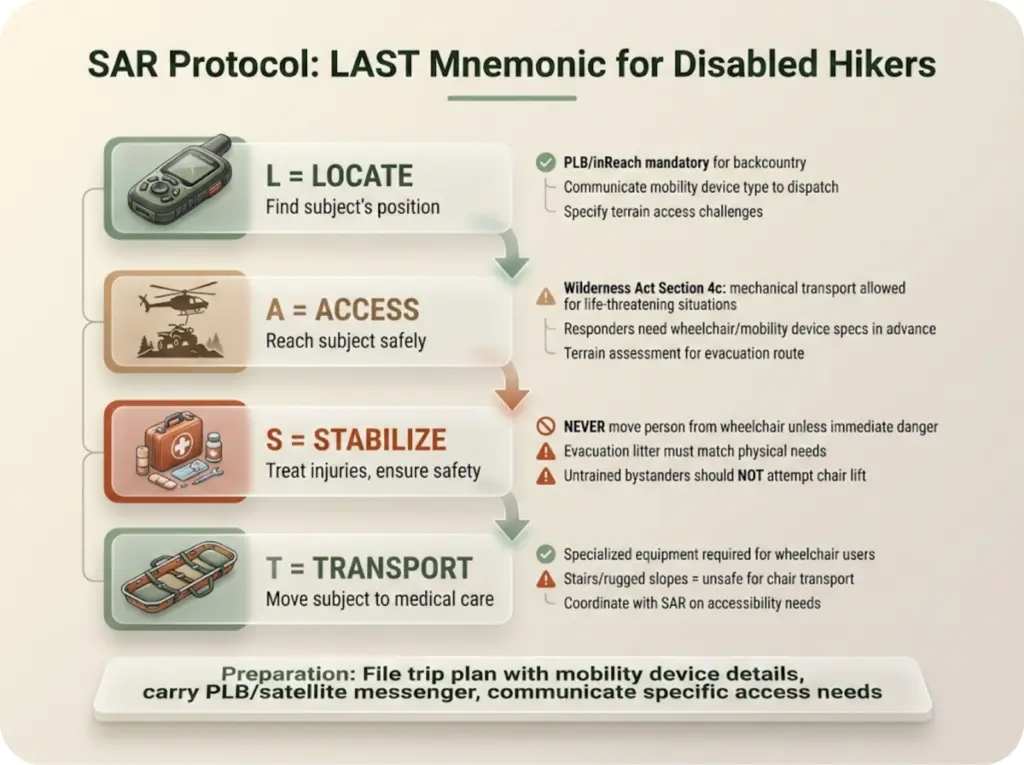
The number-one fear most disabled hikers carry is: what happens when something goes wrong and I can’t walk out? In designated wilderness areas, Section 4c of the Wilderness Act normally prohibits mechanical transport unless it’s the “minimum tool” to protect human life. That means ATVs and helicopters are available, but only when the situation is life-threatening.
The LAST mnemonic defines the SAR sequence: Locate, Access, Stabilize, Transport. Each stage has specific implications when the subject uses a wheelchair or other mobility equipment. Moving someone down stairs or rugged slopes in their chair is never safe. Evacuation litters must match the person’s physical needs, and untrained bystanders should never attempt a chair lift unless there’s immediate danger.
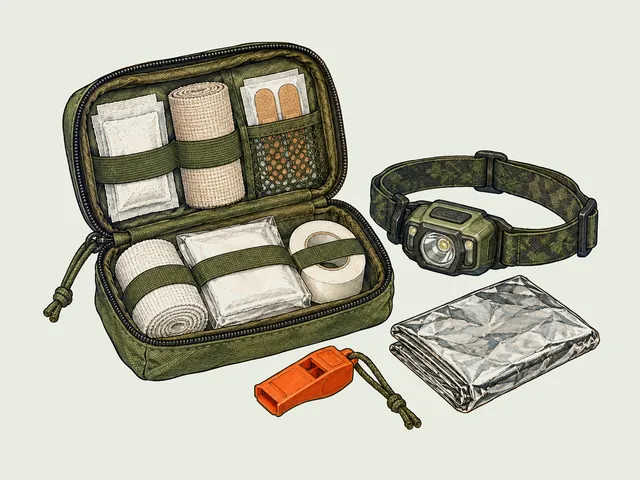
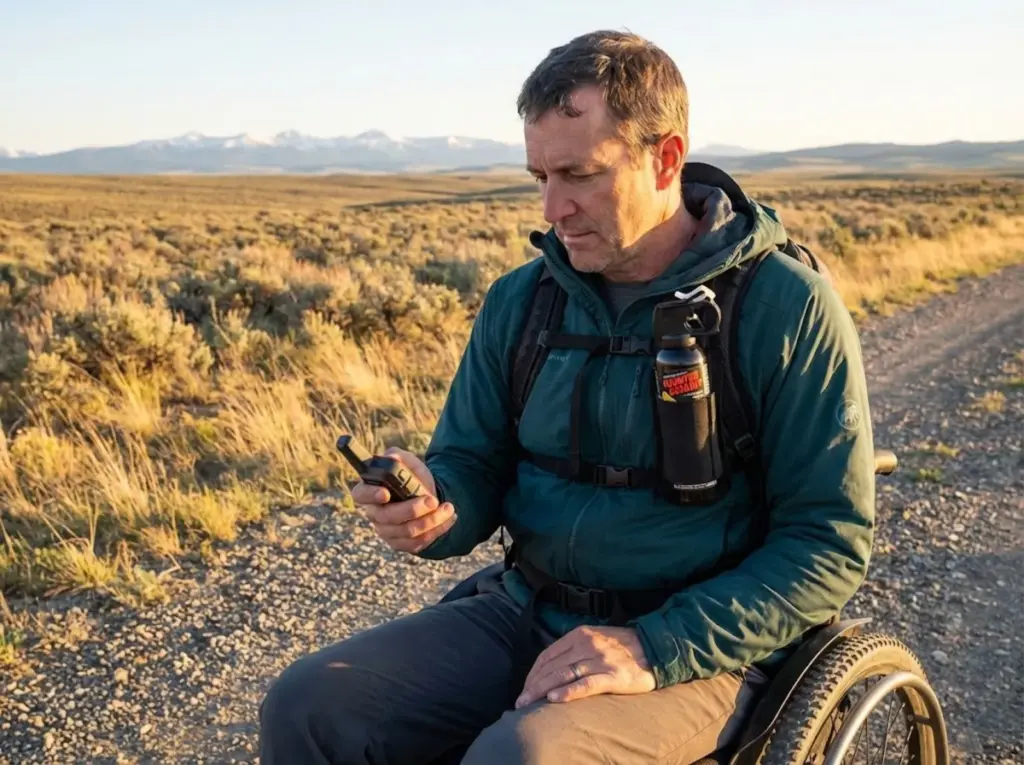
A Personal Locator Beacon or satellite messenger like the Garmin inReach is mandatory for backcountry hiking. It lets you communicate your specific access needs to responders before they reach you, so they arrive with the right gear. Understanding the trip plan protocol SAR teams want equips you to leave the kind of information that actually speeds up a rescue.
Wildlife Encounters With Limited Mobility
“Back away slowly” remains the standard, but running isn’t an option for a wheelchair user. The primary defense is noise and visual size. Clap your hands, strike trekking poles together, or shout “Hey bear!” every few minutes in bear country to avoid surprise encounters. Raise your arms or swing a jacket overhead to appear larger.
Bear spray is your final line. Holster it in a “quick-draw” chest-mount position accessible regardless of where your hands are on the levers. The data on the 2-second bear spray deployment standard applies double when you can’t sprint.
Pro tip: Carry two cans. One on the chest harness, one in the door pocket of your chair. Murphy’s Law hits harder when you can’t run.
The Mental Game — Beyond “Inspiration Porn”
Why the “Heroic Overcomer” Narrative Hurts
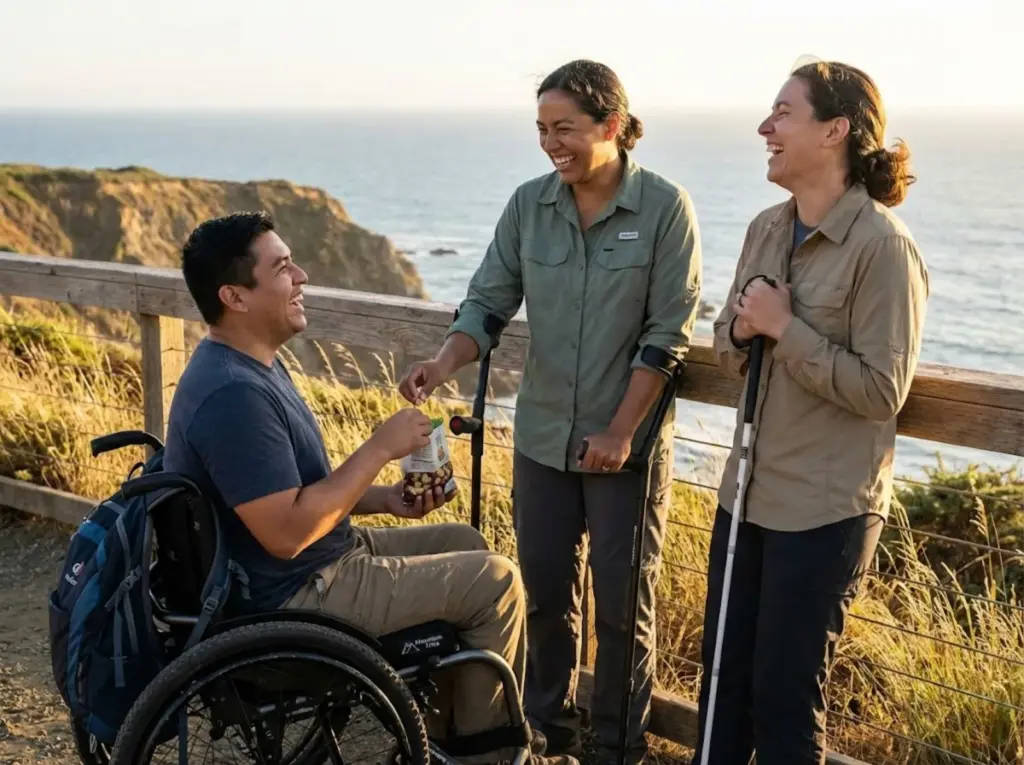
Stella Young coined the term “inspiration porn” to describe media that portrays disabled people “overcoming” their circumstances to do ordinary things. When a blind hiker goes viral, coverage ignores the 50 impassable trail sections caused by poor maintenance or missing signage. The message becomes: the problem is in your body, not in the system that built stairs where a ramp should be.
This pressure to “perform” bravery strips the simple joy out of being outdoors. A half-mile paved trail in a park is a valid hike. Sitting at a trailside overlook and breathing is a valid hike. Reframing success by what your body needs instead of what cameras want to see is not lowering the bar. It’s measuring the right thing.
Intersectionality and the “Triple Jeopardy” of Access
Disability intersects with race, gender, and class. “Triple jeopardy” describes the compounded discrimination faced by disabled Black women navigating ableism, racism, and sexism simultaneously in outdoor spaces. Marketing in the outdoor industry predominantly features young, White, able-bodied men. Disabled BIPOC hikers rarely see themselves in any of it.
Organizations like Disabled Hikers, led by Syren Nagakyrie, center lived experience and prioritize cross-disability, cross-identity representation. “Nothing About Us Without Us” isn’t a slogan. It’s the design principle every trail assessment and guidebook should follow. Check our roundup of inclusive outdoor groups and resources for organizations doing this work.
Trail Psychology and Reframing Frustration
Decision fatigue from pre-trip verification work is a real psychological cost. Hours spent calling ranger stations and cross-referencing maps drains energy before you even leave the house.
“Slow hiking” offers a reframe. It’s not a compromise. It’s a practice of immersive presence that many able-bodied hikers are now intentionally adopting. Community connection reduces isolation too. Finding local adaptive hiking groups transforms a solo logistical burden into a shared outdoor experience. The reframing trail frustration into a performance advantage approach we cover works for any hiker facing mental blocks, but it resonates especially hard here.
Conclusion
Three things to carry with you from this guide:
The biggest barrier isn’t the mountain. It’s the missing information between the parking lot and the trailhead. Technical literacy — grade ratios, surface firmness, cross-slope — puts more power in your hands than any $20,000 all-terrain chair. And the disability community is building the trail assessment infrastructure the outdoor industry should have built decades ago. Every hiker benefits from it.
Pick one trail you’ve been curious about. Call the ranger station. Ask for the running slope, the surface type after rain, and the narrowest gate width. That single call will tell you more than any app rating ever will.
FAQ
What does wheelchair accessible trail actually mean?
Legally, it means the trail meets ABAAS standards: a maximum 5% running slope for unlimited distances, cross-slope under 2% on paved surfaces, and no obstacles over 2 inches. In practice, many trails labeled accessible fail one or more of these criteria. Always verify with the ranger station before driving out.
How do I find trails that are actually accessible near me?
Cross-reference AllTrails (filter reviews by wheelchair), the Disabled Hikers Spoon Rating database, NPS accessibility pages, and TrailLink for rails-to-trails conversions. Then call the ranger station and ask three questions: steepest grade, surface type after rain, and gate or stairs barriers.
Is there financial help for all-terrain wheelchairs?
Yes. The Christopher & Dana Reeve Foundation and Craig H. Neilsen Foundation offer grants. Many national parks run equipment lending programs where you can borrow all-terrain wheelchairs for free. The FreeWheel attachment converts a daily chair for trail use at $600-$900, a fraction of the cost of a dedicated off-road chair.
Can I hike with an invisible disability like chronic fatigue or POTS?
Absolutely. Use the Spoon Rating System to match trail difficulty to your energy budget. Apply the 50% Rule: if you can walk 2 km, plan for 1 km. Build in 24-48 hours of recovery time. Carry electrolytes and a PLB. Your hike counts even if it’s a half-mile paved trail.
What should I do if I need emergency rescue on a trail?
Activate your Personal Locator Beacon or satellite messenger. Communicate your specific access needs so responders arrive prepared with the right mobility equipment. Never allow untrained people to lift you from your chair unless there’s immediate danger. Stay visible and stay put.
I've spent more than a decade researching hiking gear and trail technique. I read the specs, the forum threads and the long-term reviews, and every pick here comes with what it gets wrong.
End of the trail
You read every mile of this one. Here's where the trail goes next.