In this article
Mile 14 on a talus-choked descent in the North Cascades, and I felt it—the first warm bloom of friction behind my left heel. I’d picked ankle socks that morning because it was 85°F at the trailhead. By the time I stripped that sock off at camp, the blister underneath had already filled with fluid. That one decision—sock height—cost me two days of limping through some of the best alpine terrain in Washington.
So I did what any obsessive hiker would do. I spent the next three seasons running the same experiment with every sock height I could find across five completely different trail types. Rocky alpine, desert sand, Pacific Northwest mud, groomed trail, and glacier. Different boots. Different fibers. Same feet.
Here’s what I learned—and why the right cuff height matters more than most hikers realize.
⚡ Quick Answer: Micro crew is the most versatile hiking sock height for most terrain and boot combinations. It clears 6-inch boot collars, provides an abrasion buffer, and doesn’t trap excess heat. Default to crew height for rocky or technical terrain, ankle for desert heat with trail runners, and over-the-calf for glacier travel with mountaineering boots. Match the sock cuff to at least one inch above your boot collar, and always choose merino-synthetic blends over cotton.
Why Sock Height Is a Biomechanical Decision (Not a Style Choice)
The Friction Equation at Your Skin
Most hikers think of sock height as a comfort preference. It’s not. It’s a friction management system—and the wrong call puts you at real risk of injury.
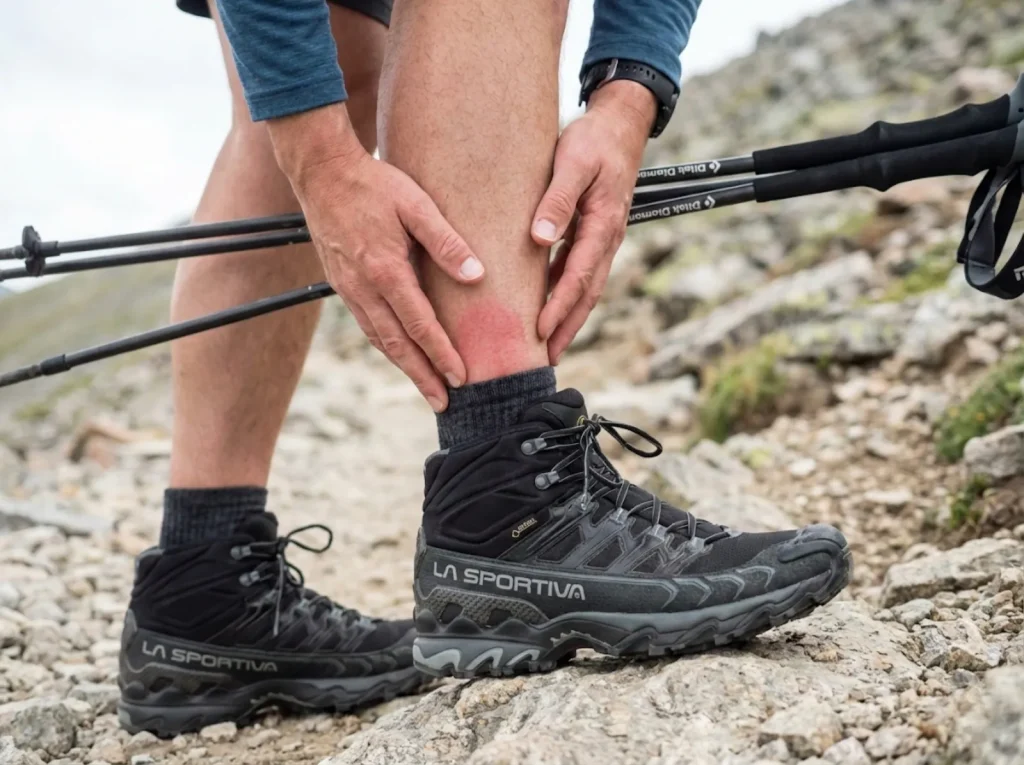
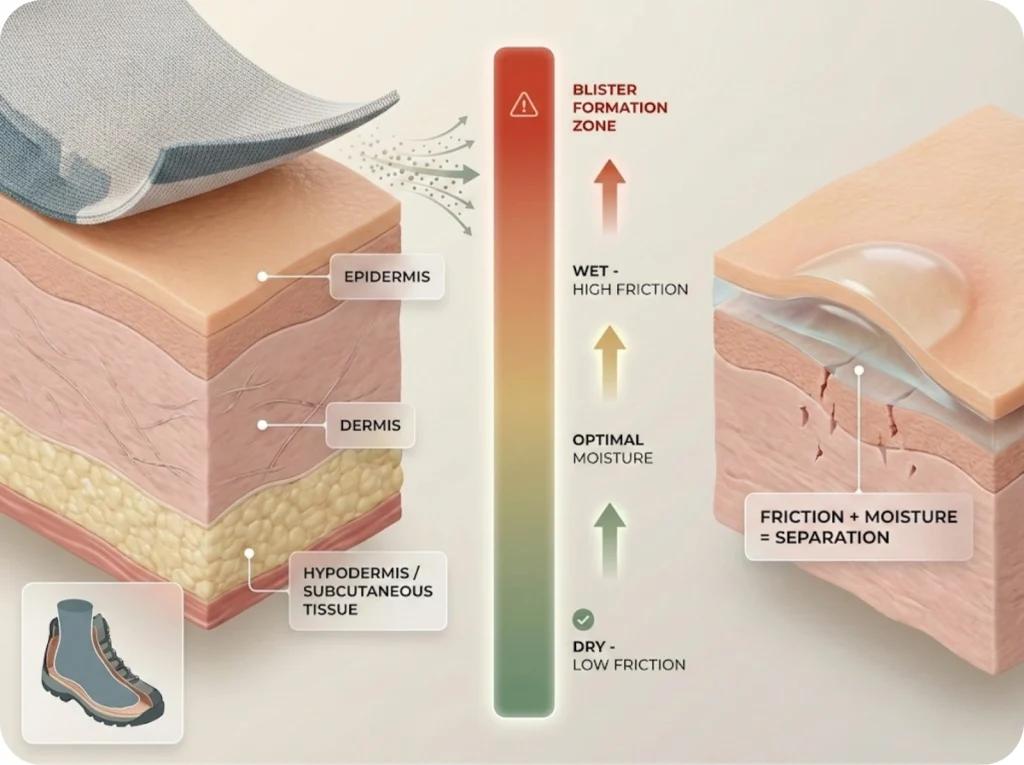
Friction blisters aren’t surface “rubbing.” They’re tears that form inside the deeper layers of your skin, caused by repetitive shear between your bones and the skin surface. Every step you take on rocky ground generates these friction cycles, and the skin between your sock cuff and boot collar absorbs the worst of it.
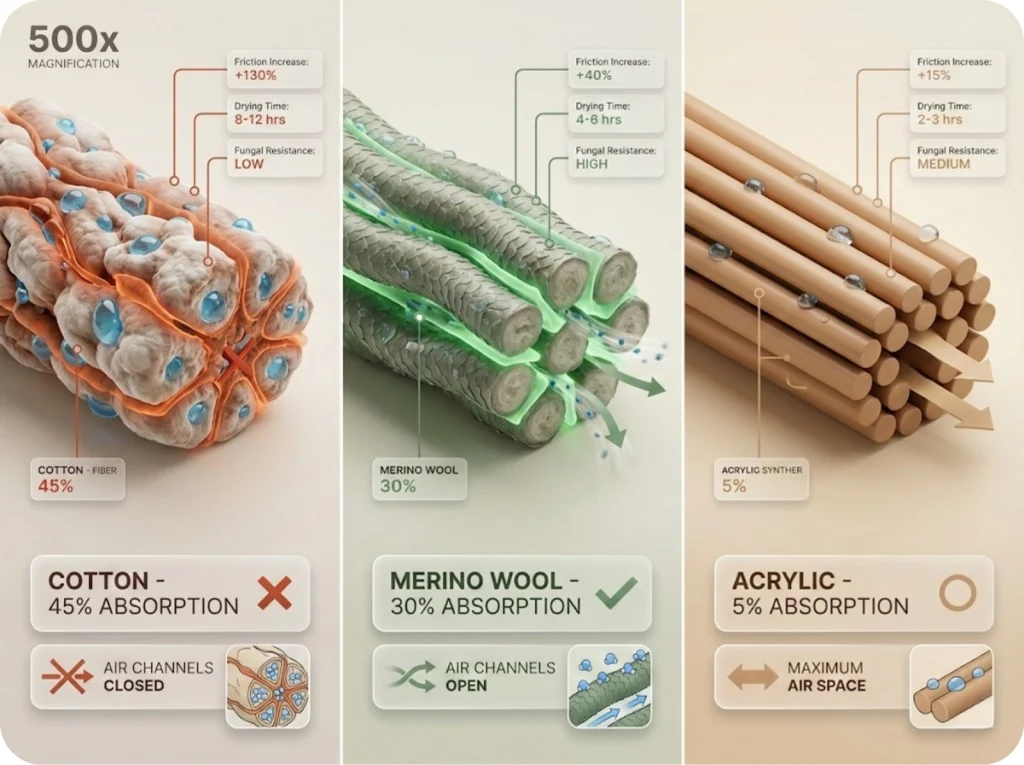
Here’s the number that changed how I think about socks: when your skin stays too wet for too long, friction at the skin-sock interface nearly doubles. Wet cotton goes from manageable when dry to dangerously slippery when soaked—a 130% jump that turns your sock into a blister machine. On the Camino de Santiago, 68.5% of hikers showed up with foot blisters, and those hiking in wet socks had 1.94 times the blister risk of those who kept their feet dry.
The takeaway? Sock height controls how much skin is exposed to your boot collar’s friction zone. And the fiber touching that skin determines whether moisture turns your feet into a mess.
The Ankle Injury Connection Most Guides Miss
The ankle is the number one injured body part during hiking—42% of all hiking injuries. But here’s the part nobody talks about: heel blisters change how you walk. You start limping, shifting weight to avoid the pain. That compensated gait sends forces straight to your knees that your joints aren’t built to handle.
Roughly 25% of overuse injuries during high-load hiking are knee injuries, and many trace back to gait changes caused by foot blisters. Your socks aren’t just protecting your feet. They’re protecting the full chain from your ankle to your knee.
Higher crew socks and micro crew socks give your ankle joint better ground-contact awareness—compression zones around the ankle improve how well you feel the terrain under your feet. That feedback reduces sprain risk on the kind of rocky, uneven ground where the friction coefficients that determine blister risk spike the hardest.
Pro tip: If you feel a “hot spot” forming, stop immediately and change socks. Your skin needs 7 to 21 days to toughen up—95% of blisters hit in the first three weeks of a trek. Don’t push through it.
The Five Heights Decoded: What Each One Actually Does
Ankle and Quarter: The Minimalist Options
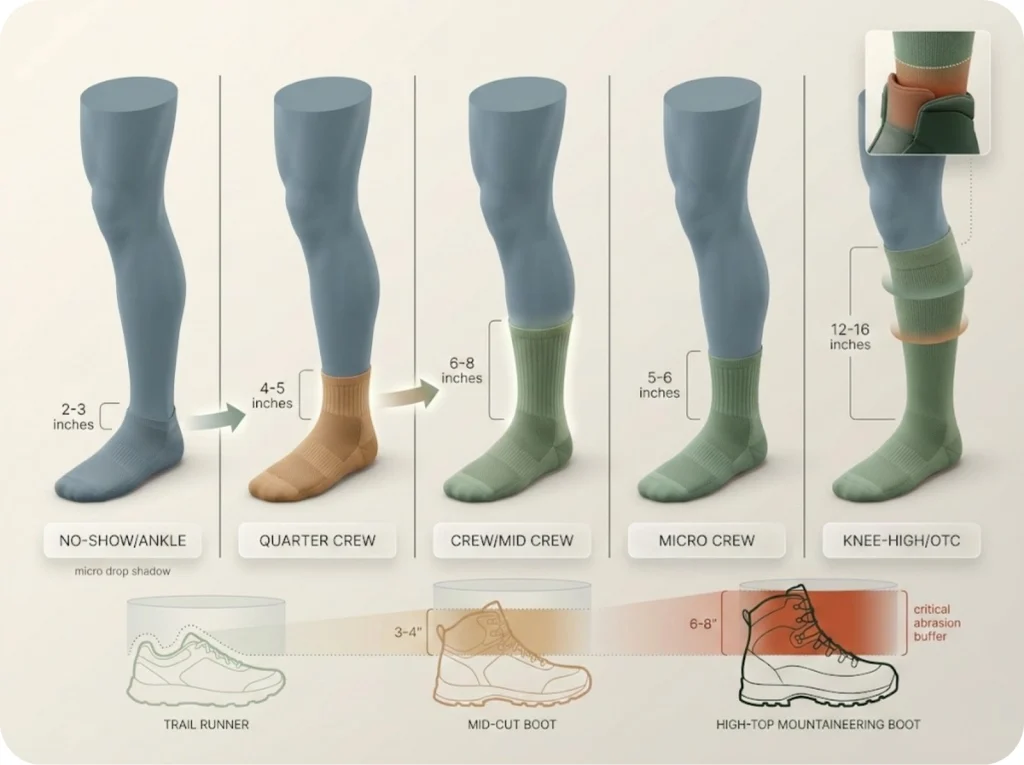
Ankle socks sit at or just below the ankle bone—roughly 3 to 4 inches from the heel. Quarter socks ride slightly higher at 4 to 5 inches. Both maximize ventilation when temperatures push above 80°F and pair naturally with trail runners and low-cut hiking shoes.
The critical weakness? Zero protection against boot-collar abrasion. With mid-cut or high-top hiking boots, the exposed skin between sock cuff and boot collar becomes a friction hotspot. On my desert test in the Mojave at 97°F, ankle-height merino wool blends outperformed every other height for heat evacuation—but only because I was in trail runners, not boots.
Micro Crew: The Versatile Middle Ground
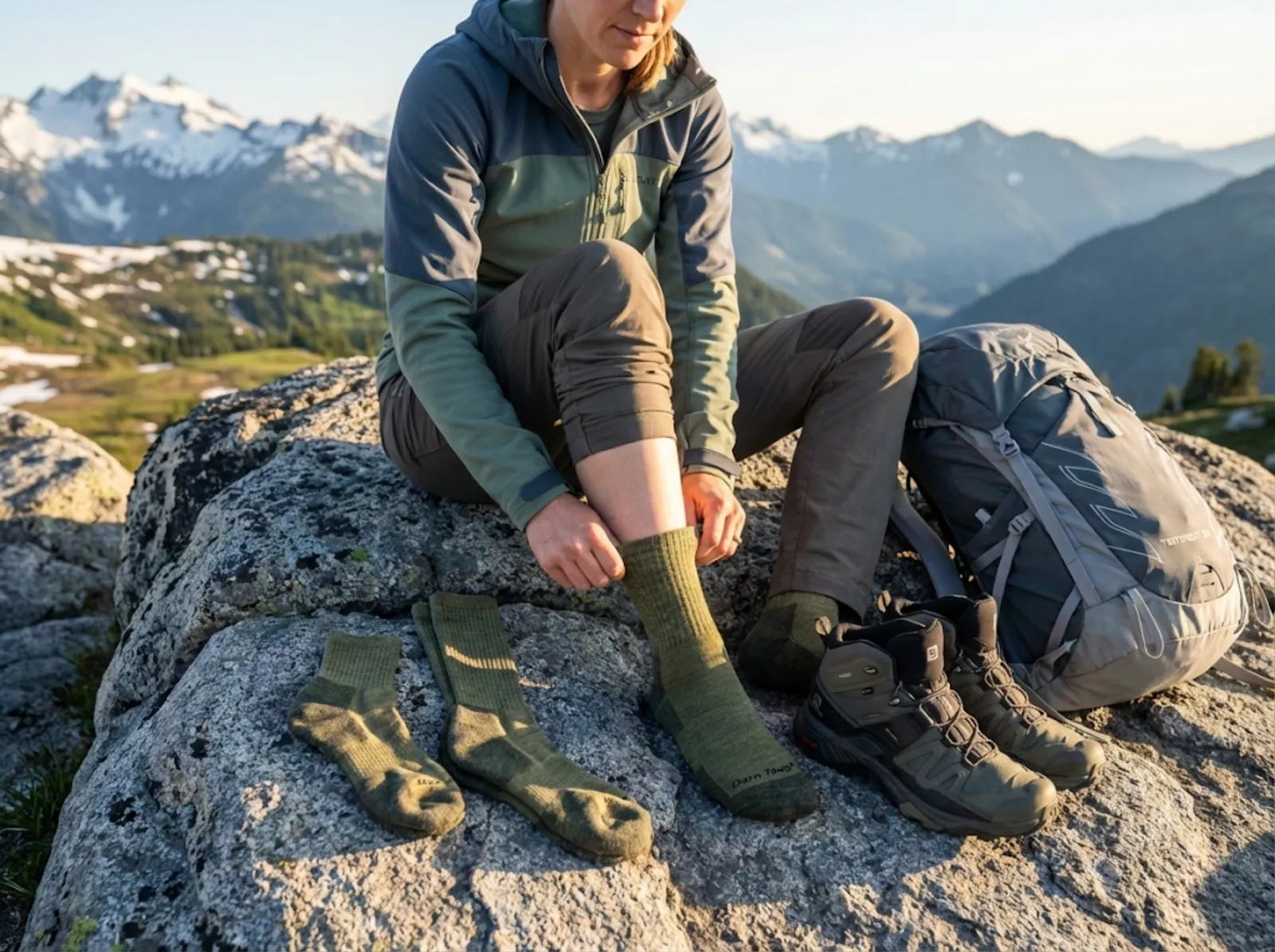
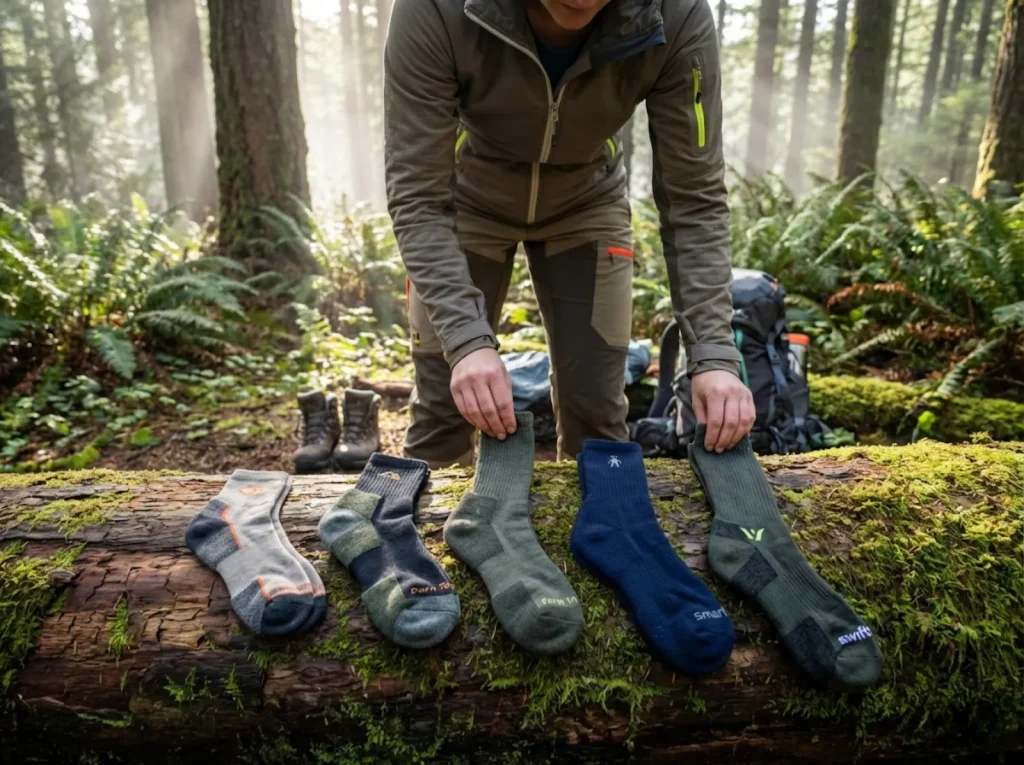
The micro crew sits just below the calf muscle—about 6 to 7 inches—clearing 6-inch hiking boots without excess bulk. Darn Tough built this height specifically as an abrasion buffer zone between skin and boot collar.
In my Pacific Northwest mud test at Olympic National Park, micro crew was the minimum viable height. Anything shorter let trail debris slip between sock and boot. Merino wool at this height absorbs up to 30% of its weight in moisture without feeling wet, compared to cotton fibers that swell 44 to 49% and physically close their air channels.
Crew: The Trail Standard
Crew height reaches mid-calf—roughly 7 to 9 inches—and it’s the dominant choice among long-distance hikers. About 81% of Appalachian Trail thru-hikers favor crew-length Darn Tough socks, and there’s a reason.
On my rocky alpine test in the North Cascades, crew-length with medium cushioning and high-density terry loops delivered the best shock absorption during steep 3,000-foot descents. The trade-off: in sustained heat above 85°F, crew socks retain slightly more warmth than micro crew. That’s why I now carry both on multi-terrain trips.
Knee-High and Over-the-Calf: The Specialists
Knee-high socks and over-the-calf variants serve glacier, mountaineering, and deep-snow applications. High wool content at 65% or more is critical at this height for thermal resistance against snow melt and rigid mountaineering boot collars.
Graduated compression socks at 20 to 30 mmHg measurably improve blood flow—clinical research on compression and arterial compliance shows pulse wave velocity drops by about 6% after just 10 minutes of wear. For post-hike recovery, hikers who wear knee-high compression for 2 to 4 hours show 34 to 42% lower muscle soreness at the 24-hour mark. If you want the full breakdown, our trail-proven compression sock analysis covers the mmHg ranges that actually work.
Pro tip: If you’re over 50, use knee-high compression socks post-hike. They reduce venous pooling and cut muscle soreness significantly at the 24-hour mark. Pop them on at camp and wear them through the evening.
What 5 Trails Taught Me About Matching Height to Terrain
Rocky Alpine: North Cascades, Washington
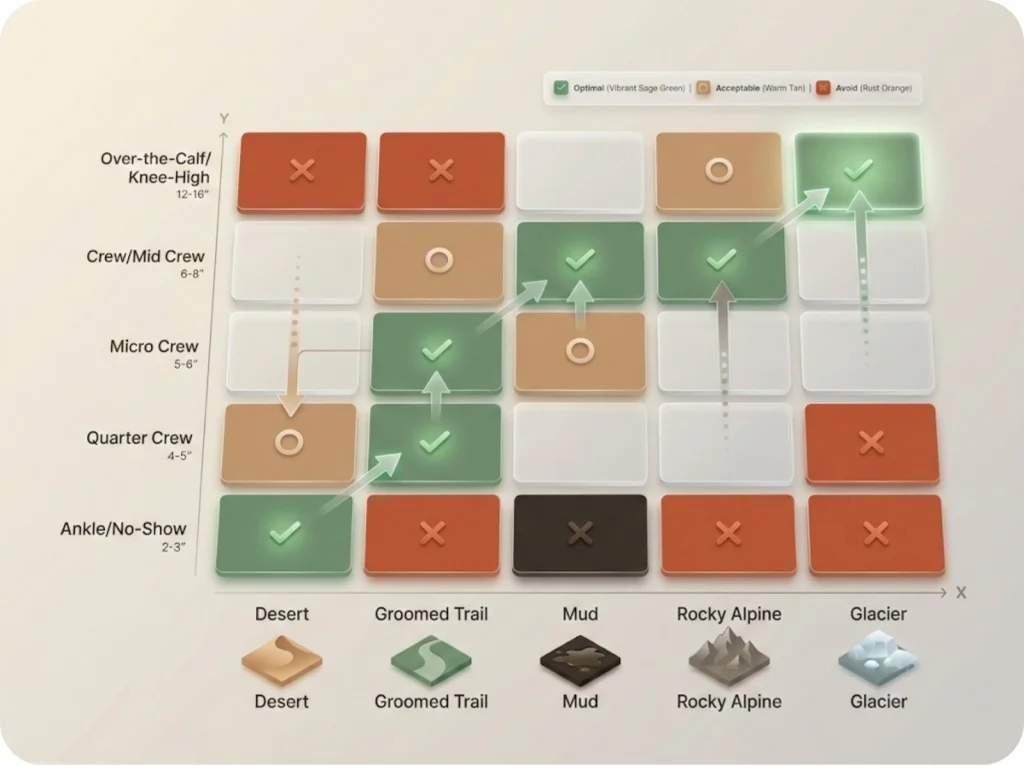
Class 2 to 3 talus fields with 3,200 feet of elevation change and an exposed ridgeline. Crew-length merino blend with targeted cushioning won decisively. The terry-loop construction absorbed energy during steep descents—ankle socks transferred every impact directly to the ball of the foot.
The ankle sock failure created a blister on mile 14 that altered my gait for 48 hours. That’s exactly the chain I keep warning about: blister leads to compensated gait, compensated gait leads to knee stress. Matching your sock height to technical terrain starts with matching your boot stiffness to the terrain and then pairing the right cuff height to that boot.
Desert Sand: Mojave Trail, California
Loose sand, 97°F, exposed with zero shade. Ankle-height merino-Coolmax blend with performance mesh on the instep—minimum fabric, maximum heat evacuation. Anything above micro crew trapped heat and created a sauna inside my trail runners.
The critical nuance: despite being minimal, the socks needed moisture management capacity because foot sweat didn’t evaporate fast enough to keep friction low. Pure synthetic ankle socks failed here. The merino wool component was essential for buffering moisture at the skin level.
Pacific Northwest Mud: Olympic National Park
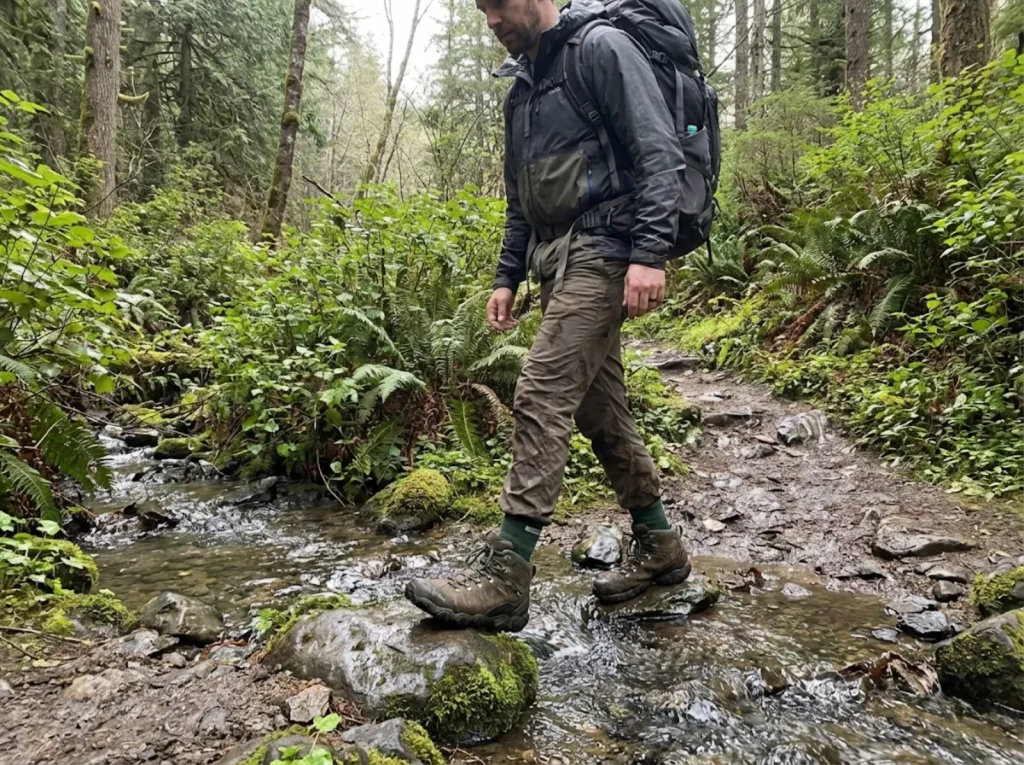
Sustained mud, creek crossings, 60°F with intermittent rain. Micro crew to crew was optimal. Anything shorter let mud and debris flood the boot-sock gap. Fast-drying synthetic blends outperformed pure wool here because sustained saturation tripled the friction.
The “3-hour swap” rule proved critical on this trail. Changing socks every 2 to 3 hours kept skin moisture below the blister threshold. That habit alone mattered more than the brand name on the sock.
Groomed Trail: Appalachian Trail, Virginia Section
Well-maintained trail, moderate elevation, 70°F, multi-day. Micro crew hit the sweet spot—low enough for breathability, high enough for boot clearance and debris protection. This is where “one sock height fits all” advice actually works, because the terrain doesn’t punish poor choices as aggressively.
Even on this forgiving terrain, cotton socks fell apart by day two. Merino fibers withstand 20,000 twist-and-fold cycles without breaking down. Cotton doesn’t survive a fraction of that.
Glacier: Mount Rainier Approach, Washington
Snowfield, glacier travel, mountaineering boots with rigid collars. Over-the-calf with heavyweight cushioning was the only viable option. The rigid boot collar demands maximum fabric buffer, and high wool content maintained warmth even when gaiters trapped moisture inside.
The Material Equation: Why Height Without the Right Fiber Fails
Merino Wool: The Hygroscopic Advantage
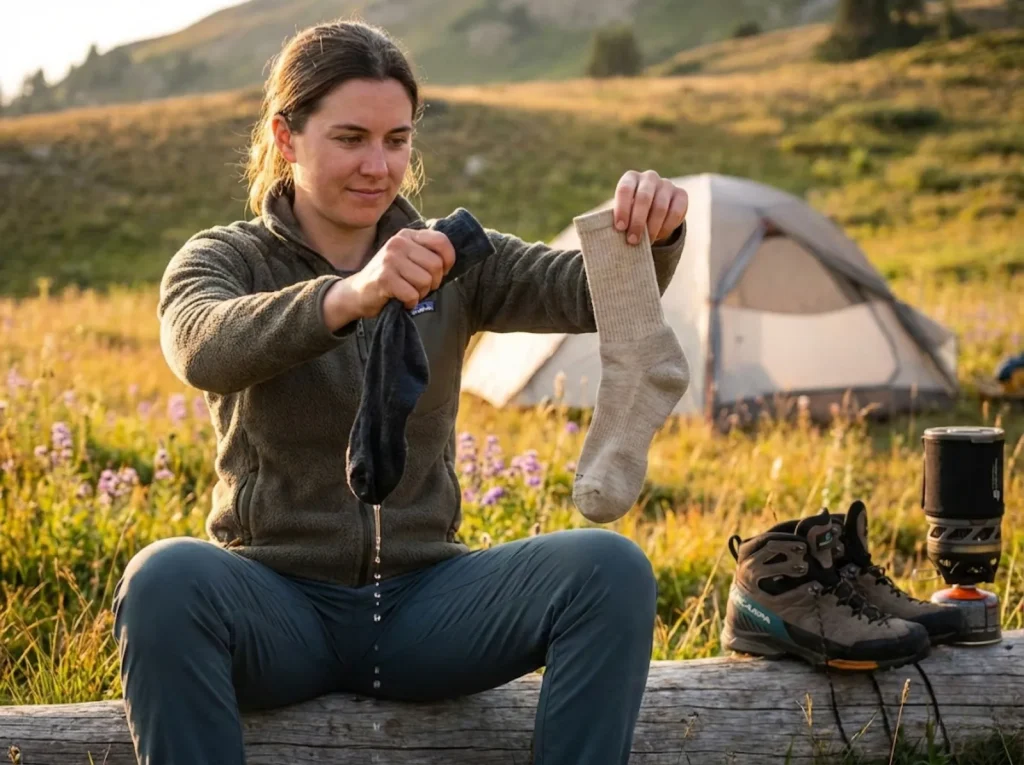
Merino wool absorbs moisture vapor into the fiber core, keeping the surface dry. Cotton absorbs at the surface and swells 44 to 49%, physically closing the air channels that make breathability possible. That’s the difference between a sock that works with your skin and one that works against it.
Modern technical merino isn’t scratchy. Fine-micron counts run 17.5 to 19.5 microns—a different animal from the old-school “ragg wool” your grandfather wore. And merino fibers can be twisted 20,000 times without breaking, which is why a solid pair of Darn Tough or Smartwool socks outlasts anything cotton-based by multiple seasons.
Dr. Adenike Sonaike, a podiatrist specializing in foot health, puts it plainly: “Wool absorbs moisture on your feet just like cotton does, but wool has enough air and space for the moisture to evaporate, keeping skin integrity higher.” That’s the hygroscopic advantage in one sentence. It’s also why the thermal conductivity difference between wet cotton and wool matters so much when temperatures drop.
Merino-Synthetic Blends: The Optimal Formula
The most efficient sock composition combines merino for temperature regulation and odor resistance with nylon or polyester for structural durability and faster drying. Acrylic fibers swell only 5% when wet—maintaining support under compression—while antimicrobial silver threads let high-merino blends stay functional for 2 to 5 days without washing on ultralight multi-day treks.
Smartwool’s 4 Degree Elite Fit uses cross-stitched X-support at the ankle to lock the heel and eliminate internal slippage. That kind of anatomically mapped construction matters more than most hikers realize—it’s the difference between a sock that stays put and one that bunches up under your arch by mile 3.
Why Cotton Kills Performance at Any Height
The hiking community’s mantra “cotton is rotten” exists for a reason. I’ve watched cotton socks go from comfortable to a soggy mess in under 4 hours on a humid East Coast trail. Wet cotton’s friction spikes 130%—past the point of no return for blister formation.
Even at “perfect” crew height, cotton socks failed every trail test by day two. The swelling closes the wicking channels, trapping moisture against your skin and speeding up damage. Dr. Bruce Pinker, a podiatrist focused on skin health, confirms that “technical wool blends retain fewer fungal elements than cotton counterparts, drastically reducing athlete’s foot risks.” Skin hydration research on blister formation backs up why keeping moisture low is the single most important factor.
Pro tip: Turn socks inside out before washing to help the machine reach and release trapped skin cells and grit from the deep terry loops. Your socks will last longer and perform better.
Boot-to-Sock Interface: The Matching Rules Nobody Teaches
Low-Cut Trail Runners: Ankle or Quarter
Trail runners with collars below the ankle bone need minimal cuff height. Ankle or quarter socks prevent excess fabric bunching. Micro crew works here but offers no ventilation advantage—it’s unnecessary coverage for low-profile footwear.
The exception: if you’re hiking terrain with fine gravel or sand, micro crew prevents debris infiltration even in low-cut shoes.
Mid-Cut Hiking Boots: Micro Crew Minimum
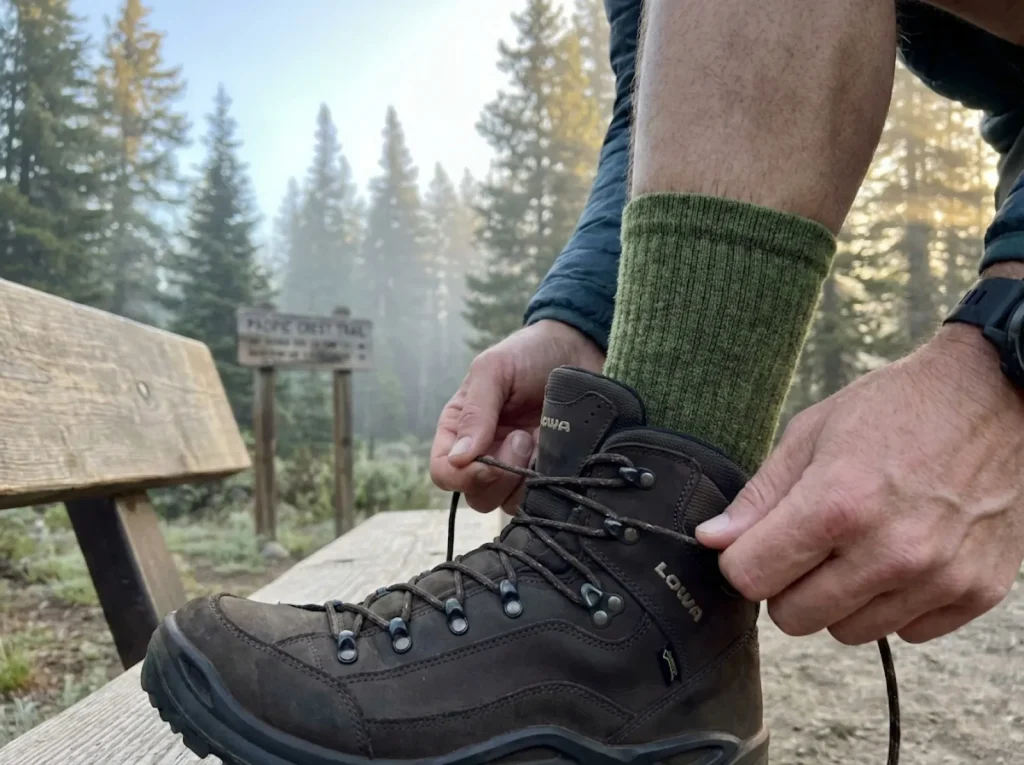
Mid-cut hiking boots with 6-inch collars demand at minimum micro crew height. Ankle socks leave skin exposed to the boot’s upper rim—this is where “boot bite” starts. The abrasion buffer zone means your sock cuff should extend 1 to 2 inches above the boot collar to prevent direct skin-leather contact.
Reinforced Achilles padding—high-density terry at the rear heel collar—is specifically engineered for this boot category. Pairing a mid-cut boot with a liner sock and the right cuff height creates a friction-reducing system. For more on that interface, adding a liner sock to reduce interface friction is worth a look.
High-Top Backpacking Boots: Crew or Higher
Full-grain leather or rigid synthetic boots with 8-inch collars require crew-length minimum. Anything shorter exposes the Achilles tendon and lower shin to sustained friction. The stiffer the boot, the more critical the sock buffer becomes—rigid collars don’t flex to accommodate your skin.
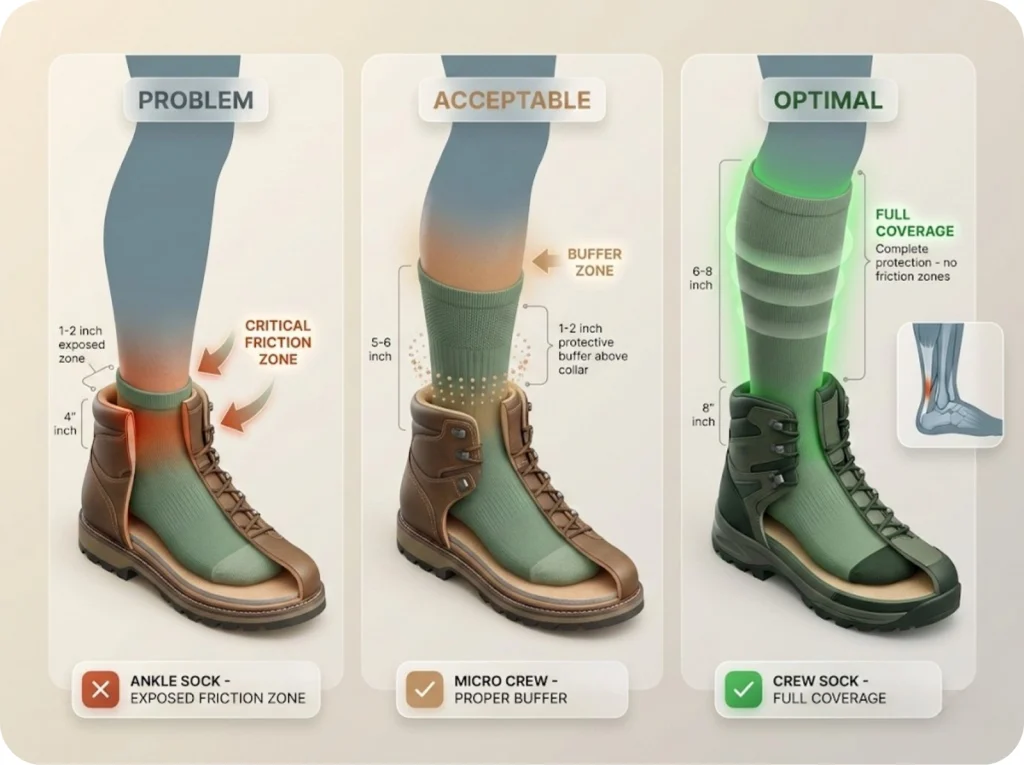
For mountaineering boots, over-the-calf is the only reliable option. No exceptions.
The 3 Mistakes I Made (So You Don’t Have To)
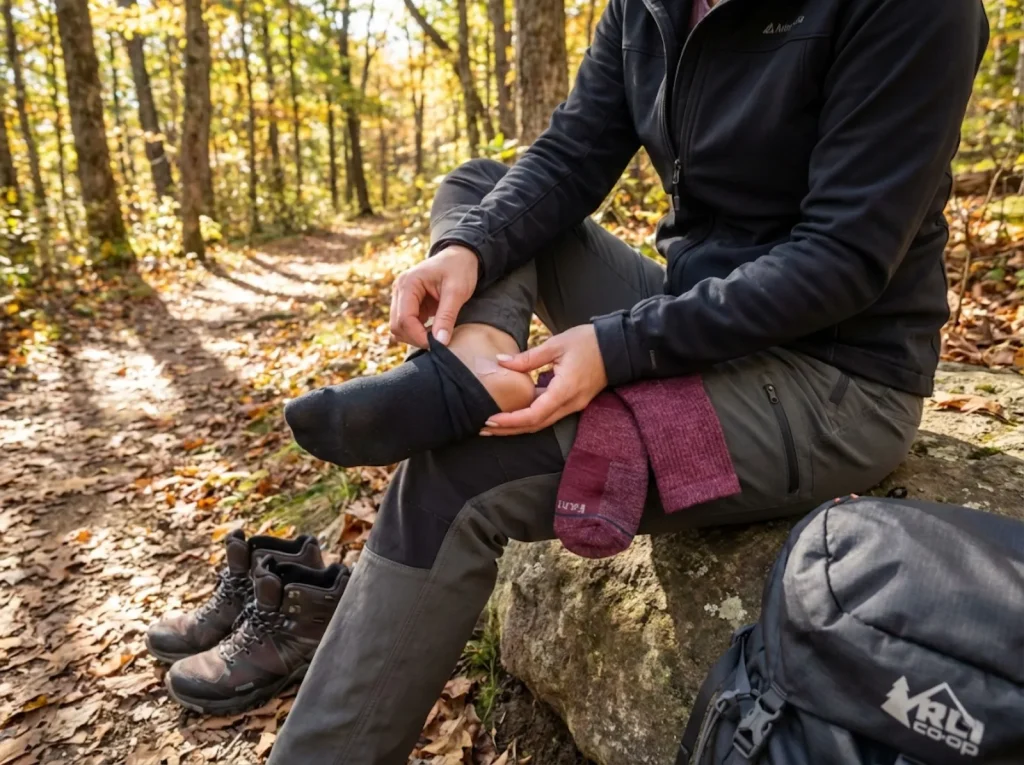
Wearing Ankle Socks With Mid-Cut Boots
This was my North Cascades lesson. The exposed strip of skin between my ankle sock cuff and boot collar absorbed every gram of friction the leather transferred. The result: a fluid-filled blister on mile 14 that forced two days of altered gait.
The fix is simple. Always match sock cuff to at least 1 inch above the boot collar. If your boots are mid-cut, micro crew is the floor. If you end up with a blister anyway, knowing how to handle it fast matters—treating blisters in the field before they sideline you can save a trip.
Choosing Height Without Considering Material
On the AT test, I used a crew-height cotton-blend sock assuming height alone would protect me. By day two, the cotton had swollen shut, and I had hot spots on both heels. Sock height without proper fiber is like a seatbelt without a buckle—it’s present but not functional.
Merino-synthetic blends are non-negotiable for any height above ankle. The fiber determines whether your chosen height actually performs under trail conditions.
Refusing to Change Socks Mid-Hike
The 1.94 times blister risk in wet socks matters more than the brand or price tag. On the Olympic NP mud test, I proved the “3-hour swap” rule: changing socks every 2 to 3 hours kept skin moisture below the threshold where blisters form.
Carry two pairs. Clip the wet pair to the outside of your pack to air-dry while you hike in the fresh pair. It sounds like overkill until the alternative is limping for three days.
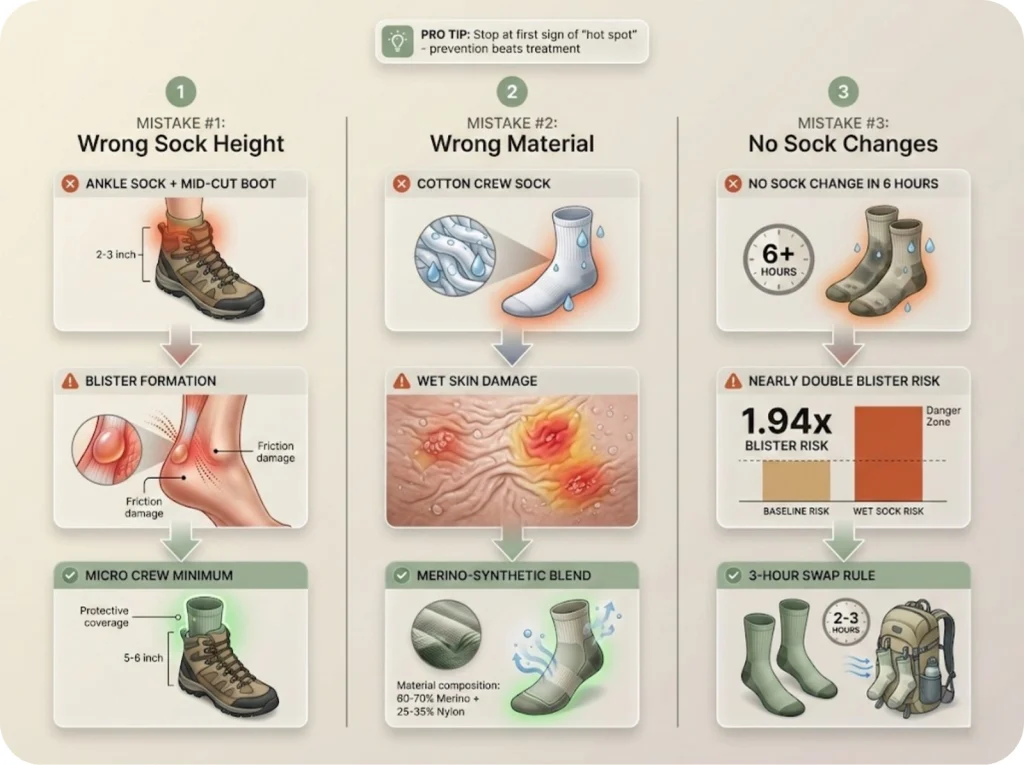
Pro tip: The community calls the moment you realize ankle socks were a mistake “Damp Regret.” If you feel it coming, stop. Swap. A two-minute sock change saves days of pain.
Conclusion
Three seasons and five trails taught me three things I won’t forget.
First, sock height is a performance decision, not a style preference. The wrong cuff-to-boot ratio creates friction zones that cause blisters—and those blisters alter your gait, sending strain straight to your knees.
Second, match your sock to the terrain and the boot. Ankle socks belong with trail runners in desert heat. Crew belongs with mid-cut boots on rocky alpine. Over-the-calf belongs with mountaineering boots on glaciers. There is no universal height.
Third, merino-synthetic blends at the right height beat everything. Cotton fails at every height. Pure synthetics dry fast but lack temperature regulation. The blend is the proven formula—pair it with the correct cuff height, and you’ve solved most foot problems before they start.
On your next trip, bring two heights: micro crew for moderate terrain and crew for anything technical. Swap every 3 hours when conditions are wet. That single habit dropped my blister rate from “every trip” to once in three seasons. Test it yourself and see.
FAQ
What height hiking sock is best for most people?
Micro crew is the most versatile height for most hiking scenarios. It clears 6-inch boot collars, provides an abrasion buffer, and doesn’t trap excess heat in warm conditions. Default to crew if you regularly hike rocky or technical terrain.
Should I wear ankle socks for hiking?
Only with low-cut trail runners on well-groomed or desert trails. Ankle socks with mid-cut or high-top boots expose skin to the boot collar, creating friction zones that lead to blisters. Match the sock cuff to at least 1 inch above your boot’s collar.
Do knee-high socks actually help with recovery?
Yes. Graduated compression socks at 20 to 30 mmHg improve blood flow by roughly 6%, and post-hike muscle soreness drops 34 to 42% at the 24-hour mark. They’re especially effective for hikers over 50.
Are hiking socks worth the cost over regular athletic socks?
Technical hiking socks reduce overall foot problems by about 40% compared to standard athletic wear. The merino-synthetic blend manages moisture, provides antimicrobial protection for multi-day wear, and lasts 20,000 twist cycles. A $25 pair of Darn Toughs outlasts five $8 cotton pairs.
Can I use the same sock height for all terrains?
Not optimally. Crew height works on most moderate terrain, but desert heat requires ankle height to maximize ventilation, and glacier travel requires over-the-calf for thermal protection. The terrain matrix in this guide maps each environment to its optimal height.
Risk Disclaimer: Hiking, trekking, backpacking, and all related outdoor activities involve inherent
risks which may result in serious injury, illness, or death. The information provided on The Hiking Tribe is for
educational and informational purposes only. While we strive for accuracy, information on trails, gear, techniques,
and safety is not a substitute for your own best judgment and thorough preparation. Trail conditions, weather, and
other environmental factors change rapidly and may differ from what is described on this site. Always check with
official sources like park services for the most current alerts and conditions. Never undertake a hike beyond your
abilities and always be prepared for the unexpected. By using this website, you agree that you are solely
responsible for your own safety. Any reliance you place on our content is strictly at your own risk, and you assume
all liability for your actions and decisions in the outdoors. The Hiking Tribe and its authors will not be held
liable for any injury, damage, or loss sustained in connection with the use of the information herein.
Affiliate Disclosure: We are a participant in the Amazon Services LLC Associates Program, an
affiliate advertising program designed to provide a means for us to earn advertising fees by advertising and linking
to Amazon.com. As an Amazon Associate, we earn from qualifying purchases. We are also an official affiliate partner
of Black Diamond Equipment via the AvantLink network. If you click on a Black Diamond affiliate link and make a
purchase, we may earn a commission at no additional cost to you. We also participate in other affiliate programs and
may receive a commission on products purchased through our links. Additional terms are found in the terms of
service.