In this article
You are wedged sideways in a rock crevice, pack already off and dangling from one hand, twisting your hips to find the angle that lets the rest of you through. Nobody in front of you can back up. Nobody behind you can pass.
That moment is what trip reports keep circling back to, and it is the one the photos never prepare anyone for. The Mohonk Preserve Lemon Squeeze does not end hikes because people are not strong enough. It ends them because of five decisions made before anyone touches rock: the wrong pass, the wrong pack, the wrong day, the wrong shoes, and the wrong read on your own comfort in tight spaces.
What the Mohonk Preserve Lemon Squeeze Actually Is
Everyone arrives thinking the Lemon Squeeze is one thing. It is two: first you navigate a boulder maze for a good while, then you climb a crevice. The maze is the part that tires people out; the crevice is the part they remember and describe badly afterward. Getting that sequence straight before you arrive changes how you pace the day.
The Labyrinth Is the Part That Tires You Out
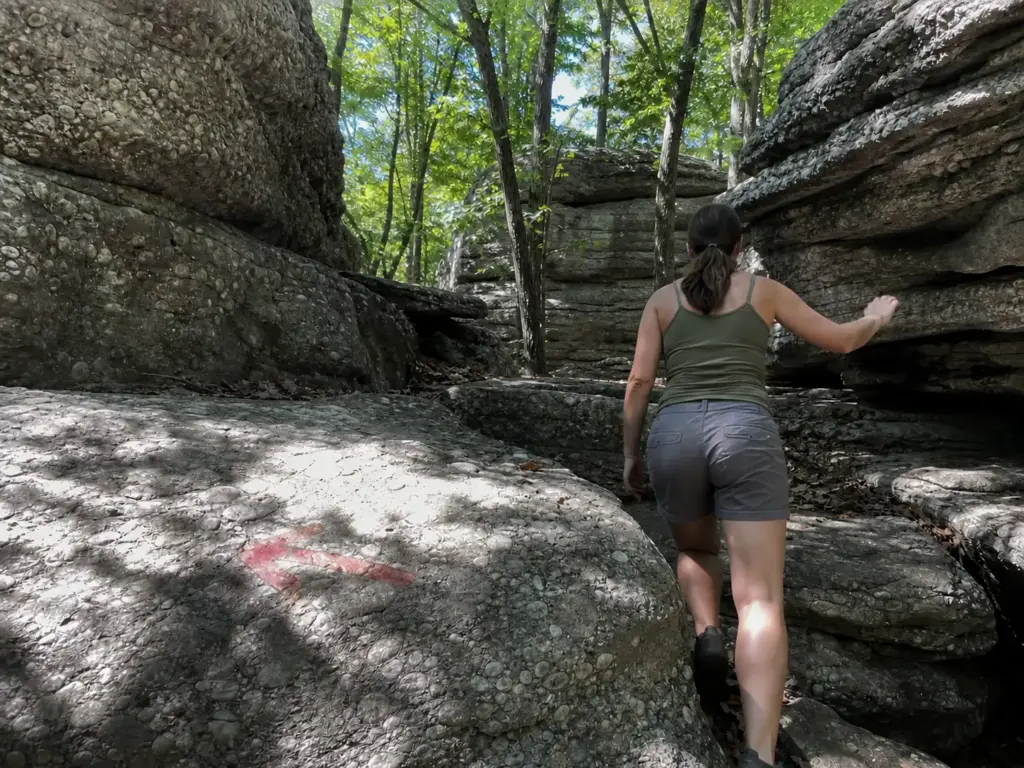
The Labyrinth comes first, and it is not a graded trail. It is a talus field turned into a route: talus-hopping, ducking under leaning slabs, following red arrows painted on rock because there is no obvious tread to follow. You are using your hands constantly. That puts this boulder scramble squarely in Class 3 scrambling territory, where a fall would matter and most people want their palms on rock.
What surprises first-timers is the rhythm. You do not walk the Labyrinth, you solve it: twenty feet of easy stepping, then a gap you have to lower yourself into, then a ledge at chest height. That stop-start pattern burns more energy than the round trip distance suggests, which is why people reach the ladders already warm and slightly annoyed. The elevation gain is modest; the fatigue is not.
The horizontal ledges and cracks you keep stepping on are not random boulder placement. Shawangunk conglomerate splits along its bedding planes, which is why the whole ridge is stacked with horizontal shelves and roofs, per the New York State Museum’s geology summary of the Shawangunk Ridge. Once you see it, you stop looking for a trail and start reading the bedding, which is a faster way to move through the whole thing.
When you lose the red arrows in the Labyrinth, stop moving and look up, not forward. The route regularly goes over a slab or under a roof rather than around it, and the next marker is usually painted at eye level on a face you would only see from a standstill.
The Squeeze Itself Is About 100 Feet
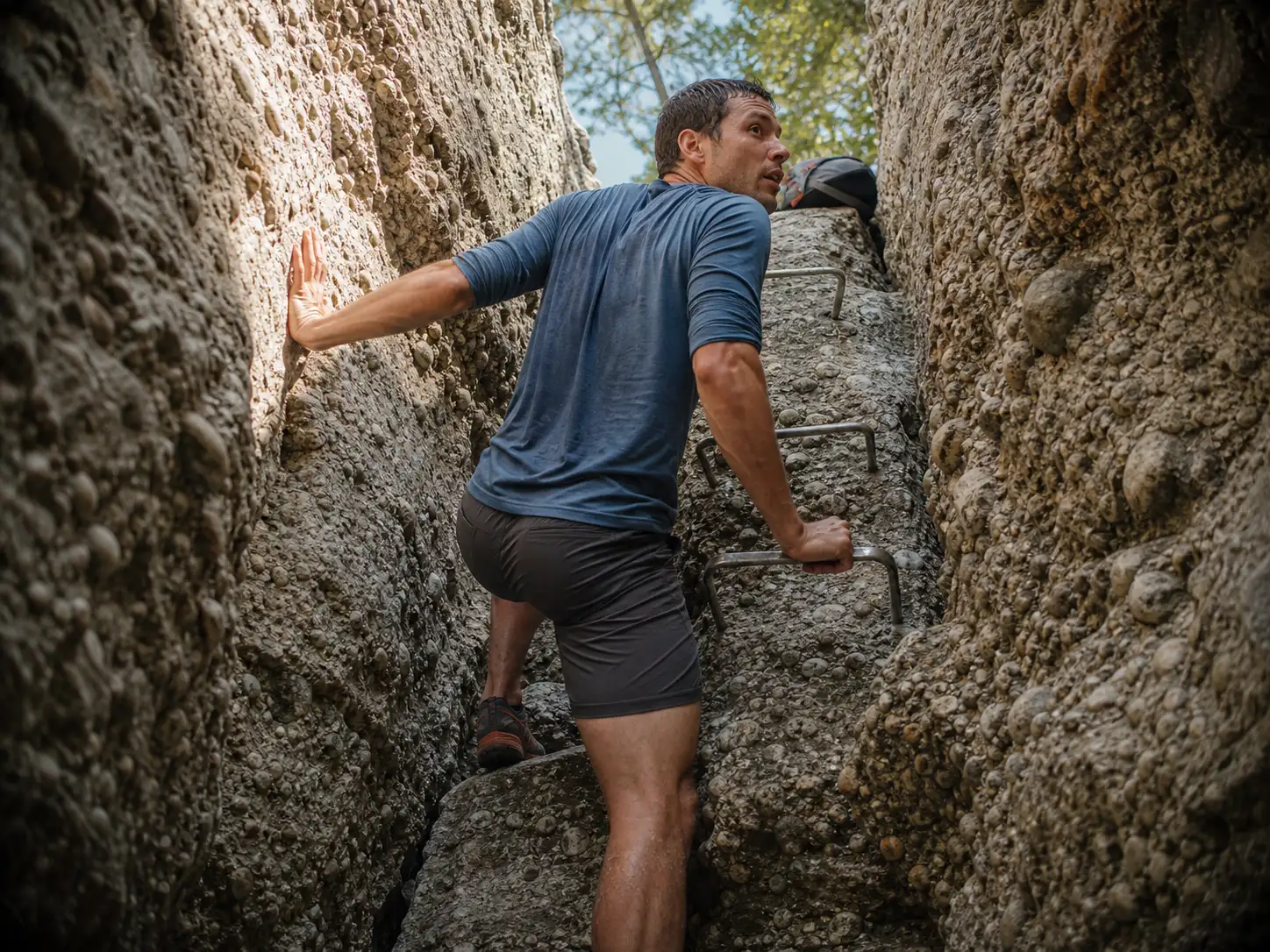
The Lemon Squeeze proper is the finish: roughly 100 feet of crevice and fixed wooden ladders that spits you out on the summit plateau near Sky Top Tower. The ladders are bolted in place and solid, and steep enough that you will be climbing them rather than walking them.
The name is literal. At the tight crevice near the top, the gap between the two rock walls narrows enough that a body plus a pack is more volume than the space allows. That is the whole story of this hike compressed into about eight feet of horizontal distance.
Locals call the whole ridge the Gunks, and you will see that shorthand everywhere in trip reports.
Why It Only Goes One Direction
This is a one-way trail through the crevice because it physically cannot handle two-way traffic. There is nowhere to step aside inside it. If someone coming down met someone going up at the narrow point, one of them would have to reverse-climb a ladder in a gap barely wide enough for one person, in front of a line.
That matters for planning: once you commit past the last ladder, turning around halfway through is not on the table. The out sits earlier, and knowing exactly where is worth more than any gear on this hike.
Mistake 1: Buying the Wrong Pass
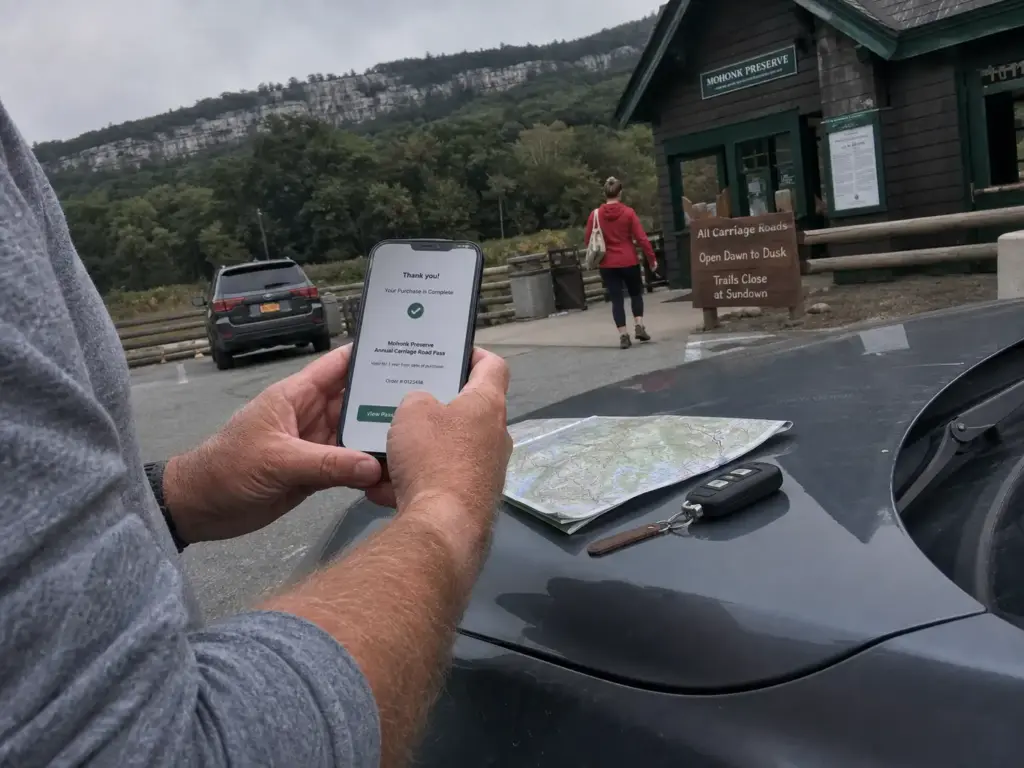
Someone books the cheaper pass thinking they saved twenty bucks, then finds out at the parking lot that they bought themselves an extra six miles of walking. This is the single most expensive planning error on this hike, and nobody explains it clearly before you pay.
Two organizations own land on this ridge. Mohonk Mountain House is a private resort; Mohonk Preserve is a nonprofit preserve next door. The Labyrinth and the Squeeze sit on Mountain House property. Both passes will get you to the feature, but not the same way.
The Mountain House Pass Buys You Distance
The Mohonk Mountain House Hiking Trail Day Pass runs $35 for ages 13 and up, $30 for ages 4 to 12, and free for kids under 3, according to Mohonk’s official hiking trail day pass page. It is the expensive one, and it is also the short one. From the Gatehouse you are looking at roughly 1.1 to 2.2 miles to reach the Labyrinth, depending on the route you take around Mohonk Lake.
Two rules on that hiking trail pass catch people out. It is online-only, bought up to 72 hours in advance, first-come first-served, and it is a non-refundable pass. There is no walk-up window at the gate. Show up on a good-weather Saturday hoping to buy one on arrival and you will be turned around before you ever see the lake.
The Preserve Pass Buys You a Longer Day
The Mohonk Preserve day pass costs $15 Monday through Thursday and $20 Friday through Sunday and holidays for hikers, with kids 15 and under free when they come with an adult. Cheaper, obviously. The catch is the approach: from Preserve-side access points you are hiking roughly 8 to 9 miles round trip to touch the same crevice.
That is not a bad day. For a lot of hikers it is a better one, because the carriage roads and the ridge walking on the Preserve side are genuinely good and you get the whole ridge instead of one feature. It is just a different outing from the one most people picture when they book it.
Which One Is Actually Right for You
Frame it as cost per mile saved, not cheap versus expensive. You are paying roughly $20 more to skip roughly four times the mileage. If your group includes kids, if you have a three-hour drive on either end, or if the Squeeze itself is the whole point of the trip, that $20 is the best money you will spend on this hike.
Flip it if you want a full day on your feet. The Preserve pass covers far more than this one hike, and if you would rather walk eight miles of ridge than pay for the shortcut, it is the better value by a wide margin. It also opens up the wider Shawangunk Ridge preserves, where the same reservation-pass logic applies and the terrain rewards a longer day.
Either way, buy the pass that matches the parking lot you are actually going to drive to. That sounds obvious right up until you are standing at a gate with the wrong reservation on your phone.
Mistake 2: Bringing a Pack That Won’t Fit Through
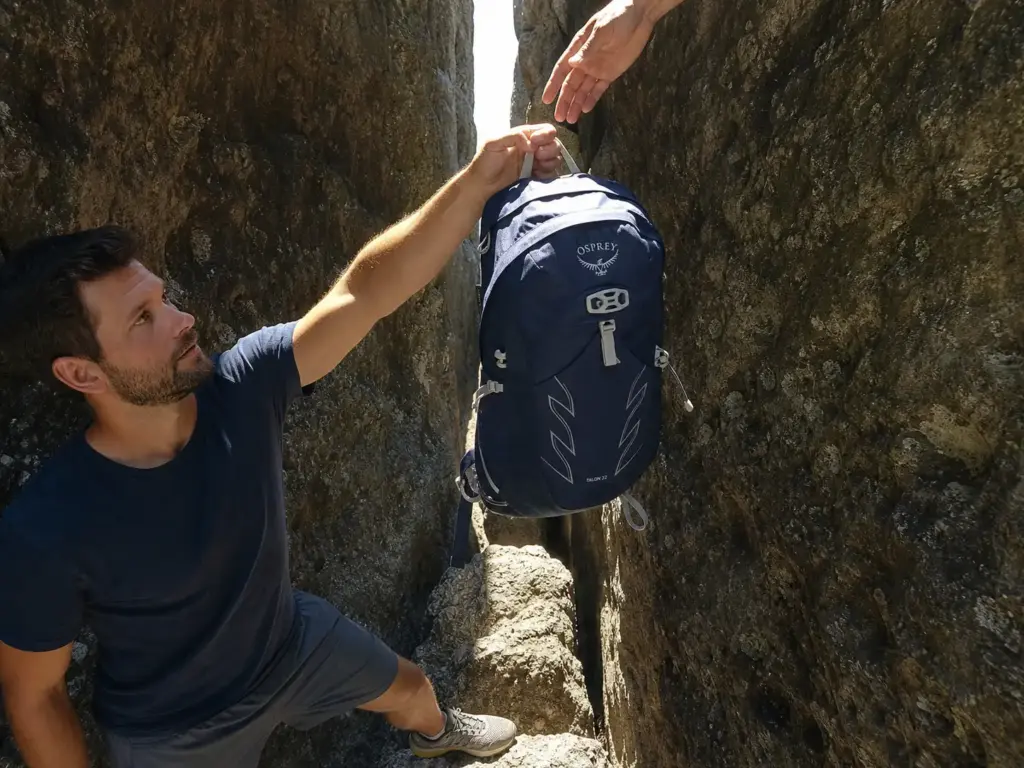
The rule everyone reads is “take your pack off.” What nobody tells you is that you are then going to be holding that pack, in a crevice, with one hand, while moving your body sideways through a gap. That changes what pack you should have brought in the first place.
Why the Pack Physically Cannot Stay On
Backpack removal here is not a courtesy rule someone posted on a sign. Your pack comes off before the tightest point because it will not clear the gap on your back, and neither will most small daypacks. Hikers who have done it report the same thing consistently.
Once it is off, the pack has to get through some other way. Hikers pass gear hand-to-hand or push it ahead of them through the crevice. Both work, and both require a pack you can shove and drag without it snagging on every edge.
Stage Your Gear Before the Gap, Not In It
Here is where people go wrong. They keep the pack on until the gap physically stops them, then try to wrestle it off while already wedged, one shoulder pinned against rock. That is the exact move that backs up the entire line behind them, and it is the most avoidable problem on this route.
Take it off early. When you can see the narrow section coming, stop somewhere with room, unclip, tighten anything loose, and move through in one continuous sequence. Thirty seconds of staging saves five minutes of struggling in front of an audience.
Trekking poles, anything strapped to the outside, anything dangling: stow it or leave it in the car. A water bottle in a side pocket will catch on rock you cannot see. Collapse the poles inside the pack, or skip them on this hike entirely, since you want both hands anyway.
What Size Pack Actually Works Here
A 20 to 22 liter pack with a low-profile back panel does all of this easily. A 30 liter-plus overnight pack fights you the whole way, and a frame sheet that holds its shape is exactly what you do not want when you are trying to compress a bag through a slot.
The Osprey Talon 22 (men’s · women’s Tempest 20) is the shape that works here: narrow panel, minimal external volume, nothing that catches. It carries a full day of water and food without turning into a barrel on your back. If you would rather not spend, a budget-friendly packable daypack like the ZOMAKE 25L does the job too, since it compresses down to almost nothing when you need to push it through a gap. If you are torn on sizing generally, 20L versus 30L for a day like this is a question worth settling before you buy anything.
Put your phone and car keys in a zipped pocket on your body, not in the pack, before you start the Squeeze. The pack is going to be handled by other people, pushed along rock, and set down in places you cannot see. Anything you cannot replace should be on you.
Mistake 3: Showing Up on a Day It’s Closed or Wet
The calendar says April. The gate says no. Ice sits deep in that crevice long after the parking lot has thawed and the trees have started budding, and nobody standing in their kitchen two hours away can see that.
Ice Closes This Route Longer Than You’d Think
The seasonal closure here typically covers the whole winter, with real risk in early spring and late fall. Shoulder season is a coin flip. The rock inside sits in permanent shade between two walls, which is exactly the geometry that keeps an ice hazard alive for weeks after everything around it has dried out.
Call the recorded trail conditions line at 845-256-2197 before you commit the drive. It exists precisely because the closure does not follow the calendar, and it takes about thirty seconds. Hikers who skip it and drive two hours in April are the ones posting about a roped-off gate afterward.
How Wet Conglomerate Actually Behaves
This is the part almost nobody covers. Shawangunk conglomerate is a quartz pebble conglomerate cemented mostly with silica rather than iron oxide, which makes it one of the hardest, most durable rock types in the region. It does not crumble, flake, or spit off holds the way weathered sandstone does when it gets soaked.
So the risk on a wet day is not the rock failing. It is rubber-on-rock friction failing. The rock stays bomber and your shoes stop working, and everything still looks and feels solid right up until your foot slides.
That inverts the usual wet-rock instinct. Most places teach you to distrust the rock itself; here you trust the rock and distrust your soles. If you want the general version of that skill, reading rock quality before you weight a hold is the framework that applies everywhere else.
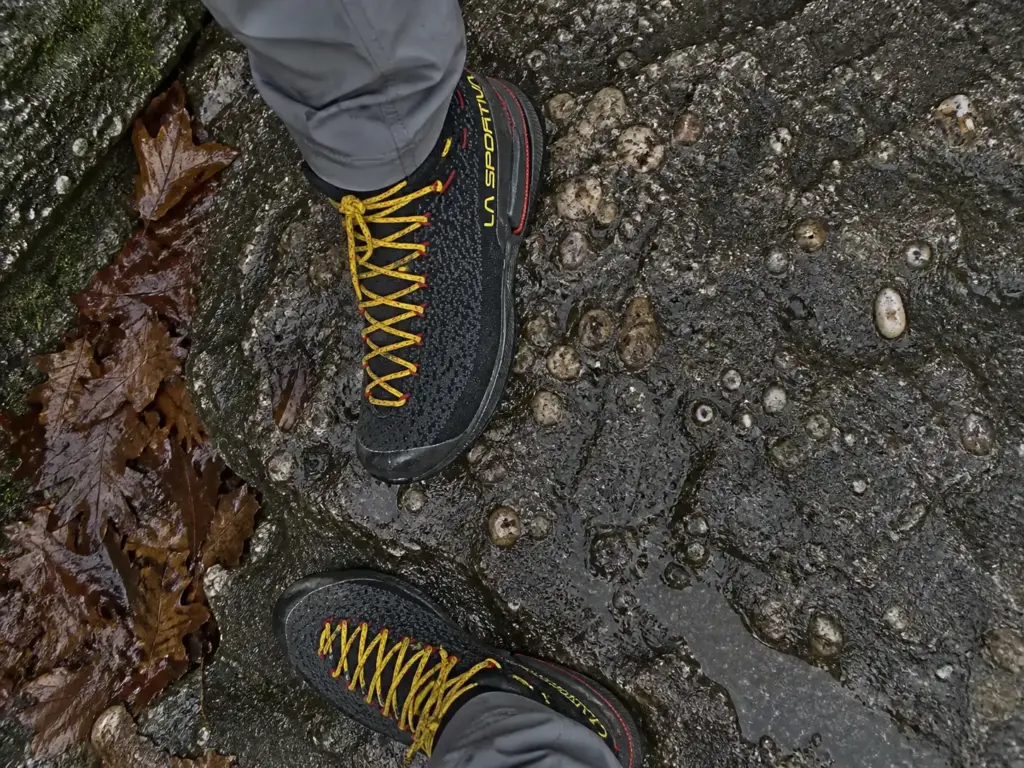
There is a second wet-day wrinkle worth knowing. The quartz pebbles embedded in the conglomerate sit slightly proud of the matrix, which is what gives the Gunks its famously grippy texture when dry. Wet, those same rounded pebbles turn into a field of tiny ball bearings under a smooth sole. Rough texture on dry rock does not automatically mean rough texture on wet rock.
What That Means for Your Shoes
On damp conglomerate, sole compound does more for you than boot stiffness or ankle height. Grippy hiking shoes are not the same as sturdy ones: a tall, stiff boot with a hard lugged sole feels secure walking the carriage road and then skates on a wet slab, while a softer, stickier rubber deforms into the surface texture and holds.
The La Sportiva TX2 EVO (men’s · women’s) is built around exactly that idea, with an IdroGrip sticky rubber compound rated for confidence on wet and dry rock, in a lightweight approach-shoe build that does not feel like overkill on the carriage-road walk-in. Now the honest part: you do not need approach shoes to do this hike. Plenty of people get through the Labyrinth in whatever trail runners they own, and on a dry day that is fine. But if you are doing the Gunks regularly, sticky rubber earns its keep, and you will notice the difference the first time the rock is even slightly damp.
What you actually want to avoid is the other extreme. Worn-smooth soles, road-running shoes, and anything with a hard plastic-feeling lug pattern are the wrong tool on this rock in any conditions.
Mistake 4: Misjudging Whether You Fit — and Whether You’ll Panic
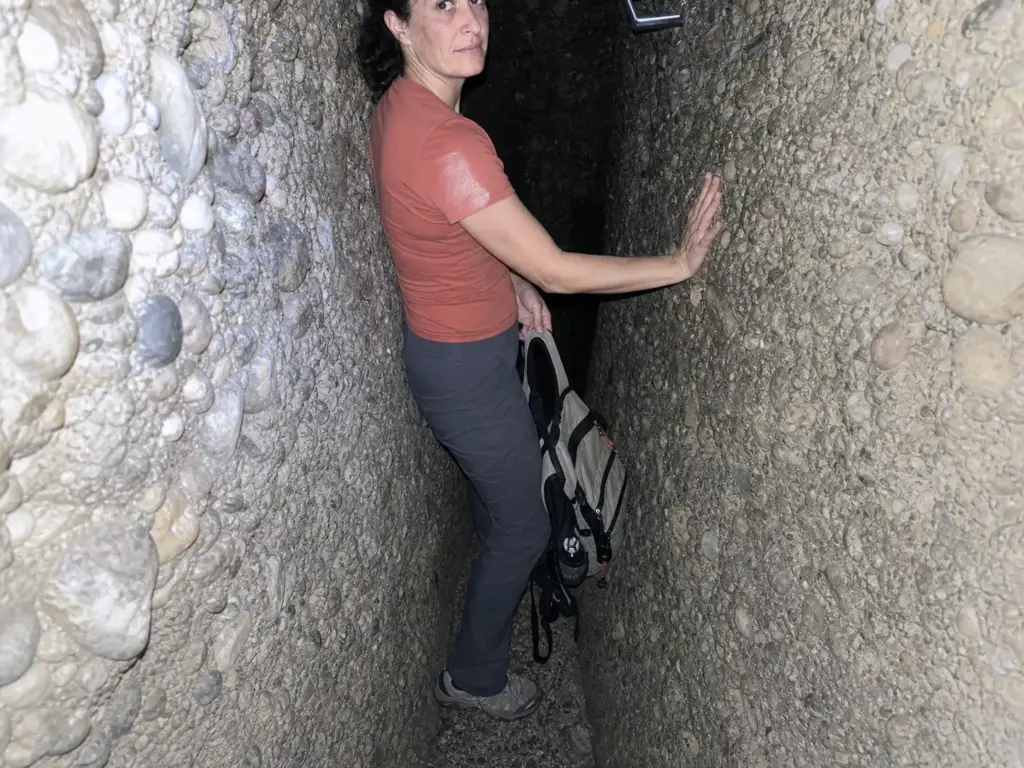
There is a fork in the trail right before the last ladder where you look at the gap and decide. Taking the road back from there is not failing the hike. Getting wedged in a one-way crevice with six people behind you is a genuinely bad afternoon.
This is the section most people arrive at this article looking for, and it is the one every competitor skips.
It’s a Body-Geometry Problem, Not a Fitness Test
Here is the honest version. The crevice squeeze does not care how fit you are. You take the pack off, turn your body at an angle, and wiggle through a gap with fixed dimensions. Your dimensions either work with that gap or they work against it.
Broader shoulders and larger frames have a harder time here than the posted strenuous difficulty rating suggests, and that has nothing to do with conditioning. A strong hiker with a wide chest can struggle where a smaller, less experienced hiker walks through. Nobody prints that, but it is the mechanic that determines who gets through comfortably.
The practical read: turning your torso sideways and leading with one shoulder buys you your narrowest profile. Facing the gap straight-on is the widest way to approach it and the way most people instinctively try first.
The Claustrophobia Question Nobody Asks Out Loud
The panic question is real and completely separate from the fitness question. Rock on both sides, no reverse gear, dim light, and people ahead of and behind you is a specific kind of uncomfortable. Some hikers who scramble confidently on open exposed terrain find this much harder than a cliff edge, because the problem is not height, it is confinement.
If you already know that elevators, MRI machines, or crowded subway cars get to you, take that seriously here instead of assuming trail confidence will carry over. It is a different system firing.
The tell to watch for, in yourself or someone in your group, shows up before the crevice. If the tighter squeezes in the Labyrinth, the ones where you duck under a leaning slab, are already producing a “let’s just get through this quickly” energy, the actual Squeeze will amplify that considerably.
Bail Right — Where the Out Actually Is
Right before the final ladder and crevice section, you can turn right and take a road back to the Mountain House. That is the whole escape. Community shorthand across trip reports calls it bail right, and it is a sanctioned, marked, ordinary option, not a rescue.
The decision point sits close enough to the crevice that you get to look at the thing before choosing. That is the best possible arrangement and you should use it deliberately: walk up, look, decide, and do not let a queue behind you make the call. If you need a framework for that moment beyond this one trail, deciding when to turn back on a scramble is the same reasoning applied more broadly.
If anyone in your group is uncertain, send the most experienced person through first, not last. Having a familiar voice on the far side of the gap talking you through foot placements is worth more than someone behind you saying you have got this. Rock swallows sound, and the person you can hear is the one who helps.
First Scramble vs. Done-This-Before
If this is your first rock scramble, expect the Labyrinth to take longer than the mileage suggests and expect to use your hands far more than you planned. Budget extra time, eat before you think you need to, and treat the whole approach as the warm-up rather than the commute. The thing that catches beginners is not the technical difficulty, it is arriving at the ladders with tired legs and a rushed clock.
If you have done Class 3 terrain before, none of the individual moves will surprise you. The ladder climb is straightforward, the boulder-hopping is standard talus work, and the exposure is minimal. The only genuinely novel element is the one-way constraint, which means your usual habit of backing off a move you do not like is unavailable once you commit.
The posted age recommendation is 8 and up, and it is a reasonable one. Read it as a comfort-and-agility guideline for the adults in the group too, not just the kids.
Mistake 5: Arriving Unprepared for a Carry-In, Carry-Out Day
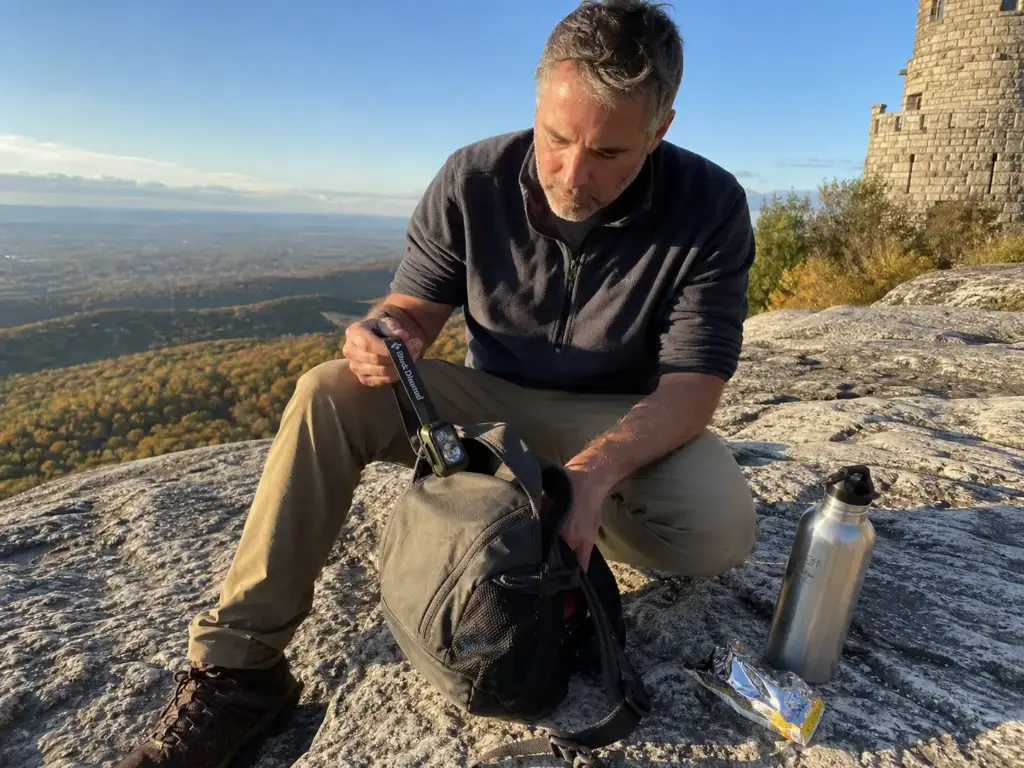
There is no snack bar, no trash can, no water fountain for hikers, and no shuttle back to your car. Everything you want up there goes up on your back, and everything you produce comes back down with you.
Everything You Bring Comes Back Out With You
The Mountain House side runs a strict carry in carry out system. No trash cans on the property, no food service for day hikers, no shuttle from the parking area to the trailhead. That last one surprises people who assume a resort means amenities: the resort has amenities, but hikers on a day pass do not get them.
Bring water and food for the entire day, plus a bag for wrappers. That is standard Leave No Trace practice, and here it is also the house rule. Bring rain gear too, because weather on the ridge changes faster than the drive up suggests and there is nowhere to shelter or buy anything.
One more hard rule: no pets anywhere on Mountain House property. This is private land, and it is a flat no rather than a “well-behaved dogs welcome” situation. Do not drive out with the dog planning to sort it out at the gate.
The 3pm Cutoff Is Real
You must arrive by 3pm on the Mountain House side, and hiking runs from 7am to dusk. Late arrivals get turned away at the gate, pass in hand, no exceptions. Build a real driving buffer instead of a best-case one, because the Hudson Valley on a fall Saturday does not move at the speed your GPS promises.
Current hours, pass terms and visitor rules are worth checking on the Mohonk Preserve’s official visitor planning page before you leave, since seasonal changes happen and a stale screenshot is not a plan.
The Headlamp Nobody Thinks They Need
The crevice sections are dim even at midday. Two rock walls, a narrow slot and tree cover above means you move through shadow while the rest of the ridge sits in full sun, and your eyes take a moment to adjust every time.
The bigger reason is the clock. Hiking runs to dusk, and anyone who starts late, gets stuck in a queue at the Squeeze, or lingers at the tower finishes in fading light on terrain that punishes a bad foot placement. That makes a headlamp the margin item here, not a luxury. An offline trail map on your phone belongs in the same category, since cell service on the ridge is unreliable.
The Black Diamond Spot 400 (check it here) covers it: 400 lumens is more than enough for descending a carriage road, it dims down for close work in a crevice, and it runs on AAA batteries you can find anywhere. It weighs less than the water you will drink in the first mile, which is the whole argument for carrying one. The gear that isn’t optional on a scramble covers what else belongs in the pack when the terrain gets more serious than this.
Getting There, Parking, and Making the Day Work
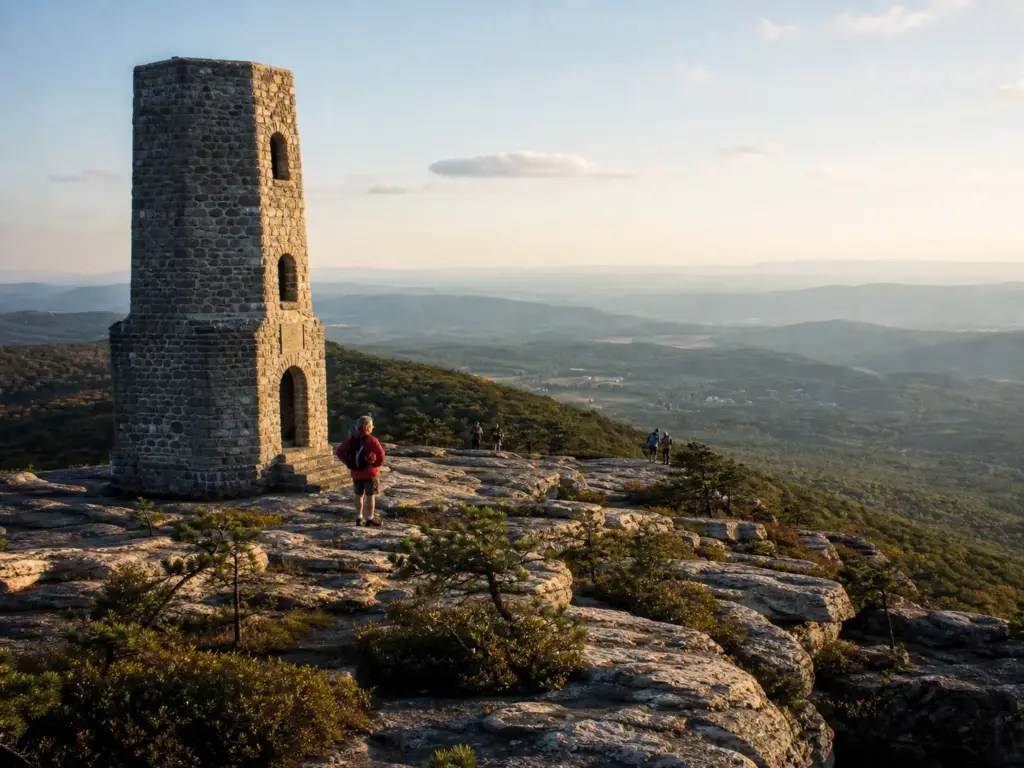
The hike itself takes most people a half day. The day around it runs considerably longer, and the parking lot fills early on a good-weather weekend.
Parking and Which Lot Matches Your Pass
Gatehouse parking is the Mountain House-side staging point and the one that pairs with the $35 hiking trail day pass. Preserve access points sit elsewhere on the ridge and feed the long approach. Confirm which one your pass matches before you set the GPS, not after.
This sounds like a small thing. It is the difference between a two-mile approach and a nine-mile one, and it is the mistake people make most often, usually while feeling clever about saving money.
Timing Around the Crowds
A weekday visit in June and a Saturday during peak fall foliage are two different hikes. The crevice is a one-way bottleneck, so when volume goes up a queue forms and you wait on rock rather than moving.
Early arrival solves parking, a crowded trailhead and the 3pm cutoff in one move. Get there when the gate opens and you will be on the ladders before the day’s traffic stacks up behind you. Sky Top Tower at the finish is the payoff, and the panoramic views across the Hudson Valley from the top are what the whole scramble buys you. They are a lot better without twenty people waiting for the same photo.
If the Squeeze Is a No-Go That Day
Closures happen and bail-right decisions happen, and neither should end your day.
If your pass is Preserve-side or you are open to relocating, the ice caves at Sam’s Point deliver a similar ladder-and-crevice experience with the same reservation logistics. The trails at Minnewaska sit on the same Shawangunk geology with more mileage and less bottleneck, which makes them the obvious fallback when the Labyrinth is roped off. Both are close enough that the pivot costs you thirty minutes rather than the whole trip.
Conclusion
Buy the pass that matches the approach you actually want to walk. That single decision costs you more time and money than any gear choice here, and it is made before you leave the house.
Small pack, sticky soles, headlamp in the lid. The Squeeze rewards travelling light far more than it rewards being strong, and nearly every problem people report in that crevice traces back to carrying too much volume through a gap that does not negotiate.
Bailing right is a legitimate finish. Getting wedged in a one-way crevice with a line behind you is not, and the fork in the trail exists specifically so you never have to find out which one you are.
Before you commit the drive, call the conditions line at 845-256-2197. Thirty seconds on the phone is the difference between a scramble and a long round trip for nothing.
Frequently Asked Questions
01Is the Lemon Squeeze hike hard?
Physically it is a moderate hike with a short, awkward scramble, and the mileage is not the challenge. What makes it hard is the crevice at the top: you take your pack off, turn your body sideways, and work through a gap that suits some frames better than others.
02Is there a Lemon Squeeze hike in Mohonk?
Yes. The Lemon Squeeze sits at the top of the Labyrinth on Mohonk Mountain House property near New Paltz, NY, finishing near Sky Top Tower. It is a separate feature from the Mohonk Preserve trails, which is exactly why the pass question trips people up.
03Do you have to pay for the Lemon Squeeze?
Yes, and you must buy the pass online in advance because there is no walk-up purchase. A Mountain House Hiking Trail Day Pass runs $35 for ages 13 and up with the shortest approach; a Mohonk Preserve day pass costs $15 to $20 but adds several miles each way.
04What movie was filmed at Mohonk Mountain House?
The Mountain House and its Labyrinth turn up in Stephen King’s novel Thinner, and the property has a long history as a filming location for period productions. Worth knowing if the architecture looks oddly familiar when you reach the top.
05Can you turn around partway through the Lemon Squeeze?
Not once you are inside the crevice, because it is one-way and too narrow for two-way traffic. The decision point comes just before the final ladder, where you can turn right and take a road back to the Mountain House instead.
Risk Disclaimer: Hiking, trekking, backpacking, and all related outdoor activities involve inherent
risks which may result in serious injury, illness, or death. The information provided on The Hiking Tribe is for
educational and informational purposes only. While we strive for accuracy, information on trails, gear, techniques,
and safety is not a substitute for your own best judgment and thorough preparation. Trail conditions, weather, and
other environmental factors change rapidly and may differ from what is described on this site. Always check with
official sources like park services for the most current alerts and conditions. Never undertake a hike beyond your
abilities and always be prepared for the unexpected. By using this website, you agree that you are solely
responsible for your own safety. Any reliance you place on our content is strictly at your own risk, and you assume
all liability for your actions and decisions in the outdoors. The Hiking Tribe and its authors will not be held
liable for any injury, damage, or loss sustained in connection with the use of the information herein.
Affiliate Disclosure: We are a participant in the Amazon Services LLC Associates Program, an
affiliate advertising program designed to provide a means for us to earn advertising fees by advertising and linking
to Amazon.com. As an Amazon Associate, we earn from qualifying purchases. We are also an official affiliate partner
of Black Diamond Equipment via the AvantLink network. If you click on a Black Diamond affiliate link and make a
purchase, we may earn a commission at no additional cost to you. We also participate in other affiliate programs and
may receive a commission on products purchased through our links. Additional terms are found in the terms of
service.