In this article
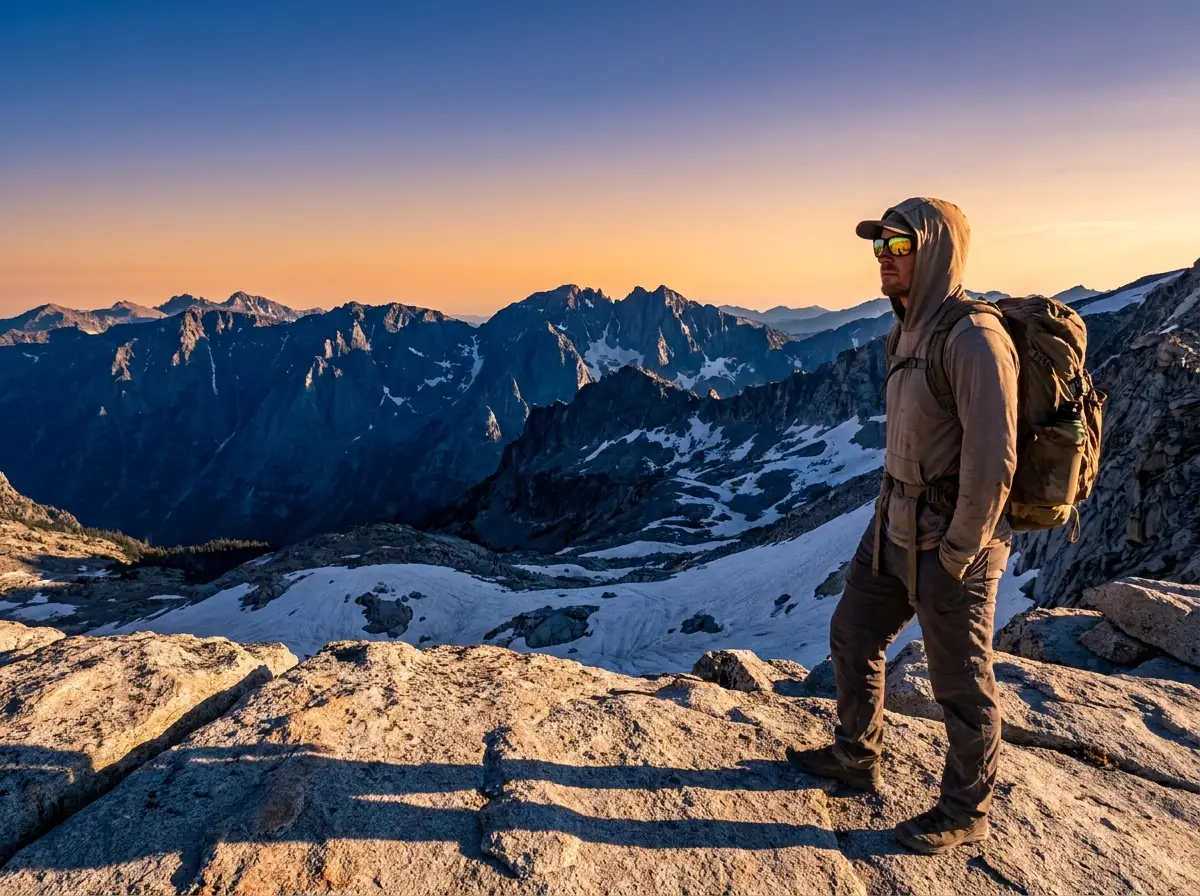
You’re standing at the trailhead, sun already cutting through the canopy, and you reach for the sunglasses that have been rattling around your glove box since last season. Scratched lenses, stretched temples, polarization that does nothing against the wet-granite glare on the ridge. That’s the pattern most hikers repeat — buy budget, watch the lenses delaminate, repeat. Worse, plenty of “hiking” sunglasses sold online quietly cap at UV380 instead of UV400, leaving the last slice of the UV spectrum free to hit your retinas at elevation, where UV intensity already runs roughly 10% higher per 1,000 meters of altitude.
After comparing verified Amazon reviews across 40+ polarized hiking sunglasses, cross-referencing lens specs against the American Academy of Ophthalmology’s UV-blocking guidance, and mapping the picks from Outdoor Life, OutdoorGearLab, and the 2026 SERP round-ups, six models stand out. Not because of marketing spend — because their lens category, frame construction, and verified long-term durability actually track with what hikers put them through. Sun-hoodie thinking applies here too; if you already trust a UPF-rated sun hoodie to protect your neck, your eyewear deserves the same standard.
Below: a comparison table for fast scanning, then six full reviews that each name the specific flaw the model carries. A review with only pros is a review you can’t use.
The 6 Best Polarized Hiking Sunglasses for 2026
The picks below are organized by who they’re for — not by brand loyalty or price tier alone. The Best Overall handles the widest range of trail conditions; the Best Value proves UV400 polarization no longer requires a triple-digit spend; the Premium and Alpine picks exist because certain conditions genuinely require them; and the ultralight Honorable Mention is there for the backpacker who counts grams on a 14-day thru-hike. Each review includes the model’s honest flaw, because reviewers who never admit flaws stop being useful fast.
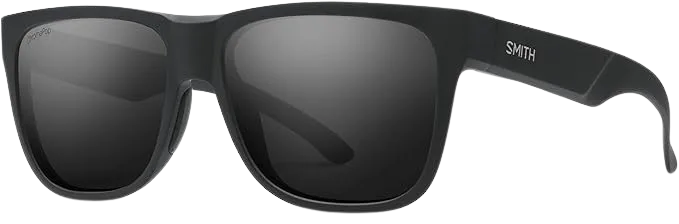
1. Smith Optics Lowdown 2 ChromaPop Polarized — Best Overall
The Smith Lowdown 2 earns this slot because it handles the four trail conditions most hikers actually cycle through — forest shadow, exposed ridge, reflective rock, shallow snow — without needing to switch lenses. ChromaPop’s selective-filter polarization cuts glare the way every polarized lens should, but it also separates color channels (green from yellow, red from orange) that most lenses collapse, which translates on trail to better depth perception on dappled terrain. A 2026 Outdoor Life round-up slotted Smith’s Shift Mag at the top of its hiking category for similar reasons, and the Lowdown 2 shares the same ChromaPop lens platform at a lower price.
Verified Amazon reviewers who’ve put the Lowdown 2 through spring skiing in Colorado and mountain biking in Arizona consistently describe the lens tint as “never too dark, never too light” — the signal that the VLT (visible light transmission) sits in the sweet Category 2-3 range that most hikers need. The carbonic polymer lens is lighter than glass, and the anti-reflective coating keeps the sun-behind-you glare off the rear surface. An available glass lens upgrade (Techlite) exists if you prioritize optical clarity over ounces.
The flaw worth knowing before you buy: Amazon’s listing has a documented quality-control issue where some units arrive labeled “ChromaPop” but ship with the non-ChromaPop standard carbonic lens. Multiple verified reviews flag this. The safest path is buying direct from Smith or from an Amazon seller whose listing explicitly shows ChromaPop in the lens spec line, then checking the engraved marking on the lens when the glasses arrive.
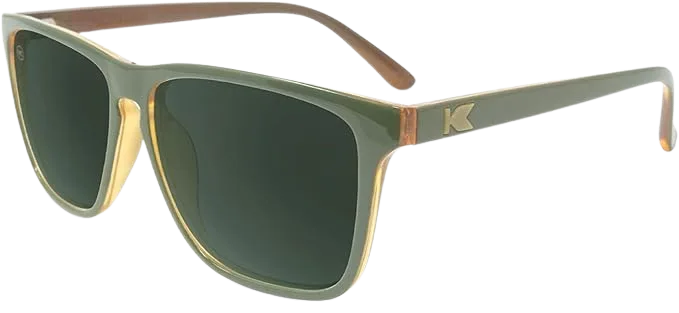
2. Knockaround Fast Lanes Polarized — Best Value
The Fast Lanes earn the Best Value slot by delivering three of the four specs that matter on trail — UV400 rating, true polarization, and impact-resistant polycarbonate — at a street price that orbits $25-$35. That’s an order of magnitude below the Smith Lowdown 2, and for entry-level hikers, day-hikers who park their glasses in a pack rough-and-tumble, or anyone who loses a pair a year, the math makes sense. Bike Hike Safari’s 2026 round-up slotted the Fast Lanes as its Best Budget pick for hiking sunglasses for the same reason.
Pattern-matching through Amazon’s verified reviews surfaces two repeated points: the rubber nose pads hold on sweaty skin better than most sub-$50 competitors, and multiple owners describe their first pair lasting over a year without lens delamination — which is the real budget-sunglass failure mode. The lens handles UVA/UVB at the UV400 standard the Skin Cancer Foundation recommends as the minimum for outdoor activity.
The flaw: the frame hinges aren’t engineered for decades. If you sit on them once wrong, you’ll feel it. The polycarbonate also scratches faster than glass — throw them in a hard case, not loose in a hip pocket, and you’ll get your year out of them. For that price, it’s a fair trade.
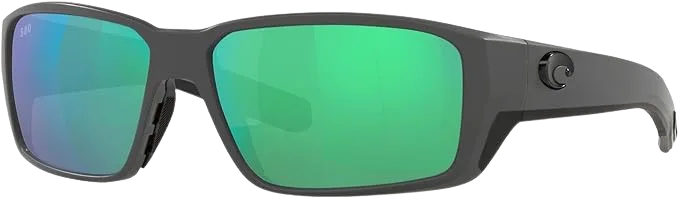
3. Costa Del Mar Fantail 580G Polarized — Premium Upgrade
Costa’s 580G glass lens is the one spec that consistently separates premium sunglasses from the pack — and the Fantail is where that lens sits in the most trail-friendly wrap frame Costa makes. Verified Amazon owners repeatedly describe the clarity as “no glare” and “colors much brighter,” which is the signal that Costa’s selective-wavelength filtering is doing what it claims: cutting yellow haze without washing out reds or greens. OutdoorGearLab picked a sibling Costa (the Rinconcito) as its Best on Water for the same optical profile.
The Fantail’s real-world durability is the other reason it lands in Premium rather than Best Overall. One verified reviewer reports a first pair lasting “over 10 years before they were misplaced” — not lost to frame failure, not delaminated lenses, just a household misadventure. Glass lenses don’t scratch the way polycarbonate does, and the frame is unforgiving in a good way. For hikers who spend long days in high-glare conditions — ridge walks above reflective lakes, desert rim trails, snow-adjacent approaches — the optical upgrade earns its cost.
The flaw: the 580G glass lens adds weight you’ll feel over a 12-hour day, and Costa’s wrap frame sits close enough to the face that multiple owners report interior fogging from body heat on steep climbs. Glass lenses also don’t survive a direct impact the way polycarbonate does — if you’re scrambling Class 3 terrain where a face-plant is on the risk matrix, this isn’t the pair to take.
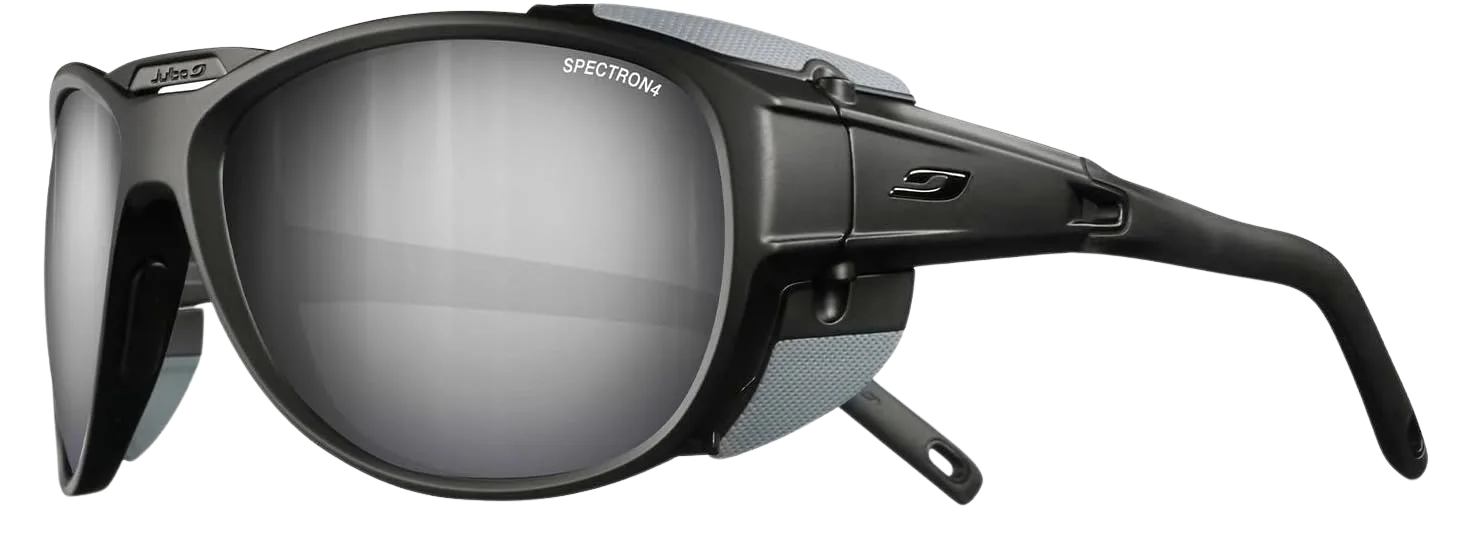
4. Julbo Explorer 2.0 Mountaineering Glacier — Best for Alpine and Glacier Travel
Above treeline and on glacier, Category 2-3 lenses stop being enough. UV intensity climbs roughly 10% per 1,000 meters, and snow reflects up to 80% of incoming UV back into your eyes — double-exposure territory. The Julbo Explorer 2.0 is the one pick in this list with a genuine Category 4 lens (Spectron 4) or a photochromic 0-to-4 REACTIV option, paired with removable side shields that block the peripheral UV your lens can’t. It’s the glacier pick cited by Broke Backpacker’s 2026 round-up for exactly those conditions.
The Amazon-verified pattern on the Explorer 2.0 is consistent: one reviewer wore the photochromic variant on a 19-day Denali climb and described them as the best mountaineering glasses they’d owned, with the lens adjusting so seamlessly to ambient light they forgot they were wearing them. The bio-sourced Rilsan frame is lighter than previous Julbo frames and carries a lifetime warranty — meaningful coverage on a product that will see abuse. If you’re doing any alpine travel where you’d rope up on a glacier, these belong in your kit.
Pro tip: Side shields are not optional on glacier. Peripheral UV exposure from reflected snow causes photokeratitis (snow blindness) even when the lens is doing its job — the damage comes in through the sides. Never remove the Explorer’s shields above the snowline.
The flaw: fogging. One climber on Cayambe (19,000 ft in Ecuador) reported the Explorer 2.0 fogging so badly during aerobic effort that the glasses became a liability and had to be removed. The vented frame helps, but at high sustained heart rates in cold air, fog forms faster than the vents clear it. Verified reviews also flag easy lens scratching without a hard case — Julbo’s glasses ship with one; use it.
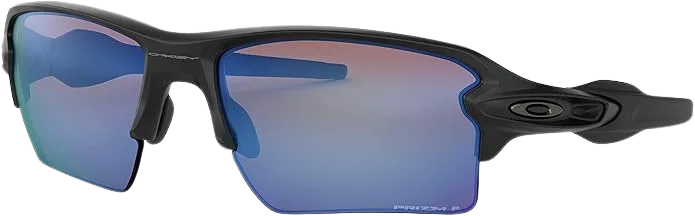
5. Oakley Flak 2.0 XL Prizm Polarized — Best for Wide Peripheral Coverage
The Flak 2.0 XL earns this slot by being the only pick here with a genuine wrap frame engineered for peripheral vision — which matters when you’re scrambling Class 2-3 terrain, trail running, or moving fast on exposed ridges where side-glare and wind debris both become issues. Prizm polarized is Oakley’s selective-wavelength lens (same concept as ChromaPop, different chemistry), and the HDO (High Definition Optics) cuts peripheral distortion that cheaper wrap lenses can introduce.
Verified Amazon reviewers consistently call out near-indestructible construction. One owner reports the glasses being dropped and stepped on with “arms and lenses popping right back in” — O-Matter frame material is rated for that kind of abuse. The Plutonite lens blocks 100% of UVA, UVB, and UVC — the latter being the band that cheaper UV380 lenses don’t touch. For hikers who want a sport-wrap geometry without paying $300+ for the premium tier, this is the lens.
Pro tip: Oakley runs their Prizm platform with lens-specific tints — Prizm Trail, Prizm Deep Water, Prizm Dark Golf, etc. The “Prizm Black Polarized” that ships on most hiking SKUs is neutral-dark and handles general trail conditions. Avoid Prizm Dark Golf for hiking — one verified review notes it cuts road-surface detail in a way that would mask trail hazards.
The flaw: the Flak 2.0 XL fits narrow. Owners with wide faces, high cheekbones, or low-bridge profiles consistently report the frame pressing on temples or the bridge sitting too low on the nose. Oakley does not make a wider variant of this specific frame — if you already know Oakley wrap frames don’t suit your face, this pick isn’t for you, and the Smith Lowdown 2 is the safer choice.
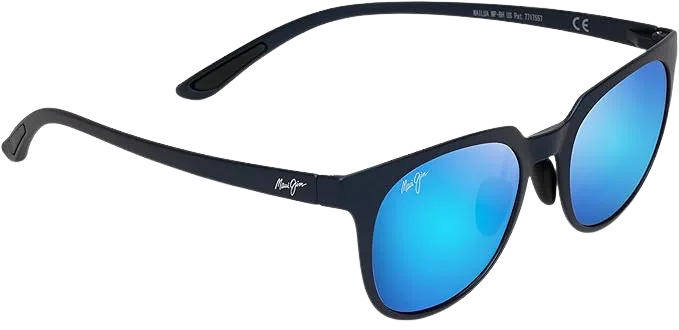
6. Maui Jim Wailua Polarized — Honorable Mention (Ultralight Composite Lens)
The Wailua earns the honorable mention for one specific reason: its MauiPure composite lens delivers near-glass optical clarity at roughly the weight of a compact disc. Outdoor Life called the Wailua the Best Ultralight pick in their 2026 hiking sunglass round-up for exactly this reason — for backpackers who weigh every gram of their kit, the composite-vs-glass tradeoff actually matters. PolarizedPlus2 is Maui Jim’s color-enhancing polarization layer, and the lens handles the UV spectrum at 100% UVA/UVB.
It lands at Honorable Mention rather than a primary category because its strengths overlap with picks above — it doesn’t clearly beat the Lowdown 2 for all-around trail use, and it doesn’t beat the Fantail 580G for pure optical quality. But if you’re planning a 14-day trek where ounces matter and glass lenses are a non-starter, the Wailua is the composite-lens answer. The injected nylon frame is also lighter than the Lowdown 2’s acetate, though less forgiving under direct stress.
How to Choose Polarized Hiking Sunglasses
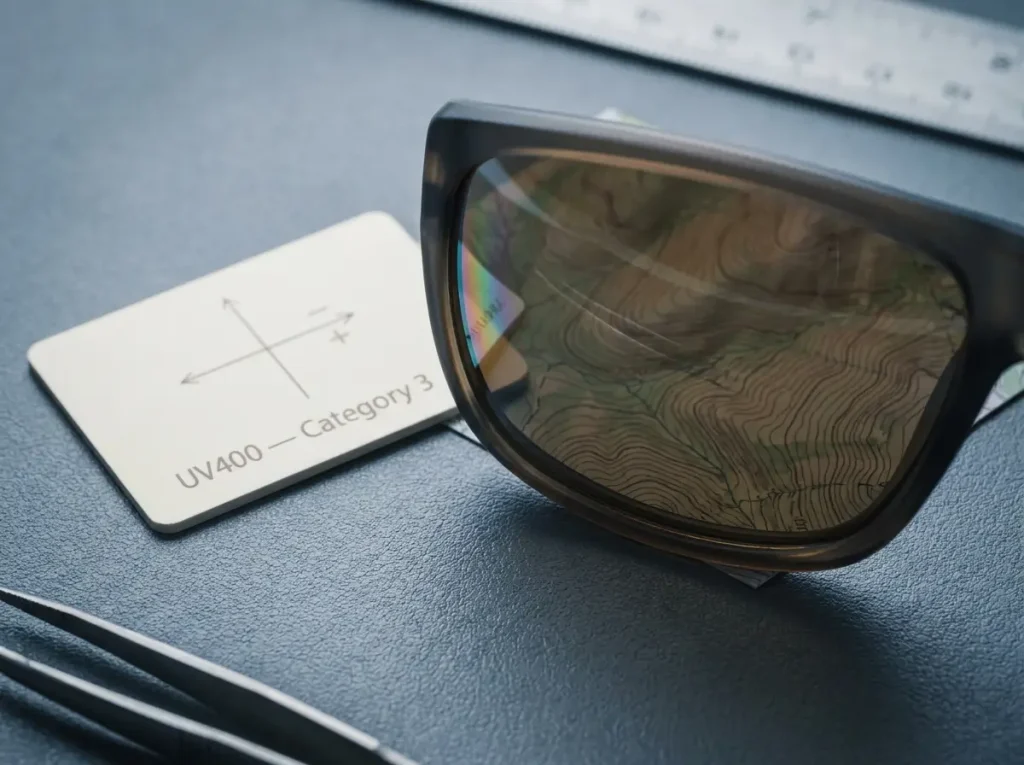
Most sunglass marketing collapses everything into “100% UV protection” and a brand name. That’s useful for the checkout page and nearly useless for picking the right pair. The four categories below are the ones that actually determine whether your eyewear works for your hiking — and where most SERP competitors skip past the details.
UV400 vs UV380 — What Actually Matters
UV400 blocks wavelengths up to 400 nanometers, which captures both UVA (320-400 nm) and UVB (280-320 nm). UV380 caps at 380 nm, leaving the top 20 nm of UVA unfiltered. That gap sounds small; it’s not. UVA penetrates deeper into the ocular tissues than UVB and is implicated in cataract formation and retinal damage, according to ophthalmology research summarized by the American Academy of Ophthalmology. Always buy UV400 — if the lens spec says UV380 or just “100% UV protection” without specifying, treat it as a warning label, not a feature.
Lens Categories 1-4 — When Cat 4 Becomes Mandatory
Lens category is the VLT (visible light transmission) rating — how much light the lens lets through.
- Category 0 (80-100% VLT): fashion, no sun protection
- Category 1 (43-80% VLT): overcast, dawn/dusk
- Category 2 (18-43% VLT): moderate sun, most day hiking below treeline
- Category 3 (8-18% VLT): bright sun, exposed ridge, open ocean — the default for most hiking
- Category 4 (3-8% VLT): glacier, high alpine, reflective snow — legally non-drivable in most countries
For most hikers, Cat 3 is the right call. Above treeline, on glacier, or during sustained snow travel, Cat 3 isn’t enough — snow reflects 80% of incoming UV back at your eyes, and you need Cat 4 plus side shields to handle peripheral exposure. This is why the Julbo Explorer 2.0 is a separate category in this list — Cat 4 on a hiking sunglass is rare, and photochromic 0-to-4 is rarer still. Review the fogging-prevention mechanics that apply to winter goggles — the same principles apply to high-altitude sunglass use.
True Polarization vs Decorative Coatings
A true polarized lens contains a laminated filter layer that blocks horizontally-oriented light waves — the ones that cause reflected glare off water, wet granite, and snow. A polarized-coating lens (common at sub-$20 price points) paints a polarizing film on the surface; it wears off in months. The fast check: hold the lens flat against a smartphone screen in landscape orientation, then rotate 90 degrees. A true polarized lens will blackout or color-shift dramatically. A coated lens will show only a minor tint change. Every pick in this list is true-polarized — not all polarized-labeled sunglasses are.
Polycarbonate, Glass, and Composite Lenses
- Polycarbonate: lightweight, impact-resistant (ANSI Z87.1 rated in premium versions), scratches faster than glass. Best for rough trails, scrambling, budget builds.
- Glass: best optical clarity, most durable against scratches, heaviest, brittle under direct impact. Best for ridge days and long drives between trailheads.
- Composite (e.g., MauiPure, Trivex, NXT): near-glass clarity, near-polycarbonate weight, moderate scratch resistance, mid-to-high cost. Best for ultralight backpackers and long-day hikers who want both.
There’s no universal best — the right material depends on what you’ll subject the glasses to.
When Polarized Sunglasses Become a Liability
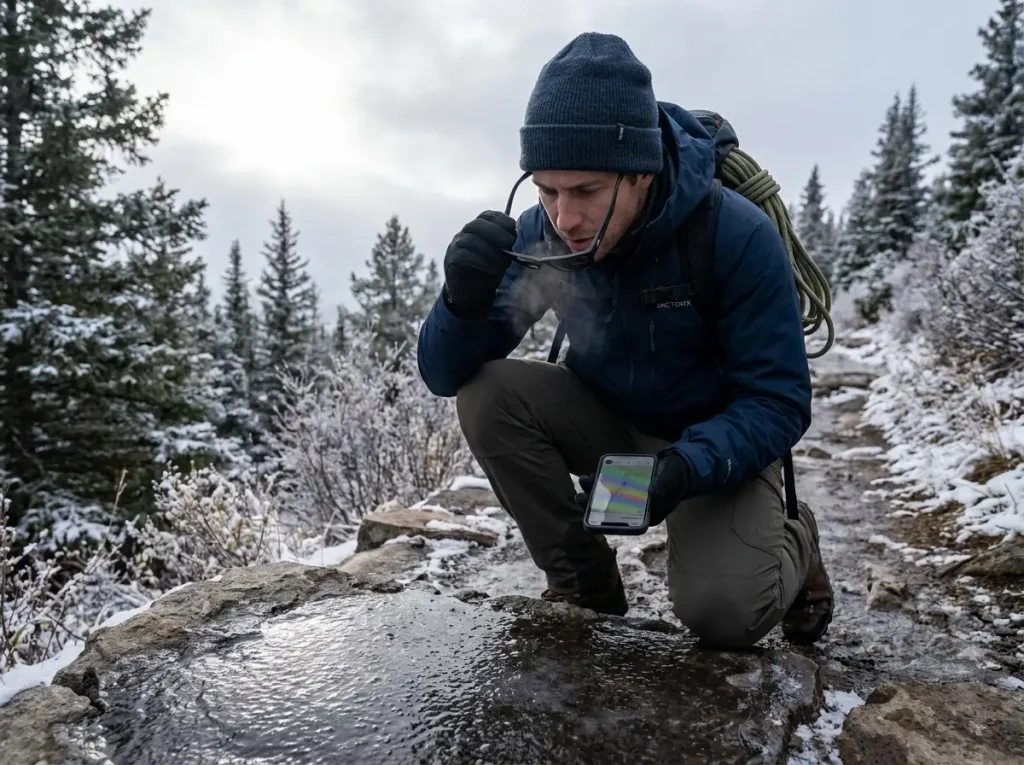
Polarized lenses solve glare; they create other problems. The short list of conditions where you should either remove them or carry a non-polarized backup:
Icy trails and frozen water crossings. Polarization cancels the surface-sheen signal that naked eyes use to spot thin ice. In early-winter conditions — especially during shoulder-season hiking when ice forms unpredictably on granite slabs and creek crossings — this matters. This is not a theoretical risk; it’s the same physics that makes ice harder to see on windshields through polarized visors. If you’re hiking early-season alpine terrain where ice detection is part of the go/no-go decision framework, carry a non-polarized backup.
LCD and smartphone screens. Polarized lenses rotated against a smartphone’s own polarization layer produce blackout or rainbow-banded artifacts. On a navigation-critical trail — one where the GPS on your phone is the difference between staying on-route and taking an unplanned bushwhack — this is a real usability issue. Fix: lift the glasses when checking the screen, or choose a display rotation where the panel goes clear.
Low-light forest or dawn/dusk conditions. A Cat 3 polarized lens cuts too much light in dim conditions. If your hike starts pre-dawn or runs into twilight, either carry a lighter Cat 1-2 option or consider photochromic variants (like the Julbo REACTIV lineup) that auto-adjust.
High-altitude aviation awareness (for hikers who glance at aircraft or weather). Polarization can mask aircraft wing flex and cloud-detail transitions that help forecast incoming weather. Minor issue for most, relevant for backcountry pilots and advanced trip planners.
Warranty and Long-Term Value
Warranty policy is where affordable and premium separate in practice. Over a decade of hiking, a $150 pair with lifetime coverage often costs less than three $35 pairs replaced every 18 months.
- Smith Lowdown 2: lifetime limited warranty against manufacturing defects; lens replacement available at cost.
- Knockaround Fast Lanes: 1-year limited warranty on frame and lens defects.
- Costa Fantail 580G: limited lifetime warranty — lens replacement program through Costa.
- Julbo Explorer 2.0: lifetime warranty on frame defects; photochromic film durability covered for several years.
- Oakley Flak 2.0 XL: 2-year manufacturer warranty against defects.
- Maui Jim Wailua: 2-year manufacturer warranty plus fee-based lens replacement program.
The numerical read: Smith, Costa, and Julbo offer the best long-term math. Oakley’s 2-year is competitive but shorter than expected at the price. Knockaround is a 1-year warranty on a sub-$35 product — that’s an honest match between coverage and price.
Conclusion
Three takeaways that should drive your choice:
Match UV rating to terrain, not marketing. UV400 is the minimum standard. Cat 3 VLT works for most hiking; Cat 4 is non-negotiable above treeline or on snow. The Julbo Explorer 2.0 is the only pick here with genuine alpine-grade protection — everyone else is Cat 2-3 territory.
Match lens material to your use profile. Glass (Costa Fantail) wins on optics and lasts a decade. Polycarbonate (Knockaround, Oakley) wins on impact and weight. Composite (Smith, Maui Jim) splits the difference. None is objectively best — the question is what you’ll do to the glasses.
Match your specific needs to the recommendations above. The Smith Lowdown 2 serves most hikers who want one pair for everything. The Knockaround Fast Lanes earn their slot for anyone who refuses to spend premium on gear that gets lost or sat on. The Costa Fantail is for long high-glare days where optical quality pays back daily. The Julbo Explorer 2.0 is alpine-specific — don’t overbuy, don’t underbuy. The Oakley Flak 2.0 XL is the sport-wrap answer if the fit works for your face. The Maui Jim Wailua closes the list for the gram-counters.
Q1 Are polarized sunglasses better for hiking?
Polarized sunglasses reduce glare from reflective surfaces like wet rock, water, and shallow snow, lowering eye strain on long days and improving trail visibility. They’re worth it for most hiking — the exception is icy or frozen-surface terrain where polarization can hide ice sheen that naked eyes detect. Always carry UV400.
Q2 Do I need UV400 for day hiking, or is UV380 enough?
UV400 is the minimum standard for day hiking at any elevation. UV380 leaves the top slice of the UVA spectrum unfiltered — UVA penetrates deeper into the eye than UVB and contributes to cataracts. The $5-$10 price gap between UV380 and UV400 lenses is never worth the exposure gap.
Q3 Can I wear polarized sunglasses on snow or glacier?
Polarized sunglasses work on snow and glacier, but only if the lens is also Category 4 (3-8% VLT) with side shields to block peripheral UV. Standard Cat 3 polarized lenses let through too much reflected UV. The Julbo Explorer 2.0 is the reference pick for this — most hiking sunglasses are not enough for sustained snow travel.
Q4 What UV protection rating do I need at high altitude?
At high altitude, UV intensity increases roughly 10% per 1,000 meters of elevation gain, meaning a 3,000-meter peak receives about 30% more UV than sea level. Baseline: UV400 plus Category 4 VLT above treeline or on snow. Below treeline, UV400 with Cat 3 handles most alpine national park conditions.
Q5 Do expensive hiking sunglasses actually last longer?
Premium hiking sunglasses (Smith, Costa, Julbo) typically last 5-10+ years with lifetime warranty coverage, compared to 1-2 years for sub-$50 polycarbonate models. Over a decade, the math usually favors buying one premium pair over replacing four budget pairs — unless you routinely lose or damage glasses regardless of price.
Risk Disclaimer: Hiking, trekking, backpacking, and all related outdoor activities involve inherent
risks which may result in serious injury, illness, or death. The information provided on The Hiking Tribe is for
educational and informational purposes only. While we strive for accuracy, information on trails, gear, techniques,
and safety is not a substitute for your own best judgment and thorough preparation. Trail conditions, weather, and
other environmental factors change rapidly and may differ from what is described on this site. Always check with
official sources like park services for the most current alerts and conditions. Never undertake a hike beyond your
abilities and always be prepared for the unexpected. By using this website, you agree that you are solely
responsible for your own safety. Any reliance you place on our content is strictly at your own risk, and you assume
all liability for your actions and decisions in the outdoors. The Hiking Tribe and its authors will not be held
liable for any injury, damage, or loss sustained in connection with the use of the information herein.
Affiliate Disclosure: We are a participant in the Amazon Services LLC Associates Program, an
affiliate advertising program designed to provide a means for us to earn advertising fees by advertising and linking
to Amazon.com. As an Amazon Associate, we earn from qualifying purchases. We are also an official affiliate partner
of Black Diamond Equipment via the AvantLink network. If you click on a Black Diamond affiliate link and make a
purchase, we may earn a commission at no additional cost to you. We also participate in other affiliate programs and
may receive a commission on products purchased through our links. Additional terms are found in the terms of
service.