
In this article
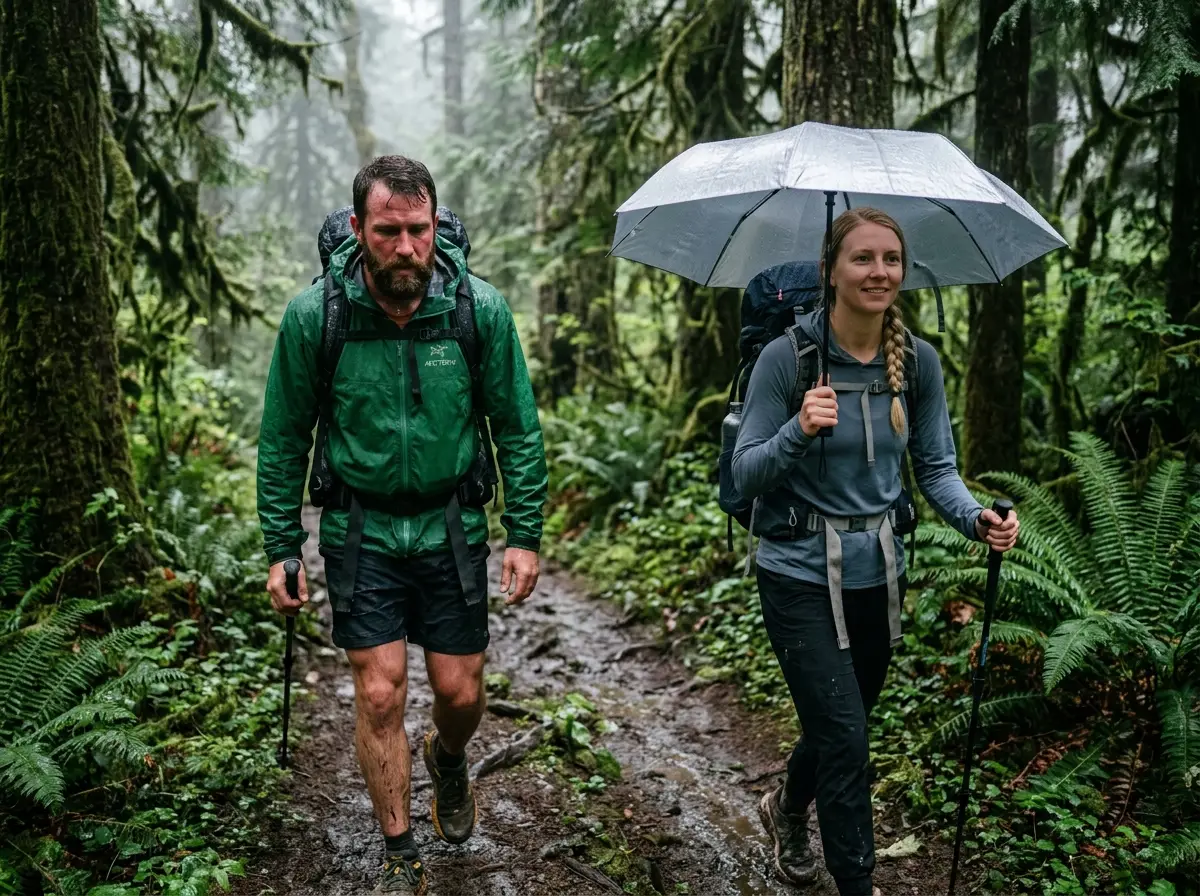
Four miles out on the Wonderland Trail, rain sheeting sideways off the flanks of Rainier, I watched the hiker twenty feet ahead of me walk completely dry and relaxed under a silver trekking umbrella. Pack straps soaked through, sweat pooling inside my $380 Gore-Tex shell, I had nothing—not a single argument left for the jacket I’d been loyal to for seven years. That moment cracked something. Not just my pride, but my entire framework for thinking about rain gear.
I’ve tested both systems across hundreds of miles in the Pacific Northwest, the Appalachian Trail, and Colorado’s high country. What follows isn’t a gear review. It’s an honest reckoning with the physics of staying dry when the physics have been working against you the whole time.
⚡ Quick Answer: On Class 1–2 trails in humid, low-wind environments, a trekking umbrella system—umbrella (7 oz) + wind shirt (3 oz) + rain kilt (2.5 oz)—outperforms a traditional shell system by nearly every metric: total weight (12.5 oz vs. 24 oz), thermal comfort, and physiological efficiency. The hard limits are wind (Beaufort Force 4 / ~15 mph) and technical terrain (Class 3+), where a waterproof-breathable shell is the only rational choice. Most hikers on most trails in most conditions would be better served by the umbrella. That’s not an opinion—it’s the physics.
| Rain Protection System Comparison | ||
|---|---|---|
| Factor | Umbrella System | Traditional Shell System |
| Total System Weight | 12.5 oz | 24 oz |
| Wind Limit | Beaufort 4 (~15 mph) | No hard limit |
| Breathability Failure Point | None (mechanical ventilation) | 100% external humidity |
| Optimal Terrain | Class 1–2 (maintained trails) | Class 3+ (scrambling, exposed) |
| Heat Stress Risk | Low (open air gap) | High (greenhouse micro-climate) |
Why Rain Jackets Fail the Physics Test in Humid Conditions
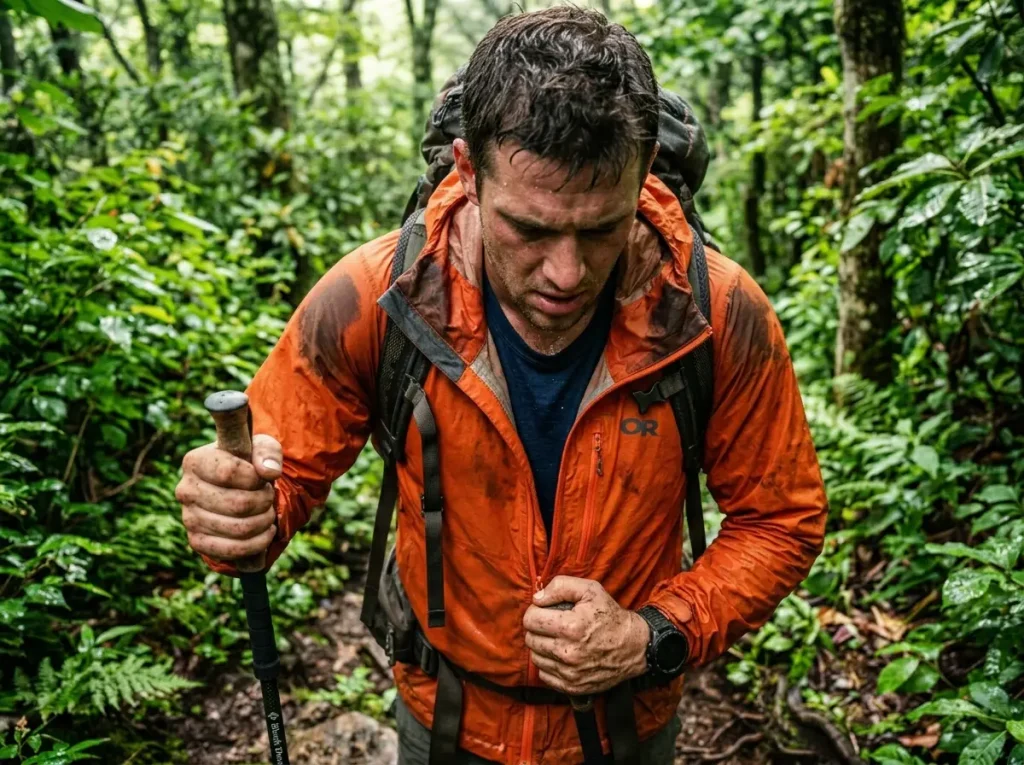
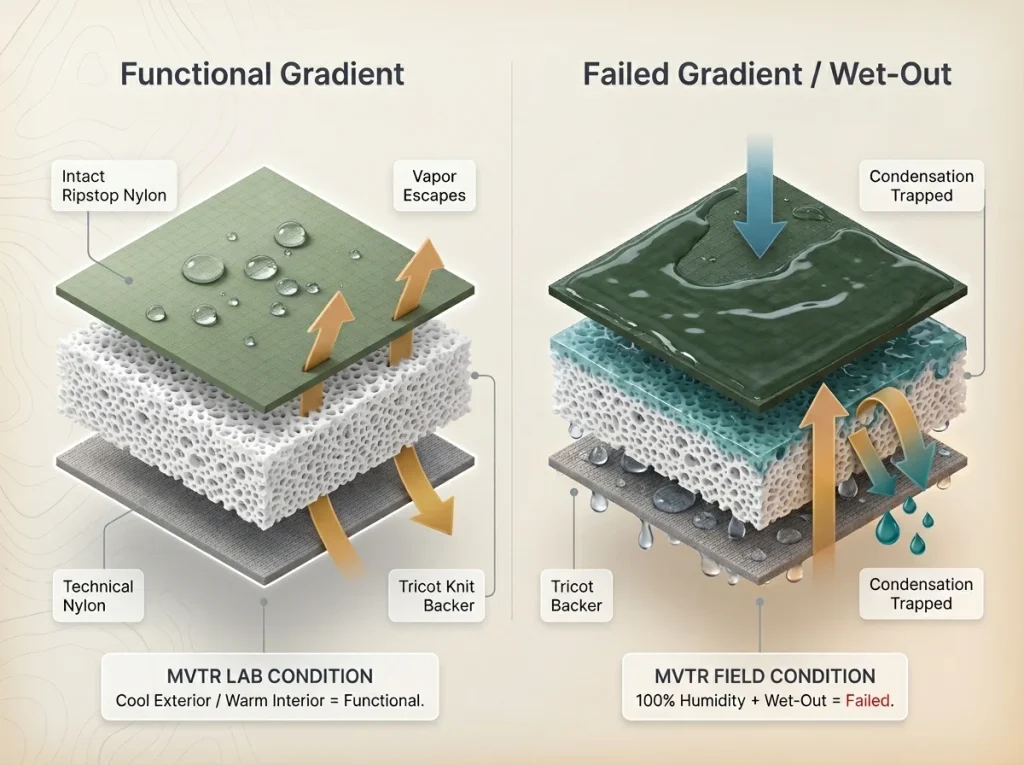
Here’s the thing no gear manufacturer will tell you plainly: a waterproof-breathable membrane (Gore-Tex, eVent, Pertex Shield) only breathes when the outside air is drier and cooler than the inside. That’s it. That’s the whole system. When you’re hiking at 3 mph with a 30-pound pack through a Pacific Northwest forest in July—where ambient humidity is sitting at 100% and rain is cooling the exterior of your shell—the vapor pressure gradient collapses completely. Your sweat has nowhere to go. It condenses on the interior of the jacket.
Philip Werner of SectionHiker.com put it plainly: “The harsh reality is that you’re probably going to get damp inside with any rain jacket.” He’s being diplomatic. The damp usually arrives around mile 6 on a humid trail day, not mile 20. You’re sweating from the inside out, and the jacket is the reason.
The MVTR ratings (20,000–30,000 g/m²/24h) you see on gear tags are measured in still air under controlled lab conditions. In real rain, once the face fabric wets out, effective breathability drops toward zero. As the USDA Forest Service hypothermia guidance notes, wet clothing loses approximately 90% of its insulating value—so this isn’t a comfort issue. It’s a safety issue. If this sounds familiar, it’s the same breathability trade-off that plagues Gore-Tex footwear on wet trails.
Pro tip: Breathe on the inside of your jacket’s forearm in the field. If the interior fogs immediately, external humidity is high enough that the membrane is doing nothing for you. You’re wearing a heated tent.
The Vapor Pressure Gradient — How the Shell Actually Works
WPB membrane pores measure around 9 microns—too small for liquid water droplets, large enough for vapor molecules. At rest in light rain on a cool day, this works. The body produces limited metabolic heat, the exterior stays relatively dry, and vapor migrates outward.
Push that same jacket onto a hiker moving at a sustained trail pace with a loaded pack? Metabolic output spikes. The interior fills with warm, humid air. Rain cools the exterior surface below the dew point of the inside air. Vapor hits the cold membrane and condenses back into liquid. The jacket isn’t failing—it’s doing exactly what thermodynamics forces it to do.
Once you understand this, you stop blaming budget jackets. The problem isn’t price. It’s physics.
DWR Wet-Out — The Silent Hazard of Shell Performance
The DWR coating—the chemistry that makes water bead and roll off the face fabric—takes a beating from backpack shoulder straps, hip belt contact, and body oils. Once it fails, the face fabric “wets out”: it goes dark, stays saturated, and physically seals the membrane pores with a continuous water film.
Modern PFAS-free DWR treatments (C6 chemistry) wet out faster than the legacy C8 fluorocarbon coatings they replaced. A $350 jacket with dead DWR performs identically to a $30 rain poncho. Not worse. Exactly the same.
One quick field test: drape a soaked shell over a warm camp mug lid for five minutes. The residual heat can reactivate dying DWR in the short term—not a permanent fix, but it buys hours on a wet day when you need them. Not sure if your DWR is dead? Run the 3 field tests to diagnose DWR failure before your next trip.
The 30,000 MVTR Marketing Problem
MVTR tests (ISO 11092) use still air, upright cups, and controlled lab conditions. No rain contact. No backpack compression. No moving body. The number that gets printed on the hangtag is technically accurate for a mannequin standing still in a humidity-controlled warehouse.
The more honest metric is CFM (Cubic Feet per Minute), which measures actual airflow through fabric. An 80 CFM wind shirt ventilates better in motion than any sealed WPB membrane in rain. Most gear reviews don’t mention CFM. That tells you something.
The Trekking Umbrella — Mechanical Ventilation vs. Passive Diffusion
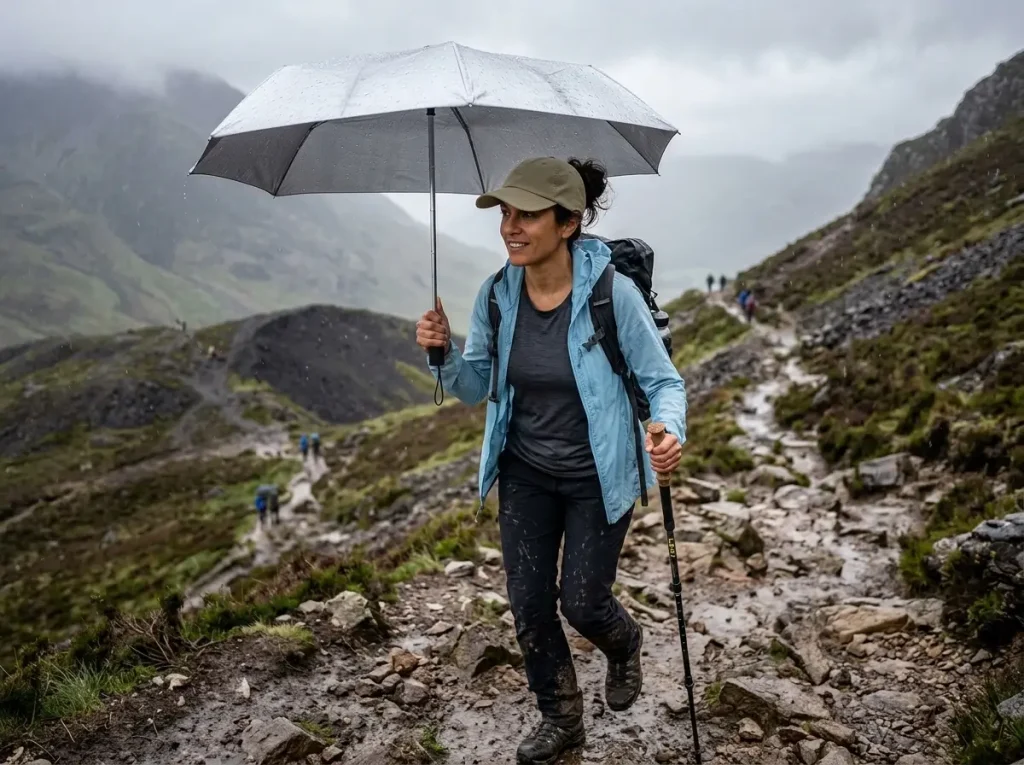
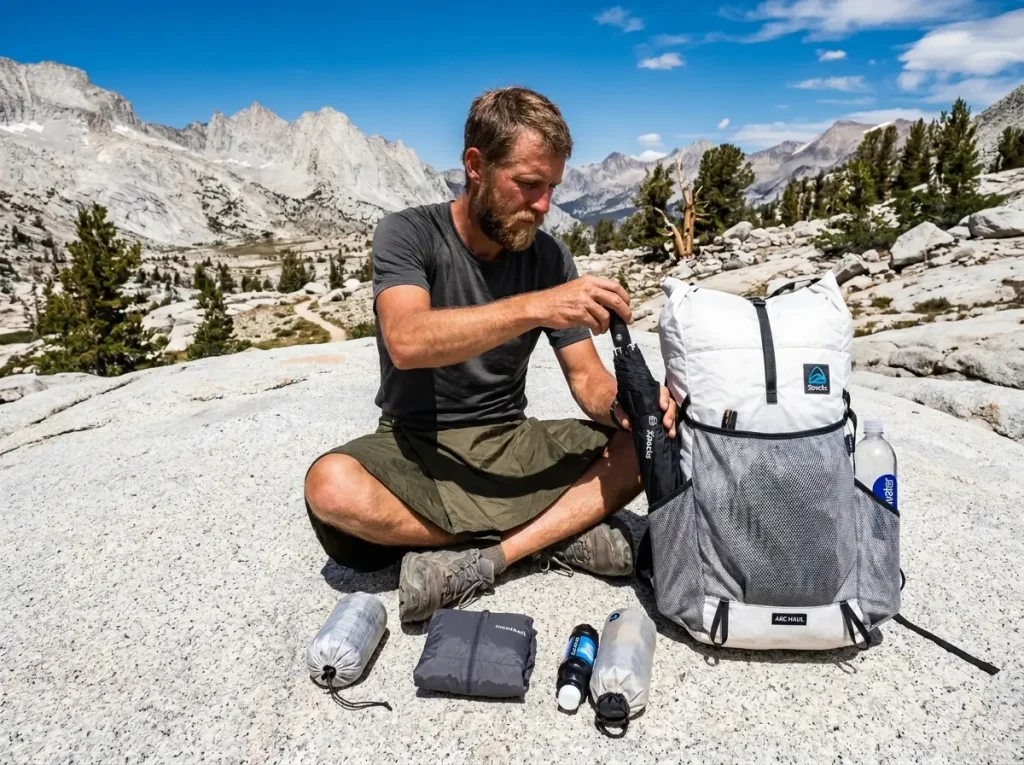
The umbrella isn’t a gimmick. It’s a structurally different answer to a different problem. Instead of trying to push vapor through a membrane under unfavorable conditions, it creates a mechanical ventilation system: a physical air gap between you and the rain. Convective airflow moves freely over your torso, shoulders, and head. Sweat evaporates because it has open air to evaporate into.
Andrew Skurka, who has logged thousands of backcountry miles, wrote: “In the mild temps, moderate humidity, and calm air at the trailhead, we were jealous of the airy umbrella.” Several thru-hikers on the AT report that the umbrella allowed them to keep a wind shirt unzipped or eliminate it entirely, running cooler in humid forest conditions than any shell-wearing hiker nearby.
The canopy hydrostatic head on a quality trekking umbrella (1,000–1,500 mm HH) handles vertical precipitation easily. Where it fails is wind-driven rain—and we’ll cover that threshold precisely. Silver and chrome canopies (Six Moon Designs Silver Shadow, GG Lightrek Chrome) lower the temperature beneath the canopy by 10–15°F, adding a UV shield that functions as sun protection on summer and high-altitude approaches. When paired with wind shirts that pair with umbrellas in the Umbrella System, the setup becomes a complete ventilation platform.
Pro tip: Slightly angle the umbrella into the wind rather than holding it vertical. The canopy edge catches moving air and accelerates the flow beneath it. More air movement under the umbrella means more sweat evaporation—exactly what a WPB shell can’t provide in the same conditions.
How the Air Gap Actually Works
The body cools itself through evaporative cooling—sweat evaporating from the skin surface. For that to work, air has to move across the skin. A sealed shell traps a humid micro-climate against your body, saturating it. The umbrella’s ~2-inch air gap is enough to maintain convective heat transfer and continuous evaporation on all but the most still, heavily humid days.
In light-to-moderate wind (Beaufort 1–3), airflow through the gap becomes active. You’re running your own personal HVAC system at zero weight penalty beyond the umbrella itself. Paul “BigTex” Bunker, a long-distance thru-hiker, summarized it: “Wearing rain gear is often more about psychological projection than actual protection because the hiker ends up wet from sweat regardless.”
There’s also a side benefit nobody writes about. In a trail town mid-summer, watching hikers peel off soaking rain jackets in the grocery store while the umbrella hiker walks in bone dry—that’s not anecdote. That’s the air gap doing what no membrane can match in those conditions. The “Mary Poppins” stigma fades fast once you’ve seen it in action.
Trekking Umbrella Materials and What They Actually Mean
Carbon fiber shafts save 1–2 oz over aluminum but fail in a way you don’t want to experience in the field—they snap rather than bend. In an alpine wind gust, a snapped carbon shaft leaves you without shelter at the worst possible moment. Aluminum shafts are ductile; they deform under load, which means you get a warning before failure. Fiberglass ribs can absorb inversion forces without splintering—important in gusts.
Handle the shaft before buying. Grip the umbrella at the handle and push the shaft sideways with two fingers. A quality trekking umbrella shows no lateral flex at the ferrule joint. Any wobble means it won’t hold in a sustained wind, regardless of the marketing language on the hang tag.
The “brolly” crowd—international thru-hikers who’ve been carrying them for decades—will tell you the same thing: canopy diameter matters as much as weight. A 41-inch canopy covers pack and torso on most hikers. A 36-inch canopy covers only the hiker. Verify diameter before purchase.
The Six Models Worth Knowing
| Backpacking Umbrella Comparison | ||||
|---|---|---|---|---|
| Model | Weight | Shaft | Canopy | Best For |
| Six Moon Designs Silver Shadow | 6.8 oz | Carbon | 46″ | Ultralight long-distance |
| Gossamer Gear Lightrek | 6.3 oz | Aluminum | 41″ | Durability, wind flex |
| Montbell UL Trekking | 4.3 oz | Carbon | 38″ | Emergency backup only |
| EuroSchirm Swing Liteflex | 7.4 oz | Fiberglass | 42″ | Durability, automatic open |
| Zpacks Lotus | 8 oz | Carbon | 48″ | Maximum coverage |
The Weight Math — Where the Umbrella Actually Wins
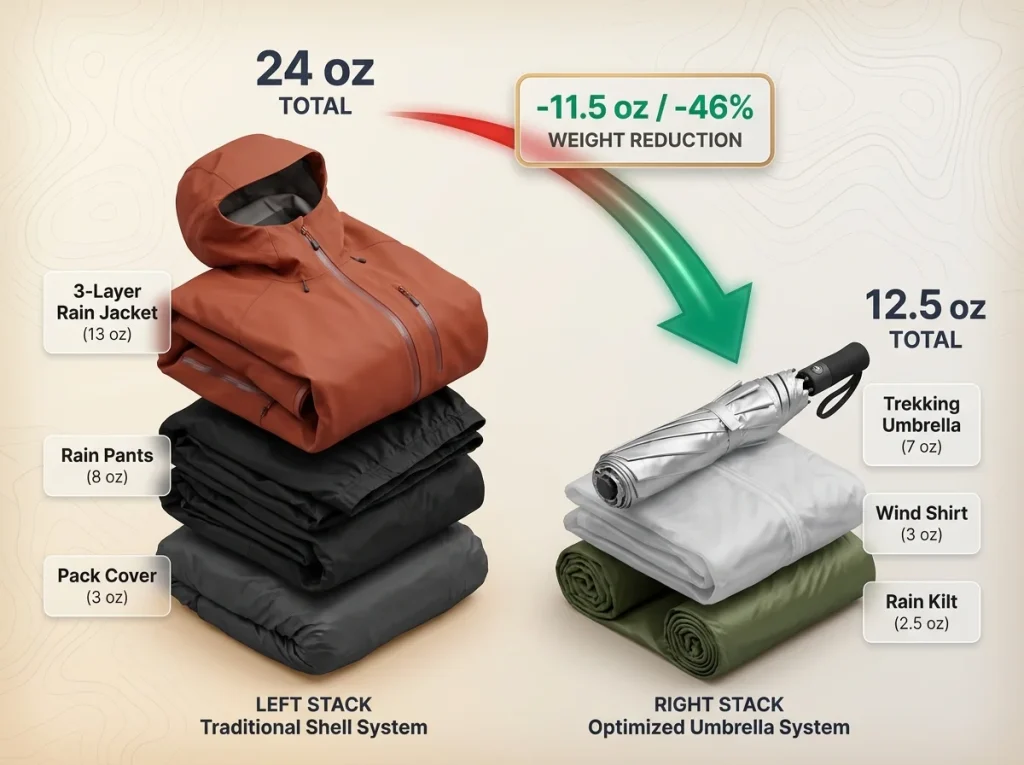
Traditional Shell System: 3-layer jacket (13 oz) + rain pants (8 oz) + pack cover (3 oz) = 24 total ounces.
Optimized Umbrella System: trekking umbrella (7 oz) + wind shirt (3 oz) + rain kilt (2.5 oz) = 12.5 total ounces.
That’s 11.5 oz saved—a 46% reduction in total rain system weight. Nearly the weight of a water filter. Competitors compare jacket weight to umbrella weight in isolation and wonder where the math goes wrong. The math goes wrong when you forget the rain pants and pack cover the jacket system requires.
The wind shirt in the umbrella system isn’t dead weight. It doubles as camp insulation, replaces a fleece layer on cool mornings, and provides cold-start warmth on every approach. The rain kilt (silnylon, 2.5 oz) covers lower body in steady rain and rolls into a shirt pocket. Neither item is one-dimensional.
The weight difference doesn’t hit you in the parking lot. You notice it at mile 18 when your calves still feel like legs, not sandbags. To see how this shifts your total carry, run the numbers through the base weight vs. pack weight framework and recalculate your Big 3.
What the Umbrella Replaces (and What It Doesn’t)
The umbrella eliminates rain pants (when paired with a rain kilt on Class 1–2 terrain), the pack cover (a correctly positioned umbrella shelters the hiker and pack together), and the mental overhead of managing a hot, sticky shell.
What it does not replace: wind protection (the wind shirt handles this), waterproof lower body coverage in driving sideways rain (a kilt with a cinched hem handles most of it), and hypothermia protection in sustained wind-driven conditions. Below 50°F, wet legs become a hypothermia vector. The umbrella handles the most common rain scenario well. It doesn’t handle every scenario. That distinction matters.
The Hybrid Setup — Umbrella Plus Shell (The Pro Trekker Method)
Carry a 6–7 oz umbrella for 90% of rain events and sun protection. Stow a 6 oz minimalist shell (OR Helium, Arc’teryx Atom SL) in the top lid for emergencies. Total hybrid system: ~13 oz. You don’t need a $400 3-layer jacket as backup. You need something windproof that you can deploy in 30 seconds at the ridge when the weather turns. A $100 2.5-layer is enough for under 2 hours of emergency use.
Keep that emergency shell in the brain, not the bottom of the main compartment. Knowing you can grab it without stopping to unpack is what makes the system work. See the full tradeoffs at packable rain jacket tradeoffs when choosing your backup shell.
Wind, Terrain, and the Beaufort Limit — Where Umbrellas Break Down
This is the section umbrella advocates skip. I’m not going to.
Beaufort 0–2 (0–5 mph): Maximum utility. Hands-free systems work. Ventilation benefit is highest. This is where the umbrella makes you look effortlessly prepared while everyone in a rain jacket looks like a sweaty mess.
Beaufort 3–4 (10–15 mph): The umbrella must be held and tilted into the wind. Hands-free systems become unstable. You start fighting the canopy rather than hiking. The energy cost creeps up.
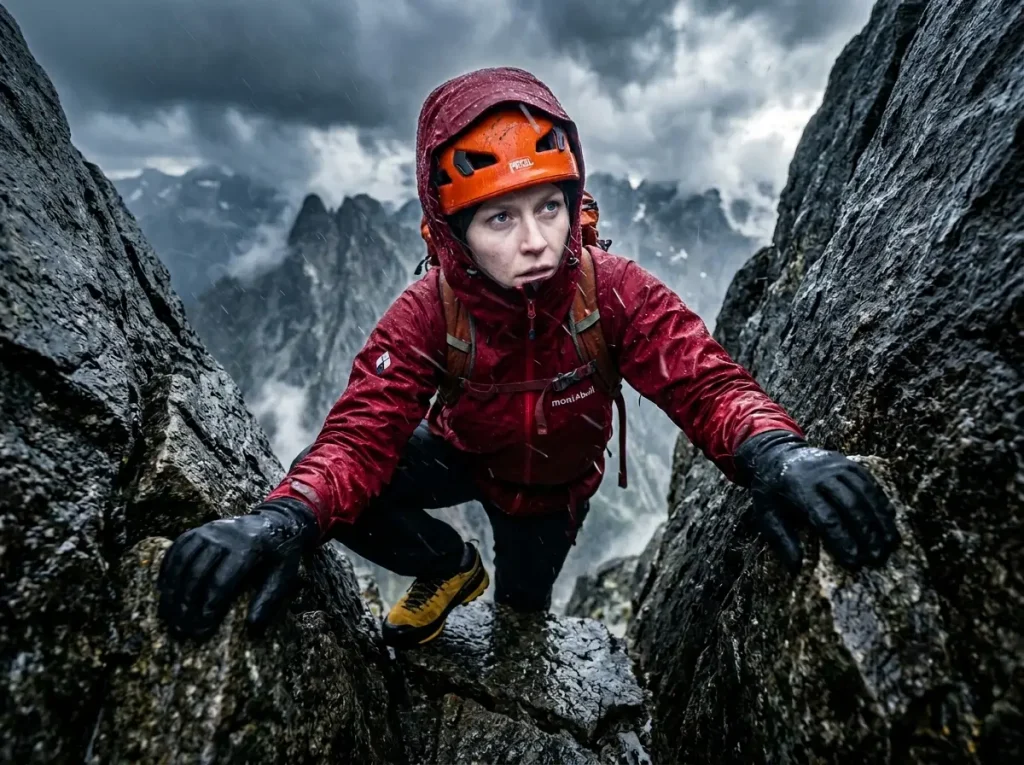
Beaufort 4+ (>15 mph): Structural failure territory. Carbon shafts snap. Aluminum shafts bend. Fiberglass ribs invert. In high-alpine gusts, the canopy becomes a sail that can pull you off balance on wet scree or an exposed traverse. I’ve watched experienced thru-hikers go down in exactly this situation. The same weight carried as a shell would have kept them upright.
Per NOAA’s Beaufort Wind Force Scale, Force 4 corresponds to 11–16 mph and creates small waves and disturbs light branches. When you see branches moving with purpose, the umbrella goes back on the pack.
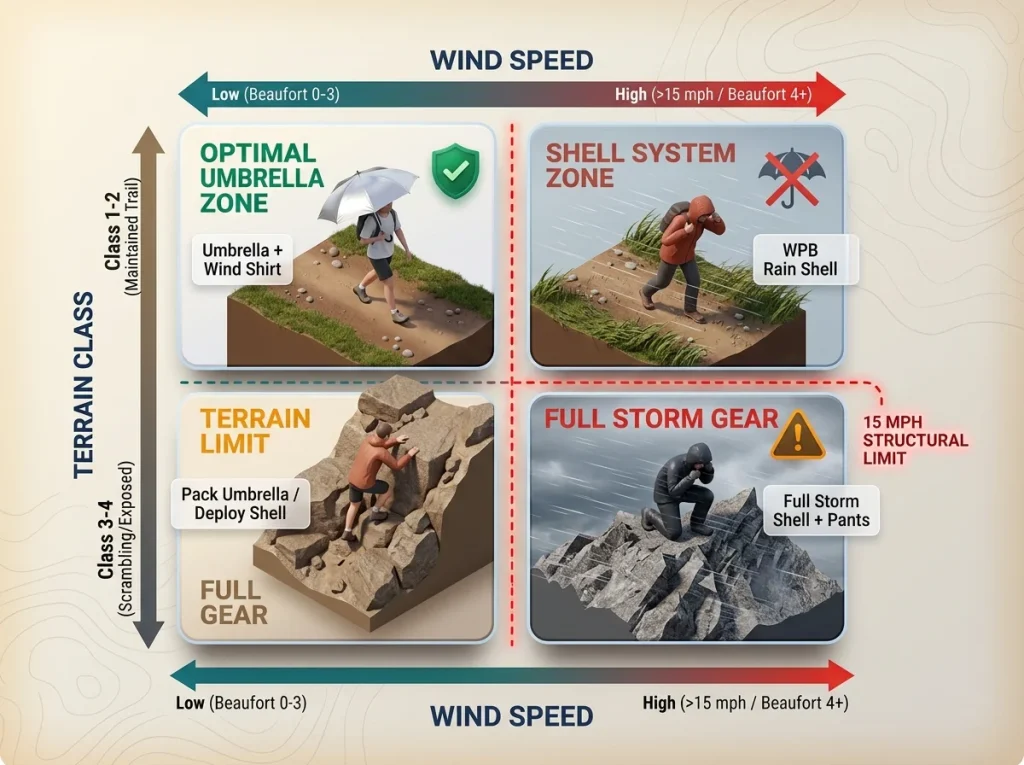
Beyond wind, terrain is the other hard limit. Once you’re in the Yosemite Decimal System terrain classes where umbrellas become a liability—Class 3 and above, requiring hands for stability—the umbrella is physically incompatible with safe movement. Even a hands-free rigged umbrella snagged to a shoulder strap will catch on rock features and obstruct your sightline to foot placements. And don’t take an umbrella into thick brush or catclaw—the canopy will last about a quarter mile.
The Safety Matrix — When to Abandon the Umbrella and Deploy the Shell
The critical variable isn’t rain intensity. It’s wind direction.
A downpour with zero wind is an umbrella condition. Light mist with 20 mph gusts is a shell condition. That reframe solves most of the confusion people have about this system. Apply it simply: low wind, warm rain → umbrella. Low wind, cold rain → umbrella plus wind shirt with the collar up. High wind, any rain → shell. High-alpine sustained storm → shell plus rain pants, full stop, regardless of preference.
Pro tip: If your umbrella arm is fighting the wind more than 50% of the time—checking, correcting, reanchoring—stow it and pull the shell. The energy you burn fighting the umbrella costs more than the comfort it provides. Your body knows when the math is wrong.
Hands-Free Rigging — DIY vs. Manufacturer Systems
The DIY bungee method is more stable than most OEM attachment kits. Two 12-inch bungee cords from any hardware store (~$3 total), threaded through the D-rings on both shoulder straps, clipped around the umbrella shaft angled 15–20° forward. User-adjustable tension means you can tune it for your specific pack geometry and wind conditions.
Thread through both shoulder strap loops, not just one. Single-point attachment rotates under load. Two-point attachment holds the shaft angle and keeps it from swinging on descent. Test it at 5–10 mph before you trust it at 12. This is the same hands-free system that serious ultralight backpackers have refined over decades—and a $3 hardware store solution usually wins over the $30 manufacturer kit.
Heat, Sweat, and the Physiological Case for the Umbrella
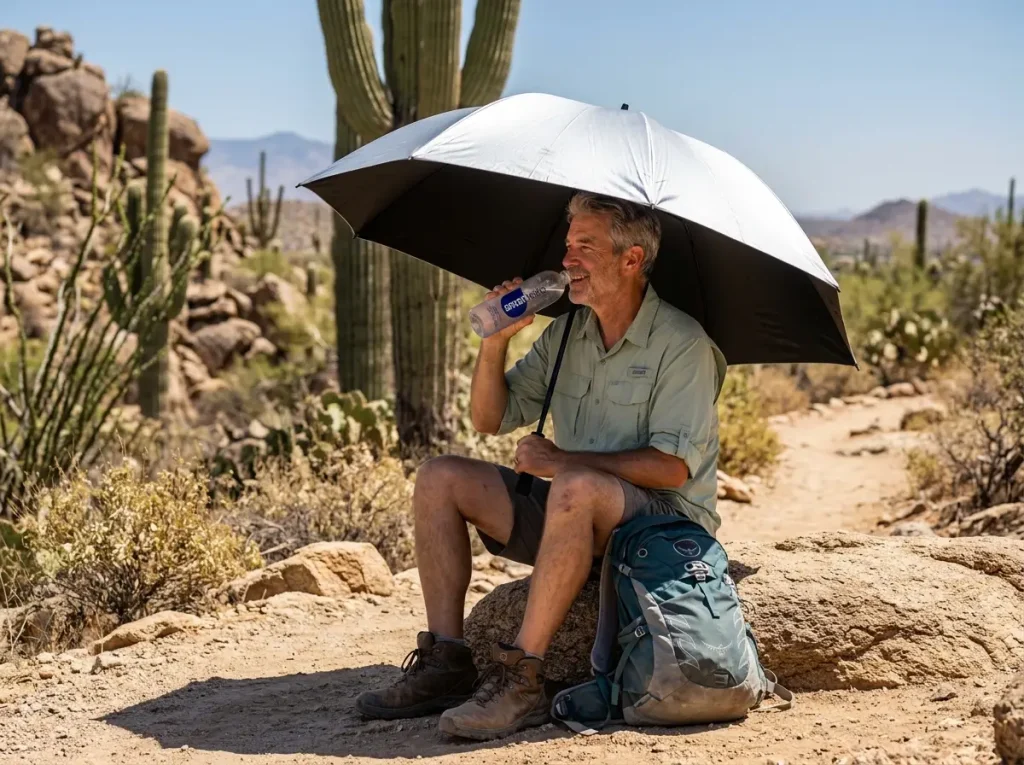
In warm, wet conditions—>70°F, >80% humidity—this stops being a gear debate and becomes a physiology discussion. A sealed rain jacket creates a “greenhouse micro-climate” against your skin. Core temperature rises. Heart rate climbs. Perceived exertion spikes. You sweat harder, which the jacket cannot remove, which raises temperature further. It’s a feedback loop with one exit: take the jacket off.
OSHA’s physiological data on heat stress in protective equipment shows that subjects in occlusive protective barriers experienced a Wet Bulb Globe Temperature (WBGT) safety threshold approximately 9°C lower than subjects in ventilated systems. Nine degrees is not a rounding error. For hikers, this means the jacket triggers heat stress—fatigue, elevated heart rate, dehydration—at ambient temperatures where the umbrella user is still comfortable.
Watch for the heat exhaustion symptoms that manifest when rain jackets create core overheating on humid trail days. The umbrella eliminates the primary cause.
The UPF Dual-Use Argument — Rain and Sun in One System
Silver reflective canopies carry UPF 50+ ratings and reflect UV radiation as well as infrared heat. The thermal benefit exceeds standard shade by roughly 30% compared to a non-reflective canopy of the same diameter—the silver coating is doing work that shadow alone doesn’t do.
On high-altitude approaches or desert traverses where sun is a secondary hazard, the UL trekking umbrella with a chrome or silver canopy eliminates the need for a separate sun hat, reduces water requirements, and extends the comfort window of base sun hoodies into stronger UV conditions. For more on how UPF ratings work in outdoor fabrics, the principles apply directly to umbrella canopy selection.
Hypothermia Prevention — When the Umbrella Saves (and When the Shell Saves)
Wet clothing loses ~90% of insulating value. That’s not a statistic to gloss over—it’s the reason people develop hypothermia in conditions most hikers would call “mild.” Hypothermia onset at 40°F with saturated base layers can begin within 30–60 minutes at trail pace.
The umbrella prevents base layer saturation from external rain. That’s the entire hypothermia prevention argument for steady vertical rain conditions, moderate temperatures, sustained exertion—which describes the most common hypothermia scenario on popular trails. The shell does the same job when wind-driven horizontal rain makes the air gap irrelevant.
In marginal conditions—45–55°F, steady rain, no significant wind—an umbrella over a wool base layer is the most effective hypothermia prevention setup per ounce. You’re keeping your insulation dry without adding any metabolic heat load. The shell generates heat that the humid air traps. The umbrella keeps the wool dry without raising your core temperature.
If prevention fails, know the hypothermia treatment protocol if prevention fails on the trail before you need it. Field treatment without that knowledge is improvised and unreliable.
Conclusion
Three things worth taking onto the trail with you.
The shell doesn’t breathe in the rain. When external humidity hits 100%, no MVTR rating on any jacket functions as advertised. The vapor pressure gradient isn’t optional physics—it’s the system. You’re paying for a performance that stops working at exactly the moment you need it most.
The umbrella wins the weight math cold. An Umbrella System (umbrella + wind shirt + rain kilt) at 12.5 oz vs. a Traditional Shell System at 24 oz isn’t a close comparison—it’s 46% less weight covering the same precipitation needs on Class 1–2 terrain. That’s not an upgrade. That’s a different category.
Know your Beaufort limit. Above 15 mph and Class 3 terrain, stow the umbrella and pull the shell. Not because the umbrella is a bad tool—it’s an excellent one. Because it was never designed for that situation, and pretending otherwise is how people get hurt.
Go back to your rain jacket. Hold it at arm’s length and pour a water bottle over the shoulder fabric. If it soaks in rather than beading off, your DWR is dead and you’ve been hiking in an expensive plastic bag. Fix that first—umbrella or not.
FAQ
Is a trekking umbrella worth it for hiking?
For Class 1–2 trails in humid, low-wind environments, yes—the umbrella system outperforms a traditional rain shell by weight, thermal comfort, and physiological efficiency. It replaces the rain jacket, rain pants, and pack cover at roughly half the combined weight. The hard limits are the Beaufort 4 wind threshold (~15 mph) and Class 3+ technical terrain where hands are needed for movement.
Can you use a normal umbrella for hiking?
A consumer umbrella is structurally wrong for trail use: heavy plastic shafts (8–14 oz), small canopy diameters (~32 inches), no tilt mechanism, and handle wobble that telegraphs every gust into your wrist. A purpose-built trekking umbrella like the SMD Silver Shadow or GG Lightrek is a different object entirely. The comparison is like asking if dress shoes work for trail running.
How do you carry an umbrella hands-free on a backpack?
Thread two 12-inch bungee cords through the D-rings on both shoulder straps and clip them around the umbrella shaft, angled 15–20° forward. Tune the tension until the umbrella holds steady in a 5–10 mph headwind without rotating. This costs $3 at a hardware store and outperforms most manufacturer attachment kits because the tension is adjustable for your pack and body geometry.
Is an umbrella better than a rain jacket for heat?
In warm, humid conditions (>70°F, >80% humidity), the umbrella is significantly more effective. The mechanical ventilation of the air gap prevents the greenhouse micro-climate that accelerates heat stress under a jacket. OSHA’s physiological data shows that occlusive barriers lower the safe thermal work limit by up to 9°C compared to ventilated systems. The umbrella avoids this entirely.
What wind speed is too high for a trekking umbrella?
The functional limit for carbon fiber and aluminum shaft umbrellas is approximately Beaufort Force 4 (~15 mph). Above this threshold, the canopy creates structural drag that stresses the shaft and compromises balance on rough terrain. Fiberglass rib models like the EuroSchirm Swing Liteflex handle inversion forces better, but no handheld umbrella is safe as a primary shelter above 20 mph in exposed conditions.
Risk Disclaimer: Hiking, trekking, backpacking, and all related outdoor activities involve inherent
risks which may result in serious injury, illness, or death. The information provided on The Hiking Tribe is for
educational and informational purposes only. While we strive for accuracy, information on trails, gear, techniques,
and safety is not a substitute for your own best judgment and thorough preparation. Trail conditions, weather, and
other environmental factors change rapidly and may differ from what is described on this site. Always check with
official sources like park services for the most current alerts and conditions. Never undertake a hike beyond your
abilities and always be prepared for the unexpected. By using this website, you agree that you are solely
responsible for your own safety. Any reliance you place on our content is strictly at your own risk, and you assume
all liability for your actions and decisions in the outdoors. The Hiking Tribe and its authors will not be held
liable for any injury, damage, or loss sustained in connection with the use of the information herein.
Affiliate Disclosure: We are a participant in the Amazon Services LLC Associates Program, an
affiliate advertising program designed to provide a means for us to earn advertising fees by advertising and linking
to Amazon.com. As an Amazon Associate, we earn from qualifying purchases. We are also an official affiliate partner
of Black Diamond Equipment via the AvantLink network. If you click on a Black Diamond affiliate link and make a
purchase, we may earn a commission at no additional cost to you. We also participate in other affiliate programs and
may receive a commission on products purchased through our links. Additional terms are found in the terms of
service.