

In this article
Ten miles into the descent from Mount Whitney, your knees start screaming with every single step. You glance down at your trusty, five-year-old boots—the rubber looks fine, and the leather remains perfectly intact. But beneath the surface, your midsoles have crumbled into dead powder, transmitting every shockwave straight up your legs. Knowing exactly when your hiking shoes are worn out isn’t about tracking arbitrary miles recorded on Strava or AllTrails. It’s about diagnosing invisible structural fatigue before a critical failure leaves you stranded. Using the field-proven the Press Test and a complete hiking boot autopsy, you’ll learn how to identify polymer breakdown, chemical rot, and alignment shifts before they sabotage your next trip.
⚡ Quick Answer: The most reliable way to tell if your hiking shoes are worn out is the Press Test—pushing your thumb hard into the center of the outsole. If the foam shows deep, permanent creases or feels like a hard brick, the shock-absorbing midsole is dead. Never rely solely on visual tread wear or the generic mileage rule, as materials like polyurethane can chemically rot in your closet without you ever taking a step.
| Component Lifespan and Failure Modes | |||
|---|---|---|---|
| Component | Material Type | Average Lifespan (Miles) | Primary Failure Mode |
| Outsole | Vibram / Rubber | 500 – 1,500 | Tread balding, rubber hardening |
| Midsole | EVA Foam | 300 – 500 | Compression pack-out |
| Midsole | PU (Polyurethane) | 800 – 2,000 | Chemical hydrolysis |
| Upper | Leather / Synthetic | 500 – 2,000 | Micro-tears, membrane failure |
| Insole | Open-cell foam | 100 – 300 | Total flattening |
The Biology of Boot Failure: Why Mileage Rules Lie
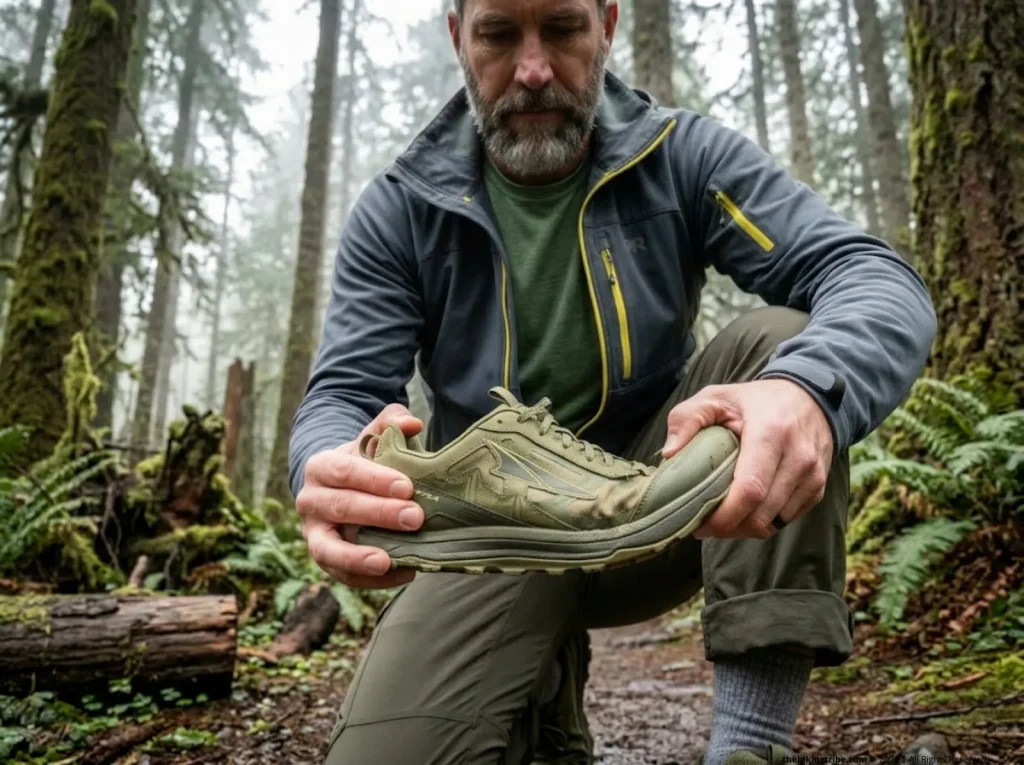
Tossing a pair of boots based purely on the mileage rule is a guessing game that costs you money and comfort. Chemical and structural failure happens completely independent of visible wear on the outside. Understanding hiking boot anatomy helps you separate cosmetic damage from a true safety hazard.
EVA Foam vs. Polyurethane Midsoles
Modern midsoles rely on one of two core materials: EVA foam or polyurethane. They operate under entirely different physical rules. Brands like Salomon and Merrell often use EVA to construct exceptionally lightweight trail runners and day hikers. This material is made of microscopic, gas-filled bubbles that provide an incredible, bouncy rebound. However, EVA degrades through mechanical compression. Every step crushes those bubbles slightly. After 300 to 500 miles, the foam loses its memory and densifies into a solid block, ending its midsole cushioning lifespan.
In contrast, heavy-duty trekking boots from companies like Lowa and Scarpa use PU midsoles. This dense synthetic plastic lasts over 1,000 miles and resists packing out. However, PU hides a structural weakness that catches many weekend hikers completely off guard.
The “Storage Death” Phenomenon (Hydrolysis)
If you wear a PU boot frequently, the physical compression pumps moisture out of the material. But if you leave those expensive boots sitting in a damp basement for three years, they suffer from hydrolysis. Water molecules invade the polymer chains, breaking them apart from the inside.
This creates chemical dry rot. You pull the boots out for a big trip, step onto the trail, and the whole sole crumbles into black powder within a mile. You cannot fix hydrolysis. The chemical death of the foam is irreversible.
Pro-Tip: Store your boots in a climate-controlled room, not a hot car trunk or a damp garage. Wearing them around town once a month keeps the foam flexible and delays hydrolysis.
How Pack Weight Accelerates Foam Densification
The heavy pack factor radically shifts how long your shoes survive. A 200-pound hiker carrying a 40-pound load will crush an EVA midsole much faster than a lighter hiker with a daypack. If you log your miles while carrying serious pack weight and heavy body weight, those lightweight foam cells will permanently flatten long before the treads rub off. This is why thru-hikers frequently adapt and swap their shoes completely every 400 miles. They know the cushioning dies long before the upper fabrics tear.
Executing The Press Test: Diagnosing Invisible Midsole Failure
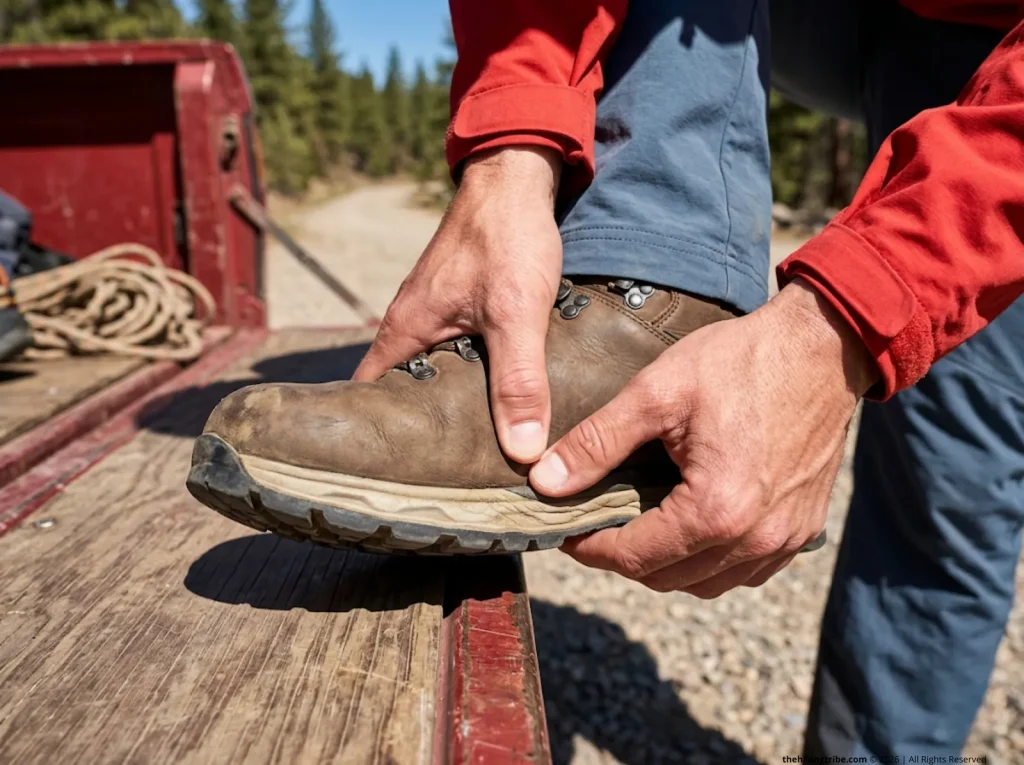
You cannot judge a boot just by staring at it on the floor. You need a highly actionable, tactile diagnostic check to measure its remaining elasticity. We call this the press and flex test, which evaluates how the foam rebounds under heavy pressure.
Preparing Your Boot for the Press Test
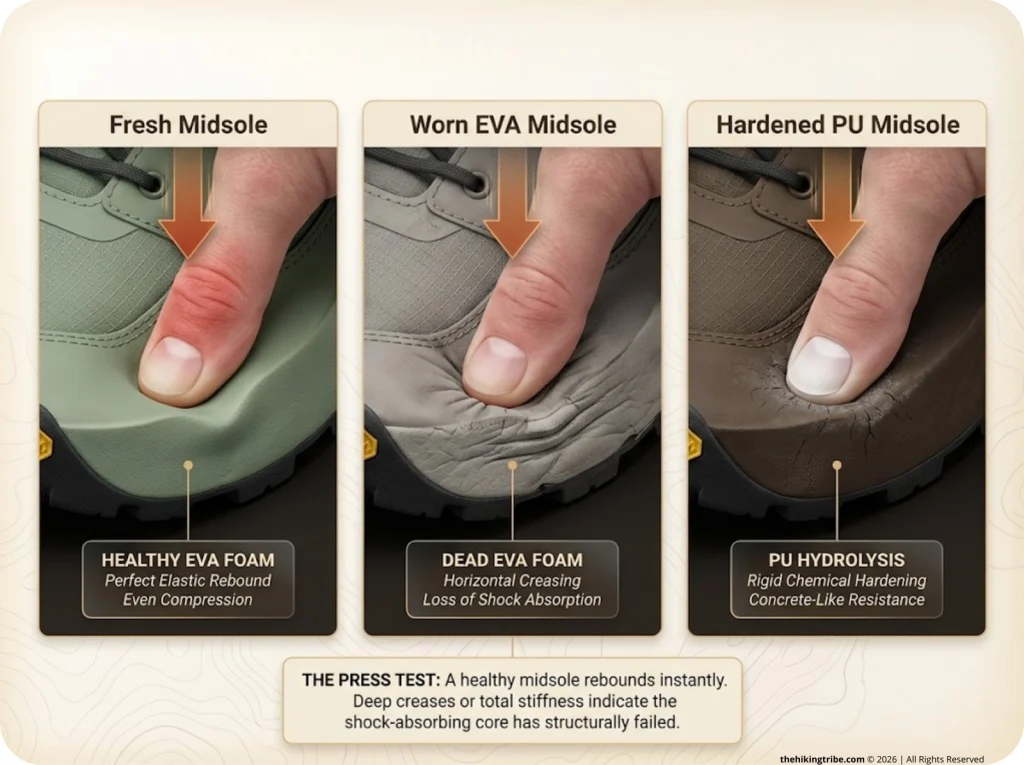
You want to simulate the hard impact of a heel strike. First, pull the removable insole completely out of the shoe. You need the rigid interior footbed to act as a solid backing floor. Next, grab the shoe firmly in both hands. Push your thumb aggressively upwards into the absolute center of the outsole, right where the ball of your foot strikes the ground. Press as hard as you can to flex that underlying foam layer.
The Deep-Crease Warning Sign
As you mash your thumb upward, watch the sidewall of the foam closely. A healthy foam layer will show tiny, temporary wrinkles that vanish the second you let go. But if you spot deep, permanent horizontal creases that linger after you remove the pressure, you have compressed midsoles. The material has densified to the point of failure. This simple check tells you when it is time to start proactively rotating hiking shoes so you avoid hitting the trail with dead gear.
What It Means When the Midsole Won’t Compress at All
Sometimes you press your thumb into the rubber and the foam feels like a concrete sidewalk. If it refuses to yield under heavy pressure, the polymer has chemically hardened. Old, baked foam loses its ability to absorb trail shock. Every single step you take from here on out will transfer that raw impact directly into your bones.
Outsole Degradation and Traction Failure
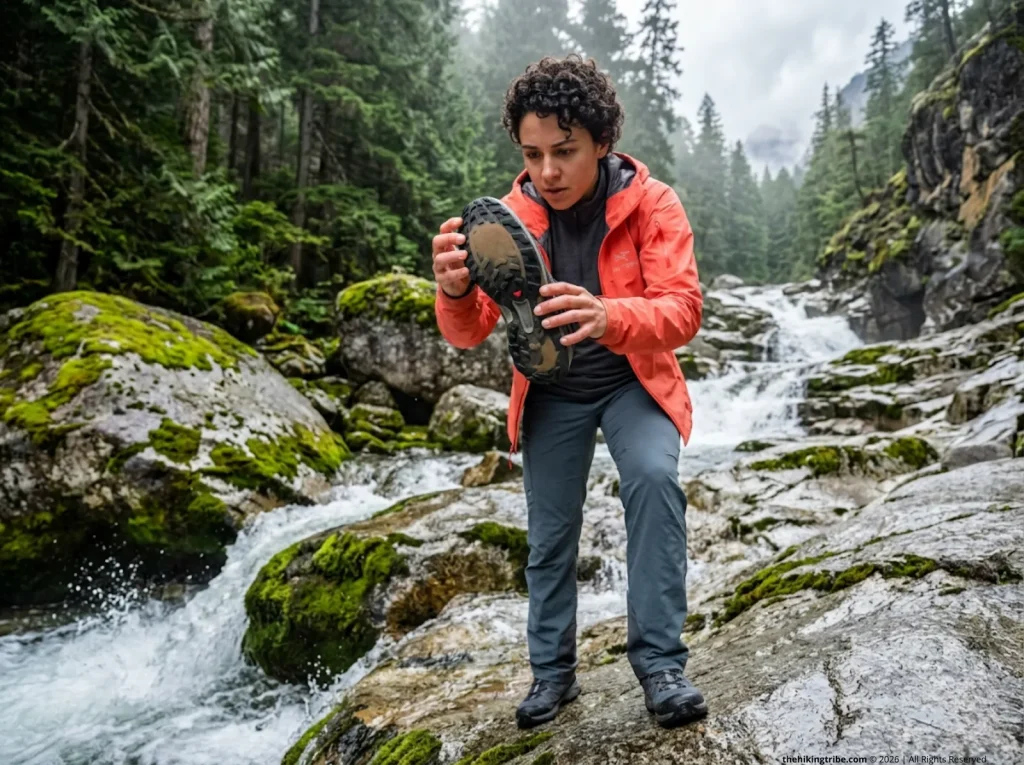
When the foam inside dies, you lose comfort. When the rubber outside dies, you risk a catastrophic fall. You need to routinely audit your worn outsoles for serious safety risk level indicators beyond just looking for a smooth spot.
The 3mm Lug Depth Rule
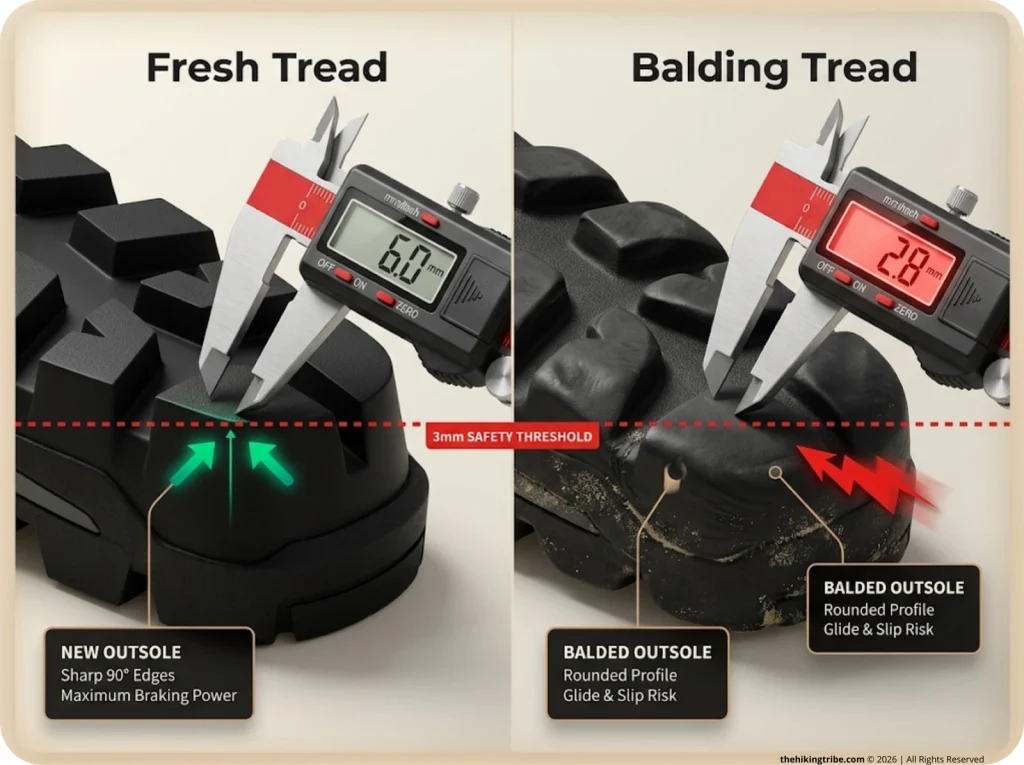
Technical terrain demands bite. An outsole tread depth holding less than three millimeters of rubber is a massive red flag. Those deep, chunky lugs act like shovel blades digging into loose dirt. When they wear down past that 3mm line, you severely compromise your physical braking ability. You will find yourself slipping uncontrollably during steep, loose descents.
The Fingernail Test for Chemical Hardening
Rubber chemically oxidizes over time, turning from a sticky compound into slick, hard plastic. Press the sharp edge of your thumbnail straight down into one of your Vibram outsoles. If your nail leaves a temporary indent, the compound remains healthy and grippy. If your nail slides off without making a mark, the rubber has plasticized. This hardened state turns wet granite slabs into ice skating rinks.
Danger Signs of Asymmetric Wear Patterns
Lay your boots flat on a level table and view them from behind. If one heel leans wildly to the side, you have asymmetric wear. Walking on warped platforms forces your ankles and knees to absorb constant torque. Worn treads like this aren’t just a loss of traction and grip; they act as a physical lever snapping your lower joints out of proper alignment. Understanding exactly what is a shank in a boot and how it handles twisting forces helps explain why a flat, even outsole is critical for staying upright.
Pro-Tip: Check the inside edge of your heel box. If the dark fabric of the interior heel lining is worn completely through to the white plastic backing, the boot will rapidly chew through your socks and generate massive heel blisters.
Assessing Upper Integrity and Hidden Structural Damage
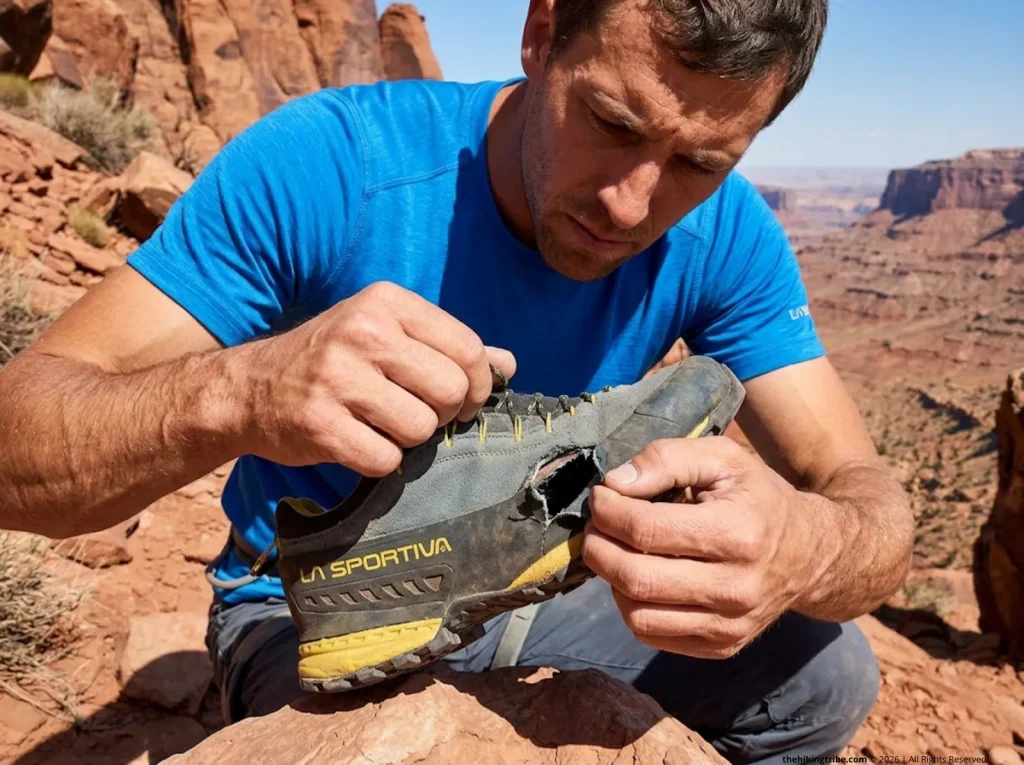
The upper fabric structure acts as the protective envelope keeping your foot locked in place. Countless thousands of bending cycles eventually break down even the toughest materials, compromising upper integrity in ways you can hear and feel before you actually see them.
The “Squeak Test” for Broken Shanks
The internal shank operates as a stiff spine running through the middle of the boot, providing crucial torsion resistance. When this stiff piece breaks or delaminates from the foam, it creates internal friction. Walk around your quiet living room and listen closely. A distinct clicking or rubbery sound with every step is the classic squeak test pointing directly to delaminated shanks. This hidden structural failure drastically limits your ability to safely scramble across uneven scree fields.
Diagnosing Failed Waterproof Membranes
You stomp through a morning meadow and suddenly feel that familiar, damp chill soaking your socks. Waterproofing effectiveness drops to zero the second your internal liner tears. At the major flex point right behind your toes, thousands of bends create micro-cracking in the Gore-Tex membranes or other waterproof liners. Those microscopic tears turn your expensive, waterproof fortress into a sponge. This forces a leaking shoe to hold moisture against your skin all day. It doesn’t matter if you decide on leather versus synthetic hiking boots; once the hidden liner shears inside, your dry days are over.
Collapsed Heel Counters and Ankle Support
The heel counter is the rigid cup surrounding the back of your foot. If you habitually step on the back of your boots to slide them off, you will crush this structural piece. A collapsed counter guarantees unstoppable heel slip and massive friction blisters. Similarly, pinch the foam padding around the ankle collar. If it feels mushy and offers zero resistance, the boot has permanently lost its ankle support rigidity. Your risk of a severe sprain skyrockets the moment that collar flattens out.
Biomechanical Red Flags: When Your Body Signals Failure

Sometimes the most accurate indicator of a dead shoe isn’t a torn stitch or a bald tread. It is your own body screaming at you. When your footwear fails, your muscles and joints instantly compensate for the missing support.
Kinetic Chain Compensation (Why Your Knees Hurt Lately)
You usually hike fifteen miles without a single ache, but suddenly you are swallowing ibuprofen at mile six. When the foam bottoms out, the dampening effect vanishes. Your body takes the full, raw impact of every step. This force rockets straight up your shins and into your knee joints, resulting in severe foot pain and sharp pain after hiking. Data from the National Institutes of Health shows that combining heavy pack weights with degraded, rigid footwear directly increases the prevalence of nerve tingling and lower-extremity pain among hikers. The shock wave forces your body to weakly adjust your stride, placing unnatural strain on your lower back. Discovering the benefits of trekking poles can help offset this impact temporarily, but poles cannot fix dead foam.
“Toe Bang” and the Stretched Upper
Cracked uppers and blown-out stitching allow your foot to slide forward on steep downward pitches. The failure of your eyelets and laces condition to lock the heel creates the dreaded “toe bang,” where your toes hammer mercilessly into the hard front rubber cap. This repeated trauma causes painful black toenails that can ruin an entire backpacking trip. A well-fitted, structurally sound upper prevents this slippage entirely.
Escaping the “Boiled Frog” Effect
Hikers frequently ignore a slow decline in comfort, adapting to the subtle sting of hot spots and foot fatigue. You adjust your stride to account for slight over-pronation or supination caused by a warped sole, completely unaware of the damage accumulating in your tendons. Stop ignoring the aches. If your feet feel significantly different after a familiar day hike, your footwear is the prime suspect. Notice the early warning sign when you start blaming the trail instead of blaming the boot.
Pro-Tip: Plantar fasciitis frequently flares up the exact moment your insole completely flattens. Simply swapping out the cheap factory footbed for a premium aftermarket insole can instantly cure arch pain without forcing you to buy entirely new boots.
The Decision Matrix: Resole, Maintain, or Retire
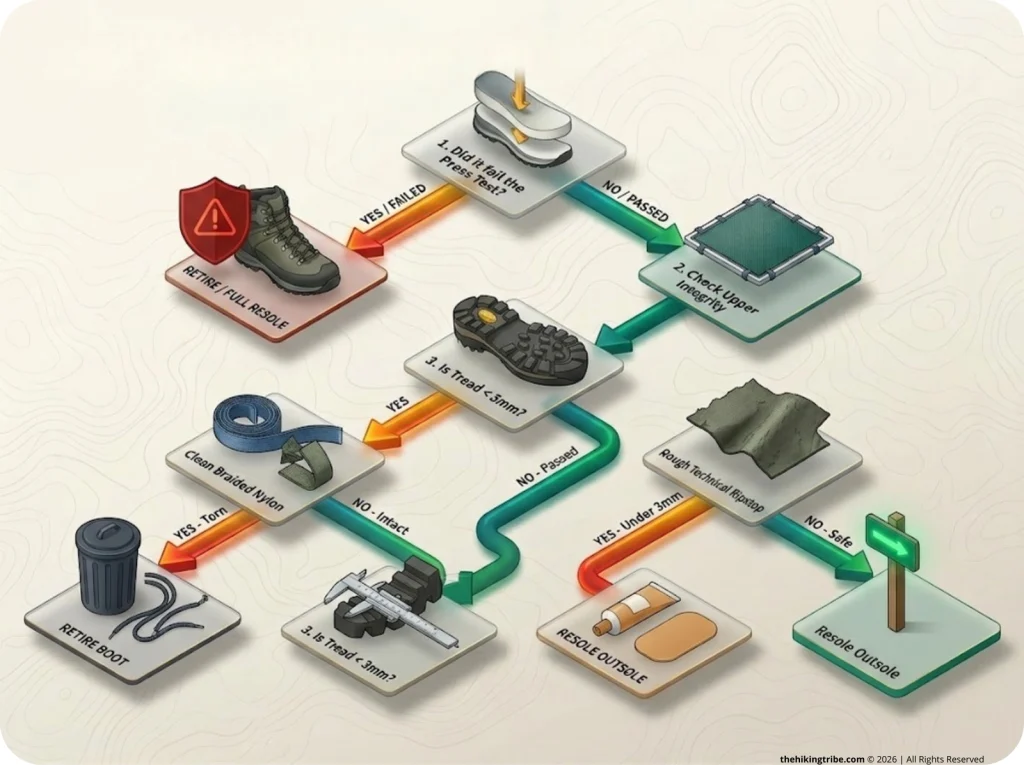
Throwing away gear hurts, both financially and environmentally. But pushing a dead boot another hundred miles jeopardizes your physical safety. Learning to navigate the resole vs. retire dilemma requires looking at the construction type and the true state of the midsole.
The Resole Criteria (Construction Types)
You cannot fix every boot. Look at how the sole attaches to the fabric. Heavy-duty boots utilizing a stitched welt or a cemented construction are excellent candidates for repair. However, lightweight trail runners and many modern hiking shoes use injection molding. These soles are permanently fused to the fabric. Once the tread vanishes on a molded shoe, repairing them is chemically impossible. You must throw them out.
The Hidden Costs of Factory Resoling
If you own a premium leather boot, a full factory resole breathes fresh life into a perfectly broken-in upper. A professional cobbler will rip off the old rubber and glue on a fresh block of traction. But watch out for the repair vs. replace trap: if your boot failed the thumb test, an outsole-only patch job is a complete waste of money. The cobbler must strip out the dead foam wedge and rebuild the entire platform. Understanding resoling hiking boots cost variables helps you decide if a local cobbler or a trip to REI makes more financial sense than buying a new setup, especially if the upper leather remains waterproof and retains its repairability.
Field Maintenance to Delay Material Breakdown
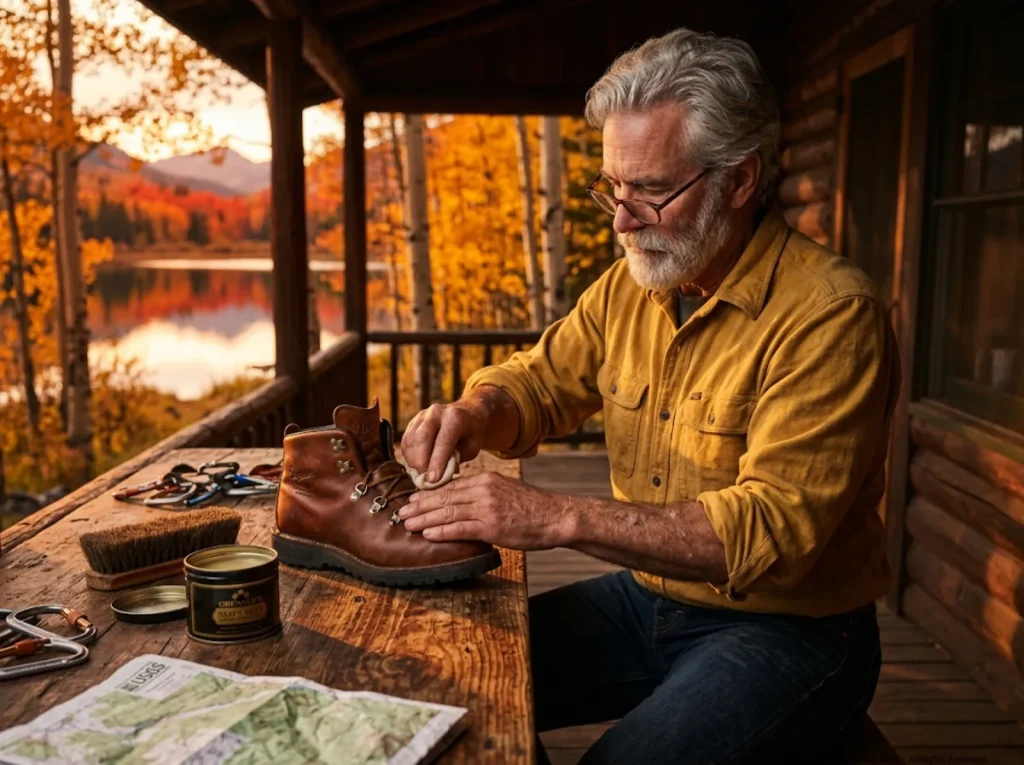
The way you treat your boots entirely dictates how quickly they hit your comfort threshold. Dirt acts as a molecular desiccant, sucking the natural oils straight out of the leather and causing it to crack. Scrub the trail mud off your gear with warm water and a stiff nylon brush immediately after you return home. Condition the leather with natural waxes to keep it supple and to block out moisture. Treat your boots like critical safety equipment, not driveway beaters, and they will easily carry you across another season.
Conclusion
Your hiking setup serves as your absolute first line of defense against the raw physics of gravity and granite. Respecting the lifespan of your gear means recognizing that insidious breakdown like foam densification and chemical rot happen entirely out of sight. Make the thumb pressure check a non-negotiable part of your monthly maintenance habit. Rotate your footwear, scrub off the corrosive trail grit, and never hesitate to replace a shoe that threatens your safety. Head to your gear closet right now, yank out the insoles from your current pair, and push hard into the center. Find out exactly where your setup stands before the mountain tests you.
FAQ
How many miles do hiking boots actually last?
Trail runners and lightweight foam shoes typically pack out between 300 to 500 miles, while heavy-duty trekking boots push past 1,000 miles. However, lifespan heavily depends on your physical weight and the roughness of the trail, which makes checking the stiffness of the foam a much better indicator than simply counting up trail miles. Do not trust generic mileage recommendations over actual physical pressing.
Can you fix hydrolysis in hiking boots?
No, once polyurethane hydrolysis begins, the chemical breakdown of the interior foam is irreversible and catastrophic. The material literally crumbles into a dry, useless powder from the inside out. The only remedy for a boot experiencing this rot is a complete professional rebuild off the original last or immediate retirement to the trash bin.
Do trail runners wear out faster than hiking boots?
Yes. Because trail runners utilize airy, lightweight foam to shave off heavy ounces, their overall shock absorption capabilities collapse twice as fast as high-density polymers in traditional boots. You trade extreme comfort and low weight for a much shorter product lifespan and lower overall durability.
Why do my feet suddenly hurt in boots I’ve worn for years?
Your body is absorbing all the kinetic shock your crushed padding can no longer handle. Once the internal foam permanently bottoms out, the protective barrier vanishes. This forces the small bones in your feet, knees, and hips to absorb the harsh impact of every single heel strike on hard ground.
Risk Disclaimer: Hiking, trekking, backpacking, and all related outdoor activities involve inherent
risks which may result in serious injury, illness, or death. The information provided on The Hiking Tribe is for
educational and informational purposes only. While we strive for accuracy, information on trails, gear, techniques,
and safety is not a substitute for your own best judgment and thorough preparation. Trail conditions, weather, and
other environmental factors change rapidly and may differ from what is described on this site. Always check with
official sources like park services for the most current alerts and conditions. Never undertake a hike beyond your
abilities and always be prepared for the unexpected. By using this website, you agree that you are solely
responsible for your own safety. Any reliance you place on our content is strictly at your own risk, and you assume
all liability for your actions and decisions in the outdoors. The Hiking Tribe and its authors will not be held
liable for any injury, damage, or loss sustained in connection with the use of the information herein.
Affiliate Disclosure: We are a participant in the Amazon Services LLC Associates Program, an
affiliate advertising program designed to provide a means for us to earn advertising fees by advertising and linking
to Amazon.com. As an Amazon Associate, we earn from qualifying purchases. We are also an official affiliate partner
of Black Diamond Equipment via the AvantLink network. If you click on a Black Diamond affiliate link and make a
purchase, we may earn a commission at no additional cost to you. We also participate in other affiliate programs and
may receive a commission on products purchased through our links. Additional terms are found in the terms of
service.