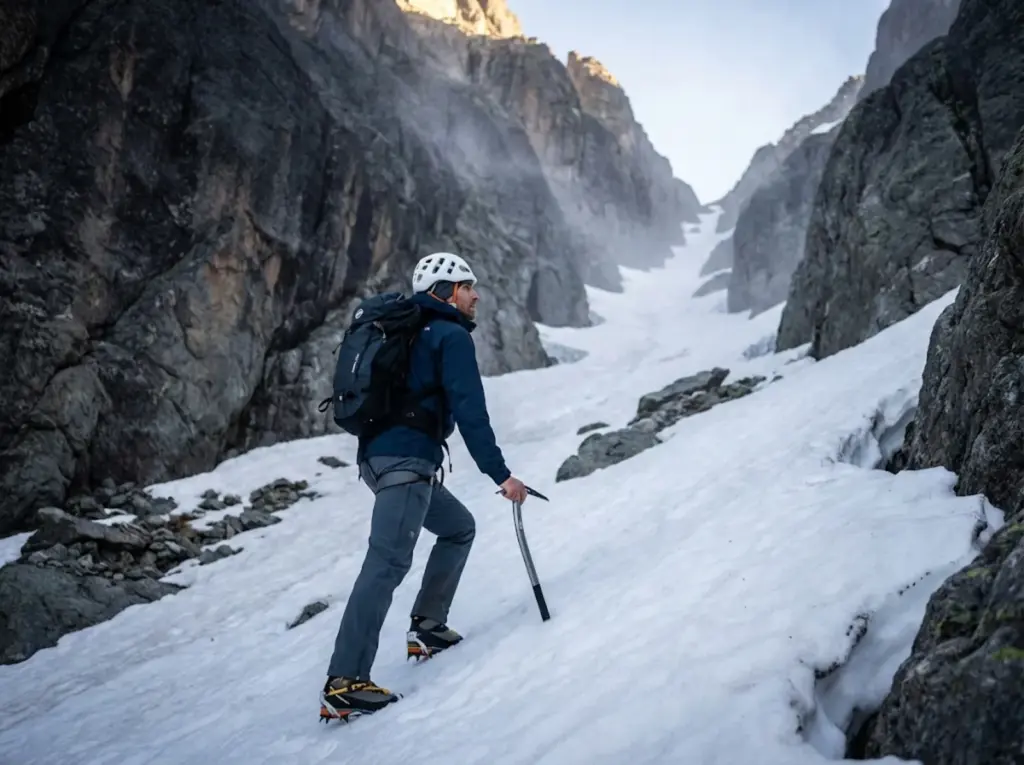
The sound came from above—a low grinding, then a crack like a rifle shot. Three baseball-sized rocks screamed past, maybe ten feet to my left, and hammered into the snow below with enough force to crater it. I was frozen mid-step in the Grand Couloir du Goûter, 3,340 meters up Mont Blanc, and the clock on my wrist read 5:47 PM.
I was six hours too late.
That crossing taught me more about couloir rockfall than any guide service brochure or online forum post. After years of alpine routes across the Alps and the Cascades, I learned something that sounds obvious but somehow isn’t: surviving a couloir has almost nothing to do with luck, and almost everything to do with knowing when the mountain goes quiet and when it doesn’t.
This guide breaks down the science of rockfall timing, pulled from the Petzl Foundation’s seismic sensor study of 2,662 rockfall events, into a field protocol you can use on any couloir from the Goûter to Mount Hood’s Pearly Gates. You’ll walk away with a five-factor decision framework called the 5-T System, the specific time windows to target, and tactical know-how for moving through the danger zone with purpose instead of panic.
⚡ Quick Answer: The safest time to cross a couloir is between 9:00 AM and 10:00 AM, when rockfall frequency hits its daily minimum. This window occurs after overnight freezing stabilizes the rock and before the day’s heat reaches the deeper joints. The most dangerous window is 6:00–8:00 PM, when a rockfall event occurs roughly every 24 minutes.
| Metric | Value |
|---|---|
| Safest crossing window | 9:00–10:00 AM |
| Most dangerous window | 6:00–8:00 PM |
| Average rockfall frequency | 1 event every 37 min |
| Peak danger frequency | 1 event every 24 min |
| Events recorded (68 days, 2019) | 2,662 |
| Average fatalities per summer (Goûter) | 3.7 |
Why Rocks Fall on Schedule (And Not at Random)
Most people think rockfall is random. It isn’t. Rocks fall on a clock, and if you understand the mechanism, you can read that clock before you leave camp.
The Freeze-Thaw Cycle and Thermal Expansion
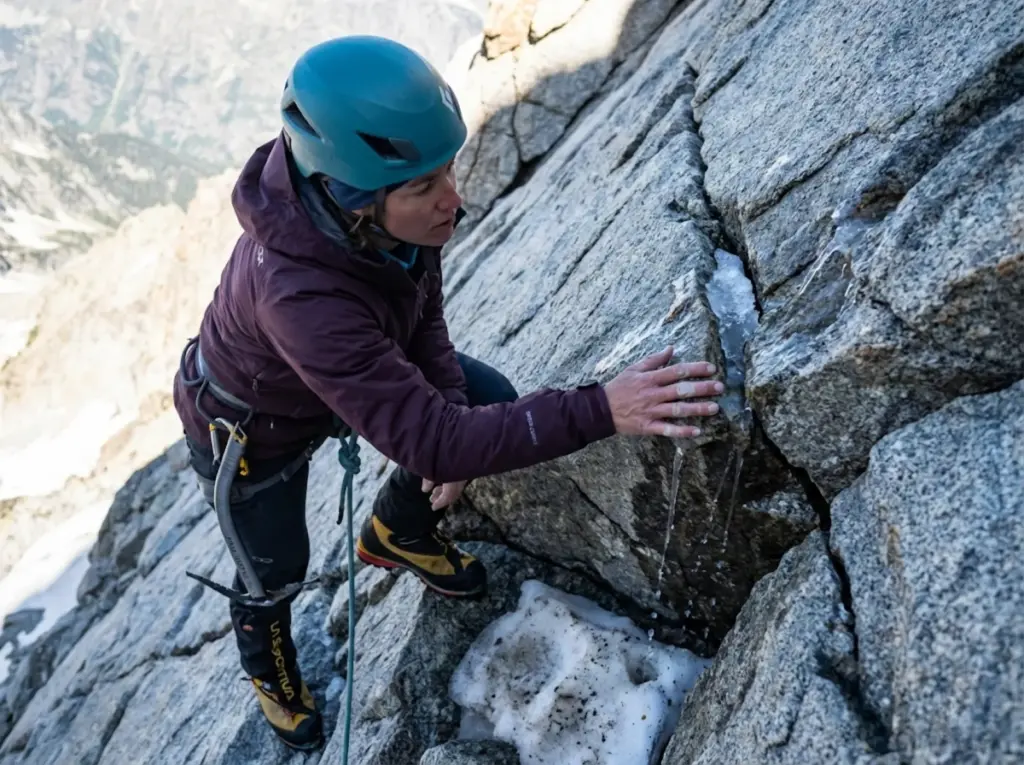
In the Mont Blanc Massif, permafrost stabilizes between 45% and 79% of rock walls steeper than 40 degrees above 3,600 meters. That permafrost—ice filling cracks and joints—acts like cement holding the mountain together. When daytime sun exposure heats rock surfaces, it melts those ice bonds and expands fractures through what climbers call ice wedging.
Snowmelt makes it worse. Water runs into joints and adds pressure, prying apart blocks even when air temperatures seem moderate. You can sometimes hear it before you see it—a low creak, almost like wood flexing, when warming rock shifts. Experienced alpinists call it “the mountain breathing.”
Climate change is accelerating permafrost degradation across the Alps, increasing both the rockfall frequency and the volume of falling material on classic routes. The Grand Couloir isn’t getting safer with time. It’s getting worse.
The Two-Hour Thermal Lag You Can’t Ignore
Here’s the detail that changes everything, and the one that most online guides skip.
The Petzl Foundation and EDYTEM-ISTerre researchers deployed seismic sensors in the Grand Couloir and discovered a two-hour delay between peak air temperature and peak rockfall activity. Rock holds heat differently than air—it takes hours for warmth to travel from the surface into the deeper joints where stabilizing ice sits. So the most dangerous period isn’t midday when the air is hottest. It’s late afternoon and early evening, between 6:00 PM and 8:00 PM, when the thermal expansion finally reaches the joints that matter.
During that peak window, the sensors recorded a rockfall event every 24 minutes. Twenty-four minutes. If you’re in the couloir at 6 PM, you’re gambling with those odds.
Climbers who time their crossing based on air temperature alone are consistently misjudging the actual danger. The rock’s worst moment lags behind the thermometer by about two hours.
What Liquid Precipitation Does to a Couloir
Rain acts as an immediate lubricant. It forces water into fractures and can trigger what the EDYTEM-ISTerre multi-method monitoring study calls boulder showers—large-volume, sustained rockfall events far more dangerous than the isolated falls caused by thermal expansion alone.
The largest and most sustained rockfall events in the study were tied to liquid precipitation, not heat. Late-season events in August and September tend to involve fewer individual falls, but each one releases bigger blocks from deeper rock destabilization.
One common mistake: assuming snow in a couloir “glues” rocks in place. It doesn’t. Snowmelt is a primary driver of rock destabilization—the water runs straight into joints and does the same damage as rain.
If you’re working on testing handholds for stability before committing your weight on approach scrambles, the same freeze-thaw physics apply at a smaller scale. Same mechanism, different consequences.
Pro tip: Check the 48-hour precipitation history before committing to a couloir crossing. If liquid rain fell in the last 24 hours, treat the entire couloir as a boulder shower hazard regardless of the current air temperature. This weather precondition assessment takes two minutes and could save your life.
The 9-to-10 AM Safe Window (And the Times That Kill)
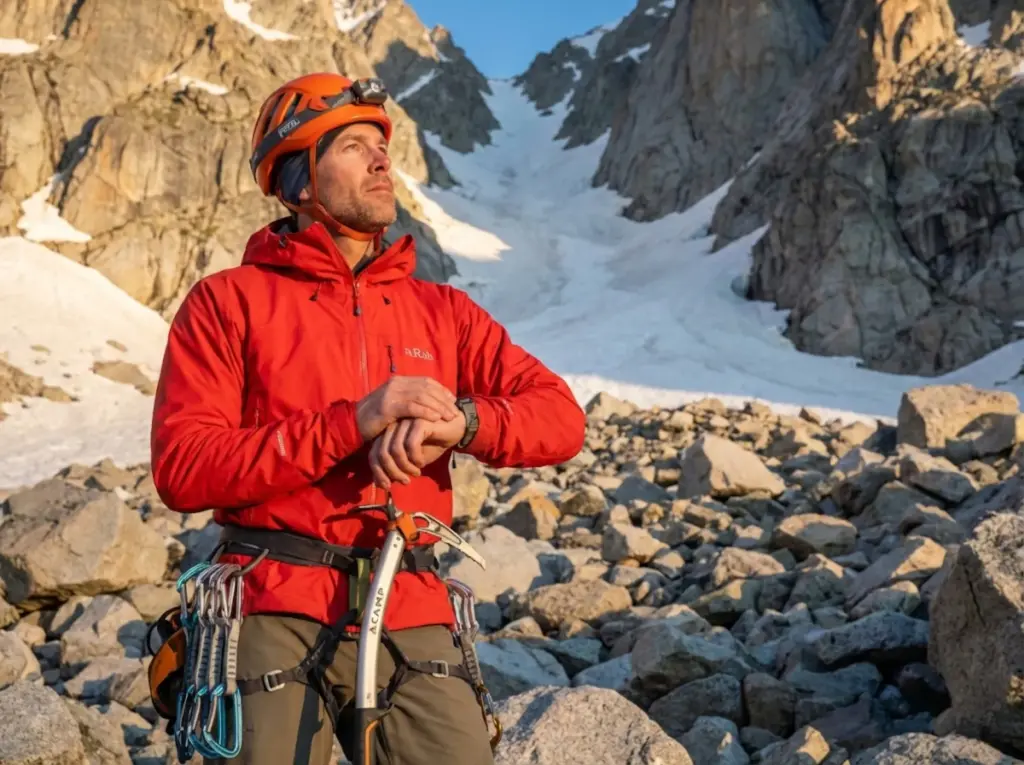
The Petzl study gives you a number worth memorizing: between 9:00 AM and 10:00 AM, rockfall frequency in the Grand Couloir hits its daily minimum.
Why This Window Works
Seismic data from 2019—2,662 events recorded over 68 days, averaging 39 per day—shows the lowest risk falls in a specific transition state. Overnight freezing has stabilized joints. The initial morning thaw of surface rime has passed. But the cumulative heat hasn’t yet reached deep enough to break the ice bonds holding major blocks.
This data was compelling enough that the Mont Blanc Tramway Company changed its schedule. In 2022, the tramway began departing at 7:00 AM instead of 8:00 AM, specifically to help climbers reach the Grand Couloir during this minimum-risk window. The traditional alpine start still matters, but the data now tells you exactly where to aim.
The 6:00–8:00 PM Danger Window
Between 6:00 PM and 8:00 PM, rockfall frequency spiked to one event every 24 minutes—the highest concentration of the day. Despite this data, the study found that climbers regularly cross during these hours. Fixed refuge schedules, slow pace, and sheer lack of awareness about the two-hour thermal lag all contribute.
If your timeline puts you in a couloir after 4:00 PM, you need to seriously weigh an emergency bivouac in a protected zone against pushing through.
Between 1990 and 2017, the PGHM (French High Mountain Gendarmerie) recorded 347 rescue operations, 102 fatalities, and 230 injuries in the Grand Couloir alone. Rockfall was the direct cause in 29% of those cases—and an indirect factor in close to 50%, because the threat of falling rocks causes climbers to look up, lose their footing, and slip.
That’s 3.7 fatal accidents every summer. In a single couloir.
The concept of calculating your turnaround time before committing to the crossing applies directly here. If your math puts you in the couloir after the safe window closes, the math is telling you to stop.
The Full Diurnal Risk Curve
| Time Period | Rockfall Frequency | Risk Level |
|---|---|---|
| 2:00–5:00 AM | Low | Moderate (poor visibility) |
| 9:00–10:00 AM | Lowest | Minimum |
| 11:00 AM–12:00 PM | 1 event every 17 min | High |
| 3:00–6:00 PM | Sustained high | Very High |
| 6:00–8:00 PM | 1 event every 24 min | Extreme |
Source: Petzl Foundation rockfall monitoring study, 2019 seismic data.
Pro tip: Work backwards from the 9-10 AM safe window. If you need three hours to reach the couloir from your refuge, you leave at 6:00 AM. Don’t negotiate with the clock. Your turnaround time is non-negotiable.
The 5-T Decision Framework for Any Couloir
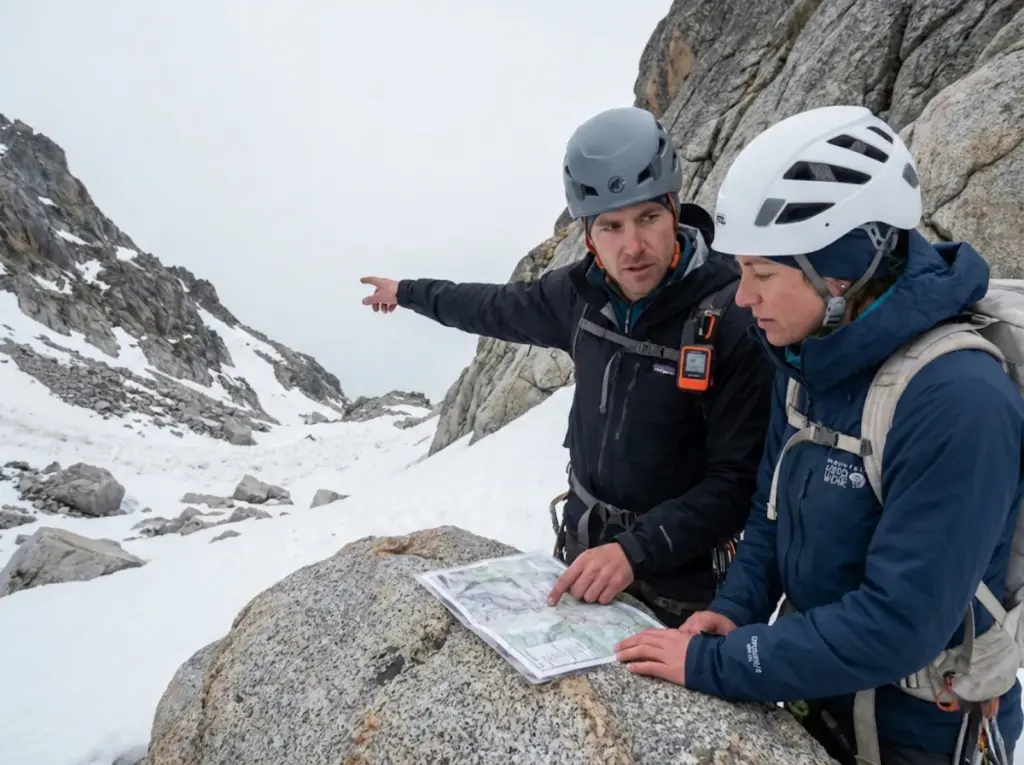
Data is worthless if you can’t apply it at the base of a gully. The 5-T System takes the science from the Petzl study and North American guide practices and turns it into a repeatable go/no-go checklist you can run in five minutes.
Time — Where You Fall on the Diurnal Curve
Target the 9:00–10:00 AM window if a pre-dawn crossing isn’t an option. Never enter a couloir after 4:00 PM unless all four other factors are green. Calculate your crossing time backwards from the safe window to set your departure. Use Naismith’s Rule adjusted for altitude to estimate approach time accurately.
Temperature — Reading the Thermal Load
Check overnight minimums. If temps didn’t drop below freezing, the rock never re-stabilized. The couloir is “pre-loaded” for early rockfall. A warm night followed by direct morning sun exposure on the couloir face compresses your safe window to almost nothing. Remember: the rock’s most dangerous moment is roughly two hours after peak air temperature.
Traffic, Terrain, and Team
Traffic: A crowded couloir is objectively more dangerous. Human-triggered rockfall from parties above is well-documented. Use the leap-frog technique—wait for the party above to clear the gully before starting your crossing.
Terrain: Look at the physical state. Liquid rain in the last 24 hours is a red flag for boulder showers. Active runnels—water channels carved into the rock—mean ongoing destabilization. Some experienced climbers use a chalk x marking system to flag suspicious blocks for parties behind them.
Team: Exposure time is the one variable you fully control. The danger zone in the Goûter couloir is roughly 100 meters wide. A fast, proficient team crosses in 2 minutes. A slow team takes 10. Proficiency with proper ice axe technique for steep terrain is what separates those two numbers.
Record a go/no-go decision for each factor. If two or more are amber, or any single factor is red, turn around. No summit is worth dying in a gully.
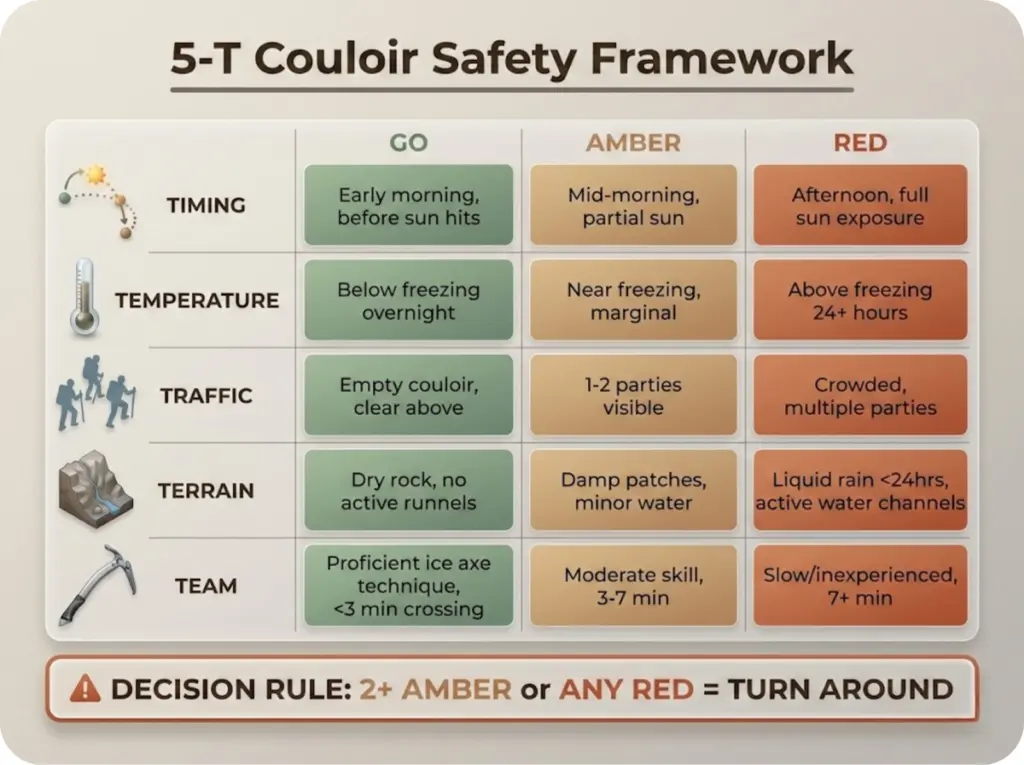
Pro tip: Write the 5-T factors on a piece of tape on your ice axe shaft. In the stress of a real couloir approach, you won’t remember a framework you read online six months ago. But you’ll read what’s in front of your hands.
Gear That Matters When Rocks Are Falling
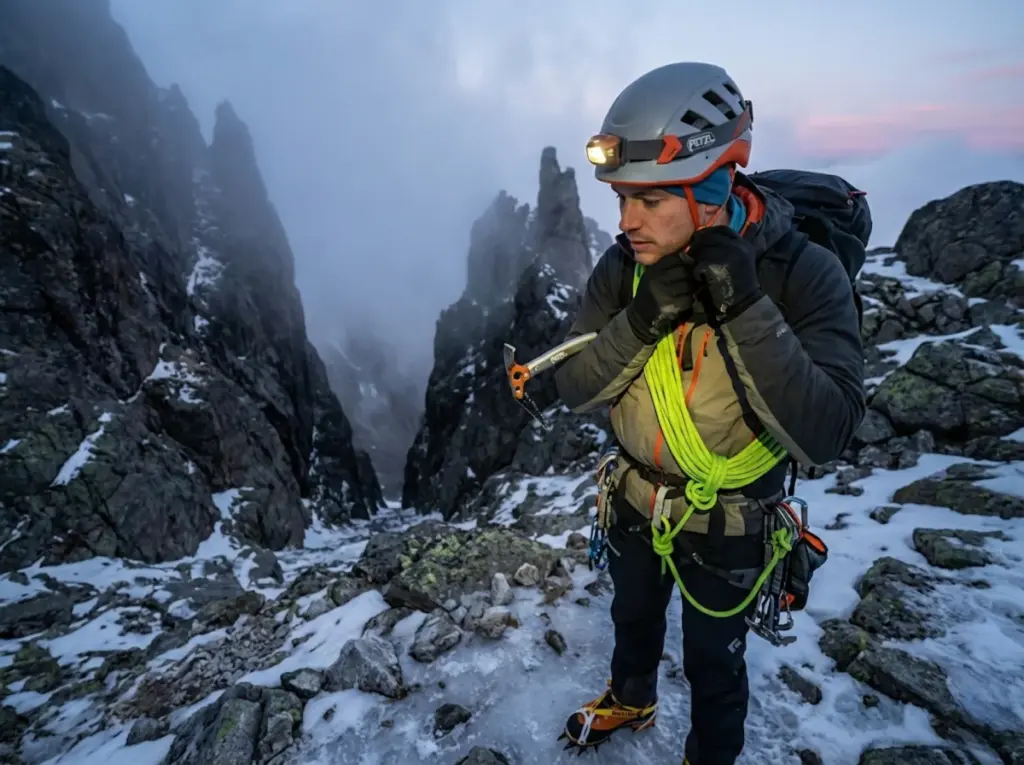
Timing is your first defense. Safety equipment is your last one. Here’s what actually matters and why.
Helmets — Your Last Line of Defense, Not Your Only One
A climbing helmet that actually fits is the single most important piece of safety gear in a couloir. Full stop.
UIAA 106-certified mountaineering helmets protect against top, side, and front impacts from falling rocks and ice. They’re designed for exactly this scenario. Trail running helmets and bike helmets are not—they don’t meet the EN 12492 multi-impact falling object protection standards that couloir terrain demands.
But a helmet is a mitigation tool, not an immunity tool. The Petzl Foundation sensors detected rocks as small as 100 kg. A hit from something that heavy is unsurvivable regardless of what you’re wearing on your head. The helmet protects you from the small-to-medium debris that makes up the majority of couloir rockfall. It doesn’t make you invincible.
Fit matters as much as certification. A loose helmet shifts on impact and reduces protection. Adjust it before you enter the couloir, not during it.
Crampons, Ice Axes, and the Saddlebag Technique
Crampons provide the traction to cross frozen couloir floors at speed. Without them, your safe window becomes irrelevant because you can’t move fast enough to clear the danger zone. If you’re unsure about when to use crampons versus microspikes, a couloir is firmly in crampon territory.
Saddlebagging your rope—carrying it in organized loops across your torso rather than trailing it behind—is a key rope management technique that prevents rope-triggered rockfall onto climbers below. This is a documented hazard on multi-party routes. Use directionals to keep the rope close to the wall and out of the fall line.
UIAA-certified harnesses and ice anchors allow you to create what some guides call islands of safety—regrouping zones in longer couloirs where you’re out of the direct fall line. On a couloir like the Ford-Stettner on the Grand Teton, these anchored rest points can mean the difference between a controlled crossing and a panicked sprint. The UIAA safety standards for mountaineering equipment cover helmets (UIAA 106), harnesses (UIAA 105), and ice anchors (UIAA 151)—all critical for couloir terrain.
How to Move Through the Danger Zone
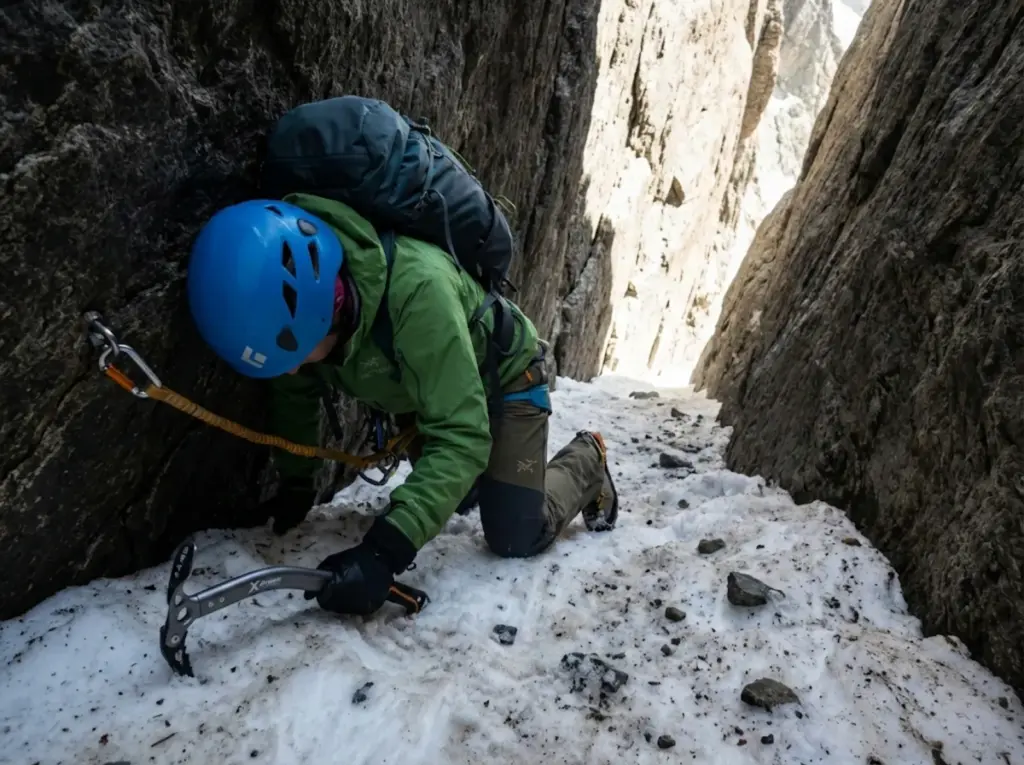
You’ve checked the clock. You’ve run the 5-T checklist. Now you’re standing at the mouth of the couloir, and it’s time to move.
The “Tuck and Shield” Response
When you hear “ROCK!”—the universal warning—do not look up and do not run.
I know that sounds wrong. Every instinct says look for the threat. But here’s what the data says: looking up is an indirect cause of up to 50% of couloir accidents. You take your eyes off the terrain, lose your footing on ice or wet rock, and slip. The fall, not the stone, is what gets you.
Correct response: make yourself small. Tuck your chin to your chest, press against the rock wall, and let your backpack shield your spine and neck. Stay under the crown of your helmet. Unstable rocks bouncing in a couloir are unpredictable and spend time airborne. Running across the slope only makes you a wider, more exposed target. Shelter toward the wall and wait it out.
Islands of Safety and the Leap-Frog Technique
In long couloirs, identify micro-islands of safety before you start moving—sheltered spots behind rock buttresses, within bends, or at the base of walls that are out of the direct fall line. Then leap-frog: move from one protected position to the next, with only one climber or party exposed in the active zone at any time.
Maintain vertical spacing between parties. Never position yourself directly below another group. Human-triggered rockfall is as dangerous as the natural kind—maybe more so, because it comes without the warning grinding sound.
In 2019, 17,768 passages were recorded through the Grand Couloir. At that traffic level, managing other people is as important as managing the mountain. Party positioning protocols and crowding etiquette aren’t just good manners—they’re survival.
Communication and Crowding
When multiple parties converge on a couloir simultaneously, a social dilemma develops. Everyone increases risk for everyone else. Crowding leads to rushing, and rushing leads to dropped gear, sloppy crampon technique, and loose rocks kicked onto the people below.
Communicate with nearby parties: agree on crossing order, use whistle signals for “clear” and “hold,” and designate regrouping zones. If the couloir is packed, waiting 15 to 20 minutes for the crowd to thin is statistically safer than joining the bottleneck.
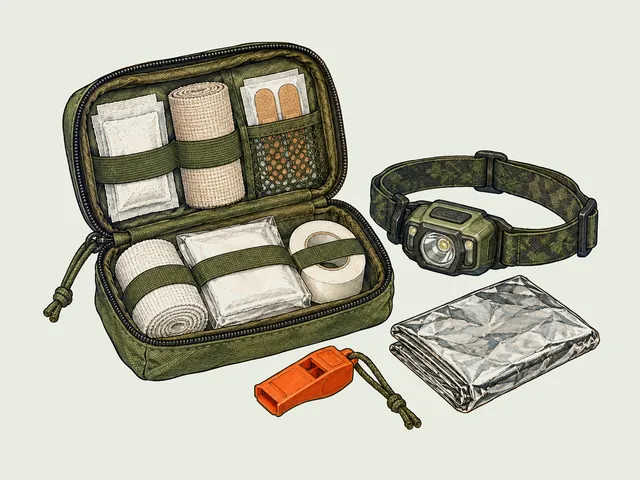
Pro tip: Carry a whistle attached to your sternum strap. Three short blasts means “hold, rockfall in progress.” One long blast means “clear to cross.” Agree on these signals with adjacent parties before anyone enters the couloir.
North American Couloirs Where This Science Applies
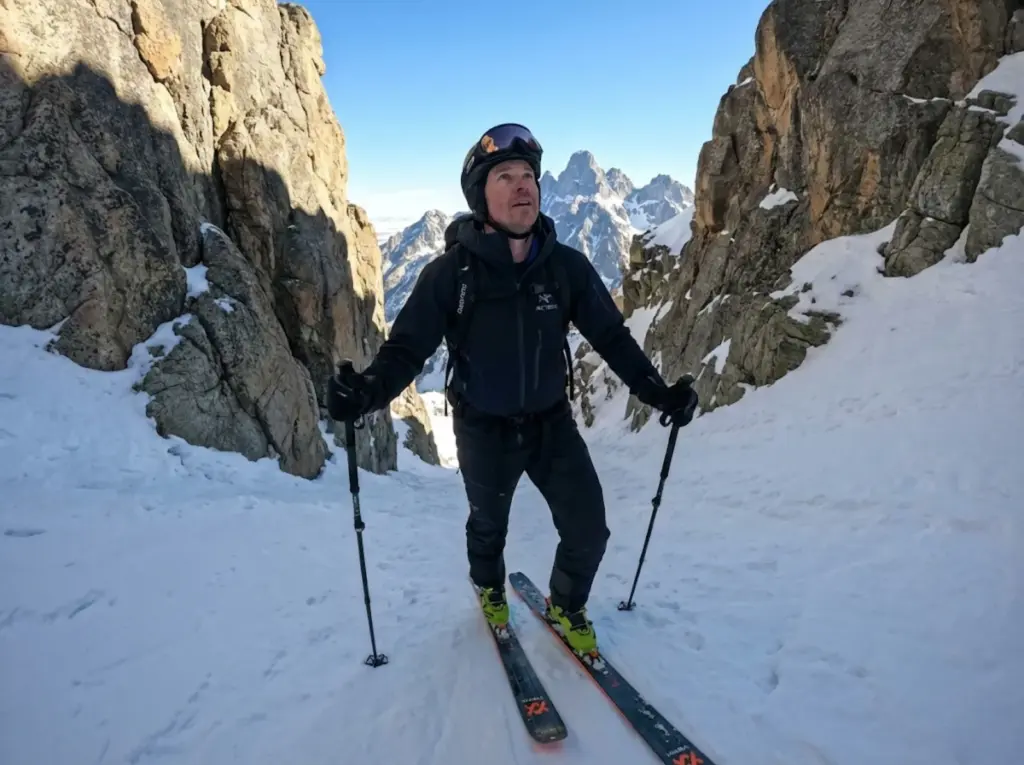
The Petzl study was conducted in the Grand Couloir du Goûter, but the physics don’t stop at the French border. Freeze-thaw destabilization, thermal lag, and solar-driven rockfall operate everywhere steep rock holds frozen water. Here’s where it applies in North America.
Mount Hood — Pearly Gates and Old Chute
Mount Hood’s South Side route is essentially a volcanic version of the Goûter problem. The Pearly Gates—a narrow Y-shaped chute near the summit—sits between rime-coated rock towers that shed debris as the morning sun hits. The traditional alpine start departs Timberline Lodge between 11:00 PM and 2:00 AM, aiming to summit and clear the Pearly Gates before 9:00 AM.
On Hood, the danger curve begins its steepest climb immediately after 9:00 AM. Experienced climbers who top out late and descend through the Pearly Gates at noon are accepting far more risk than those who cleared it at 8:30 AM. Same physics, different mountain.
Grand Teton — Ford-Stettner Couloir
The Ford-Stettner route on the Grand Teton stacks three couloirs—Stettner, Chevy, and Ford—in succession. The Stettner in particular collects debris from the massive walls above and has become what some local guides describe as a “veritable mogul run” on high-traffic days.
Ski mountaineers descending the Ford-Stettner target an 11:00 AM to 12:00 PM window—late enough for snow to “corn” for safe skiing, but before the two-hour thermal lag triggers the afternoon rockfall surge. Saddlebagging ropes and maintaining spacing are non-negotiable on these technical climbs.
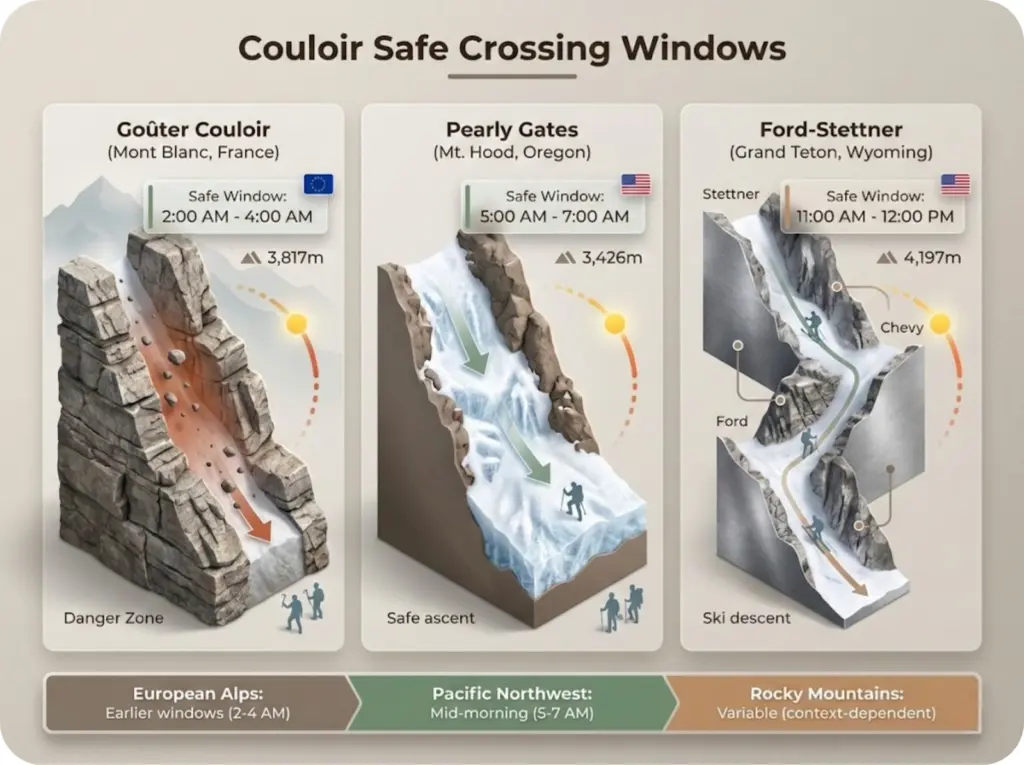
If you’re transitioning from hiking to non-technical mountaineering and considering your first couloir route, these North American objectives are where the couloir timing science you’ve just learned meets the real world.
Three Things to Take Into the Mountains
First: the 9:00–10:00 AM window is real, it’s measured, and it works. Build your entire summit day around reaching the couloir during this window. Every other decision flows from that.
Second: the two-hour thermal lag means the danger doesn’t peak when the air does. The worst rockfall comes between 6:00 and 8:00 PM. If you’re behind schedule, stop and reassess before you stumble into the most dangerous hours.
Third: run the 5-T System at the base of every couloir—Time, Temperature, Traffic, Terrain, Team. Two ambers or one red means turn around. No go/no-go decision made on incomplete information is worth the risk.
The next time you’re standing at the mouth of a couloir, checking your watch and looking up at the gully, you’ll have something most people don’t: a framework built on 2,662 data points instead of guesswork. Use it.
FAQ
What is the safest time to cross a couloir?
Between 9:00 AM and 10:00 AM, when rockfall frequency hits its daily minimum. This window falls after overnight freezing has stabilized the rock and before the day’s heat reaches deeper joints. The Petzl Foundation’s 2019 seismic study confirmed this pattern across 2,662 recorded events.
What causes rocks to fall in couloirs?
Freeze-thaw cycles, thermal expansion, and snowmelt. Water enters fractures during warming periods, expands when freezing at night, and pries joints apart. There’s a two-hour delay between peak air temperature and peak rockfall because rock conducts heat slowly.
How do you protect yourself from rockfall while climbing?
Wear a UIAA 106-certified climbing helmet, move quickly through exposed zones, and use micro-islands of safety. If you hear ROCK!—do not look up. Tuck chin to chest, press against the wall, and let your backpack shield your spine. Looking up diverts attention from footing and contributes to roughly half of couloir accidents.
Is the Goûter couloir on Mont Blanc really that dangerous?
Yes. Between 1990 and 2017, the PGHM recorded 102 fatalities and 230 injuries from 347 rescue operations in the Grand Couloir alone—3.7 fatal accidents every summer. It is the deadliest single section of any standard alpine route.
Does the one-hour window apply to couloirs outside the Alps?
The specific 9:00–10:00 AM window was measured at the Goûter, but the physics—sun exposure timing, thermal expansion, and the two-hour lag—apply everywhere. On Mount Hood, climbers clear the Pearly Gates before 9:00 AM for the same reason. Adjust your window based on local sunrise, aspect, and altitude.
I've spent more than a decade researching hiking gear and trail technique. I read the specs, the forum threads and the long-term reviews, and every pick here comes with what it gets wrong.
End of the trail
You read every mile of this one. Here's where the trail goes next.