In this article
You hand your kid a pair of trekking poles for the first time and within five minutes they’re sword-fighting with their sibling. Ten minutes later, the poles are dragging behind them like forgotten toys. The problem usually isn’t the kid — it’s the poles. After hiking with my kids through everything from flat forest loops to rocky switchbacks with real elevation gain, I’ve learned that sizing makes or breaks whether a child actually uses their trekking poles or abandons them by mile two. This guide covers how to size trekking poles for kids by height, when children are developmentally ready for poles, and the specific mistakes that turn a useful trail tool into dead weight.
Here’s how pole length maps to a child’s height:
| Children’s Pole Sizing Guide | |||
|---|---|---|---|
| Child’s Height | Pole Length (cm) | Pole Length (in) | Typical Age Range |
| 3’6″ (107 cm) | 73 cm | 29″ | 4–5 years |
| 3’9″ (114 cm) | 78 cm | 31″ | 5–6 years |
| 4’0″ (122 cm) | 83 cm | 33″ | 6–7 years |
| 4’3″ (130 cm) | 88 cm | 35″ | 7–8 years |
| 4’6″ (137 cm) | 93 cm | 37″ | 8–10 years |
| 4’9″ (145 cm) | 99 cm | 39″ | 10–11 years |
| 5’0″ (152 cm) | 103 cm | 41″ | 11–13 years |
| 5’3″ (160 cm) | 109 cm | 43″ | 12–14 years |
How to Size Trekking Poles for Kids by Height
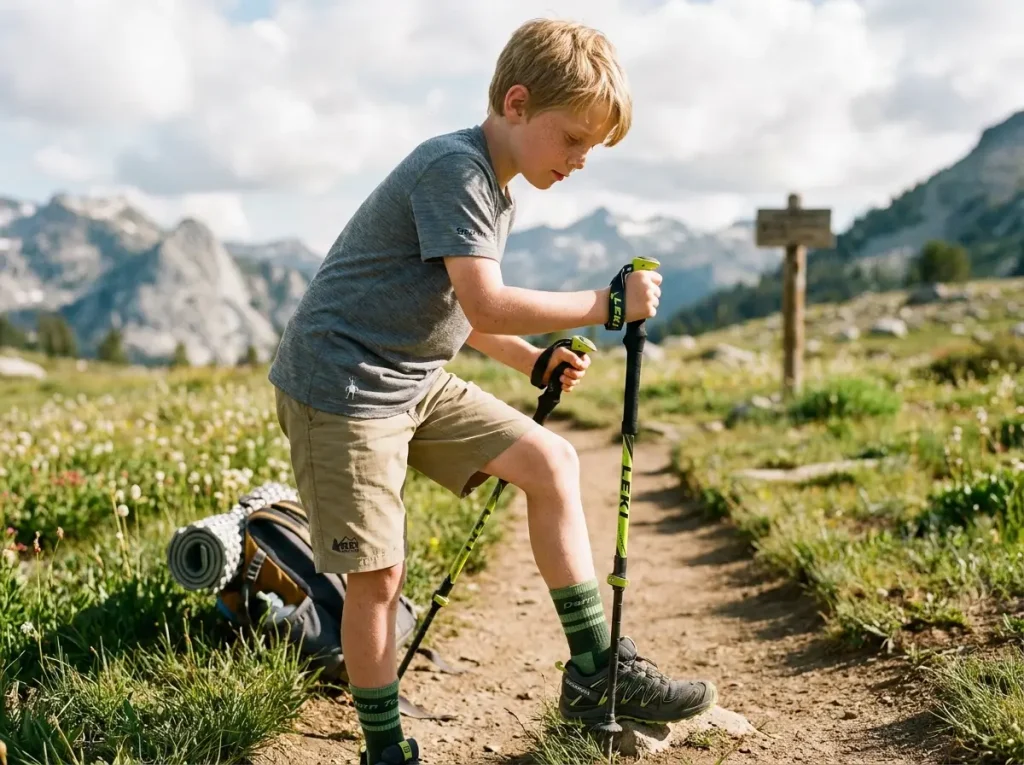
Most parents grab a pair of poles, guess at the height, and call it done. That’s how you end up with a kid whose shoulders are hunched up near their ears on every uphill or whose arms hang straight down doing nothing on the flats. Getting the length right takes about 60 seconds, and it changes everything about how comfortable your child is on trail.
The 90-Degree Elbow Rule for Children
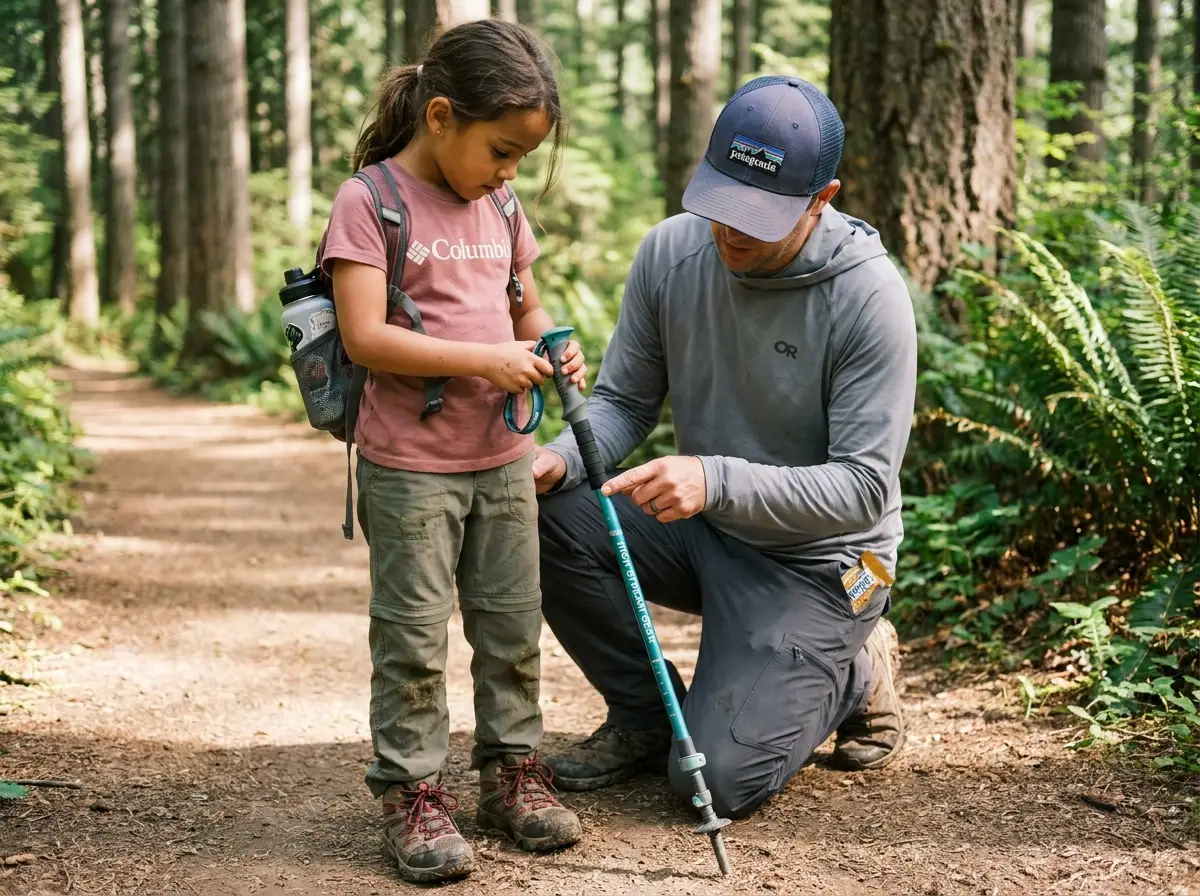
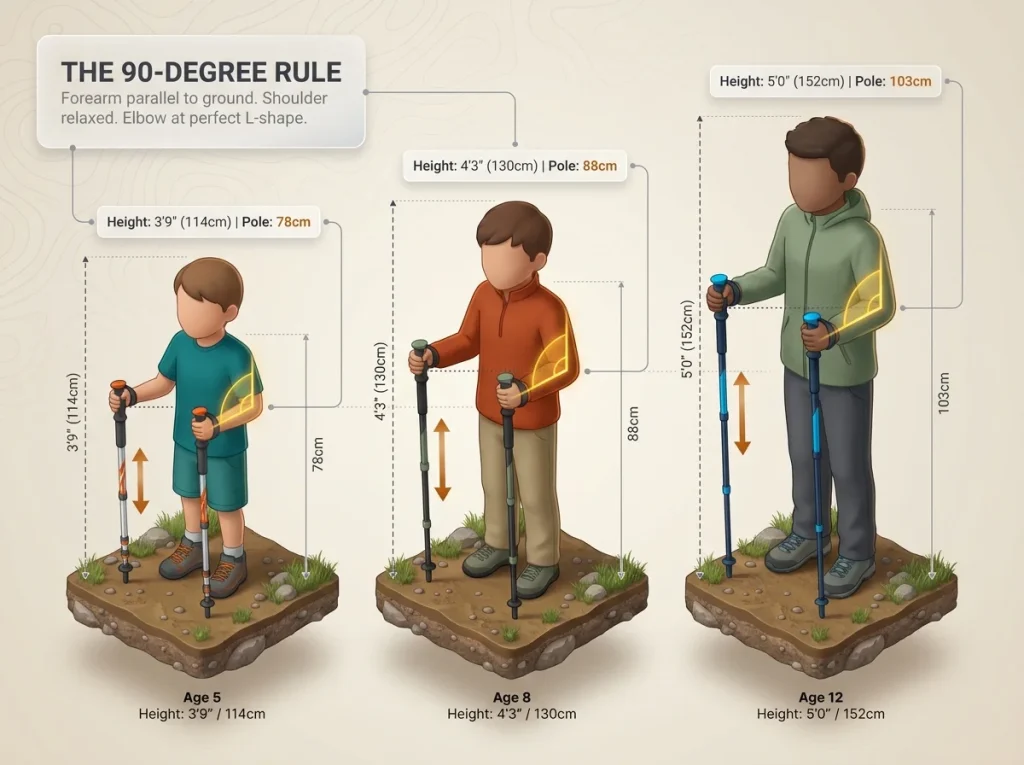
The same rule that works for adults works for kids: plant the pole tip on flat ground next to your child’s foot. If their elbow bends at roughly 90 degrees with their forearm parallel to the ground, the pole is the right length. If their elbow is higher than 90 degrees, the pole is too short. If their arm is nearly straight, it’s too long.
Have your child stand on a flat surface — not on a slope, not on stairs. Kitchen floors work fine for the initial setup. Hold the pole straight up and down, grip in hand, tip on the floor. Check the elbow angle from the side, not from the front. You’re looking for that relaxed L-shape where the shoulder isn’t doing any extra work.
Pro tip: Don’t eyeball this from across the room. Stand next to your kid and look at the elbow angle from directly beside them. A 10-degree error looks like nothing from the front but feels like everything after two miles.
Kids Height-to-Pole-Length Chart
The quick math behind the chart above is straightforward: multiply your child’s height in centimeters by 0.68 to get the ideal pole length in centimeters. A 4-foot-tall kid (122 cm) needs roughly 83 cm poles. A 4’6″ kid (137 cm) needs about 93 cm.
The chart gives you a baseline. The 90-degree test gives you the final answer. Some kids have longer arms relative to their torso, some have shorter. The chart gets you close; the elbow test dials it in.
Why the Formula Changes for Growing Kids
Kids grow. That’s obvious. What’s less obvious is how fast it changes the pole fit. A growth spurt of two inches — which can happen in a single summer — shifts the ideal pole length by about 3.5 cm. If you bought fixed-length poles at the start of the season, they might be too short by August.
This is why adjustable trekking poles are the only sensible option for children. Look for a model with at least 6 inches of adjustment range above your child’s current ideal setting. That gives you roughly two to three seasons before they outgrow the poles entirely.
Mark the correct height on the shaft with a strip of colored tape. Your kid can set up the poles at the trailhead without needing you to measure every time. Independence on the small stuff matters — it’s the difference between a kid who feels like a hiker and a kid who feels managed.
What Age Can Kids Start Using Trekking Poles?
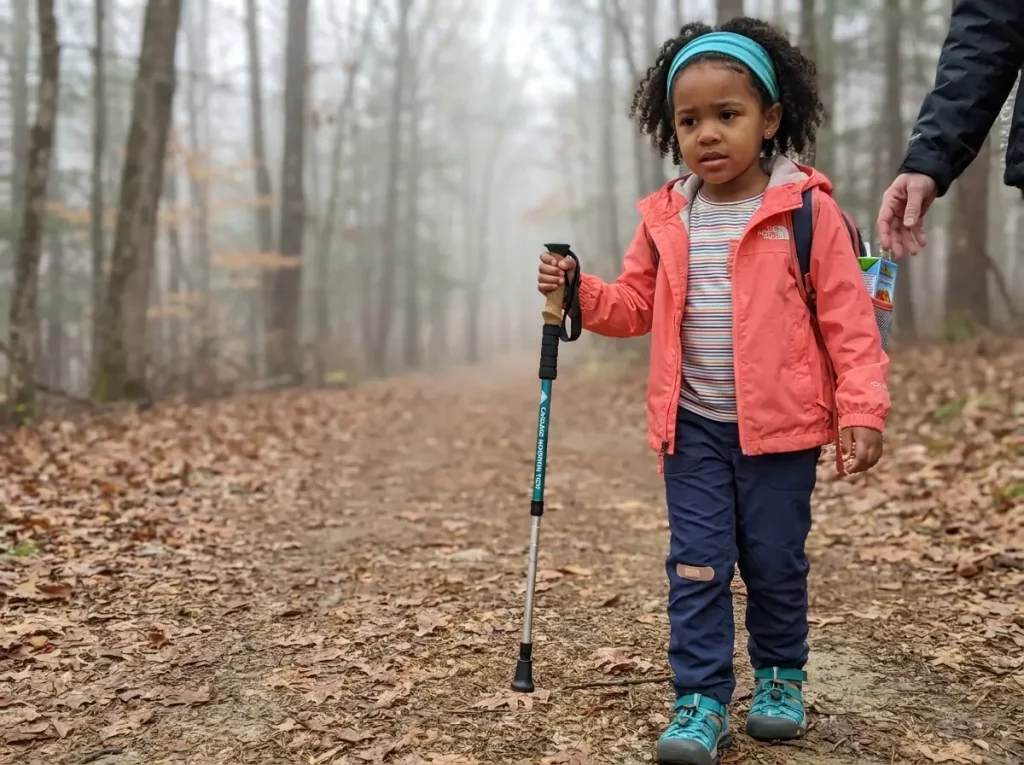
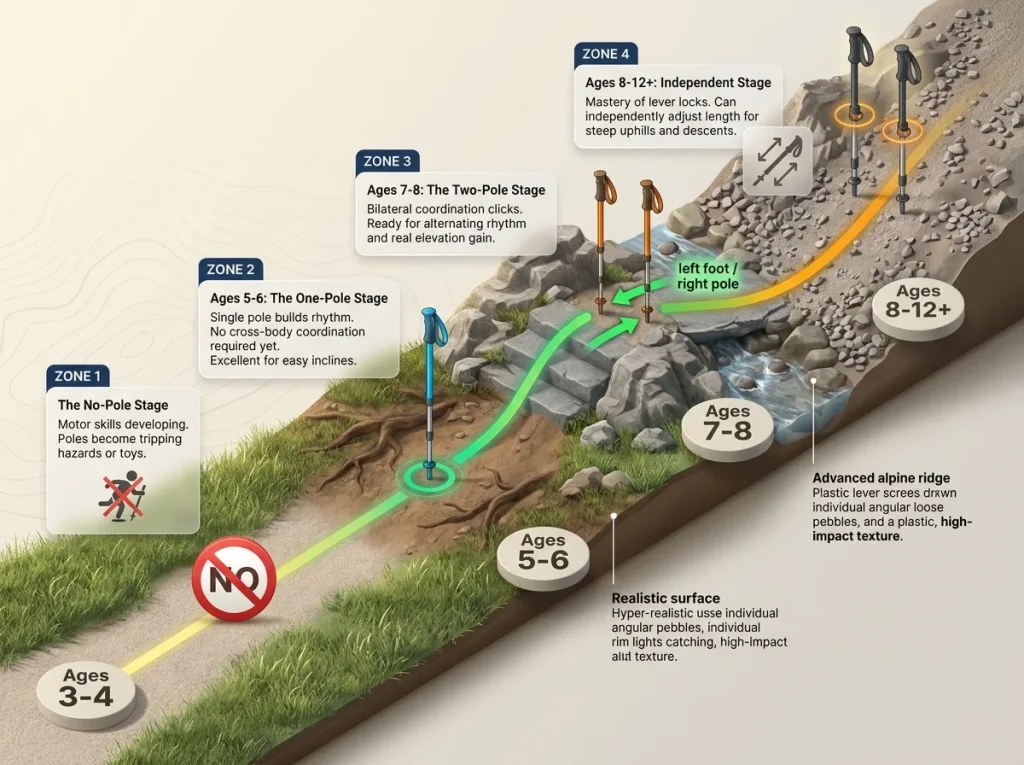
This is the question every hiking parent asks, and the answer isn’t a single number. It depends on your kid’s coordination, attention span, and the terrain you’re hiking. Age is a rough guide, but readiness is what actually matters.
Motor Skills and Coordination by Age
Children develop bilateral coordination — the ability to do different things with each arm in a rhythmic pattern — at different rates. Research on gross motor development in children shows that stability, locomotion, and object manipulation skills improve significantly between ages 3 and 6, with wide individual variation.
At ages 3–4, most kids don’t have the coordination to plant poles in rhythm with their steps. They’ll jab them randomly, trip over them, or use them as walking sticks held in the middle like a staff. That’s normal — their brains are still wiring the cross-body movement patterns.
At ages 5–6, many kids can handle a single trekking pole on easy, flat terrain. One pole is simpler because it doesn’t require the alternating left-right coordination that two poles demand. Think of it as training wheels for pole use.
By age 7 and up, most kids can manage a pair of poles with some initial coaching. The alternating rhythm — right foot, left pole; left foot, right pole — clicks naturally for most kids at this age once you show them the pattern a few times.
Signs Your Kid Is Ready
Forget the age charts for a moment. Watch your kid walk. Can they maintain a steady rhythm on flat ground without stumbling? Do they swing their arms naturally when they walk, or do they keep their hands in their pockets? Can they follow multi-step instructions without losing focus after 30 seconds?
If yes to all three, they’re ready to try poles. If they’re still working on any of those, give it another season. There’s no rush, and poles given too early just become something else for you to carry.
When Poles Actually Help vs When They’re a Distraction
Poles genuinely help kids on trails with elevation change, loose gravel, stream crossings, and rocky terrain. The extra contact points improve balance and take load off small knees on descents. On a steep, loose downhill, a kid with properly sized poles is noticeably more stable than one without.
On flat, smooth trails with no obstacles? Most kids under 10 don’t need them. They’ll use them for the first quarter-mile, get bored, and hand them to you. If the trail is easy enough that your kid is running ahead, leave the poles in the car.
The Green Mountain Club’s guide to hiking with kids puts it well — match the gear to the terrain and the child, not the other way around.
Pro tip: Bring the poles on a short, easy hike first. Let your kid practice planting and walking on flat ground before you hit anything steep. The first real test should be a trail they already know and like — not a new challenge on top of a new skill.
Kids Trekking Pole Features That Actually Matter
Every product page lists 15 features. About three of them matter for a kid. Here’s what to pay attention to and what’s marketing noise.
Grip Size and Material for Small Hands
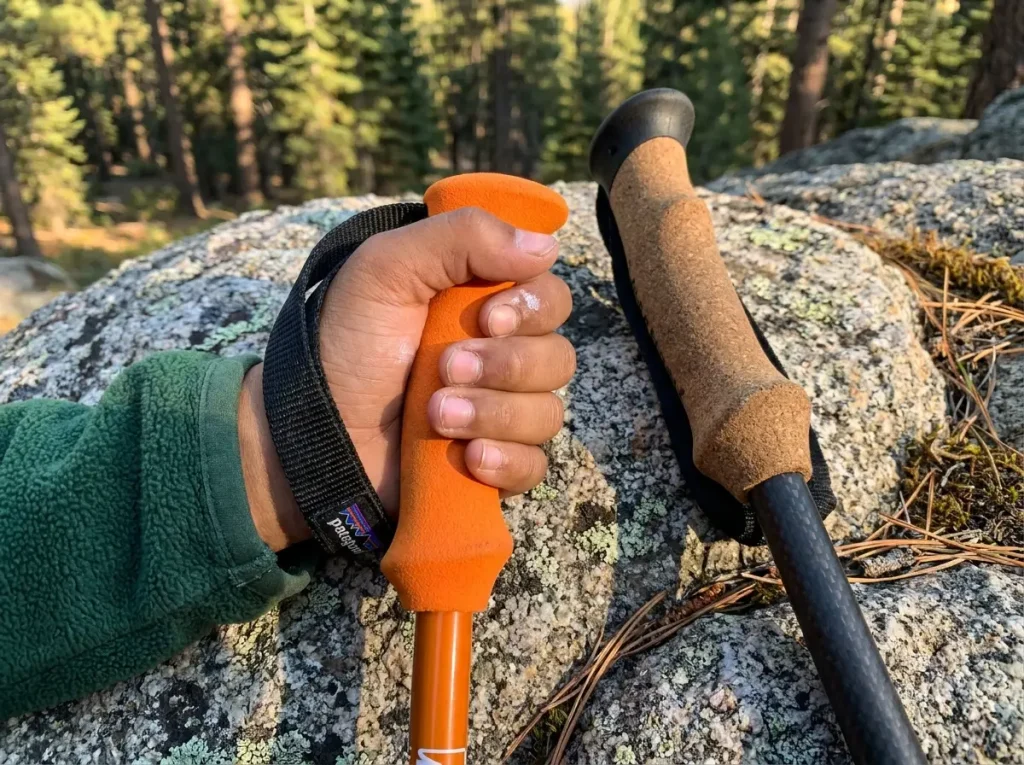
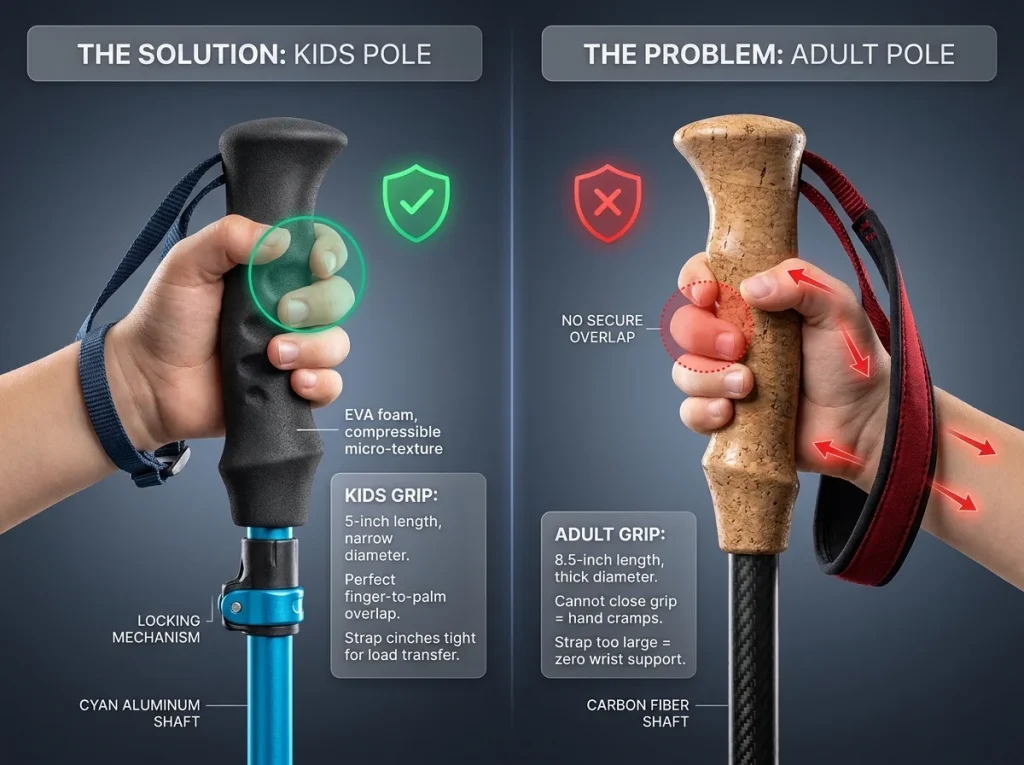
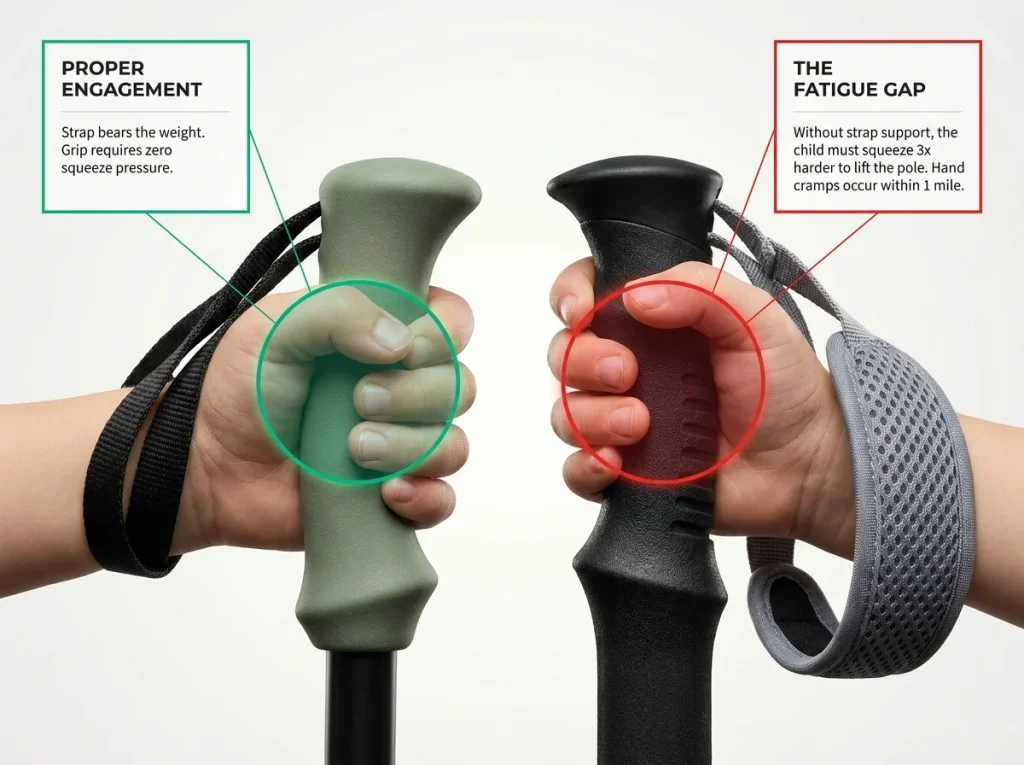
This is the feature parents underestimate the most. Kids’ trekking pole grips are roughly 5 inches long with a smaller diameter. Adult grips run 8–9 inches long and noticeably thicker. If your child can’t wrap their fingers fully around the grip, they’ll squeeze harder to compensate — and their hands will cramp within an hour.
Cork grips absorb sweat and conform to hand shape over time. They’re comfortable in warm weather but wear down faster. Foam grips are softer, lighter, and work well across temperatures. Rubber grips insulate well in cold conditions but can cause blisters when hands get sweaty. For most kids hiking in three-season conditions, foam is the safest choice.
Locking Mechanisms Kids Can Actually Operate
Lever locks (also called camlocks) are the right call for kids. They flip open, slide to adjust, and snap closed. A 7-year-old can do it.
Twist locks require gripping the pole sections and rotating them in opposite directions until they tighten. In theory, simple. In practice, kids don’t tighten them enough, and the pole slowly telescopes down during use. It happened to my daughter on a descent — the pole collapsed mid-step and she stumbled. She didn’t trust her poles again for three hikes after that.
If you’re looking at a specific pair, check the locking mechanism first. Lever locks cost a few dollars more and add a fraction of an ounce. They’re worth both.
Weight and Durability Trade-offs
Kids’ poles typically weigh 5–7 ounces each. Adult poles run 9–12 ounces each. That sounds like a small difference, but over a 5-mile hike swinging your arms several thousand times, it adds up — especially for arms attached to a 60-pound human.
Aluminum shafts are the right material for kids’ poles. They survive being dropped on rocks, thrown in a trunk, and used as leverage to flip over logs. When aluminum fails, it bends. You can sometimes bend it back. Carbon fiber is lighter but shatters on impact. For adults who baby their gear, carbon works. For kids who don’t, aluminum is the answer.
Pro tip: Don’t spend extra on carbon kids’ poles. Your child will outgrow them before the weight savings matter, and the first time a pole gets wedged between rocks and levered, carbon snaps. Aluminum bends and keeps working.
How to Adjust Trekking Poles on Trail With Kids
Setting the poles at the trailhead is step one. Adjusting them when the terrain changes is where most families stop — because nobody explained that it matters.
Uphill, Downhill, and Sidehill Settings
For uphill sections, shorten each pole by 5–10 cm from the flat-ground setting. This gives your child better leverage for planting above their feet and keeps their shoulders from lifting into their pack straps. The steeper the climb, the more you shorten.
For downhill sections, lengthen each pole by 5–10 cm. Longer poles keep the body more upright and let the poles absorb some of the impact that would otherwise hit the knees. Kids’ knees are resilient, but a long rocky descent is still a long rocky descent.
For sidehill traverses — trails that cut across a slope — shorten the uphill pole and lengthen the downhill pole. This keeps both arms at a comfortable angle instead of one arm reaching and the other cramped.
If you want to know when terrain changes are coming before you’re standing on them, reading contour lines to predict steep sections on a topo map takes about 10 minutes to learn.
Teaching Kids to Adjust Their Own Poles
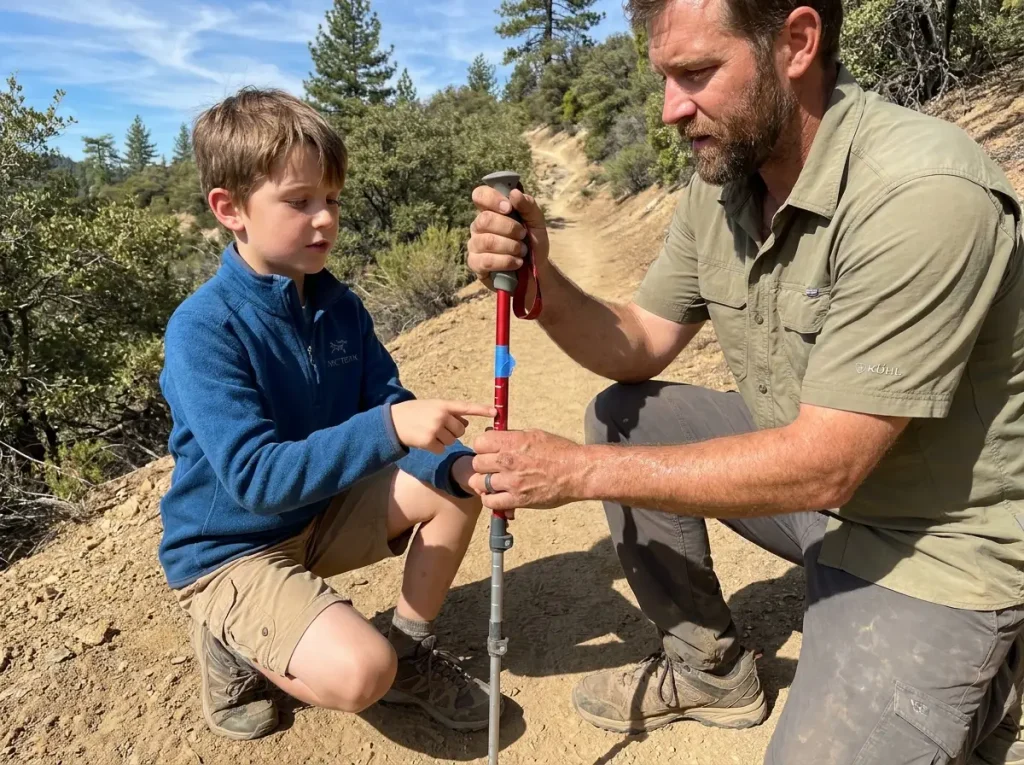
Kids under 8 will need you to make adjustments. Show them what you’re doing and explain why, but do it yourself. The fine motor coordination for working a lever lock while maintaining grip on the pole shaft is harder than it looks.
Kids 8 and up can learn to adjust their own poles. The trick is simplifying it: set the bottom section at baseline and lock it. All on-trail adjustments happen with the top section only. One section to adjust, one lever to operate, one decision to make — shorter going up, longer going down.
If your kid can’t remember which way, give them a physical cue: “Going up, poles go down. Going down, poles go up.” It’s counterintuitive until it isn’t. Before any hike with real elevation, it’s worth testing gear before you hit the trail so adjustments feel automatic when the terrain demands them.
Cut-Down Adult Poles vs Purpose-Built Kids Poles
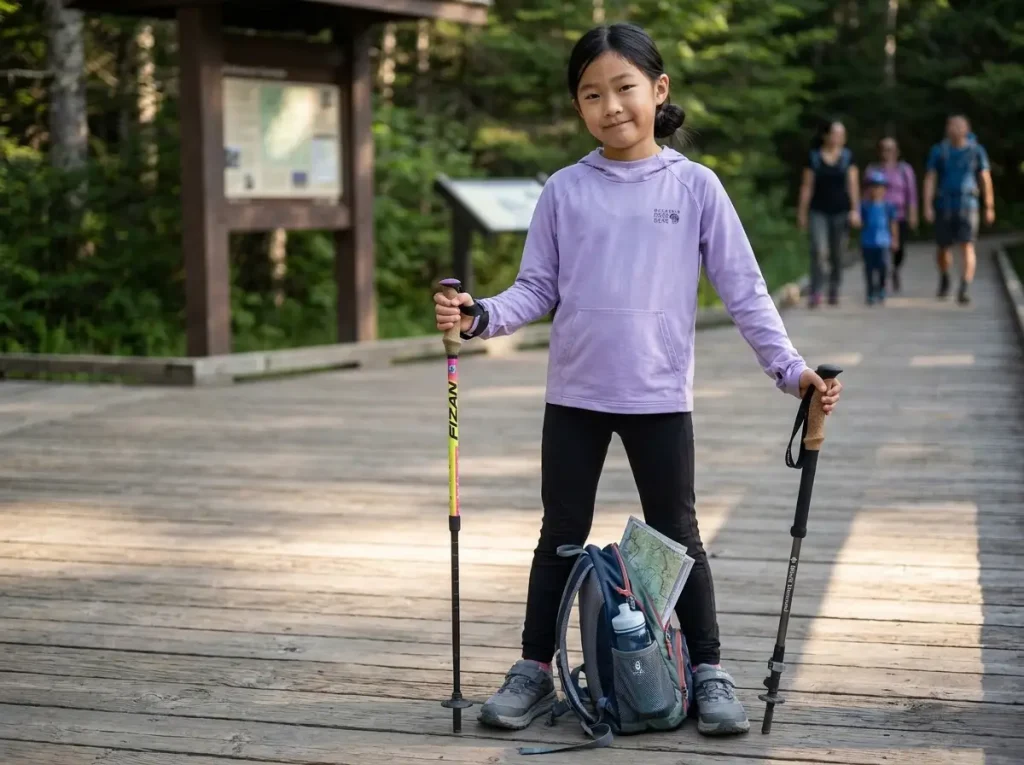
The question every budget-conscious hiking parent asks: can I just shorten my old poles instead of buying new ones?
Where Adult Poles Fail for Kids
The grip is the problem. A shortened adult pole still has an adult-sized grip — typically 8–9 inches long with a larger diameter. A child’s hand can’t wrap around it properly. They compensate by squeezing harder, which leads to hand cramps, forearm fatigue, and eventually abandoning the poles.
The wrist straps on adult poles are also sized for adult wrists. They won’t cinch down enough for a child’s wrist, which means the strap can’t do its job of supporting the hand and transferring load. Without proper strap engagement, your kid is doing all the work with grip strength alone.
Weight matters too. Adult poles at 9–12 ounces each vs kids’ poles at 5–7 ounces each doesn’t sound dramatic until you watch a 55-pound kid carry them for three miles. That’s a proportionally larger percentage of their body weight than it would be for you.
If you’ve ever wondered when trekking poles can actually work against you, poorly fitted poles on a child is a textbook example.
When Shortening Adult Poles Actually Works
For kids 10 and up with larger hands, shortening adult poles can work — if the grip fits. Have your child grip the pole. If their fingers wrap around it fully without straining, and the wrist strap adjusts small enough to snug their wrist, the adult pole is fine.
The break-even point is usually around 5’0″ tall with hands that fit a standard grip. Below that, purpose-built kids poles at $20–40 are the better investment. Above that, shortening a decent adult pole saves money and often gets you a better shaft material and locking mechanism than budget kids’ models offer.
Pro tip: If you’re passing adult poles down to a preteen, swap the rubber tips for fresh ones. Worn tips slip on rock and hardpack. New carbide tips cost $5–10 for a set and take 30 seconds to replace.
Picking Tips and Baskets for Kids’ Trail Conditions
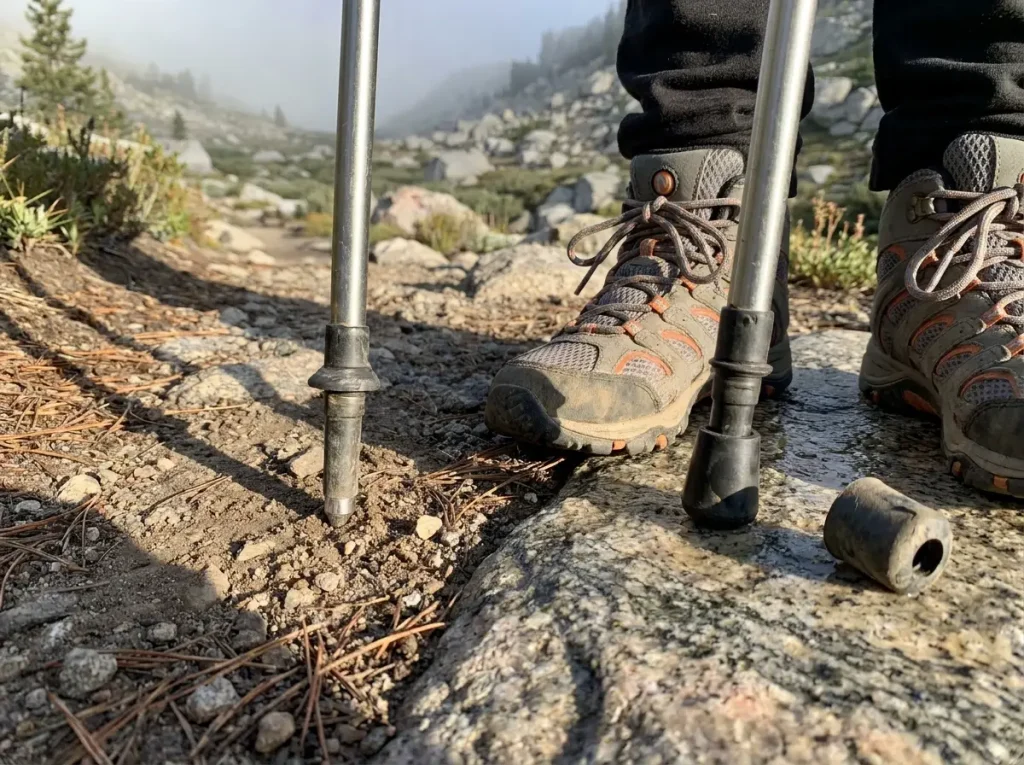
The bottom end of the pole matters more than most parents think. The wrong tip on the wrong surface is how kids slip, scratch boardwalks, or lose confidence in their poles entirely.
Carbide Tips vs Rubber Tips
Carbide tips (sometimes called tungsten tips) are the sharp metal points that come standard on most trekking poles. They bite into dirt, gravel, and soft ground. On natural trails with soil and loose rock, carbide tips provide the best traction.
Rubber tip caps slide over the carbide points and provide a flat, grippy surface for hard surfaces — pavement, rock slabs, wooden boardwalks, and indoor floors (for that inevitable post-hike restaurant stop). Rubber tips also protect the trail surface. Many trails with boardwalk sections require rubber tips to prevent damage.
Most kids’ poles come with removable rubber caps. Teach your child when to use which: rubber on rock and wood, carbide on dirt and gravel. The distinction is simple, and knowing it makes a kid feel competent rather than confused.
When to Use Baskets
Baskets are the small discs that sit above the tip and prevent poles from sinking too deep into soft ground. Standard small baskets work for summer trails. For snow or mud, wider baskets prevent the pole from plunging past the surface.
Most three-season hiking with kids doesn’t require changing baskets. The small standard baskets that come with the poles work fine on dirt, gravel, and light mud. If you’re taking kids snowshoeing or hiking in spring mud season, swap to wider baskets before you leave the car.
And if your family is considering whether a single trekking pole vs a pair makes more sense for younger hikers, a single pole is a solid starting point for kids under 7.
Keep a set of spare rubber tip caps in your pack. Kids lose them. They pop off when poles get wedged between rocks, or they get left behind at a rest stop. A spare set costs a couple of dollars and saves you from a kid hiking on carbide tips across a granite slab — which is exactly as sketchy as it sounds.
Conclusion
Three things determine whether your kid’s trekking poles become a trusted trail tool or get left in the garage after one hike. Size them using the 90-degree elbow test — not by age, not by guessing. Buy adjustable poles with lever locks and a grip that fits their actual hand, not a shortened adult pole with an oversized grip. And wait until your kid can maintain a walking rhythm and follow instructions before introducing poles — readiness matters more than age.
Take the poles on a short, flat trail first. Let your kid get comfortable with the weight, the rhythm, and the adjustments on easy ground. When they’re ready for something steeper, the poles will already feel like part of their kit — not something extra they have to deal with.
Q1 What size trekking poles for a child?
Use the 90-degree elbow rule — plant the pole tip on flat ground next to your child’s foot and check that their forearm is parallel to the ground. For most kids aged 6–12, pole lengths between 80–110 cm work. The sizing chart in this guide maps specific heights to exact pole lengths.
Q2 At what age can kids start using trekking poles?
Most children develop the coordination for two-pole use around age 6–7. Some coordinated 5-year-olds can handle a single pole on easy terrain. Below age 5, kids lack the bilateral coordination for rhythmic pole planting and the poles become toys or tripping hazards.
Q3 Are trekking poles worth it for kids?
Yes, on trails with elevation change, loose gravel, or rocky terrain. Poles reduce knee strain on descents and improve balance on uneven ground. On flat, smooth paths, most kids under 10 don’t need them and will lose interest quickly.
Q4 Should kids use one or two trekking poles?
Two poles provide better balance and distribute effort evenly across both sides. Start younger kids (ages 5–6) with a single pole to build coordination and the planting rhythm. Move to a pair once they can maintain the alternating left-right pattern naturally.
Q5 Can I cut down adult trekking poles for my child?
You can shorten the length, but the grip diameter, weight, and wrist strap size won’t change. Kids under 10 typically struggle with adult-sized grips, leading to hand cramps and fatigue. Purpose-built kids poles cost $20–40 and solve all three problems at once.
Risk Disclaimer: Hiking, trekking, backpacking, and all related outdoor activities involve inherent
risks which may result in serious injury, illness, or death. The information provided on The Hiking Tribe is for
educational and informational purposes only. While we strive for accuracy, information on trails, gear, techniques,
and safety is not a substitute for your own best judgment and thorough preparation. Trail conditions, weather, and
other environmental factors change rapidly and may differ from what is described on this site. Always check with
official sources like park services for the most current alerts and conditions. Never undertake a hike beyond your
abilities and always be prepared for the unexpected. By using this website, you agree that you are solely
responsible for your own safety. Any reliance you place on our content is strictly at your own risk, and you assume
all liability for your actions and decisions in the outdoors. The Hiking Tribe and its authors will not be held
liable for any injury, damage, or loss sustained in connection with the use of the information herein.
Affiliate Disclosure: We are a participant in the Amazon Services LLC Associates Program, an
affiliate advertising program designed to provide a means for us to earn advertising fees by advertising and linking
to Amazon.com. As an Amazon Associate, we earn from qualifying purchases. We are also an official affiliate partner
of Black Diamond Equipment via the AvantLink network. If you click on a Black Diamond affiliate link and make a
purchase, we may earn a commission at no additional cost to you. We also participate in other affiliate programs and
may receive a commission on products purchased through our links. Additional terms are found in the terms of
service.