In this article
The hive was invisible until your boot caught it. One second you were descending a talus field in the Sierra; the next, four yellow jackets had already found skin. The first sting was sharp and forgettable — you’ve been stung before. By the time the third one landed on your forearm, your throat felt like someone had slipped a drawstring around it. You’re nine miles from the trailhead. Your pack has an EpiPen somewhere in it. And you have maybe four minutes to act before the margin for error disappears completely.
I’ve worked as a trekking instructor for years, and I can tell you that bee sting allergic reaction situations follow the same pattern every time: the hiker who waited, who second-guessed, who reached for Benadryl first. The outcome of that choice is documented in every wilderness medicine case study worth reading.
Here’s exactly what to do — no panic, no improvisation.
⚡ Quick Answer: If you’re stung and develop symptoms in two or more body systems — hives plus a scratchy throat, or dizziness plus nausea — that is systemic anaphylaxis, and you inject epinephrine immediately. Remove the stinger as fast as possible (method doesn’t matter, speed does). Benadryl does not reverse an allergic reaction — it only masks hives. After injecting, stop moving, monitor for a biphasic reaction for 4–8 hours, and activate your SOS device if symptoms return or were severe. Do not hike out on your own after using an EpiPen.
Reading the Reaction — Local Sting vs. Systemic Anaphylaxis
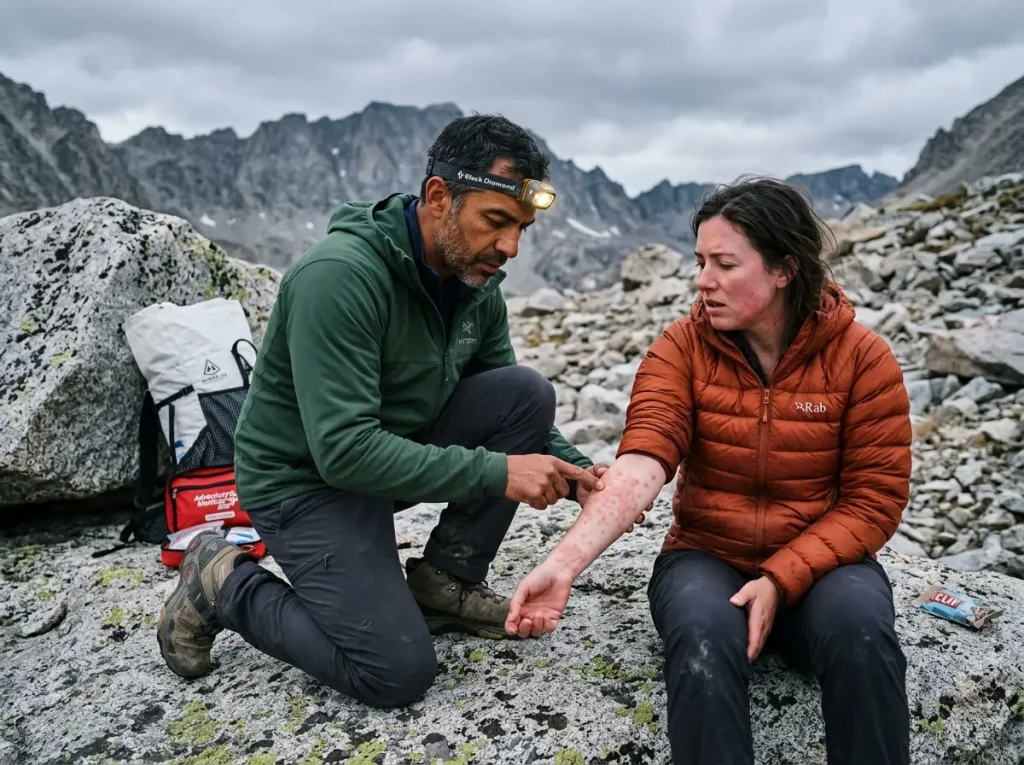
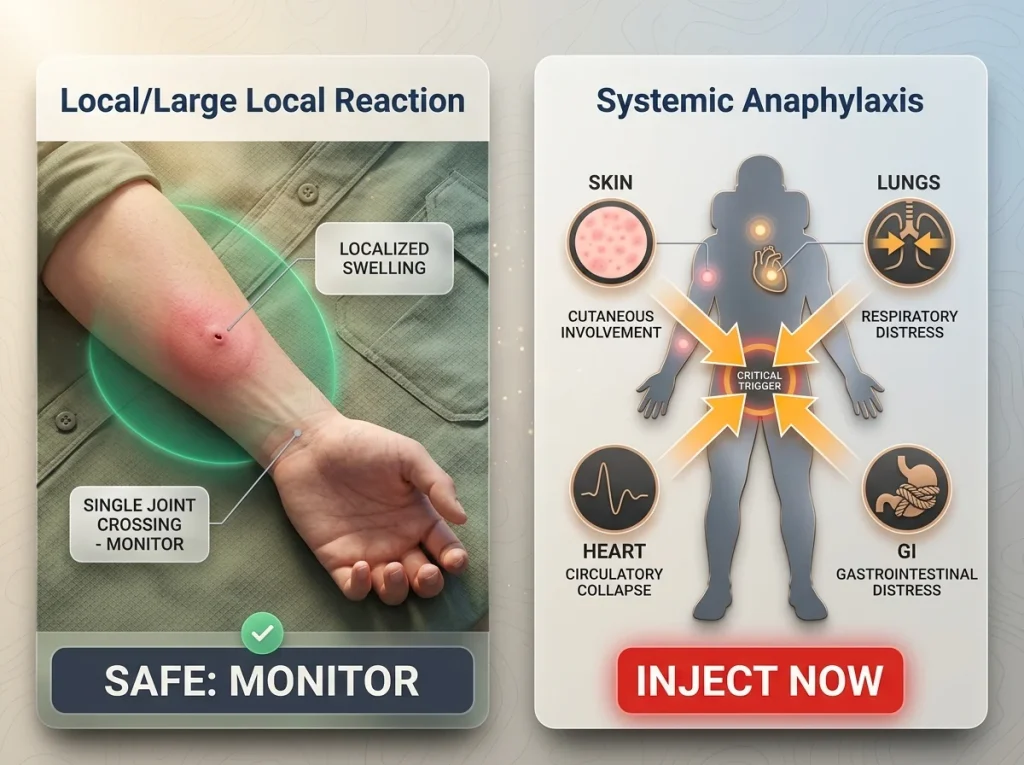
Most stings hurt. That’s normal. A local reaction — redness, swelling at the site, maybe some pain that crosses a joint — is uncomfortable but not life-threatening. It doesn’t require epinephrine.
Systemic anaphylaxis is something else. According to the Wilderness Medical Society anaphylaxis clinical practice guidelines, the field diagnostic standard is the two-system rule: when two or more organ systems show acute symptoms simultaneously after a sting, you treat for anaphylaxis. Not when you’re certain. When two systems are involved.
The most common first sign — present in 80–90% of cases — is cutaneous involvement: generalized hives appearing far from the sting site, flushing of the face and neck, lip or tongue swelling. These aren’t just itchy. They tell you the cascade has gone systemic.
The part that gets hikers in trouble isn’t always the scary-looking part. It’s the throat. A persistent dry cough, a “scratchy” or “thick” feeling, and especially a hoarse voice signal laryngeal edema — the airway is starting to close. By the time you hear wheezing or stridor on inhale, you’re already several steps down a bad road.
Circulatory signs — dizziness, a weak pulse, the subjective feeling that something is seriously wrong — often show up before the hiker loses consciousness. That “impending doom” sensation is a documented clinical marker. If a patient says “something feels really wrong,” that’s not panic. That’s a neurological early warning.
GI symptoms matter too. Sudden severe cramping or nausea after a sting satisfies the two-system criterion when paired with skin signs. Hikers dismiss this as nerves. Don’t.
The field rule is simple: if hives appear anywhere other than the sting site and you feel off, treat as anaphylaxis. You can always reevaluate once the epinephrine is in. You cannot undo ten minutes of hesitation.
Applying this diagnostic framework is the foundation of all wilderness first aid protocols for backcountry emergencies.
⚡ Pro Tip: Ask yourself — or your partner — one direct question: “Does your voice sound different?” Voice changes are something you can self-detect before anyone else hears stridor. If the answer is yes, inject immediately.
The Epinephrine Protocol — Why Nothing Else Comes First
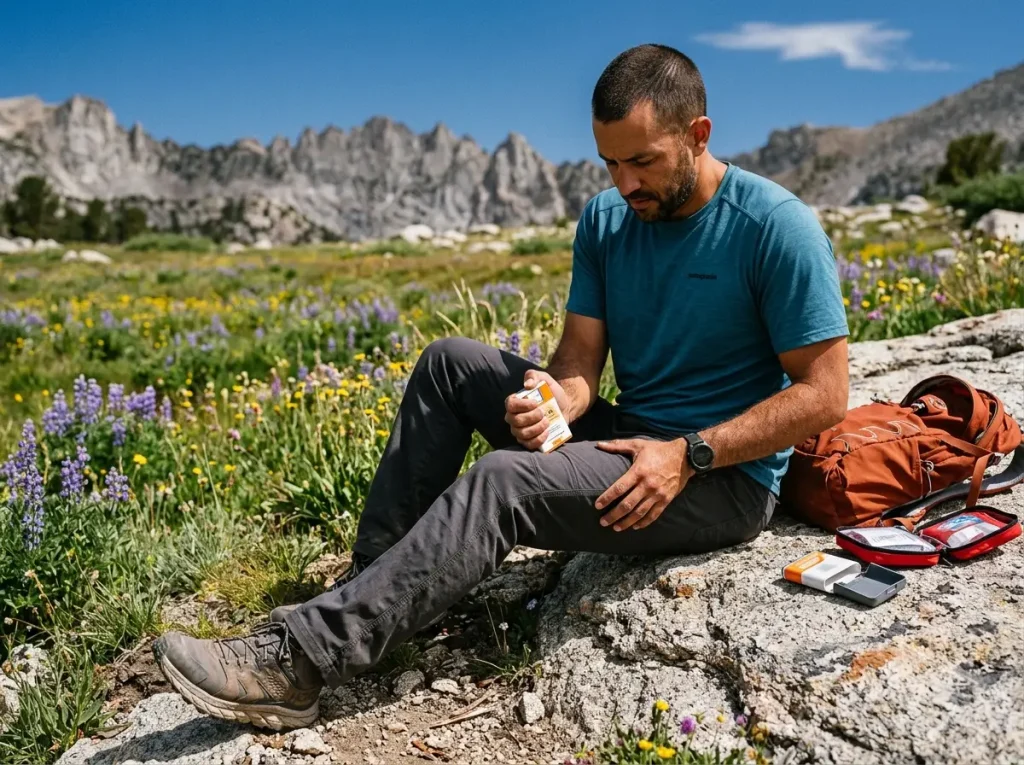
Benadryl is for hives. Epinephrine is for staying alive. These are not interchangeable, and the confusion between them has put hikers in helicopters.
Diphenhydramine (Benadryl) blocks H1 and H2 histamine receptors. It reduces itching and skin symptoms. It does nothing — absolutely nothing — to reverse airway constriction, vascular collapse, or throat swelling. A 50mg dose also causes significant sedation, which can mask a deteriorating level of consciousness in a hiker already running low on blood pressure. Giving Benadryl first wastes the critical injection window and can make you think you’re winning when the cascade is still running hot.
Epinephrine works at the receptor level to reverse the mechanisms shutting you down: it constricts blood vessels (reversing the hypotension and reducing airway mucosal swelling) and opens the bronchioles (restoring airflow). Nothing in your first aid kit does what it does.
I’ve watched hikers pull out their Benadryl first. Every time, it’s the same rationale: “I’ll see if it gets worse.” By the time worse is obvious, the window narrows fast. Five minutes of Benadryl hesitation costs you half the margin you had.
The American College of Allergy, Asthma and Immunology guidelines on insect sting anaphylaxis align with WMS clinical guidelines on epinephrine as first-line anaphylaxis treatment on one point that has no exceptions: there are no absolute contraindications to epinephrine in a life-threatening systemic reaction. Cardiac history, pregnancy — none of these override a closing airway in the backcountry. Inject.
The standard adult dose is 0.3 mg IM into the anterolateral mid-thigh — the outer thigh, through your hiking pants. Modern auto-injectors are designed to penetrate softshell and denim. You don’t need to bare skin. The outer thigh has the fastest, most reliable absorption for intramuscular dosing under stress. It also requires only a gross motor stabbing motion — which matters when your hands are going gray from low blood pressure and fine motor control has left the building.
Approximately 8–12% of patients require a second dose. This is expected, not exceptional. WMS protocols authorize repeat doses every 5–15 minutes if the condition doesn’t improve. Carry a two-pack. The “one pen” situation — where a hiker used their only EpiPen and symptoms returned 20 minutes later, five miles from the trailhead — shows up in community case analysis repeatedly. It’s preventable.
Knowing when to inject is only half the equation — knowing what to pack is the other. See our complete guide on building a backcountry first aid kit that includes epinephrine.
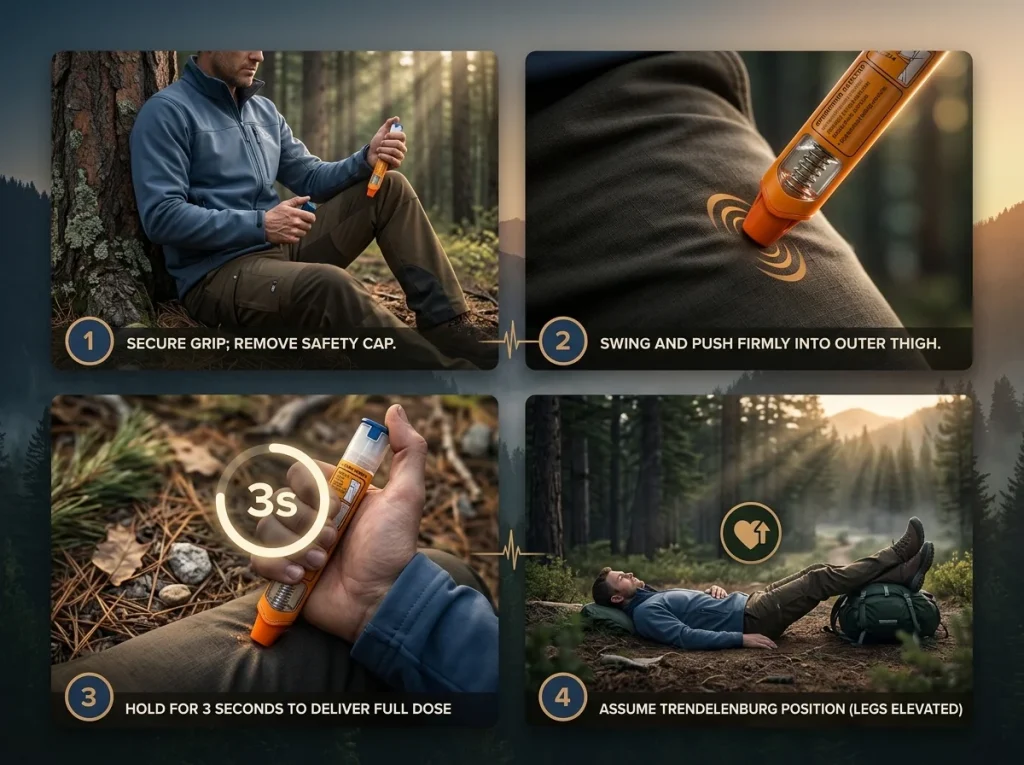
⚡ Pro Tip: Know the hierarchy cold before you leave the trailhead: Epinephrine first. Benadryl and Pepcid only after the patient is stable and can swallow safely. Prednisone (for high-risk patients per WMS guidelines) takes hours to act and is not a substitute for either of the above.
Stinger Removal — Speed Beats Technique Every Time
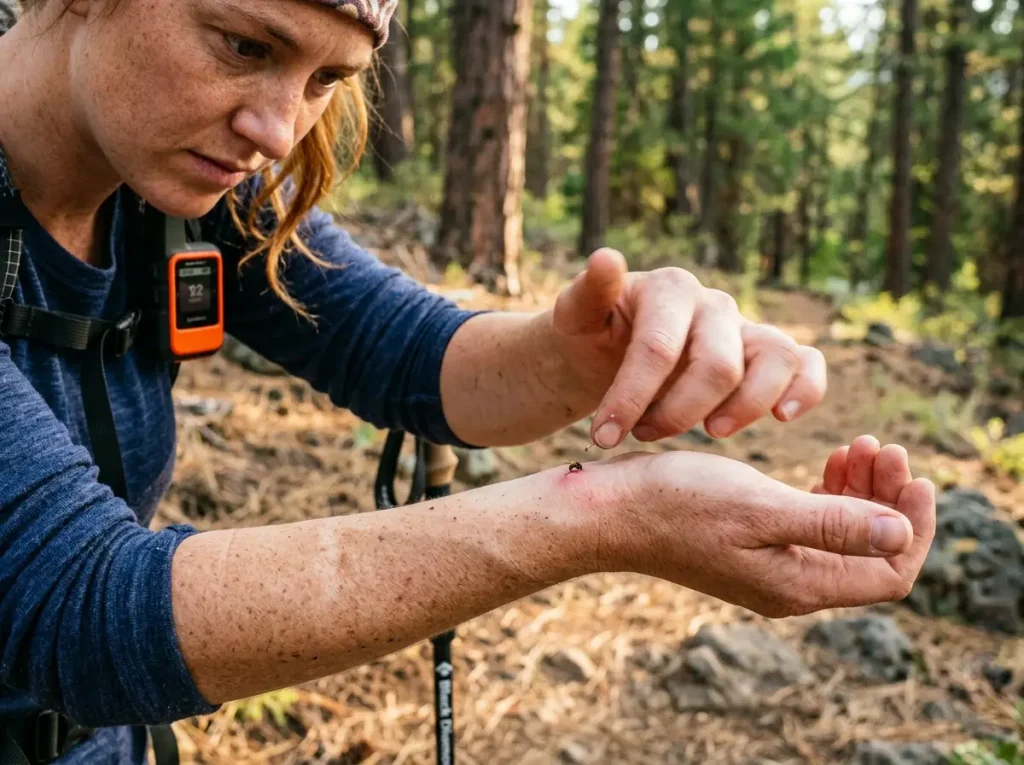
You’ve heard the advice: scrape the stinger out with a credit card, don’t pinch it, you’ll squeeze the venom sac. That advice is wrong, and the biology explains why.
A honeybee’s stinger detaches with the venom sac and an autonomous nerve ganglion intact. That ganglion drives a valve-and-piston mechanism that continues pumping venom regardless of what you do on the outside. The venom sac has no muscular walls — you literally cannot “squeeze” it by pinching. The old turkey-baster model of the venom sac is simply wrong.
Research from UC Riverside entomology on bee sting removal timing confirms what human trial data shows: venom delivery is maximally complete within 30–60 seconds regardless of removal method. Scraping at 2 seconds produces an 80 mm² wheal. Pinching at 2 seconds produces a 74 mm² wheal — marginally smaller. A 30-second delay produces maximal envenomation. Speed is the only variable that changes the outcome.
The recommended field protocol is direct: remove the stinger immediately with whatever is at hand. Your fingernail at 2 seconds beats the right tool found at 10. Pack buckle edge, trekking pole handle, credit card if it’s already in your hand — any of these work. What doesn’t work is digging through your pack while the ganglion finishes the job.
Hyaluronidase — the “spreading factor” in the venom — actively degrades connective tissue to accelerate venom migration. Every second of delay is wider distribution.
After removal, don’t rub the site. Rubbing increases mast cell activation, which accelerates histamine release. Flick the stinger out and leave it.
For the complete rapid-response decision tree, see our field-tested wilderness first aid reference for rapid response decisions.
Note: wasps, hornets, and yellow jackets have smooth stingers that don’t detach. For those stings, skip the removal search and go straight to symptom assessment.
Keeping Your Medication Alive — Epinephrine Storage in the Field
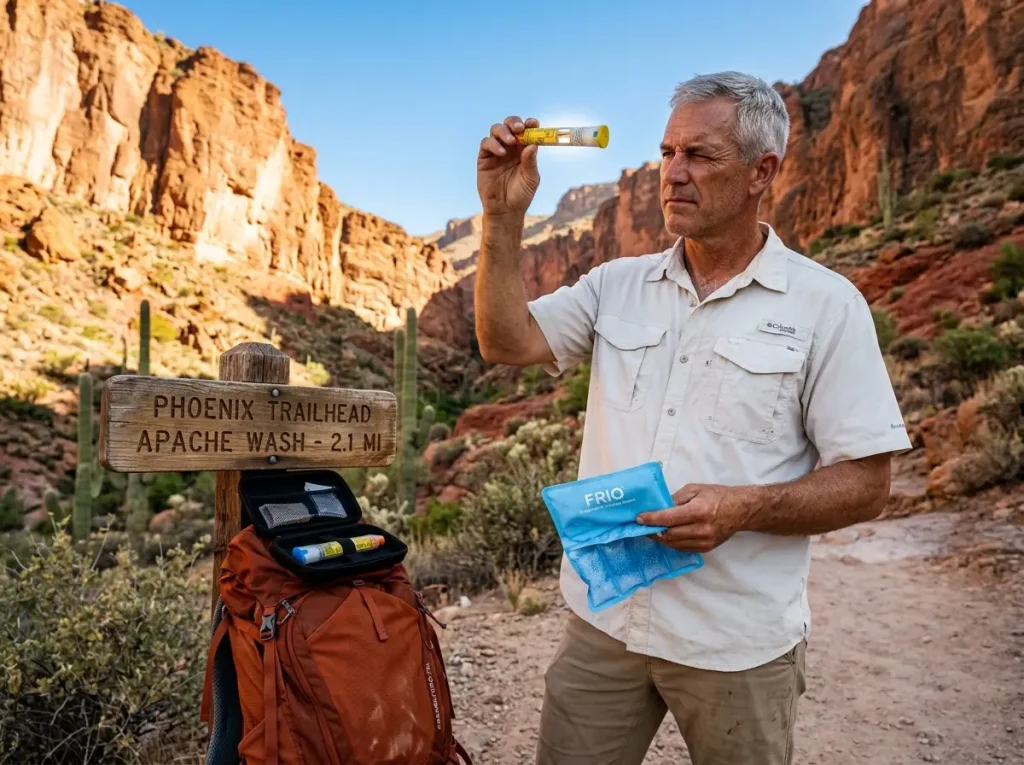
I’ve pulled EpiPens from the side pockets of packs that had been baking in Sonoran Desert sun for four hours. The devices were within their expiration date. They were also functionally compromised. Expiration labels don’t negotiate with thermodynamics.
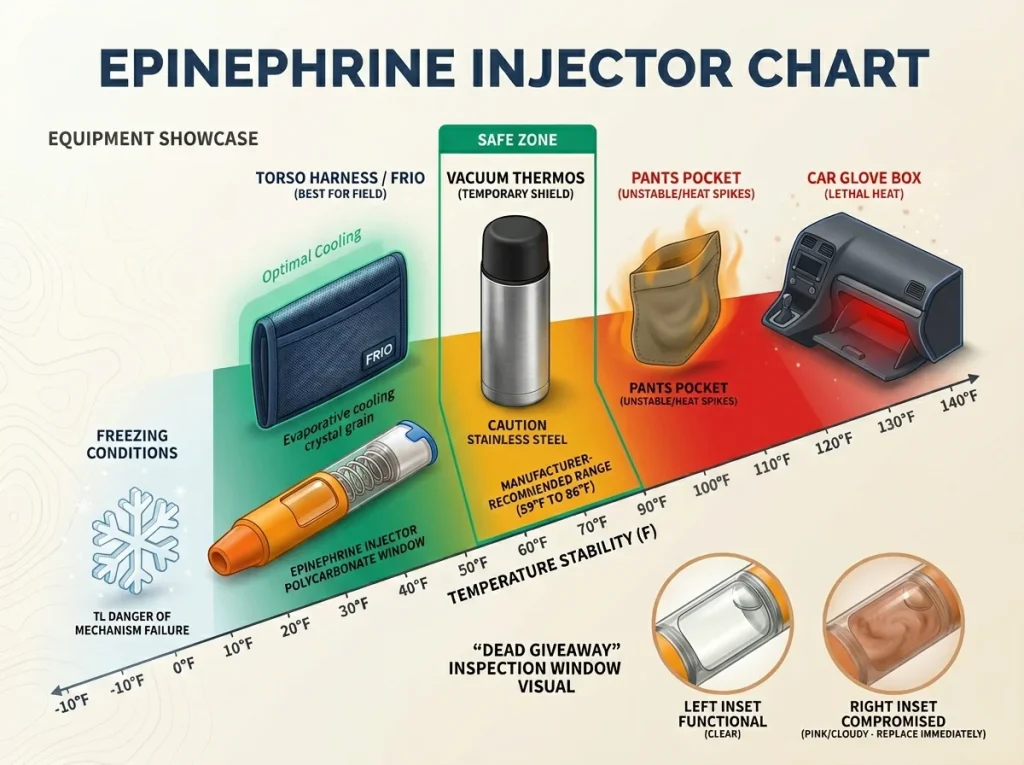
The manufacturer storage range for epinephrine is 68–77°F, with brief excursions tolerated between 59–86°F. Trail conditions don’t cooperate. A pack in direct summer sun hits temperatures well above that threshold within an hour. A pack left in a car glove box can reach temperatures that degrade potency in minutes — data confirmed by the Allergy & Asthma Network’s clinical guidance on epinephrine degradation from heat exposure.
Heat degradation causes epinephrine to oxidize — you’ll see it through the inspection window as a pinkish, brown, or cloudy appearance. Clear means functional. Any color change means replace it before your next trip, regardless of expiration date. Check the window before every trip.
Freezing is equally damaging. The auto-injector mechanism can seize at sub-freezing temperatures, and the glass vial can shatter. A device at -10°F is dead weight.
For cold-weather trekking, the body heat method works. Wear the device on a necklace or torso harness under insulating layers. Longleaf Wilderness Medicine field studies documented data loggers worn this way maintaining therapeutic temperature range through a five-day winter expedition in sub-zero ambient conditions. Pants pockets are a last resort — high temperature variance and physical damage risk.
For summer desert hiking, Frio Evaporative Cooling Wallets are the only passive solution at scale. Crystals soaked in water provide up to 45 hours of cooling through evaporation. Re-wet them at every water source you cross. A dry Frio doesn’t just stop cooling — it creates false security while temperatures climb.
The Sonoran Desert in July will teach you this faster than any manual. I started verifying the inspection window before every trip after pulling a cloudy EpiPen at a trailhead when I needed it most. That was the last time I skipped the pre-trip check.
The same layering principles that protect a water bottle from freezing apply to your EpiPen — see our deep dive on layered insulation strategies to protect liquids against freezing on winter hikes.
⚡ Pro Tip: Re-wet your Frio wallet at every water source during summer treks. Once the crystals dry out, the cooling effect ends and temperature spikes rapidly. Check it as routinely as you check your fuel canister.
The Altitude Factor — When Elevation Complicates Everything
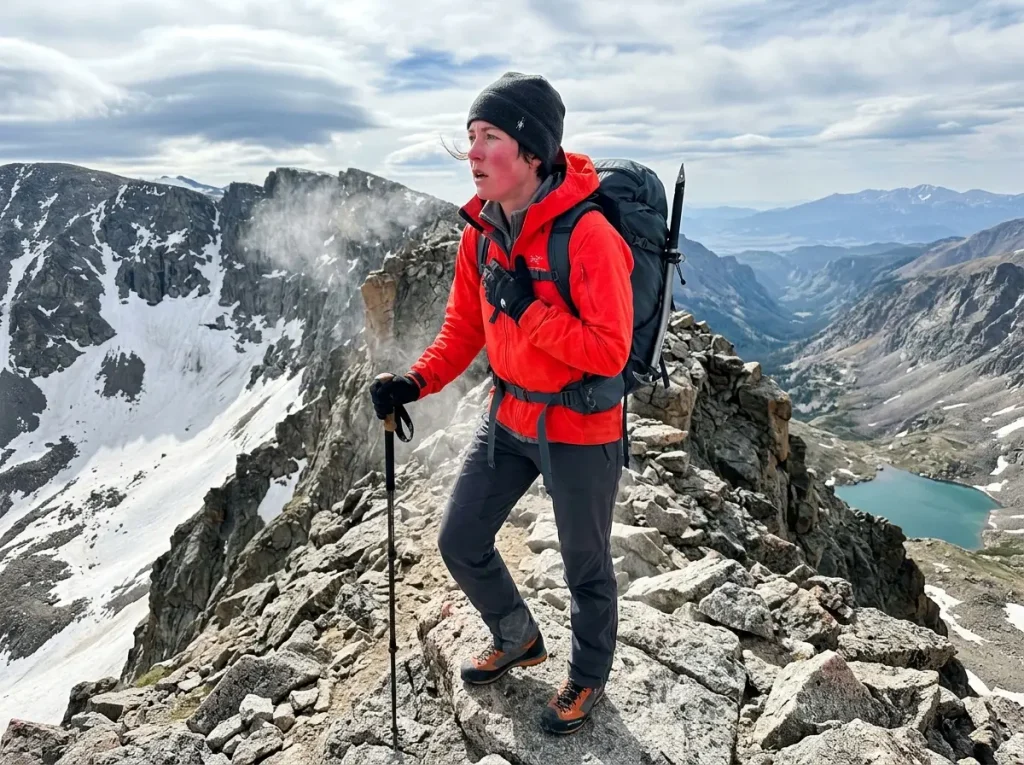
At altitude, you have about half the time you think you do. That’s not hyperbole.
Above 2,500 meters (8,200 ft), reduced barometric pressure lowers the oxygen available with each breath. An unacclimatized hiker is already running an elevated respiratory rate and baseline heart rate just to move through the terrain. When anaphylaxis-induced airway constriction hits that system, it doesn’t add to the problem — it multiplies it. The synergistic effect can accelerate respiratory failure from concerning to critical in minutes.
At Everest Base Camp (5,500 meters), atmospheric pressure is roughly half of sea level. A hiker experiencing even a moderate allergic reaction here will reach critically low blood oxygen levels far faster than at sea level. Peer-reviewed research on wilderness medicine at high altitude and physiological considerations for emergency response confirms the interaction between high-altitude low oxygen and respiratory emergencies.
The diagnostic confusion hazard at altitude deserves its own paragraph. High Altitude Pulmonary Edema (HAPE) presents with cough, wheezing, and chest tightness — nearly identical to anaphylaxis respiratory involvement. The key differentiator: anaphylaxis almost always includes skin signs (hives, flushing, angioedema). HAPE does not. If skin signs are present, treat for anaphylaxis first. Epinephrine will not worsen HAPE and may buy critical descent time if the airway is compromised.
When in doubt at altitude, inject epinephrine and descend.
Exertion has another specific impact at high elevations: increased cardiac output accelerates venom distribution, which means the stop-moving rule becomes non-negotiable the moment you notice the first systemic sign. Stop the exertion before you find the flat spot. Then find the flat spot.
If you’re trekking above 10,000 feet, understanding your altitude baseline matters for any medical emergency — our complete field guide to altitude acclimatization and physiological stress in high-elevation environments is required reading before any high-elevation trip.
The Evacuation Decision Matrix — Stay, Walk, or SOS
The epinephrine surge feels like recovery. It isn’t. That adrenergic rush — the clarity, the energy, the sense that you’re going to be fine — is the drug. The allergic cascade is still active underneath it. Hikers who inject and feel that surge often start packing up camp. That ten-minute reprieve is bait.
The WMS backcountry anaphylaxis management and evacuation protocols establish a clear decision framework:
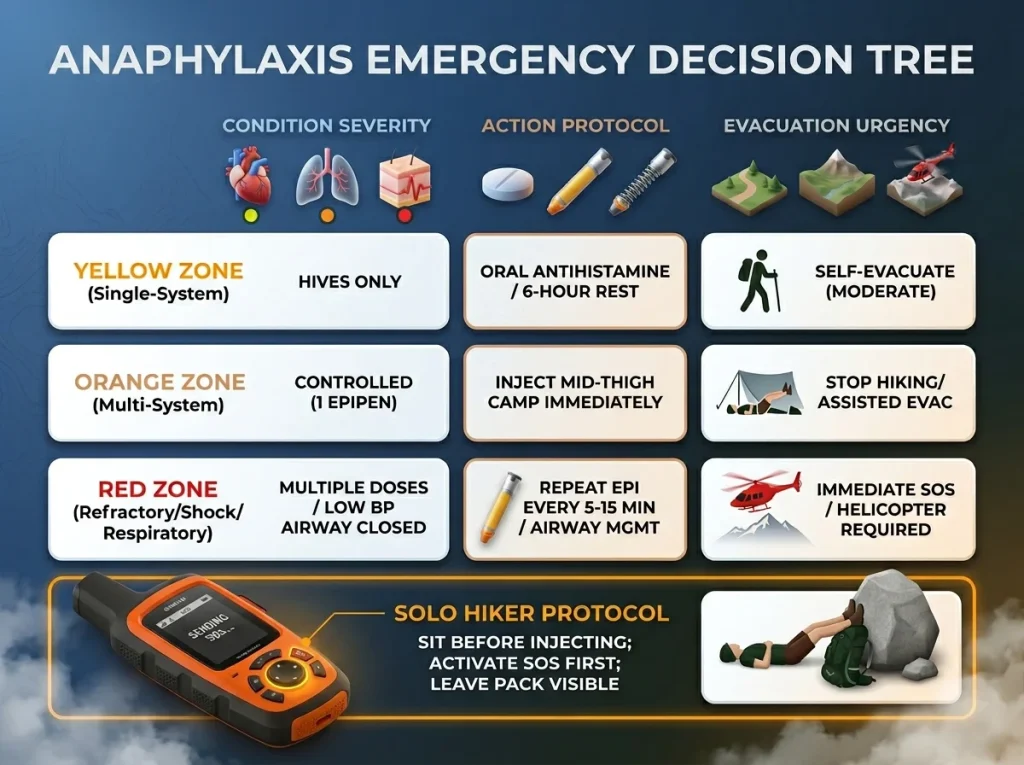
- Single-system (hives only): Oral antihistamine, 6-hour rest, monitor. Self-evacuate at moderate urgency.
- Multi-system (controlled with one EpiPen): 12–24 hour camp and monitoring. Stop hiking. Self-evacuate or assisted.
- Refractory (requires more than one dose): Immediate SOS activation. Maintain airway. Helicopter or SAR required.
- Hypotension or shock: Legs elevated (Trendelenburg position). Immediate SOS. Critical.
- Respiratory distress: Seated or semi-reclined position. Immediate SOS. Critical.
The biphasic reaction is what catches people. It occurs in approximately 4–6% of anaphylaxis cases and can appear up to 72 hours later — though the majority show up within 4–8 hours of the initial event. Risk factors include a severe initial reaction, delayed epinephrine administration, and needing more than one dose. If you stabilized with one EpiPen, you’re not out of the woods for at least half a day. Camp. Do not hike through the biphasic window.
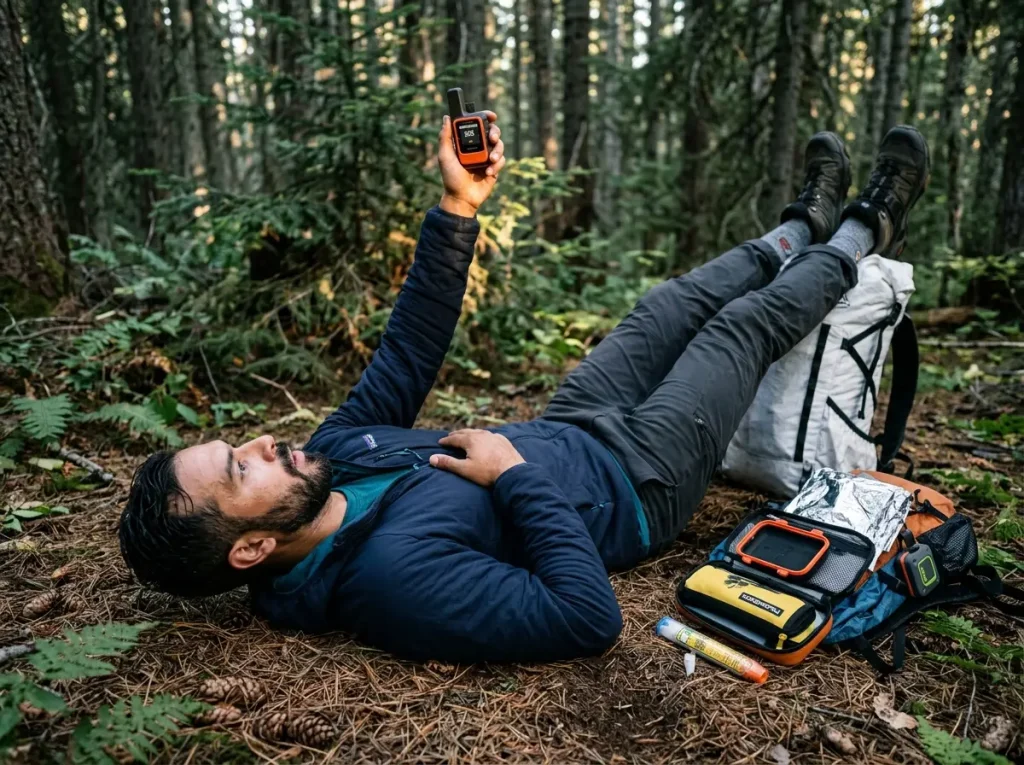
For solo hikers, the protocol is specific. Identify symptoms early — don’t wait for certainty. Sit against a solid surface (tree, rock) before injecting so you don’t fall if you faint. Inject into the outer thigh. Then activate your SOS device before you potentially lose consciousness. The SOS button on a Garmin inReach or Zoleo takes priority over texting a partner. After injection, assume Trendelenburg — legs elevated above heart level. If you can, leave your pack visible and trail-facing.
A pre-filed trip plan with a responsible contact is your second layer. SAR can begin mobilizing when your trail angel doesn’t hear from you, even if your SOS device goes silent. Our field test of PLB vs satellite messenger for wilderness SOS activation breaks down which device gets SAR moving fastest.
A pre-filed trip plan is the difference between SAR starting immediately and starting when someone notices you didn’t come home. Here’s the pre-filed trip plan protocol that SAR teams actually use.
⚡ Pro Tip: Tell your trail angel exactly what time you should be back at the trailhead. If your SOS goes silent and you haven’t returned, they call SAR. The SOS button and a pre-filed trip plan together are your two-factor field safety system. Either one alone has gaps.
Conclusion
Three things keep a bee sting allergic reaction on trail from becoming a fatality.
Epinephrine is not optional and it is not second. When two body systems react after a sting, you inject. Reaching for Benadryl first is the mistake that field case analyses keep documenting. Every second you spend on antihistamines is a second the cascade runs uncontrolled.
Speed beats technique for stinger removal. Your fingernail at 2 seconds beats the right tool at 10. The venom sac runs on a 30–60 second countdown from the moment the stinger anchors — and the biology doesn’t pause while you find a credit card.
The biphasic window is the hidden threat. Stabilized is not the same as safe. Sit, monitor for 4–8 hours, resist the adrenergic surge that tells your body it’s time to hike out. Walking it off is how a manageable emergency becomes one that requires a helicopter.
Before your next backcountry trip, run a 5-minute drill: pull your EpiPen from its pouch, practice the swing-and-press motion, confirm the inspection window is clear, and make sure every person in your group knows where the kit is. That drill has a documented survival payoff. Do it before you hit the trail.
FAQ
What is the first thing to do if you have an allergic reaction to a bee sting on a trail?
Stop moving immediately to reduce your heart rate and slow venom distribution. If you observe two or more body systems reacting — skin signs plus any respiratory, circulatory, or GI involvement — administer epinephrine into the outer thigh without delay. Do not take Benadryl first; antihistamines cannot reverse airway constriction or vascular collapse.
How long do you have to use an EpiPen after a sting before it’s too late?
There is no fixed safe window — reaction speed varies by individual sensitivity, venom load, and exertion level. The WMS protocol is to treat anaphylaxis at the first appearance of multi-system involvement rather than waiting for the reaction to declare itself. In high-exertion environments, systemic symptoms can escalate from early warning to respiratory failure in under ten minutes.
Can I hike out after using an EpiPen for a bee sting allergic reaction?
No. The adrenergic surge from epinephrine may feel like recovery, but the allergic cascade is still active. WMS protocols prohibit active hiking after epinephrine administration. Physical exertion can trigger a severe biphasic reaction as the drug wears off. Camp immediately, monitor for 4–8 hours, and self-evacuate passively via assisted carry or activate SOS.
Is Benadryl or epinephrine better for a bee sting allergic reaction?
Epinephrine is the only first-line treatment for systemic anaphylaxis. Benadryl (diphenhydramine) is a secondary, supportive medication used only after epinephrine has stabilized the patient. Benadryl reduces histamine-driven hives and itching but cannot reverse airway constriction or distributive shock. Treating with Benadryl first in a backcountry emergency is clinically hazardous.
How do I treat an insect sting if I don’t have an EpiPen on the trail?
Without epinephrine, options for true anaphylaxis are extremely limited. Position the patient flat with legs elevated (Trendelenburg) to maintain cerebral perfusion. Activate SOS or PLB immediately. An oral antihistamine may reduce skin symptoms but will not reverse airway closure. This scenario is exactly why wilderness medicine organizations uniformly advise carrying two auto-injectors — the no-kit scenario is one that field planning can prevent entirely.
Risk Disclaimer: Hiking, trekking, backpacking, and all related outdoor activities involve inherent
risks which may result in serious injury, illness, or death. The information provided on The Hiking Tribe is for
educational and informational purposes only. While we strive for accuracy, information on trails, gear, techniques,
and safety is not a substitute for your own best judgment and thorough preparation. Trail conditions, weather, and
other environmental factors change rapidly and may differ from what is described on this site. Always check with
official sources like park services for the most current alerts and conditions. Never undertake a hike beyond your
abilities and always be prepared for the unexpected. By using this website, you agree that you are solely
responsible for your own safety. Any reliance you place on our content is strictly at your own risk, and you assume
all liability for your actions and decisions in the outdoors. The Hiking Tribe and its authors will not be held
liable for any injury, damage, or loss sustained in connection with the use of the information herein.
Affiliate Disclosure: We are a participant in the Amazon Services LLC Associates Program, an
affiliate advertising program designed to provide a means for us to earn advertising fees by advertising and linking
to Amazon.com. As an Amazon Associate, we earn from qualifying purchases. We are also an official affiliate partner
of Black Diamond Equipment via the AvantLink network. If you click on a Black Diamond affiliate link and make a
purchase, we may earn a commission at no additional cost to you. We also participate in other affiliate programs and
may receive a commission on products purchased through our links. Additional terms are found in the terms of
service.