In this article
Mile 38 of a 4-day Sierra traverse. My quads were on fire, my breathing had gone ragged, and every footfall felt like dragging sandbags up a granite staircase. Then my hiking partner passed me — poles swinging in a clean, metronomic rhythmic cadence, barely winded. Same elevation. Same pack weight. Same trail. The difference was cadence. She’d been working the straps and syncing her pole plants to her breath for years. I’d been hauling expensive sticks.
That day changed how I think about poles. They’re not balance aids. They’re not optional accessories for bad knees. Used correctly, they redistribute load across your entire body, regulate your pace like a metronome, and let you cover steep terrain with measurably less effort — 21% less perceived exertion on steep inclines. But only if your cadence is right.
⚡ Quick Answer: The standard trekking pole rhythm plants the opposite pole as your leading foot strikes — right foot forward, left pole down. On flat trail, keep your elbow at 90 degrees and let the pole straps carry the load, not your grip. On uphills, shorten poles 5-10cm and consider switching to a 2:1 ratio or double-poling on steep sections. Downhill, lengthen poles 5-10cm and use quick short plants ahead of each footstrike to protect your knees. Research shows this technique reduces lower limb muscle activation by 14.8% and knee joint loading by 25% on descents.
The Science Behind Pole Cadence (And Why Your Legs Care)
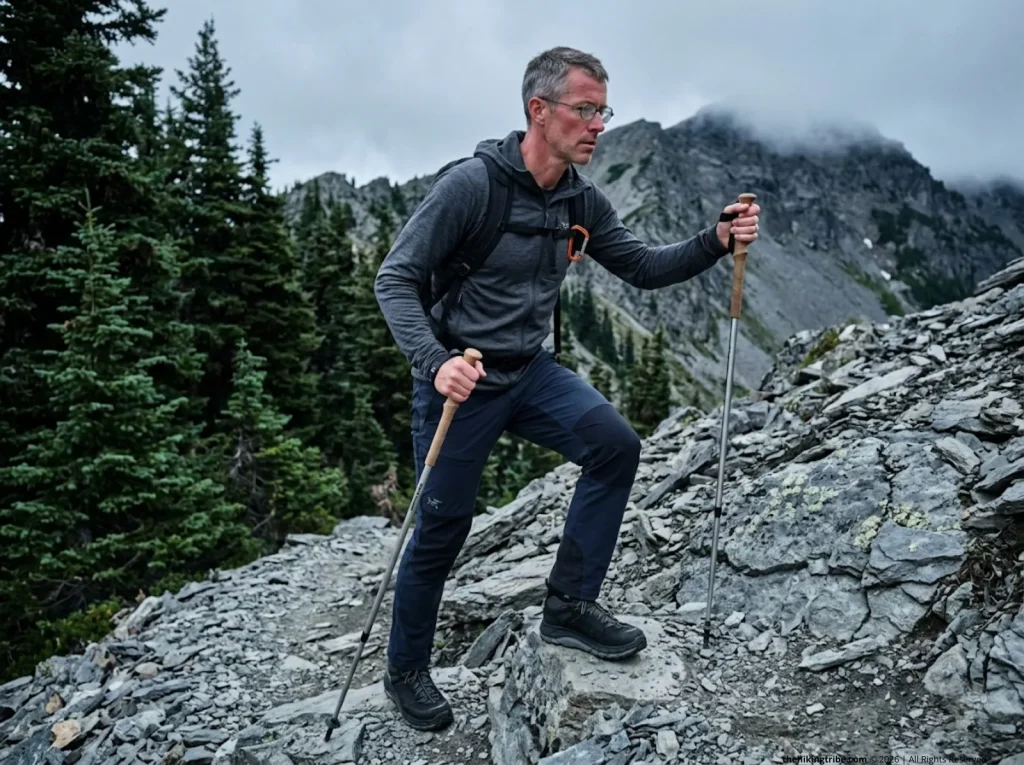
Most hikers think poles are about stability. They’re about something more useful: load redistribution across a larger muscle system. Your legs were doing all the work before. Poles recruit your arms, shoulders, triceps, and core — turning a two-wheel drive into four-wheel drive over long terrain.
How Poles Redistribute the Load
According to a systematic review published by the National Institutes of Health that analyzed 31 studies across 430 subjects, trekking poles reduce lower limb muscle activation by 14.8% as measured by EMG. Your gastrocnemius (calf) drops 26%. Your soleus — the deeper calf muscle that cramps first on descents — drops 22%. Poles also cut ground reaction force by 2.9-4.4% per step. That sounds small until you multiply it across 30,000 steps on a 15-mile day.
The trade-off is real: your triceps activation increases 150% with vigorous pole usage. You’re not eliminating work. You’re spreading it across fresh muscle groups that your legs can’t touch, which is why experienced multi-day hikers often have noticeably developed upper bodies. For a broader look at joint protection and long-term benefits, see the biomechanical benefits of trekking poles.
The Metronome Effect
Here’s what most guides miss about pole cadence. The physical load redistribution is only half the story. The other half is rhythmic regulation.
Consistent pole plant timing creates what hikers call the “metronome effect” — a steady beat that your pace and breathing lock onto. Pendular energy recovery improves 10.8% when you establish a true rhythm. Think of it like a grandfather clock: the pendulum swings easily once it’s moving. Your gait does the same thing when your poles set the beat. Stop-and-go hiking — the kind where you surge uphill then gasp and rest — burns far more energy than the same distance covered at steady rhythmic pace.
The counterintuitive part: your oxygen consumption actually goes up 22.6% when using poles because your upper body is working harder. But your perceived exertion stays flat. You’re doing more physiological work and feeling like you’re doing less. That gap is useful — it means you can push harder for longer before your body signals distress.
Pro tip: Start humming while you walk. Anything in 4/4 or 2/4 time — a song you know well — forces your pole plants to sync with a beat. Experienced hikers on long approaches do this without thinking. It works.
The Foundation: Mastering the 1:1 Rhythm
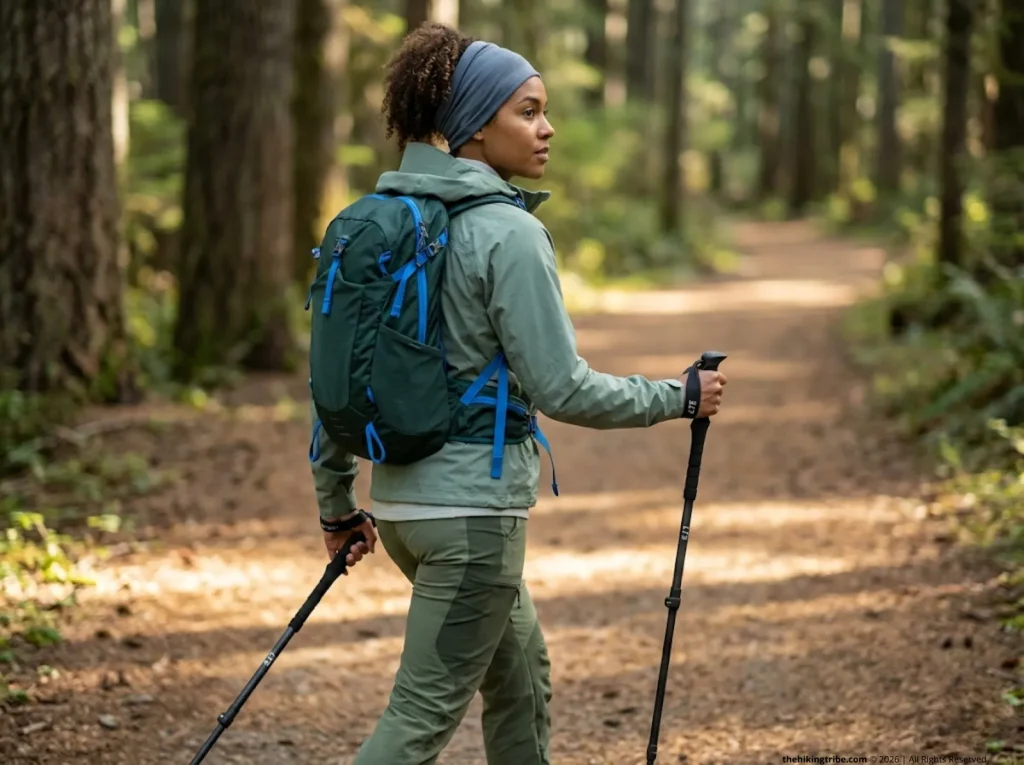
Before you can adjust for terrain or add breathing coordination, you need the fundamental 1:1 mirroring stride locked in. This is the baseline rhythm that all pole technique builds from.
Opposite Arm, Opposite Leg
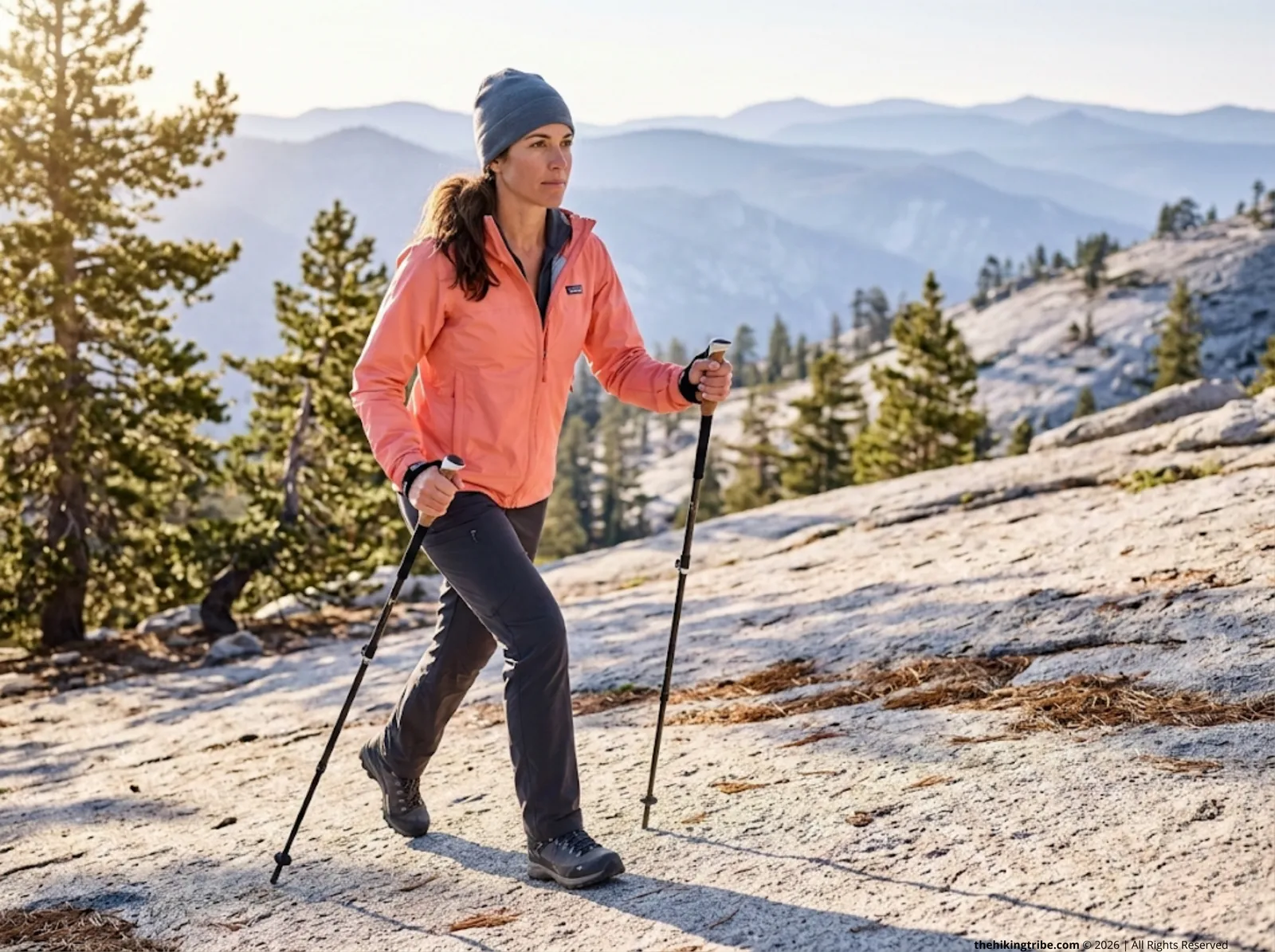
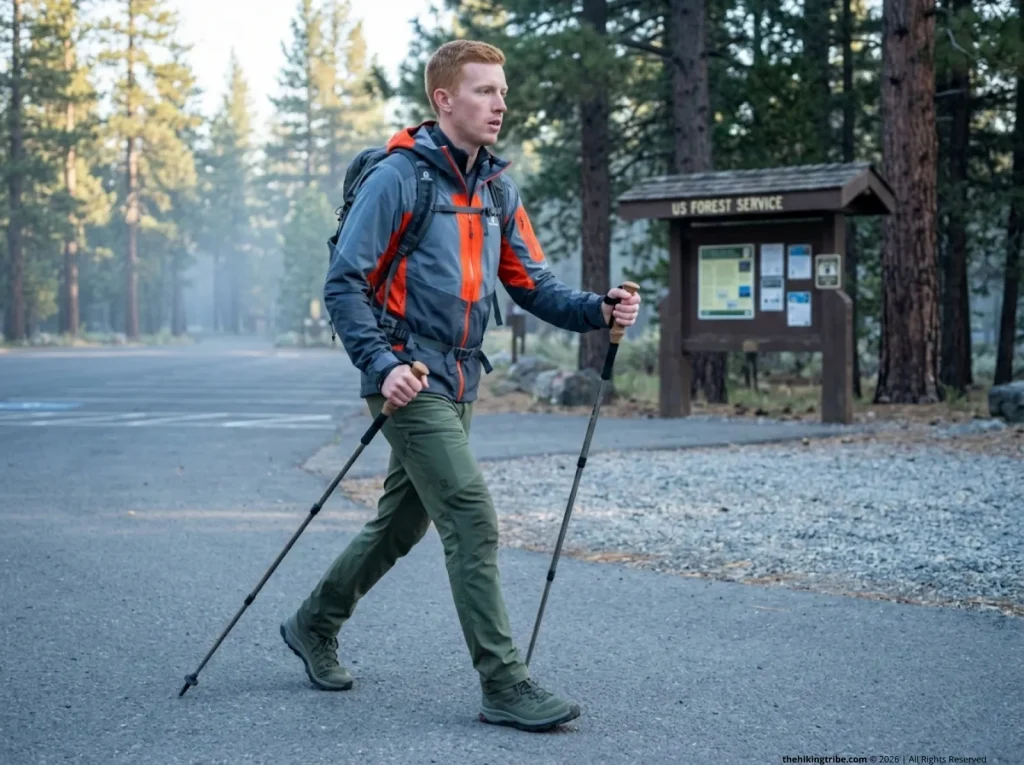
The opposite-arm/leg sync mirrors your natural arm swing when you walk without poles — because it IS your natural arm swing. Right foot forward, left pole plants. Left foot forward, right pole plants. Most hikers fall into this pattern within a few steps. The problem is what happens next.
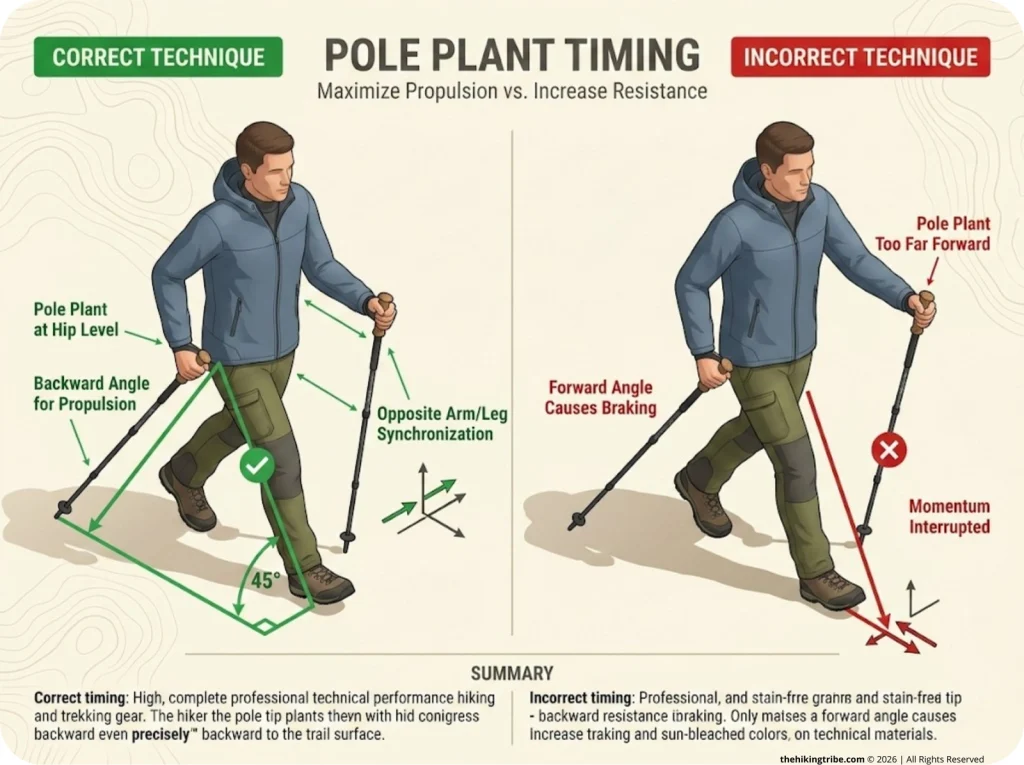
Plant the pole tip roughly in line with your hip, angled about 45 degrees backward — not in front of you (that brakes your momentum) and not so far behind you’re reaching back awkwardly. When the pole contacts the ground on flat terrain, your elbow should be at a 90° elbow angle. Straighter arm means poles are too long. More acute angle means too short. That 90 degrees is your quick calibration check before any long day.
Plant Timing and the Push Phase
The motion is push rather than pull. Your pole tip touches down opposite your forward foot, then you drive through it as your arm swings back — the plant-push rhythm that generates propulsion instead of drag. The most common mistake here is planting the tip ahead of your hip. When the pole lands in front of your body, it acts like a brake against your own forward movement.
One piece of advice from experienced Appalachian Trail hikers gets it right: “Place the tips where you want the pole and then apply your weight against the straps, not the grip.” Learning proper wrist strap technique changes everything about how load transfers through the pole — and we cover that in detail below.
Breathing Coordination
This is where most guides go silent, and it’s where serious gains live. Sync your pole cadence with your breathing: inhale for 2-3 strides, exhale for 2-3 strides. The pole plants mark the beat. On moderate terrain at steady pace, the pattern naturally becomes inhale-plant-plant, exhale-plant-plant.
If you’re gasping, your cadence is too fast for the terrain. Slow the rhythm. Lengthen the stride. Let your breathing settle before you push the pace again. Getting this integration with breathing right is what separates a hiker who arrives at camp destroyed from one who still has legs on day three.
Terrain Ratios: Shifting Cadence for Uphills, Downhills, and Flats
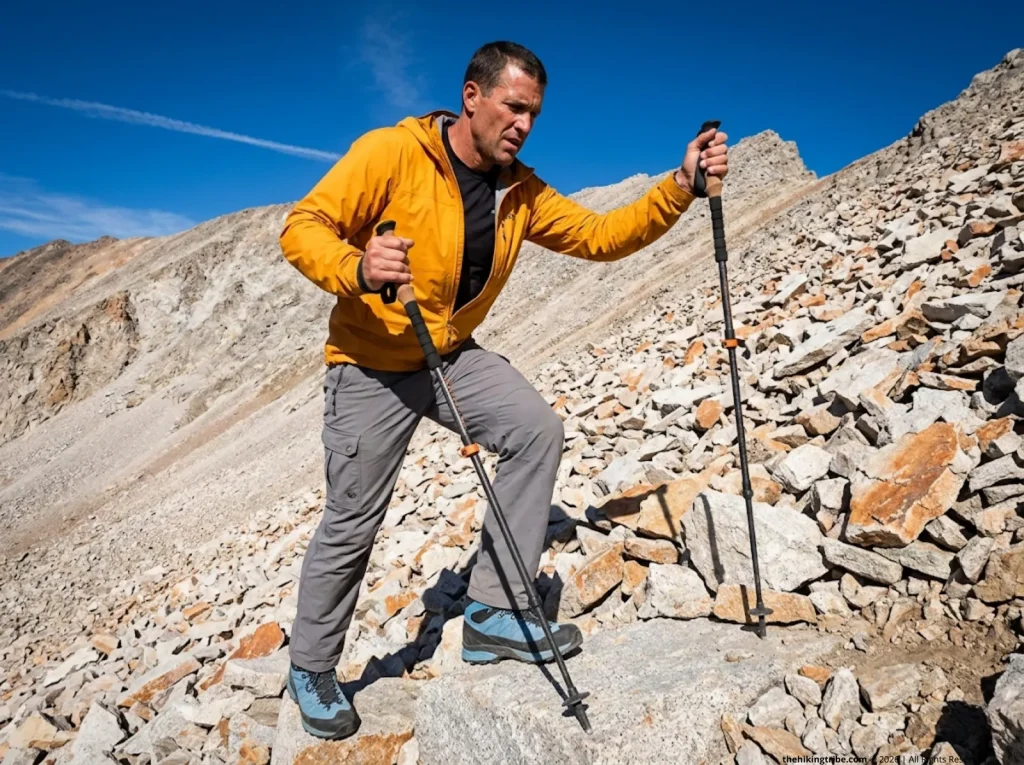
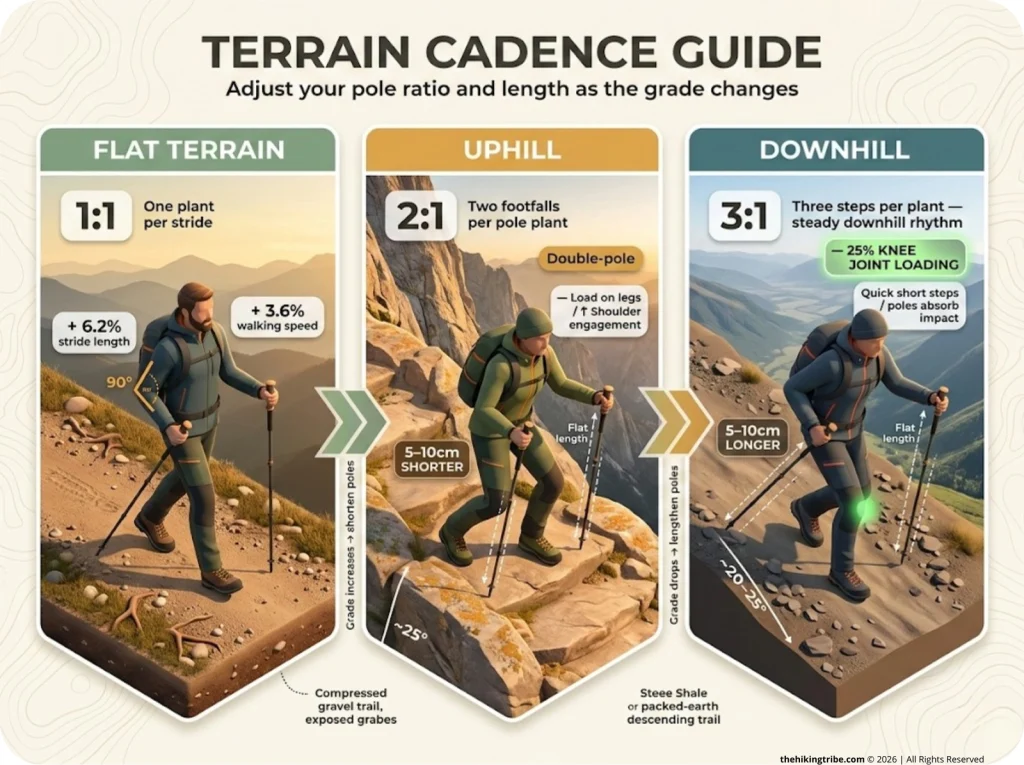
The 1:1 ratio isn’t universal. Different terrain requires different power vs. endurance ratios, and knowing when to switch is what separates conditioned polers from beginners. The core principle: shorter poles and faster rhythm for climbs, longer poles and braking cadence for descents.
Flat Terrain: The Default 1:1
On flat, established trail, stick with the standard 1:1 opposite arm and leg rhythm. Poles at 90-degree elbow angle, natural arm swing, relaxed grip. Don’t force longer strides — poles naturally extend your stride length by about 6.2% on flat terrain, and walking speed picks up 3.6%. Let both happen as the rhythm settles in.
Pro tip: Tape three reference marks on each pole shaft before you leave — your flat setting, your uphill setting (5cm shorter), and your downhill setting (5cm longer). On-trail adjustments that take 10 seconds instead of 45 actually get made.
Uphill: Power Ratios and Double Poling
For climbs, shorten poles 5-10cm to maintain your 90-degree elbow angle as the ground rises toward you. On moderate inclines, stay in 1:1 but quicken your pole swing and shorten your stride — the rhythm speeds up without losing its beat. On steep sections, switch to a 2:1 ratio (two footfalls per pole plant per side) or go to full uphill double-poling, both poles planting simultaneously for maximum thrust.
As one veteran backpacker on the Backpacking Light forum put it: “When going up hill I push on them pretty hard to propel myself up faster. When walking flats I tend to use 2:1 — longer, less frequent strides.” Double-poling burns shoulders fast, so use it in short bursts on the steepest pitches, then drop back to alternating rhythm when the grade backs off.
Downhill: Braking Cadence and Joint Protection
Lengthen poles 5-10cm for descent so your arms aren’t overreaching as the ground drops away. Then shift your pole plants ahead of your footstrike — in front of your body rather than beside your hip — to absorb deceleration force through the poles rather than through your knees.
According to research published in the Journal of Applied Biomechanics, proper pole use during downhill walking reduces knee joint loading by 25%. On a 3,000-foot descent with a loaded pack, that’s the margin between functional legs at camp and the kind of knee pain that ends trips early. Use “fast feet” on technical downhills — short, quick steps with the poles as your stable contact points between footstrikes. A 3:1 ratio (three footstrikes per pole plant per side) works for gentle downhill terrain where you still want rhythm without maximum braking force. For the full breakdown on descent technique, our complete guide to downhill pole technique covers the specifics.
Working the Straps: The Advanced Technique Most Hikers Skip
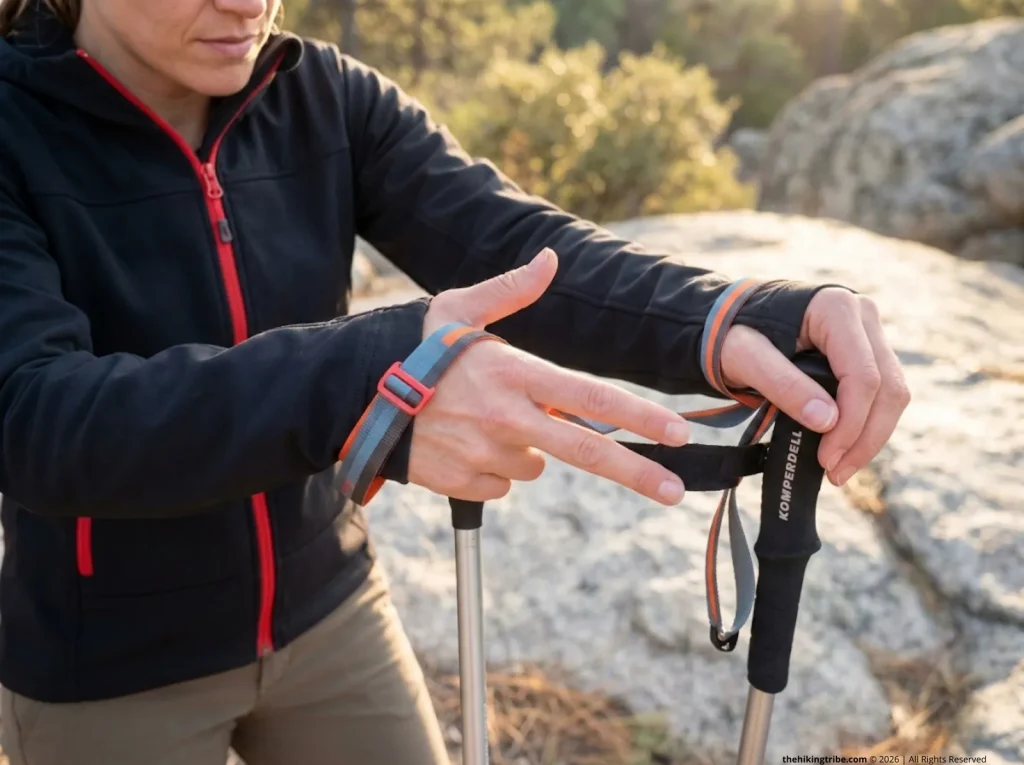
Strap vs. no-strap grip is one of the most debated topics in hiking forums — but the debate only exists because most people have never actually worked their straps correctly. Once you do, there’s no question.
The Bottom-Up Strap Insert
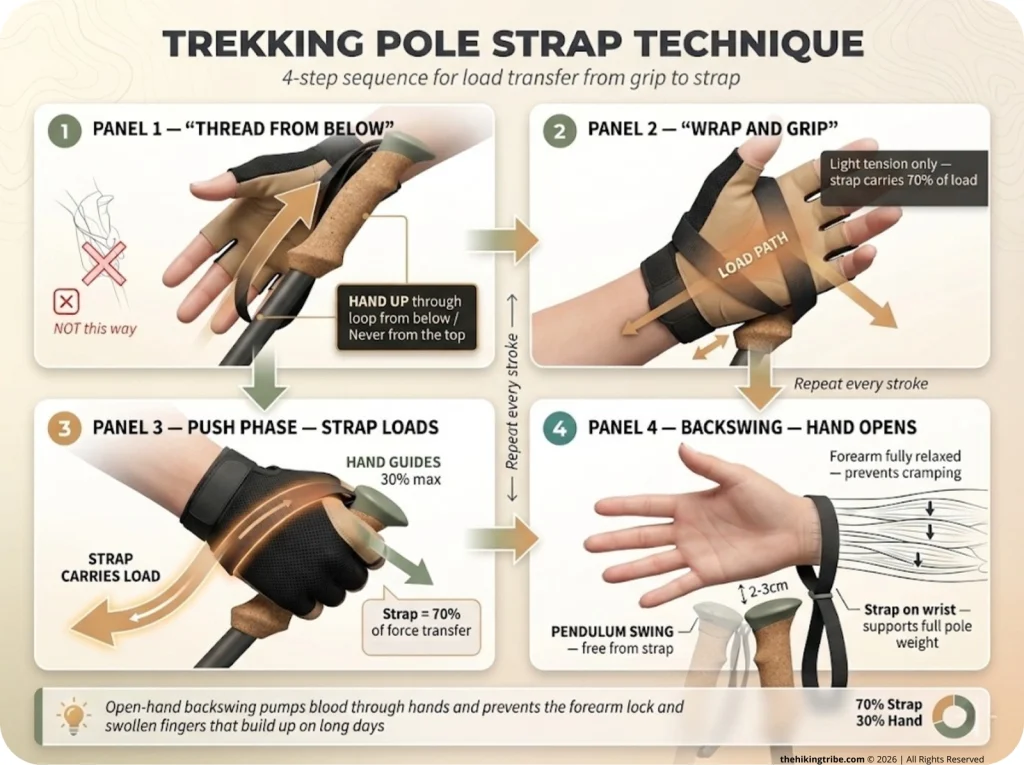
Thread your hand up through the strap loop from below, then wrap your hand down and close loosely around the grip. The strap now crosses your palm and lays across the back of your hand. When you push through the pole on the plant phase, the load transfers through the strap to your wrist — not through your forearm flexors.
Most beginners thread from the top or skip the strap entirely, white-knuckling the handle for the whole trip. They’re capturing maybe 40% of the pole’s potential. Over 20 miles, that’s an enormous amount of unnecessary forearm fatigue. The strap threading method also affects which grip material works best for you — cork absorbs sweat from an active hand position while foam performs differently in a looser hold. How grip material affects sweat and comfort is worth understanding before you commit to a pole style.
The Open-Hand Backswing
Here’s the part nobody talks about. After the push, on the back-swing, your hand should open. Fingers relax. The pole dangles freely from the strap, swinging back like a pendulum. Then your hand closes again as the pole comes forward for the next plant.
This palm-open backswing with rhythmic clenching does two things. First, it keeps your forearms from tensing continuously — which is what causes the cramped, locked-up hands many hikers get by mile 10. Second, the alternating open-close motion pumps blood through your hands and prevents the swollen “sausage fingers” that show up on long days when your arms hang below heart level.
The Hiking Philosopher describes this as centerlining — full hip rotation and shoulder rotation during each stride, with the pole strap doing the mechanical transfer. “Pole thrust and backswing — shoulders and hip/pelvis should rotate in opposition.” That full-body engagement is what separates a hiker who covers 20 miles cleanly from one who shuffles through them with arms locked.
Five Cadence Drills You Can Practice Before Your Next Trip
No competitor article in the top search results covers this. Building cadence-specific drills into your pre-trip prep is the difference between spending your first trail day thinking about technique and arriving already fluid. These four drills build the muscle memory that technique talk can’t:
Drill 1: The Parking Lot Metronome
Walk any flat surface — parking lot, sidewalk, park path — for 5 minutes with poles, counting “one-two, one-two” with each opposite arm-leg plant. The goal isn’t speed. It’s consistency. Every plant should sound like a steady tick-tick-tick. If you’re losing the beat, slow down. Speed follows consistent rhythm, not the other way around.
Drill 2: The Stairs Ratio Switch
Find a long staircase. Climb one flight in 1:1, the next in 2:1, then double-poling for 10 steps. Descend at 1:1 with lengthened poles and quick plants ahead of each step. This builds your ability to shift ratios without thinking — because on real terrain, the switchback that goes from moderate to steep doesn’t give you time to deliberate. The 1L-2R-3L repeating rhythm pattern for more complex terrain becomes accessible once the transitions are automatic.
Drill 3: The Eyes-Closed Balance Walk
On flat, safe, obstacle-free ground, close your eyes and walk 20 steps with poles. Removing visual input forces your nervous system to rely on proprioception — the body’s sense of its own position — and accelerates the neuromuscular connection to the rhythm. This is the same mechanism behind how trekking poles rewire your trail balance. When you open your eyes after the 20 steps, the cadence will feel noticeably more natural. Have a partner nearby for safety.
Drill 4: The Breathing Sync
Walk at moderate pace and count your pole plants per breath cycle — aim for 2-3 plants per inhale, 2-3 per exhale. Gradually increase pace. When your breathing breaks from the cadence — when you’re gasping instead of rhythmically syncing — you’ve found your current aerobic threshold with poles. Train just below that point, and your body adapts quickly.
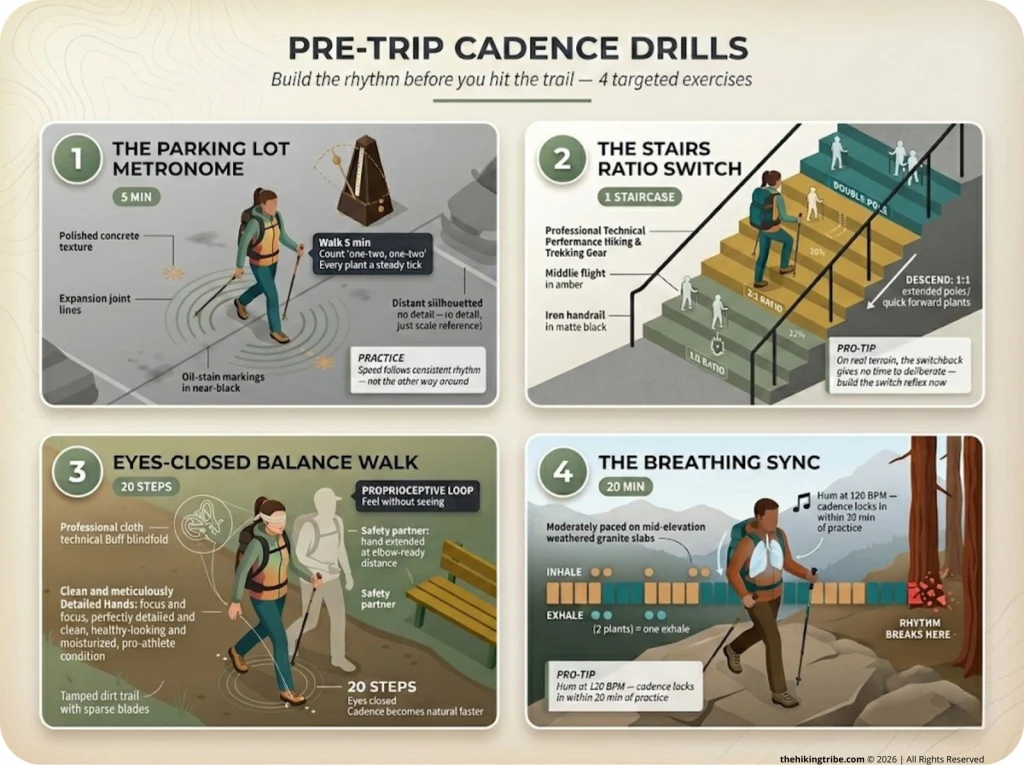
Pro tip: Hum a song at 120 BPM during the Breathing Sync drill and you’re training your cadence and your cardiovascular system at the same time. Most hikers are surprised how fast the rhythm locks in after just 20 minutes of focused practice.
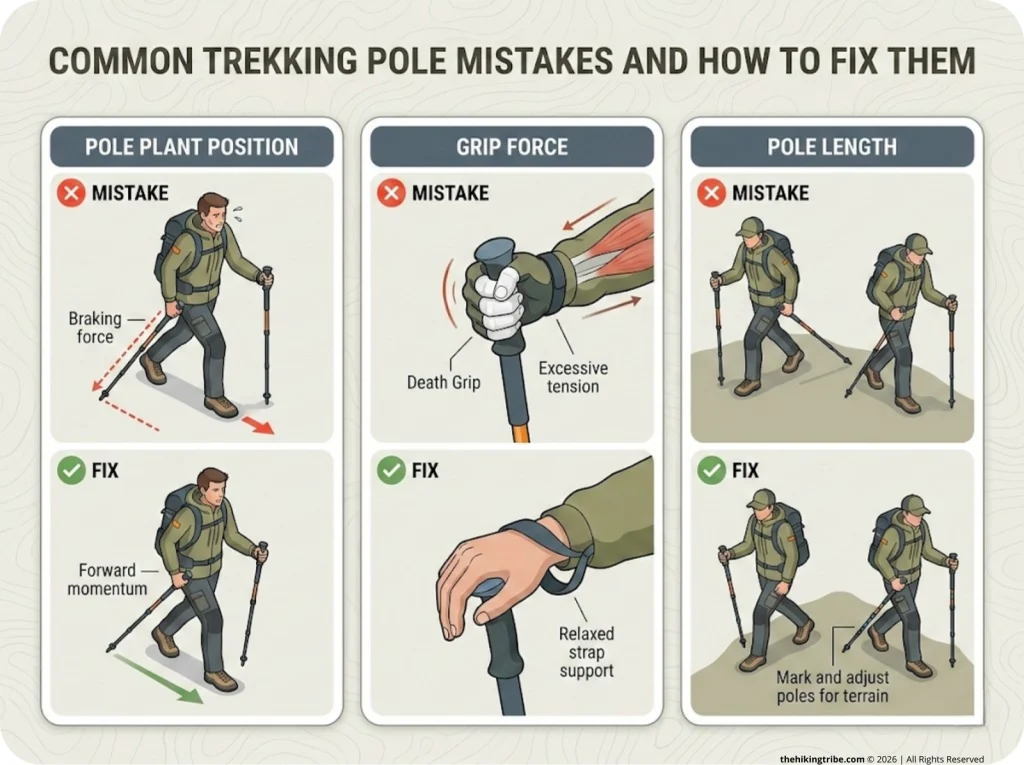
Common Mistakes That Kill Your Rhythm (And How to Fix Them)
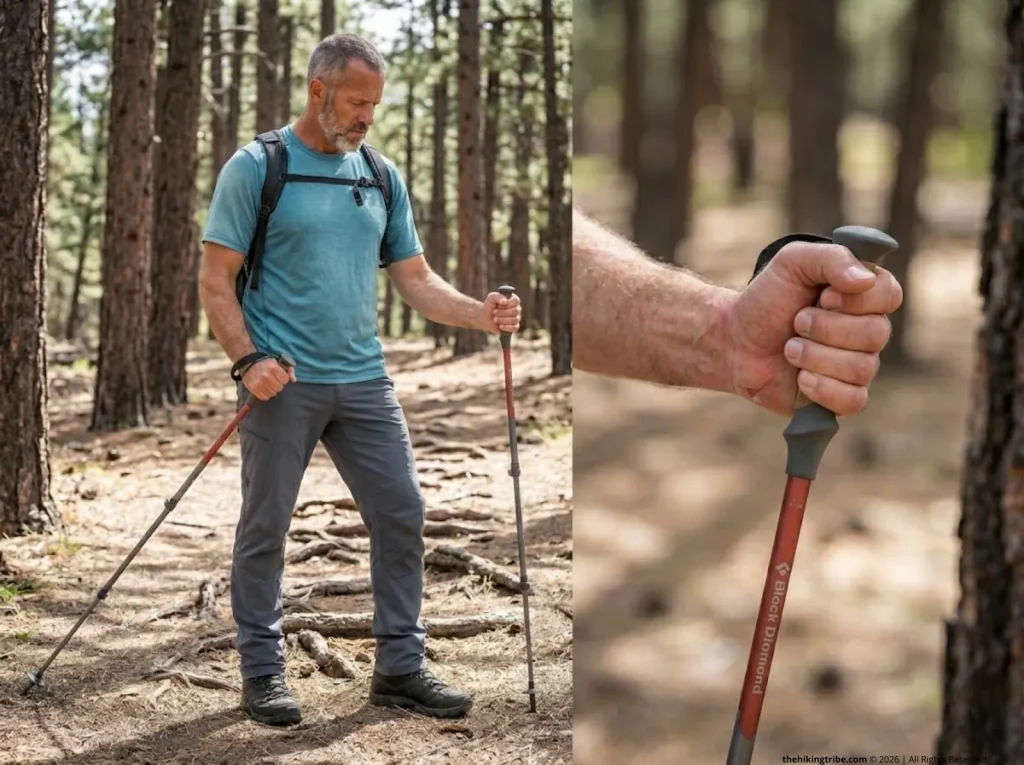
Even hikers who’ve used poles for years carry these habits. Each one costs more energy than you’d expect.
Planting Too Far Forward
This is the single most common error across inexperienced polers and returning hikers alike. When your pole tip lands ahead of your hip, it acts as a brake — you’re pushing against your own momentum instead of propelling yourself forward. You’ll know you’re doing it if your poles make a sharp clacking sound on impact rather than a smooth plant-and-push.
Fix: imagine the pole is a clock hand. It should hit at roughly 5 o’clock — beside or slightly behind your hip — not at 12 o’clock in front of your body. The further-forward pole placement is for technical terrain navigation, not for efficient locomotion on trail.
Death-Gripping the Handles
If you can see your knuckles go white, you’re holding too tight. The strap should carry 70% of the load during the push phase. Your hand is just guiding direction. When you white-knuckle the grip, your forearm flexors contract continuously, fatigue fast, and your cadence turns choppy — and choppy cadence means choppy breathing.
The strap vs. no-strap grip debate disappears once you understand this. The strap isn’t optional equipment — it’s the primary load transfer mechanism. Gripping hard with the strap doing nothing means you’re using the pole like a cane, not like a propulsion tool.
Same Pole Length for All Terrain
Keeping adjustable poles at one fixed length leaves most of their value on the table. The 90-degree elbow angle that’s right on flat terrain becomes an overreach on downhill and a strain on steep uphill. Adjust every time the terrain character shifts — not once per day.
Mark three tape reference points on each shaft before you leave home. When you’re dialing in pole length for terrain, you’re not just improving comfort — you’re recovering the 25% knee joint load reduction on downhill and the proper pole thrust angle for uphill propulsion that a fixed length throws away.
Conclusion
Three things carry the most weight from everything above.
First, the opposite-arm/leg sync is your foundation. Everything else — terrain ratios, strap technique, breathing coordination — builds on that consistent beat. Get the 1:1 rhythm automatic before you add complexity.
Second, working the straps is what transforms poles from walking sticks into propulsion tools. The palm-open backswing and strap-loaded push phase — the parts most guides skip or cover in one sentence — are what actually deliver the 21% fatigue reduction. Gripping hard and ignoring the strap means leaving that number on the table.
Third, cadence is a skill, not an instinct. Spend 20 minutes on the parking lot drills before your next trip. The rhythm becomes automatic faster than you’d expect, and by the second hour on trail you stop thinking about it entirely.
Next time you hit the trailhead, spend the first mile counting plants. Feel the strap do the work on the backswing. By mile two, the cadence carries itself. By mile 15, your legs will know exactly what the difference feels like.
FAQ
How do you use trekking poles correctly?
Plant the opposite trekking pole as your leading foot strikes — right foot forward, left pole down. Keep your elbow at 90 degrees on flat ground, thread your hand through the strap from below, and push through the strap rather than gripping the handle tight. Adjust pole length 5-10cm shorter for uphill terrain and 5-10cm longer for downhill.
What is the proper rhythm for trekking poles?
The standard rhythm is a 1:1 ratio — one pole plant per footstrike on the opposite side, mirroring your natural arm swing. For steep uphills, shift to a 2:1 ratio or double-poling. For moderate downhill where you still want consistent pole cadence without maximum braking force, a 3:1 ratio often works.
Should you use one pole or two on uphills?
Two poles distribute load evenly across both sides and provide the balanced upper body engagement that generates real uphill double-poling power. One pole creates asymmetrical arm and leg movement that can strain one side over long distances. The exception is narrow, technical terrain where two poles get in the way of hand-on-rock scrambling.
How do trekking poles help with cadence and endurance?
Poles create the metronome effect — a steady beat that regulates your pace, your breathing, and your stride length simultaneously. A systematic review found they reduce perceived exertion by 21% on steep terrain and lower limb muscle activation by 14.8%, while increasing stride length 6.2%. Each of those effects compounds over miles of multi-day backpacking.
What is the best technique for downhill with poles?
Lengthen poles 5-10cm, use quick short steps, and plant poles ahead of each footstrike to absorb impact before your foot lands. This shifts deceleration force through the poles instead of your knees. Research published in the Journal of Applied Biomechanics documents a 25% reduction in knee joint loading with proper downhill technique with poles — the difference between arriving at camp mobile and arriving hobbled.
Risk Disclaimer: Hiking, trekking, backpacking, and all related outdoor activities involve inherent
risks which may result in serious injury, illness, or death. The information provided on The Hiking Tribe is for
educational and informational purposes only. While we strive for accuracy, information on trails, gear, techniques,
and safety is not a substitute for your own best judgment and thorough preparation. Trail conditions, weather, and
other environmental factors change rapidly and may differ from what is described on this site. Always check with
official sources like park services for the most current alerts and conditions. Never undertake a hike beyond your
abilities and always be prepared for the unexpected. By using this website, you agree that you are solely
responsible for your own safety. Any reliance you place on our content is strictly at your own risk, and you assume
all liability for your actions and decisions in the outdoors. The Hiking Tribe and its authors will not be held
liable for any injury, damage, or loss sustained in connection with the use of the information herein.
Affiliate Disclosure: We are a participant in the Amazon Services LLC Associates Program, an
affiliate advertising program designed to provide a means for us to earn advertising fees by advertising and linking
to Amazon.com. As an Amazon Associate, we earn from qualifying purchases. We are also an official affiliate partner
of Black Diamond Equipment via the AvantLink network. If you click on a Black Diamond affiliate link and make a
purchase, we may earn a commission at no additional cost to you. We also participate in other affiliate programs and
may receive a commission on products purchased through our links. Additional terms are found in the terms of
service.