In this article
Water poured over the collar of my boots as I stepped into the waist-deep stream. Within seconds, I felt the familiar squelch—a kilogram of water trapped inside each boot by the very Gore-Tex membrane designed to keep it out. For the next six miles, every step was a reminder: waterproof doesn’t mean water-ready.
After testing drainage systems across canyons, mountain streams, and desert washes, I’ve learned that the physics of wet feet are unforgiving. The choice between waterproof membranes and drainage holes isn’t about preference—it’s about understanding how water actually behaves inside a shoe and what that does to your skin.
This guide breaks down the mechanics of drainage ports, mesh uppers, and the “bucket effect” that dooms waterproof boots in deep water. You’ll learn which drainage architecture works for your terrain, how to prevent the sandpaper effect of debris ingress, and why maceration (not just discomfort) is the real enemy of long-distance hikers.
⚡ Quick Answer: For prolonged wet conditions like river crossings or torrential rain, drainage holes or high-flow mesh outperform waterproof membranes. Once water breaches the collar of a waterproof boot, the membrane traps it inside, creating the “bucket effect.” Drainage shoes actively expel water through the gait cycle’s pumping action, preventing maceration and blistering. The tradeoff: debris ingress requires gaiters and nightly insole cleaning.
The Physics of Wet Feet: Why Waterproof Fails

The bucket effect is the catastrophic failure mode of Gore-Tex and similar membranes in deep water. Water enters via the large hole at your ankle—during stream crossings, heavy rain running down legs, or missteps into boggy terrain. Once the water level exceeds the collar height, the waterproof membrane is bypassed entirely.
Gore-Tex pores let vapor out but can’t pass liquid water. The shoe becomes a bucket. Field reports confirm “if water slides down your leg and gets inside, it will be almost impossible to drain it out.”
Drying time is brutal. Saturated GTX boots take 4-5 days to dry in field conditions. Non-waterproof trail runners with mesh uppers dry within hours. The “1 lb on feet = 5 lbs on back” rule means wet boots (holding 200-300g of water) feel like carrying an extra 2-3 lbs on your pack for hours.
Water conducts heat 25 times faster than air. In cold streams, this means rapid heat loss. It’s a common misconception that a layer of water warms up and insulates the foot (like a wetsuit). This only works if the water is trapped and stagnant. In a draining shoe, cold water is constantly flushing through, stripping heat. The verdict: in cold conditions, waterproof barriers (like waterproof socks) are superior if they prevent water exchange. In warm conditions, rapid drainage and evaporation are superior.
Pro tip: once you accept wet feet, the anxiety disappears. It’s a psychological barrier, not a physical one. The trauma caused by the idea of wet feet goes away with experience.
How Drainage Actually Works: Ports, Mesh & Pumping
The common misconception is that drainage holes work like a colander—gravity simply pulls water out. While this is true for a static shoe, in a hiking context, mechanical pumping is the dominant force.
As you step down, the midsole and upper compress under your body’s weight. This significantly reduces the internal volume of the shoe. If water is present, this reduction in volume creates positive hydraulic pressure. The water seeks the path of least resistance to escape this pressure.
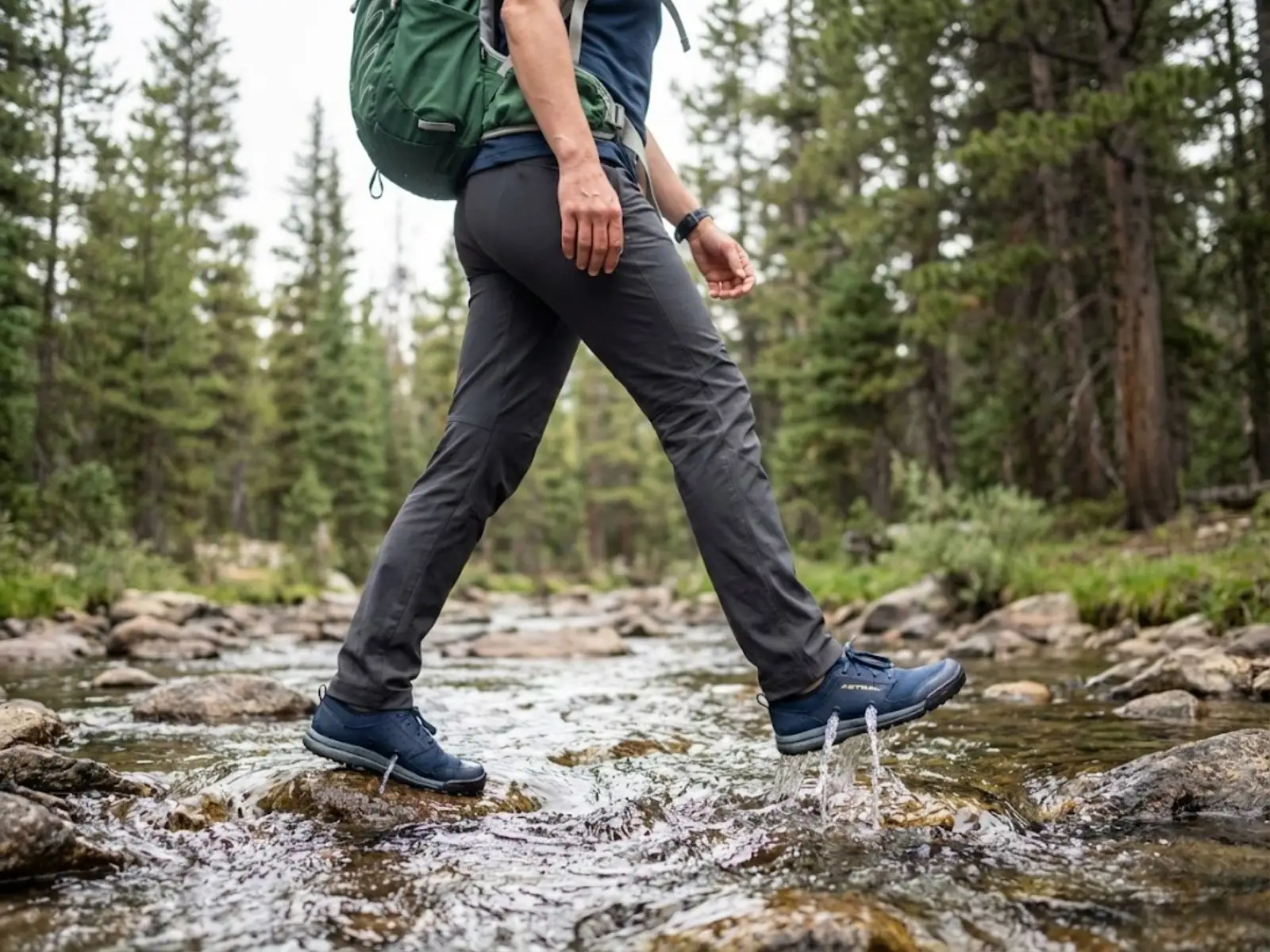
In waterproof shoes, the path of least resistance is effectively zero (sealed membrane). The water is pressurized but trapped, forcing it backward into the sock foam or upward against the skin. In mesh shoes, the water is forced out laterally through thousands of micro-pores in the upper. In ported shoes, the water is ejected as concentrated jets through dedicated ports in the midsole or lower upper.
This is the “plunging” effect—flexible shoes expel water more efficiently because they deform more, creating greater pressure differentials. Stiff boots lack this compression cycle, leading to water pooling. This physics dictates that flexible trail runners will always drain faster than stiff hiking boots, regardless of material.
Material absorption matters as much as drainage speed. A shoe that drains well but absorbs 200g of water into its padding is still a failure. Manufacturers like Astral use hydrophobic canvas and closed-cell foams to minimize weight gain. Look for uppers made of monofilament mesh or non-absorbent synthetic fibers (polyester/nylon) rather than materials that swell when wet.
Topo Athletic’s evolution is instructive. The brand removed physical drainage ports from newer models, stating “updated mesh will allow for even better drainage.” This signals that high-porosity textiles outperform ports for general hiking—ports can clog with mud or clay. Mesh offers the entire surface area of the forefoot for egress, making it much harder to block completely.
Mesh also breaks up water into smaller droplets, increasing the surface-area-to-volume ratio, which significantly aids evaporation. Understanding the biomechanics of hiking shoe performance helps you see why drainage isn’t just about holes—it’s about the entire hydrodynamic system.
Drainage Architectures: Ports vs. Mesh vs. Hybrid
The three dominant drainage systems each have distinct performance characteristics.
Open Drainage Ports
Open-port designs like the Astral Brewer 3.0 (232g/8.2oz) and Xero Aqua X Sport (212g/7.5oz) feature perforated holes in midsole, heel, and toe. Drainage is fastest—water exits instantly. Astral’s G.15 rubber is sticky on wet rock but wears faster on pavement.
The vulnerability: large ports admit sand, silt, and gravel freely. This “sandpaper effect” accelerates blister formation. Best for canyoneering and kayaking, not long-distance load carrying.
High-Flow Mesh
Mesh-based designs like the Salomon Techamphibian 5 (~311g) use “Anti-debris Mesh” to filter sand and pebbles. Drainage is fast but slightly slower than ports. The mesh solves the “gravel in shoe” problem.
Salomon’s Water Contagrip FD with siped lugs provides wet-surface adhesion and better mud shedding. The tradeoff: slower drainage for better debris management. Best for mixed hiking with both water crossings and dry trail.
Perforated Insoles + Sole Ports
The insole bottleneck is often ignored. Drilling the shoe sole is useless if the insole is a solid block of foam. Water is trapped under the foot. Specialized insoles with perforations allow water to reach drain holes. Podiatrist Julian Varney emphasizes testing sock/shoe combinations in a bucket of water to identify these bottlenecks.
DIY modification is common in the ultralight community. Hikers use a leather punch to create drainage holes in insoles that align with sole ports.
The Debris Dilemma: Sand, Grit & the Sandpaper Effect
Drainage holes are two-way streets. Sand entering through mesh or ports acts as sandpaper against skin. “Sand comes in through the mesh… builds up and won’t escape,” according to the Ultralight community. Grit accumulates under the insole and between toes, accelerating blister formation.
The paradox: larger drainage holes increase water egress speed but linearly increase debris ingress. There is no perfect solution—only tradeoffs.
Gaiters are essential for drainage shoes to seal the collar. Dirty Girl Gaiters are highly recommended to prevent sand from entering the top. This is the most effective debris prevention method. Wearing a thin liner sock under a thicker sock can help mitigate abrasion from sand that does get in. Nightly insole removal is mandatory. Feet must be dry at night to recover skin turgor.
Terrain-specific debris risk varies dramatically. In desert environments, debris risk is highest. Gaiters are non-negotiable. In mountain streams, debris risk is moderate. Hybrid mesh designs work well. Cold water requires faster drainage to prevent hypothermia. In swamp environments, debris risk is low but clogging risk is high. Mesh is superior for muck.
Understanding the 3-stage tick prevention system using gaiters shows how gaiters serve multiple protective functions.
Pro tip: shake out your shoes every time you stop for a break. Don’t wait until camp. Fine sand is easier to remove before it works its way deep into the mesh fibers.
Maceration & Blister Physics: The Medical Case for Drainage
Maceration is the softening and whitening of skin due to prolonged moisture exposure. The stratum corneum (outer skin layer) absorbs water and expands, but underlying dermal layers don’t expand at the same rate, causing wrinkling. Hydrated skin has significantly lower tensile strength. It tears under much lower loads than dry skin.
Blisters are caused by shear force—layers of skin sliding against each other. Dry skin resists shear well. Macerated skin tears easily. The “roof” of the blister separates from the base with minimal friction. Prevention is simple: drying.
“Freely-draining shoes” allow the moisture gradient to reverse when you step out of water or into a dry section. Even short periods of drying can restore skin turgor. This is why drainage speed matters medically, not just for comfort.
The causal chain: Water Ingress → Retention → Elevated Humidity → Maceration → Reduced Shear Resistance → Blistering → Hike Failure. This chain is broken by drainage. Fast-draining shoes interrupt the retention phase, preventing maceration before it weakens skin.
Water conducts heat 25 times faster than air. Neoprene socks trap a thin layer of water. This only works if there’s circulation. Hikers often find toes freezing in neoprene socks during rest stops because trapped water cools down.
While hiking (active), blood flow keeps feet warm even if wet. When stopped, conductive loss takes over. In cold conditions, waterproof barriers (like waterproof socks) are superior if they prevent water exchange. In warm conditions, rapid drainage and evaporation are superior.
Understanding preventing maceration in wet hiking conditions and the field treatment protocol for hiking blisters completes the foot care education.
Field-Tested Drainage Shoes: What Works for Your Terrain
After testing drainage systems across multiple environments, specific shoes excel in distinct use cases.
The Astral Brewer 3.0 is built for canyoneering and water sports. Maximum drainage capability with ports at heel and toe. Weight is 232g (8.2 oz) per shoe. G.15 rubber is sticky on wet rock. Zero drop provides exceptional stability. Water exits instantly. The limitation: not designed for long-distance load carrying. Debris entry is a significant risk.
The Salomon Techamphibian 5 balances protection with drainage for mixed hiking. Mesh upper with “Anti-debris Mesh” filters out sand and pebbles. Weight is ~311g (11 oz). Water Contagrip FD provides adhesion on wet surfaces. Collapsible heel converts into slide. Protective toe cap is critical for rocky riverbeds. Versatile for both water crossings and dry trail.
The Merrell Hydro Moc works as a camp shoe. Large, open cutouts in EVA foam. Weight is ~205g (7.2 oz). Fast drainage and lightweight. The problem: serious hiking is dangerous. Lack of structure causes heel slippage. Runs large; size down. Best use case: camp shoe only.
The Xero Aqua X Sport serves ultralight and barefoot hikers. Weight is ~212g (7.5oz). Zero drop. Stack height 9mm total. Fast drainage and excellent ground feel. Zero cushioning requires conditioned feet. Not suitable for hikers used to supportive boots.
For readers considering zero-drop platforms, the comprehensive guide to zero-drop hiking shoes explains the biomechanical implications.
Pro tip: test your drainage system in a bucket of water before your trip. Fill the shoe, put it on, and walk around. If water pools under your foot, your insole is the bottleneck. Perforate it or replace it.
DIY Drainage: Modifying Existing Footwear
For hikers unsatisfied with market options, modifying existing footwear is common in the ultralight community.
The hot needle method involves melting holes through non-structural parts of the upper (arch area). Cauterizes synthetic fabric as it punctures, preventing fraying. Drilling using a power drill bit creates clean holes in rubber sole units but creates ragged edges in fabric uppers that can fray. Debris entry points are permanent.
Saucony Mad River TR historically featured “guide holes” instructing users where to drill for drainage. This validates the DIY approach as legitimate customization.
The arch (medial side) is the safest spot for modification—it doesn’t flex as much as the toe box and isn’t a high-impact zone like the heel. Insoles must be perforated or replaced with open-cell foam to allow water to reach drain holes. Common modification: use a leather punch to create drainage holes in the insole that align with holes drilled in the sole.
Avoid placing holes near stress points (flex zones like metatarsal heads). Understanding modular gear repair kit essentials shows how repair knowledge empowers hikers to customize equipment safely.
Environmental Ethics: Leave No Trace & Invasive Species
Drainage shoes impact both trail erosion and ecosystem health.
Hikers often widen trails to skirt puddles, creating vegetation trampling. Wearing shoes that drain encourages walking through water and mud (the durable surface) rather than around it, adhering to Leave No Trace principles for muddy trails.
Didymo (“Rock Snot”) is Didymosphenia geminata, an invasive algae that blooms in cold, low-nutrient streams, choking waterways. It spreads easily through contaminated fishing gear and footwear. Felt soles are now banned in many states (Alaska, Maryland) because they act as a sponge, trapping algae and transferring it between watersheds.
Porous materials and complex drainage channels can harbor invasive larvae or algae cells. The protocol: “Clean, Drain, Dry.” Hikers moving between watersheds must disinfect shoes (using bleach solution or 5% salt solution) or ensure complete drying for at least 48 hours. Following USDA invasive species protocols for Didymo protects waterways.
It’s not about staying dry; it’s about drying fast. The ideal hiking shoe for wet environments possesses zero waterproofing (no GTX), active drainage (mesh or ports that utilize the gait cycle), low absorption materials (closed-cell foam, hydrophobic uppers), and security (a lacing system that locks the foot to prevent internal sliding when wet).
Match your drainage architecture to your terrain: open ports for canyoneering, hybrid mesh for mixed hiking, and always pair drainage shoes with gaiters for debris management. Test your system in a bucket of water before your trip—the insole bottleneck will reveal itself. Embrace the wet, manage the skin, and walk straight through.
FAQ
Can I drill holes in my existing hiking boots to add drainage?
Yes, but use a hot metal spike (cauterize) rather than a drill bit (frays fabric), and avoid the heel counter and toe box structure. The arch (medial side) is the safest spot. Also modify your insole with a leather punch to create aligned drainage holes—otherwise water is trapped under your foot.
Do Gore-Tex shoes dry out?
Eventually, but they take 4-5x longer than mesh shoes. In humid conditions, they may never fully dry overnight. The waterproof membrane traps moisture in the lining and padding, extending drying time from hours (mesh) to days (GTX).
How do I keep sand out of water shoes?
High-ankle gaiters (like Dirty Girl Gaiters) and choosing tight-weave mesh over open ports. There is no perfect solution—it’s a tradeoff between drainage speed and debris protection. Remove insoles nightly to flush out accumulated grit.
Are drainage holes better than mesh for water crossings?
It depends on terrain. Open ports (Astral) drain fastest but admit more debris—best for canyoneering. Mesh (Salomon) drains slightly slower but filters debris—best for mixed hiking. For general backpacking, high-flow mesh is more versatile.
Will my feet get cold in drainage shoes during winter stream crossings?
Yes, but only temporarily. Water conducts heat 25x faster than air, so cold water strips heat rapidly. However, while actively hiking, blood flow keeps feet warm. The danger is stopping—once you’re stationary, conductive loss takes over. For cold conditions, consider waterproof socks (not boots) to prevent water exchange while maintaining drainage capability.
Risk Disclaimer: Hiking, trekking, backpacking, and all related outdoor activities involve inherent
risks which may result in serious injury, illness, or death. The information provided on The Hiking Tribe is for
educational and informational purposes only. While we strive for accuracy, information on trails, gear, techniques,
and safety is not a substitute for your own best judgment and thorough preparation. Trail conditions, weather, and
other environmental factors change rapidly and may differ from what is described on this site. Always check with
official sources like park services for the most current alerts and conditions. Never undertake a hike beyond your
abilities and always be prepared for the unexpected. By using this website, you agree that you are solely
responsible for your own safety. Any reliance you place on our content is strictly at your own risk, and you assume
all liability for your actions and decisions in the outdoors. The Hiking Tribe and its authors will not be held
liable for any injury, damage, or loss sustained in connection with the use of the information herein.
Affiliate Disclosure: We are a participant in the Amazon Services LLC Associates Program, an
affiliate advertising program designed to provide a means for us to earn advertising fees by advertising and linking
to Amazon.com. As an Amazon Associate, we earn from qualifying purchases. We are also an official affiliate partner
of Black Diamond Equipment via the AvantLink network. If you click on a Black Diamond affiliate link and make a
purchase, we may earn a commission at no additional cost to you. We also participate in other affiliate programs and
may receive a commission on products purchased through our links. Additional terms are found in the terms of
service.