In this article
You’re standing in front of a wall of CamelBak packs, and every name reads like it was written for a mountain biker. M.U.L.E. HAWG. Cloud Walker. None of it tells you which CamelBak hydration backpack actually belongs on a hiking trail, so the easy move is to grab the biggest one and call it safe. That’s usually the wrong call. This guide decodes the names, sizes the water and gear to the kind of hiking you actually do, and hands you a short list you can buy from without second-guessing.
What CamelBak’s Pack Names Actually Mean for Hikers
Here’s where most people get steered wrong before they even compare specs. CamelBak names its packs like it’s selling to the bike crowd, and a hiker has to translate that into trail terms on their own. The result is a first-timer skipping the perfect day-hike pack because the website filed it under cycling, or hauling a loaded HAWG Pro 20 up a three-mile loop that needed a quarter of that pack.
The Bike Pack Myth
Two of CamelBak’s best hiking packs, the M.U.L.E. 12 and the HAWG Pro 20, get marketed and categorized as cycling gear. Independent testers at CleverHiker put both through their paces as hiking packs and rank them among the best day-hike hydration packs you can buy. The cycling label is a marketing artifact, not a verdict on the trail. If you let it steer you, you walk past the exact pack a guide would point you toward.
CamelBak’s bike packs hike great. Don’t let the cycling label talk you out of the best day-hike option on the shelf. The M.U.L.E. and HAWG were built to carry water and gear over rough ground, which is exactly what a trail asks of them.
A Plain-English Name-to-Trail Translation
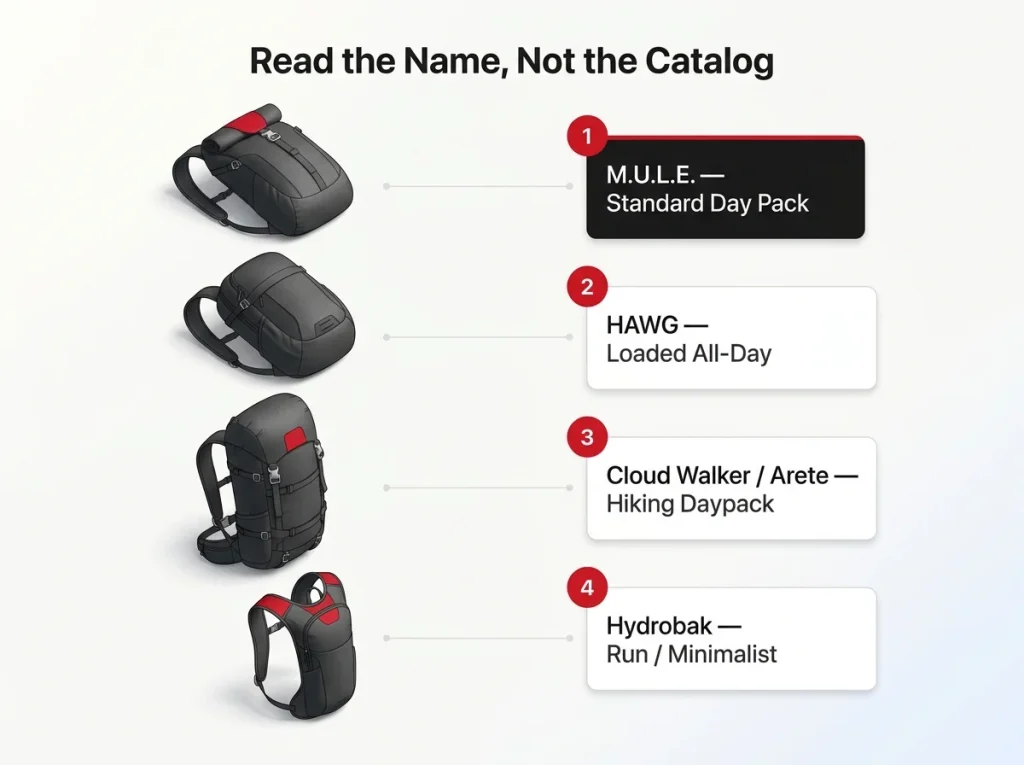
Strip away the branding and the lineup sorts into four buckets. The M.U.L.E. is your standard day pack. The HAWG is the loaded, all-day pack. The Cloud Walker and Arete are purpose-built hiking daypacks with no cycling pretense. The Hydrobak and Classic Light are run-and-minimalist packs, water-first with almost no gear room. Once you read the names that way, the whole wall of packs stops being a guessing game.
Reading the Number on the Tag
The number in the name is gear volume, not water. A “12” or a “20” tells you the liters of storage, while the reservoir size is a separate spec entirely. A M.U.L.E. 12 carries 12 liters of gear and a full 3 liters of water; a Cloud Walker 18 carries more gear (18 liters) but a smaller 2.5-liter bladder. Confuse the two numbers and you end up with plenty of water and nowhere for a rain layer, or the reverse. Keep them separate, and the next two sections give you the math for each.
How to Size Your Reservoir to the Hike

The marketing default is “buy the 3-liter to be safe.” The trailhead reality is that most day hikers never drink it, and water is the heaviest thing in the pack. Size the hydration bladder to the hours you’ll actually be out, not to the biggest number on the shelf.
The Half-Liter-Per-Hour Rule
The working number is about a half liter of water per hour for moderate activity in mild weather, climbing toward a liter or more per hour for strenuous hiking in real heat. A mellow three-hour hike lands near 1.5 liters; a hot, hard all-day push runs 3 liters or more. That single calculation tells you which reservoir to buy before you ever look at a pack.
It’s the core of simple hydration planning: enough water to stay hydrated, factoring in water availability on your route so you don’t get caught short where refills are scarce. If you want to pin it to your terrain and pace, run the numbers through a per-mile hydration calculator and size up from there.
Reservoir Size Tiers, Decoded
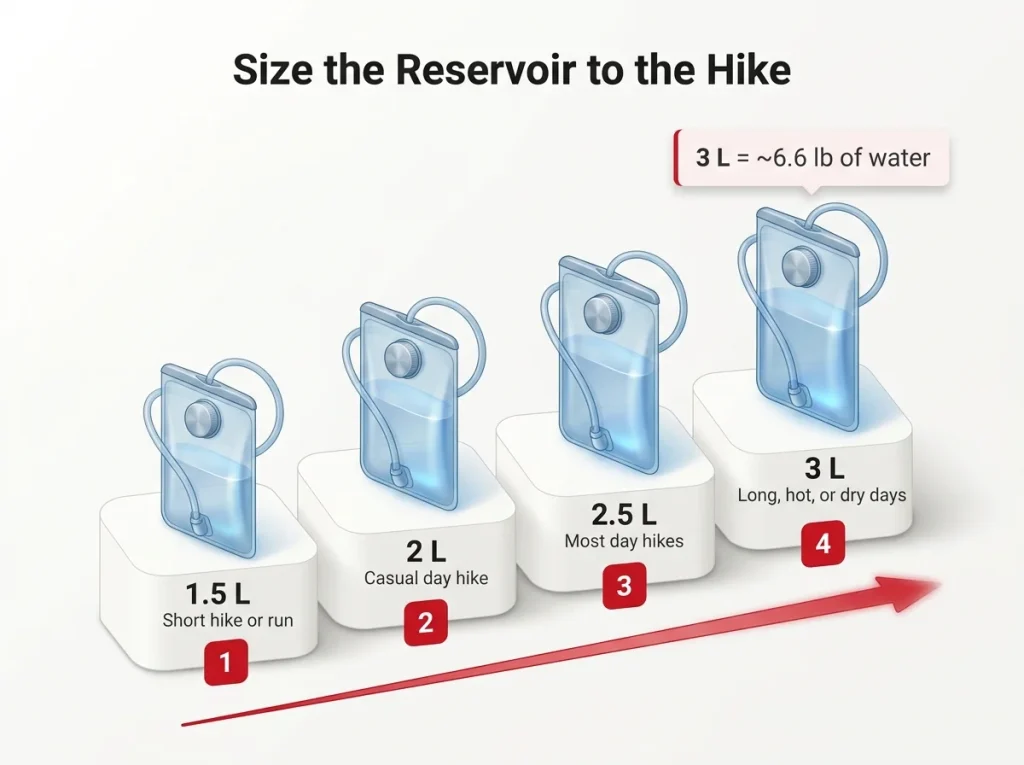
Reservoirs sort into three honest tiers. The 1 to 1.5-liter range (32 to 50 oz) suits minimalists, kids, and short hikes or trail runs. The 2 to 2.5-liter range (70 to 85 oz) is the weight-versus-capacity sweet spot for most day hikes. The 3-liter and up tier (100 oz) is for the thirstiest hikers, long days, or dry terrain where refills are scarce. REI’s hydration-pack sizing guidance breaks the reservoir tiers down by activity the same way, and most hikers who think they need the top tier actually live in the middle one.
Why Bigger Isn’t Safer
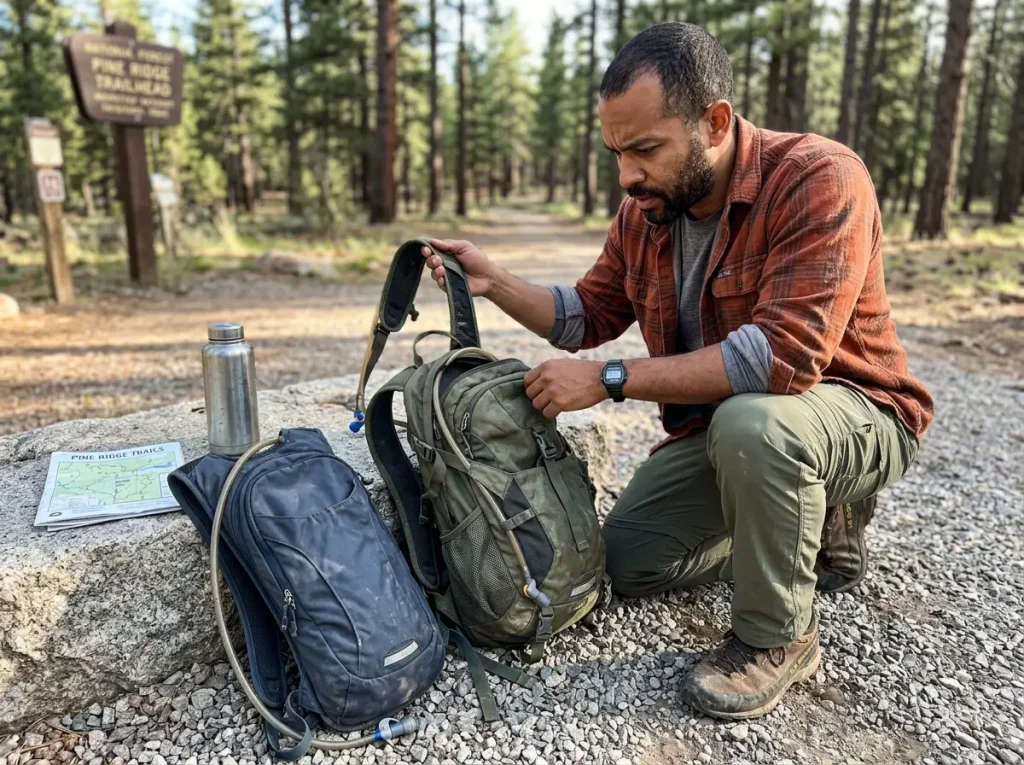
Water weighs about 2.2 pounds per liter, which means a full 3-liter reservoir is roughly 6.6 pounds of water alone, sitting on top of the pack’s own weight. Top one off for a four-mile loop and you’re carrying close to seven pounds of water you’ll never drink. That’s the overbuying tax nobody warns you about, and it’s the single most common mistake hikers make with a CamelBak. The fix is boring and effective: fill to the hike, not to the brim.
A bladder makes steady sipping effortless, and steady is what keeps you ahead of dehydration. Aim for a mouthful every twenty minutes instead of chugging at the overlook, and check your output: medium-to-light yellow means you’re pacing it right.
The reservoir itself is worth understanding, because it’s where CamelBak earns its reputation. The current Crux reservoir moves about 20% more water per sip than the older Antidote, adds an on/off lever that stops mystery leaks from soaking your map, and uses a self-sealing Big Bite valve. It’s BPA, BPS, and BPF-free with a Hydroguard lining that slows microbial growth inside the bladder and tube. That lining buys you time, but it doesn’t replace drying the thing out, which is its own section later.
How Much Gear Capacity You Actually Need
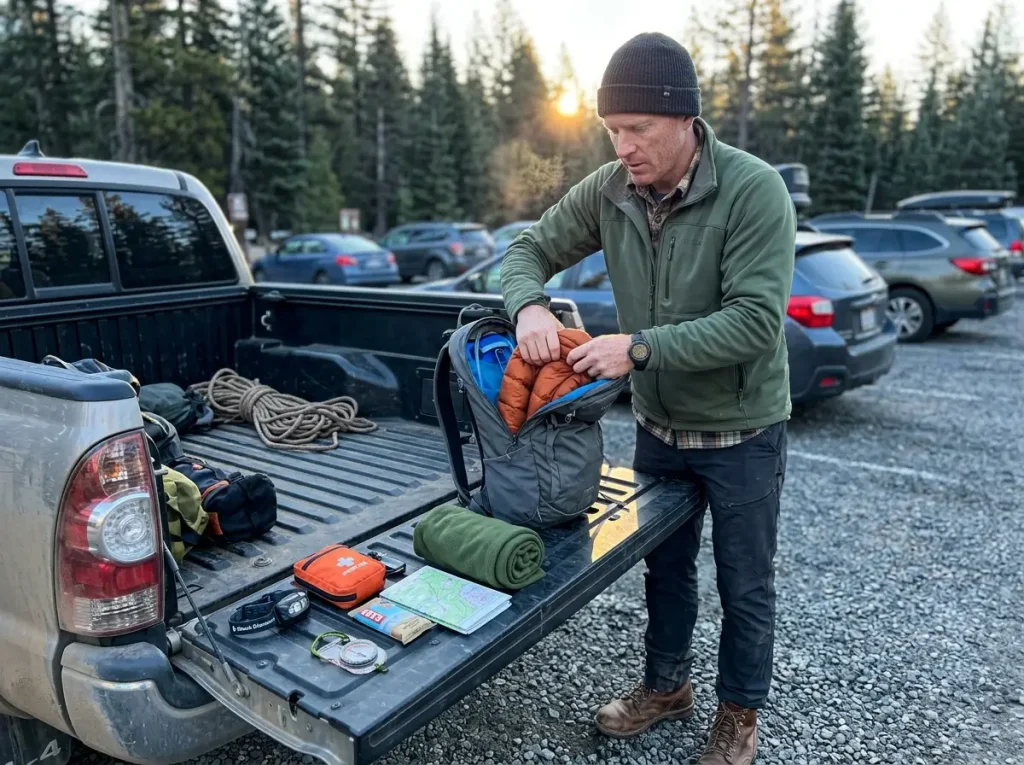
Water is half the equation. The other half is whether the pack has room for everything else you carry, and this is where the slim, water-first packs trap people. The classic mistake is unzipping a minimalist hydration pack at the trailhead and realizing there’s nowhere to stuff the puffy you just peeled off.
Volume by Trip Length
Pack volume sorts cleanly by how long you’re out. A short hike needs 8 to 14 liters of gear room. A full day with the ten essentials wants 14 to 22 liters. A big day or an overnight pushes into the 28 to 32-liter range. Sizing volume to your trip is the same way you’d choose any hiking backpack without wasting money: buy for the trips you actually take, not the one epic you might do someday. If you’re genuinely torn between a daypack and a true backpacking pack, that’s a real line worth understanding before you spend.
Don’t Forget the Ten Essentials
Reservoir-only packs like the Hydrobak Light and Classic Light carry a respectable 1.5 to 2 liters of water but leave almost no room for the safety kit a real day hike requires. A layer, snacks, a headlamp, a small first-aid pouch, navigation: that gear needs real estate, and a water-first pack doesn’t have it. Match volume to your gear, not just to your water, and the reservoir-only packs reveal themselves for what they are: fast-and-light tools for short, simple outings.
The Weight-to-Volume Tradeoff
Every pack is carried weight before a drop of water goes in. A loaded HAWG Pro 20 runs around 3.1 pounds with its bladder, back protector, and tool roll, while a lighter Cloud Walker 18 saves you most of a pound on the same trail. On a short hike that gap is noise. On a 12-mile day with a lot of elevation gain, it’s the difference between fresh shoulders and sore ones. Buy the support when the load justifies it, and skip it when it doesn’t.
Getting the Fit and Ventilation Right
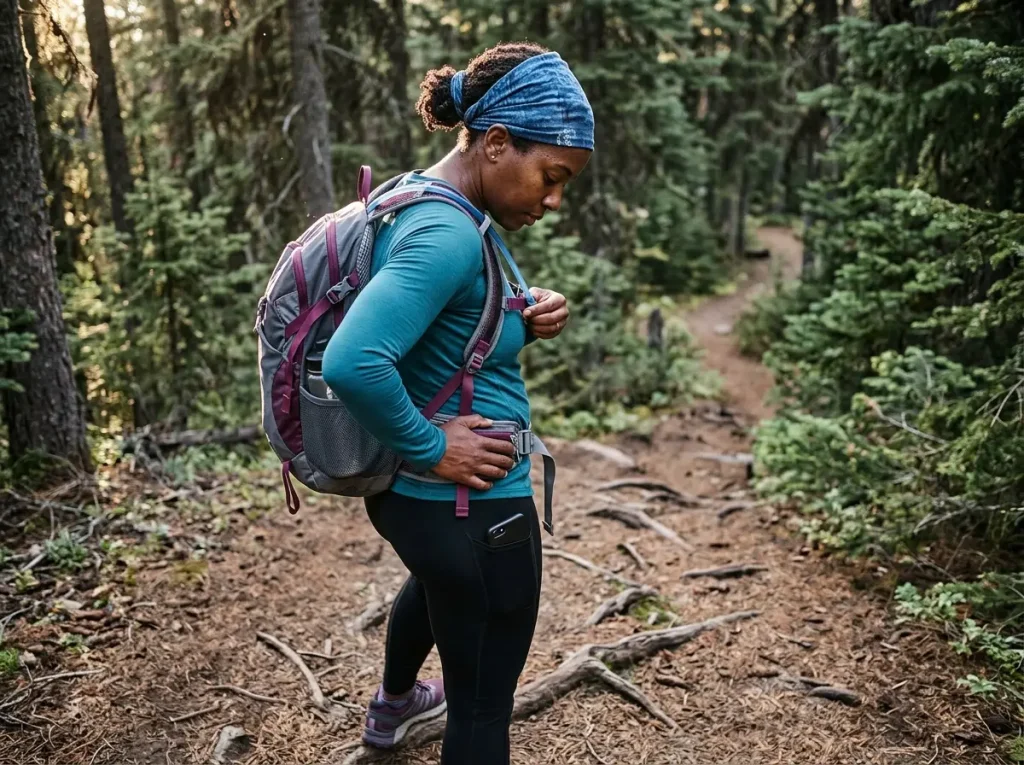
A pack that fits is one you forget you’re wearing. A pack that doesn’t turns into a mile-counter you feel in your shoulders. Fit is where the right size on paper meets your actual back, and it’s worth getting right before you commit.
Measure Your Torso First
Fit tracks your torso length, not your height. Two hikers the same height can need different pack sizes because their torsos differ, and a pack sized to the wrong torso rides badly no matter how you crank the straps. Measure from the bony bump at the base of your neck down to the level of the top of your hip bones, and match that to the pack’s torso range before anything else.
Straps, Sternum, and Stability Belt
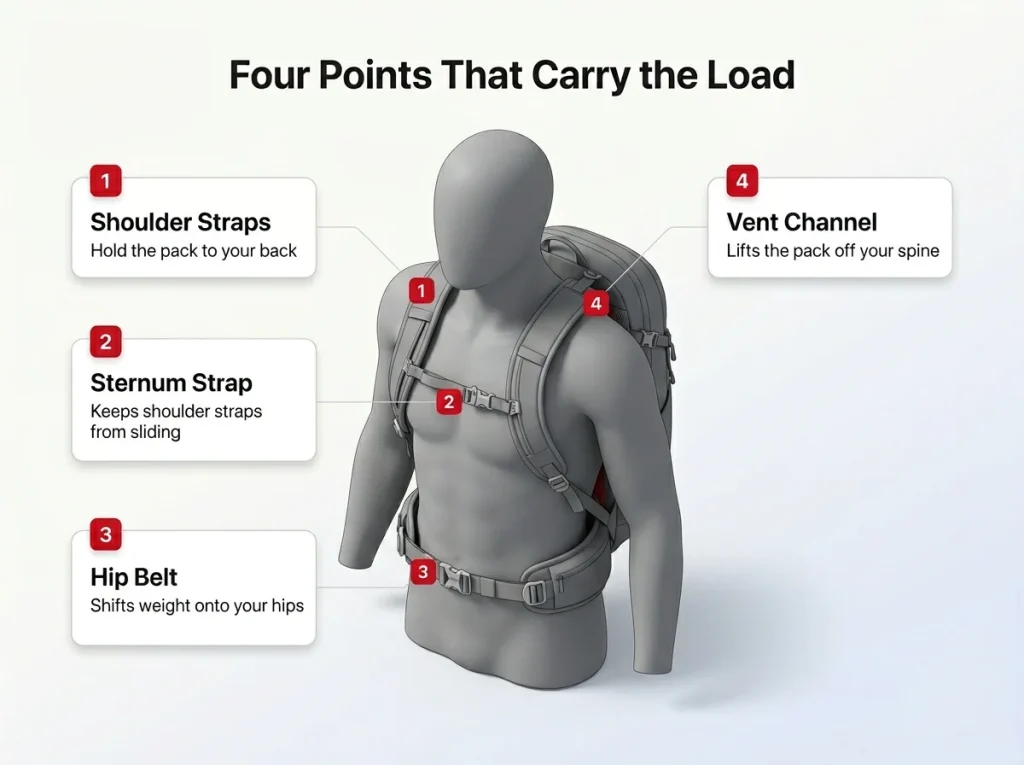
Three contact points carry the load. The shoulder straps hold the pack to your back, the sternum strap clips across your chest to keep the shoulder straps from sliding outward, and the hip belt on bigger packs transfers weight off your shoulders onto your hips, where your legs can actually carry it. On a loaded pack the hip belt does most of the work, which is why a Fourteener feels lighter than its weight and a strapless minimalist pack feels heavier than its. If you want to dial in each one, this full fit walkthrough covers the straps and hip belt step by step.
Back-Panel Ventilation and the Magnetic Tube Trap
A sweaty back is the price of a pack that sits flat against you, and CamelBak fights it with Air Support and NV back panels plus 3D vent mesh that lifts the pack slightly off your spine. It matters most on the loaded HAWG and Fourteener, where you’re working harder and longer. The Magnetic Tube Trap is a smaller touch that pays off every mile: it holds the hose and bite valve at chest level so you’re not fishing for a swinging tube. Worth noting that testers found the M.U.L.E. 12’s magnet knocks loose more easily than the bigger packs’, so if that detail drives you up a wall, size up.
Women’s-Specific Fit
Several of these packs come in women’s-specific versions, and it’s not a color swap. The M.U.L.E. 12, the Fourteener (sold as the Fourteener 30 for women), and the Hydrobak Light all offer shorter torso ranges and shaped harnesses built around a different frame. If a unisex pack has always dug into your shoulders or sat too long in the torso, women’s-specific hiking packs are built around exactly that difference. Try the women’s version before you assume the pack just doesn’t fit you.
The CamelBak Hiking Lineup, Pack by Pack
Now that you can decode the names and size both the water and the gear, here’s the short list, matched to your hike instead of to CamelBak’s catalog. The lineup spans a compact 12 liters up to a 32-liter hauler, which is really the line between a daypack and a true backpacking pack. Start with the quick comparison, then drop to the pack that matches your day.
| Model | Gear / Water | Best For | Weight Class |
|---|---|---|---|
| M.U.L.E. 12 | 12 L / 3 L | Standard day hike | Light |
| Cloud Walker 18 | 18 L / 2.5 L | Easy-to-moderate day hike | Light |
| HAWG Pro 20 | 20 L / 3 L | Long, loaded day | Heavier (~3.1 lb) |
| Fourteener 32 / 30 | 32 L / 3 L | Big day or overnight | Heaviest |
| Hydrobak Light | Minimal / 1.5 L | Short hike or trail run | Ultralight |
| Arete 14 | 14 L / 1.5 L | Travel or summit day | Ultralight, packable |
| TETON Oasis 18 | 18 L / 2 L | Budget all-rounder | Light |
The Everyday Day-Hike Picks
For the hikes most people actually do, these two cover it. The M.U.L.E. 12 is the organized all-rounder; the Cloud Walker 18 is the simpler, lighter pick with more room for layers.
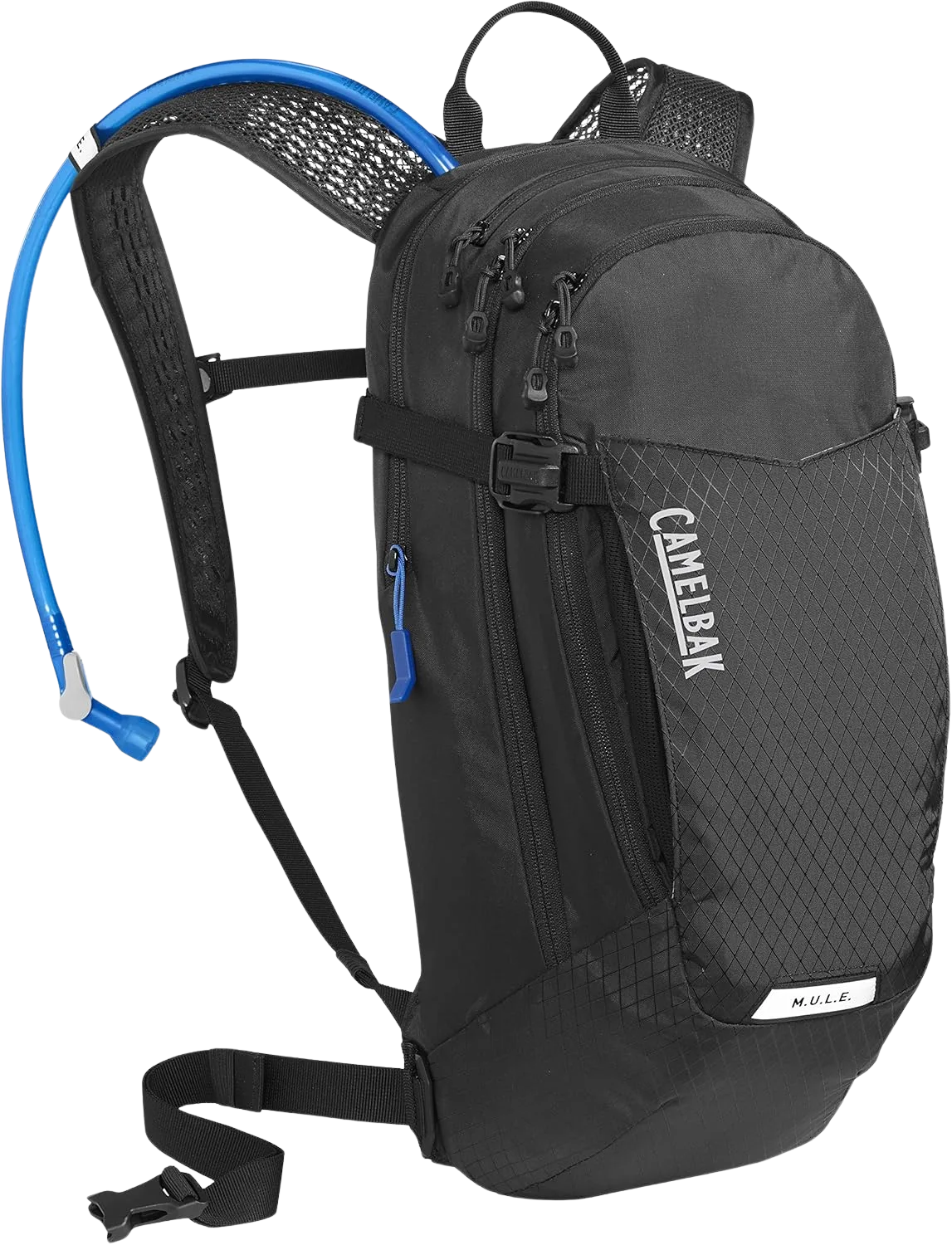
The M.U.L.E. 12 is the pack I’d hand a hiker who asked for one CamelBak to do most of their days. Twelve liters of gear is enough for the ten essentials and a layer, the 3-liter Crux covers long days, and the organization (side cargo pockets included) keeps small stuff from disappearing into a single sack. Its one quirk is that magnetic tube trap working loose on rough ground, which is a minor annoyance rather than a dealbreaker. Women get a properly shaped version, so this is one to buy in your actual fit.
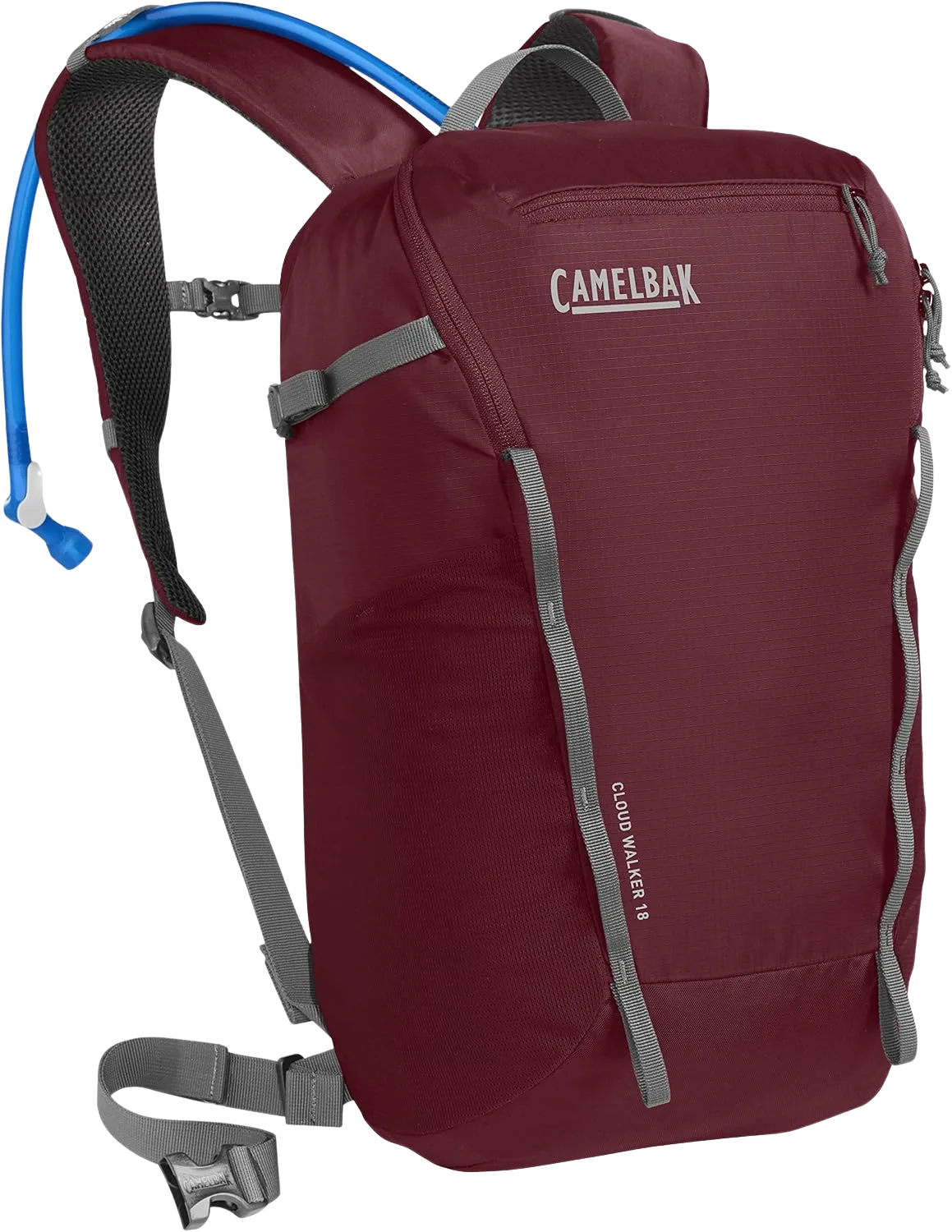
If the M.U.L.E. is the organized choice, the Cloud Walker 18 is the easy one. It gives you more gear volume for layers and lunch, keeps the weight down, and skips the cycling-pack styling. The 2.5-liter bladder is plenty for a normal day hike, and the extra storage means you’re not playing Tetris with your rain shell. For a casual-to-moderate hiker who wants one pack and no fuss, this is the value-of-simplicity pick. On a tight budget, the TETON Oasis 18 further down covers the same ground for less.
When You’re Carrying More
Some days you carry more: more layers, more food, more miles. These two are built to wear that load without beating up your shoulders.
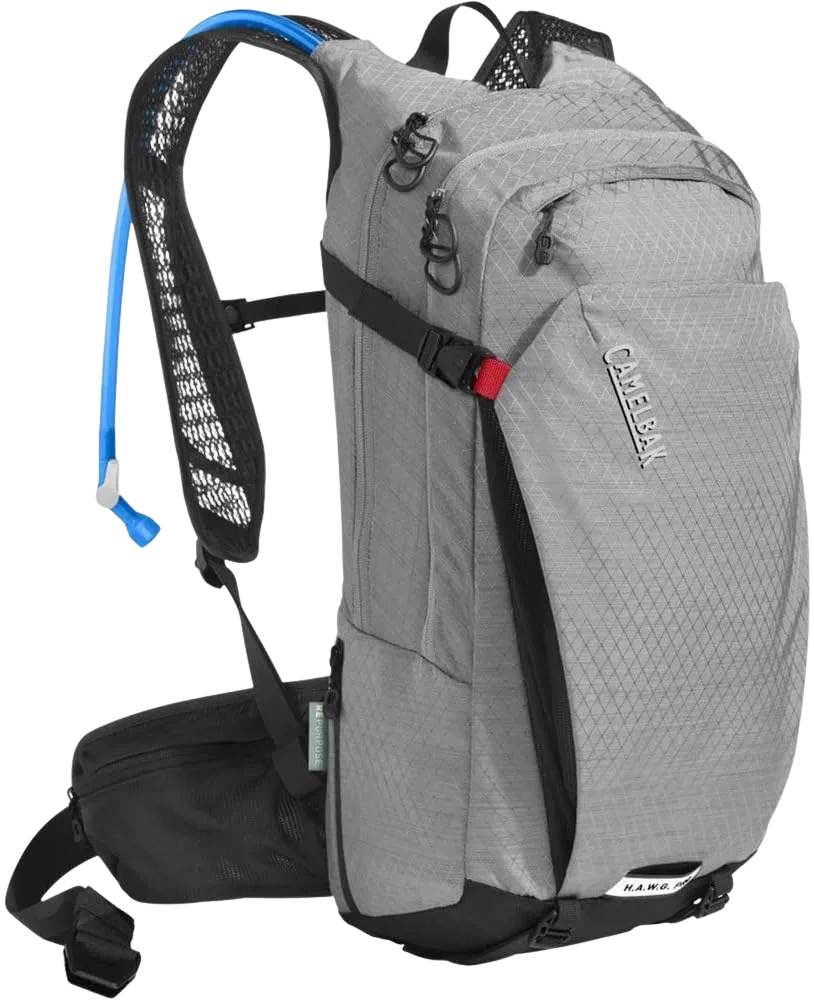
The HAWG Pro 20 is the pack for the days that earn it. Twenty liters of gear plus a 3-liter Crux means you can carry the layers, the extra food, and the just-in-case kit a long day demands, and the suspension actually transfers that load instead of dumping it on your shoulders, with a trekking pole attachment that frees your hands on steep climbs. It runs heavier at around 3.1 pounds loaded, so it’s more pack than a casual hiker needs. But when you’re moving from first light to late afternoon, that structure is what keeps you comfortable. Its load-hauling comes down to the back-panel suspension doing its job, which is the same reason the Fourteener below feels lighter than it weighs.
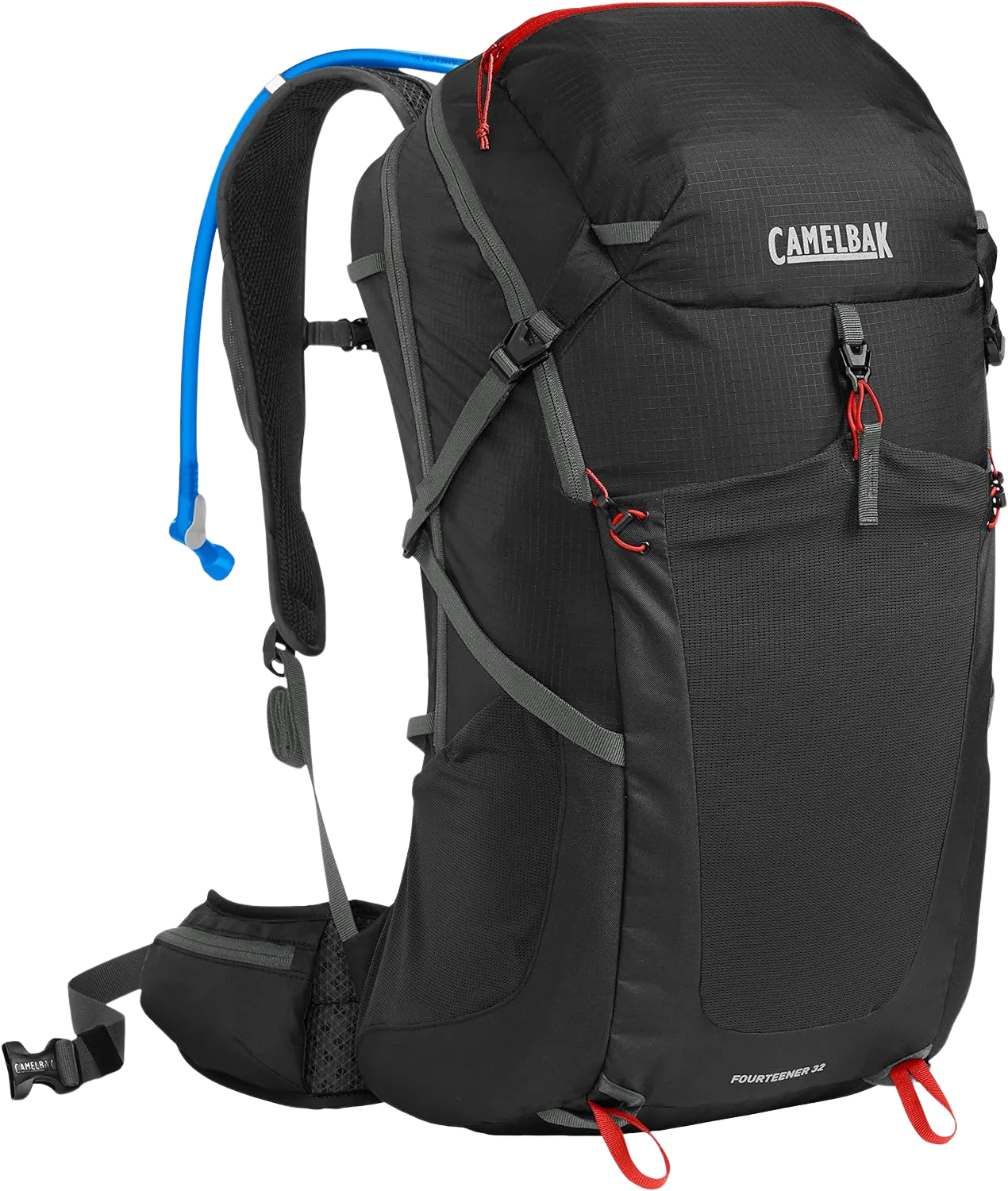
When you need a hydration pack that can also handle an overnight, the Fourteener 32 is the one. Thirty-two liters swallows the ten essentials plus a light overnight kit, the dedicated reservoir sleeve keeps the bladder from crushing your gear, and the vented back panel earns its keep when you’re moving under a full load. It’s the heaviest pack here and overkill for a short day, so buy it only if your trips genuinely run big. Women should look at the Fourteener 30, which carries the same idea on a shorter frame.
Short, Fast, or Packable
Not every hike needs a full pack. For quick outings and travel, these two strip down to the essentials.
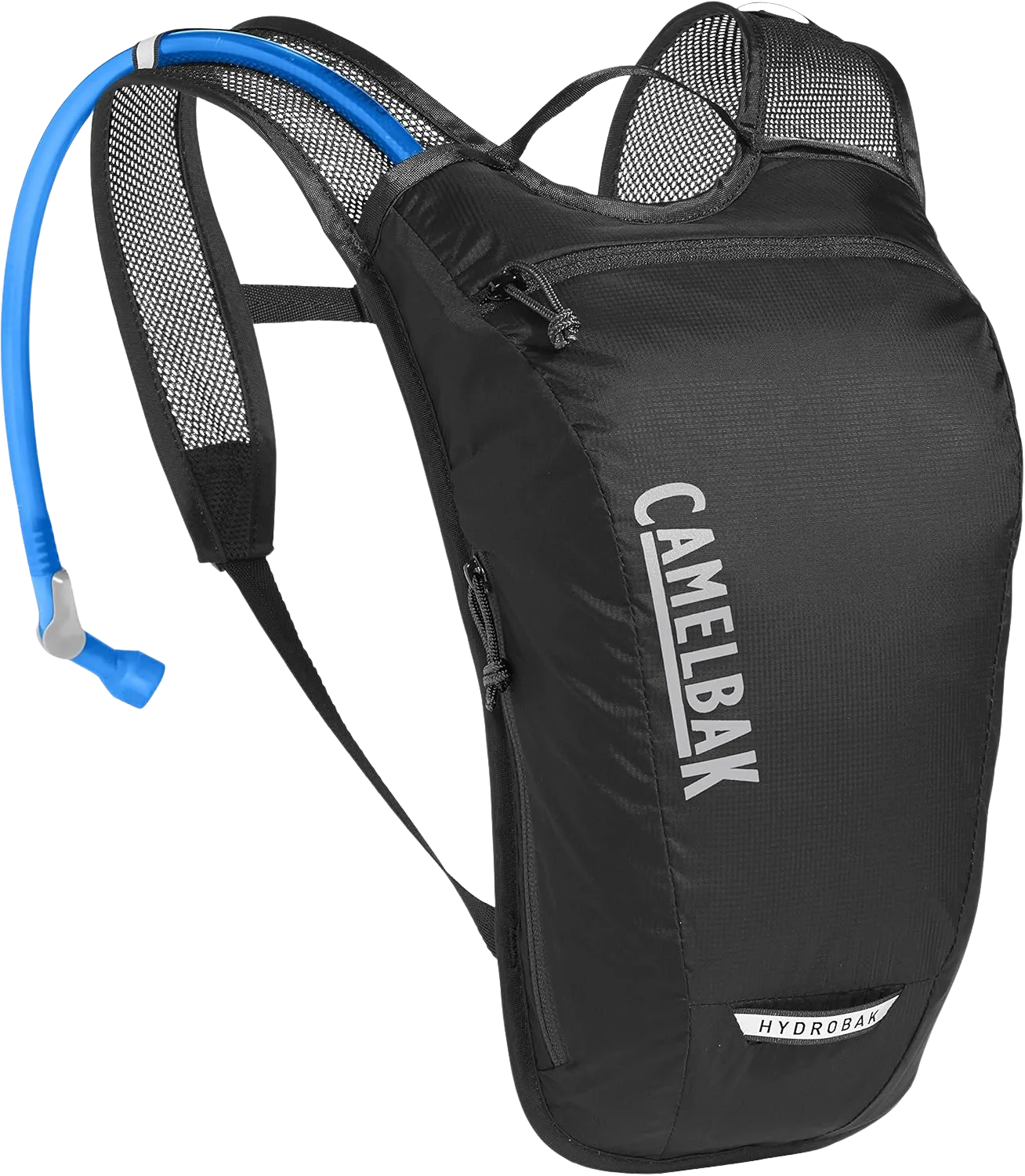
The Hydrobak Light does one job and does it well: carry about 1.5 liters of water with the least possible weight and fuss for a quick trail run or a short, simple hike. Just be honest about what it isn’t. There’s no room for a layer or the ten essentials, so the moment your outing turns into a real day hike, it’s the wrong tool. If you’re weighing this against a slightly bigger pack, the running vest versus daypack question is worth thinking through before you buy. Both men’s and women’s frames are available.
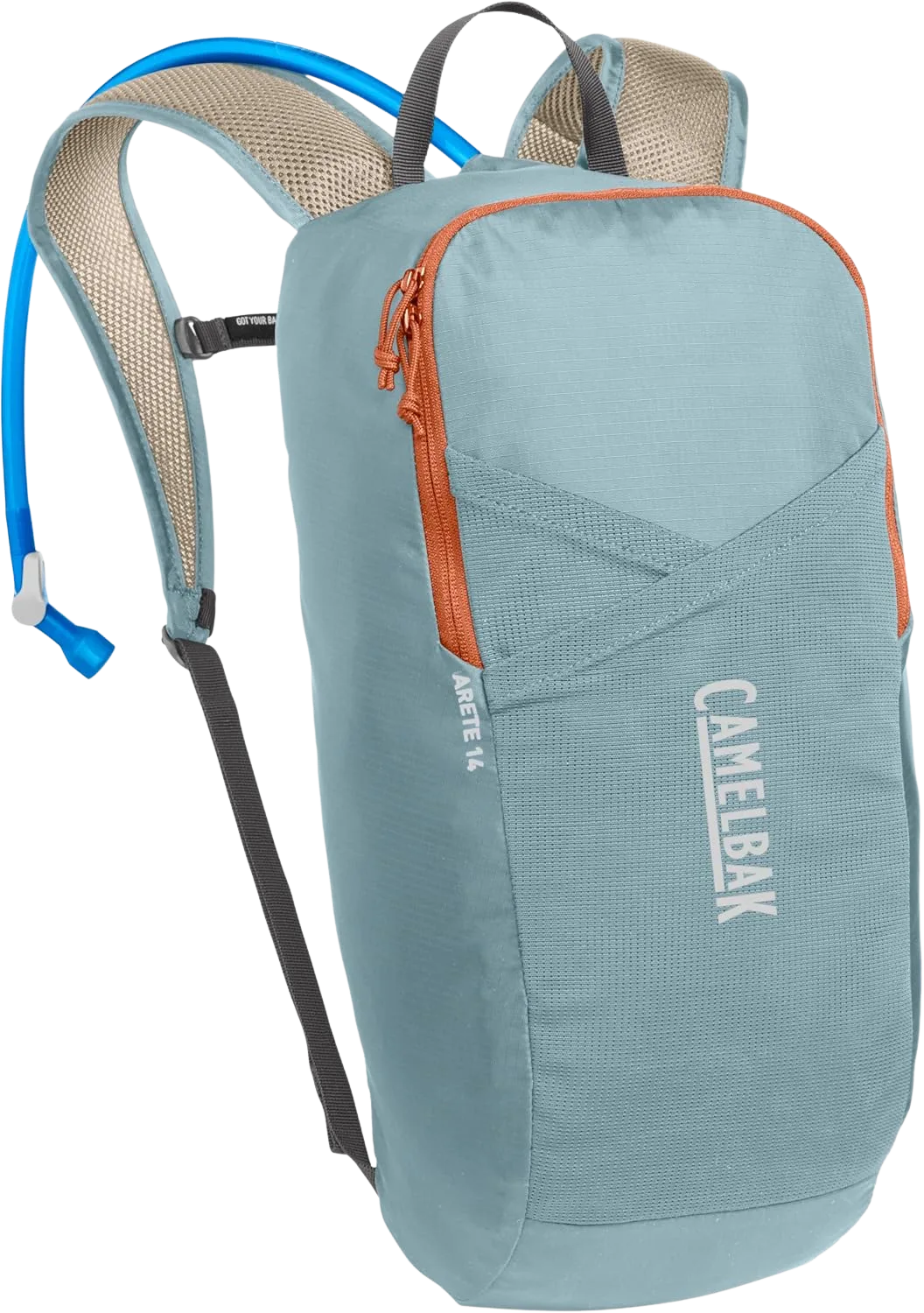
The Arete 14 solves a specific problem: you want a real daypack on a trip, but you don’t want to dedicate luggage space to it. It collapses down to almost nothing, then opens up to a usable 14 liters with a 1.5-liter bladder for a summit push or a travel-day hike. It’s not the pack for your weekly local trail, where the Cloud Walker or M.U.L.E. does more. It’s the one you throw in a suitcase and forget about until you need it.
The Budget Pick That Isn’t a CamelBak
You don’t have to buy CamelBak to get a working hydration pack, and pretending otherwise would be dishonest.
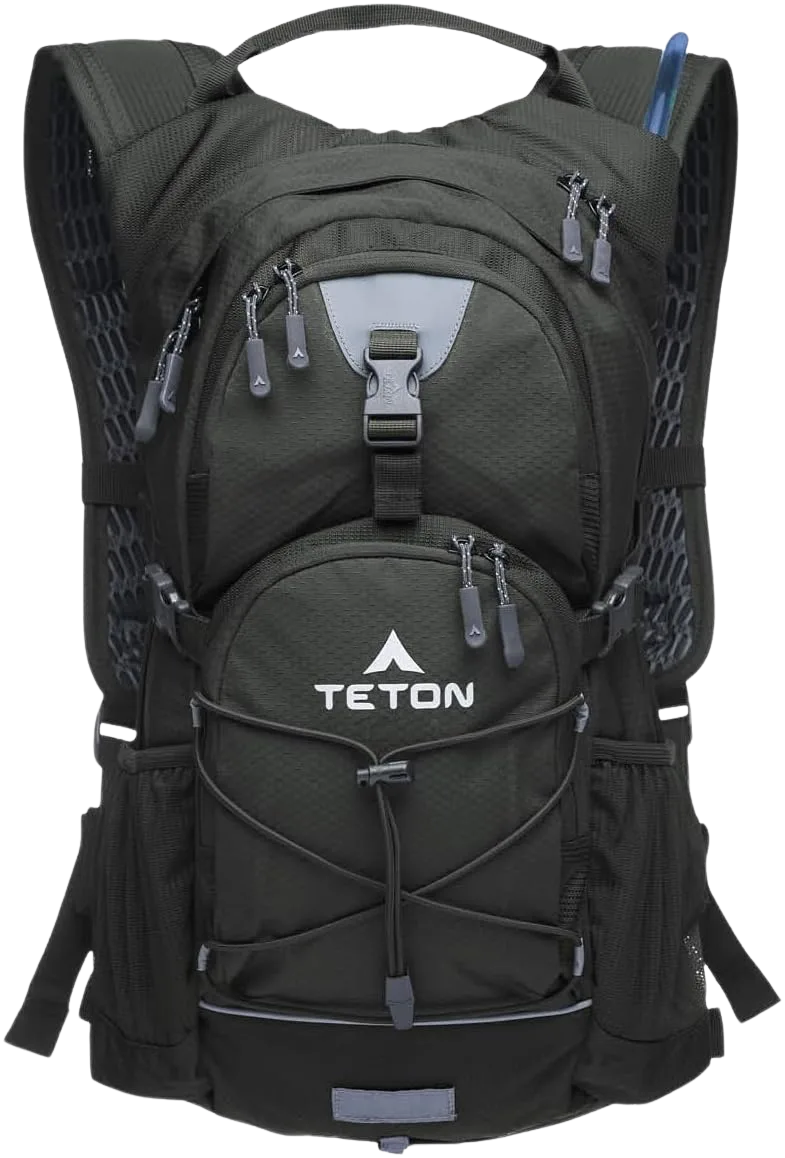
The TETON Oasis 18 is the pack to buy when you hike a handful of times a year and can’t justify CamelBak money. You get 18 liters of gear room and a 2-liter bladder, which is genuinely enough for a normal day hike. The reservoir and bite valve feel a step down from the Crux, and you’ll likely replace the bladder before the pack wears out. But as the honest answer to “do I have to spend big,” it’s a clear yes-you-can-skip-CamelBak option.
When a CamelBak Isn’t the Right Pack
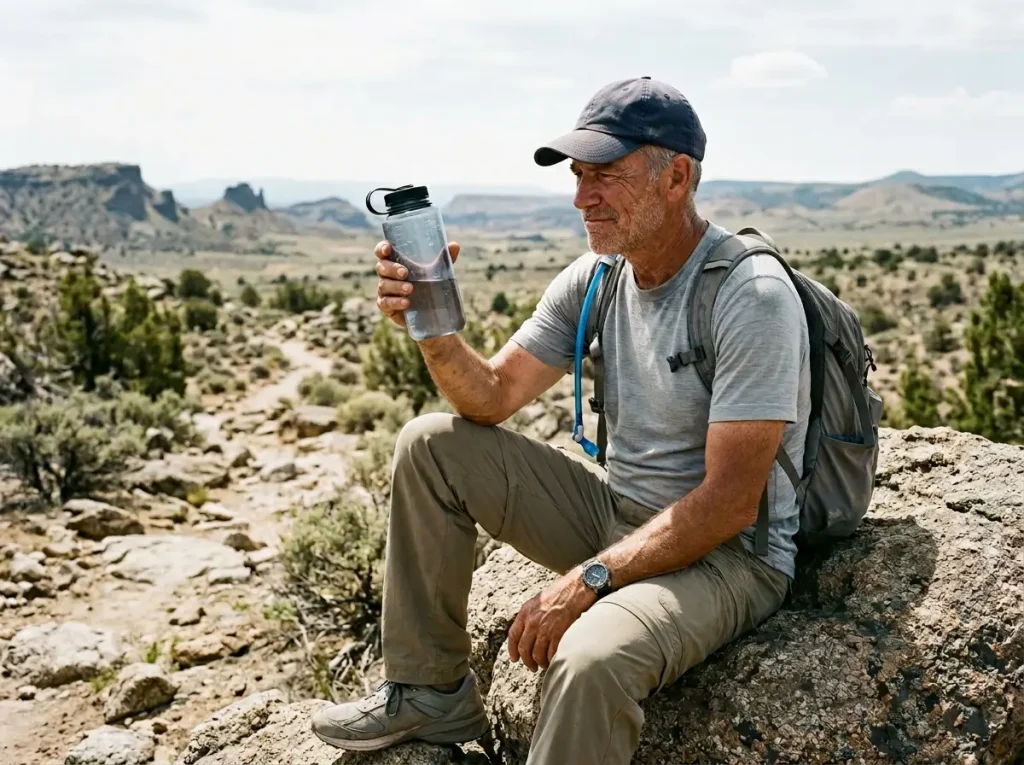
A friend who isn’t trying to sell you anything will tell you when to keep your money. A hydration backpack is a great tool, but it’s not always the right one, and a CamelBak specifically isn’t always worth the premium. Here’s where the honest lines are.
Signs You’re Buying Too Much Pack
Most day hikers never need 3 liters of water or 20 liters of gear, full stop. If your typical outing is a few hours on a marked trail with water at the car, the 2 to 2.5-liter, 14 to 18-liter middle of the range covers you with room to spare. Buying bigger because it feels safer just means carrying weight you’ll never use, which is the overbuying tax from earlier showing up again. If you’re consistently doing short, fast outings, a fast-and-light setup might serve you better than any daypack. Match the pack to your real hikes, not your aspirational ones.
When Bottles Beat a Bladder
A bladder’s biggest hidden flaw is that you can’t see how much water is left without pulling it out. Hikers sip happily for two hours, reach for one more pull near the summit, and get nothing but air, miles from the next source. A bottle shows you exactly what you have at a glance, which is why bottles win for short hikes, for freezing weather (more on that next), and any time knowing your remaining water matters more than effortless sipping. The bladder’s real strength is the steady, no-effort sip schedule that keeps you ahead of dehydration, and that’s a genuine reason to carry one. It’s a tradeoff, not a clear win for either side.
Carry one small backup bottle alongside the bladder. It’s your visible water gauge, your insurance if the bite valve clogs or freezes, and the easiest way to know whether you’ve got enough left to push for the summit or need to turn around.
The One-Bottle Backup Trick
That backup bottle solves more than one problem. It gives you a visible read on your water, it’s a fallback if the valve fails, and it makes refilling at a source quicker than wrestling the bladder out of a full pack. A simple packable bottle makes an easy visible backup that weighs almost nothing and lives in a side pocket. Plenty of experienced hikers run exactly this setup: bladder for the steady sipping, bottle for the gauge and the insurance.
Keeping Your Bladder Clean and Drinkable
Nobody warns you that the bite valve, not the bladder, is where the funk and the leaks actually start. And that an insulated hose still freezes before the bladder does. Get these two things right and your pack lasts for years and never tastes like mildew. Get them wrong and you’ll blame the pack for problems you caused at home.
Why Your Bladder Gets Moldy
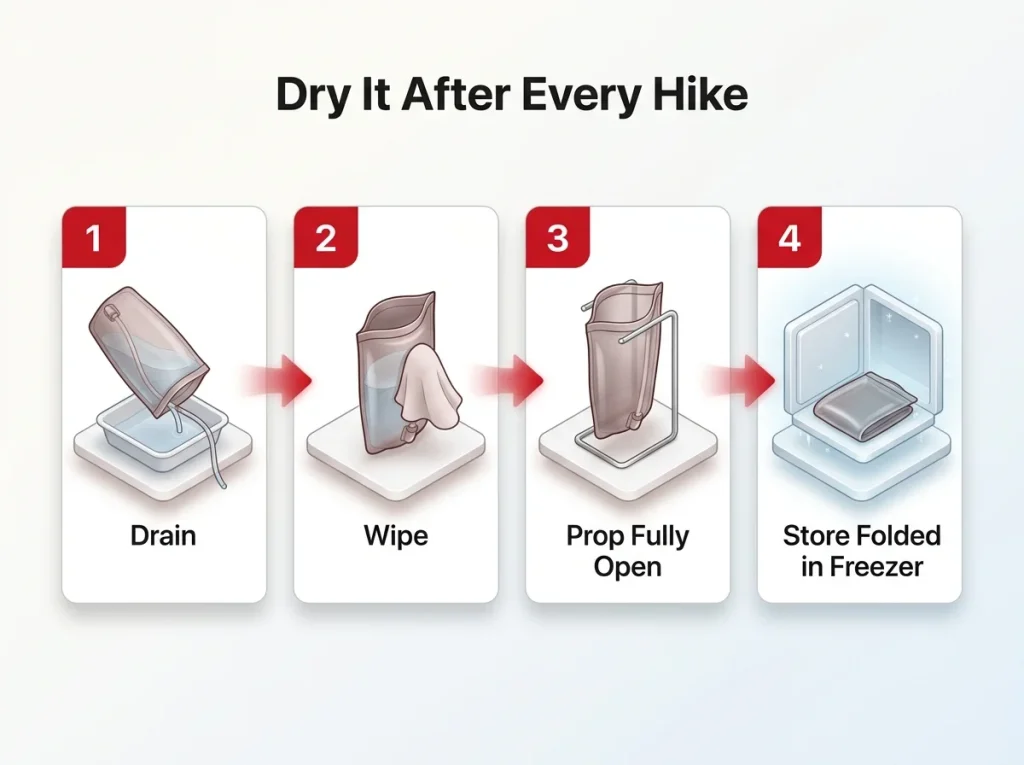
Bladder hygiene comes down to one habit, and mildew is what grows when you skip it: storing the bladder wet and rolled up in a dark cabinet. The fix is just as simple. Drain the bladder and the hose, wipe the inside, and prop it fully open to air-dry so no damp surfaces touch. Many hikers then store the dry bladder folded in the freezer between trips, which stops biofilm cold. The Hydroguard lining slows microbial growth, but it does not replace drying, and the step-by-step bladder-cleaning routine REI recommends follows the same drain-prop-dry logic. If you want the visual, this short clip shows the prop-open drying and tube-brush motion that text can only describe.
The accessory that makes this painless is the cleaning kit, because the brushes reach the spots a paper towel can’t.
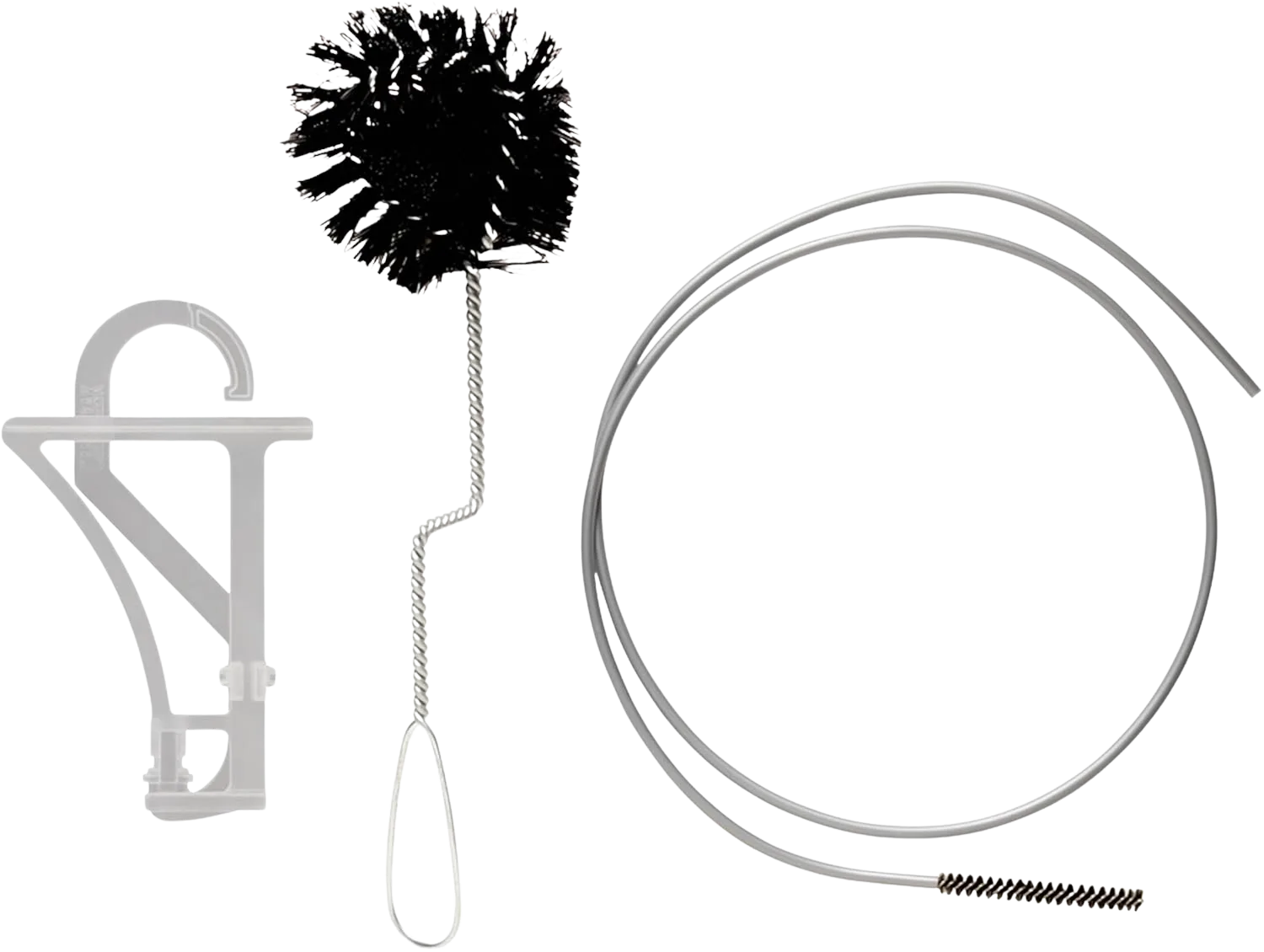
You can do this with baking soda and a prop-open dry if you’re on a budget, but the kit’s hanger and brushes make it the difference between a chore you skip and one you actually do. Skipping it is how the funk gets started.
Clean the Tube and Valve, Not Just the Bag
The bladder itself rarely causes trouble. The hose and bite valve do, because water sits trapped in them and the valve traps backwash every time you drink. Run the long brush through the tube, pull the bite valve apart to clean it, and use the Crux on/off lever religiously so a jostled valve doesn’t soak your map and snacks. CamelBak’s own care-and-cleaning instructions for the Crux reservoir walk through the valve disassembly, and it takes about two minutes once you’ve done it once.
Cold-Weather Hose Freeze
This is the one that ruins a CamelBak on a winter hike, and almost no hiking guide explains it. The hose and bite valve freeze well before the bladder does, even on insulated tubes, because the thin water in the line gives up its heat first. Your bladder can be full and liquid while the valve is a solid plug by mid-morning. The field fix costs nothing: after every sip, blow the water back down the hose into the reservoir so there’s nothing left in the line to freeze. Preventing mildew and managing freeze both come down to the same habit of clearing water out of the parts that hold it, and the deeper routine lives in this guide to preventing mold in hydration bladders.
In freezing weather, blow water back into the reservoir after every single sip. An empty hose can’t freeze. It feels fussy for the first mile, then it’s automatic, and it’s the one trick that keeps your water drinkable when the temperature drops.
Final Take
Decode the name first, then size to your hike: reservoir to the hours, volume to the gear. Most hikers want the middle of the range, a M.U.L.E. 12 or a Cloud Walker 18 with a 2 to 2.5-liter bladder, not the biggest pack on the wall. And whichever you pick, the pack only stays good if you dry it out every time and blow the hose back when it’s cold.
Pull whichever pack matches your next hike off the shelf, fill it to the half-liter-per-hour math instead of to the brim, and you’ll carry exactly what you need and nothing you don’t.
Frequently Asked Questions
01What size CamelBak do I need for hiking?
For most day hikes, a 2 to 2.5 L (70 to 85 oz) reservoir in a 14 to 18 L pack covers it. Drop to 1.5 L for short hikes or runs, and step up to 3 L only for long, hot days or dry terrain.
02Are CamelBak hydration packs worth the money?
For frequent hikers, yes. The Crux reservoir, on/off lever, and fit hold up over years of use. If you hike occasionally or you’re on a budget, a TETON Oasis 18 does the core job for far less.
03What’s the difference between the CamelBak M.U.L.E. and the Cloud Walker?
The M.U.L.E. 12 is the organized, compact all-rounder with 3 L of water and 12 L of gear. The Cloud Walker 18 is a simpler, lighter hiking daypack with a 2.5 L bladder and more room for layers.
04How do I clean and dry a CamelBak bladder so it doesn’t get moldy?
Drain the bladder and the hose, wipe the inside, and prop it fully open to air-dry. Never store it wet and rolled up. Between trips, many hikers keep the dry bladder folded in the freezer to stop biofilm.
05Can a CamelBak hydration pack carry enough gear for a full day hike?
Yes, if you size it right. A 14 to 22 L model like the Cloud Walker 18, M.U.L.E. 12, or HAWG Pro 20 fits the ten essentials plus a layer. Reservoir-only packs like the Hydrobak Light don’t, so skip those for full days.
Risk Disclaimer: Hiking, trekking, backpacking, and all related outdoor activities involve inherent
risks which may result in serious injury, illness, or death. The information provided on The Hiking Tribe is for
educational and informational purposes only. While we strive for accuracy, information on trails, gear, techniques,
and safety is not a substitute for your own best judgment and thorough preparation. Trail conditions, weather, and
other environmental factors change rapidly and may differ from what is described on this site. Always check with
official sources like park services for the most current alerts and conditions. Never undertake a hike beyond your
abilities and always be prepared for the unexpected. By using this website, you agree that you are solely
responsible for your own safety. Any reliance you place on our content is strictly at your own risk, and you assume
all liability for your actions and decisions in the outdoors. The Hiking Tribe and its authors will not be held
liable for any injury, damage, or loss sustained in connection with the use of the information herein.
Affiliate Disclosure: We are a participant in the Amazon Services LLC Associates Program, an
affiliate advertising program designed to provide a means for us to earn advertising fees by advertising and linking
to Amazon.com. As an Amazon Associate, we earn from qualifying purchases. We are also an official affiliate partner
of Black Diamond Equipment via the AvantLink network. If you click on a Black Diamond affiliate link and make a
purchase, we may earn a commission at no additional cost to you. We also participate in other affiliate programs and
may receive a commission on products purchased through our links. Additional terms are found in the terms of
service.