In this article
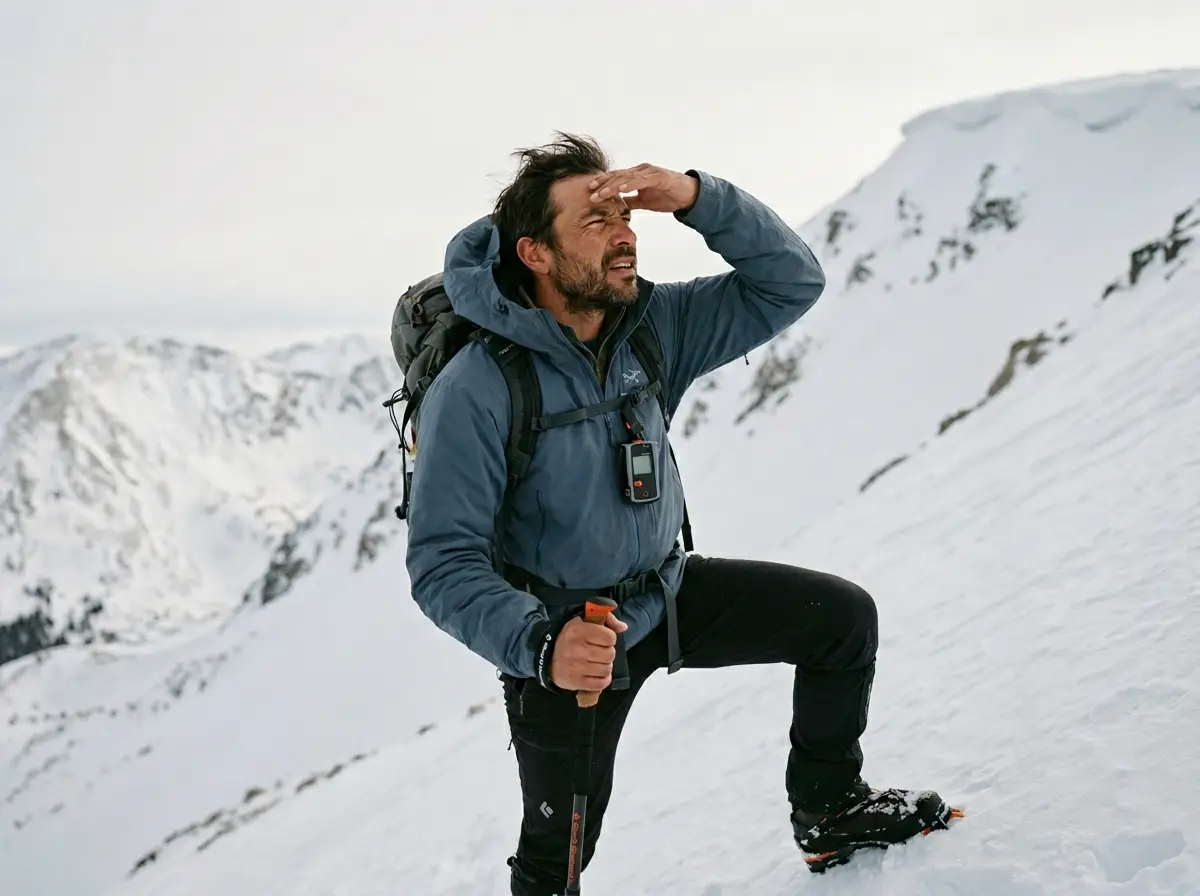
The slope looked fine. Wind-packed, firm, no debris at the bottom. We’d camped below it the night before without a second thought. On the way back, crossing at 9,400 feet, I heard it before I felt it — a low, resonant whumpf, like someone punching the ground from underneath. The surface dropped half an inch across a patch the size of a living room. We sprinted laterally. The fracture never propagated into a full release. That time.
I’ve guided winter routes in the Rockies for over fifteen years. That sound is the one thing I never stop taking seriously, no matter how solid the forecast looked at the trailhead. Snow doesn’t care about your plans. What it does respond to is a specific field protocol grounded in physics, observation, and hard-coded decision frameworks.
This guide covers every layer of that protocol: the thermodynamics that build hazardous snowpacks from the ground up, the red flags you can read on approach, the snowpit tests that verify what your eyes can’t see, and the cognitive traps that have cost even experienced backcountry travelers their lives. Run all three stages. Every time.
⚡ Quick Answer: Safely reading snow conditions requires three stages: (1) Check the regional avalanche bulletin before you leave — focus on avalanche problem type, not just the hazard number. (2) Scan for five unambiguous red flags on approach: recent avalanche activity, whumpfing, shooting cracks, rapid loading, and rapid warming. (3) On ambiguous days, dig a snowpit and run an Extended Column Test (ECT). If the result is ECTP, the slope is unstable. If 3+ ALPTRUTH factors are present at any point, divert your objective. No summit is worth the alternative.
The Physics of an Unstable Snowpack
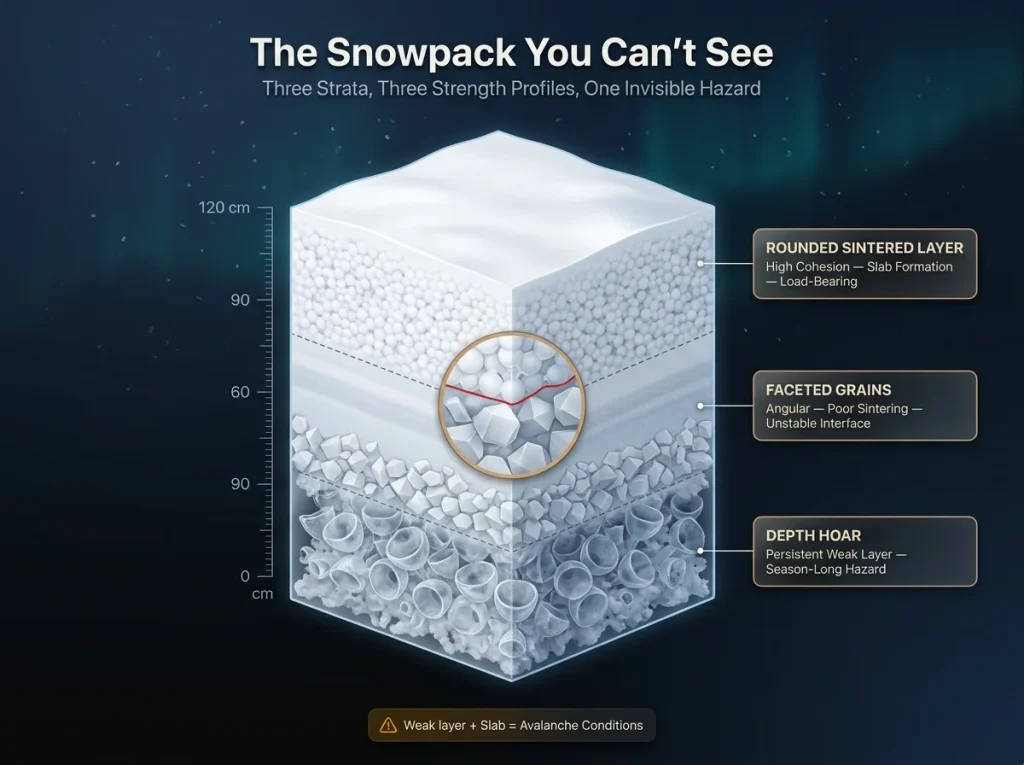
Most hikers think of snow as a single material. It isn’t. A seasonal snowpack is a stack of distinct layers, each with its own crystal structure, strength profile, and history. What happens at the invisible boundaries where hard meets soft is where avalanches start.
Equitemperature Metamorphism: When Snow Gets Stronger
When the temperature gradient inside a snowpack stays below roughly 10°C per meter of depth, equitemperature metamorphism takes over. Water vapor migrates from sharp crystal tips toward concave surfaces, rounding them out over time. The result is sintering — inter-granular bonds that lock rounded grains together the way wet sand packs into a castle wall. This dominates in deep maritime snowpacks like the Pacific Northwest.
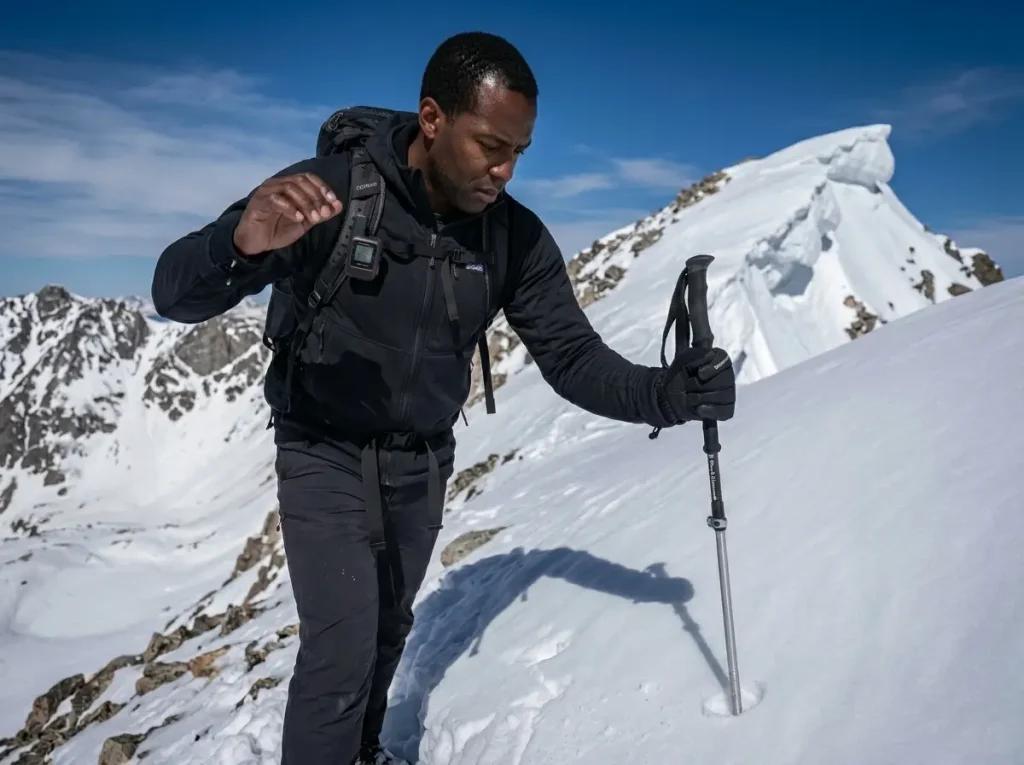
Probe the snow with your pole tip: consistent resistance with no sudden soft zones means you’re likely on a well-sintered pack. Not a guarantee, but one of the better profiles you’ll encounter.
Pro tip: Any sudden depth where the pole drops free — remember that spot. That’s your weak layer.
Kinetic Metamorphism and Depth Hoar
Push the gradient past 10°C/meter — common in shallow Rocky Mountain snowpacks during cold, clear stretches — and the process flips. Vapor sublimes from warmer basal grains upward, depositing onto colder upper grains in angular, flat-faced shapes called facets. Rub a handful between your fingers: it crumbles. It won’t cohere into a ball. That’s the diagnostic test.
Faceted snow carries load the way a pile of marbles does — until the marble on the bottom shifts. If kinetic metamorphism runs unchecked for weeks, facets evolve into depth hoar: large, hollow, cup-shaped crystals that resist sintering even when conditions improve. Per Utah Avalanche Center’s technical breakdown of depth hoar management, this rotting foundation can plague a shallow snowpack for an entire season in continental climates. If you’re digging a pit and the bottom 20–30 cm produces an audible crunch like popping bubble wrap, you’ve hit depth hoar. Get off that aspect.
This is where avalanche awareness fundamentals for winter hikers becomes essential reading before you venture above treeline.
Slab Mechanics: How Layers Actually Fail
A weak layer alone doesn’t trigger an avalanche. You need a slab above it — a cohesive plate of snow with enough internal strength to fracture as a unit and slide. Wind builds most of them.
Wind Loading and the Architecture of a Wind Slab
Wind moves snow roughly ten times faster than it falls. As it transports snow over ridges, it mechanically fragments crystals into smaller pieces that pack with extreme density on leeward slopes. The result is a wind slab: dense, cohesive, often stiff on top — spanning a weak layer below like a bridge over empty air.
Tap a wind slab with your fist or pole and it sounds hollow. Run your pole along the surface: if it plunges through firm crust and then drops into soft resistance, you’re standing on a slab over weak snow. Move sideways, not uphill. According to avalanche.org’s documentation of shooting cracks as slab failure indicators, fracture propagation across a loaded slab is one of the clearest signs of critical instability.
I’ve watched people tap a suspect wind slab, hear the hollow knock, and keep moving anyway. The rationalization is always the same: “It’s probably fine.” That sound is not ambiguous. It means the slab is sitting on air. I’ve made that mistake once. Once was enough.
Understanding how snowpack fractures affect post-holing risk adds another dimension — the same structural failure mechanics that drive slab avalanches also dictate when and how hard a crust breaks under a hiker’s foot.
Graupel, Surface Hoar, and the “Stepping Down” Phenomenon
Graupel — rime-encrusted snow pellets — acts like a layer of Styrofoam balls when buried. Near-zero friction. Surface hoar, the winter equivalent of dew, forms during cold, clear nights as feather-like crystals grow on the snow surface. Buried by the next storm, those crystals stand upright like a forest of glass — an ultra-thin, highly reactive failure plane that can persist for weeks. Check for it by looking for sparkling, flat crystal clusters on the snow surface in morning light.
Here’s what most hiking guides never explain: a small storm slab or loose wet slide can provide enough mechanical impulse to trigger a much more hazardous persistent weak layer below it. That’s the “stepping down” phenomenon — a chain reaction that releases a Deep Persistent Slab from terrain that looked completely benign. AIARE accident analysis consistently finds that expert-level fatalities involve these chain reactions more often than direct triggers on obvious wind slabs.
Stage 1 — The Forecast: Reading Avalanche Bulletins Before You Leave
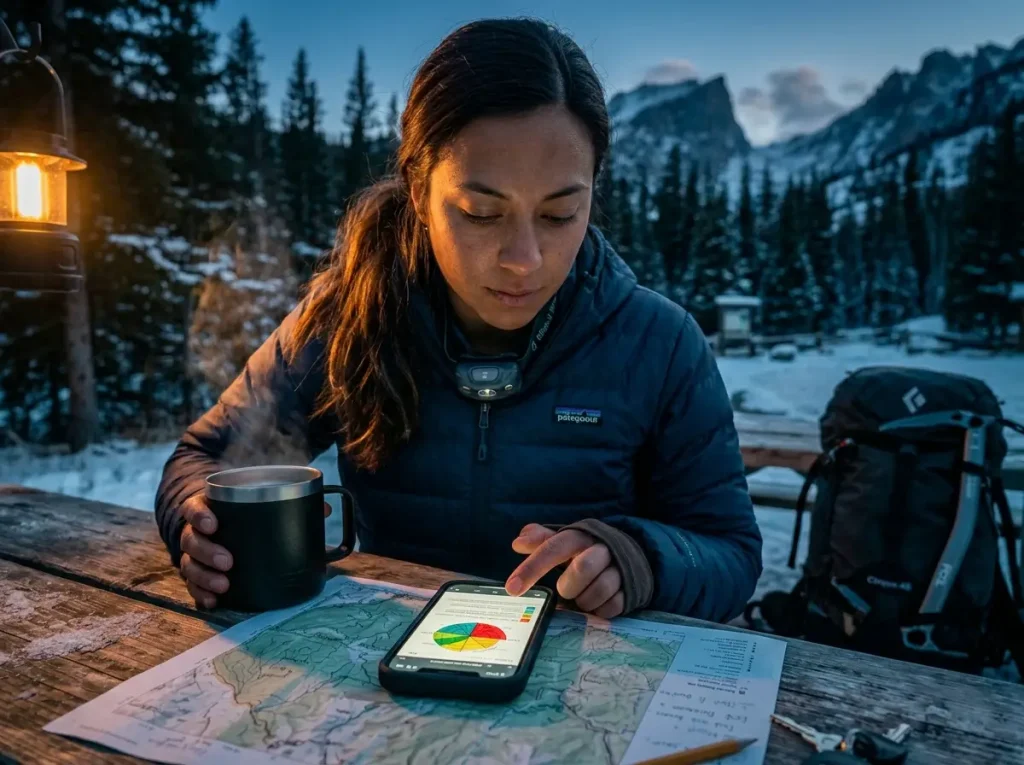
The bulletin is your intelligence layer. Reading it wrong is almost worse than not reading it at all.
Decoding the Hazard Rose and the 1–5 Scale
The North American Avalanche Hazard Scale runs 1 (Low) to 5 (Extreme) — and it isn’t linear. “Considerable” (3) is statistically the most lethal level because it still reads like a viable day. People go out on Considerable days. People don’t come back on Considerable days.
The Hazard Rose maps that rating by aspect AND elevation band. A Considerable rating on north-facing alpine terrain is a very different day than Considerable across all aspects. Know your regional agency: CAIC for Colorado, NWAC for the Northwest, CNFAIC for Alaska, UAC for Utah. NOAA’s avalanche safety overview and hazard scale definitions provides the authoritative breakdown of what each level means.
The bulletin is not a permission slip. I’ve seen groups read “Low” at lower elevations and immediately stop reading. The problem section is where the actual information lives. A Low overall rating with a listed Persistent Slab problem at alpine elevations is not a Low day for anyone planning to cross the alpine zone.
Reading the Problem Section and Pre-Trip Route Screening
The hazard number is not the whole story. Modern bulletins list specific avalanche problems — storm slab, wind slab, persistent slab, wet avalanche, cornice — each with its own likelihood-versus-consequence matrix. A low-likelihood but high-consequence persistent slab is more hazardous than a high-likelihood low-consequence loose wet slide. Read the problem section, not just the number. “Spatial distribution” tells you whether the hazard is isolated or widespread — widespread persistent slab problems mean a single stable pit doesn’t clear the terrain.
Slopes between 30 and 45 degrees account for over 90% of human-triggered slab avalanches. Use CalTopo or Gaia GPS slope angle overlays to pre-screen every section of your planned route, not just the obvious steep pitches. A terrain trap below a 32° slope transforms a survivable slide into a burial event. Check reading NOAA forecasts and shoulder-season weather patterns for trail conditions for how to build pre-trip weather reading into your full planning protocol.
Stage 2 — The Approach: Environmental Scanning for Red Flags
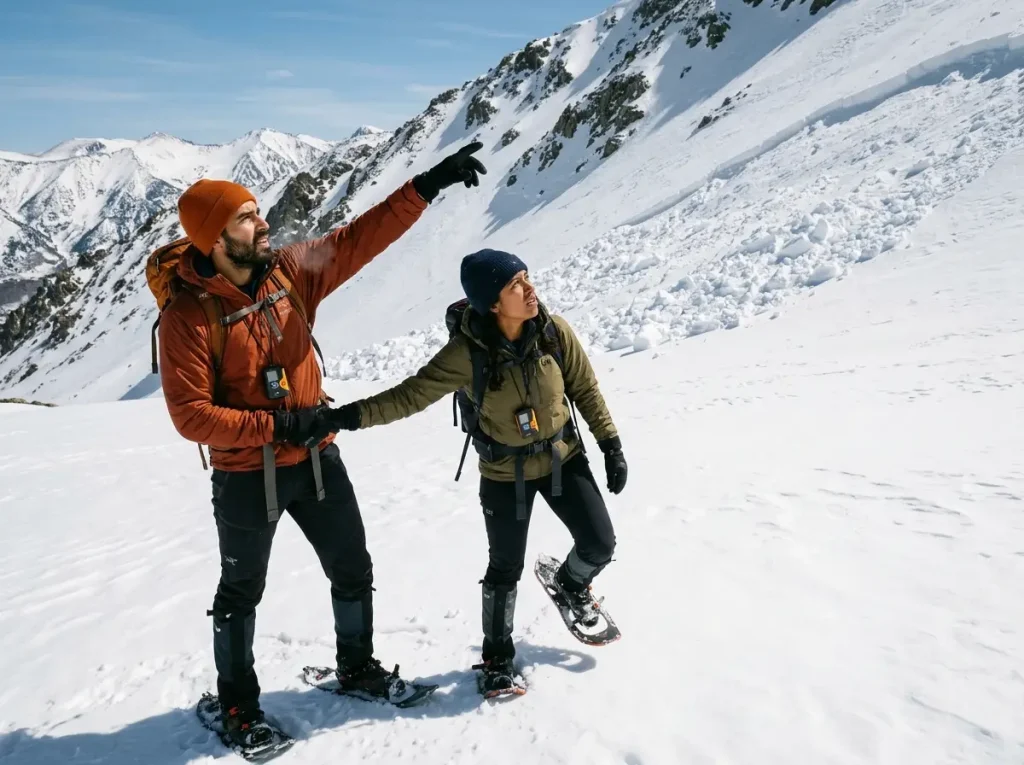
You’ve read the bulletin. Now you’re in the field. The scan starts the moment you leave the trailhead and doesn’t stop until you’re back at the car.
The Five Unambiguous Red Flags
In 90% of human-triggered avalanche accidents, at least one of these was present before the event and was ignored or rationalized away. Per a 45-year PubMed analysis of avalanche fatalities in the United States, behavioral patterns in accident scenarios show consistent failure to act on observable warning signs.
Recent Avalanche Activity: fresh crowns or debris within the past 48 hours on aspects similar to your planned route. If something slid yesterday, the conditions haven’t necessarily changed.
Whumpfing: the sound of a weak layer failing without propagating into a full release. You triggered it. Leave immediately, traveling laterally. Not uphill — that keeps you in the instability zone.
Shooting cracks radiating from your feet or ski tips mean the slab is transmitting energy across the slope. That energy is looking for a place to release.
Rapid loading from snowfall greater than 1 inch per hour means stress is accumulating faster than snow can bond. This gets worse while you’re watching it.
Rapid warming produces rollerballs, pinwheeling, and a wet, gloppy surface. Wet slide risk escalates exponentially through afternoon hours on a warm spring day.
Pro tip: Before entering any sustained snowfield, identify your lateral escape route — not the way you came in. If you hear a whumpf, you move sideways, immediately, without discussion.
Reading Terrain Traps and the Hiker’s Specific Vulnerability
A terrain trap multiplies consequences. Gullies, creek drainages, cliff bands, and dense tree zones turn a 1-foot burial event into lethal trauma. The right question before stepping onto a slope is not “is this steep enough to slide?” It’s “where does this run out?” Identify convex rolls too — those are unsupported slab zones where a hiker’s weight creates point stress on the steeper section below.
A hiker or snowshoer creates a concentrated point-load — high PSI — compared to the distributed platform of a ski. That concentrated force penetrates deeper into slab bridges, reaching buried weak layers that might survive a skier’s pass. Single-file travel on snowfields creates repeated stress on the same terrain feature, amplifying fracture initiation risk. The “it’s already been tracked out, so it’s safe” logic is a Social Proof heuristic trap — the previous travelers may have been lucky rather than skilled.
For deeper coverage of avalanche terrain navigation and safety gear essentials for winter hikers, the full guide covers terrain selection from the hiker’s perspective.
Stage 3 — The Pit: Formal Snowpack Stability Tests
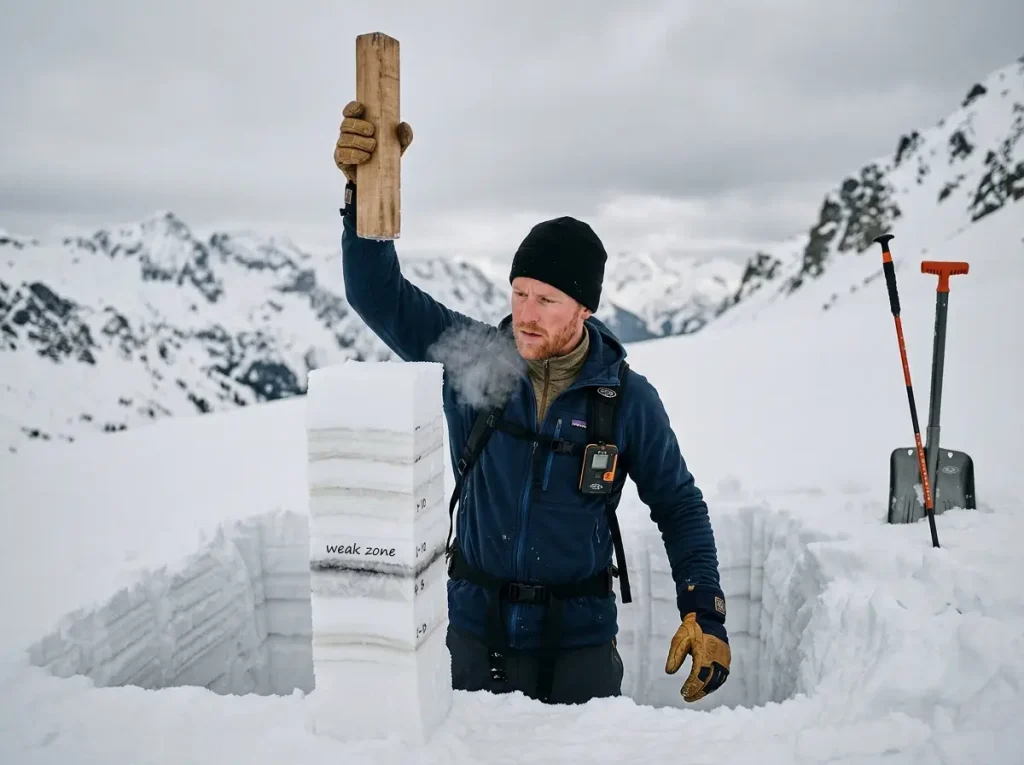
Visual evidence is often ambiguous. The pit gives you sub-surface data. It doesn’t eliminate uncertainty — it reduces it. One pit is not permission to travel a slope; it’s one data point in a larger stack.
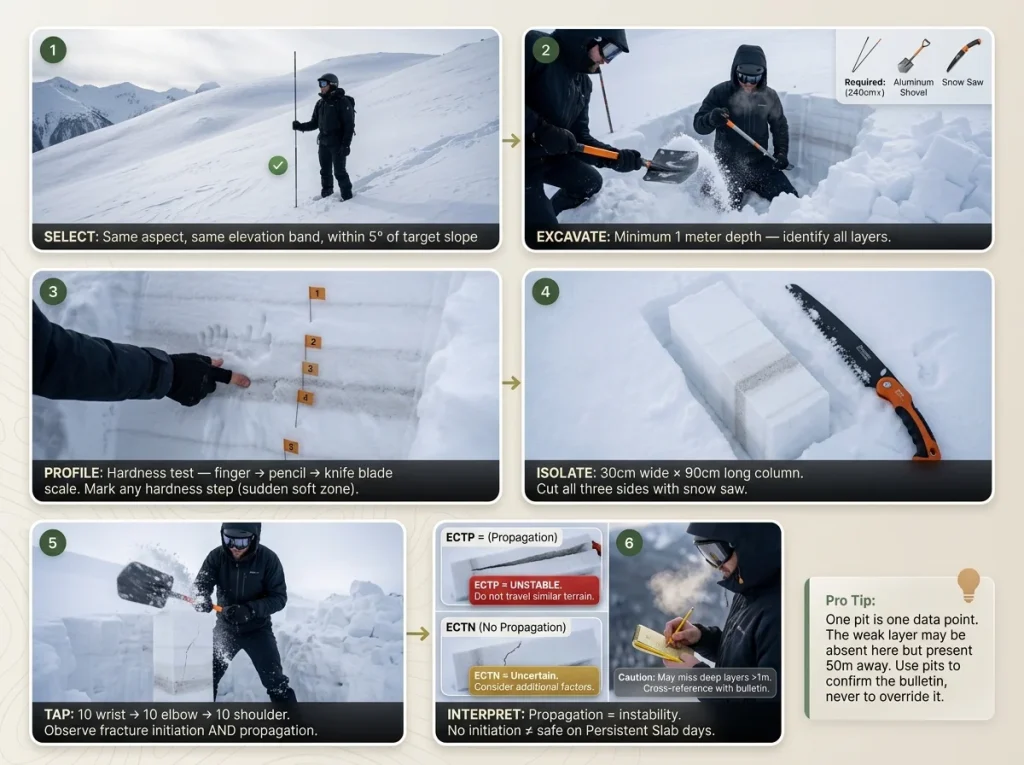
How to Dig a Representative Snowpit
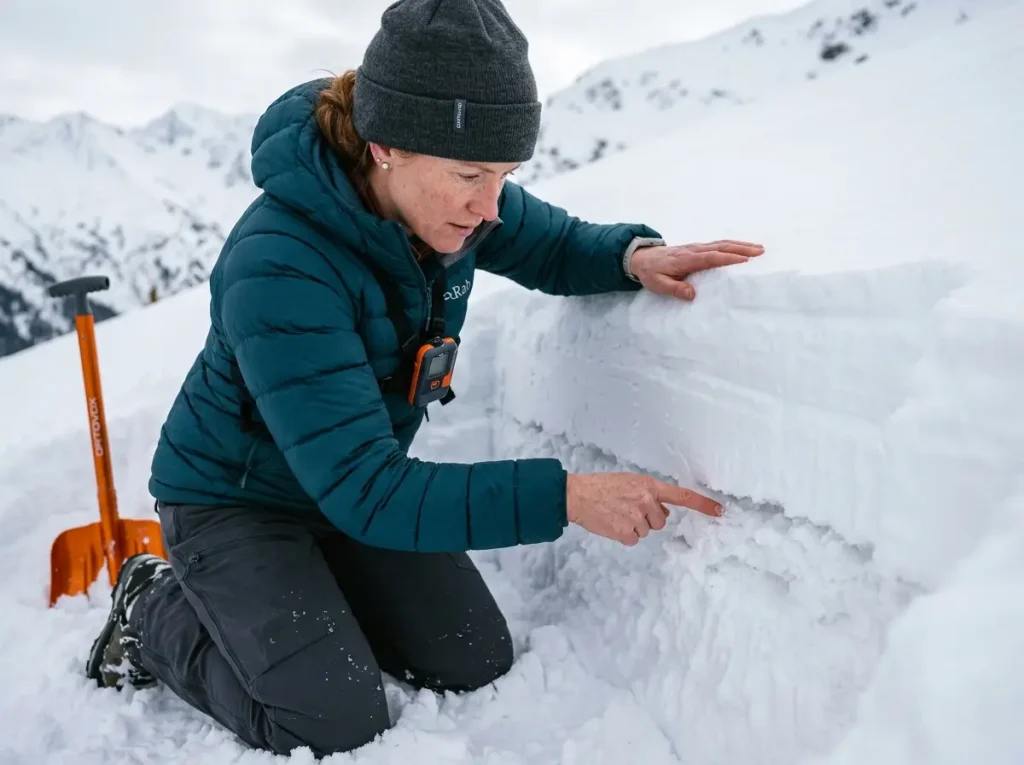
Location matters more than technique. Your pit must be on the same aspect, elevation band, and slope angle — within 5 degrees — as the terrain you intend to travel. A pit on a 10° meadow tells you nothing about the 38° face above you. Dig to at least 1 meter. Identify layers by probing with a finger and record the hardness profile top to bottom. Any sudden transition from hard to soft — a hardness step — is the most reliable predictor of a structural weak layer.
Equip yourself for this before you need it: the complete winter hiking safety gear checklist — including snowpack tools covers the probe and shovel kit required to run these tests in the field.
Pro tip: A pit on a suspected Persistent Slab day is never a green light. The buried weak layer may be absent where you tested and intact 50 meters to the right. Use pit results to confirm your reading of the bulletin, not to override it.
The ECT Protocol and Interpreting False Stability
The Extended Column Test isolates a 30 × 90 cm column. Apply 10 taps from the wrist, 10 from the elbow, 10 from the shoulder. The critical metric is propagation: does the fracture travel across the full column?
- ECTP (Propagation): Critical warning — the slope is highly unstable on similar terrain.
- ECTN (No Propagation): Fracture initiated but stopped — propagation is less likely.
- ECTX (No Initiation): Do not read this as clearance on Persistent Slab days — it may be a false negative from layer depth.
- ECTPV (Propagation during isolation): Extremely sensitive — the slope failed while you were still cutting the column.
Per peer-reviewed ECT effectiveness and false-stability research, the ECT has a lower false-stability rate than older tests like the Rutschblock — but it can miss deep layers buried beyond 1 meter. The Rule of Three: a weak layer within the top 1 meter + a hardness step + faceted crystals in that layer = the structure is primed for failure, regardless of tap count.
The Human Factor: Cognitive Traps That Override Good Data
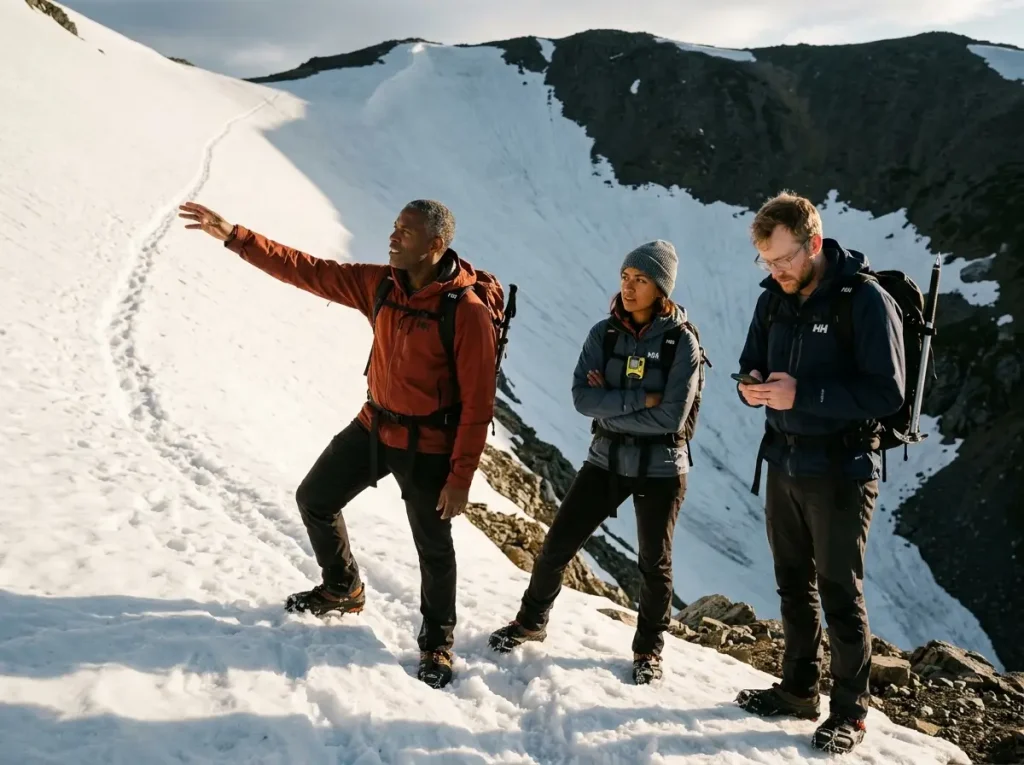
You can read the bulletin, scan the approach, and run a clean ECT — and still make a fatal decision. Ian McCammon’s research shows that even AIARE Level 1 trained individuals die in terrain they have the skills to evaluate, because cognitive bias overrides data processing under social pressure and physical commitment.
The FACETS Framework and ALPTRUTH Checklist
The FACETS human factors framework documented by the American Avalanche Association identifies six specific traps. McCammon’s data shows that when three or more are active simultaneously in a group, accident involvement rises sharply — even among trained individuals.
Familiarity: “I’ve crossed this ridge 30 times.” The most hazardous slope is often the one you think you know. Acceptance: Group members suppress red-flag observations to avoid conflict. That silence has consequences. Commitment: Sunk cost — time, money, physical effort — displaces present-moment risk assessment. Expert Halo: Deferring to the most experienced person without running your own independent assessment. Tracks/Scarcity: The fear of missing conditions overrides stability evaluation. Social Proof: “There are already tracks on that slope.” The previous travelers may have been lucky. That’s not data.
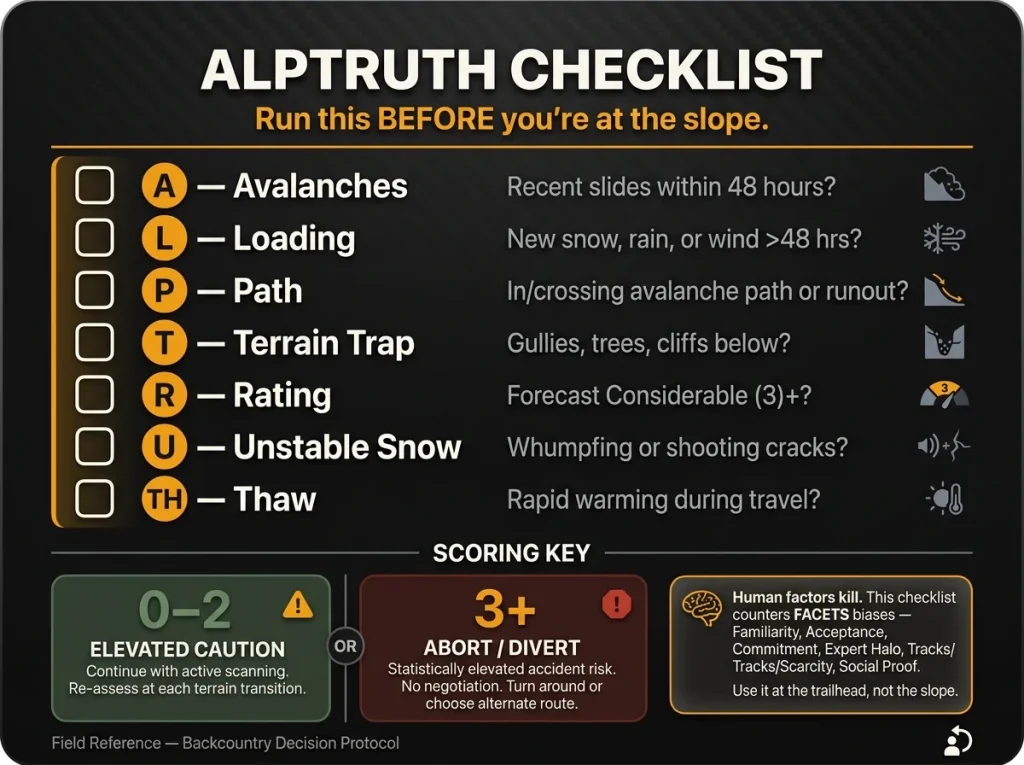
To counter these biases, run the ALPTRUTH checklist at the trailhead — not at the base of the slope you’re already committed to. Cognitive momentum is real.
- A — Avalanches: Recent slides within 48 hours?
- L — Loading: New snow, rain, or significant wind within 48 hours?
- P — Path: Are you in or crossing an avalanche path or runout zone?
- T — Terrain Trap: Gullies, trees, cliffs, or constrictions below the slope?
- R — Rating: Is the forecast Considerable (3) or higher for your elevation and aspect?
- U — Unstable Snow: Whumpfing or shooting cracks observed on approach?
- TH — Thaw: Rapid warming during your travel window?
Three or more factors present = statistically elevated accident risk = divert or descend. No negotiation.
Building a Group Decision Protocol
Establish a pre-trip agreement before anyone sets foot on snow: any group member can call a no-go without justification. The call is respected, full stop. Designate one person to run ALPTRUTH independently and share results before the group reaches the decision point. Pre-define your turnaround time at home — the turnaround time rule that prevents summit fever from becoming a fatality explains exactly why setting that number before you leave is the whole ballgame.
Debrief every close call, even when nothing happened. Near-misses are the best data your group will ever generate.
Essential Safety Gear for Snow Travel
The Non-Negotiable Three: Beacon, Probe, and Shovel
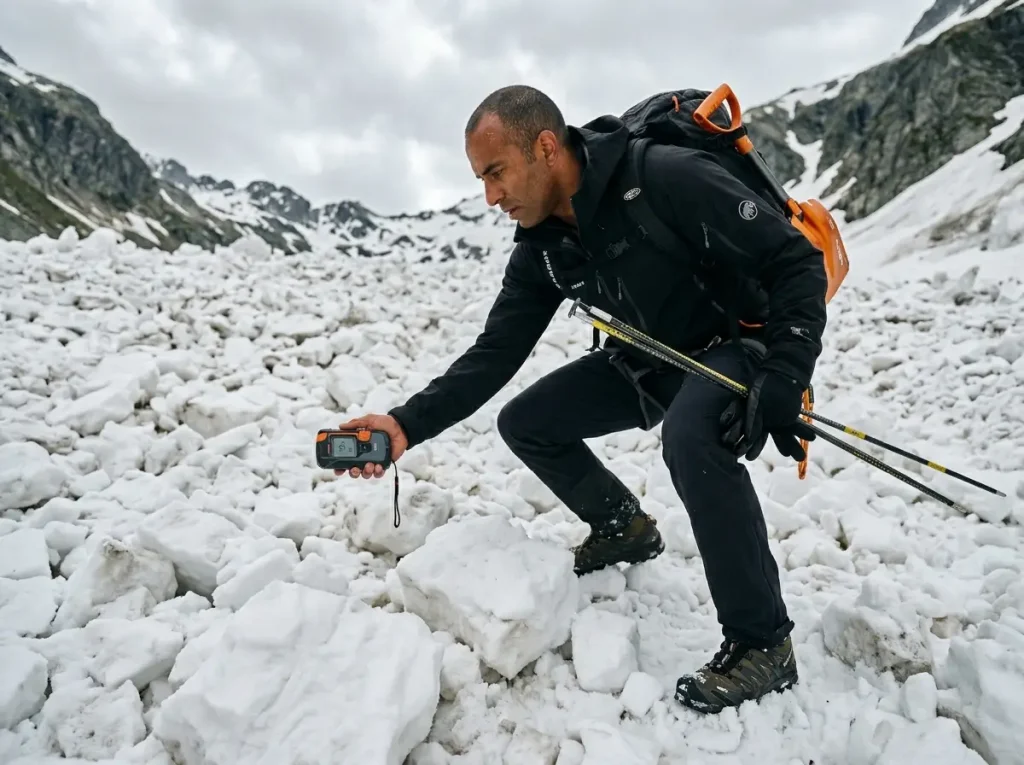
All three or none. A beacon without a shovel means you can locate someone but not reach them before the 15-minute survival window closes. A shovel without a beacon means you’re digging randomly.
Beacon: Must transmit at 457 kHz. The key specs for 2025–2026 are Search Strip Width and signal lock stability under interference. The Mammut Barryvox S2 leads on strip width; the Arva EVO BT leads on interference management. Keep electronics at least 50 cm from the beacon during search operations.
Probe: Minimum 240 cm, preferably 300 cm. Debris compacts under pressure; a short probe only tests the surface. Fast-deployment cable lock beats sectional twist locks every time.
Shovel: Aluminum blade only — polycarbonate fails under compacted slab debris. Hoe-mode designs (BCA Dozer series) enable strategic shoveling — conveyor system extraction rather than digging straight down — which saves critical minutes. All three must be accessible without removing your pack.
Traction Devices and Emergency Gear
Kahtoola MICROspikes handle consolidated trails with firm snow or ice. Snowshoes reduce PSI significantly on unconsolidated snow, cutting post-hole risk and energy expenditure. Crampons are for technical terrain above 45° — they require B2/B3 rated boots with structural stiffness. A flexible softshell hiking boot with C1 crampons will flex and detach under load on steep terrain. The boot-crampon compatibility guide breaks down the B/C rating system in full. Per the Chugach National Forest Avalanche Information Center’s guidance on interpreting stability tests, having the right tools is the prerequisite for executing any of the tests described in this guide.
An avalanche airbag pack uses inverse segregation physics to help keep victims on top of debris, but efficacy is conditional — airbags don’t prevent trauma-related injuries in terrain traps. RECCO reflectors enable SAR helicopters to narrow search areas but do not replace a transceiver. For winter hikers venturing above treeline, a Personal Locator Beacon (PLB) or satellite messenger adds rescue capability beyond avalanche scenarios.
Conclusion
Three things to take with you.
Snow is thermodynamics, not luck. Whether your snowpack contains faceted grains or rounded grains tells you more about slide risk than the surface appearance ever will. The physics are learnable. The field indicators are observable. Learning them isn’t optional if you travel above treeline in winter.
The protocol has three stages and you don’t skip any of them. Forecast check at home. Red-flag scan on approach. Snowpit for ambiguous days. Running only one stage is how experienced people die in terrain they could have evaluated.
The data is only as useful as your willingness to act on it. FACETS and ALPTRUTH exist because humans are biologically poor at processing risk under social pressure. Build the decision systems before you’re standing at the slope with your group watching. That 30-second ALPTRUTH exercise at home has more safety value than any piece of gear you can buy.
FAQ
What are the signs of unstable snow conditions?
The five unambiguous red flags are recent avalanche crowns or debris within 48 hours, whumpfing sounds underfoot, shooting cracks radiating from your feet, rapid loading from snowfall greater than 1 inch per hour, and rapid warming producing wet rollerballs on the surface. If any single red flag is present, treat all terrain in the 30–45° zone as actively hazardous and avoid it.
What slope angle is most hazardous for avalanches?
Slopes between 30 and 45 degrees produce over 90% of human-triggered slab avalanches. Below 30°, slabs rarely release spontaneously, but runout from above can bury travelers in flat terrain. The most hazardous section of most winter routes is often a short 35–38° pitch on the approach or descent — not the obvious steep objective.
What is a whumpf in snow, and what should I do when I hear one?
A whumpf is the audible and tactile collapse of a weak snow layer — the sound of air being expelled as a house-of-cards structure of faceted snow fails beneath you. Move off the slope immediately, traveling laterally across the fall line. Never uphill — that keeps you in the instability zone. Treat the entire aspect or elevation band as a no-go for the rest of that day.
How do you test snow stability in the field?
The standard test is the Extended Column Test (ECT): isolate a 30 × 90 cm column and apply taps from wrist, elbow, and shoulder. If a fracture propagates across the full column (ECTP), the slope is highly unstable. A stable result (ECTX) on a Persistent Slab bulletin day is not a clearance — cross-reference test results with the regional forecast and your approach observations.
Can you safely hike on 45-degree slopes in winter?
A sustained 45° slope in winter is technical mountaineering terrain — it requires crampons, an ice axe with practiced self-arrest technique, and the ability to evaluate the slope’s specific snowpack independently. For hikers transitioning into winter terrain, 45° is near the absolute upper limit without a full mountaineering toolkit. If you’re questioning whether 45° is safe for your skill level, that uncertainty is the answer.
Risk Disclaimer: Hiking, trekking, backpacking, and all related outdoor activities involve inherent
risks which may result in serious injury, illness, or death. The information provided on The Hiking Tribe is for
educational and informational purposes only. While we strive for accuracy, information on trails, gear, techniques,
and safety is not a substitute for your own best judgment and thorough preparation. Trail conditions, weather, and
other environmental factors change rapidly and may differ from what is described on this site. Always check with
official sources like park services for the most current alerts and conditions. Never undertake a hike beyond your
abilities and always be prepared for the unexpected. By using this website, you agree that you are solely
responsible for your own safety. Any reliance you place on our content is strictly at your own risk, and you assume
all liability for your actions and decisions in the outdoors. The Hiking Tribe and its authors will not be held
liable for any injury, damage, or loss sustained in connection with the use of the information herein.
Affiliate Disclosure: We are a participant in the Amazon Services LLC Associates Program, an
affiliate advertising program designed to provide a means for us to earn advertising fees by advertising and linking
to Amazon.com. As an Amazon Associate, we earn from qualifying purchases. We are also an official affiliate partner
of Black Diamond Equipment via the AvantLink network. If you click on a Black Diamond affiliate link and make a
purchase, we may earn a commission at no additional cost to you. We also participate in other affiliate programs and
may receive a commission on products purchased through our links. Additional terms are found in the terms of
service.