
In this article
The 40mph gust flattened my shelter instantly on the exposed ridge, snapping the aluminum pole like dry kindling just as the freezing sleet really started coming down. Three hours from the nearest bailout point, my survival depended on systems I’d only ever pitched in my living room. That night taught me a brutal lesson. Your gear limits are non-negotiable thresholds.
Most people treat the concept of knowing how to test gear before a thru hike like an afterthought—a quick overnight trip where everything goes right. That’s a mistake. A real testing protocol involves applying deliberate stress to your setup. You have to push every single item to its absolute breaking point before the unforgiving physics of the trail do it for you. A casual shakedown hike isn’t enough. You need a technical validation protocol to find out exactly when your equipment gives up, long before you depend on it to keep you warm.
| Risk Priority Number (RPN) Assessment | ||
|---|---|---|
| Component | Failure Mode | Risk Priority Number (RPN) |
| Water Filter | Membrane Fracture (Freezing) | 360 |
| Inflatable Pad | Puncture (Slow Leak) | 252 |
| Rain Shell | DWR Failure (Wet-Out) | 96 |
| Trekking Pole | Shaft Fracture (Flex) | 30 |
| Backpack | Hip Belt Buckle Snap | 16 |
⚡ Quick Answer: A proper shakedown is fundamentally a structured failure mode analysis. You push the functional boundaries of your setup. Load your backpack, sleep system, and shelter onto a rough local trail carrying more weight than your maximum expected carry. Force your kit through intentional stress like high winds, heavy rain, and simulated exhaustion to find its breaking points before you end up miles from a trailhead.
Load Carriage Biomechanics: How to Test Gear Before a Thru Hike Starts Here

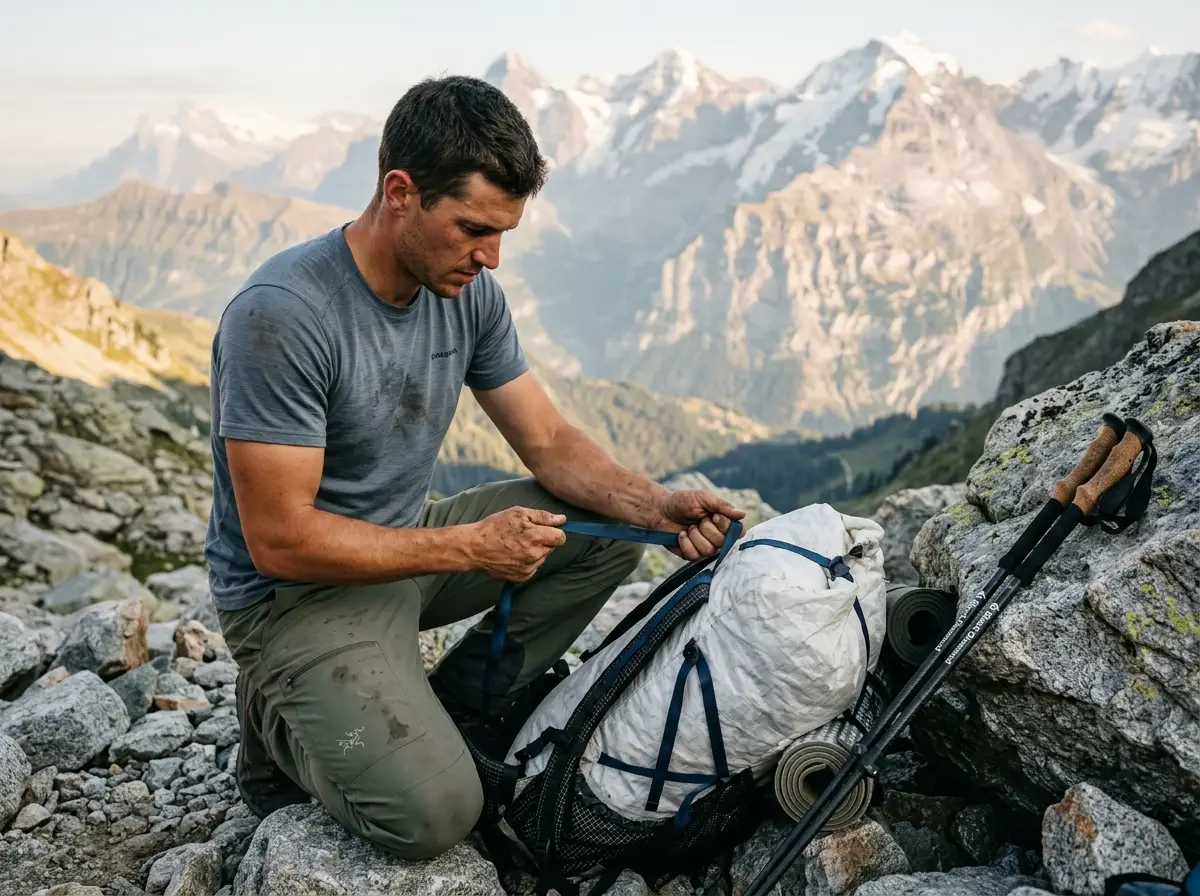
Backpack suspension actually dictates how your skeleton moves under load. Tell a new hiker to put forty pounds on their back, and they stop walking like a normal person and start trudging like a pack mule. When you exceed the functional carry limits of your frame, your stride alters indefinitely. The steady-state energy burn rate goes absolutely haywire relative to your overall mass. You burn significantly more energy simply fighting the pack to stay upright.
Walking energy expenditure spikes roughly 7.6 watts for every kilogram of extra load you haul. That extra output isn’t just you carrying the physical weight. It’s actually the mechanical work required to redirect the center of mass between each foot strike. A true gear failure happens out the moment your suspension system fails to push that weight directly into your iliac crest—the boney part of your hips. When you take the time to intentionally assess the functional limits of your backpack suspension systems, you are quantifying how efficiently your pack redirects your core momentum rather than collapsing into your shoulders.
Your pack’s load lifters perform a massive job here. If they are cinched tighter than a 45-degree angle, they pull the shoulder straps off your chest entirely, distributing zero weight forward. If they lie flat in a straight line back to the pack, they do absolutely nothing, dumping every ounce of tension right onto your collarbones. Dialing in the perfect 45-degree angle is exactly what saves your back on a twenty-mile grind.
You have to watch closely for “marketing drift” during your shakedown pack weight trials. Brands love to advertise that a pack holds 50 liters. But the realistic manufacturer volume yields significantly less usable space the second you start stuffing rigid bear canisters and lumpy sleeping bags inside. Your compressed volume vanishes rapidly. Thirty-five pounds in an overloaded ultralight pack feels infinitely heavier than forty-five pounds in a robust, correctly fitted hauler.
Metabolic Energy Expenditure and the LCDA Equation
To grasp why your energy output crashes so fast, look at the Load Carriage Decision Aid (LCDA) equation model. Jumping from a ten percent to a twenty percent relative mass load creates a severe mechanical compensation. That exact threshold triggers an involuntary increase in stride frequency. You start taking shorter, choppier steps with significant trunk lean just to balance the load. This alters your trail walking pattern completely.
At that twenty percent mark, your torso leans aggressively forward to offset the mass pulling you backward. Your frame starts fighting the pack’s center of gravity instead of moving fluidly with it. You spend all your fuel compensating for bad leverage.
Pro-Tip: Do not just toss your backpack on a digital scale in the bathroom. Throw it on, jump on a treadmill, and film yourself walking from a side profile. You will objectively spot the exact moment your stride shortens and your head tilts forward. You cannot feel these changes while walking, but the video won’t lie.
Assessing Kinematic Failure Modes
Load your pack with five pounds more than your absolute maximum goal trail weight. This overloads the suspension and violently exposes the marketing drift. If half the weight migrates from your iliac crest up to your traps, the internal frame structure has failed. It doesn’t matter what the glossy hangtag claims at the register. The stays simply cannot maintain the required tension under load.
While testers rely heavily on hipbelt sensor data, on the trail you just monitor your double-support phase. If you realize you are spending an abnormal amount of time with both feet planted on the dirt, your stabilizing system is struggling to balance a compromised center of mass. I test my own heavy setups late in the afternoon when my glycogen stores are fully depleted. I have watched experienced hikers develop a wide, unstable side-to-side flutter on basic downhill grades purely because their overloaded pack overpowered their leg muscles. Proper backpack fit is all about preventing this muscular override from ruining your joints.
Footwear Biometrics and the 100-Mile Degradation Curve

Footwear problems ruin more thru-hikes than any broken tent pole. The midsole foam of your shoe compresses permanently under constant loading. As you grind down dirt all day, swelling predictably forces your foot to expand by a full size or more. Finding the right shoe requires mastering this podiatric expansion before you ever touch a trailhead.
Heavy backpack loads—anything over ten percent of your mass—trigger a direct, load-dependent increase in plantar pressure. Your arches flatten violently under the strain. You must focus on identifying precisely when the midsole compresses past the point of return. Once those tiny EVA foam air cells fully collapse from thousands of steps, the shoe is absolutely dead.
The 100-mile rule dictates that a failure to rebound leads directly to brutal ground reaction forces shooting up your legs. This is the fastest path to stress injuries and debilitating plantar fasciitis. I refuse to test trail footwear in the morning. I wait until 4 PM, usually after at least 10 miles of heavy walking, to simulate genuine trail volume. If the boots comfortably accommodate how many miles to test boots you plan to push, they should feel strangely loose at 8 AM.
Podiatric Expansion and Lacing Dynamics
Swelling is a harsh reality on long trails. You absolutely must verify fit when your foot has fully expanded from friction and heat. During your tests, assess the mechanical advantage of the lacing system to ensure your heel remains totally locked in place while the forefoot spreads comfortably outward. A solid heel lock is what stops your toes from violently ramming into the rubber front guard on a long descent.
When you execute your downhill test, try implementing a surgeon’s knot—a simple double overhand loop—right at the ankle crease before tying off the top hooks. This simple friction lock isolates the tension in your forefoot from the tension around your ankle, effectively pinning your heel down against the sole. It’s the most reliable way to prevent sliding inside the shoe.
High foot strike pressure forces your arch downward with every step. Shoes that feel miraculously supportive while you walk unweighted around the store will flatten out completely under a fully loaded pack. The volume inside the toe box disappears entirely.
Take your setup and find the steepest downhill grade near your neighborhood. Test your lacing tensions by aggressively bombing down the hill. If your toes touch the front bumper even slightly, the lacing geometry is failing to mitigate interior shear force. Ignore this, and you’ll easily lose three toenails by week two of your expedition.
Midsole Fatigue and the “Rebound” Failure
Standard EVA foam undergoes compression set because the microscopic air cells eventually crush permanently under your load. The bounce goes completely dead. EVA trail runners regularly hit their primary failure mode in as few as 300 to 400 miles under a heavy pack weight. This is a silent, insidious gear failure. The shoe won’t show obvious external blowouts or torn mesh, but internally, the damage is done.
When that rebound goes away, the concussive impact transfers straight up into your foot and shins. The upper fabric still looks perfectly fine on the outside, but structurally, the foam has given up the ghost.
If your natural walking gait alters strangely or joint pain spikes sharply right around the first hundred-mile mark, the midsole is functionally clapped out. Replace the shoes instantly. Pushing through the pain simply compounds the impact, leading to a permanent physical injury that boots you off the trail entirely.
Fluid Dynamics and Structural Stability of Shelters
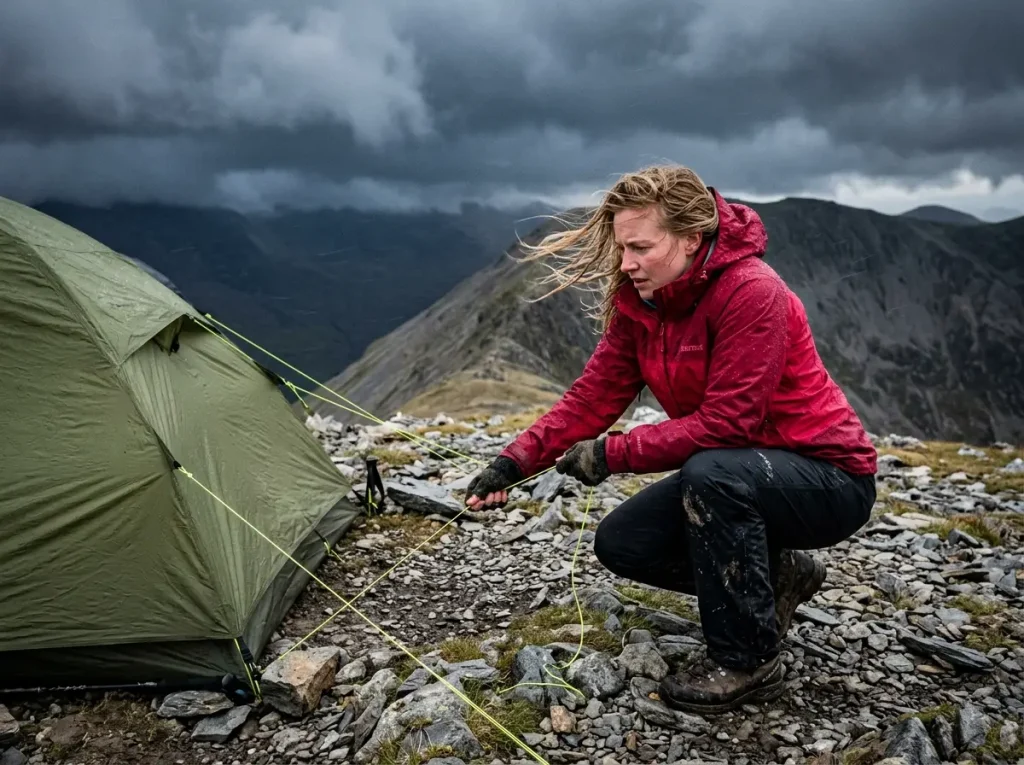
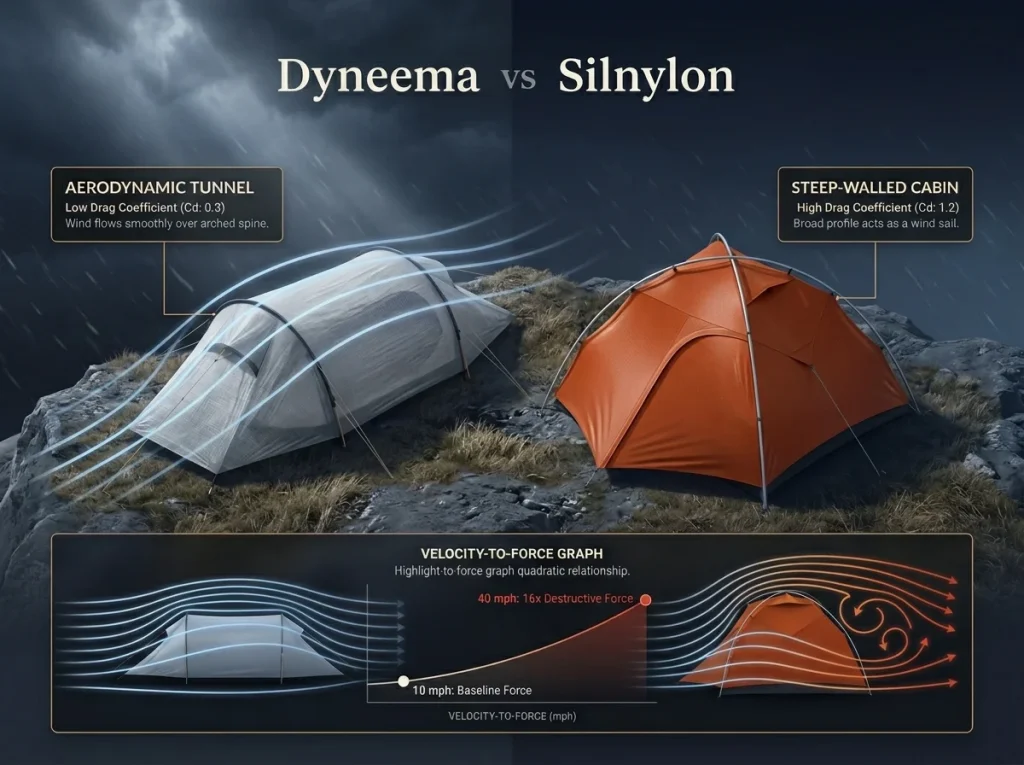
Wind speed amplifies aerodynamic force exponentially. Your shelter’s stability is governed entirely by the quadratic relationship between external wind velocity and structural resistance. The brute force exerted on your tent panels works off Bernoulli’s Law, which relies heavily on the shelter’s drag coefficient. This singular factor dictates how your setup handles an unexpected gale on an exposed saddle.
Doubling the wind velocity causes a massive fourfold increase in sheer breaking force. Dyneema Composite Fabric handles rough static loads remarkably well, but it proves highly vulnerable to permanent bias deformation when placed under immense, sustained corner tension. Traditional silnylon fabrics, on the flip side, suffer from eventual coating failure. This leads to fabric saturation—known universally as wet-out. This effectively eliminates all breathability from the material. Rigorously evaluating your internal condensation and vapor transmission properties remains just as important as inspecting the rainfly stitching itself.
Most recreational dome tents claim to handle high winds. Yet, I have pitched steeply walled cabin-style tents in a true 20 mph sustained gale and watched the aluminum poles instantly fold flat. You must verify these structural edge-cases independently before trusting a ridge. Taking pride in the high denier count of your tent floor means strictly nothing if the poles snap under a broadside gust. Understanding The Beaufort Wind Scale before you pitch is your only real defense mechanism against total shelter collapse.
Wind Force and Aerodynamic Drag
Wind force math proves that a nasty 40 mph gust puts sixteen times the stress on your composite poles compared to a manageable 10 mph breeze. This reality is exactly why tents get shredded in the backcountry. The drag coefficient is everything here. A sleek, low-profile dome reacts fundamentally differently under aggressive wind loading than a flat, broad trekking pole tarp face catching the wind like a massive sail.
Checking the Beaufort scale allows you to understand exactly what kind of atmospheric energy you are walking into. Environmental variables change violently the moment you cross above the treeline.
Pro-Tip: Borrow an anemometer during your backyard phase pitch testing to find the exact wind velocity where your specific shelter begins to dangerously deform. Most consumer dome tents will fold completely flat to the ground in sustained 35 mph winds. Pinpoint your shelter’s failure threshold while you are still close to civilization.
Material Fatigue and Wet-Out Audits
Checking the tension on your high-wind guylines matters critically. Nylon absorbs water and stretches, while Dyneema cord holds static. If you employ nylon guylines under heavy rain, they slacken during the night, reducing your entire aerodynamic geometry to a flapping mess. Always re-tension your lines right before you go to sleep if a storm is blowing in, regardless of how tired you feel.
You must aggressively test your silnylon and silpoly hydration limits by measuring the exact moment the durable water repellent (DWR) fails. Once that chemical DWR layer wears off, the exterior face fabric absorbs water directly and sags heavily. Even if the tent’s inner polyurethane membrane prevents rain from dripping directly onto your face, a saturated outer fabric drops the moisture vapor transmission rate to exactly zero. This traps all your expelled breath and sweat inside, mimicking a severe leak via massive internal condensation.
Inspect your Dyneema Composite Fabric shelters for micro-delamination near the heavy-stress corner reinforcements. Those individual tie-out points have to handle massive ounce-inches of torque during a rough squall.
Run a rigorous shower test directly on your shelter. Set it up in your yard, grab a garden hose, and unleash a high-pressure stream directly over the top seams for 30 uninterrupted minutes. This simulation violently exposes un-taped seams, poor factory waterproofing, and microscopic cuff leaks before you take the gear outside your zip code.
Thermal Efficiency and the Physics of Sleep Systems
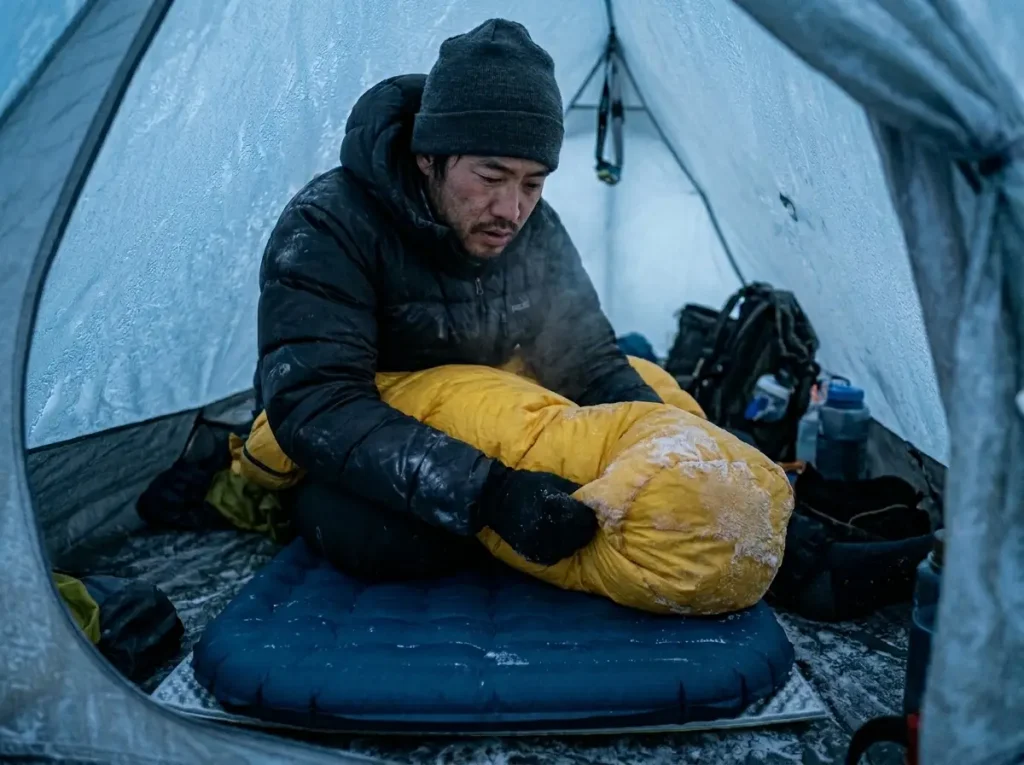
Your sleeping pad provides the only conductive resistance you have against the frozen earth. Survival during cold nights relies completely on maintaining core thermal equilibrium through rigid baselines like the iso/en ratings and ASTM F3340-18 testing protocols. Properly choosing your sleeping bags and pads is the sole deciding factor between sleeping deeply or shivering violently until sunrise.
The standard limit rating assumes a perfectly idealized static sleeper. It represents the absolute lowest threshold for an average person curled tight in a fetal position. Your pad’s r-value actually measures the exact conductive resistance sitting between your warm core and the freezing ground beneath you. Severe exhaustion, calorie depletion, and common trail sickness act as a multiplier, artificially shifting your personal comfort rating by 10 to 15 degrees right when you desperately need the warmth the most.
Night-time movements compress your down insulation dynamically. The second you roll onto your side, you create severe temperature cold spots right at the high-pressure points under your hips and knees. Understanding the fundamental performance differences between down and synthetic lofts dictates exactly how you mitigate these freezing gaps. Getting entirely humbled by bringing a 20-degree down sleeping bag onto a 30-degree night is a brutal rite of passage. Lab mannequins don’t toss and turn on rocks, exposing uninsulated side baffles to whipping drafts.
ISO 23537-1 Benchmarks vs Real World Conditions
Never rely upon the extreme rating for your trip planning. That terrifying number denotes the brink of hypothermia and a severe risk of lasting harm from frostnip. You should focus strictly on the comfort rating for actual safety margins.
The drafting collar around your neck acts exactly like a weatherseal on a front door. If you don’t cinch that internal baffle tightly over your shoulders, the chimney effect slowly pumps all your generated metabolic heat right out the top opening every single time you shift your legs. This pulls freezing air right back down to your toes.
You have to acknowledge the individual variation gap. Your basal metabolic rate crashes aggressively when you hike 20 miles a day for weeks on end. You burn through any excess fat reserves. This harsh reality renders pristine lab-tested comfort ratings severely optimistic compared to your fatigued reality on a long expedition.
Pro-Tip: Validate your sleeping bag in safe conditions, like your backyard or during a car camping trip, that perfectly match its stated comfort limit. If the bag claims 30 degrees, sleep in it on a 30-degree night close to your house. If you wake up shivering uncontrollably, you instantly know your personal biological offset without paying the price offshore.
The ASTM F3340-18 R-Value Stacking Protocol
Ensure your entire sleep system base meets ground terrain physics head-on. Warm summer hiking requires at least an R-2.0, while high-altitude snow trips demand a strict minimum of R-4.0 just to stop the snowpack from draining your core temperature. Guaranteeing real thermal efficiency requires adapting your pad loadout specifically to the freezing earth.
R-values stack perfectly. You can lay flat mats directly on top of each other to multiply their thermal resistance, provided you leave absolutely no air gaps between the rigid layers. This grants massive flexibility for pushing into shifting shoulder seasons.
Always test the definitive stacking protocol by laying a cheap closed-cell foam pad flat underneath your primary inflatable pad. This redundancy guarantees your thermal survival if the inflatable suffers a catastrophic blowout puncture in the dark at 10,000 feet.
Life Support Kinetics: Filtration Decay and Stoves
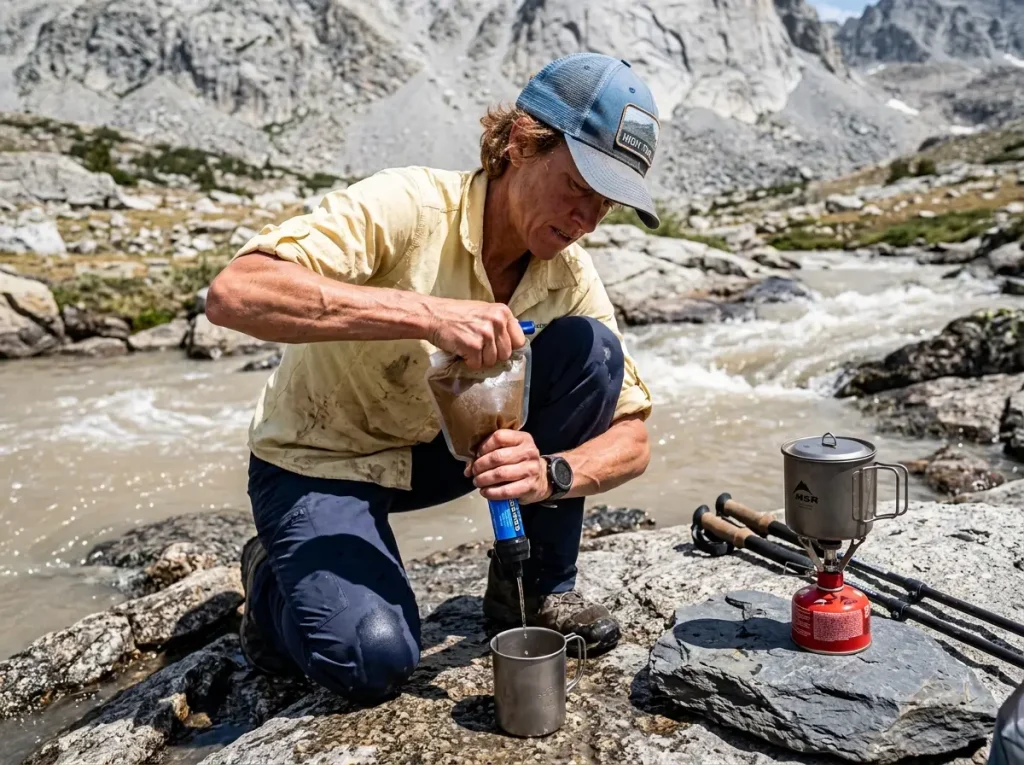
A hollow fiber membrane filter constantly suffers unseen mineral scaling across its operational lifespan. A water filter‘s true reliability hinges completely on its flow rate sustainability, not whatever theoretical maximum gallon rating a marketing department approved. The microscopic pores exclude pathogens incredibly effectively but suffer inevitably from stubborn organic bio-fouling.
A sharp drop in ambient temperature below 32 degrees causes a devastating silent failure. Expanding ice micro-fractures the delicate interior hollow fibers. The filter happily continues to let water flow through, but it now lets dangerous microscopic pathogens slip right past. Separately, the boil-time-to-fuel-ratio for your cooking stove also completely tanks the second it gets exposed to strong sweeping winds.
I watched a desperately thirsty hiker struggle to squeeze a single liter of brown water through a completely clogged sawyer squeeze for twenty agonizing minutes in the desert heat—purely because he completely neglected to test its flow-degradation slope. To genuinely grasp the conductivity and precise rate of flow, you have to measure it accurately before relying on it in an arid, isolated climate.
Flow Rate Degradation Analytics
Track your exact flow rate by logging the precise time it takes to filter 500 milliliters. Measure it brand new straight out of the box, and then measure it again after subjecting the entire system to harsh, dirty water simulations. Pushing several liters per minute out of a fresh box means strictly nothing if that rate plummets rapidly the second it hits local creek silt. This is classic water filter flow rate degradation in action.
Performing a backflush out on the trail using a standard smartwater bottle requires extreme physical pressure to actually dislodge the compacted silt. If you just gently squeeze clean water through the nozzle, the water effortlessly finds the path of least resistance around the clogs, leaving the heavy sediment locked inside the fibers forever.
Hard water environments cause insidious mineral scaling deep inside the hollow individual fibers. Calcium deposits build up rigidly like plaque, and standard syringe backflushing cannot physically force them out. Properly identifying the realistic lifespan of hollow fiber trails filters requires pushing far past manufacturer estimates and dealing with real muddy water.
Execute a preventative vinegar soak protocol in your kitchen. Circulate warm water and vinegar heavily through your squeeze filter to dissolve unseen mineral blockages. Do this before your flow rate drops to an unusable trickle miles from your car.
High-Wind Fuel Efficiency Tolerance
Utilize a heavy variable-speed fan out on your patio to measure precisely how wind stress exponentially destroys your stove’s boil times. Small canister stoves lose massive output efficiency in even a mild eight-mile-per-hour breeze.
You urgently need to understand the volatile physics of thermal runaway. Shielding a top-mounted canister stove too tightly completely traps the rapidly escaping heat. This oversight pushes the sealed pressurized vessel severely close to an explosive rupture.
Always validate a cold-soak stress test as an impenetrable backup plan. Know the exact water saturation duration for your dry starches, like couscous or instant ramen, in the event your primary heat source fails completely and you have to aggressively consume cold rations to sustain your miles.
The FMEA Validation Protocol: A Three-Phase Shakedown
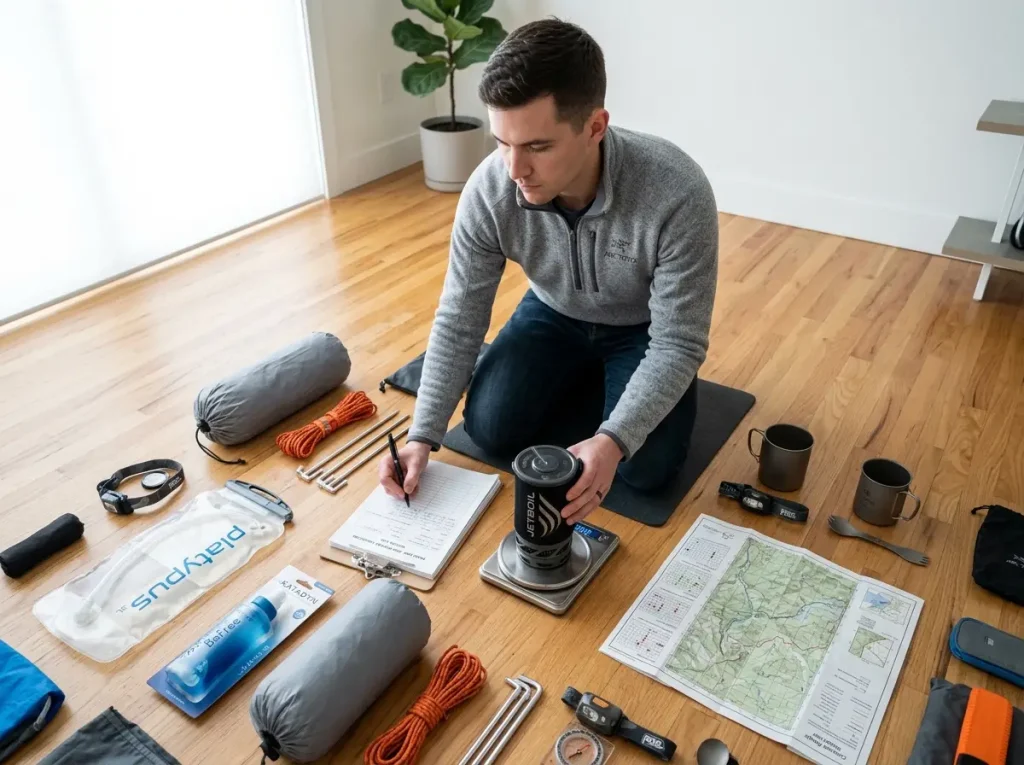
The FMEA framework dictates assigning rigid numeric risk priority numbers to every piece of your gear. Producing a highly authoritative validation isn’t a simple walk in the park. It requires a carefully calculated progression from a highly controlled home environment straight out to the ragged edge of a bad time.
By systematically utilizing a safety matrix to analyze your kit, you intelligently rank the objective risk of every component. Phase one handles your basic static testing to confirm manufacturer claims. Phase two violently subjects the equipment to the biological interface over sustained, grinding mileage. Phase three intentionally hunts for worst-case atmospheric weather to document exactly when and how safety boundaries crack.
Your shakedown remains only a success if something eventually fails. Before you ever try diagnosing fatal gear failures and replacement timelines out in the wild, you need to execute brutally honest failure testing locally. The singular way to know your limits is to deliberately blast right past them. Reading an established rigorous shakedown guide and safety standards manual before pushing into Phase III alone ranks as the smartest move you can make. Treat the shakedown guide as gospel.
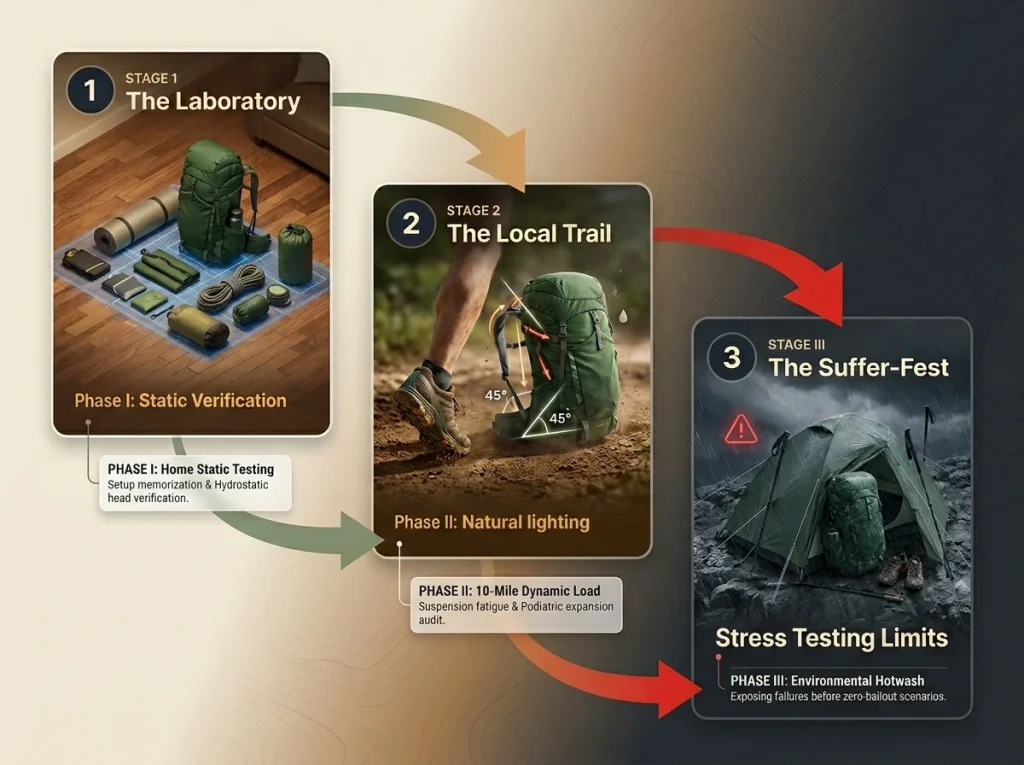
Phase I: Static Verification (The Laboratory)
Identify your true capacity specifications by packing the kit entirely full. Scrutinize the ease of setup under perfectly ideal conditions. Build pure baseline muscle memory through sheer, relentless repetition.
The ultimate static stress test is the night-time assembly drill. Force yourself to fully pitch your shelter using solely ambient moonlight to flawlessly simulate exhausted, late-arrival conditions. If you absolutely cannot set up your tent cleanly in the pitch dark, you simply do not know the gear well enough.
Conduct a rigorous hydrostatic head verification test at home utilizing a DIY water column to prove your expensive rain shell or dry bags are actually waterproof. Never trust factory tape jobs without aggressively testing them yourself.
Phase II: Dynamic Shakedown (The Local Trail)
Focus directly on the brutal biological impact over a manageable six to ten-mile trail increment. Carrying your absolute maximum expected water and food weight bluntly reveals the undeniable truth regarding lab vs. trail conditions.
Expose the hidden gear quirks during your deliberate testing phases. Actively hunt for those tiny micro-abrasions, unnoticeable shoulder strap slippages, and asymmetrical pack loads that only ever emerge when your legs begin to flag.
Practice complete navigation redundancy here. Intentionally shut down your phone and force yourself to orient purely using a printed topographic map and a baseplate compass.
Phase III: The Suffer-Fest (Stress Testing Limits)
Hunt aggressively for gale-force winds or torrential downpours. Put your 72-hour gear validation matrix under immense, terrifying environmental stress while rigidly maintaining a safe bailout option straight to your car. Doing this properly constitutes a true execution of the stress test.
Execute the grueling 15-mile hotspot audit in stifling high humidity. When the interior friction inevitably builds, acknowledge that treating a tiny skin shift with leuko tape immediately prevents mission-ending blisters.
Pro-Tip: Don’t ignore hotspot friction for even a single mile. If you feel a tiny prickle on your heel, stop walking instantly and apply Leukotape directly over the spot. Never wait for the blister to form. Taking off your boots feels like a chore, but limping out of the woods with a blown-out heel is worse.
Execute the high-wind pitch. Seek out an incredibly exposed ridgeline amid heavy winds to critically evaluate how your hiking poles deflect and if your aluminum stake anchors can actually hold the dynamic shear forces. Let the weather physically beat you down while close to home so you completely understand the exact breaking point. This pushes far past the backyard phase.
Conclusion
The hard evidence gathered through a grueling validation protocol acts as the only reliable predictor of success. Surviving the unforgiving math of the trail fiercely demands stepping away from flashy marketing hype and utilizing the Failure Mode and Effects Analysis matrix properly. Execute the three testing phases aggressively and thoroughly document the results.
Let the physics break your system safely at home so that it cannot break you in the backcountry. A snapped trekking pole acting as a tent support in your backyard is a minor nuisance. A broken pole on a freezing, exposed peak is an absolute tragedy. The next time you pack up for a massive two-thousand-mile attempt, you’ll know exactly where your gear’s limits lie, and precisely how to safely navigate around them.
FAQ
How do you adequately test gear before a thru hike if you live in a flat, warm area?
Use industrial workarounds to aggressively simulate stress. Load your pack with 30 pounds and climb concrete parking garage stairwells until your quads burn. Blast your tent with a high-powered garden hose to scrutinize the waterproofing seals. Map out an extended, unshaded road-walk to force maximum heat output on your clothing systems. Even perfectly devoid of high altitude, you can reliably replicate severe muscle fatigue, moisture barriers, and friction points near sea level.
What is a shakedown hike fundamentally supposed to accomplish?
A proper shakedown operates fundamentally as an empirical failure mode analysis. It actively forces your equipment systems and your physical body directly to their extreme limits in a semi-controlled environment. This brutally yields measurable, concrete thresholds before you lose access to bailout points and enter remote wilderness.
How do you effectively test a waterproof rain jacket at home?
Utilize the shower test. Force the jacket over a gray cotton t-shirt—which easily reveals wet spots—and stand directly under a high-pressure cold shower for 30 uninterrupted minutes. Deliberately focus the heavy water stream specifically on the zippers, neck baffle, and shoulders to fiercely expose hidden membrane leaks or DWR weaknesses.
How much weight should a shakedown pack legally have to be effective?
Your shakedown pack weight must definitively exceed your expected maximum trail weight by at least five solid pounds. If your anticipated full load-out hiking away from town with a harsh five days of food and heavy water sits at 35 pounds, your stress-test pack should weigh exactly 40 pounds. This operates as the singular way to effectively evaluate the utter outer bounds of your suspension limits.
Risk Disclaimer: Hiking, trekking, backpacking, and all related outdoor activities involve inherent
risks which may result in serious injury, illness, or death. The information provided on The Hiking Tribe is for
educational and informational purposes only. While we strive for accuracy, information on trails, gear, techniques,
and safety is not a substitute for your own best judgment and thorough preparation. Trail conditions, weather, and
other environmental factors change rapidly and may differ from what is described on this site. Always check with
official sources like park services for the most current alerts and conditions. Never undertake a hike beyond your
abilities and always be prepared for the unexpected. By using this website, you agree that you are solely
responsible for your own safety. Any reliance you place on our content is strictly at your own risk, and you assume
all liability for your actions and decisions in the outdoors. The Hiking Tribe and its authors will not be held
liable for any injury, damage, or loss sustained in connection with the use of the information herein.
Affiliate Disclosure: We are a participant in the Amazon Services LLC Associates Program, an
affiliate advertising program designed to provide a means for us to earn advertising fees by advertising and linking
to Amazon.com. As an Amazon Associate, we earn from qualifying purchases. We are also an official affiliate partner
of Black Diamond Equipment via the AvantLink network. If you click on a Black Diamond affiliate link and make a
purchase, we may earn a commission at no additional cost to you. We also participate in other affiliate programs and
may receive a commission on products purchased through our links. Additional terms are found in the terms of
service.