In this article
The Tasmanian sun was already hammering at nine in the morning when my partner hauled his pack upright and I heard his knees buckle. Day four of the Overland Track. A 12-hour dry section ahead. He had loaded 10 liters of water — over 22 pounds of dead weight — because it felt like the safe play. It wasn’t. Within two hours he was sweating harder than the guy who packed half that, his heart rate was pinned, and we were doing the math on turning around. His water cache had become the very thing dehydrating him.
Stop trusting the generic “half a liter per hour” rule. It was written for someone walking on flat pavement in mild weather. You are not that person. This guide will show you exactly how to calculate your fluid carry based on pack weight, elevation gain, heat load, and your own sweat profile — so you carry enough to survive, and not one pound more than necessary.
⚡ Quick Answer: For most day hikers in moderate conditions (under 80°F, under 30 lb pack, flat to rolling terrain), plan on 0.5 liters per hour of hiking. Add 0.1 liters per 1,000 feet of climbing. If your pack exceeds 30 pounds, bump your baseline up by 10%. Above 10,000 feet, double your respiratory loss estimate. Then “camel up” at every water source and carry only the volume between sources — not the entire day’s total at once.
The Physics of the Carry: Understanding the Efficiency Gap
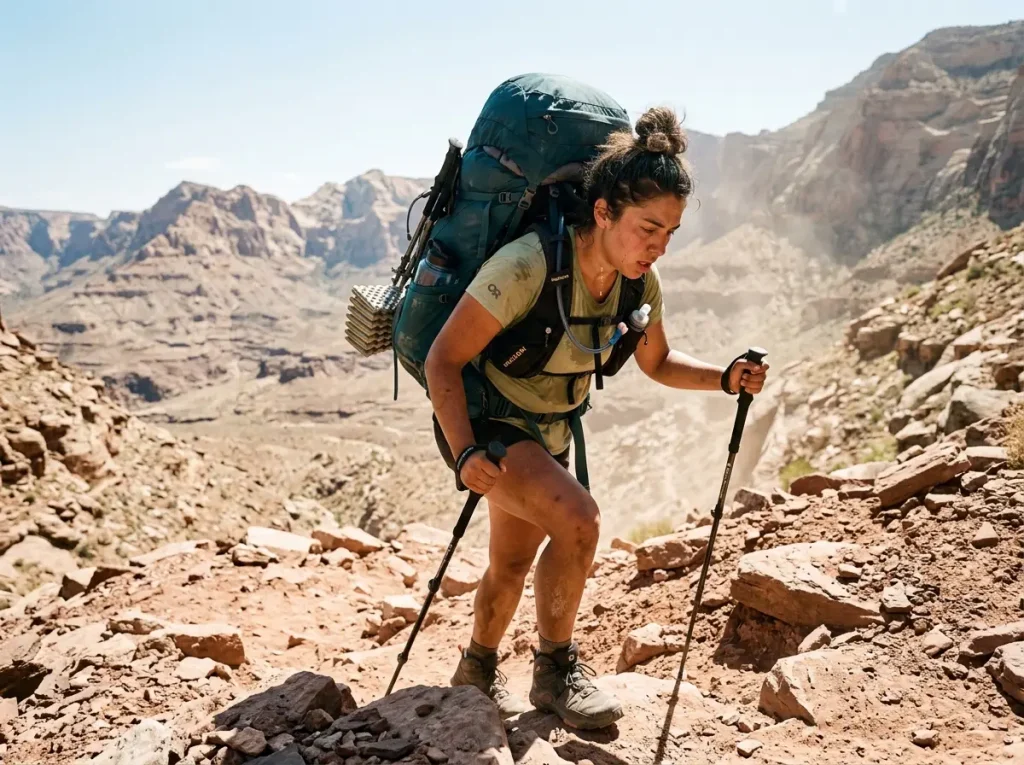
Water weighs exactly 2.2 pounds per liter. No negotiation, no discount for positive thinking. Every liter you strap to your back is a fixed metabolic penalty, and that penalty compounds in ways most hikers never think about.
Here’s what the Pandolf Equation — the load carriage formula used by the U.S. Army Research Institute — tells us: every kilogram of added pack weight increases your metabolic cost of transport proportionally, and that extra effort produces heat. More heat means more sweating. More sweating means you burn through your water supply faster. At some point, carrying an additional liter of water generates more metabolic heat than that fluid can cool — and you’ve crossed the Efficiency Gap.
I’ve watched thru-hikers haul six liters of water on exposed desert ridgelines “just in case.” By mile three they’ve dumped 1.5 liters of sweat and their pace has cratered. In humid forest environments like the Appalachians, that ceiling is even lower. Sweating handles only about 70% of heat loss when the air is saturated — which means overexertion from water weight pushes you toward uncompensable heat stress, where no amount of fluid intake can stabilize your core temperature.
There’s a lesser-known piece of this puzzle too: metabolic water yield. Your mitochondria produce water as a byproduct of fat oxidation — roughly 107 grams of water for every 100 grams of fat burned. A fat-adapted hiker in aerobic Zone 2 is generating meaningful internal hydration. It won’t replace your water carry, but it does mean the hikers who stay slow and steady aren’t just conserving energy — they’re keeping their internal cooling system running longer. Follow the authoritative hiking safety and trip planning protocols from the NPS for your baseline load-carriage guidelines, then layer these mechanics on top.
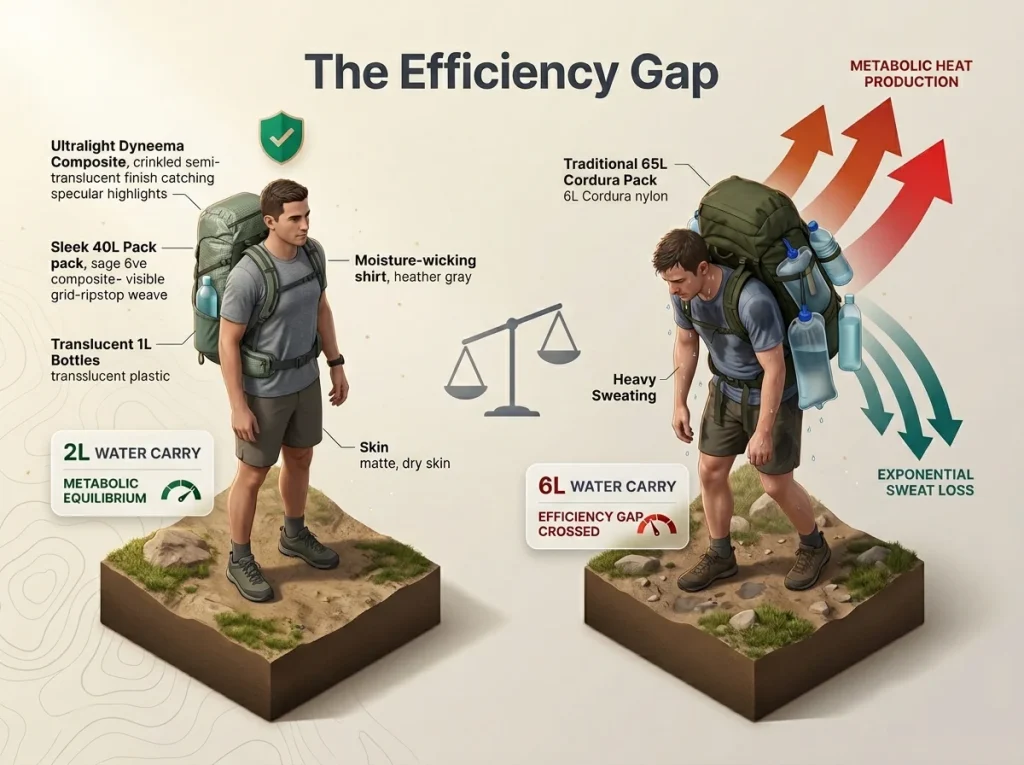
Pro tip: Before you even hit the trail, calculating your true total pack weight is non-negotiable. Water is often the biggest wildcard between your base weight and your total carry — knowing that number changes every decision you make at the trailhead.
The 2.2-Pound Metabolic Penalty
The math is simple and brutal. Three liters of water weighs 6.6 pounds. Four liters is 8.8 pounds. By the time you’re carrying five liters “for safety,” you’ve added 11 pounds of pure water weight penalty to your pack — and every single pound of that weight is rolling through the Pandolf equation and spitting out additional heat production.
Think of it this way: every liter past your actual need is not a safety buffer. It’s a tax on your thermoregulation system.
The Diminishing Returns of Over-Packing Water
The break-even point where extra water costs more than it provides is closer than you think. On a flat 70°F day with a 25-pound pack, you’re probably fine with 0.5 liters per hour. Put that same hiker on a steep, exposed ridgeline at 90°F with a 45-pound pack and that number can triple — but packing three times the water also triples the metabolic penalty, which drives the sweat rate higher, which demands even more water.
The solution isn’t to carry more. It’s to carry precisely the right amount between reliable water sources, and we’ll get to how to calculate that.
Metabolic Water Yield: Internal Hydration from Fat
One thing almost no hiking resource mentions: if you’re burning fat efficiently, your body is self-hydrating at a slow but consistent rate. This is not a reason to carry less water. It’s a reason to stay in a comfortable aerobic pace rather than pushing into hard anaerobic effort, which burns glycogen (which produces less metabolic water and depletes faster).
The Calculator Variables: Quantifying Your Baseline Demand
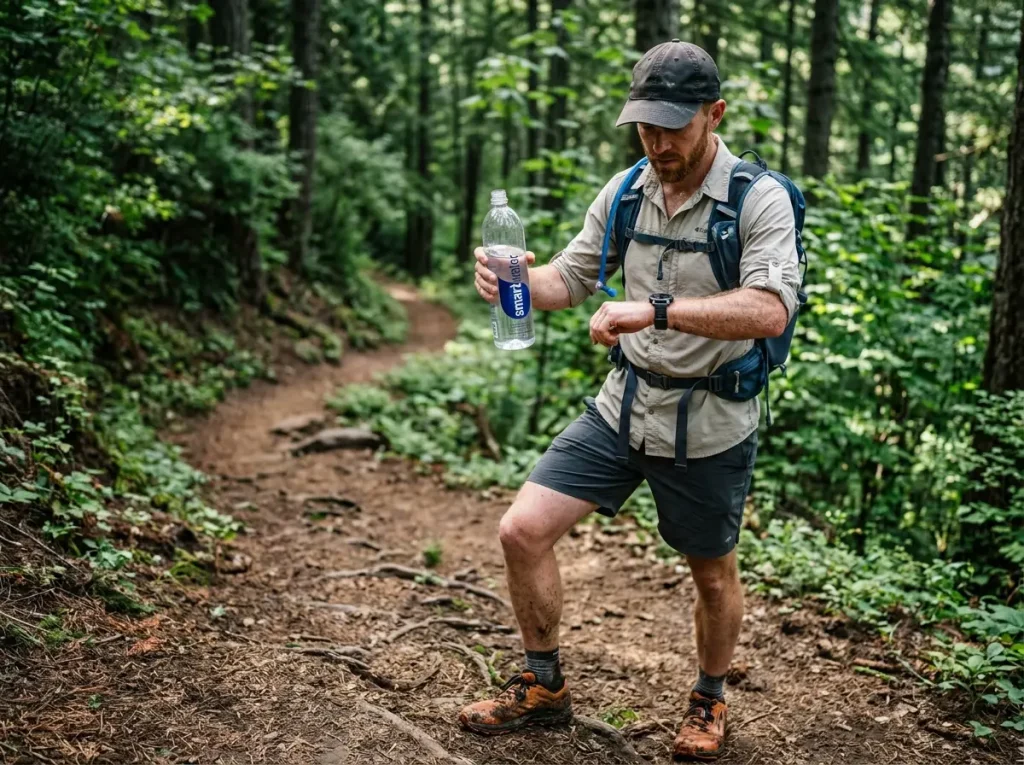
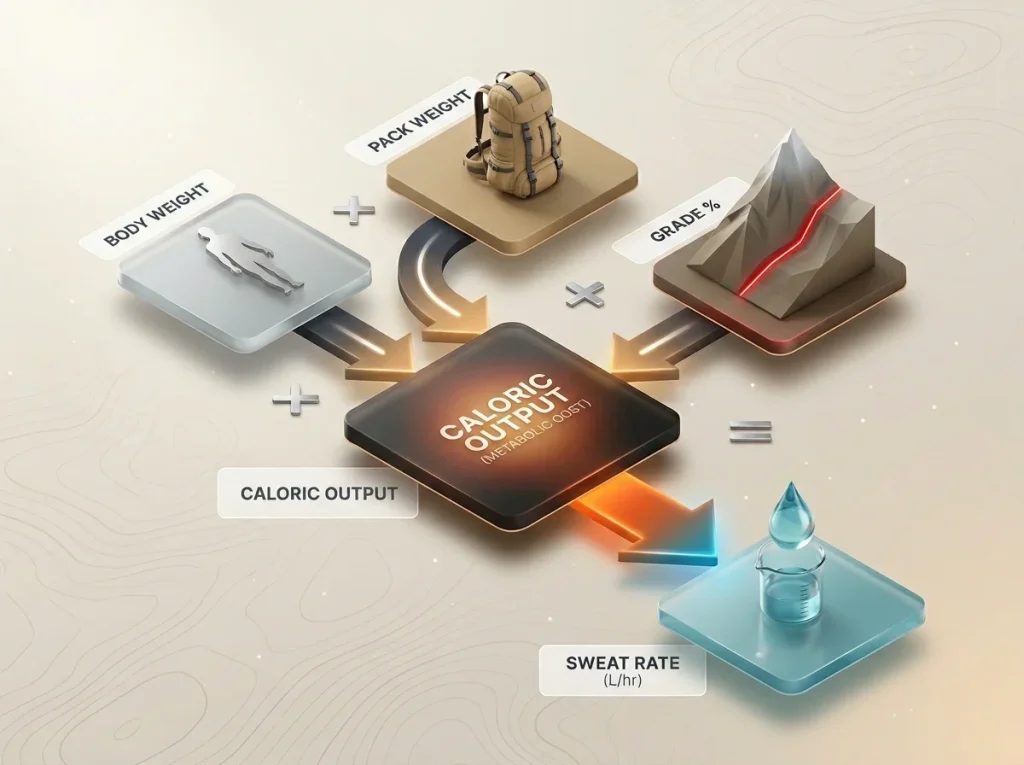
Getting your water carry right is a multiplication problem, not a guess. Here are the variables that actually matter, and how they stack.
The Core Triad: Ambient Temp, Distance, and Body Mass
Baseline sweat rates for active hiking typically run 0.5 to 2.0 liters per hour, depending on your body mass and the ambient temperature. A 200-pound hiker in 90°F heat is not in the same universe as a 130-pound hiker at 65°F. Your body weight matters because mass drives heat production. Temperature matters because it determines how much evaporative capacity the air has left after accounting for its existing humidity.
As Floris Wardenaar from Arizona State University has noted, current hydration guidelines for hikers are “geared more toward safety than quantifying the adequate amount of fluid they need.” Translation: the rules of thumb are conservative by design — and that conservatism carries its own weight penalty.
The Pack Weight Multiplier
A pack over 30 pounds triggers a measurable 10% increase in your fluid requirements. A 60-pound pack on a backpacking trip can push that modifier higher. This is the pack weight multiplier, and it’s the variable most online calculators ignore entirely.
The mechanism is straightforward: more load means more muscular work per step, which produces more heat, which demands more sweat. The Pandolf equation accounts for this explicitly. Most free hydration calculators online treat pack weight as irrelevant — which is exactly why they fail you on the loaded miles that matter.
Pro tip: Use the “shadow shorter than you” rule as a real-time UV indicator. When your shadow is shorter than your height, you’re in the peak intensity window. UV radiation increases by roughly 10% for every 1,000 meters of gain — which accelerates fluid loss even when the air feels cool. Double your hydration awareness immediately if you’re on an exposed ridge at elevation.
Elevation Gain and Respiratory Water Loss
Add 0.1 liters per 1,000 feet of climbing as your elevation penalty. That sounds small, but a 3,000-foot climb adds 0.3 liters to your baseline — and that doesn’t account for the respiratory component.
Above 10,000 feet, hypobaric hypoxia kicks in, and your body responds by breathing faster to maintain blood oxygen saturation. That hyperventilation strips moisture from your airways with every breath. Expired air is always fully saturated with water vapor. If the ambient air is cold and dry — which it usually is at altitude — the moisture gradient is extreme. A conservative estimate for cold, dry conditions above 10,000 feet is an additional 0.5 liters per hour lost through respiration alone. The physiological effects of high altitude on water balance are well documented — this is not a fringe concern.
Your understanding of trail difficulty ratings should be factored into your hydration plan from the start, not after you’re already breathing hard on the switchbacks.
Water Treatment Logistics and Point-to-Point Planning
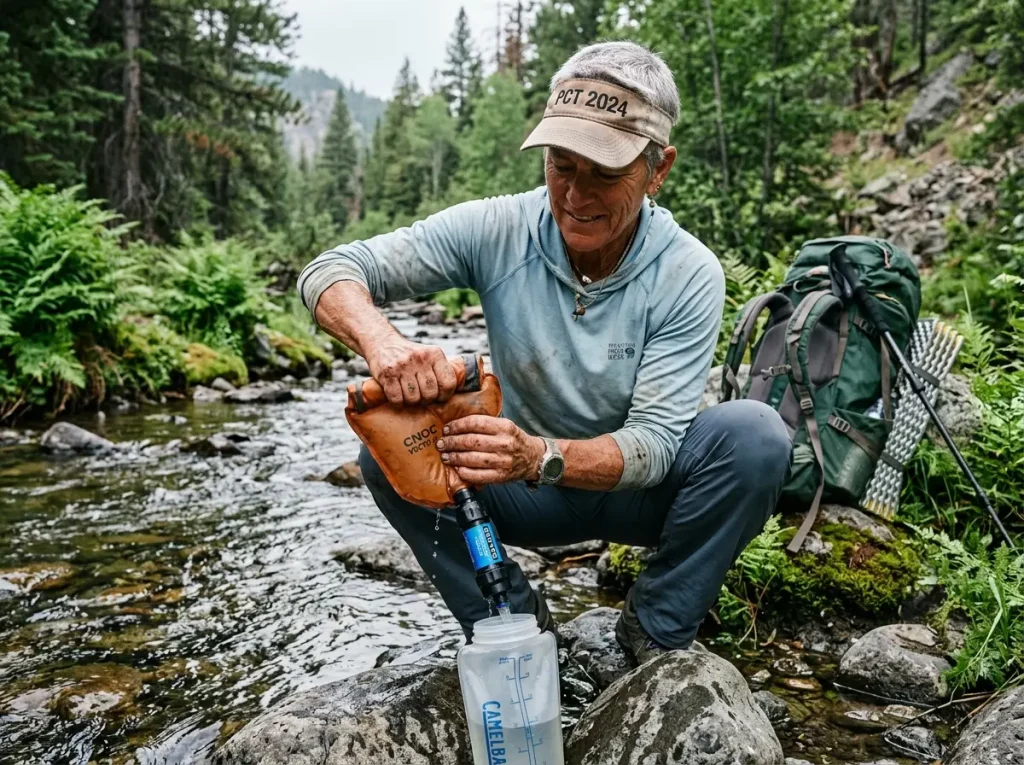
Here’s where most hydration guides fail. They calculate your “daily water needs” as one big number, then tell you to carry it all from the trailhead. That’s not how experienced backpackers think.
The “Camel-ing Up” Pre-Hydration Tactic
The most efficient place to carry water is inside your body. Camel-ing up — drinking a full liter at a water source before leaving — uses your stomach as a weightless reservoir for the first hour of hiking. You still absorb and utilize that water. You just don’t have to lug it in a bottle.
This tactic can cut 2+ pounds off your carry at any given moment, zero cost, no tradeoff. Every experienced thru-hiker on the PCT or CDT knows this. Most weekend hikers don’t.
Point-to-Point Water Planning
The point-to-point water carry strategy asks: how far is it to the next reliable source? Not how far is the whole day. Just the next source.
If the next reliable spring is four miles away and you’re hiking in moderate conditions with a 30-pound pack at 75°F, you need roughly two liters. Not five. Not eight. Two. Apps like FarOut (formerly Guthook) show recent source reports from other hikers in real time — don’t plan around a topo map spring that hasn’t been verified this season. Water data a year old on a dry-year route is not water data.
The point-to-point approach also forces you to think about the full hydration calculator picture: sweat rate, sun exposure, trail difficulty, and the time between sources. Once you’ve run those numbers two or three times, it becomes automatic. You stop guessing. You stop over-packing.
“Dry Camping” Ratios and Overnight Deficits
A dry camp requires a minimum of two liters added to your evening carry — and this is a hard floor, not an approximation. The accounting breaks down like this: 0.5L for the meal, 0.5L for overnight sipping, 0.5L for breakfast, 0.5L for first aid and cleanup. If you arrive at a dry site already running a 1-2% deficit — which is entirely possible after a hard day — you wake up in trouble before the sun clears the ridge.
Plan the dry camp carry before you start the segment, not when you’re already tired and thirsty at the last water source.
Treatment Redundancy for High-Risk Sources
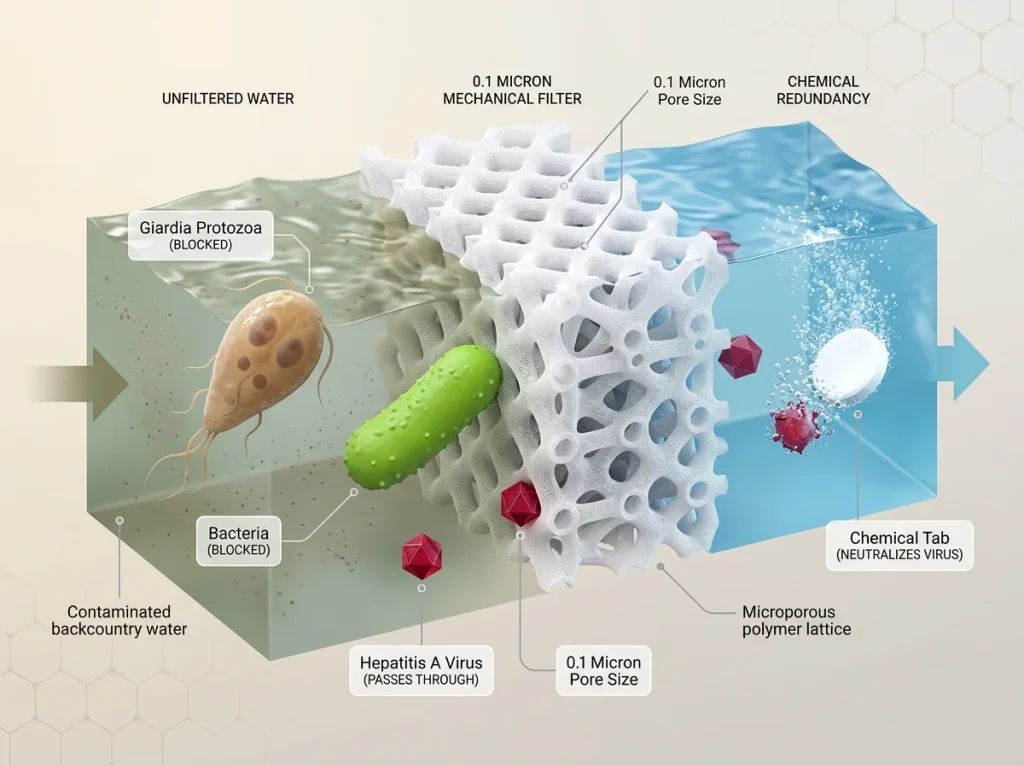
Relying on a single mechanical filter is a safety failure. I’ve had ceramic squeeze filters crack apart on granite when temperatures dropped below freezing overnight. I’ve had tubes ice up before dawn. I carry Aquatabs every single trip, without exception.
Mechanically, most 0.1-micron filters like the Sawyer Squeeze handle Giardia and bacteria with no issues. Viruses — Hepatitis A, Norovirus — slip straight through. In high-use North American wilderness, most people accept this risk because viral loading is low. In international trekking or areas with significant agricultural runoff, you need chemical treatment or UV in addition to filtration. The evidence-based guidelines for wilderness water treatment from the Wilderness Medical Society are unambiguous on this.
Before you choose your treatment protocol, check assessing backcountry water sources — what looks clear can still carry invisible pathogens that no amount of visual inspection catches.
Sodium Homeostasis: The Electrolyte Survival Protocol
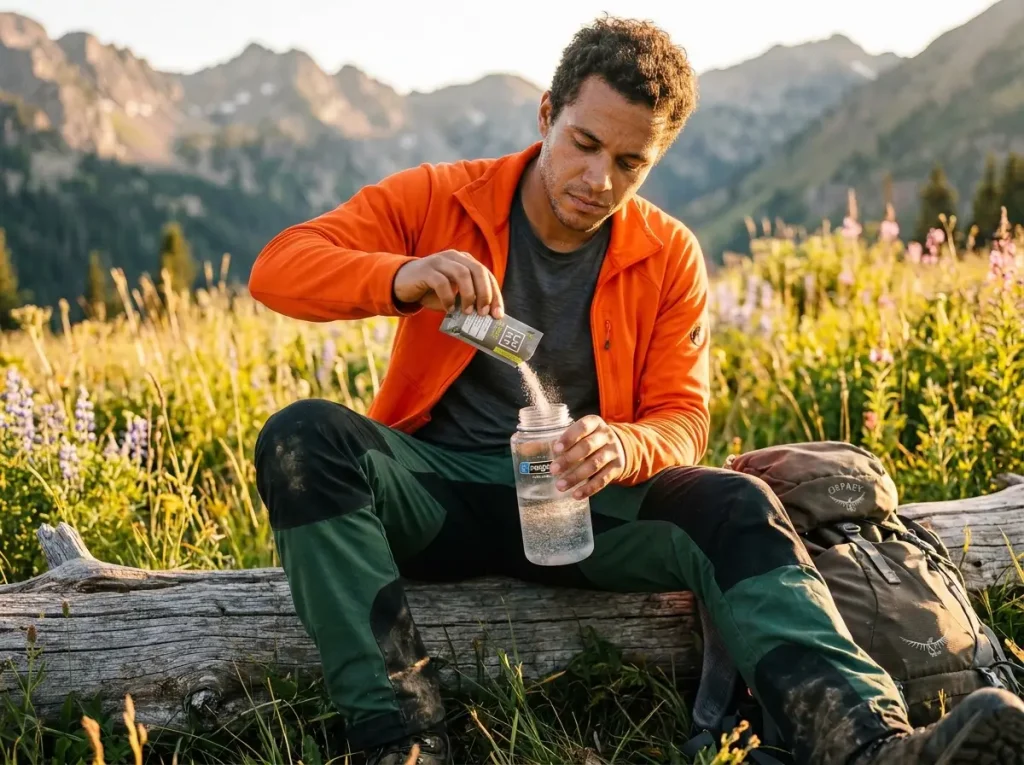
Plain water will harm you faster than you think if you’re not replacing sodium. Drinking excessive plain water without sodium replacement causes Exercise-Associated Hyponatremia (EAH) — a condition where blood sodium drops low enough to cause brain swelling, seizures, and serious collapse on remote trails. The practice guidelines for exercise-associated hyponatremia from the Wilderness Medical Society classify it as a serious and underdiagnosed wilderness emergency.
Why “Drinking to Thirst” Triggers Voluntary Dehydration
The thirst mechanism is a trailing indicator. It doesn’t fire until you’ve already lost 1-2% of body weight as fluid. By then, you’re in voluntary dehydration on the trail — the state where ad-libitum drinking only replaces 40-60% of your actual losses. You feel okay. You drink when you’re thirsty. You arrive at camp in a 2% deficit without knowing it.
The fix is scheduled micro-sipping, not reactive chugging at breaks. Micro-sipping maintains plasma volume steadily rather than triggering a surge-dump absorption cycle that sends most of your bolus straight to urination.
The “Salty Sweater” Trap and Sodium Dilution
Salty sweaters lose between 700mg and 1,500mg of sodium per liter of sweat — at the high end, that’s a meaningful chunk of extracellular sodium gone with every hour of hard work. When you replace that volume with plain water, you dilute blood sodium further, creating an osmotic pressure gradient that drives fluid into the cells. Sausage fingers are the benign version.
For hikes exceeding four hours, target 300-700mg of sodium per hour from electrolyte supplements like LMNT or Nuun, or from real food (pretzels, jerky, cheese). This isn’t optional for long days in heat.
Pro tip: Keep your electrolyte solution in a separate ultralight bottle rather than your primary hydration bladder. Sweet or salty mixes create biological growth inside drinking tubes over multiple days. This is a hygiene issue that can take you off trail faster than dehydration.
Bicarbonate Diuresis: Why Altitude Forces Urination
At altitude, the body faces a blood pH challenge. Increased breathing flushes CO2, which makes the blood alkaline. The kidneys respond by dumping bicarbonate — an osmotic agent — and water follows it out. This is Bicarbonate Diuresis, and it explains why you’re peeing constantly at 12,000 feet even when you’re clearly not drinking too much.
This isn’t a malfunction. It’s your body doing chemistry work to survive the elevation. But it means altitude hikers have an additional baseline fluid loss that doesn’t exist at sea level. Your proper high-altitude acclimatization plan should build this diuresis window into your fluid schedule from day one.
System Failure: When Hydration Planning Collapses
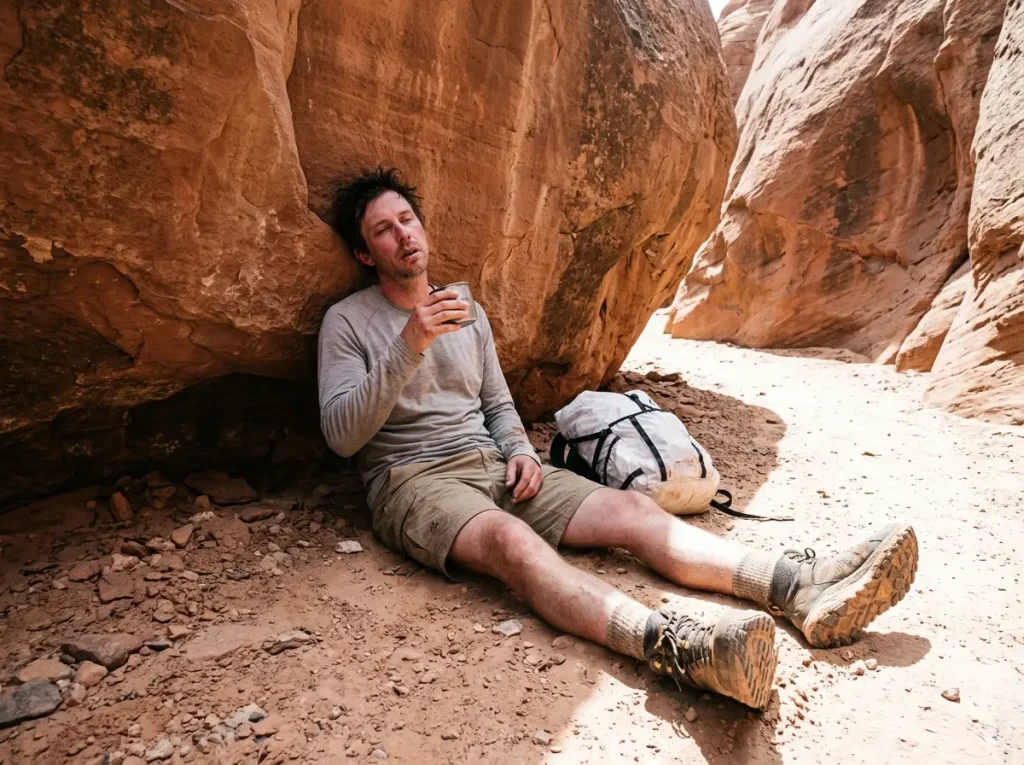
At some point, the calculation doesn’t save you. The weather changes, the source dries up, or you pushed harder than planned. This is where you need to recognize what’s happening before it gets away from you.
The 2% Body Mass Performance Cliff
Dehydration of just 2% of body mass — three pounds for a 150-pound hiker — triggers measurable drops in VO2 Max, aerobic performance, and cognitive function. This is the point where navigation errors become statistically more likely. You feel fine. You are not fine. The technical markers of dehydration in athletes from the Korey Stringer Institute put this threshold front and center for a reason.
Resting heart rate spikes. Urine turns dark. Thought slows. These are Level 1 signs. Trust them.
Recognizing Exercise-Associated Hyponatremia (EAH)
EAH is the opposite failure mode — too much plain water, not enough sodium. The symptoms overlap confusingly with dehydration: headache, nausea, disorientation. The critical difference is that EAH patients are often clearly well-hydrated by volume but progressively worsening.
A Grand Canyon hiker who drank two gallons of plain water over a hot day and stopped eating collapsed from hyponatremia — not heat stroke, not dehydration. The water-sodium balance is not optional. If someone in your group is confused, nauseated, and has been drinking heavily without eating salty food, the treatment is not more water.
The 30-Minute Heat Stroke Window
Exertional Heat Stroke (EHS) crosses when core temperature exceeds 104°F with central nervous system dysfunction. Cool first, transport second. Immersion in cold water is the only intervention with near-100% survival if started within that window. Knowing how to distinguish between heat exhaustion and heat stroke symptoms while hiking is a skill that belongs in your brain before you need it — not as you’re watching someone’s condition deteriorate.
Gastric absorption maxes out at about 1.2 liters per hour. You cannot chug your way out of severe heat stress. The only interventions that work are reducing exertion, getting into shade, and active cooling.
Pro tip: Use the 3-4 hour rule. If you’re moving longer than that in summer heat, plain water stops being your complete solution. Add sodium, eat salty snacks, and don’t wait until you feel thirsty to start.
Conclusion
Three things to carry out of this article:
First, your pack weight is a direct variable in your sweat rate — not background context. Every liter past your section-to-section need is costing you more fluid than it’s providing at some point. Calculate to the next reliable source, not to the trailhead and back.
Second, camel up at every water source you trust. Let your body carry it for free. Then re-evaluate what you actually need before the next dry stretch.
Third, sodium is not optional on long days. Plain water without electrolyte replacement is how otherwise prepared hikers end up requesting evacuation.
Next weekend, plan one segment using point-to-point logic instead of loading your pack for the full day. Run the weight difference. Then run the math on your sweat rate and see how close your original carry would have been to the Efficiency Gap. The first time you feel the difference in your knees on the descent, you’ll never go back to guessing.
FAQ
How much water is 2 miles of hiking?
For two flat miles in mild weather, 0.5 to 1 liter is a reasonable range depending on your pack weight and the ambient temperature. A steep, exposed two-mile climb with a heavy pack can require a full liter just to maintain cooling efficiency — elevation gain and heat load matter far more than raw mileage.
How many liters of water for a 10 mile hike?
A 10-mile day hike with no reliable refill sources typically requires 3 to 5 liters for most hikers under moderate conditions. Add an extra liter if temperatures exceed 85°F or if you’re on sustained exposed ridgeline terrain. With point-to-point planning and regular sources, you may carry far less at any given moment.
How heavy is 3 liters of water?
Three liters of water weighs exactly 6.6 pounds — 2.2 pounds per liter, no exceptions. This weight feeds directly into the Pandolf equation, increasing your caloric output and subsequent sweat rate. Every liter counts.
What are the first signs of dehydration?
The earliest signs on the trail are a resting heart rate that climbs without a corresponding effort increase, dark urine, and a subtle mental fog. By the time you feel intensely thirsty, you’re already operating in a measurable 1-2% body mass deficit — which is enough to impair cognition and aerobic performance.
Can you drink too much water while hiking?
Yes. Drinking excessive plain water without consuming salty snacks or electrolyte tabs triggers Exercise-Associated Hyponatremia. The dilution of blood sodium leads to brain swelling and severe confusion, and it can become a serious medical emergency on remote trails. The water-sodium balance is not optional — it’s the chemistry that keeps the physics from getting you into trouble.
Risk Disclaimer: Hiking, trekking, backpacking, and all related outdoor activities involve inherent
risks which may result in serious injury, illness, or death. The information provided on The Hiking Tribe is for
educational and informational purposes only. While we strive for accuracy, information on trails, gear, techniques,
and safety is not a substitute for your own best judgment and thorough preparation. Trail conditions, weather, and
other environmental factors change rapidly and may differ from what is described on this site. Always check with
official sources like park services for the most current alerts and conditions. Never undertake a hike beyond your
abilities and always be prepared for the unexpected. By using this website, you agree that you are solely
responsible for your own safety. Any reliance you place on our content is strictly at your own risk, and you assume
all liability for your actions and decisions in the outdoors. The Hiking Tribe and its authors will not be held
liable for any injury, damage, or loss sustained in connection with the use of the information herein.
Affiliate Disclosure: We are a participant in the Amazon Services LLC Associates Program, an
affiliate advertising program designed to provide a means for us to earn advertising fees by advertising and linking
to Amazon.com. As an Amazon Associate, we earn from qualifying purchases. We are also an official affiliate partner
of Black Diamond Equipment via the AvantLink network. If you click on a Black Diamond affiliate link and make a
purchase, we may earn a commission at no additional cost to you. We also participate in other affiliate programs and
may receive a commission on products purchased through our links. Additional terms are found in the terms of
service.