In this article
Mile 14 on the exposed ridge above Harts Pass, thermometer pinned at 97°F, and my arms felt cooler than my sunscreen-slathered face. I’d been skeptical—wearing a long-sleeve sun shirt in scorching temperatures sounded like a punishment, not a strategy. But after 600 miles of thru-hiking the Pacific Crest Trail in a lightweight sun hoodie, I stopped questioning the concept and started questioning why I’d ever hiked without one.
That’s how it happens for most hikers. One day of wearing a UPF sun hoodie through brutal heat, feeling the breeze hit wet fabric while your bare-skinned buddy turns lobster-red, and you’re a convert for life. Here’s the field-tested breakdown of how these featherweight layers actually keep you cooler, safer, and more comfortable than bare skin—even when the trail feels like the surface of Mars.
⚡ Quick Answer: A lightweight sun hoodie with high air permeability blocks UV radiation, facilitates evaporative cooling through moisture wicking, and eliminates the need for constant sunscreen reapplication. In direct sunlight above 90°F, a breathable UPF fabric can keep your skin surface cooler than exposed skin by reflecting solar radiation and accelerating sweat evaporation. The catch? You need the right fabric weight and breathability—a dense UPF 50+ hoodie in humid heat will cook you. Choose wisely.
The Medical Case for Covering Up in Heat
What UPF Actually Measures (And How It Differs from SPF)
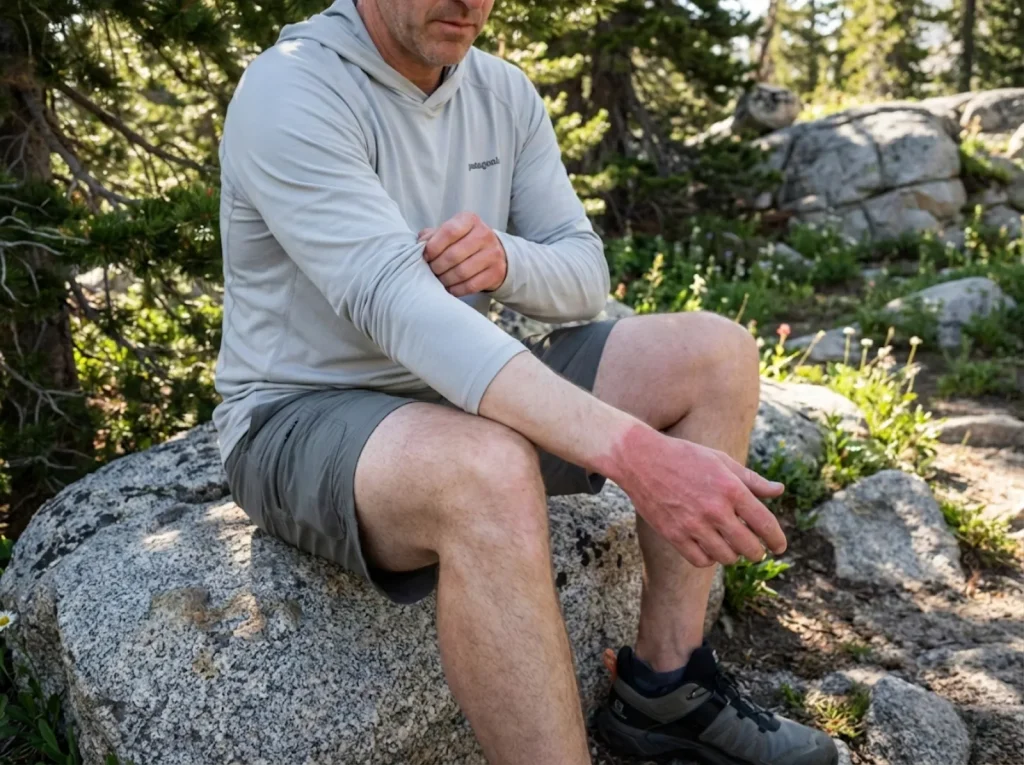
Most hikers know about SPF in sunscreen, but few understand what UPF actually means for clothing. Here’s the plain version: SPF only measures UVB protection—the rays that give you a visible sunburn. UPF measures both UVA and UVB blocking, which means it accounts for the deeper damage you can’t see, the kind that ages your skin and raises your cancer risk years down the trail.
A garment rated UPF 50 allows only 1/50th of UV radiation through the fabric—that’s just 2%. Drop to UPF 15, and 6.7% gets through. Those numbers matter when you’re spending 10-12 hours in full sun on an exposed ridge. The Skin Cancer Foundation requires UPF 50+ for its Seal of Recommendation, and understanding what UPF clothing actually means at high altitude is worth your time before buying.
Here’s what trips people up: a sun hoodie that fits skin-tight across your shoulders is stretching those fibers apart, literally opening gaps in the weave that let UV slip through. A standard white cotton tee that starts around UPF 7 can plummet to UPF 3 when soaked with sweat. Quality synthetic fabric maintains its rating wet or dry.
Pro tip: Size up one. A sun hoodie stretched tight over broad shoulders has a lower effective UPF than its label claims. Loose fit equals better protection.
The 33% Melanoma Risk Reduction Nobody Talks About
CDC data tells a straightforward story: combining UPF clothing with traditional sunscreen drops melanoma risk by 33% compared to sunscreen alone. That’s not a marginal gain—that’s a statistically significant reduction in your chances of getting skin cancer.
Think about where sunscreen fails on the trail. The back of your neck where your hat doesn’t reach. The tops of your ears. Your knuckles wrapped around trekking poles for eight straight hours. Dr. Doris Day, a leading dermatologist, highlights these blind spots as the reason fabric-based sun protection outperforms topical application alone. The American Academy of Dermatology’s guidelines on sun-protective clothing confirm that covering up with rated apparel is one of the most effective forms of skin protection available.
And then there’s the reapplication problem. Sunscreen needs refreshing every two hours. On a big mile day, that’s four to six reapplication stops—fumbling with greasy bottles, sunscreen mixing with sweat and dripping into your eyes. A sun hoodie is “always on” protection that never degrades, never needs reapplication, and never stings when it runs into an open blister.
How a Long-Sleeve Hoodie Keeps You Cooler Than Bare Skin
Evaporative Cooling and the “Swamp Cooler” Effect
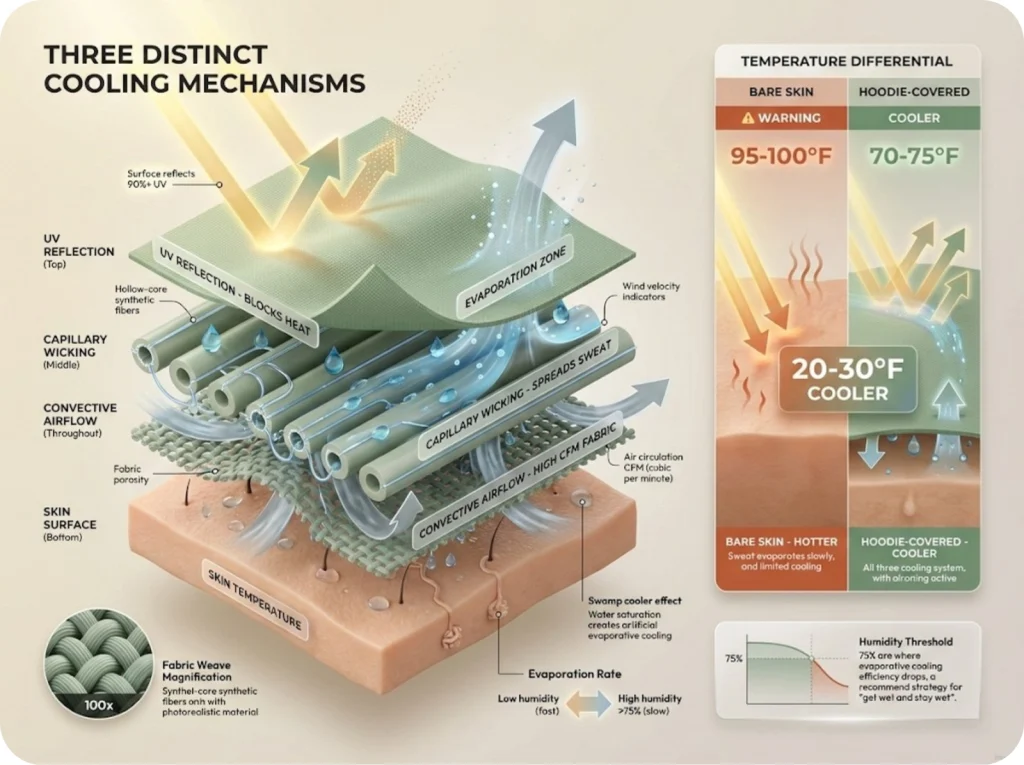
Here’s where the physics gets practical, and where most people’s intuition is dead wrong. Moisture-wicking fibers don’t just soak up sweat—they use capillary action to pull it outward and spread it across the outer surface of the fabric. More surface area means faster evaporation. Faster evaporation means more heat pulled away from your body.
Some sun hoodie fabrics take this a step further. Testing from Vapor Apparel shows that fabric surface temperatures can drop to 70°F through active evaporative cooling—even when the air around you is significantly hotter. The fabric becomes a personal air conditioner powered by your own sweat.
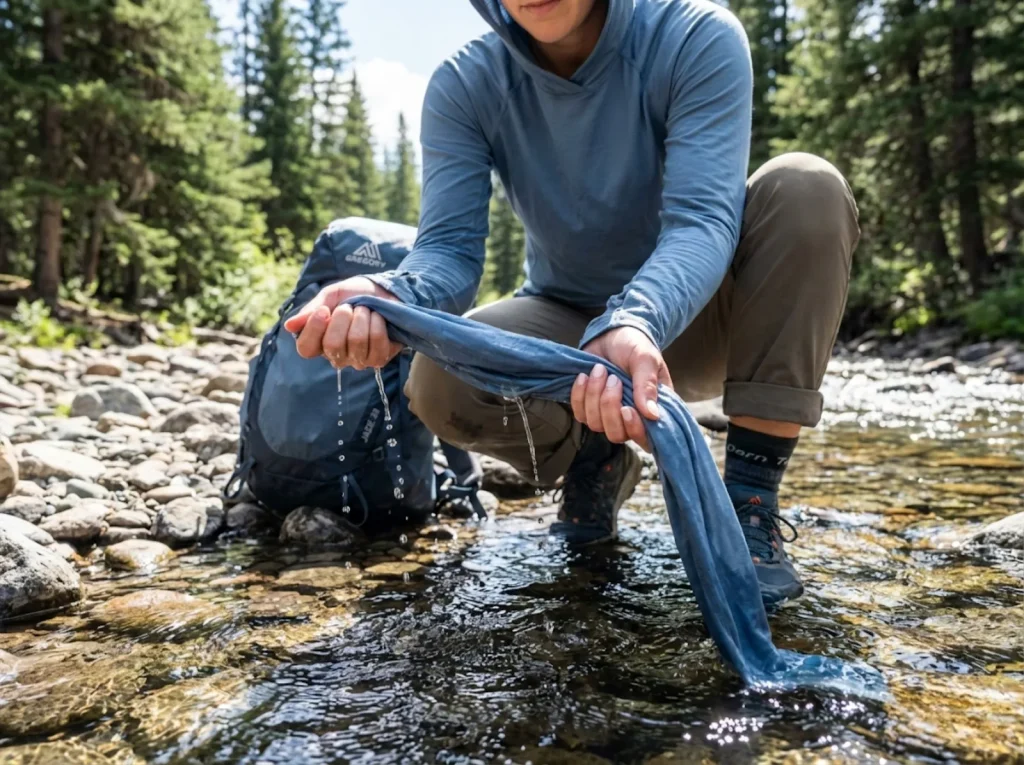
When humidity climbs above 75%, though, the system loses efficiency. Your sweat can’t evaporate fast enough into air that’s already saturated with moisture. That’s when the “get wet and stay wet” strategy kicks in—soaking the hoodie at every stream crossing creates the cooling effect artificially. It works incredibly well in humid weather conditions where dry evaporation stalls.
Pro tip: Hit every stream crossing. Dunk the entire hoodie. The next 30 minutes of evaporative cooling is worth the 10 seconds it takes.
If you notice that cooling isn’t working and you start feeling dizzy or nauseous, you may be dealing with something more serious. Know the early signs of heat exhaustion every hiker should recognize before they become an emergency.
Air Permeability (CFM) and Why It Matters More Than UPF
CFM—Cubic Feet per Minute—measures how much air passes through fabric. Higher CFM means more convective heat escape, and that’s where the real comfort difference lives. The Outdoor Research Echo leads the market in air permeability, with the Himali Eclipse close behind.
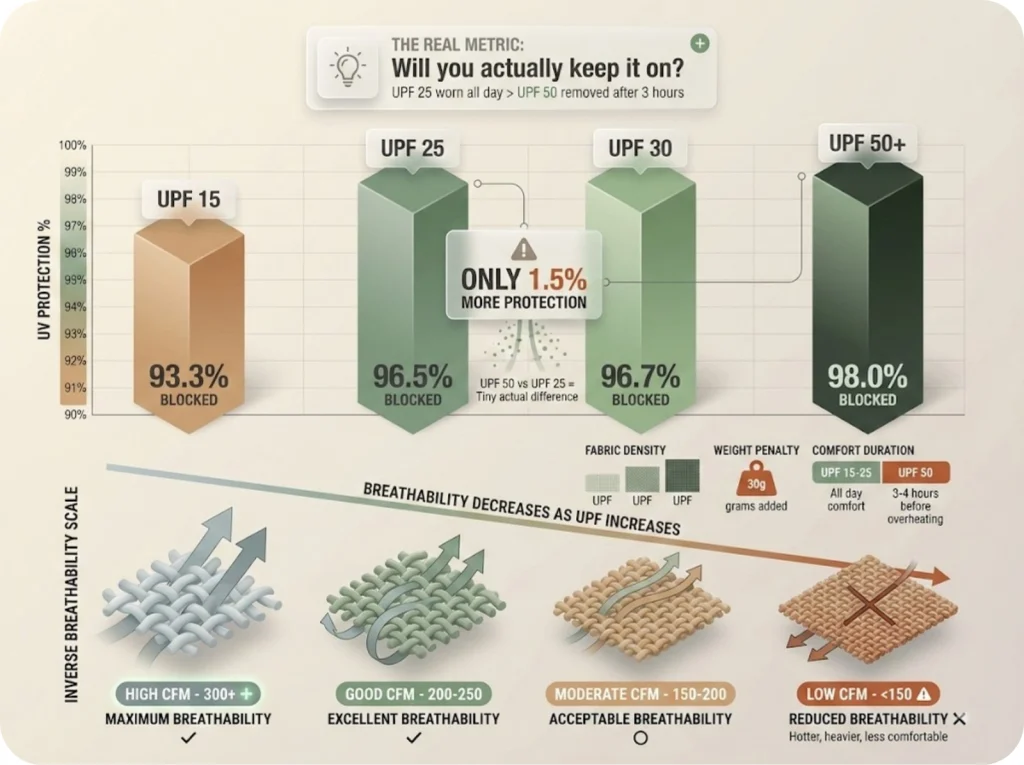
Here’s the trade-off nobody tells you about: achieving UPF 50+ requires a denser knit, which can cut breathability by up to 50% compared to a UPF 15 fabric. For temperatures above 90°F, a UPF 15-30 garment with high CFM provides superior thermal comfort compared to a denser UPF 50+ garment. You’re better off with more airflow and slightly less UV blocking than a garment that blocks everything—including the breeze.
You can also boost airflow with strategic pit-zip ventilation to regulate core temperature, especially during steep climbs where heat output spikes.
What’s Inside the Fabric: Materials That Make or Break Performance
Polyester vs. Nylon: The Synthetics Showdown
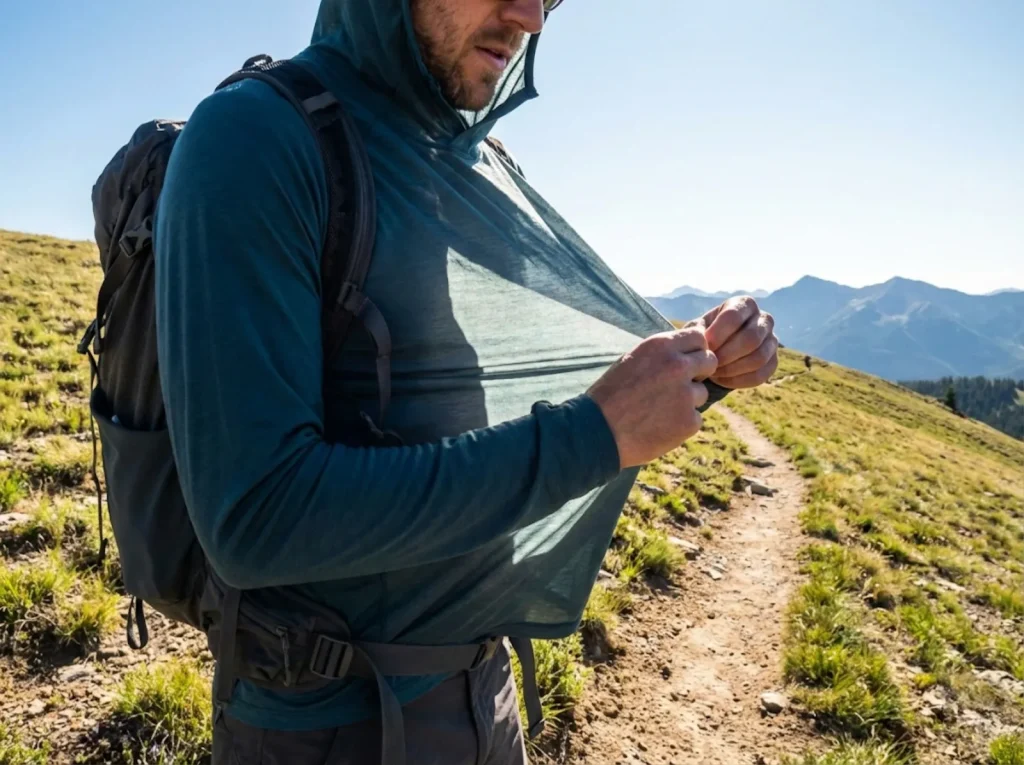
Polyester dominates the sun hoodie market for good reason. It’s hydrophobic (repels water at the fiber level), so it doesn’t absorb sweat into the fiber itself—instead, it moves moisture along the surface for faster dry time. The Outdoor Research Echo uses 100% recycled polyester, the Patagonia Capilene Cool Daily does the same, and both perform exceptionally in hot conditions.
Nylon brings a different strength: superior abrasion resistance and a softer hand-feel. The Black Diamond Alpenglow Pro uses 92% nylon for this reason. It holds up better under rough pack straps and resists pilling, but it dries slower than polyester. For pure hot weather performance, polyester wins. For multi-purpose durability, nylon earns its place.
Modern fiber engineering creates profiled cross-section shapes that form microscopic channels, accelerating moisture transport even further. And antimicrobial treatments like silver ions or bio-based finishes from HeiQ inhibit the odor resistance problem that plagues synthetic garments on multi-day trips.
The Merino Wool Question: Worth It in Extreme Heat?
Merino wool is the darling of the gear world for good reason—natural odor resistance, excellent thermoregulation across shifting temperatures, and a soft feel that synthetic fibers can’t quite match. The Ridge Merino Solstice is the leading option for sun protection.
But merino has a heat problem. It’s structurally thicker and “fuzzier” than synthetics, trapping a layer of warm air against your skin that becomes a liability above 90°F. Testing consistently shows merino runs noticeably hotter than comparable polyester in direct sun. If you explore our full durability comparison of merino wool vs. synthetic base layers, you’ll see the trade-offs laid out clearly.
The decision framework is simple. Multi-day trip where laundry isn’t happening? Merino’s odor management might outweigh the heat penalty. Single day hike in brutal heat? Stick with synthetic fabric. No exceptions.
Anatomy of a Trail-Ready Sun Hoodie: Features That Earn Their Weight
Hood Architecture: Scuba vs. Over-Hat vs. Cross-Over
Not all hoods are created equal, and the wrong style will have you ripping it off within the first mile. Three designs dominate the market, each built for a different kind of hiker.
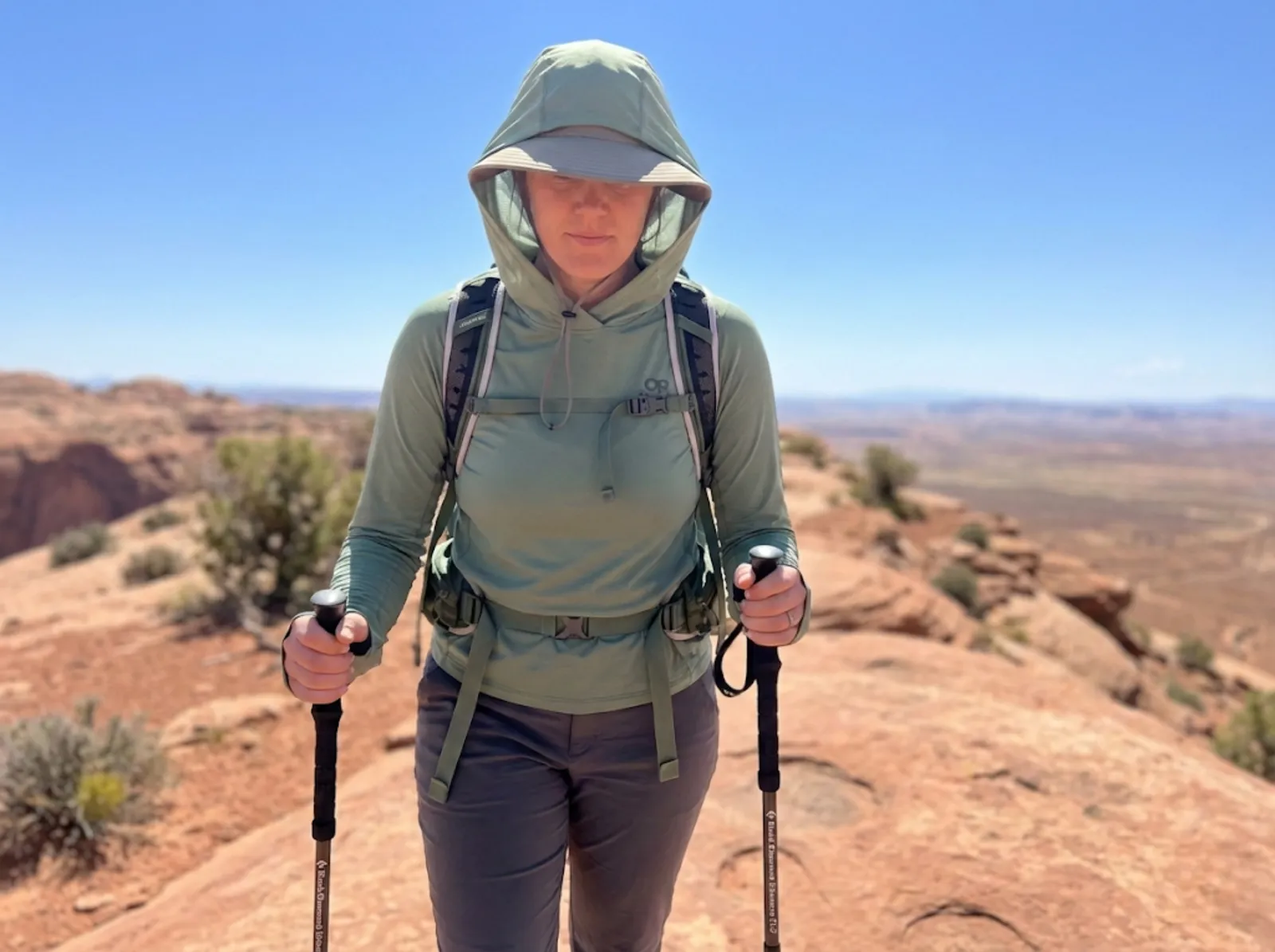
The scuba hood fits snug against your face and slides under a climbing helmet without bunching. It’s the choice for alpine routes and scrambling. The relaxed over-hat style pulls over a baseball cap or hiking hat—the brim gives the hood structure, promotes airflow underneath, and keeps the fabric off your face. This is the default for most trail hikers, and pairing it with choosing the right hiking hat for your conditions gives you maximum coverage. The cross-over gaiter style features a high collar that pulls up over your mouth and nose, acting as a built-in buff for dusty desert singletrack.
Pro tip: Wear your wide-brim hat UNDER the hood, not over it. The hood shields your ears and neck. The brim gives you face shade. It looks ridiculous. It works perfectly.
Thumbholes, Ventilation, and the Details That Matter
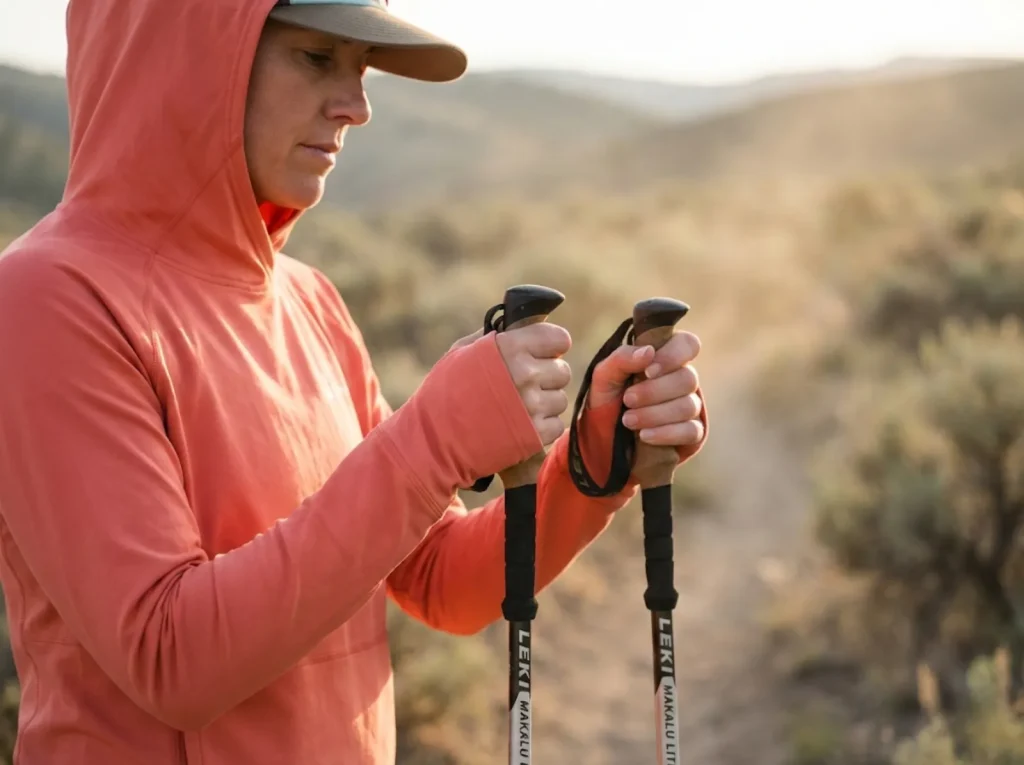
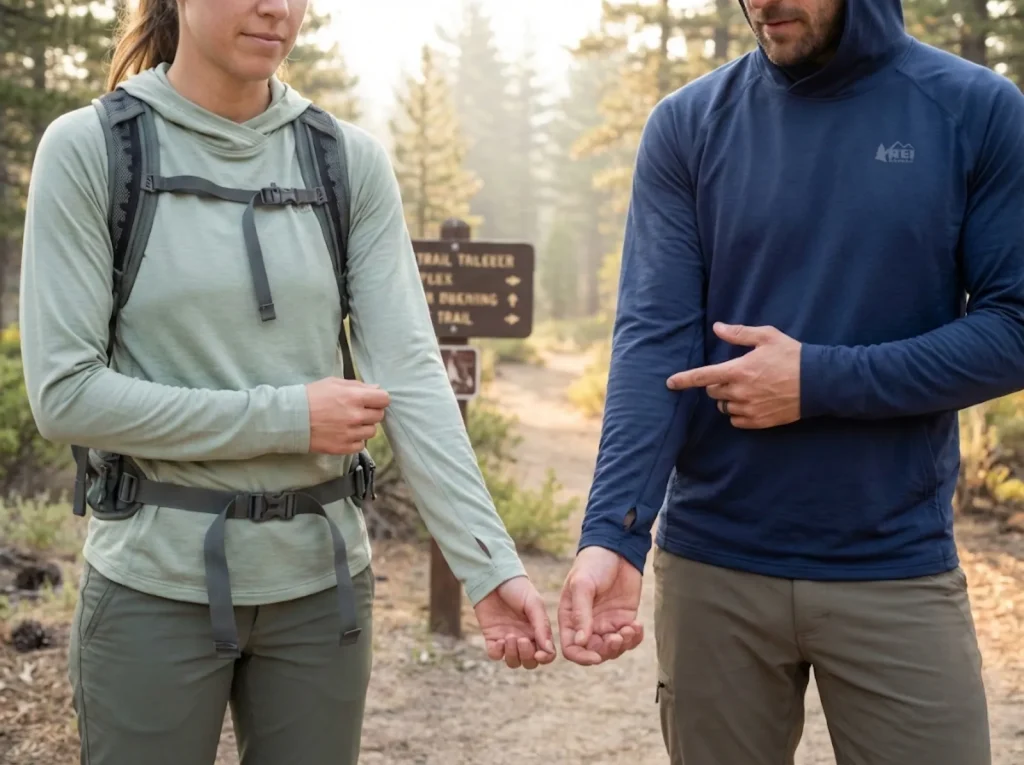
Thumbholes or thumb loops solve one of the most common sunburn problems on the trail: the backs of your hands. When you’re gripping trekking poles for eight hours, those knuckles get hammered by UV. Thumbholes keep the fabric extended over the back of your hand without restricting your grip.
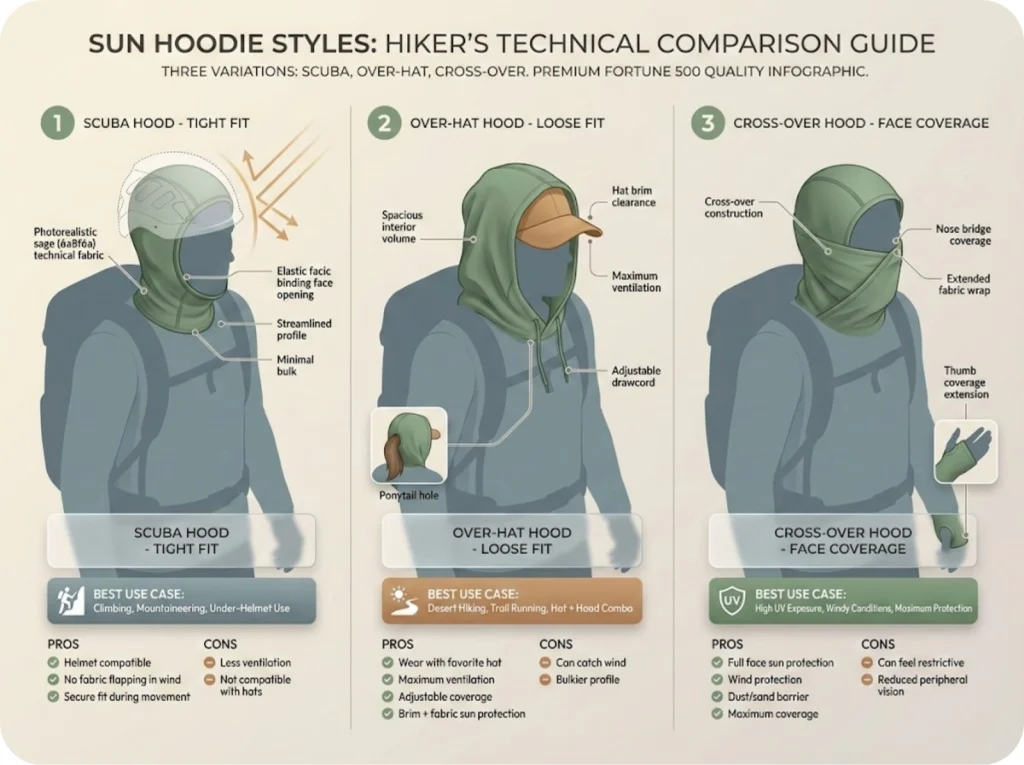
Laser-cut underarm vents on models like the Outdoor Research Astroman and quarter-zips on the BD Alpenglow Pro allow rapid heat dumping during steep climbs. Flat-seam construction prevents chafing under pack straps on high-mileage days. And for women hikers, a ponytail hole compatible hood design eliminates the fabric bunching at the nape that creates a pressure point under the pack’s head strap. When integrating a long-sleeve sun layer into your backpacking system, these details separate a 12-hour garment from a 2-hour frustration.
When Environment Changes the Rules: Altitude, Humidity, and Color
The Alpine UV Amplifier: Why Altitude Demands More Protection
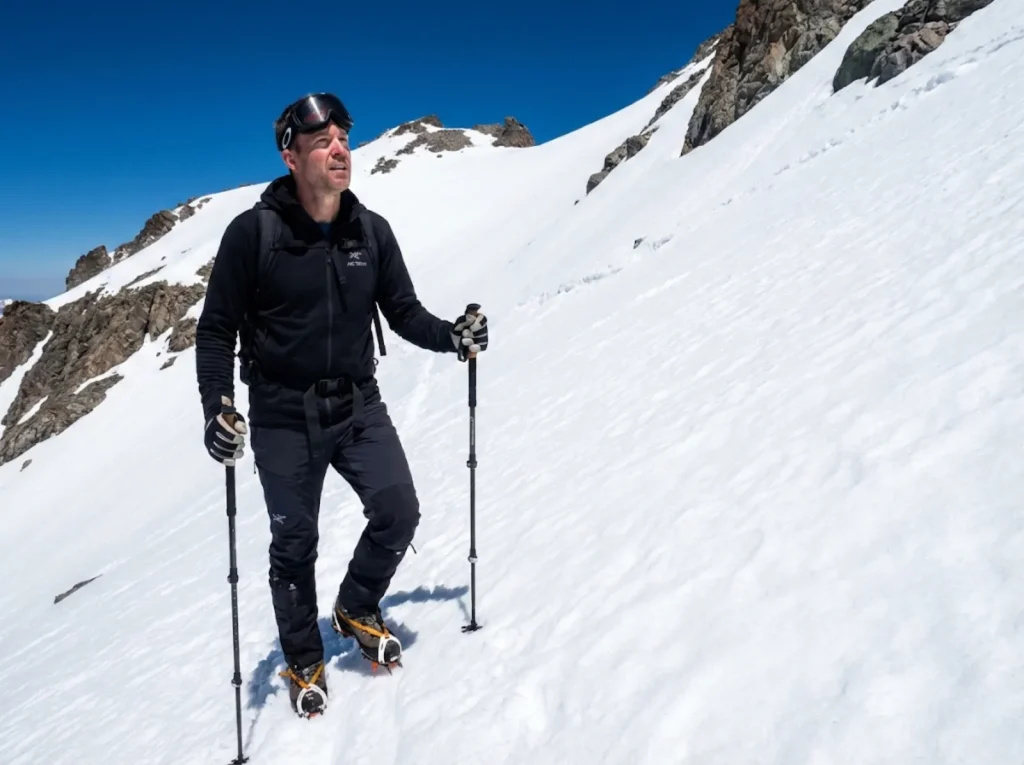
UV radiation increases roughly 10-12% for every 1,000 meters of elevation gain. At 14,000 feet, you’re absorbing about 35-40% more UV than at sea level. Stack on the fact that snow and glacier surfaces reflect up to 80% of UV rays, and you’ve got a “double exposure” situation—radiation hitting you from above AND bouncing up from below.
This is where the UPF 50+ rating stops being optional and becomes a safety requirement. At high altitude in direct sun exposure, covering every inch of exposed skin matters. Your sun hoodie also doubles as a mild wind layer on exposed ridges, and understanding how the layering system adapts to changing conditions connects the sun hoodie to your broader hiking gear strategy.
⚠️ Above treeline, removing your sun hoodie creates a double threat: immediate UV bombardment AND rapid evaporative cooling that can trigger hypothermia when afternoon storms roll in. Keep it on.
The Color Debate: Light vs. Dark in Direct Sun
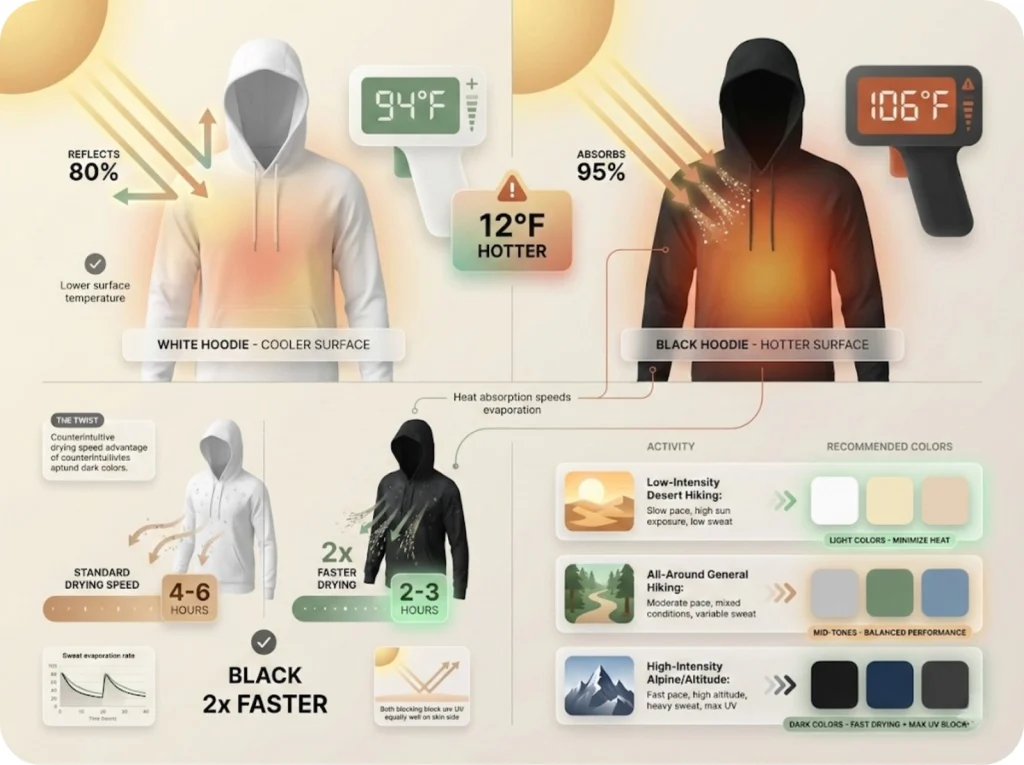
Testing puts numbers to the color question: a black sun hoodie reaches surface temperature of 106°F in direct sun. A white version of the same garment? 94°F. That’s a meaningful 12-degree difference in how hot the fabric feels against your skin.
But here’s the twist most articles miss. Dark sun hoodies absorb more heat, which actually accelerates sweat evaporation—a black hoodie dries almost twice as fast as white. If you’re moving hard and sweating heavy at high altitude, faster drying means faster cooling cycles.
The practical framework: light colors (white, yellow) for low-intensity desert hiking. Mid-tones (light gray, sage) for all-around general hiking. Dark colors (black, navy) for high-intensity movement at altitude where maximum UV blocking and fastest dry time outweigh the heat absorption penalty.
Humid Heat vs. Dry Heat: Different Strategies for Different Climates
In dry heat below 40% humidity, evaporative cooling works at peak efficiency. Prioritize high-CFM fabrics and the “stay dry” approach—your body’s sweat system handles the rest.
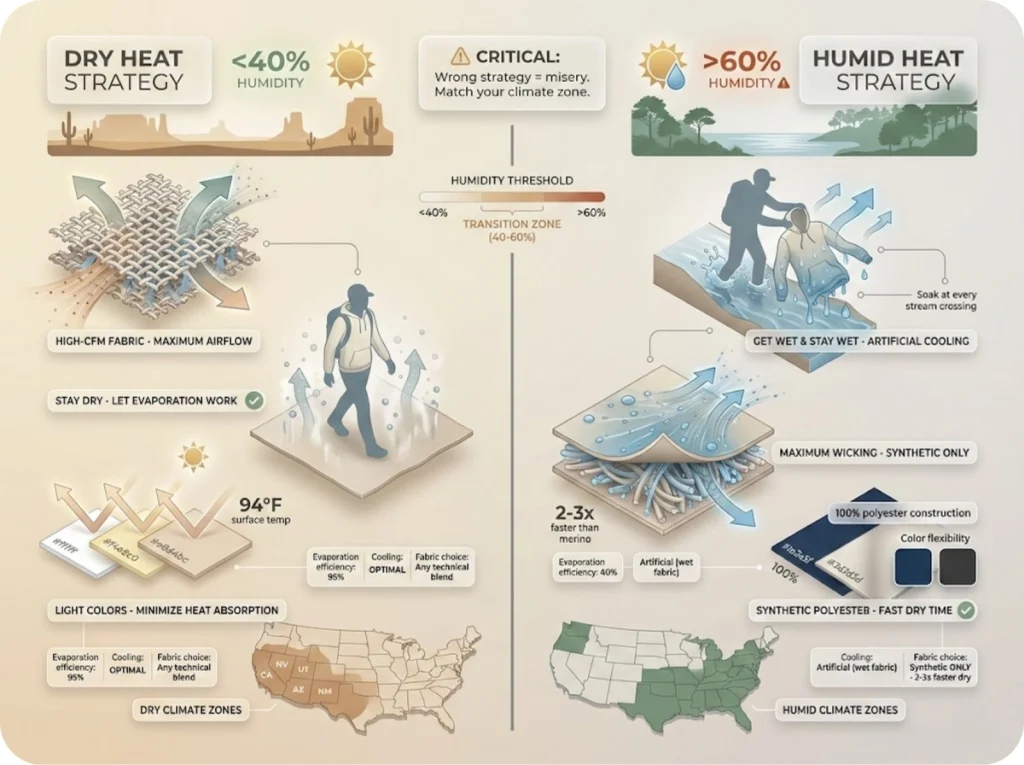
In humid weather above 60% humidity, everything changes. Sweat can’t evaporate into saturated air, so the “get wet and stay wet” strategy becomes essential. Soak the hoodie at every water source. Synthetic polyester outperforms merino by 2-3x on dry time in these conditions, which is why it’s the only real choice for humid climates. And when you’re sweating that heavily, managing electrolyte balance in extreme heat becomes just as important as what you’re wearing.
The “UPF 50 Myth” and How to Actually Choose the Right Hoodie
Why UPF 50 Isn’t Twice as Good as UPF 25
Here’s the number that should change how you shop: UPF 50 blocks 98% of UV. UPF 25 blocks 96.5%. The actual difference? Just 1.5% more UV protection. But the physical density required to hit that UPF 50+ rating creates a garment that’s significantly hotter, heavier, and less breathable.
Expert mountain guides and thru-hikers agree: a UPF 15-30 hoodie you keep on all day provides more cumulative sun protection than a UPF 50+ hoodie you rip off after three hours because you’re overheating. The real metric isn’t the UPF number—it’s “will I actually keep this on?”
The Decision Matrix: Matching Your Hoodie to Your Hike
Stop chasing the highest UPF number and start matching the garment to your actual conditions. Here’s how:
Day hike in mild heat (<90°F): UPF 30-50+, mid-weight, any color. When the hike is short, comfort matters less than coverage.
Day hike in brutal heat (>95°F): UPF 15-30, ultralight (<5 oz), high CFM, light color. Maximum airflow wins. The Himali Eclipse at 4.0 oz or the Ketl Mtn NoFry at 4.6 oz are built for this.
Multi-day thru-hike: UPF 20-30, synthetic, recycled materials, with odor resistance. The Patagonia Capilene with 50-100% recycled content handles the stink and the miles. Check out our field-tested breakdown of men’s hiking shirts for detailed comparisons.
Alpine/high-altitude: UPF 50+, dark color, thumbholes, scuba hood. Protection is non-negotiable above treeline. The Arc’teryx Cormac or BD Alpenglow Pro are purpose-built for this.
One final consideration: the PFAS-free transition. As of January 2025, major brands like Outdoor Research and Patagonia have eliminated “forever chemicals” from all new products. Look for bluesign® certified fabrics if supply chain sustainability matters to you—and it should.
Conclusion
Three things to carry off this page and onto your next hot-weather trail:
The science is settled. Covering up with a lightweight sun hoodie doesn’t make you hotter—it makes you smarter. Evaporative cooling and UV shielding work together, not against each other. Wearing sun shirts in even scorching temperatures is more than doable when the fabric is right.
Forget the UPF number. Chase the airflow. A UPF 15-30 hoodie with high air permeability will outperform a dense UPF 50+ garment in any temperature above 90°F. The best sun hoodie is the one you never take off.
Match the hoodie to the environment. Desert hikers, humid climate hikers, and alpine scramblers need different tools. There’s no single “best” sun hoodie—only the best one for your next hike.
On your next hot weather day on the trail, commit to wearing the hoodie for the full day. Don’t peel it off when you feel warm—give it 20 minutes to start working. Once you feel that first breeze hit wet fabric, you’ll understand why every long-distance hiker on the PCT treats their sun hoodie like the most important piece of hiking gear in their pack.
FAQ
Do sun hoodies actually make you hotter in the summer?
No—a well-designed sun hoodie keeps you cooler than bare skin in direct sun. Lightweight fabrics with high air permeability facilitate evaporative cooling while blocking infrared radiation that heats exposed skin. The key is choosing a breathable fabric (UPF 15-30) rather than a dense UPF 50+ garment that traps heat.
What is the best UPF rating for hiking in hot weather?
For most hot weather hiking below treeline, UPF 15-30 provides the best balance of UV protection and breathability. UPF 50 blocks only 1.5% more UV than UPF 25, but the denser fabric significantly reduces airflow. Reserve UPF 50+ for high altitude, snow travel, or extended desert exposure.
Can I just use sunscreen instead of a sun hoodie?
You can, but a hoodie is more effective and practical. CDC data shows UPF apparel combined with sunscreen reduces melanoma risk by 33% compared to sunscreen alone. Sunscreen requires reapplication every 2 hours, degrades with sweat, and misses coverage gaps like ear tops and the backs of hands on trekking poles.
Are sun hoodies worth it for short day hikes?
Yes, especially if the trail has significant sun exposure. Even on a 3-hour hike, a sun hoodie eliminates the need for multiple sunscreen reapplications and protects commonly missed areas. Ultralight models like the Himali Eclipse at 4.0 oz add negligible weight to your pack.
How do I care for my sun hoodie to maintain the UPF rating?
Machine wash cold with mild detergent and line dry. Avoid fabric softeners—they coat fibers and reduce moisture wicking performance. UPF ratings in quality synthetics are built into the fiber density and weave, so they don’t wash out like a topical treatment. Physical stretching from aggressive drying or overly tight fit does reduce effective UPF over time.
Risk Disclaimer: Hiking, trekking, backpacking, and all related outdoor activities involve inherent
risks which may result in serious injury, illness, or death. The information provided on The Hiking Tribe is for
educational and informational purposes only. While we strive for accuracy, information on trails, gear, techniques,
and safety is not a substitute for your own best judgment and thorough preparation. Trail conditions, weather, and
other environmental factors change rapidly and may differ from what is described on this site. Always check with
official sources like park services for the most current alerts and conditions. Never undertake a hike beyond your
abilities and always be prepared for the unexpected. By using this website, you agree that you are solely
responsible for your own safety. Any reliance you place on our content is strictly at your own risk, and you assume
all liability for your actions and decisions in the outdoors. The Hiking Tribe and its authors will not be held
liable for any injury, damage, or loss sustained in connection with the use of the information herein.
Affiliate Disclosure: We are a participant in the Amazon Services LLC Associates Program, an
affiliate advertising program designed to provide a means for us to earn advertising fees by advertising and linking
to Amazon.com. As an Amazon Associate, we earn from qualifying purchases. We are also an official affiliate partner
of Black Diamond Equipment via the AvantLink network. If you click on a Black Diamond affiliate link and make a
purchase, we may earn a commission at no additional cost to you. We also participate in other affiliate programs and
may receive a commission on products purchased through our links. Additional terms are found in the terms of
service.