
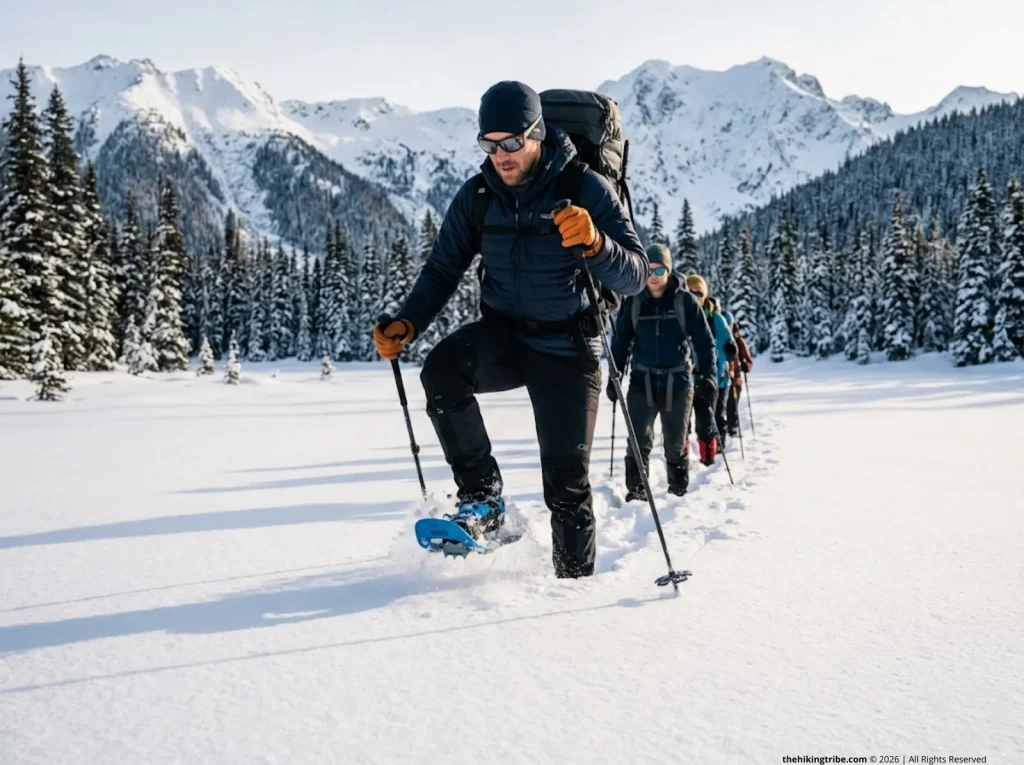
Two hours into what should have been an easy five-mile loop, my quads were on fire and I was leaning on my poles like crutches. Fresh powder had buried the trail to mid-shin. I’d been breaking every single step solo since the trailhead. Heart rate locked above 170. I wasn’t out of shape — I’d crushed this same route on packed snow last month in half the time. That’s the brutal reality of breaking trail in snowshoes: nobody warns you that you’re burning running-level calories at walking speed.
Years of backcountry snowshoeing — and a few punishing solo days like that one — have made one thing very clear. Energy expenditure in untracked powder isn’t just higher than most people expect. It’s higher than most fitness calculators even attempt to estimate. Once you understand the science behind it, and more importantly the field strategies to manage it, your time out there changes completely.
Here’s exactly what’s happening to your body when you’re the breaker, and how to handle it.
⚡ Quick Answer: Breaking trail through unpacked snow burns up to twice as many calories as snowshoeing on a packed trail at the same speed, because your body has to lift each foot completely clear of the snow and overcome full snow resistance on every step. The University of Vermont study by Dr. Declan A.J. Connolly — the only peer-reviewed research on snowshoe energy expenditure — found that prior estimates were off by more than 50%. Expect 600–1,000+ kcal per hour during active trail-breaking, and plan your route, rotation, and fuel accordingly.
The Science of Snowshoe Energy Expenditure
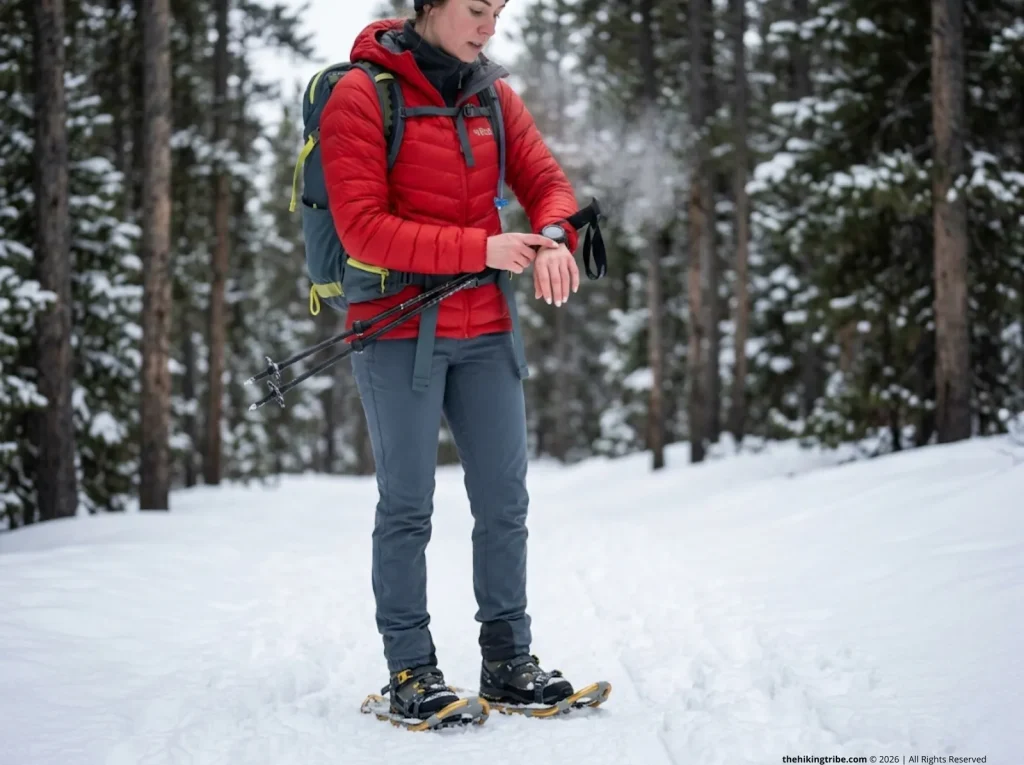
Most online calorie calculators for snowshoeing are built on outdated assumptions. They pull from general walking formulas and slap on a snow multiplier. Dr. Declan A.J. Connolly at the University of Vermont sat down in 2002 and actually measured what’s happening — recording VO2 demand (the volume of oxygen your body consumes per kilogram per minute) at different speeds across different snow conditions. The results, published in the Journal of Strength and Conditioning Research, were a wake-up call.
What the Connolly Study Actually Found
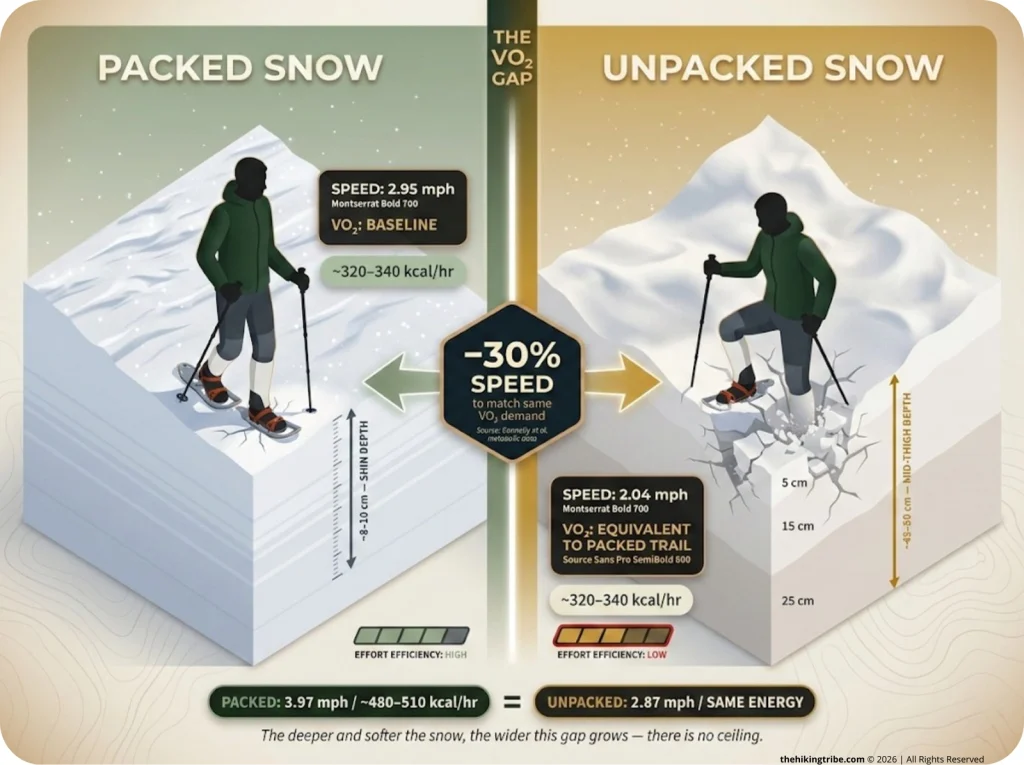
On packed snow at 2.95 mph, snowshoeing pulls a VO2 of around 18 ml/kg/min — equivalent to walking on a treadmill at 4 mph. Push that to 3.97 mph on packed snow, and VO2 jumps to 36.72 ml/kg/min, which matches treadmill walking at 6 mph. That’s a running-level demand at what feels like a brisk walk. The most striking finding: increase your speed by just 1 mph at slow paces, and you roughly double your caloric burn. The study concluded that existing estimates were undervaluing snowshoe energy expenditure by more than 50%.
Pro tip: Most fitness trackers wildly undercount calories burned on snow. Add 30–50% to whatever your watch tells you during a breaking trail session, and you’ll be closer to reality.
MET Values and What They Mean for Your Body
The Arizona State Compendium of Physical Activities — the same reference used by the ACSM and CDC — assigns a metabolic equivalent (MET) of 5.3 to moderate snowshoeing on packed trails. Vigorous snowshoeing and breaking trail in powder push that to MET 10.0. For a 180-pound hiker, that translates to roughly 857 calories per hour. The caloric expenditure range across typical snowshoeing sits at 420–1,000+ kcal per hour, depending on snow conditions, speed, terrain slope, and body weight.
Packed vs. Unpacked Snow — The VO2 Gap
The Connolly data makes the unpacked snow penalty concrete: a packed-trail speed of 2.95 mph demands the same VO2 as 2.04 mph on untracked snow. You have to slow down 30% just to match effort. At 3.97 mph packed, the unpacked equivalent is only 2.87 mph. The deeper and softer the snow, the worse this gap becomes — there’s no linear ceiling. If you want to build the foundational knowledge that makes this performance data click, snowshoeing fundamentals and basic technique is the right starting point.
Why Breaking Trail Drains You Faster Than Following
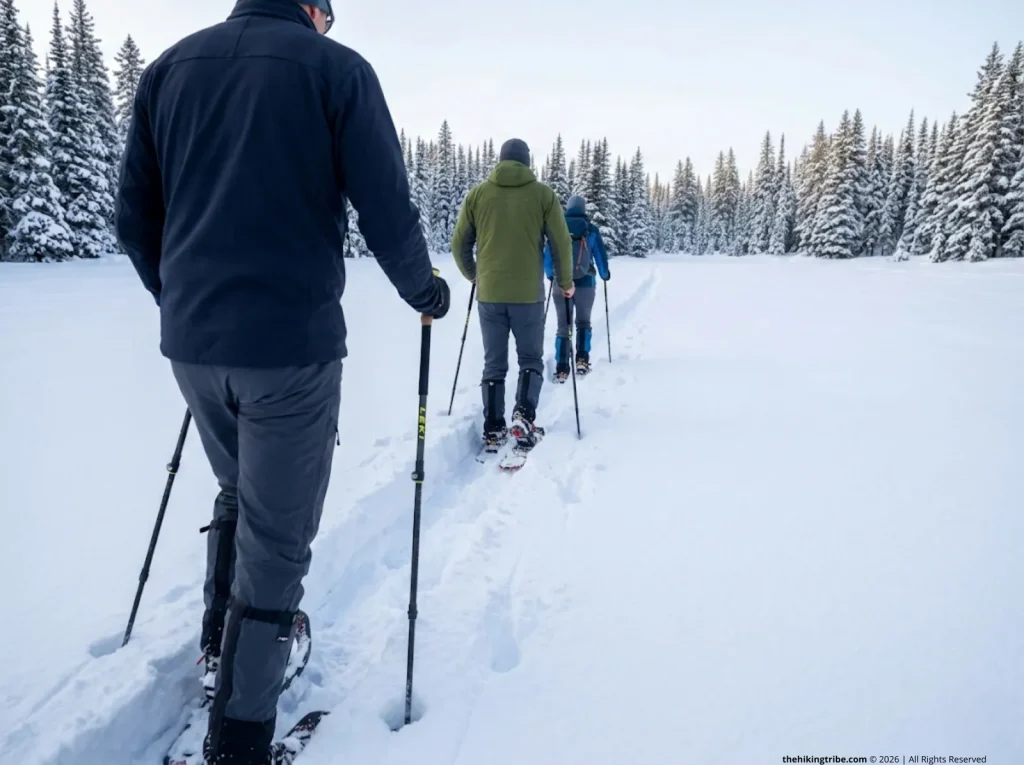
There’s a gap between the second hiker in line and the person out front that most snowshoers don’t fully appreciate until they’ve led a long powder day. The breaker does 100% of the compaction work. Everyone behind them steps into a groove that’s already been compressed, lowering their energy cost by an estimated 30–40%. Trail-breaking fatigue sets in after just 5–15 minutes of continuous leading — not because you’re weak, but because the physics don’t negotiate.
The Biomechanics of Breaking Fresh Snow
Snow resistance doesn’t just push back against your foot. It acts on the entire snowshoe frame in three dimensions — forward drag, downward sinking force, and rotational pull on the ankle. Breaking trail requires an exaggerated high-step gait with real upper-body engagement through your poles. Your hip flexors, quadriceps, and core muscles are all firing in a way that following a packed track simply doesn’t demand. If you’ve been using a packed-trail benchmark to plan multi-day hikes in backcountry winter terrain, those numbers are probably way off.
Postholing — The Energy Disaster Without Proper Flotation
Postholing — sinking thigh-deep into soft snow without adequate flotation — makes trail-breaking look easy by comparison. Without snowshoes, a typical hiker sinks 12–24 inches in consolidated powder. With undersized snowshoes that can’t handle your backpack weight plus body weight, you might still be sinking 10–12 inches per step. The energy cost of yanking a boot out of a deep hole on every stride compounds fast. Understanding the risks and self-rescue techniques for postholing is worth doing before any serious powder day — it’s not just a nuisance, it’s a genuine safety issue. And if your gaiters aren’t up to the job in deep powder, the problem gets worse; what works and what doesn’t in deep powder gaiter setups is worth a read before you gear up.
Technique That Saves Energy on Every Step
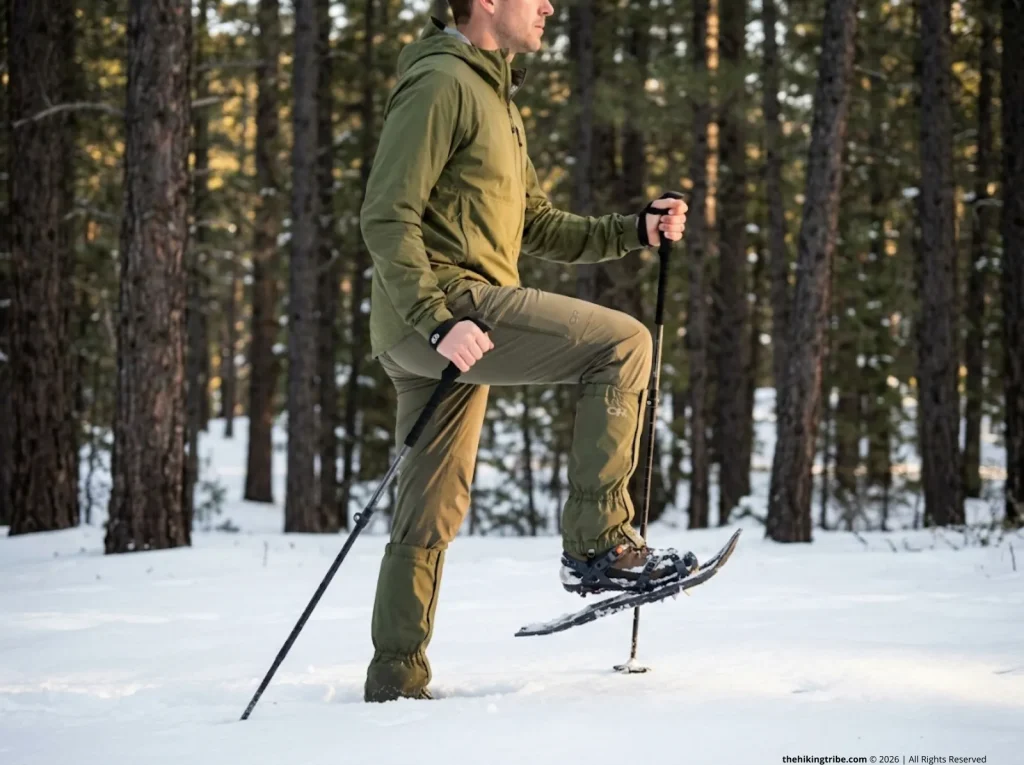
The biggest efficiency gains in breaking trail come from technique, not fitness. You can be in excellent shape and still burn out in 30 minutes if your movement pattern is wrong. Two adjustments — one with your feet, one with your poles — will change how far you actually go out there.
The Foot-Lift Method — Up Before Forward
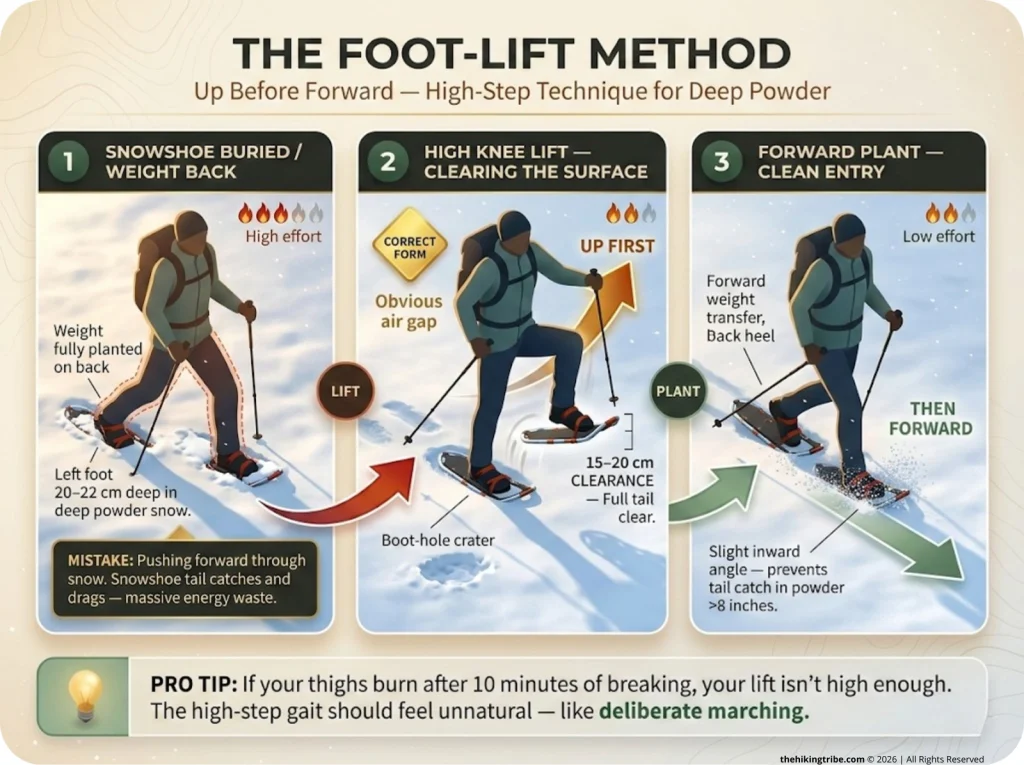
The most common mistake is pushing the snowshoe forward through the snow instead of lifting it up and out first. It feels natural, but it creates massive drag on the frame and tail. Correct form means lifting your knee high enough to clear the snow surface completely before stepping forward. Think “march,” not “shuffle.” In powder deeper than 8 inches, angling your foot slightly inward on the lift prevents the snowshoe tail from catching. This one adjustment cuts the per-step energy cost significantly, and it compounds across thousands of steps on a long route.
Pro tip: If your thighs are burning after 10 minutes of breaking, your lift isn’t high enough. The high-step gait should feel unnatural — like deliberate marching, not walking — because that’s exactly what it is.
Pole Timing for Rhythm and Power Transfer
Plant your pole simultaneously with the opposite foot. This transfers upper-body power into forward momentum and keeps you balanced when the leading foot hits unexpected resistance in deep powder. You need wide powder baskets — standard baskets punch straight through and provide zero support. For trail-breaking specifically, set your poles 2–3 inches longer than your summer setting to account for the sinking. For a closer look at matching pole baskets to deep snow conditions, the field test breakdown there is worth reviewing before a heavy powder day.
Group Rotation — The Non-Negotiable Energy Protocol
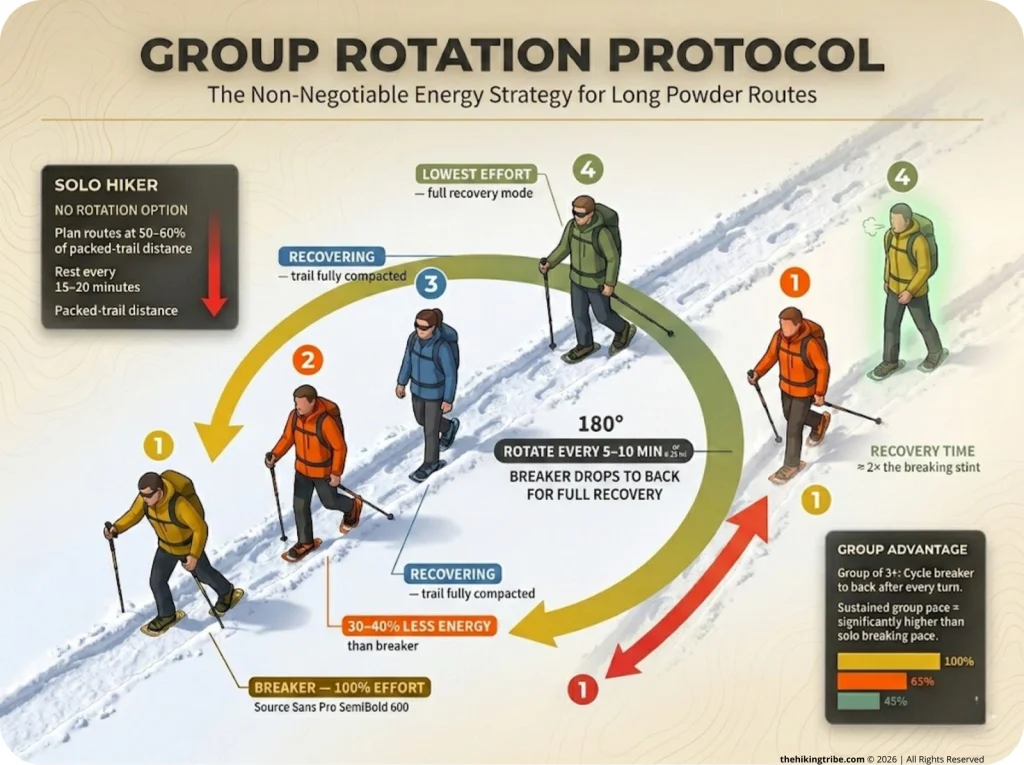
Group rotation is where teams consistently outperform solo hikers on long powder routes. Rotate the lead every 5–10 minutes or 0.25 mile in deep powder. The second hiker expends roughly 30–40% less energy than the breaker on identical terrain. For groups of three or more, cycle the breaker to the back of the line after their turn — full recovery takes approximately twice as long as the breaking stint. Solo hikers don’t have this option, which means planning routes at 50–60% of your packed-trail distance and building in rest breaks every 15–20 minutes.
How Pack Weight Compounds the Problem
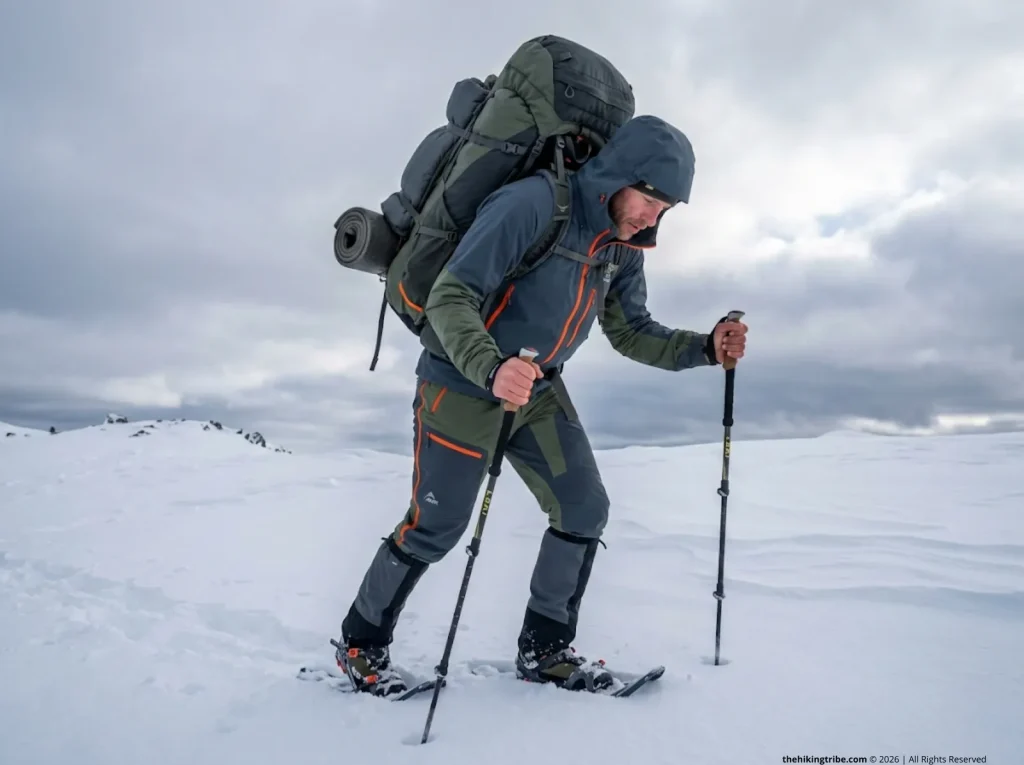
This is the part most articles skip entirely. On solid ground, a 25-pound pack adds roughly 15–20% to your energy expenditure. In deep snow, that same pack increases your sinking depth by 1–3 inches, and the effect compounds from there. Snowshoe flotation is calculated on total load — body weight plus pack plus gear. A snowshoe that handles a 160-pound hiker in a light daypack can become dangerously undersized when that same hiker straps on a 30-pound winter pack. If you’re planning an overnight, start by sizing snowshoes for your total loaded weight — not just your body weight on the bathroom scale.
The Sinking-Weight Multiplier
A 25-pound winter pack on powder may push your real energy increase to 30–50% above unloaded breaking. There’s no peer-reviewed study on this exact combination yet — it’s a genuine gap in the energy expenditure literature — but the physics and field consensus among experienced winter hikers point in the same direction. Expect your loaded effort to feel dramatically different from a day pack outing, and plan your pace and rotation intervals accordingly.
Multi-Day Energy Budgeting
The University of Minnesota Duluth winter camping nutrition guidelines put total daily caloric needs for active winter backcountry travel at 3,600–6,000+ calories per day. Cold forces your body to burn extra fuel just maintaining core temperature on top of the activity load. A multi-day winter trekker breaking trail with a loaded pack may genuinely need 4,500–5,000 kcal per day — roughly double what that same person burns on a summer backpacking trip. Under-fueling in cold with high energy output doesn’t just hurt performance. It raises hypothermia risk as your blood sugar drops and decision-making deteriorates well before you feel it.
Fueling for Sustained Trail-Breaking
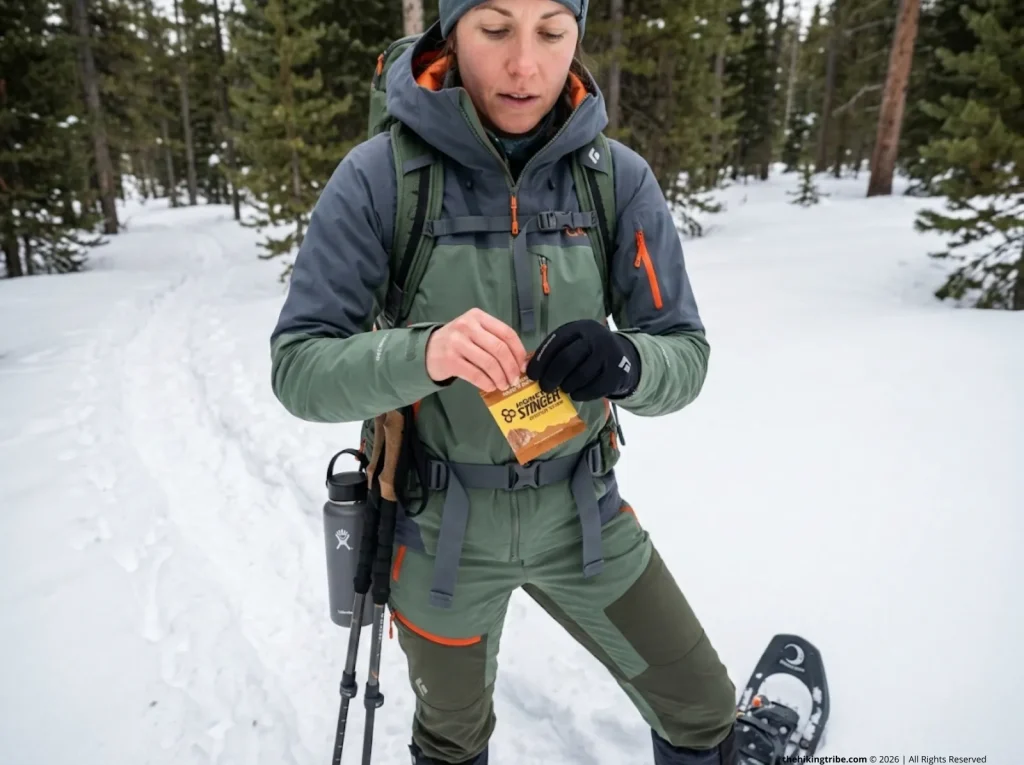
At 600–1,000+ kcal per hour, your glycogen stores deplete 2–3x faster than they would on a summer trail. Bonking — that sudden, heavy exhaustion when your blood sugar crashes — can hit within 90 minutes of active breaking without intentional fueling. The fix is simple but requires discipline: eat before you’re hungry, drink before you’re thirsty.
The 30-Minute Fueling Cycle
Eat 200–300 calories every 30 minutes during active trail-breaking. You want a mix of fast-acting carbohydrates for immediate energy and some fat for sustained burn. The best nutrition strategies for sub-freezing conditions prioritize foods that don’t freeze solid: nut butter packets, cheese in tortillas, energy chews, dark chocolate with nuts. Hard energy bars and many gels become rock-solid below 20°F — keep them in an inside pocket against your body if you rely on them.
Pro tip: Rotate the lead breaker on a food schedule, not just a distance schedule. The outgoing breaker eats and drinks during their recovery walk at the back of the group. After 5–10 minutes of rest and refueling, they’re ready for their next turn — and the rotation keeps moving.
Hydration in the Cold
Cold air suppresses your thirst response, but you’re losing significant water through heavy breathing and sweat under your layers. Target 0.5–1 liter per hour during active breaking — the same rate as vigorous summer hiking. Bladder hose lines freeze first, then bottle caps, then your motivation to drink at all. For winter hiking, insulated bottles and thermoses with warm liquids outperform any bladder system. A thermos of hot tea or broth provides hydration plus a small thermal boost that matters when you stop for breaks. For a full breakdown of preventing your water from freezing on winter trails, the solutions there go well beyond just wrapping your bottle in a sock.
Leave No Trace When You’re the First One Through
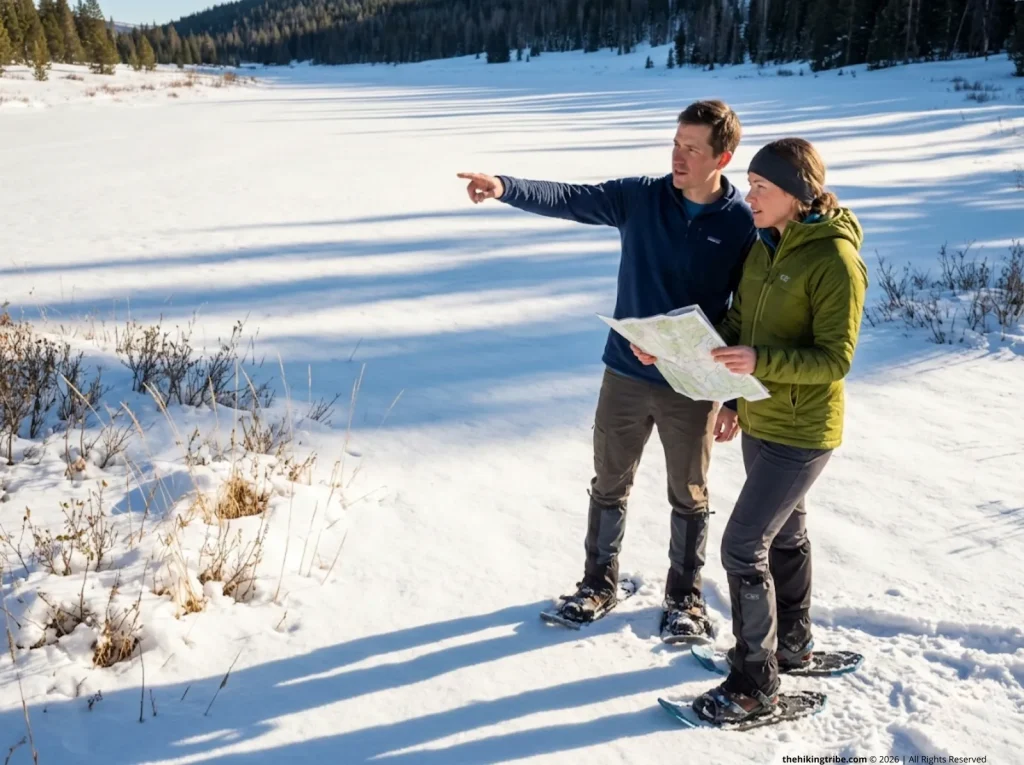
Your breaking trail track becomes the path of least resistance for everyone who follows you that day — and potentially that season. Where you route that track matters far more in winter than most snowshoers realize.
Concentrate or Disperse — The Winter LNT Decision
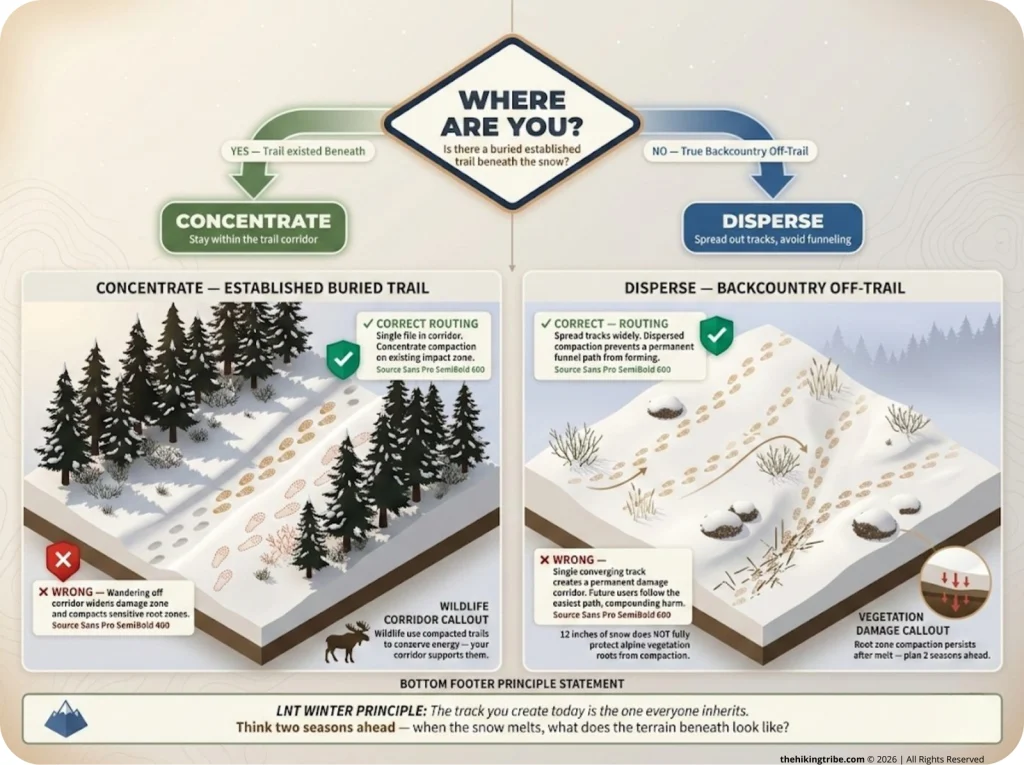
On a buried established trail, stay as close to the corridor as possible. Concentrate impact. Off-trail in backcountry snowshoeing zones, the opposite applies: disperse your track to avoid funneling future traffic into sensitive areas. Twelve inches of snow does not fully protect fragile alpine meadow vegetation from compaction. If you can see dried grass stalks or shrub tips poking through the snow, route around them. The LNT principle in winter is about thinking two seasons ahead — when that snow melts, what does the terrain underneath look like?
Respecting Other Users and Wildlife
Your broken track doesn’t just affect vegetation. Moose, deer, and snowshoe hare actively use existing compacted paths to conserve energy in winter. Breaking trail near known wildlife corridors can displace animals that depend on energy conservation for survival in cold months. Pack out everything — microtrash is highly visible against white snow, and cold temperatures slow decomposition dramatically. The track you create today is the one everyone else inherits.
Conclusion
Three things separate a controlled, rewarding powder day from a miserable survival march. First: understand that breaking trail in deep powder burns running-level calories at snowshoeing speeds — the landmark 2002 University of Vermont study proved that existing estimates are off by more than 50%, and your body doesn’t care about the calculator on your phone. Second: group rotation conserves energy — rotate the lead every 5–10 minutes, and your team’s sustainable distance effectively doubles. Third: fuel proactively at 200–300 calories every 30 minutes, because bonking in cold weather with a heavy winter pack is genuinely dangerous, not just uncomfortable.
Before your next powder day, share those three points with your group at the trailhead. Agree on a rotation interval, load your pockets with snacks that won’t freeze, and size your snowshoes for your total loaded weight. The gap between a great day and an epic suffer-fest is almost always about energy management, not how fit you are.
FAQ
How many calories do you burn snowshoeing per hour?
Snowshoeing burns between 420 and 1,000+ calories per hour depending on snow conditions, speed, terrain, and body weight. Breaking trail in unpacked snow sits at the high end — a MET value of 10.0, equivalent to running effort. On packed trails at a moderate pace, expect 420–600 kcal per hour.
Is snowshoeing better exercise than walking?
Yes — snowshoeing burns up to twice the calories of walking at the same speed. The Connolly study showed that snowshoeing at 2.95 mph on packed snow demands the same oxygen as treadmill walking at 4 mph. On untracked snow at trail-breaking pace, the gap is even wider.
How often should you rotate the lead when breaking trail?
Every 5–10 minutes or 0.25 mile in deep powder. The breaker expends 30–40% more energy than followers stepping into a broken track. Without rotation, fatigue sets in fast, and the group’s sustainable total distance drops significantly.
Do trekking poles help reduce energy expenditure when snowshoeing?
Poles don’t lower your total calorie burn — they actually increase it slightly by adding upper-body work. But they redistribute the load away from fatigued legs, improve balance in deep snow, and prevent falls when the leading foot catches unexpected resistance. For breaking trail, they’re non-negotiable.
How much extra food should I carry for winter snowshoeing?
Plan for 3,600–6,000+ calories per day on active winter days — roughly double a summer backpacking food budget. Center your nutrition strategies on foods that function below freezing: nut butter, cheese, chocolate, chews. Eat 200–300 calories every 30 minutes during active breaking to stay ahead of the deficit.
I've spent more than a decade researching hiking gear and trail technique. I read the specs, the forum threads and the long-term reviews, and every pick here comes with what it gets wrong.
End of the trail
You read every mile of this one. Here's where the trail goes next.