In this article
She was wearing tan gloves and a coyote-brown Mystery Ranch pack. She never heard the shot. The hunter said he thought the white flash of her glove was a deer’s tail flagging through the brush. That was Maine, 2019. She didn’t come home.
That one incident contains all five mistakes in this article, stacked on top of each other like a deck of bad bets. The terrifying part? Most technical hikers — the ones who can read topo maps and identify scat on the trail — never think about hunting season safety as a physics problem. They think about it as a calendar problem: know when it is, wear something orange, done. That’s wrong. And the gap between that assumption and reality is where people get hurt.
This guide breaks down five specific, preventable mistakes that place hikers in the ballistic path of hunters — using visibility science, acoustic physics, terrain ballistics, and the psychology of misidentification. By the end, you’ll have a working Backcountry Safety Matrix for navigating shared wilderness with real precision.
⚡ Quick Answer: The five most hazardous mistakes hikers make during hunting season are: wearing non-fluorescent orange (or no orange at all), positioning themselves on ridgelines with no ballistic backstop, wearing white or tan gear that mimics game animal coloring, moving silently through heavy timber without vocal alerts, and hiking during crepuscular hours on active public game land. Fix all five and your risk drops to near zero. Miss even one and you’re counting on a stranger’s trigger discipline to keep you safe.
Mistake #1: Treating Your Gear Color Like a Fashion Choice
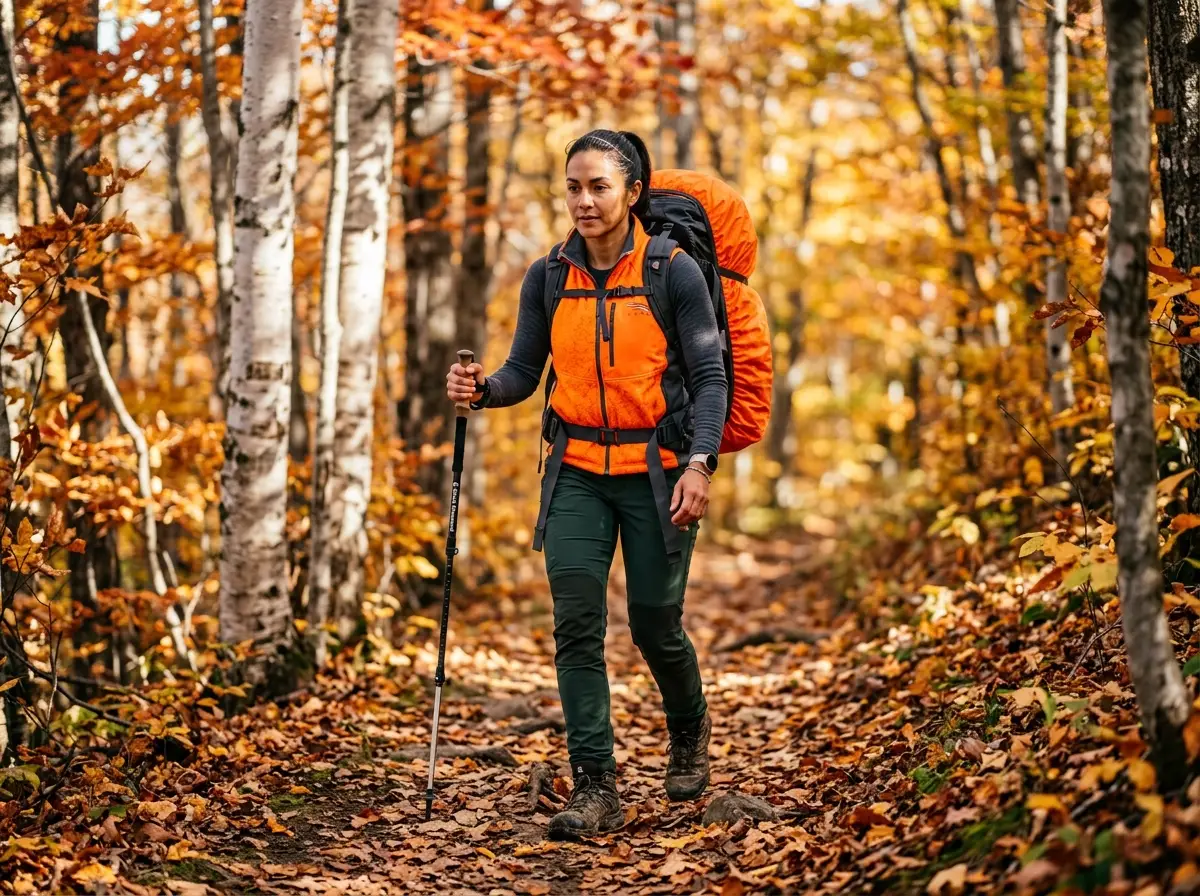
The technical hiking world has a color problem. Coyote brown, olive drab, desert sage — the gear industry pushed earth tones hard for a decade and we all bought in. On a normal summer trail, that’s fine. From October through December, that color palette is an active liability.
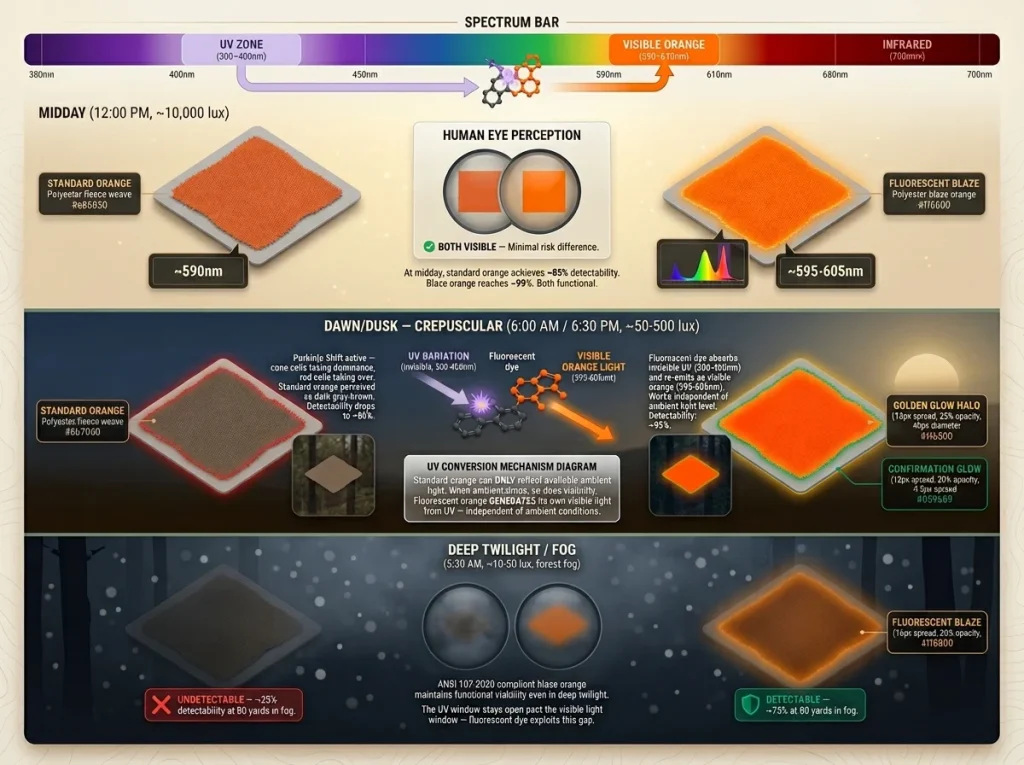
Here’s where the physics of visibility get specific: not all orange is the same. True fluorescent blaze orange operates on a completely different level, and what makes it different from standard orange is that fluorescent dyes absorb invisible ultraviolet light and re-emit it as visible orange light. The color doesn’t just reflect — it generates. That’s why it looks like it’s almost glowing in flat light.
The Purkinje Shift: Why Your Orange Hat Fails at Dawn and Dusk
Standard orange functions normally at noon. But at dawn and dusk — the crepuscular hours — it fails due to the Purkinje effect. As light levels drop, human vision shifts sensitivity, causing a bright afternoon orange to appear dark gray to a hunter at 6am.
Fluorescent blaze orange sidesteps this. Because it’s converting UV energy into visible light rather than just reflecting ambient light, it keeps popping even in crepuscular conditions. At 200 yards in fog, ANSI 107-compliant blaze orange hits around 95% human detectability. Standard red or orange tops out around 60% in the same conditions.
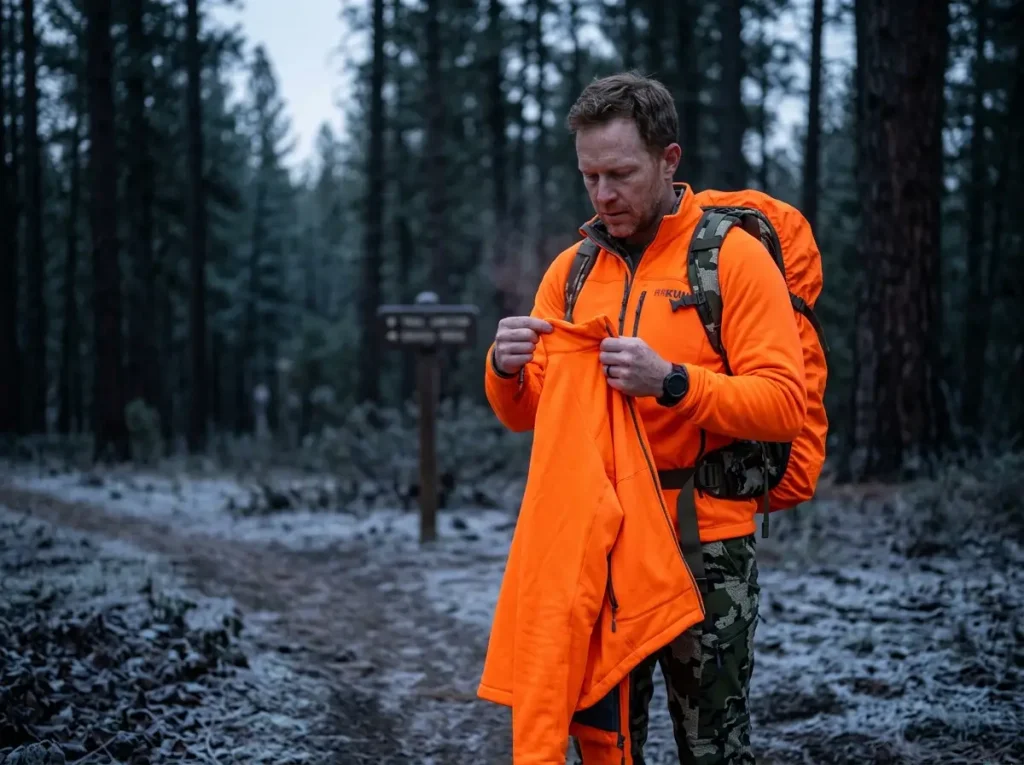
I tested a standard orange fleece next to a fluorescent blaze vest in a hemlock grove at 6am. At 80 yards, the fleece had turned the color of dried mud. The vest still stood out like a flare. Forty-three of 50 U.S. states require blaze orange for hunters during firearm season — most at a minimum of 250–500 square inches. Dress to at least that standard, even if you’re not hunting. Check the official hiking safety protocols during hunting season from the American Hiking Society before you head out.
Pro tip: Don’t stop at an orange hat. A hat covers maybe 40 square inches. An orange vest gets you 500. Do the math.
To maintain actual safety, you have to think beyond a single high-visibility item. Upgrading to a comprehensive visibility setup requires understanding how your loadout changes angles.
The 360-Degree Orange Rule
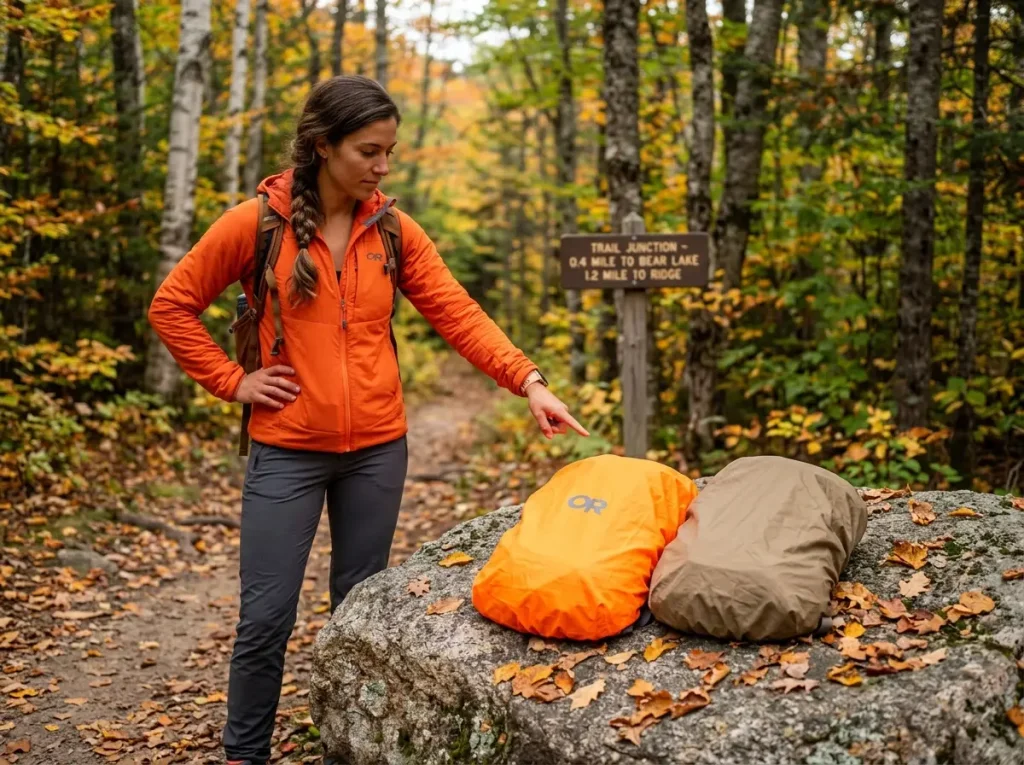
Here’s the thing guides never tell clients: your backpack is blocking your orange. A vest is visible from the front. Your pack covers everything from the rear — which is exactly the angle a hunter is looking at when you’re walking away from them. A blaze orange pack cover solves this. They weigh under four ounces, cost under $20, and they’re the highest value-to-weight safety purchase available for fall hiking. Look for pack cover selection for visibility and weather protection to find a cover that works for your specific setup.
360-degree visibility is the standard. Pennsylvania and Georgia explicitly require it for hunters — there’s no reason hikers should settle for less.
The UV Brightener Trap
Deer lack the yellow pigment filter that humans have in our lenses — the one that blocks ultraviolet light. Because of that, deer perceive UV light as a vivid, glowing blue. Standard laundry detergents contain optical brighteners that cling to fabric fibers and emit UV, which means your hiking vest is potentially glowing blue to every deer within range.
Wash your blaze orange gear in UV-free detergents like Sport-Wash or Atsko’s products to avoid appearing as a glowing alarm. This prevents spooking game and keeps hunters from misidentifying your movement.
Mistake #2: Not Understanding Ballistic Physics in Your Terrain
Most hikers model bullets as aimed things. Point A to target, end of story. That’s wrong, and that mental model will get you injured causing lasting harm.
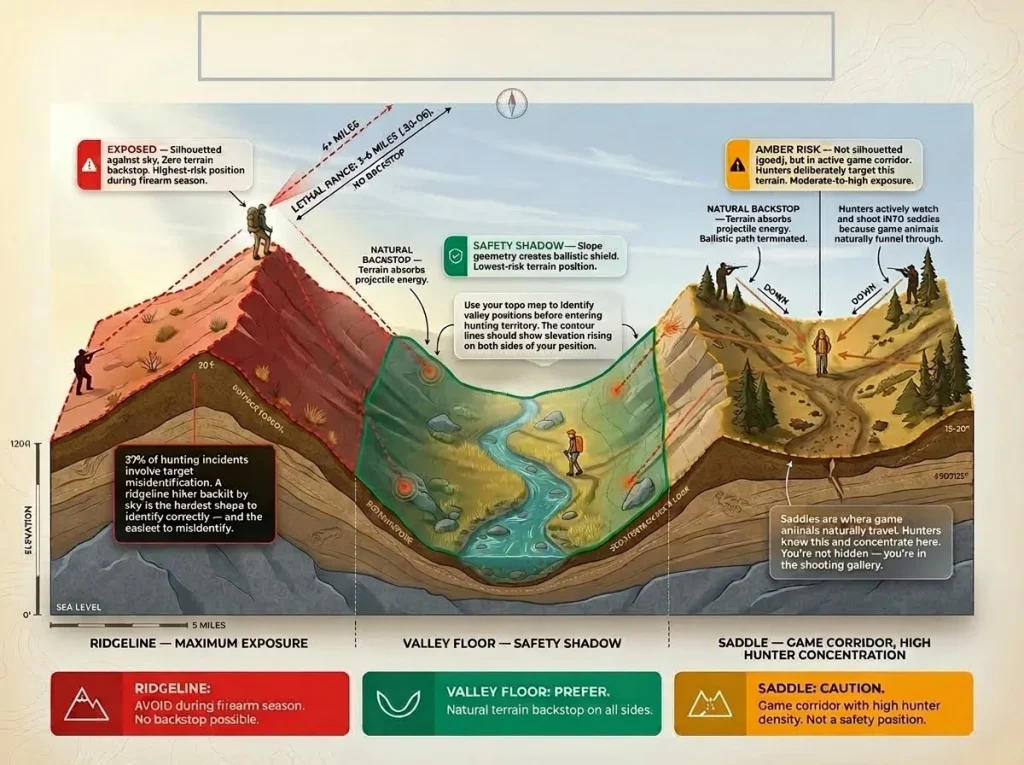
A bullet doesn’t stop when it passes its intended target. It keeps going until it strikes a solid backstop or loses velocity through drag and gravity. A .30-06 centerfire round — the most common hunting firearm cartridge in North America — can maintain lethal energy for 3 to 6 miles. A .22 rimfire travels 1.5 miles. Even birdshot carries 200–350 yards. In a scenario where a hunter is tracking a moving animal and fires as it crosses a ridgeline, the round that misses continues its trajectory into whatever watershed lies behind his position. If you’re on the ridgeline, that’s you.
The Lethal Range Every Hiker Underestimates
The Appalachian Trail hunting regulations and blaze orange requirements page notes a protected corridor of just 1,000 feet on each side. That narrow strip is your only protection, assuming you stay perfectly on the trail.
“Swinging on game” is one of the leading causes of misidentification-related accidents. Target misidentification accounts for 37% of hunting incidents nationally. Being in the wrong terrain position puts you in the path of those statistics.
Pro tip: Stay on the trail centerline in active hunting areas. Stepping off to take a shortcut puts you in timber where hunters have sightlines — and no one knows you’re there.
Once you acknowledge that projectiles travel farther than expected, you have to actively position yourself to mitigate that exposure.
Safety Shadows — Using Topography as a Natural Berm
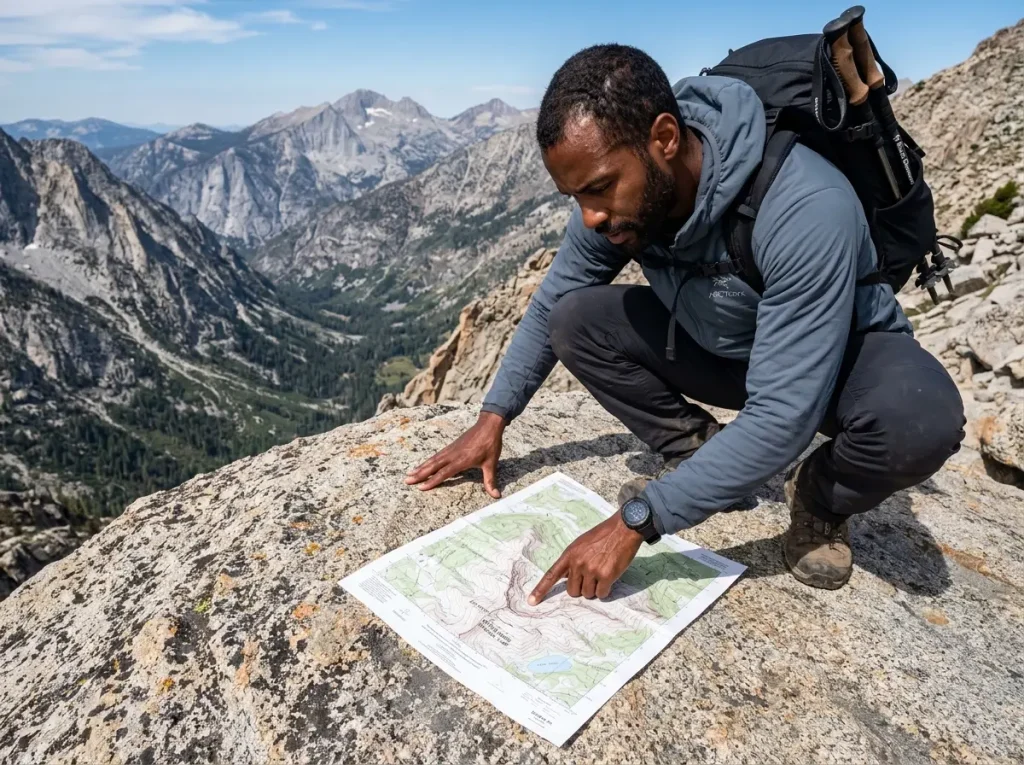
This is what no competitor article explains: you can use topo maps to find positions where a bullet physically cannot reach you. I call these safety shadows — topographic positions where terrain geometry creates a natural backstop between you and likely hunter positions.
Ridgelines are the worst place to be during firearm season. You’re silhouetted against the sky with zero backstop behind you. A missed shot travels miles into the next watershed. A valley floor with 30-degree slopes on both sides is the opposite — the terrain itself acts as a berm. Saddles are ambiguous, but hazardous: they’re natural game corridors with high hunter concentration.
For a deeper look at reading contour lines to identify terrain shielding, the illustrated guide will walk you through it in detail.
Mistake #3: Wearing Colors That Look Like Game
The Tan Pack Fallacy
Here’s the psychology behind why this is so hazardous: pareidolia. A hunter who has been sitting motionless in 35-degree weather for six hours has a brain primed to complete familiar shapes. Show that visual system a patch of moving tan at waist height in an earth-tone environment and it fills in the rest — deer flank, hip, quarter, shot. The conscious evaluation is slower than the pattern recognition. This is a human visual system doing exactly what it evolved to do.
According to Massachusetts safety tips for non-hunters, the behavioral guidance for avoiding misidentification is straightforward: don’t match the visual profile of game animals. Colors to avoid during firearm season: white (deer tail), tan and coyote brown (deer flank), dark brown (elk body), and gray (winter deer coat). For a broader framework on rescue-grade visibility color selection by terrain type, the visibility matrix covers which colors maximize human detectability across different background types.
The positive case: blaze orange and blaze pink (legally recognized in some states) are the only colors with no game animal match in the North American forest palette. Either one works. Black is technically safe — no game animal is solid black — but it doesn’t help you get spotted by hunters at distance. Pick orange.
While matching the body color of game animals is a massive risk, wearing colors that mimic their alarm signals creates an entirely different hazard.
White, Gray, and the Tail Flag Problem
The Maine incident with the woman in the white gloves didn’t happen because the hunter was irresponsible. It happened because a white-tailed deer’s alarm flag — the raised tail as it flees — is one of the most powerful visual triggers in a hunter’s trained perception. White objects moving in the woods register as high-priority targets at a deep pattern-matching level that bypasses deliberate thought.
Practical applications: no white gloves, no white handkerchiefs, no light gray rain jackets, no white fleeces during firearm season. If you hike with dogs, this extends to them. A yellow lab or golden retriever moving at knee height through brush is a near-perfect game animal silhouette. Ruffwear makes orange pack saddles specifically for this reason — use one.
Pro tip: If your dog is white or cream-coated, outfit them with a blaze orange bandana or vest before entering any area with active hunting. This is not optional if you care about your dog coming home.
Mistake #4: Making the Wrong Sounds (Or No Sound at All)
The stealth hiking culture has a dark side in fall. Approach shoes, soft footfalls, minimal talking — every move optimized for silence. Between June and September, that’s good trail etiquette. During firearm season, it’s a liability.
A hunter who can’t hear you coming has no chance to identify you before they decide whether to shoot.
The 6dB Decay Law and Why Dense Timber Swallows Your Whistle
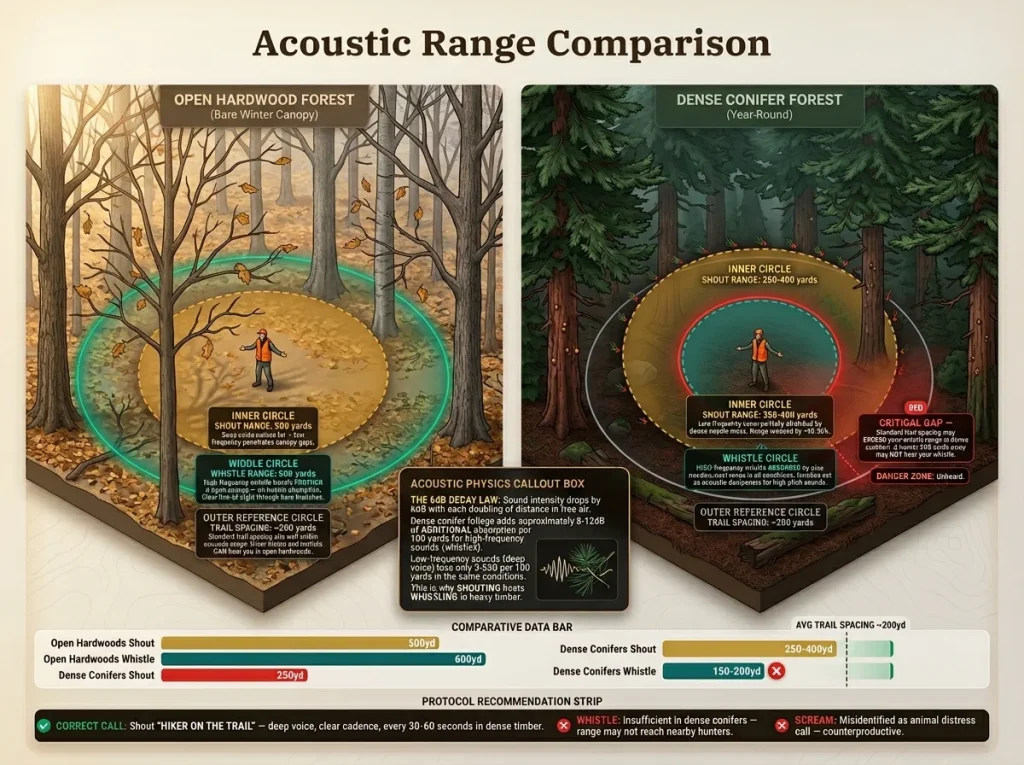
Sound doesn’t travel the same distance in all forests. Sound gets swallowed up fast. In dense pine forests, needles and branches act like a sponge, crushing the range of any noise you make. The peer-reviewed noise attenuation data across forest land-cover types documents exactly this — dense conifers absorb sound dramatically faster than open hardwoods.
High-frequency sounds like a safety whistle are absorbed by pine needles and leaves much faster than low-frequency sounds like a human voice . In dense timber, a whistle blast carries 150–200 yards. A deep-voiced shout carries 250–400 yards in the same trees. An open hardwood forest with bare winter canopy is different — the shout range opens to around 500 yards, whistle to 600.
Most hikers assume their sternum strap whistle is omnidirectional and works at any range. For the actual field performance data on the real-world decibel limits of sternum strap whistles, the range numbers might surprise you.
The “Speak Clearly” Protocol
When you hear shots or know hunters are nearby, the protocol matters. Whistle: no. The sound pattern overlaps bird calls in most regions and won’t register as human. Screaming: no. Distress vocalizations overlap animal sounds — deer in distress, elk calls, foxes. Both of these responses are wrong about the tool.
I used to carry a maritime whistle thinking it was the ultimate fail-safe, until I tried testing it with my hiking partner in heavy timber and realized he couldn’t hear me past a few hundred feet.
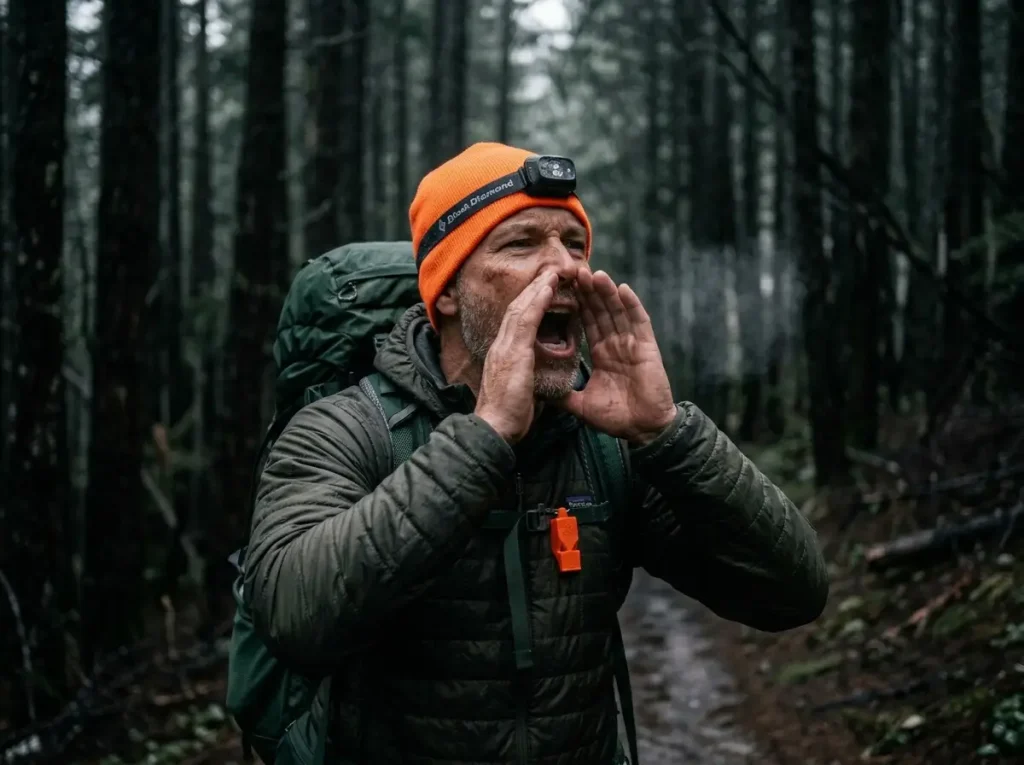
The correct call: shout “HIKER ON THE TRAIL” in a clear, deep voice. That phrase has a specific three-syllable, two-word cadence that doesn’t exist anywhere in the non-human sound library of the forest. Repeat it every 30–60 seconds when you’re moving through dense timber or changing direction.
Mistake #5: Ignoring the Timing and Land-Access Matrix
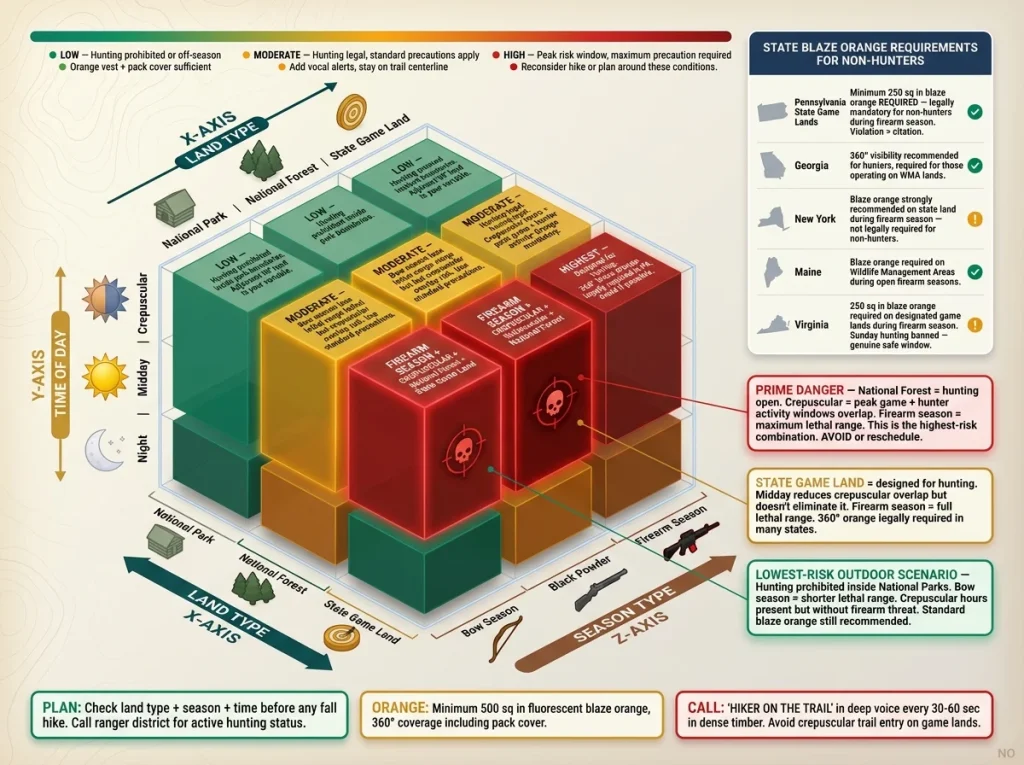
“Just check if hunting is allowed” is incomplete advice. The full picture requires knowing the land type, the season type, the time of day, and the state regulations — because those variables combine to create your actual exposure level.
The Crepuscular Window
Crepuscular hours — the 30 minutes before sunrise and after sunset — are peak activity windows for game animals, which means they’re peak alertness windows for hunters. Both the Purkinje Shift for orange visibility and the pareidolia risk for tan gear hit their maximum at exactly these times. Dawn entry to a trailhead is the single highest-risk moment of a fall hike. Parking in a hunter-access lot before first light and walking in is how most hiker-hunter proximity incidents begin.
Bow season vs. firearm season matters: bow season generally runs September–October; firearm season for deer, elk, and bear concentrates peak risk from mid-October through December, with variation by state. Sunday hunting bans in Pennsylvania, Virginia, and several New England states create genuine safe windows that most hikers don’t know exist. That planning step — checking pre-trip intelligence protocol for hunting season trail research — takes five minutes and removes an entire risk variable.
Beyond just planning the right time of day to hit the trail, identifying exactly who owns the land dictates the ground rules you need to follow.
Public Game Land vs. National Parks
The land type distinction is the one hikers get most wrong. Here’s where your exposure actually sits:
National Parks generally prohibit hunting within boundaries. But most national parks are adjacent to national forests where hunting is legal, and trail corridors frequently cross jurisdictional lines that are not marked on the ground. You can step across an invisible boundary from a no-hunt zone into an active hunting zone without seeing a sign.
National Forests are open to hunting unless posted otherwise. This includes major hiking corridors — Allegheny NF, Chattahoochee NF, Shoshone NF. If you’re hiking in a national forest in October and haven’t checked, assume hunting is active in the area. The U.S. Forest Service hunting access and Know Before You Go protocols spell out exactly what access rights apply to which lands.
State Game Lands are designed for hunting. Hikers are guests. Blaze orange is often legally required for non-hunters on these lands, and in Pennsylvania, non-compliance is a punishable offense. The Appalachian Trail’s protected corridor is 1,000 feet wide on each side — far narrower than most hikers picture — and trail relocations routinely cut through active game lands.
Research protocol: call the local ranger district directly, not a general NPS or NFS hotline. Ask: “Is hunting active in [specific area] during [specific dates]?” Do this before any fall backcountry trip. And share that information with your emergency contact using a trip plan protocol that includes hunting season exposure alerts.
Pro tip: “I checked the website” is not the same as calling the ranger district. Websites are often out of date during special seasons and early-season adjustments. A two-minute phone call is worth more than twenty minutes of online research.
The Short Version Before You Hit the Trail
Three things to lock in before October:
Visibility is physics. Fluorescent blaze orange at 595–605nm is the only color that survives the Purkinje Shift in low light. Cover yourself 360 degrees — vest, pack cover, hat — and wash that gear in UV-free detergent. If you’re bringing your dog, orange them too.
Terrain decides your exposure. Ridgelines during firearm season are hazardous. Use your topo map to find safety shadows — positions where the slope geometry puts solid earth between you and any hunting area. Stay off the skyline.
Sound and timing are decisions, not afterthoughts. Shout “Hiker on the trail” in heavy timber every 30–60 seconds. Avoid dawn and dusk entry on active game lands. Know whether you’re in a National Park, National Forest, or State Game Land — the legal hunting status of those lands changes your actual risk level entirely.
Before your next fall hike, pull your topo map and run one check: is there a ridgeline in your route where you’d be silhouetted against the sky during the first or last hour of daylight? If yes, find an alternative line or adjust your schedule. That five-minute planning step is the difference between a clean summit day and a story that starts the way this one did.
FAQ
Do hikers have to wear blaze orange during hunting season?
It depends on the state and land type. Non-hunters are legally required to wear a minimum of 250 square inches of blaze orange on Pennsylvania State Game Lands during specific firearm seasons. Most other states strongly recommend it for non-hunters but don’t mandate it — with exceptions in certain State Game Land designations. Always check the specific state DNR or wildlife commission requirements for the exact area you’re hiking before you go.
Is it safe to hike during deer season?
Yes, with the right approach. Statistical risk is low on maintained trails in National Parks. It rises significantly in National Forests and State Game Lands during firearm season, especially during crepuscular hours. Wearing 360-degree fluorescent blaze orange, avoiding dawn and dusk entry on game lands, and staying on the trail centerline brings exposure down to an acceptable level for most terrain.
What colors should you NOT wear hiking during hunting season?
Avoid white — it matches a deer’s tail flag. Avoid tan and coyote brown — they match elk and deer flanks. Avoid dark gray — it matches winter deer coats. Avoid olive and earth tones in general. The only safe neutral is solid black, which has no game animal color match in North American forests. The positive list: fluorescent blaze orange, blaze pink (legal in some states), and any high-contrast fluorescent color above 500nm.
Can I hike with my dog during hunting season?
Yes, but your dog needs orange too. A yellow lab, golden retriever, or white-coated dog moving at knee height through brush matches a deer silhouette at range. Use an orange pack saddle (Ruffwear makes them), an orange vest specific to dogs, or tie a blaze orange bandana on. Keep dogs on leash in active hunting areas — a dog running off-trail into a hunting setup is a serious risk scenario that develops faster than you can call them back.
What should I do if I hear a shot near me on the trail?
Stop moving immediately. In a clear, deep voice, shout HIKER ON THE TRAIL — loudly and repeatedly. Don’t whistle (the sound pattern reads as a bird call). Don’t scream (reads as a prey animal in distress). Step into a clearing if one is accessible and make your orange gear visible. Stay stationary until the shooting stops or you’ve made direct human contact with the hunter.
Risk Disclaimer: Hiking, trekking, backpacking, and all related outdoor activities involve inherent
risks which may result in serious injury, illness, or death. The information provided on The Hiking Tribe is for
educational and informational purposes only. While we strive for accuracy, information on trails, gear, techniques,
and safety is not a substitute for your own best judgment and thorough preparation. Trail conditions, weather, and
other environmental factors change rapidly and may differ from what is described on this site. Always check with
official sources like park services for the most current alerts and conditions. Never undertake a hike beyond your
abilities and always be prepared for the unexpected. By using this website, you agree that you are solely
responsible for your own safety. Any reliance you place on our content is strictly at your own risk, and you assume
all liability for your actions and decisions in the outdoors. The Hiking Tribe and its authors will not be held
liable for any injury, damage, or loss sustained in connection with the use of the information herein.
Affiliate Disclosure: We are a participant in the Amazon Services LLC Associates Program, an
affiliate advertising program designed to provide a means for us to earn advertising fees by advertising and linking
to Amazon.com. As an Amazon Associate, we earn from qualifying purchases. We are also an official affiliate partner
of Black Diamond Equipment via the AvantLink network. If you click on a Black Diamond affiliate link and make a
purchase, we may earn a commission at no additional cost to you. We also participate in other affiliate programs and
may receive a commission on products purchased through our links. Additional terms are found in the terms of
service.