In this article
Last summer on a ridge above Lake Chelan, I watched a search helicopter fly directly over a group of stranded hikers three times before spotting them. The hikers had been yelling for over an hour. Their voices were gone. The helicopter crew never heard a thing.
The fourth pass, someone in the group pulled out a signal mirror. One flash — one deliberate, aimed flash — and the pilot banked hard. Rescue was on the ground in twelve minutes.
Two pieces of gear made the difference that day. A signal mirror that weighs less than two ounces. A pea-less whistle that costs about eight dollars. Together, they weigh less than a granola bar, take up less space than a pack of gum, and outperform the human voice by a factor that would embarrass most survival gadgets on the market.
This guide breaks down exactly how to use both, when each one works best, and the specific signaling for rescue techniques that separate a hiker who gets found from one who keeps waiting.
⚡ Quick Answer: Three short whistle blasts repeated every 30 to 60 seconds is the universal hiking distress signal. A signal mirror aimed using the V-finger method can reach rescuers up to 50 miles away in direct sunlight. Carry both. The whistle works when the mirror fails (fog, night, dense forest), and the mirror reaches distances your voice never will.
Why Your Voice Fails When You Need It Most
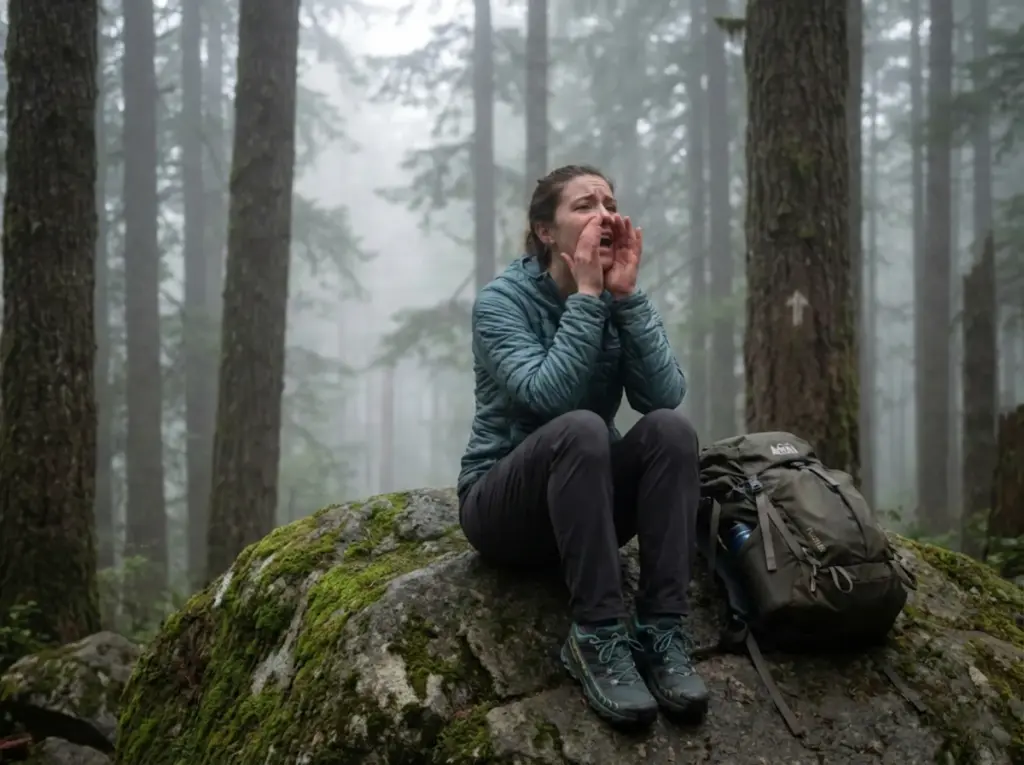
Here is a number most hikers never think about: the human voice maxes out at roughly 200 meters in open terrain. Add trees, wind, or a canyon wall, and that range drops to almost nothing. A rescue whistle carries over a mile and a half.
The gap gets worse under stress. After 30 to 60 minutes of sustained shouting, most people lose their voice entirely. You are burning calories, dehydrating your throat, and exhausting respiratory muscles you need for warmth and movement. Meanwhile, a single whistle blast demands about the same effort as breathing through a straw.
But the physical limitations are only half the problem. When adrenaline and cortisol flood your system during a genuine emergency, your brain narrows. Fine motor skills deteriorate. Complex decision-making slows. Search and rescue professionals call this “cognitive freeze,” and they report finding subjects who had signaling tools in their packs but never pulled them out because panic shut down their ability to act.
This is why SAR experts teach the STOPA protocol before anything else. Sit down. Take a breath. Observe your surroundings and inventory your gear. Plan which signal is most effective for your terrain and time of day. Then act. That five-step reset takes about 90 seconds, and it is the difference between a disciplined signal pattern and 30 minutes of screaming into wind that carries your voice nowhere.
The science behind whistle frequency matters here too. Human voice frequencies scatter against foliage and water droplets. A whistle operating at 3,000 to 4,000 Hz produces shorter wavelengths that diffract around obstacles — trees, boulders, fog. This is why a pea-less whistle cuts through dense forest where your voice dies three trees deep.
Being prepared to signal starts with being prepared to handle the emergency itself. Our guide on wilderness first aid and emergency preparedness covers the immediate response steps that keep you alive long enough for signaling to work.
Pro tip: Practice the STOPA protocol at home until it becomes automatic. Under genuine survival stress, you will not remember something you read once — you will revert to whatever behavior you have trained into muscle memory.
The Signal Mirror — 50 Miles of Reach in Your Pocket
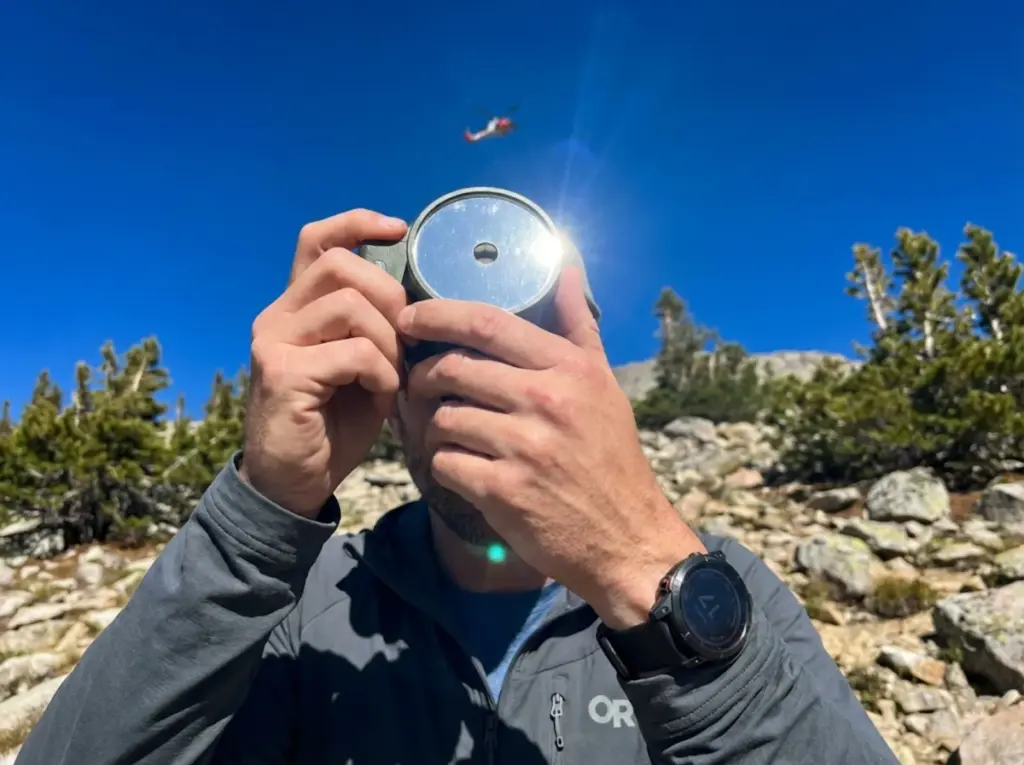
A purpose-built signal mirror can produce a flash visible to aircraft up to 50 miles away. During World War II, downed pilots were spotted at distances exceeding 100 miles using nothing more than a polished glass mirror and sunlight. Pound for pound, no other passive signaling device comes close.
Not all mirrors perform equally. A laminated glass mirror reflects nearly 100 percent of incoming light and produces the tightest, brightest beam. Acrylic mirrors hit roughly 80 to 90 percent reflectivity but resist shattering, making them a better choice for rough packing. Polished metal surfaces drop to 60 to 70 percent. Your phone screen or a CD? Around 30 to 50 percent on a good day, with a fraction of the range.
The real differentiator is the sighting system. A mirror with a retroreflective grid and a central aperture outperforms a standard compact mirror by roughly 2.5 times in target acquisition accuracy. The grid works by allowing a tiny amount of sunlight through a mesh on the back of the mirror. That light reflects off your face and shines back through the aperture, creating a bright dot — the “fireball” — that shows you exactly where your main beam is hitting. You do not have to guess. You can see it.
V-Finger Aiming — The Technique That Works with Any Reflective Surface
This method works with any mirror, including improvised ones. Hold the mirror close to your dominant eye. Extend your free hand toward the target — a helicopter, a distant ridgeline where you spotted movement, a clearing — and form a V with your index and middle fingers. Tilt the mirror until you see the reflected sunlight land on your fingers. Then slowly raise your aim until the flash walks up from your hand and onto the target.
The key mistake most people make is sweeping the mirror in wide arcs. That scatters the beam across the entire sky and gives any observer a split-second flash that looks like random glint off water or rock. Instead, hold the flash steady on your target for two to three seconds, then dip the mirror to create a deliberate on-off pattern. Rescuers are trained to distinguish this from natural reflections.
The Retroreflective Grid — How Military-Spec Mirrors Lock On Target
The MK-3 signal mirror (MIL-M-18371E specification) is the standard issue for military survival kits for a reason. The laminated glass face with an embedded retroreflective mesh gives you a visible reference point even when you cannot see the reflected beam on a distant target. You look through the sighting hole, find the bright dot the grid produces, and overlay it on your target.
The physics are simple — the mesh bounces incoming light back along the same path it arrived — but the result is a precision aim that works at distances where the V-finger method starts losing accuracy.
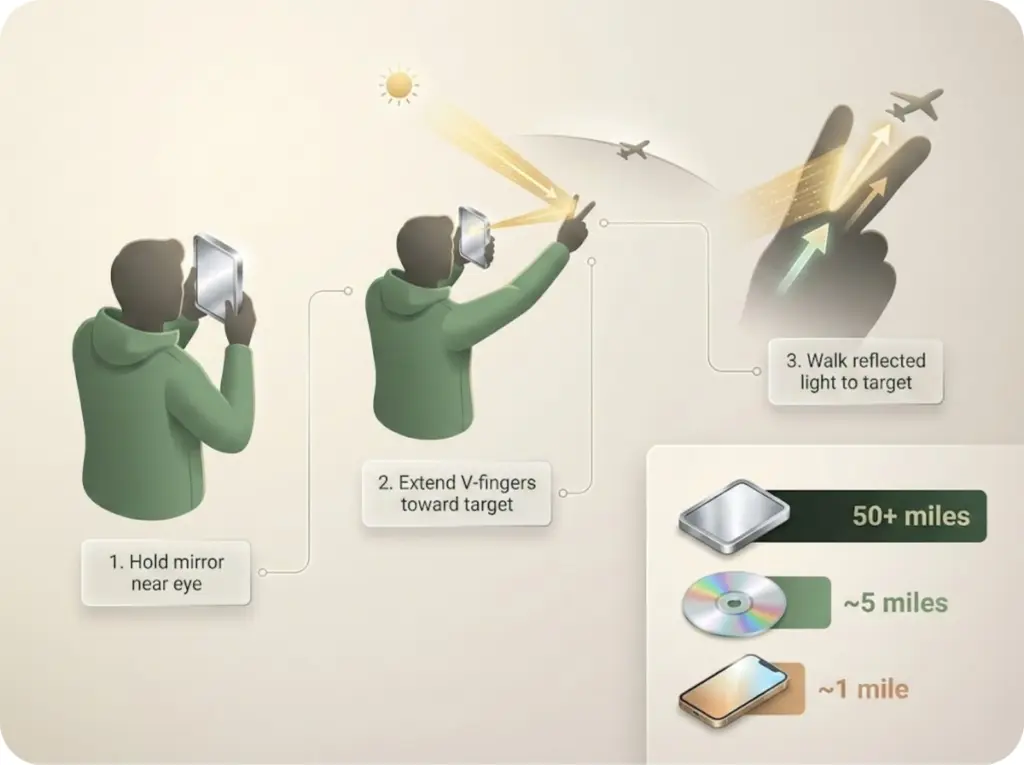
When to reach for the mirror: open terrain, ridgelines, anywhere with direct sunlight and a potential observer. When the sun drops behind clouds or you are under dense canopy, put the mirror away and switch to your whistle or a headlamp strobe.
Visibility is a two-way street. If rescuers cannot distinguish you from the terrain, even a good signal flash can go unnoticed. Our breakdown of high visibility colors for rescue safety explains which colors pop against different terrain types and why blaze orange is not always the best choice.
The Rescue Whistle — Three Blasts That Trigger a Search Response
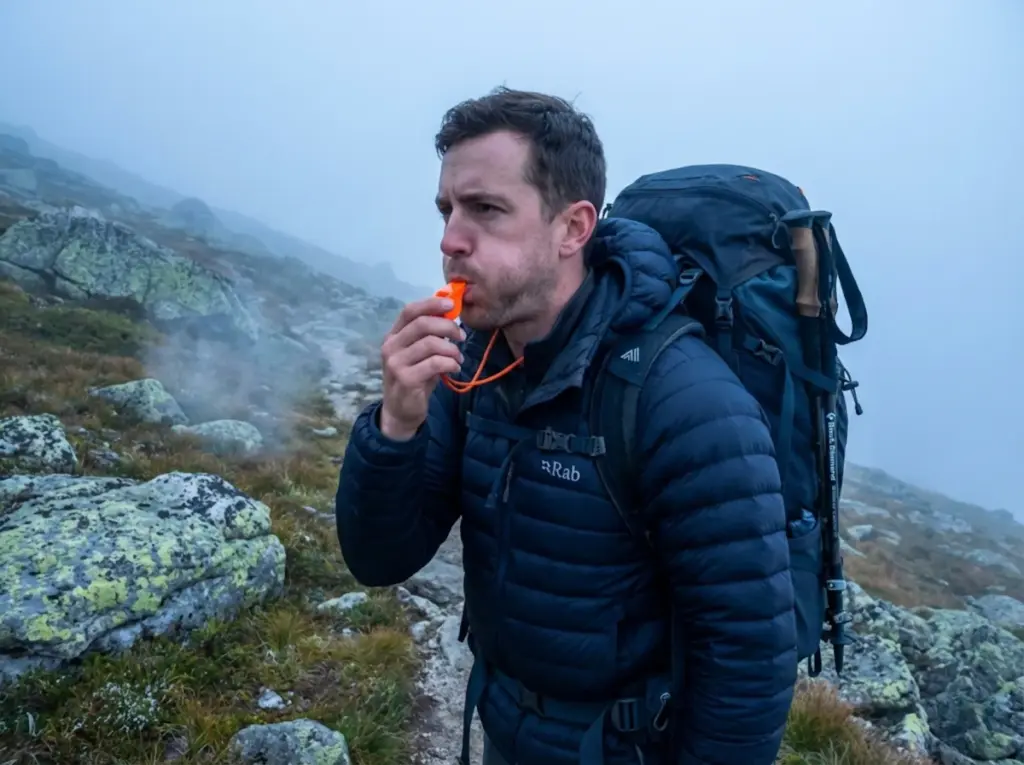
Three short whistle blasts repeated every 30 to 60 seconds. That is the universal distress signal recognized by search and rescue teams across North America. Three of anything — blasts, flashes, fires — means distress. The Rule of Three has been the international standard for decades because it is simple enough to remember under the worst conditions your brain will ever face.
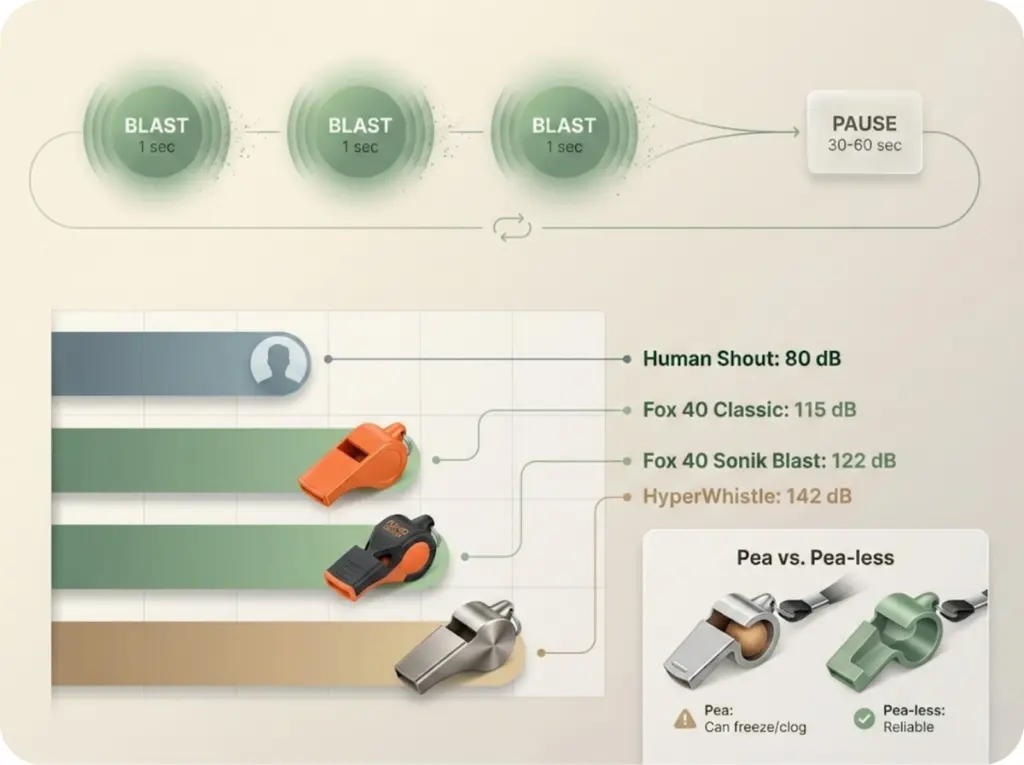
The numbers behind whistle performance tell the story. A human shout produces roughly 80 decibels. A Fox 40 Classic whistle hits 115 dB. The Fox 40 Sonik Blast pushes 122 dB. The HyperWhistle reaches a verified 142 dB. Because decibels are logarithmic, that difference between your voice and a Sonik Blast is not a gentle increase — it is roughly 50 times louder in perceived volume.
High-pitched sounds in the 3,000 to 4,000 Hz range also carry better through fog, wind, and rain. The shorter wavelengths diffract around water droplets in the air rather than being absorbed the way lower-frequency voice sounds are. This is not marketing language from whistle manufacturers. It is acoustic physics, and it is why every alpine rescue team I have spoken with carries pea-less whistles rated above 100 dB regardless of conditions.
The Three-Blast Protocol — Timing, Rhythm, and Response
The pattern: three sharp blasts, each roughly one second long, followed by a 30 to 60 second pause. Then repeat. Do not blow continuously — that wastes air and makes it harder for rescuers to determine your direction.
When a search team hears your signal, they respond with two blasts. That means “we hear you.” At that point, switch from the repeating pattern to directional bursts — short blasts every 10 to 15 seconds — that help the team home in on your position through the terrain.
In Europe, the alpine distress signal is six blasts per minute rather than three. If you hike internationally, learn both patterns. The principle remains the same — a repeated, rhythmic signal that cannot be mistaken for natural sounds.
Pea-less vs. Pea — Why Your Whistle Design Matters at Altitude
A pea whistle like the ACME Thunderer contains a small ball inside the chamber that creates a trilling sound. In dry, warm conditions, it works fine. Take it above treeline in freezing rain, and the moisture from your breath condenses on the pea and freezes it to the chamber wall. Your whistle becomes a silent plastic tube at the exact moment you need it most.
Pea-less whistles use air-flow resonance chambers with no moving parts. The Fox 40 design is self-clearing — blow water through it, and it keeps working. Submerge it completely, shake it once, and it sounds identical to one that has been sitting dry in your pocket. That reliability is why SAR teams, the Red Cross, and the Coast Guard all standardized on pea-less designs.
Buckle-integrated whistles are a gamble. They tend to produce lower decibel output, and under stress, fumbling with your sternum buckle to find the whistle eats precious seconds. We tested a handful of sternum strap whistles and the results were not great — our piece on emergency whistles and sternum straps has the full decibel data and why redundancy matters.
How to Signal When You Can Barely Breathe
Most signaling guides assume you are healthy and at full lung capacity. If you have cracked ribs from a fall, altitude sickness that has restricted your breathing, or exercise-induced asthma, standard whistle technique may fail.
The pursed-lip breathing method helps. Exhale slowly through pursed lips to build air speed before delivering short, controlled bursts into the whistle. Think of blowing out a candle from three feet away — that same lip shape concentrates airflow. The “hollow cheeks” technique maximizes air pressure with minimal lung effort by pulling your cheeks inward as you blow.
Sit upright if possible. Even leaning against a rock at a 45-degree angle improves diaphragm expansion compared to lying flat. Position the whistle on a lanyard short enough that it rests against your chest so you never have to reach for it.
Building Your Signaling System — The Layered Approach
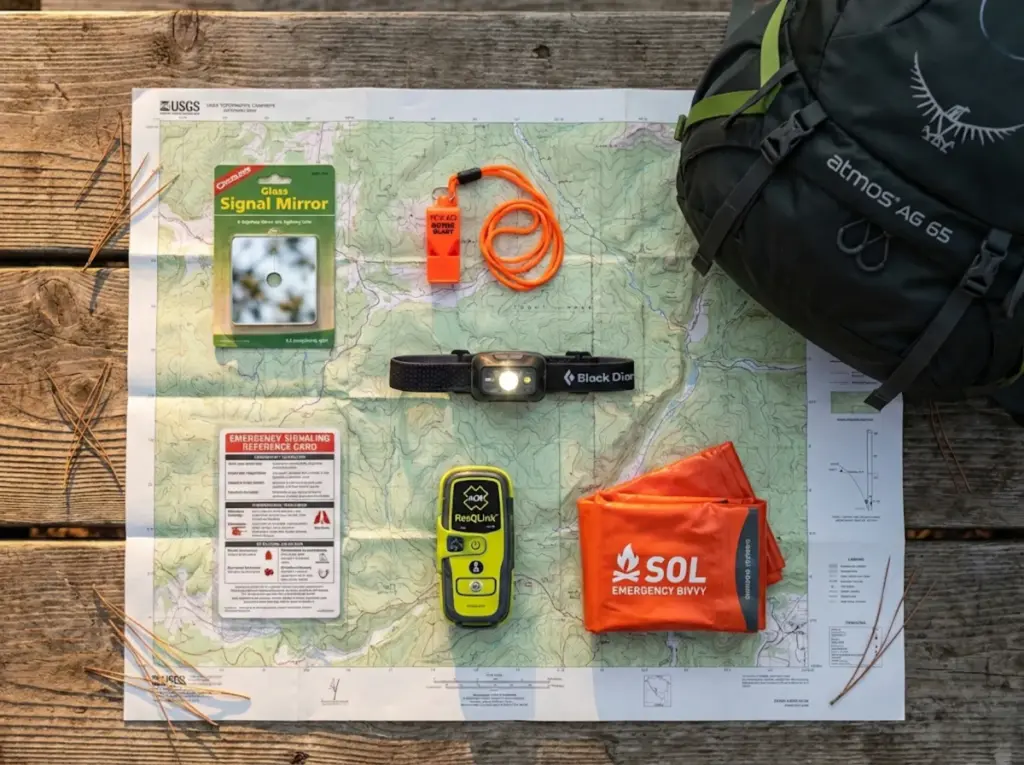
No single signal method works in every scenario. A mirror is useless at night. A whistle gets swallowed by rotor noise from a helicopter a quarter mile away. Ground signals do nothing if no aircraft are searching your area. The hikers who get found are the ones who layer their signals — primary, secondary, and tertiary methods selected for the specific conditions they are facing.
Here is the matrix I use when teaching signaling courses:
Open country with sunshine — signal mirror primary, whistle secondary, ground symbols (a large X made from contrasting materials, minimum 10 to 12 feet across) tertiary. Dense forest during daytime — whistle primary, smoke signal from a signal fire secondary, bright gear draped on vegetation tertiary. Alpine terrain in fog — pea-less whistle primary, headlamp strobe secondary, movement with bright clothing tertiary. Night in any terrain — headlamp strobe or flashlight primary, whistle secondary, fire or chemical light sticks tertiary.
How Digital Beacons and Analog Signals Work Together
A personal locator beacon like the ACR ResQLink sends your GPS coordinates to the SARSAT satellite network. A satellite messenger like the Garmin inReach or SPOT sends coordinates and allows two-way text messaging. Both solve the “where are you” problem at a continental scale.
Neither solves the “final mile” problem. Once a search team arrives in your general area, they still need to locate you among trees, boulders, and terrain folds. Your whistle and mirror close that gap. The PLB tells them which drainage you are in. Your three whistle blasts tell them which side of the boulder field you are sitting behind.
Carry both categories. A digital beacon is the “where.” Your analog tools are the “right here.”
Signaling When You Cannot Move — Techniques for Injured Hikers
If a fall or injury has left you immobilized, prioritize passive signals immediately. Drape a bright orange emergency blanket or jacket over the nearest rock or bush where it can catch light and attract attention even if you lose consciousness. This creates a visual signal that works without you.
Pre-position your whistle on a short lanyard around your neck before every hike. If you go down, it is already within reach. The V-finger method for your mirror works while sitting or lying on your back — reflect sunlight off your hand and walk the beam toward where you hear or see rescuers.
If you expect to lose consciousness, build ground symbols while you still can. Arrange rocks, branches, or gear in a large X or SOS pattern that will remain visible from the air long after you stop being able to signal actively.
If you are hiking solo, a detailed trip plan filed with someone at home might be the first thing that triggers a search in your direction. Our guide on solo hiking safety and sharing trip plans walks through the SAR-recommended protocol for making sure people know where you are before something goes wrong.
Pro tip: When hiking in a group, designate one person as the primary signaler before you hit the trail. That person carries the mirror and whistle accessible, and everyone else knows to prepare ground symbols and tend fire while the designated signaler runs the protocol.
Practice Before You Pack — Three Drills That Build Muscle Memory
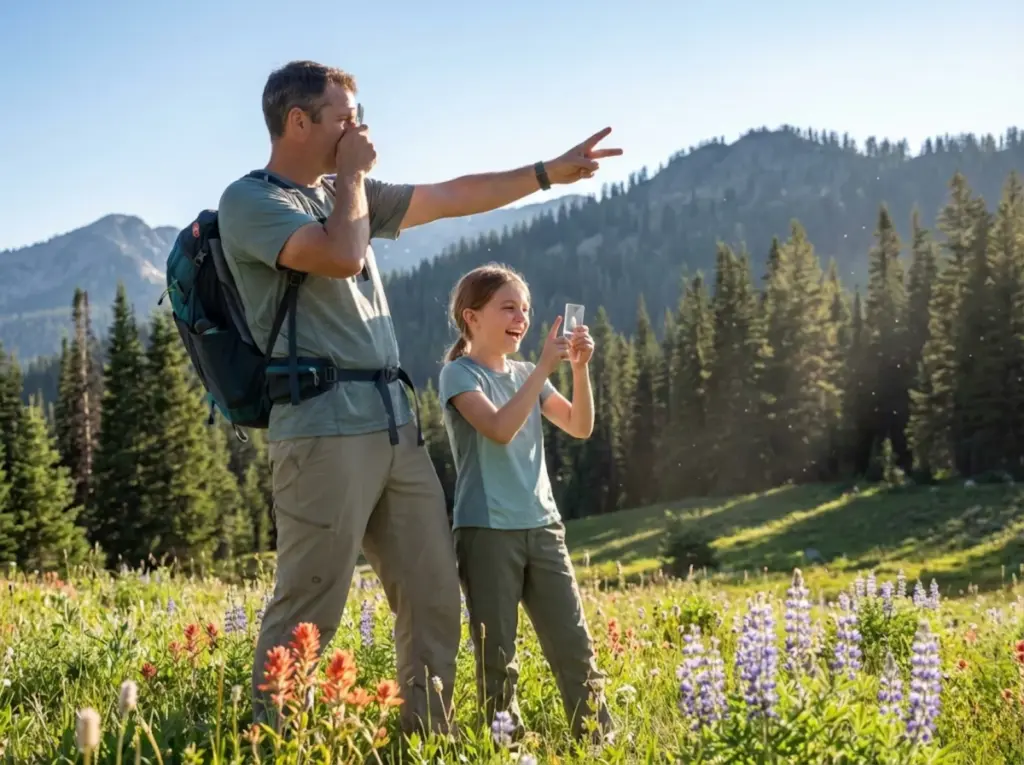
Under survival stress, you revert to your training — not what you read on a blog at 2 AM before your trip. If you have never aimed a signal mirror under pressure or blown a rescue pattern with cold fingers, you will struggle when it matters. These three drills take less than 30 minutes total and build the reflex you need.
Drill 1 — Mirror Target Acquisition (Your Backyard)
Tape a piece of aluminum foil to a fence post or tree trunk at 50 to 100 yards from where you stand. Using the V-finger method, practice landing the reflected flash on the foil target. Time yourself. Most people start at 15 to 20 seconds; you want consistent hits under 5 seconds. Once you can do it at 100 yards, increase the distance or add partial shade to simulate cloudy conditions.
Drill 2 — The SOS Rhythmic Test (Anywhere)
Pull up a metronome app on your phone and set it to one beat per second. Practice the three-blast pattern — one-second blast with each beat, then pause for 30 ticks. Repeat for 10 minutes straight. The goal is not volume; it is rhythm. Under stress, your timing will compress and your blasts will run together. Training the rhythm now prevents that erosion later. Variation: restrict your breathing by exhaling most of your air before each cycle to simulate altitude fatigue.
Drill 3 — The Family Signaling Game (Day Hike)
One person moves 200 to 400 meters off the main trail and sits behind cover. The rest of the group uses whistle blasts to locate them, triangulating the sound from different positions. Switch roles every round. For kids, frame it as “Marco Polo with whistles” — three blasts means “come find me.” Debrief after each round: how did terrain affect the sound? Could you tell direction? What would you do differently?
Understanding how light behaves through your headlamp also matters for night signaling. Our guide on choosing the best hiking headlamp covers strobe functions, battery life under cold-weather drain, and beam patterns — all relevant when your headlamp doubles as a nighttime signaling device.
The Legal Side — What Happens When You Signal Without a Real Emergency
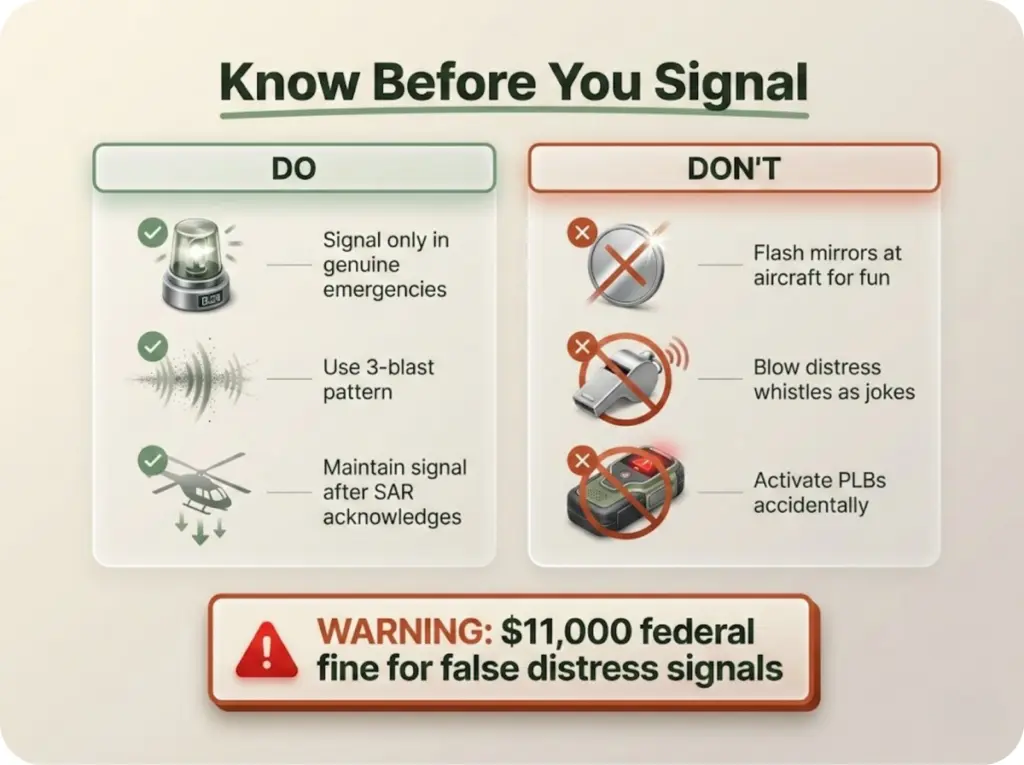
Signaling for rescue is a right in a genuine emergency. Misuse carries real consequences that most hikers never think about until a federal notice arrives in the mail.
The Communications Act of 1934 makes transmitting a false distress signal via radio or electronic beacon a federal offense. Penalties include fines up to $11,000 and imprisonment for up to one year. The Coast Guard and local agencies can pursue cost recovery for false rescues, and helicopter time alone runs $5,000 or more per hour. States add their own penalties — California classifies false emergency reports as a misdemeanor under Penal Code 148.3, often requiring reimbursement of all dispatch costs. The Appalachian Trail Conservancy’s emergency protocols page provides additional context on responsible signal use in National Scenic Trail corridors.
This does not mean you should hesitate during a genuine emergency. It means you should understand that flashing a signal mirror at passenger aircraft for amusement or blowing a distress whistle pattern as a joke on trail carries potential consequences beyond a dirty look from a ranger.
Signaling Etiquette — Rules Every Hiker Should Know
Signal only when there is a genuine threat to life or limb. Once a SAR team acknowledges your signal with two whistle blasts or mirror flashes, maintain your signal in a steady rhythm to help them home in on your position. If a search aircraft passes without responding, conserve your energy and wait for the next pass rather than exhausting yourself chasing a receding helicopter with increasingly desperate mirror sweeps.
In a group, designate one person to signal while others prepare ground markers. Multiple people signaling simultaneously from different positions can confuse rescue teams trying to establish a direction bearing.
Pro tip: Register your PLB with NOAA before your trip and update the registration annually. A registered beacon provides rescuers with your emergency contact info, medical conditions, and planned itinerary — all data that accelerates the rescue response if your beacon activates.
The Signal That Gets You Home
A signal mirror and a pea-less whistle together weigh under four ounces and cost less than $25. There is no weight penalty. There is no budget excuse. They take up less room than the snack bar you will eat at the first switchback.
The mirror reaches aircraft at distances your voice cannot dream of touching. The whistle cuts through fog, forest, and darkness where the mirror goes blind. Together, layered with passive signals like bright clothing and ground symbols, they form a system that covers every terrain and every time of day.
But gear you have never practiced with is gear you will not use under stress. Run the three drills. Build the muscle memory. Teach your hiking partners. Make the Rule of Three as automatic as buckling your helmet.
Pack it. Practice it. Know the rules. That is the difference between waiting to be rescued and getting yourself found.
Pro tip: Clip your whistle to your sternum strap, not buried in your pack. Attach your signal mirror to a lanyard inside your chest pocket. In an emergency, both should be reachable in under three seconds without removing your backpack.
FAQ
How do you aim a signal mirror at a rescue helicopter?
Hold the mirror close to one eye. Extend your free hand toward the helicopter with two fingers in a V shape. Tilt the mirror until the reflected sunlight lands on your fingers, then slowly raise your aim until the flash reaches the helicopter. With a sighting-hole mirror, look through the hole and align the bright dot with your target.
What is the universal whistle signal for help?
Three short, loud blasts in succession, repeated every 30 to 60 seconds. This pattern is recognized internationally as a distress call. Rescuers acknowledge by responding with two blasts.
Does a signal mirror work on cloudy days?
A signal mirror needs direct sunlight to generate a visible flash. Overcast skies reduce effectiveness dramatically. On cloudy days, switch to your whistle as the primary signal and drape bright-colored clothing or gear on rocks as a passive visual signal for aerial searchers.
What is the difference between a pea-less and pea whistle?
A pea whistle holds a small ball inside the chamber that creates a trilling sound. Moisture from your breath can freeze the pea in cold temperatures, silencing the whistle when you need it most. Pea-less whistles use air-flow resonance chambers with no moving parts and function in sub-zero cold, rain, and even underwater.
Can you use a phone screen as a signal mirror?
In a pinch, yes, but treat it as a last resort. A phone screen reflects roughly 30 to 50 percent of light compared to 100 percent from a purpose-built glass signal mirror. The effective range drops from 50 or more miles to maybe one or two. A dedicated signal mirror weighs two ounces and costs under ten dollars.
Risk Disclaimer: Hiking, trekking, backpacking, and all related outdoor activities involve inherent
risks which may result in serious injury, illness, or death. The information provided on The Hiking Tribe is for
educational and informational purposes only. While we strive for accuracy, information on trails, gear, techniques,
and safety is not a substitute for your own best judgment and thorough preparation. Trail conditions, weather, and
other environmental factors change rapidly and may differ from what is described on this site. Always check with
official sources like park services for the most current alerts and conditions. Never undertake a hike beyond your
abilities and always be prepared for the unexpected. By using this website, you agree that you are solely
responsible for your own safety. Any reliance you place on our content is strictly at your own risk, and you assume
all liability for your actions and decisions in the outdoors. The Hiking Tribe and its authors will not be held
liable for any injury, damage, or loss sustained in connection with the use of the information herein.
Affiliate Disclosure: We are a participant in the Amazon Services LLC Associates Program, an
affiliate advertising program designed to provide a means for us to earn advertising fees by advertising and linking
to Amazon.com. As an Amazon Associate, we earn from qualifying purchases. We are also an official affiliate partner
of Black Diamond Equipment via the AvantLink network. If you click on a Black Diamond affiliate link and make a
purchase, we may earn a commission at no additional cost to you. We also participate in other affiliate programs and
may receive a commission on products purchased through our links. Additional terms are found in the terms of
service.