In this article
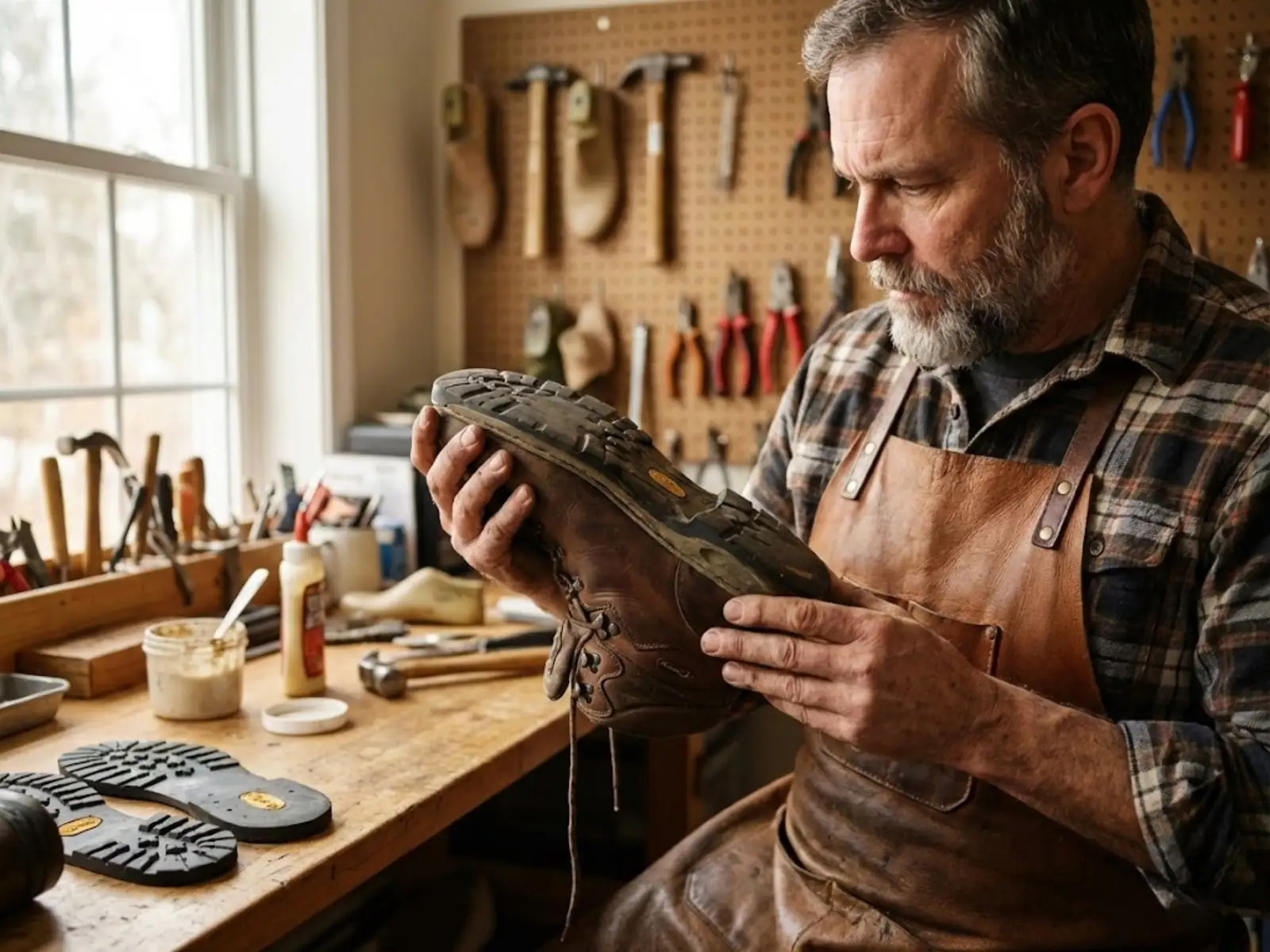
The cobbler peeled back the sole of my $350 Asolo TPS boots and shook his head. “You waited too long,” he said, pointing to the crumbling foam midsole that looked like coffee grounds. “This isn’t a resole anymore—it’s a rebuild.” What should have been a $110 repair just became a $180 gamble, and I had no one to blame but myself for ignoring the warning signs.
After testing dozens of boots across Sierra granite and Pacific Northwest mud, I’ve learned that resoling hiking boots isn’t just about saving money—it’s about understanding construction methods, timing your repair correctly, and choosing the right cobbler for your specific boot type. The difference between a smart $110 investment and a wasted $200 gamble comes down to knowledge.
Here’s what you need to know about boot resoling costs, when it makes financial sense, and how to avoid the mistakes that turn a simple repair into an expensive rebuild.
⚡ Quick Answer: Resoling hiking boots costs $75-$200 in 2025, depending on construction type and service complexity. Basic outsole replacement on Goodyear welt boots runs $75-$110, while cemented boots requiring midsole replacement cost $110-$160. Resoling makes financial sense when total repair costs stay under 50% of replacement price AND the leather uppers are crack-free. Timing matters—catching wear early saves $70+ compared to waiting for catastrophic failure.
Understanding Boot Construction: What Makes Resoling Possible
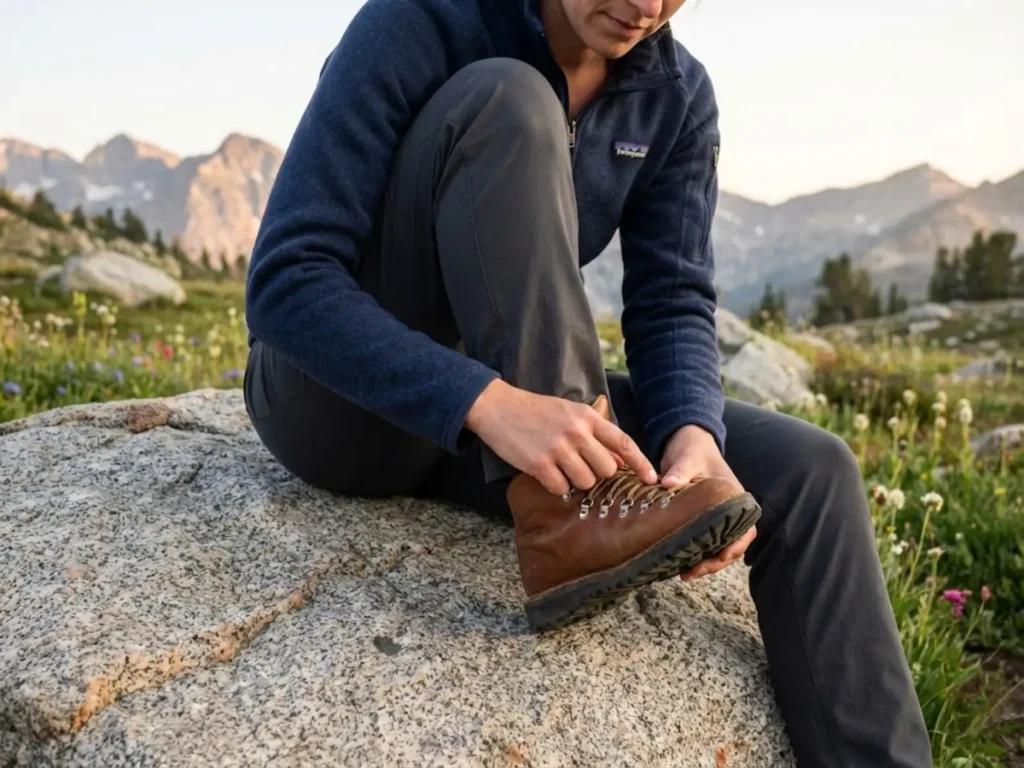
The first question isn’t “how much” but “can my boots even be resoled?” The answer lives entirely in how the sole attaches to the upper. Three construction methods dominate the hiking boot market, and each determines both feasibility and cost.
Cemented construction is what you’ll find in most modern hiking boots—Lowa, Asolo, Scarpa, and La Sportiva all use this method. The upper is stretched over a last and glued directly to the midsole and outsole using high-heat industrial adhesives. No stitches connect the sole to the upper. This makes boots lighter and more waterproof, but historically they were considered disposable.
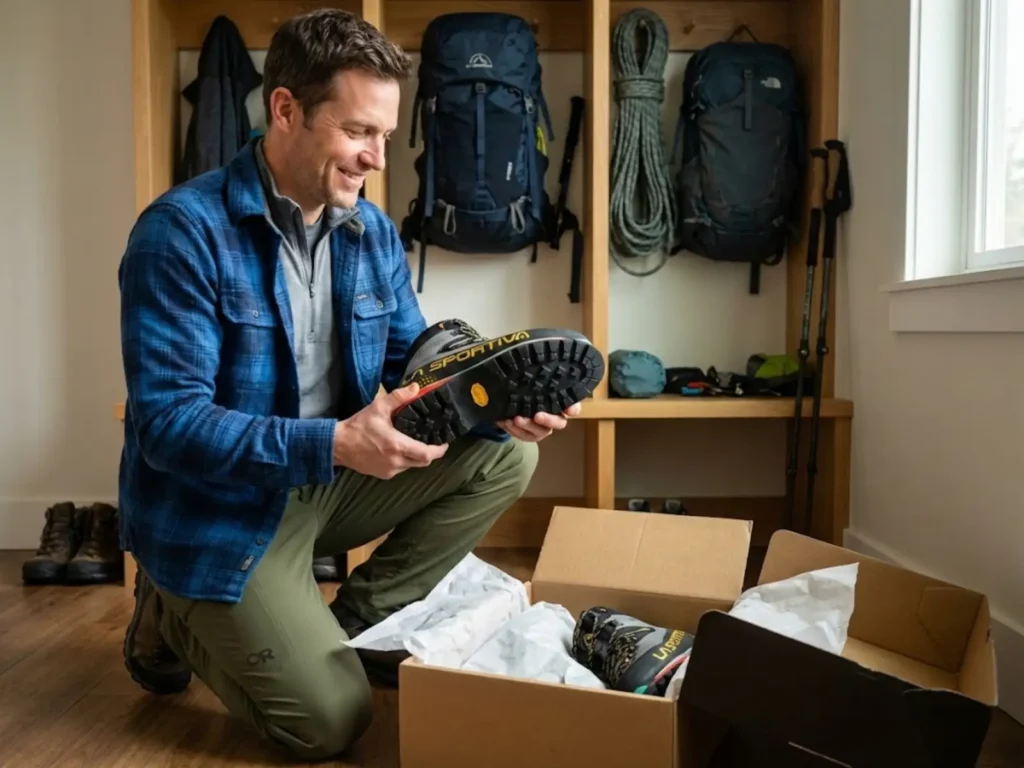
Here’s the truth: cemented boots CAN be resoled, but only by specialized cobblers with the right equipment. The process requires heat presses to activate adhesive removal and Vibram cup soles that wrap up the boot’s side to ensure proper bonding. The risk? If the leather delaminates during sole removal, the boot is ruined. If the cobbler doesn’t have your boot manufacturer’s original last for relasting, the internal volume can change—usually tightening—which destroys the fit you’ve spent months breaking in.
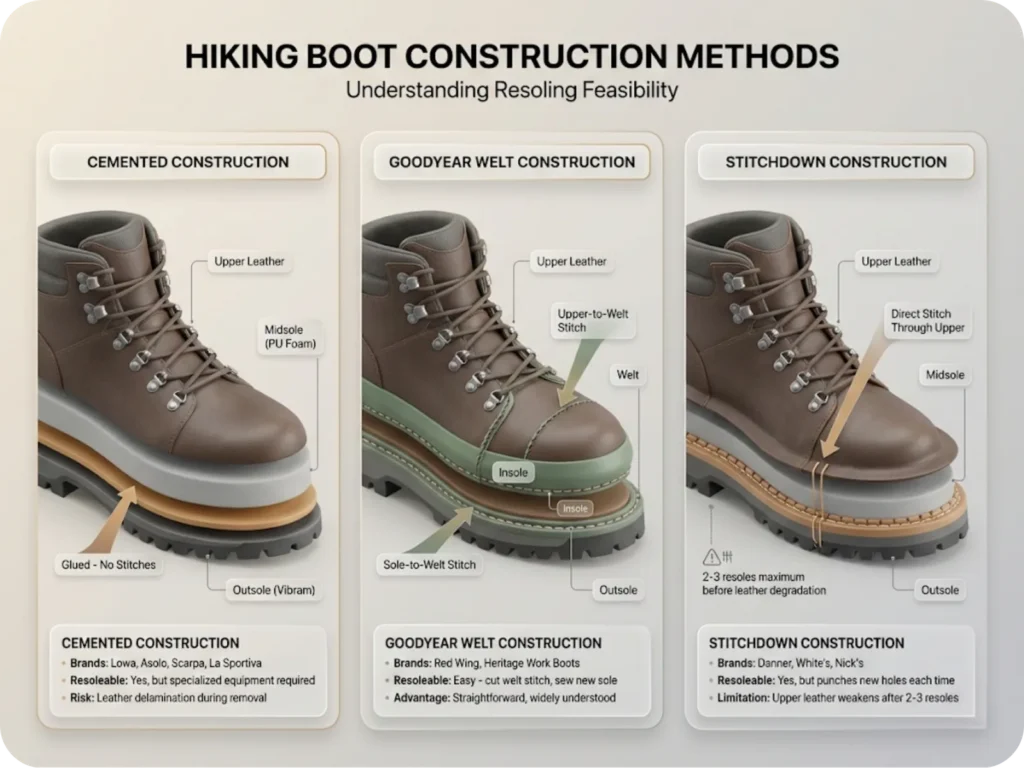
Goodyear welt construction is the heritage standard you’ll find in work boots and some traditional hikers like Red Wing. A strip of leather or plastic (the welt) is stitched to both the upper and the insole. The outsole is then stitched to this welt. The beauty? A cobbler simply cuts the welt stitch and sews on a new sole without ever touching the upper leather. It’s straightforward, widely understood by most cobblers, and parts are generic and easy to source. The trade-off is that the welt stitch channel can allow water ingress unless you treat it heavily with wax.
Stitchdown construction is the Pacific Northwest icon—think Danner, White’s, and Nick’s. The upper leather is flared outward at the bottom and stitched directly through to the midsole and outsole. This creates a wider, more stable platform perfect for heavy packs, but there’s a catch: each resole punches new holes through the upper leather. After 2-3 resoles, that stitch line starts looking like Swiss cheese. Danner’s factory recrafting service tries to reuse original stitch holes when possible to preserve leather integrity.
Pro tip: Before sending boots to any cobbler, press your thumbnail into the midsole foam. If it stays depressed or crumbles, you have hydrolysis—chemical degradation where water vapor breaks down polyurethane bonds. You’ll need a full midsole replacement, not just an outsole swap, which adds $25-$50 to the bill.
The paradox of polyurethane hydrolysis is that it’s accelerated by lack of use. Compression during walking forces air in and out, drying the material. Boots stored in a closet for five years are more likely to fail than boots worn daily for five years. When the foam crumbles, you can’t just glue a new sole on—there’s no substrate for adhesion. The entire midsole unit must be excised and replaced with a solid rubber cup sole, which changes the cushioning feel of the boot.
Understanding Goodyear welt versus cemented construction helps you predict long-term repair costs before you even buy your next pair of boots.
The Real Cost Breakdown: $75-$200 Explained
The advertised “base price” for resoling is rarely what you’ll actually pay. The $75-$200 spectrum reflects service tiers, regional pricing, and the hidden costs that stack up faster than you’d expect.
Basic resoles ($75-$110) cover outsole-only replacement on boots with intact midsoles. This works for Blake stitch, Goodyear welt, or simple stitchdown boots where the foam hasn’t degraded. Turnaround runs 2-4 weeks. You’re in and out for under $100 if you catch the wear early.
Full restoration ($110-$160) is what you need when hydrolysis has set in. The cobbler must replace both the outsole and the crumbling midsole, which means scraping and grinding down old polyurethane—labor-intensive work that adds 4-8 weeks to turnaround. This is the tier where most serious hikers with cemented boots land.
Technical alpine repairs ($150-$200) handle mountaineering boots with crampon inserts, full rand replacements, and specialized sole units. If you’re resoling La Sportiva Nepal Cubes or Scarpa Mont Blancs, expect 6-12 week turnarounds and prices at the top of the spectrum.
Factory recraft services ($125-$280) from brands like Danner and Red Wing use original lasts and materials. A Danner full rebuild at $280 effectively gives you a new boot on your broken-in upper. The catch? Once you use a third-party cobbler, you can never return to factory service—they won’t touch previously modified boots.
Regional pricing creates significant arbitrage opportunities. West Coast shops charge $140-$180 due to high labor costs and the Dave Page retirement vacuum. The Mountain West (Colorado, Utah, Montana) offers competitive $100-$150 pricing but suffers extreme demand—8-12 week backlogs during spring and summer are common. Midwest and Southern shops run $75-$110 but may lack experience with technical cemented boots.
The hidden costs hit harder than you’d think. Round-trip shipping for 4-pound boots runs $30-$50. Midsole replacement isn’t optional when foam has crumbled—add $25-$50. Rand damage occurs during sole removal in over 60% of repairs, tacking on another $40-$60. Gore-Tex membrane puncture risk during stitchdown repairs requires specialized sealing ($25+ premium). Minor repairs discovered during diagnostic—eyelet replacement, heel lining, hook replacement—each cost $15-$25.
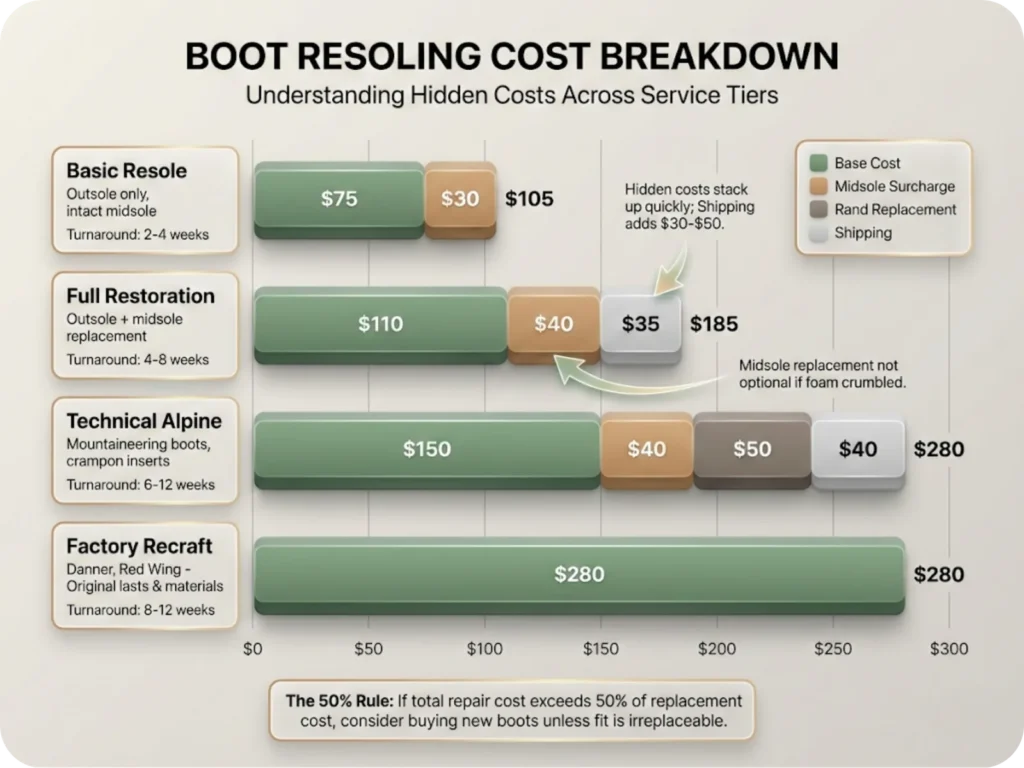
Here’s the critical decision metric: the 50% Rule. If total repair cost (base price + shipping + extras) exceeds 50% of replacement cost, the financial argument weakens unless your fit is irreplaceable.
I ran the numbers on my Asolo TPS 520 GV boots ($360 new). The repair breakdown: $110 resole + $40 rand + $40 shipping = $190 total. That’s 53% of replacement price. Verdict? Marginal. If the uppers were pristine and the fit perfect, I’d resole. But with visible leather cracking at the flex points, I replaced them.
Compare that to a Merrell Moab 3 ($140 new). Repair: $95 + $30 shipping = $125 total. That’s 89% of replacement price. Economically inefficient—better to invest $140 in fresh midsole cushioning and waterproofing.
But a Danner Mountain Light ($460 new) at $280 for full recraft? That’s 60% of replacement, yet the heritage value and stitchdown longevity justify the cost. The recrafting uses original lasts, preserving exact fit and volume.
The paradox of proper gear storage prevents hydrolysis by maintaining compression cycles—boots that get used last longer than boots that sit unused.
When Resoling Makes Financial Sense: The Decision Matrix
Numbers tell half the story. The other half is leather condition, timeline constraints, and the biomechanical value of a boot that’s already molded to your foot.
Start with upper condition. Press your fingers into the leather at the toe crease—the flex point where your foot bends with every step. If you see cracks, stop. Don’t resole. That upper will fail before your new sole wears out, and you’ll have wasted $150 on a boot that’s headed for the trash anyway. Torn mesh panels, delaminated leather, or separated heel counters are all deal-breakers.
Timeline matters more than most hikers realize. Need boots in one week? Buy new. Can wait 4 weeks? Use NuShoe or Resole America for reliable 3-4 week turnarounds. Can wait 3 months for perfection? Gary’s Shoes or Rocky Mountain Resole will do it right, but their backlogs stretch to 16 weeks during peak season.
The “broken-in fit” premium is real but hard to quantify. A boot that’s conformed to your unique ankle shape, heel cup, and forefoot width has biomechanical value that no spreadsheet captures. Breaking in new boots takes 20-50 miles and often involves blisters, hot spots, and adjustment periods. Preserving a broken-in fit avoids repeating the break-in process for new hiking boots, which can sideline you for weeks.
Construction type shifts the 50% threshold. Goodyear welt boots justify resoling at a 40% cost ratio because the repair is straightforward and repeatable. Cemented boots need to stay under 45% due to volume change risk and the one-shot nature of the repair—if it goes wrong, you’re done.
Here’s the decision framework I use: If you’re on the fence, ask yourself, “Would I pay this much for a brand-new pair of boots that are already broken in?” If yes, resole. If no, replace.
Original boot cost creates a natural threshold. Boots over $200 with intact uppers almost always justify resoling. Sub-$100 boots rarely do—the economics don’t work unless you’re resoling for sentimental reasons or the fit is genuinely irreplaceable.
Pro tip: If you’re planning exposed Class 3 scrambling or technical terrain in the next 4-6 weeks, don’t gamble on a resole turnaround. Worn soles on technical terrain dramatically increase fall risk. Order new boots or postpone the trip.
Vendor Landscape: Where to Send Your Boots
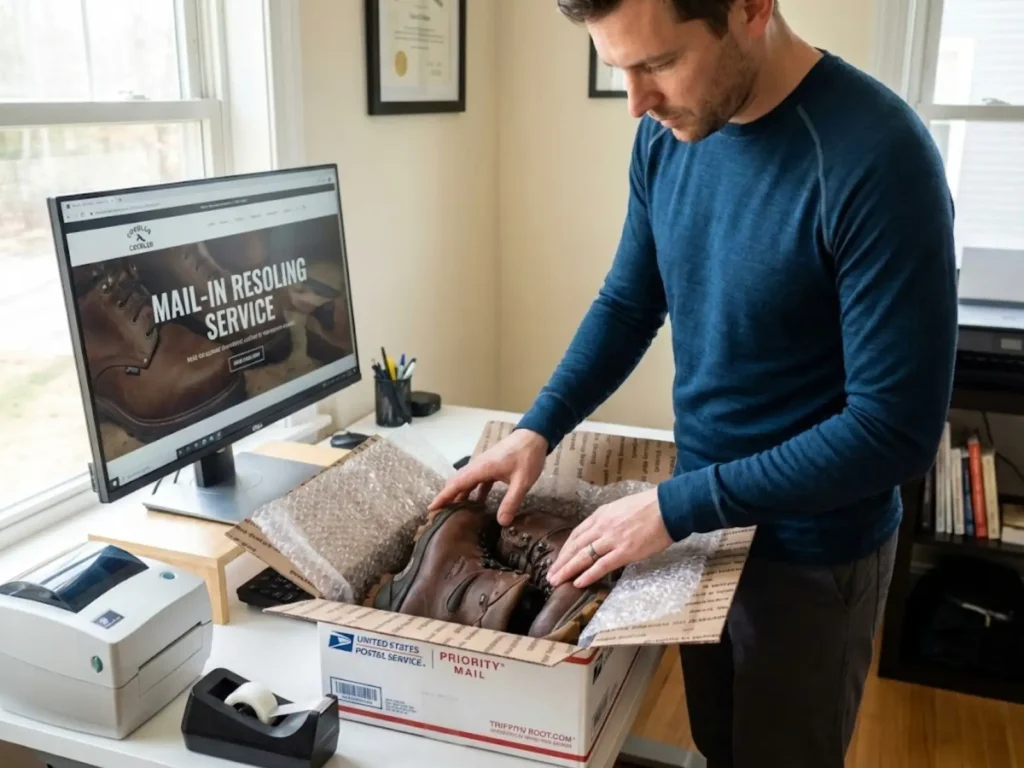
The 2024 retirement of Dave Page—the legendary Seattle cobbler who served as the authorized service center for virtually every major boot brand—fundamentally reshaped the resoling market. For decades, “Dave Page, Cobbler” was the default answer to “where do I fix my boots?” His closure redistributed demand across remaining specialists, extending industry-wide turnaround times by 2-4 weeks.
Rocky Mountain Resole in Salida, Colorado, is now the top pick for technical cemented boots. They stock factory lasts for La Sportiva, Asolo, and Scarpa, which eliminates volume change risk. Pricing runs $73-$105 with 4-8 week turnarounds. Their specialization in European mountaineering boots makes them the go-to for serious alpine footwear.
NuShoe in San Diego offers the best value for general hikers. Their “Renewal” packages run $80-$95 with reliable 3-4 week turnarounds. They’re authorized for Ariat and Vasque, and they handle volume repair efficiently. If you’re resoling mid-range boots and need them back quickly, NuShoe delivers.
Resole America in Warrenton, Virginia, provides transparent pricing ($99-$130) and mail-in kits that simplify the shipping process. As a Vibram authorized partner, they stock the full range of sole compounds and tread patterns. Their 3-4 week turnaround is consistent.
Gary’s Shoes in Richfield, Utah, has a cult following for Crispi and Kenetrek hunting boots. Pricing runs $130-$135, but turnarounds stretch to 6-16 weeks because Gary is perceived as the only cobbler who handles these brands correctly. The backlog is extreme—if you’re planning a fall hunt, ship your boots in spring.
Daub’s Cobbler Shop in New Hampshire is factory-trained in Germany and serves as Lowa’s premier US service partner. If you own Lowa boots and want warranty-compliant work, Daub’s is non-negotiable.
Local mall cobblers are equipped for dress shoes and heel caps. They rarely have the heat presses or Vibram cup soles required for technical hiking boots. Using a local cobbler for cemented boots often results in delamination on the first hike because they use standard contact cement instead of heat-activated urethane bonding agents.
Before shipping boots anywhere, call the cobbler. Ask if they stock the specific Vibram sole for your boot model and if they have experience with your construction type. A five-minute phone call can save you weeks of turnaround time and the heartbreak of a botched repair.
Choosing to resole is part of extending gear lifecycle through repair, reducing the environmental impact of manufacturing new boots while supporting artisan trades that are rapidly disappearing.
Timing Your Resole: Signs of Wear and Preventive Action
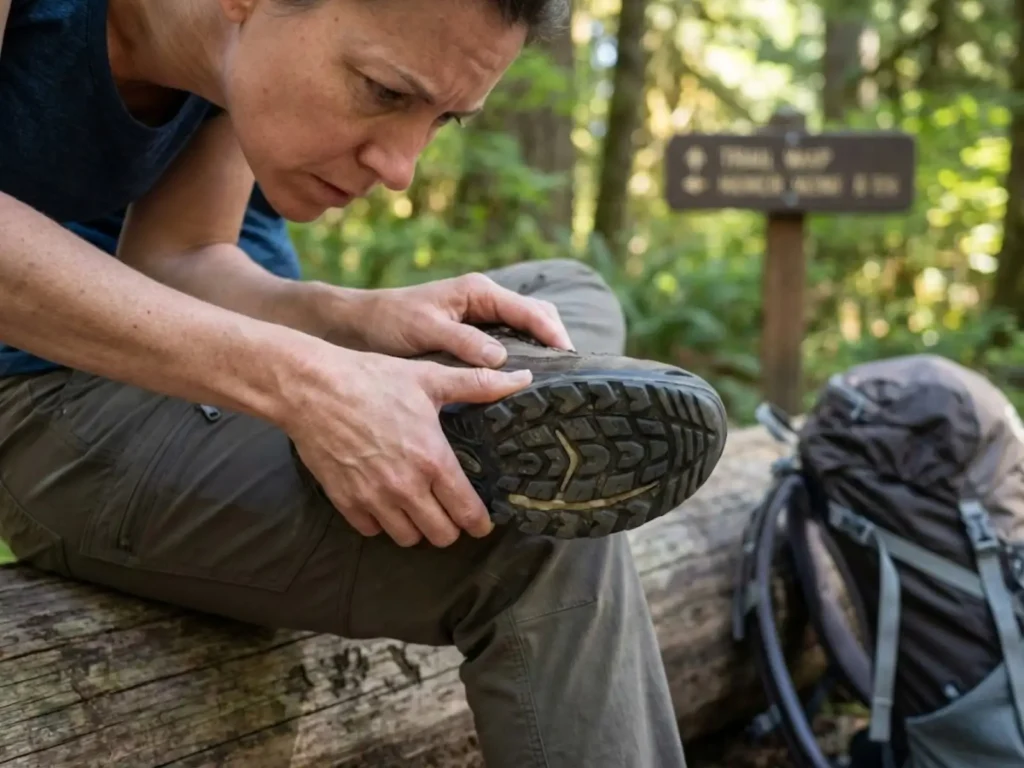
The difference between a $110 resole and a $180 rebuild comes down to timing. Catch wear early, and you’re replacing an outsole. Wait too long, and you’re rebuilding a boot.
Tread depth is your primary indicator. When lugs are worn to 50% of original depth, it’s time to resole—before they’re completely flat. Waiting until lugs are gone risks midsole exposure and water damage that turns a simple repair into a complex rebuild.
The thumbnail test reveals hidden midsole degradation. Press your thumbnail firmly into the midsole foam. If it stays depressed or crumbles, you have 6-12 months before catastrophic failure. Act now, not later.
Sole separation is the urgent warning. If you see daylight between the sole and upper at the toe or heel, you have 2-4 weeks before moisture intrusion accelerates delamination. Ship those boots immediately.
Terrain dictates wear rates more than most hikers realize. Sharp granite in the Sierra Nevada or Tetons wears outsoles twice as fast as soft forest trails in the Appalachian Mountains. Mud accelerates lug wear through abrasive particle suspension—those fine sediment particles act like sandpaper in the lug channels.
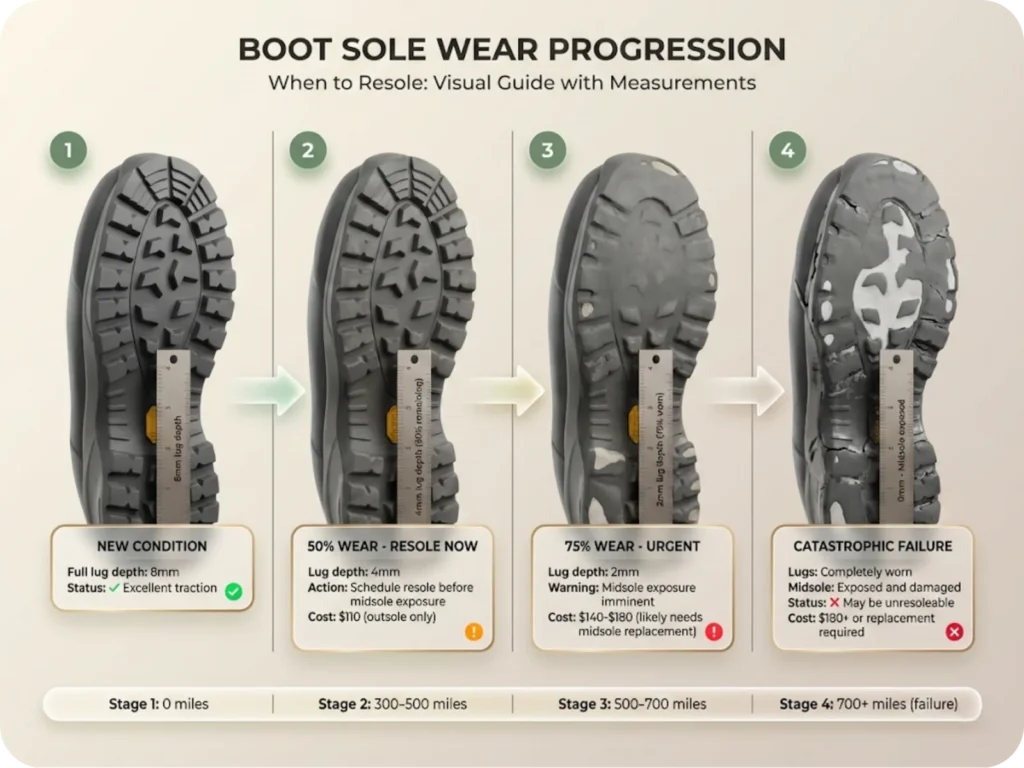
The cost of inaction is quantifiable. Delaying repair from simple resole ($110) to full rebuild ($180) costs an extra $70 plus 2-4 weeks of additional turnaround time. Worse, waiting until the upper sustains water damage from sole separation can render the boot unresoleable entirely.
Preventive maintenance extends the time between resoles. Clean debris from welt stitching after every hike to prevent moisture retention and rot. Treat full-grain leather with conditioner monthly—not weekly, as over-conditioning softens leather structure. Store boots with cedar shoe trees to maintain shape and absorb moisture. Avoid rapid drying near heat sources like campfires or radiators, which degrades adhesives and causes leather cracking.
After wet hikes, use proper boot drying techniques to prevent adhesive degradation and leather rot that can make boots unresoleable.
Pro tip: Photograph your boot soles every 100 miles of use. Visual progression helps you catch wear before it becomes critical. When you can see the difference between photos taken 200 miles apart, it’s time to start planning your resole.
Terrain-specific wear patterns reveal gait issues. Uneven wear on the outside edge suggests supination; inside edge wear indicates pronation. A good cobbler can spot these patterns and recommend sole compounds or tread patterns that compensate.
Sole Technology: Upgrading During Resole
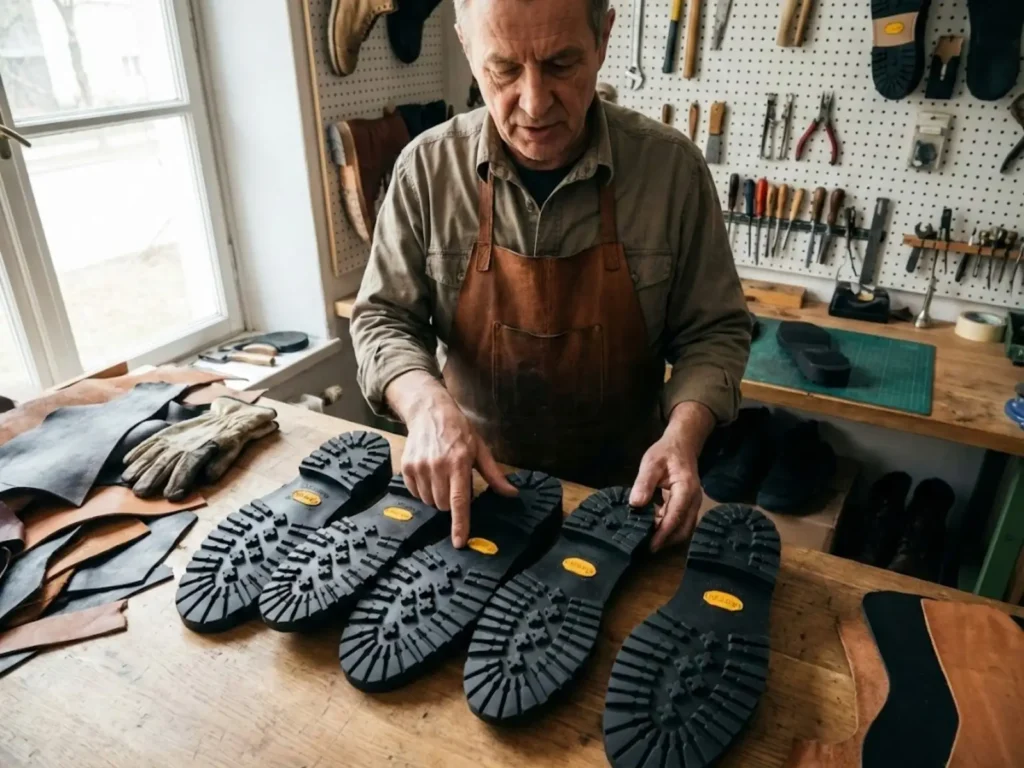
Resoling isn’t just repair—it’s an upgrade opportunity. Factory boots often come with “jack-of-all-trades” rubber compounds chosen to perform adequately in multiple environments. When you resole, you can optimize for your primary terrain.
Vibram Megagrip is the sticky choice for wet rock, roots, and technical approaches. The friction on wet surfaces is excellent, but abrasion resistance is moderate. If you hike the Pacific Northwest, where wet roots and mud dominate, Megagrip outperforms the factory compound on most boots. The trade-off? It wears faster on dry, abrasive granite.
Vibram Mont stays firm in freezing temperatures and resists sharp granite wear. The harder compound sacrifices some wet traction for durability and temperature stability. If you’re hiking the Sierra Nevada, Tetons, or winter mountaineering routes, Mont is the compound that lasts.
Vibram Idrogrip offers superior wet friction but low abrasion resistance. It’s designed for fly fishing, canyoneering, and extreme wet smooth surfaces. It wears fast on dry trail but grips like nothing else on wet slickrock or river crossings.
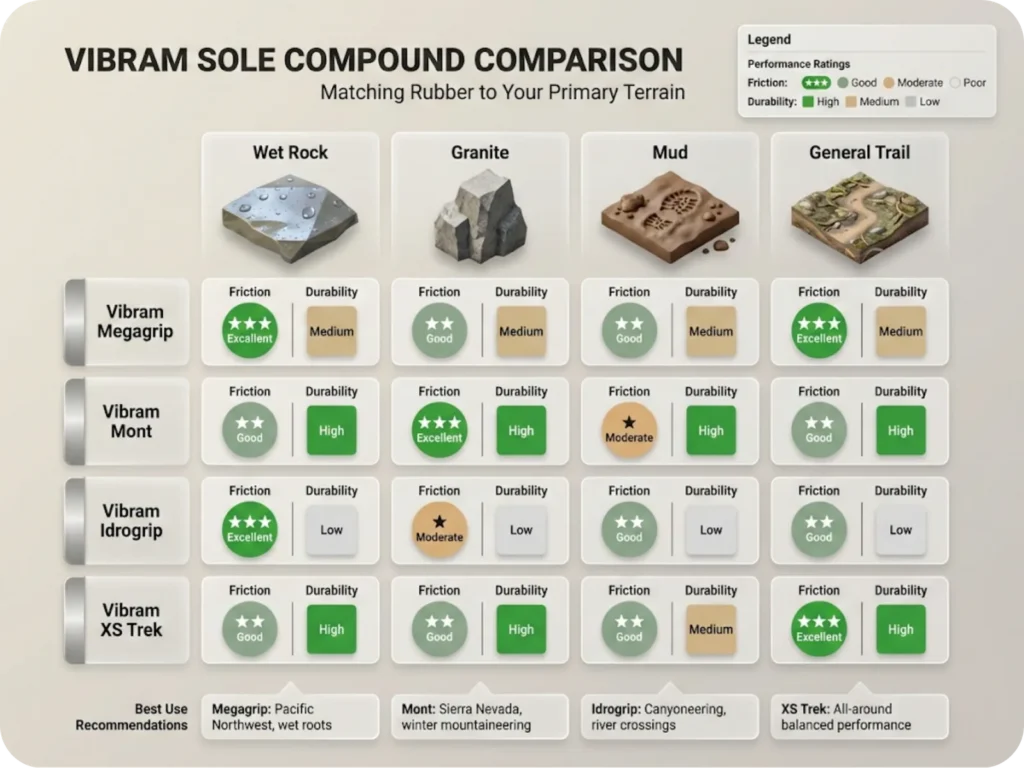
Vibram XS Trek is the balanced general trekking compound. Good wet friction, high abrasion resistance, and stable performance across temperature ranges. If you hike varied terrain and want one compound that does everything well, XS Trek is the safe choice.
Lug architecture matters as much as compound. Carrarmato features deep, widely spaced lugs that prevent mud buildup through self-cleaning. Best for soft ground, mud, and snow. Kletterlift is Danner’s specialized version with a heel undercut for braking stability and a compound optimized for hard surface comfort. Bifida is the cup sole construction that integrates midsole and outsole—heavy but bombproof for salvaging boots with hydrolyzed midsoles.
Vibram sole upgrades typically add $20-$40 to base resole cost, but the performance gain can exceed the original factory spec. Understanding how lug depth affects traction helps you select the optimal Vibram pattern for your primary terrain.
Pro tip: If you hike in multiple environments, choose XS Trek for balanced performance or keep a second pair of boots with specialized soles. Swapping between Megagrip boots for wet Pacific Northwest trips and Mont boots for Sierra granite trips optimizes performance without compromise.
The Environmental Case for Resoling
Manufacturing a pair of technical hiking boots generates carbon emissions from leather tanning (chromium process), polymer synthesis for midsoles (PU/EVA), and global logistics. Resoling consumes only rubber and adhesive, generating an estimated 6-10% of the carbon emissions of manufacturing new boots, according to La Sportiva’s sustainability report.
High-quality leather takes decades to decompose in landfills. Synthetic soles take centuries. Resoling keeps 80% of boot material—the upper, midsole structure, and hardware—out of the waste stream.
La Sportiva reuses 50% of rubber sole waste in other manufacturing processes, creating a partial circular economy. The cobbler industry contraction from 100,000 shops in the 1930s to fewer than 5,000 today reflects disposable culture. Choosing repair supports artisan trades that are rapidly disappearing.
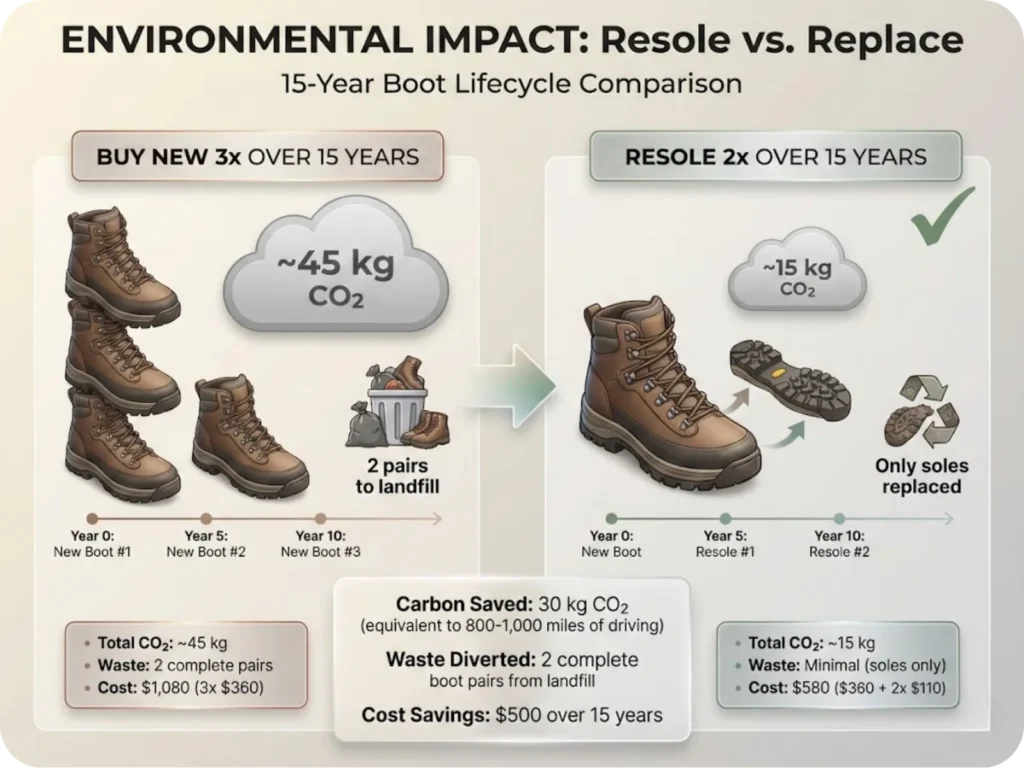
Resoling twice extends boot life from 3-5 years to 10-15 years, reducing per-mile environmental cost by 60-70%. According to research on sustainable footwear practices, repairing a pair of shoes can reduce carbon dioxide emissions by roughly 13.6 kilograms compared to manufacturing new footwear. If 10% of hikers resoled instead of replaced, it would divert 50,000+ tons of footwear waste annually.
If environmental impact matters to you, prioritize boots with Goodyear welt or stitchdown construction at purchase—they’re designed for multiple resoles from the start. Resoling is one component of comprehensive gear lifecycle management that includes repair, resale, and responsible disposal.
The carbon footprint comparison is stark. A hiker who resoles twice over 15 years instead of buying three new pairs saves the equivalent carbon of driving 800-1,000 miles. That’s not marketing—it’s physics.
Conclusion
Resoling hiking boots makes financial sense when total repair costs stay under 50% of replacement price and the uppers are structurally sound. Construction type determines both feasibility and cost—Goodyear welt and stitchdown boots are straightforward repairs, while cemented boots require specialized equipment and carry volume change risks.
The $75-$200 price spectrum reflects service complexity, regional labor costs, and hidden extras like midsole replacement and shipping. Timing matters: catching wear early saves $70+ and weeks of turnaround time compared to waiting for catastrophic failure.
The Dave Page retirement reshaped the vendor landscape, but specialists like Rocky Mountain Resole, NuShoe, and Resole America fill the gap with reliable service. Choose cobblers based on your boot’s construction type and their specific brand experience.
Inspect your boot soles tonight. If you see worn lugs or feel soft spots in the midsole, you’re in the decision window. Use the 50% rule, check construction type, and choose a cobbler with experience in your boot brand. The difference between a smart resole and wasted money comes down to acting before damage spreads from the sole to the upper—and understanding that a perfectly broken-in boot has value that no spreadsheet can capture.
FAQ
How much does it cost to resole hiking boots?
Resoling hiking boots costs $75-$200 in 2025, depending on construction type and service complexity. Basic outsole replacement on Goodyear welt boots runs $75-$110, while cemented boots requiring midsole replacement cost $110-$160. Technical alpine boots with crampon inserts and rand repairs reach $150-$200. Add $30-$50 for round-trip shipping and potential surcharges for midsole replacement ($25-$50) or rand repair ($40-$60).
Is it worth resoling hiking boots?
Resoling is worth it when total repair costs (including shipping and extras) stay under 50% of replacement cost AND the leather uppers are crack-free and structurally sound. Boots over $200 with intact uppers almost always justify resoling. The broken-in fit factor adds value—a boot molded to your foot topography is worth paying the higher end of the repair spectrum to preserve.
Can all hiking boots be resoled?
No. Boots with cemented construction (most modern hikers) CAN be resoled by specialized cobblers with heat presses and cup soles, but the process risks leather damage and volume changes. Goodyear welt and stitchdown boots are easily resoled by most cobblers. Boots with torn mesh uppers, cracked leather at flex points, or catastrophic midsole hydrolysis are not worth resoling—the upper will fail before the new sole wears out.
How long does boot resoling take?
Turnaround time ranges from 2-4 weeks (NuShoe, Resole America) to 6-16 weeks (Gary’s Shoes, Rocky Mountain Resole during peak season). Factory recraft services (Danner, Red Wing) take 4-10 weeks. The Dave Page retirement in 2024 extended industry-wide turnaround times by 2-4 weeks as remaining shops absorbed overflow demand. Always call ahead for current lead times before shipping boots.
What are signs my boots need resoling?
Resole when tread lugs are worn to 50% of original depth, before they’re completely flat. Other signs: visible midsole foam through worn outsole rubber, sole edge separation (daylight between layers), loss of traction on familiar terrain, or the thumbnail test showing soft or crumbling midsole foam. Act within 2-4 weeks of noticing sole separation to prevent moisture damage that turns a $110 resole into a $180 rebuild.
Risk Disclaimer: Hiking, trekking, backpacking, and all related outdoor activities involve inherent
risks which may result in serious injury, illness, or death. The information provided on The Hiking Tribe is for
educational and informational purposes only. While we strive for accuracy, information on trails, gear, techniques,
and safety is not a substitute for your own best judgment and thorough preparation. Trail conditions, weather, and
other environmental factors change rapidly and may differ from what is described on this site. Always check with
official sources like park services for the most current alerts and conditions. Never undertake a hike beyond your
abilities and always be prepared for the unexpected. By using this website, you agree that you are solely
responsible for your own safety. Any reliance you place on our content is strictly at your own risk, and you assume
all liability for your actions and decisions in the outdoors. The Hiking Tribe and its authors will not be held
liable for any injury, damage, or loss sustained in connection with the use of the information herein.
Affiliate Disclosure: We are a participant in the Amazon Services LLC Associates Program, an
affiliate advertising program designed to provide a means for us to earn advertising fees by advertising and linking
to Amazon.com. As an Amazon Associate, we earn from qualifying purchases. We are also an official affiliate partner
of Black Diamond Equipment via the AvantLink network. If you click on a Black Diamond affiliate link and make a
purchase, we may earn a commission at no additional cost to you. We also participate in other affiliate programs and
may receive a commission on products purchased through our links. Additional terms are found in the terms of
service.