

In this article
You’re twenty minutes into a climb, breathing hard, and the chest strap that felt fine back at the car is now sawing across your throat. Flip it around and you get the opposite problem: the strap rides low near your ribs, your shoulder straps keep creeping outward, and it chafes every time you lift a knee. Both come down to one setting almost nobody adjusts on purpose, the height of your sternum strap, and most fit guides hand you a single line about it before moving on. Get it right and the pack mostly disappears on your back; get it wrong and your body tells you inside the first mile. Here’s where the strap should sit, how to move it, how tight is right, and how to read what too high and too low actually feel like.
Where Your Sternum Strap Should Sit (the Height Rule)

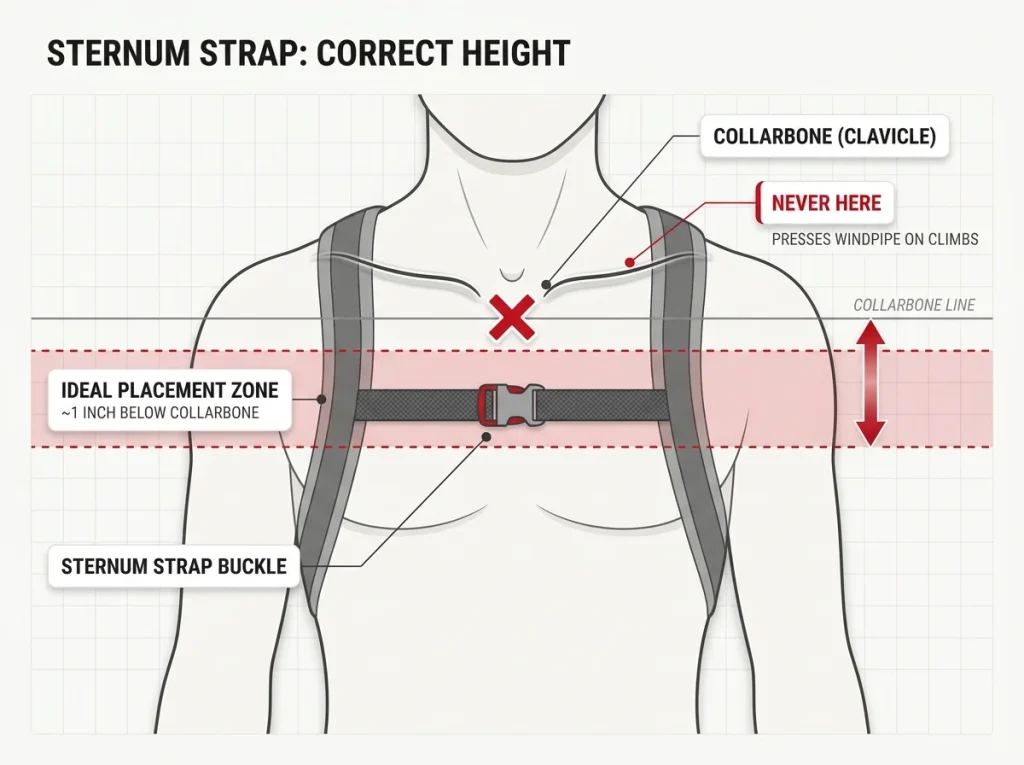
Start with the target, because everything else is just hitting it. The short version most fit guides give you, REI included, is right as far as it goes: about one inch below the collarbone, sitting across the mid-chest. The trouble is nobody explains why that inch matters or what the strap is even doing up there, so people set it once and wonder why the pack never feels settled.
The one-inch-below-the-collarbone rule
Find the bony ridge at the top of your chest with two fingers, then drop down about a finger-width. That band across the middle of your chest is where the buckle wants to live. Run it any higher, right over the collarbone or into the soft hollow at the base of your throat, and it presses where it has no business pressing. That spot has your windpipe right behind it, which is exactly why a too-high strap feels like it is choking you the moment you start working hard.
What the strap is actually for
Here is the part that reframes everything: the sternum strap is not holding any weight. Its only job is to keep your shoulder straps from sliding outward off your shoulders and to add a little lateral stability so the pack doesn’t sway when you rock-hop or sidehill. Think of it as an anti-slip clip, not a support strap. That single fact kills the most common mistake in the whole topic, which we’ll get to, and it is why the strap earns its keep mostly on a loaded pack of roughly 22 pounds and up, or any time you’re wearing a slick wind shell that lets the straps skate around.
A quick way to eyeball it
Stand relaxed with the pack on and loaded, look down, and check that the buckle sits a finger-width under that collarbone ridge and runs level across your chest, not angled. If you can see it riding up near your throat or sagging down toward your stomach, you already know your first adjustment. The height rule is really the last piece of a bigger picture, so it helps to understand it alongside dialing in the whole pack from the hips up.
The on-body difference between too high and just right is far easier to see than to read, so this short clip is worth thirty seconds before you fiddle with your own pack.
How to Slide and Adjust the Height Step by Step

Most people never realize the buckle is supposed to move. They grab the loose ends, yank the strap tighter across their chest, and wonder why nothing improves. Tightening changes the tension, not the height, and height is usually the thing that was off.
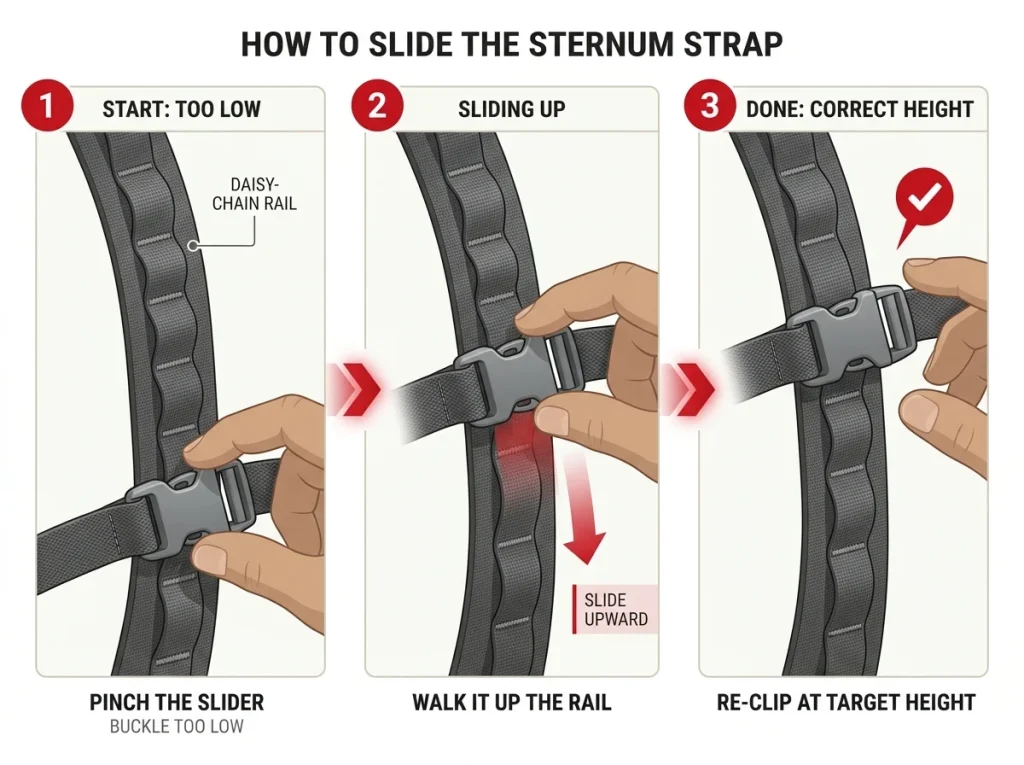
Sliding it on the daisy-chain webbing rail
Modern sternum straps are vertically adjustable. The buckle clips onto a little ladder of loops or a track running up each shoulder strap, the daisy-chain webbing rail, and it slides up and down that rail to whatever height fits you. Pinch the slider, walk it up or down a loop or two, and re-clip. Many straps are also elastic, with a stretchy section built in so your chest can expand as you breathe. If yours has that give, don’t fight it by cinching it solid.
Sewn-in versus attachable systems
Two broad setups exist. Some packs have a sewn-in strap that only slides within a fixed range. Others use an attachable strap that clips into the rail and pops off entirely. Deuter’s VariQuick and VariSlide systems work this way, and cottage makers like Atom Packs use the same removable setup, so you can reposition or pull the strap off completely. If your pack has no sternum strap at all, or you lost the clip off an older one, a universal replacement clips onto standard shoulder-strap webbing for a few dollars. Most hikers never need to buy one, since the strap almost always ships on the pack, and plenty of experienced backpackers actually strip the attachable strap off if their build doesn’t need it. Use it or don’t, but now you know what it is there for.
Where it falls in the fit sequence
The sternum strap is one of the last things you set, not the first. The order that works is hip belt first, then shoulder straps, then load lifter straps angled back toward the pack at roughly 45 degrees, then the sternum strap, then any side stabilizer straps. Set it out of order and you’ll be re-doing it anyway. Before any of that, load the pack with about 15 pounds and loosen every strap, because an empty pack lies about how it carries. If you want the full bottom-to-top routine, the Appalachian Mountain Club’s pack-fitting walkthrough lays out the sequence, and it’s worth understanding the load lifters you set just before it and how your pack’s suspension system is built so the strap makes sense in context.
The slide itself is the part text struggles with, so watching the buckle actually move on the rail clears it up quickly.
Never dial in a strap on an empty pack. Drop your usual day’s weight in first, around 15 pounds, loosen everything, then build the fit from the hips up. The strap that feels perfect on a floppy empty pack will feel completely different once there’s real load pulling on it.
How Tight Is Right (the Breathing and Two-Finger Check)

Here’s where people go wrong more than anywhere else: they crank the sternum strap down hard to fix sore shoulders. It feels like it should help. It does the opposite.
The until-it-slips-through-your-fingers test
Tighten it slowly and stop the instant the webbing just starts to slide through your pinched fingers. That’s snug. The old two-finger check works too: you want about two fingers of room and a strap that holds the shoulder straps in place without pulling them inward. The goal is snug, not tight, and the difference is small but you feel it immediately.
Why cranking it tighter backfires
Remember the strap isn’t load-bearing. Overtightening doesn’t move weight off your shoulders, it just squeezes your chest, and it drags the shoulder straps inward and distorts the fit you already set. Worse, a too-tight strap restricts breathing and can leave you with tingling or numbness in your hands and fingers, which is your body’s blunt way of telling you to back it off. If your shoulders genuinely hurt, the strap is the wrong tool. A well-fitted pack puts roughly 80 percent of the weight on your hips, and the American Hiking Society notes a well-fitted pack puts about 80% of the weight on your hips, so sore shoulders almost always mean it’s time to get the hip belt carrying the load first, not to cinch the chest strap.
Snug, not strangled
The simplest test is the one you already own. Set the tension, then take a full deep breath. If your chest can’t expand all the way, it’s too tight, full stop. Your ribs need room for full chest expansion, especially once you’re working, so leave the strap a hair looser than feels perfect when you’re standing in the parking lot.
If your hands go tingly or your fingers fall asleep on the trail, your first move is the sternum strap, not your shoulders. Loosen it a notch before you blame the pack. Nine times out of ten the numbness eases within a few minutes of walking.
Too High vs. Too Low (How to Read What Your Pack Is Telling You)

Forget the ruler for a second. Your body is already giving you a precise readout of whether the strap is too high or too low, and once you learn to read it you can fix the height by feel without taking the pack off. This is the part the one-line guides skip, and it’s the most useful thing here.
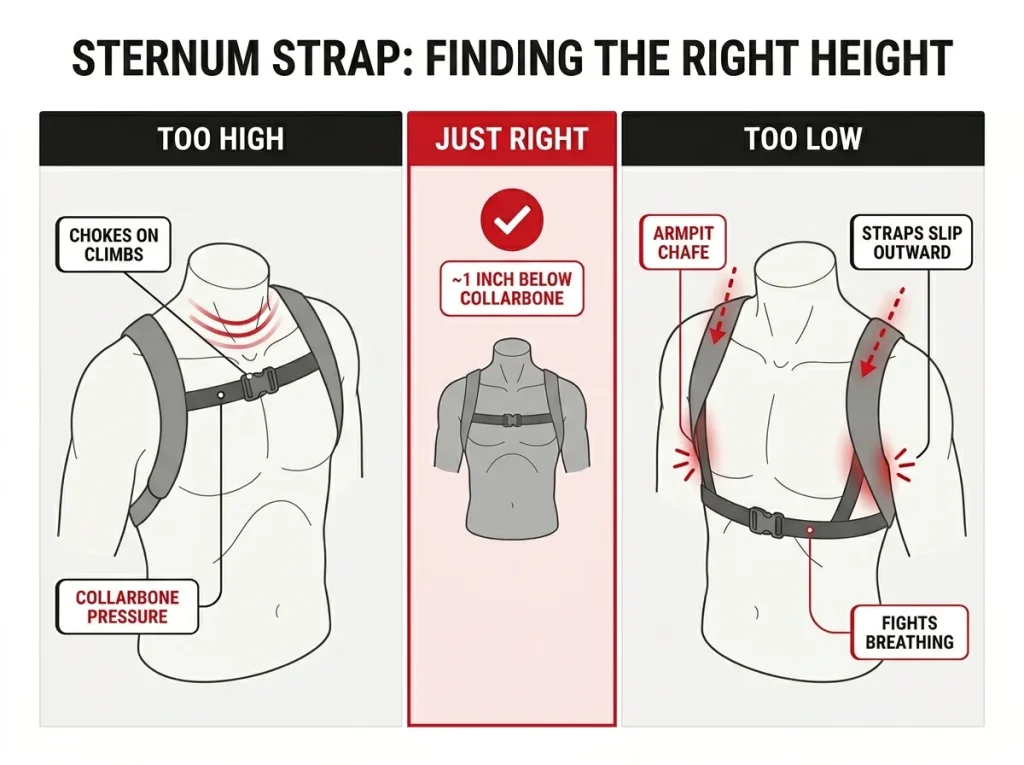
Too high — choking and collarbone pressure
A strap set too high rides up toward your throat and presses the collarbone. On flat ground you might barely notice. Start climbing and breathing hard, though, and it creeps into your windpipe zone and feels like it’s choking you, right when you most need air. If you find yourself hooking a finger under the strap to pull it off your throat on every steep section, it’s too high. Drop it down a loop.
Too low — armpit chafe and slipping straps
Too low causes the opposite mess. When the buckle sits down near your stomach, it pulls the shoulder straps into a narrow V that digs into your armpits and rubs with every stride, the classic armpit chafe. It also sits near your diaphragm and fights your belly-breathing, and ironically it lets the shoulder straps slip outward, the exact shoulder strap slippage the strap exists to stop. A counterintuitive note worth knowing: a strap left too loose can also leave you with pins and needles, and Osprey’s own fit guidance notes a strap left too loose can leave fingers tingly or numb. Both extremes tingle, so tension alone isn’t the tell. Position is.
Self-diagnose from the symptom
So here’s the cheat sheet. Discomfort up at your neck or throat means the strap is too high, so move it down. Chafing in the armpits, plus shoulder straps that keep slipping off, means it’s too low, so move it up. Most of the time the cure is a couple centimeters of slider travel, not a new pack, though not always, which is the next thing to check.
The advice experienced backpackers keep repeating is high and loose beats low and tight. Set the buckle toward the upper end of its comfortable range and keep the tension light. You get the anti-slip benefit without the choke, and your chest stays free to breathe.
When the Real Problem Is Pack Size, Not the Strap
Sometimes you slide the strap to its very top or its very bottom and it still never feels right. When that happens, stop blaming the strap. It’s covering for a pack that doesn’t actually fit your back, and no amount of fiddling fixes a sizing problem.
The maxed-out-slider warning sign
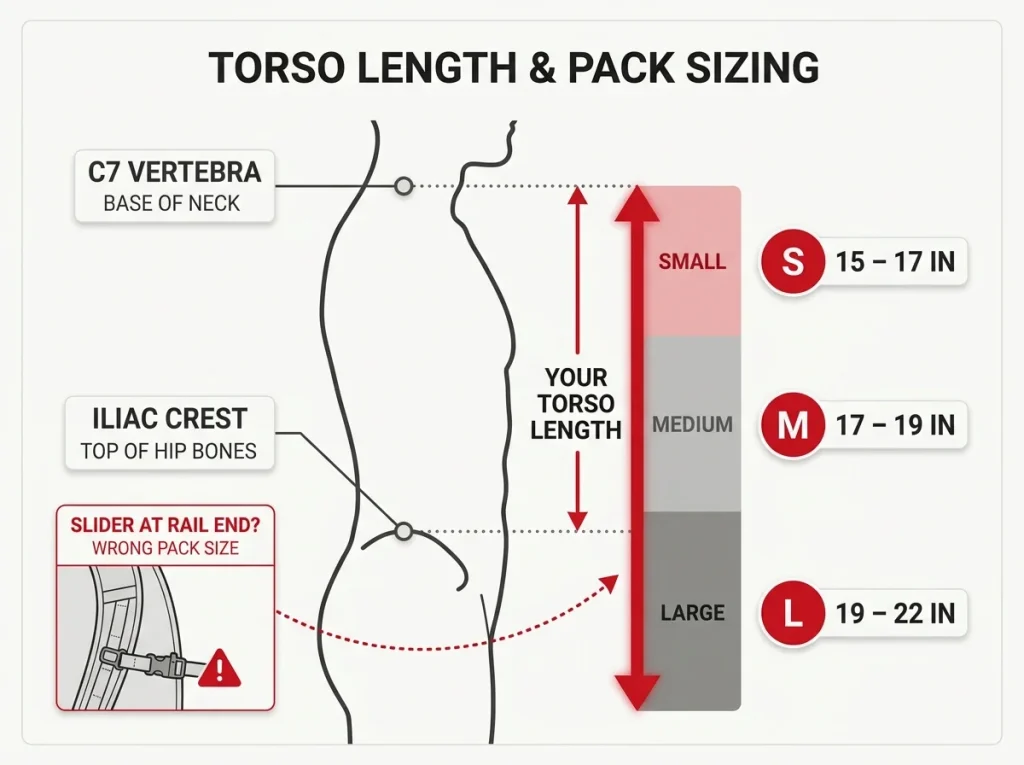
The tell is simple. If you’ve run the slider to the extreme top or bottom of the rail just to get close to comfortable, the strap is masking a fit error, not solving one. A strap that works should land you in the comfortable middle of its travel, with room to go either way. Pinned against the end of the rail means something upstream is wrong.
Why it traces back to torso length
That something is almost always torso length, sometimes called back length. Pack fit is built around the distance from the C7 vertebra at the base of your neck down to your iliac crest, the top of your hip bones, and it has nothing to do with how tall you are. Most packs come in sizes built around that measurement, often small at 15 to 17 inches, medium at 17 to 19, and large at 19 to 22, or with an adjustable back panel. If your torso length falls between sizes or your pack is the wrong one, the sternum strap ends up doing damage control. The fix is the pack, so it’s worth measuring your torso length the right way before you spend another hike fighting the symptom.
Adjust the back panel, or admit it’s the wrong size
If your pack has an adjustable suspension, this is the moment to reset the back-panel length to your torso and re-run the whole fit. If it doesn’t adjust and the size is simply wrong, the honest answer is that it’s the wrong pack, and that’s worth knowing before your next trip rather than during it. Getting this right starts further back, with choosing a pack that actually fits your torso in the first place.
Body Type, Chest Shape, and Women-Specific Placement

The tidy “inch below the collarbone” rule quietly assumes everyone has the same chest. They don’t. Larger-chested hikers, women, and people with broad or narrow frames all need the strap placed a little differently, and the community has been pointing this out for years while most guides keep repeating the one-size rule.
Larger chests — ride it higher
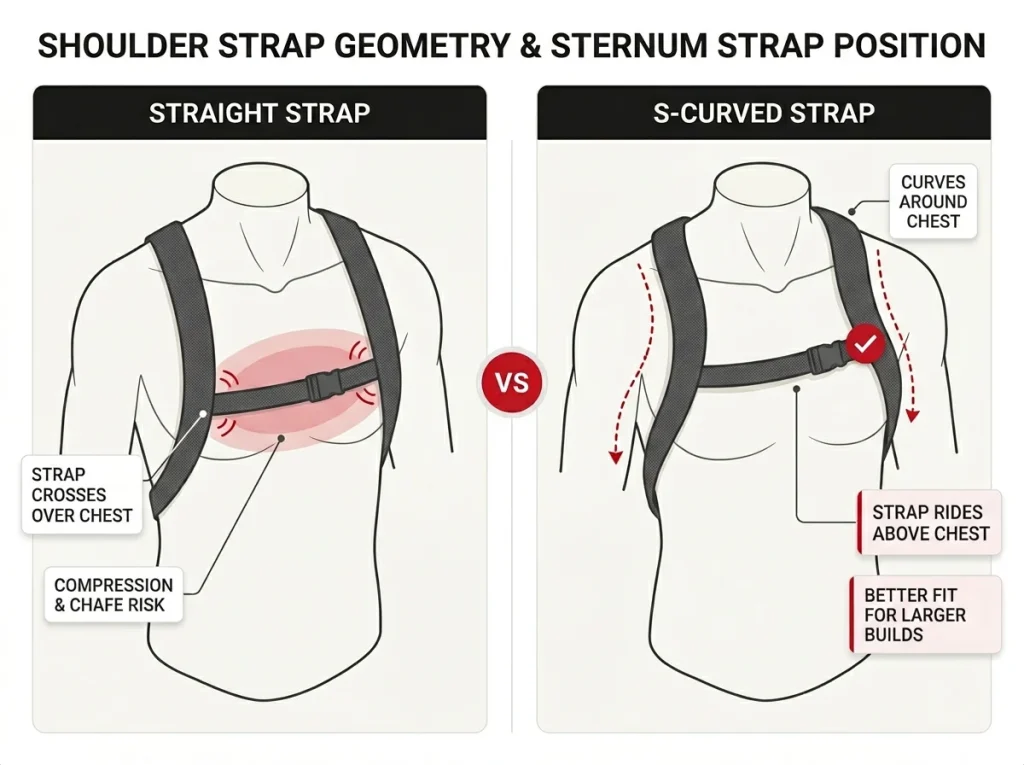
For a larger chest, running the strap straight across the fullest part causes compression and chafe instead of stability. The fix the community keeps landing on is to set it higher than the standard rule says, up just under the collarbones and above the chest rather than across it. That’s the least intrusive spot, and it still does its anti-slip job without squeezing where it shouldn’t.
S-curved shoulder straps and women-specific packs
Strap geometry matters as much as height here. S-curved shoulder straps, offered by makers like ULA and Six Moon Designs, curve out and around the chest so the sternum strap can ride above it instead of cutting across. They solve the compression problem for larger-chested and broad-built hikers, and plenty of men find them more comfortable too. If the standard placement never feels right no matter where you slide it, the answer may be the strap shape or a women-specific fit, like a pack built around a women’s torso and shoulder geometry, not more adjusting. The real voices on this are blunt about it, from chests going numb under a bad strap to people simply leaving it unclipped because it was never comfortable.
Broad versus narrow frames
Width comes into it as well. A broad frame and a narrow frame want the strap at different widths across the chest, not just different heights, and the fixed rule ignores that entirely. If your pack’s strap only slides up and down but never adjusts how wide it sits, that’s a real limit of the pack, and it’s worth weighing when you shop for the next one.
Breathing Under Load on the Climb (Re-Checking Mid-Hike)

Almost every guide tests your breathing the same way: stand still at the trailhead, take a deep breath, done. The problem is that you don’t hike standing still. Your chest moves differently once you’re grinding uphill under a loaded pack, and the strap that passed the parking-lot test can turn on you halfway up.
Why a strap that felt fine chokes you on the climb
When you’re working hard on a sustained uphill with weight on your back, your chest expands more with every breath than it does at rest. A strap set snug while you were standing around suddenly has nothing to give, and it starts to feel like it’s tightening across you on the climb even though you never touched it. That’s not in your head. Your ribs are pushing against a strap that was set for a body that wasn’t breathing hard yet.
Set it slightly loose, then re-check mid-hike
The field fix is dead simple and almost nobody writes it down. Set the strap a touch looser than feels perfect at the trailhead, then re-check it once you’re actually breathing hard on the first real climb and loosen it a hair more if you need to. Bonus: loosening or repositioning the strap partway through the day also shifts the pressure to a fresh spot on your shoulders, which is a comfort lever most beginners never think to use.
Elastic straps and the layering factor
This is where an elastic strap earns its keep, since the built-in stretch gives your chest room to expand without you touching anything. Layering matters too. A height you dialed in over a t-shirt will ride differently over a puffy or a shell stack, so re-check the strap whenever you add or shed a layer. The layering bulk of winter changes the geometry more than people expect.
Treat the first big climb of the day as your real fit test. If the strap starts to feel like it’s closing in as you breathe, reach up and give it a notch without breaking stride. The version you set at the car was never the final answer.
The Whistle Buckle and Small Details People Miss
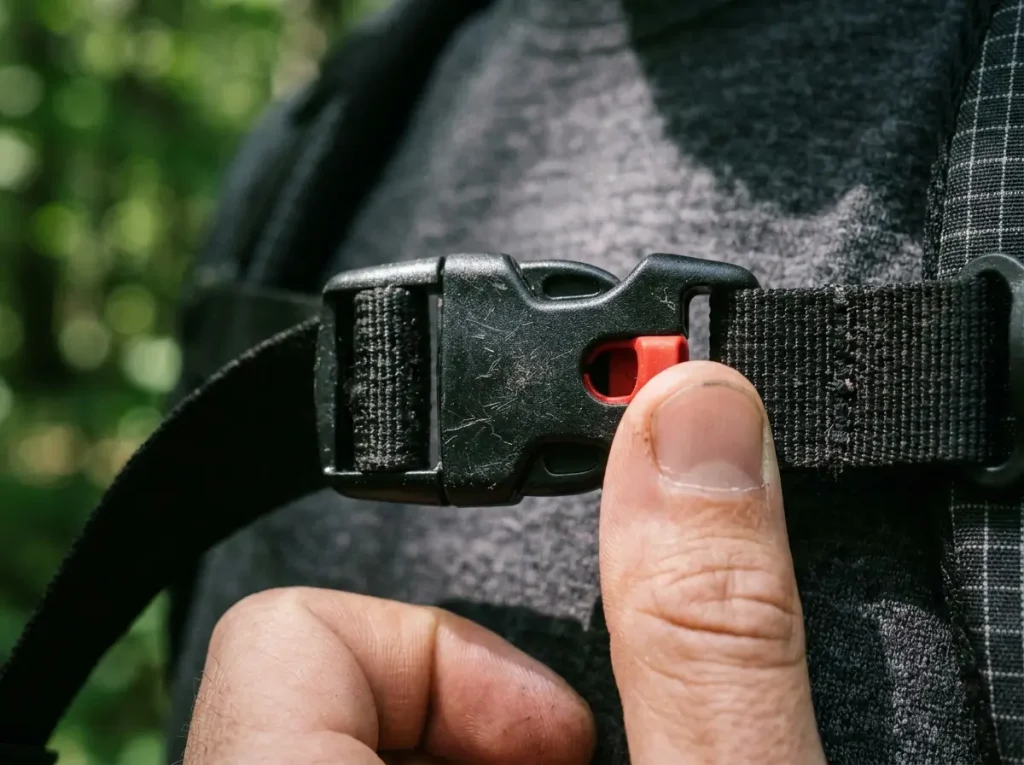
A few small things hang off this one strap that rarely get a mention, and a couple of them are genuinely worth knowing before you need them.
The whistle buckle — reachable, but not a real signal
Look at your sternum buckle. On a lot of packs it doubles as a small emergency whistle buckle, and the height you set it at decides whether you can actually reach it and get it to your mouth in a hurry. A strap riding too low means fumbling for it at the worst possible moment. Be honest about what it is, though: these built-in whistles are quiet compared to a dedicated one, so it’s a nice backup, not your primary signal. It’s worth understanding how loud those built-in buckle whistles really are before you rely on one, and carrying a real whistle regardless.
Slick fabrics and when the strap matters most
The strap pulls its weight mostly when your shoulder straps want to slide. Smooth, slick fabrics like a wind shell let the straps skate right off your shoulders, and that’s exactly when the sternum strap saves you. On a grippy cotton shirt with a light load, you may barely notice whether it’s clipped at all. Match how much you fuss over the strap to what you’re wearing and how heavy you’re loaded.
Small tweaks worth stealing
Two more from the field. Repositioning the strap up or down partway through a long day moves the pressure off a tired spot, which is a free comfort reset. And some hikers repurpose the strap webbing as an anchor for a small clip-on chest pocket for a phone or a snack, since it’s right there at the center of your chest. None of it is required gear knowledge, but it’s the kind of thing you pick up from people who’ve spent real time under a pack.
The Bottom Line
Aim the buckle a finger-width below your collarbones, snug but never strangling, with enough slack to pull a full breath. Read the feel before you read a ruler: pressure at the throat means too high, armpit chafe and slipping straps mean too low. And if you’ve run the slider to the end of its track and it still fights you, that’s the pack size talking, not the strap. Before your next hike, load the pack, set the strap by feel, and re-check it on the first climb. It’s five seconds of fiddling that changes the whole carry.
Frequently Asked Questions
01Do you really need a sternum strap on a backpack?
Not always. It is an anti-slip stabilizer, not a load-bearing strap, so on a light daypack with grippy clothing you may barely notice it. It earns its keep on heavier loads, roughly 22 pounds and up, and with slick shell fabrics that let the shoulder straps slide.
02Where should a sternum strap sit on a backpack?
About one inch below the collarbones, across the mid-chest, never directly over the collarbone where it presses the bone and restricts breathing. Slide it up or down the webbing rail until your shoulder straps stop pulling outward.
03How tight should a sternum strap be?
Snug, not cinched. Tighten it only until the webbing just starts to slip through your pinched fingers, then stop. You should still be able to take a full, deep breath, and if you cannot, it is too tight and needs backing off.
04Can you add or replace a sternum strap if your pack does not have one?
Yes. Many packs use an attachable strap that clips onto the daisy-chain webbing, and a universal replacement clip fits most standard shoulder straps. Most hikers never need to, since the strap usually ships on the pack, but it is an easy fix for an older pack that lost one.
05Why does my sternum strap make it hard to breathe?
Almost always because it is too tight or sitting too low near the diaphragm, both of which fight your chest as it expands. Loosen it, slide it up to about an inch below the collarbones, and re-check with a deep breath. Remember it expands more on a climb, so set it slightly loose.
Risk Disclaimer: Hiking, trekking, backpacking, and all related outdoor activities involve inherent
risks which may result in serious injury, illness, or death. The information provided on The Hiking Tribe is for
educational and informational purposes only. While we strive for accuracy, information on trails, gear, techniques,
and safety is not a substitute for your own best judgment and thorough preparation. Trail conditions, weather, and
other environmental factors change rapidly and may differ from what is described on this site. Always check with
official sources like park services for the most current alerts and conditions. Never undertake a hike beyond your
abilities and always be prepared for the unexpected. By using this website, you agree that you are solely
responsible for your own safety. Any reliance you place on our content is strictly at your own risk, and you assume
all liability for your actions and decisions in the outdoors. The Hiking Tribe and its authors will not be held
liable for any injury, damage, or loss sustained in connection with the use of the information herein.
Affiliate Disclosure: We are a participant in the Amazon Services LLC Associates Program, an
affiliate advertising program designed to provide a means for us to earn advertising fees by advertising and linking
to Amazon.com. As an Amazon Associate, we earn from qualifying purchases. We are also an official affiliate partner
of Black Diamond Equipment via the AvantLink network. If you click on a Black Diamond affiliate link and make a
purchase, we may earn a commission at no additional cost to you. We also participate in other affiliate programs and
may receive a commission on products purchased through our links. Additional terms are found in the terms of
service.