In this article
The trail turns steep on the descent. Your knees ache, your pack feels like it’s filled with lead, and you shift your full weight onto your right pole to negotiate a drop-off. Suddenly—without a creak or warning—the shaft collapses. Gravity takes over. You stumble forward, bracing for impact on the granite below.
In that split second, the difference between a bruised ego and a season-ending injury comes down to a mechanism smaller than your thumb.
As a mountaineering instructor who has spent decades guiding groups through the Rockies and the Cascades, I have seen this scenario play out more times than I care to count. It rarely happens in the parking lot; gear failure waits for the moment the system is under maximum load. We tend to view hiking poles as static sticks, but they are engineered safety systems. Trekking pole maintenance is not just about keeping your gear shiny; it is about ensuring the gear longevity and mechanical integrity of your “third and fourth legs” when you need them most.
By the end of this guide, you will stop thinking like a consumer of disposable gear and start thinking like a “Field-Ready Mechanic.” You will learn to diagnose stuck mechanisms, chemically restore seized metal, and engineer structural repairs miles from the nearest trailhead.
Why Do Trekking Poles Fail and How Can We Prevent It?

What is the Physics Behind the Locking Mechanism?
Trekking poles rely entirely on Tribology—the science of friction—to support your weight. Whether your poles use an internal twist lock (expander) found on classic models, an external flip lock (lever) common on Black Diamond or Diorite poles, or the push button release of a Z-pole, the holding force is generated by the Static Coefficient of Friction multiplied by the pressure applied. The engineering requirement is simple: the holding force must exceed your body weight plus your pack weight to prevent the telescopic pole segments from sliding.
Manufacturers design the interface between the aluminum or carbon fiber shafts and the plastic locking components to have a specific, high friction coefficient when clean and dry. This is where most outdoor enthusiasts inadvertently sabotage their own safety.
The “Lubrication Fallacy” is the most dangerous mistake you can make. Introducing oil, WD-40, 3-in-One Oil, or silicone spray reduces the friction coefficient drastically. To compensate for this loss of grip, the locking mechanism would need to exert three to four times the normal pressure to hold the same weight. This usually exceeds the breaking point of the plastic levers or the internal tension block.
The primary goal of routine hygiene is absolute dryness and cleanliness. Any residue that lowers friction turns a safety device into a liability. This understanding is crucial when adjusting hiking pole length to ensure the lock holds reliably at your desired setting.
Pro-Tip: If you have accidentally lubricated your poles, you must strip them completely. Use a degreaser or high-percentage rubbing alcohol to wipe down the shafts and the locking mechanism until the surface feels “squeaky” and resistant to the touch.
Scientific data supports this approach. You can review coefficient of friction experiments for aluminum interfaces to see just how drastically lubricants reduce holding power.
What is the Proper Cleaning Protocol to Preserve Function?
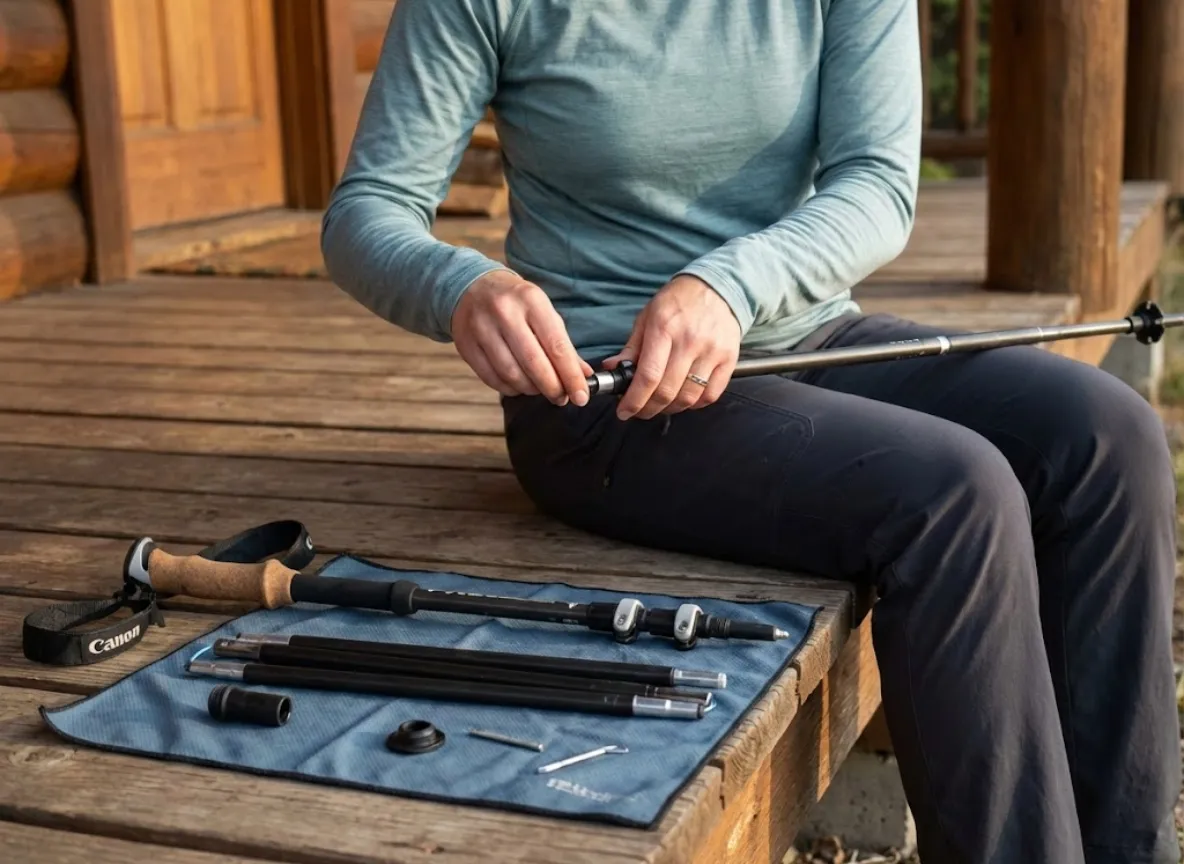
The “Deep Clean” protocol begins with total disassembly. You must dismantle poles segment by segment, pulling the sections completely apart to expose the inner overlapping zones. This is the only way to access the grit and grime that grinds away at the material.
Washing should be done with a mild detergent or dish soap and warm soapy water. This removes sweat oils and trail dust. A nylon brush or an old toothbrush works wonders for scrubbing the interior of the tubes and the threads of the expander.
Rinsing is the step most people rush, but it is critical. Residual soap can act as a lubricant, which defeats the purpose of cleaning. Rinse the tubes until the water runs perfectly clear and the surface drags against your finger rather than sliding.
Grips need attention too. A cork grip absorbs sweat differently than an EVA foam grip, and salty residue can eventually rot the wrist strap stitching. Scrub these gently with water and let them breathe.
Drying is where the battle against corrosion is won or lost. After you give each trekking pole section a thorough rub-down with a rag or lint-free cloth, the poles must dry disassembled and vertically, standing upright in a corner, for at least 24 to 48 hours.
Reassembling a pole while moisture is trapped inside creates a humid micro-climate. This accelerates oxidation in aluminum or promotes mildew. For twist locks, inspect the plastic expander wedge. If it looks glazed or shiny, scuff it gently with fine grit sandpaper to restore its grip texture.
Proper maintenance isn’t just a chore; it is a vital part of the hiking gear lifecycle, extending the usability of your equipment and delaying the need for recycling or replacement parts.
Standards set by organizations like the ISO reinforce these protocols. The ISO 13992:2014 standards for pole durability highlight the importance of maintaining mechanical integrity through proper care.
How Do You Restore Function to Damaged or Seized Poles?
How Can You Safely Unfreeze a Seized Aluminum Pole?
Seized poles are typically caused by Aluminum Oxide, a white, chalky corrosion product. This oxide occupies more volume than the metal itself, effectively welding the tubes together via an interference fit.
The mechanical approach involves Thermal Shock. Pour boiling water over the outer tube to cause it to expand, while keeping the inner tube cool with an ice pack. This differential expansion can often break the oxide bond and un-seize the joint.
If heat fails, avoid using pliers, which will crush the thin tubes. Instead, use a “friction grip” technique with rubber shelf liners or have two people twist in opposite directions to generate torque without deformation.
If force fails, we turn to the “Nuclear Option”: chemical dissolution using Ammonia. Unlike strong acids that eat the metal, ammonia specifically attacks the aluminum oxide lattice.
Soak the seized joint in a household ammonia solution for one to two hours. This peptizes the aluminum hydroxide gel, allowing the poles to slide apart. Once separated, the “white powder” must be mechanically removed with a fine-grit abrasive like steel wool or 400-grit sandpaper before the pole is washed and returned to service.
This failure mode is specific to metal. Understanding aluminum corrosion mechanisms can help you decide if you want to deal with this maintenance or switch materials, a key factor in the carbon vs. aluminum poles debate.
How Do You Check for Invisible Damage in Carbon Fiber?
Unlike aluminum, which bends when stressed (ductile failure), carbon fiber is brittle. It can harbor invisible internal delamination that leads to sudden, catastrophic failure.
The “Coin Tap Test” (Sonic Resonance Testing) is a non-destructive testing method borrowed from the aerospace industry. It is the most effective way to detect these flaws at home during a pre-season inspection.
Gently tap a coin, such as a quarter, along the length of the shaft at 1-inch intervals. You are listening for a consistent, sharp “ping” or “ring.” A compromised section, where the epoxy matrix has separated from the carbon layers, will produce a dull, dead “thud” or a sudden change in pitch.
Any pole that fails the tap test or shows deep gouges exposing raw fibers should be retired immediately. The risk of the shaft snapping and creating a jagged spear during a fall is too high. You should also inspect the joints where carbon meets aluminum, as galvanic corrosion can weaken the bonding agents.
Checking for these structural signs of wear or damage is consistent with certification marks for trekking poles, ensuring your gear meets safety standards. This diagnostic process is often the deciding factor when weighing trekking poles: ultralight vs. durability.
What Are the Best Emergency Field Repair Techniques?
How Can You Fix a Snapped Shaft in the Backcountry?
A snapped shaft requires a Splint to restore bending resistance. A simple wrap of tape offers zero structural rigidity against the bending moments of hiking.
The ideal repair uses a V-shaped tent stake or a sturdy green branch acting as a rigid bridge. Align the broken ends carefully, trimming loose carbon fibers if necessary. Place the splint along the shaft, ensuring it overlaps the break by at least 3 to 4 inches on either side.
Secure the splint using Duct Tape or medical tape. Do not just wrap randomly. Anchor the top and bottom of the stake first to prevent sliding.
Follow with a spiral wrap along the entire length to create “Hoop Strength” (compression). If you have zip ties, use them for maximum tightness. Treat the repaired pole as a “cane” for balance only. It is compromised and should not be trusted with your full body weight on steep descents.
To perform this repair, you need the right tools in your pack. A well-stocked DIY hiker’s emergency kit should always include duct tape and zip ties for these MacGyver fixes. Understanding the tensile properties of carbon fiber composites highlights why a rigid splint is necessary to counter the material’s brittleness.
How Do You Replace a Lost Tip Without Factory Tools?
Carbide tips are often held on by friction or heat-sensitive adhesive. If one is lost, you can improvise a replacement if you carry a spare or scavenge one from a broken pole found on the trail. Note that you may need to remove the mud basket or snow basket to access the ferrule.
To remove a damaged tip housing in the field, use boiling water. Submerge the tip for 30 to 60 seconds. This softens the factory glue enough for you to twist it off with pliers or a multi-tool.
If you have a spare tip but no superglue, look to the trees. You can utilize Pine Resin (pitch) collected from a coniferous tree wound.
Mix the melted resin with a small amount of crushed charcoal from a campfire. The charcoal acts as a binder, creating a natural “hot melt” adhesive that is surprisingly durable once cooled. Press the new tip onto the resin-coated shaft and let it cure. This bushcraft style fix restores traction and prevents the pole shaft from fraying against the ground.
This kind of improvisation requires knowing your gear inside and out, a topic covered in trekking poles 101. The effectiveness of this field repair is backed by the historical use of resin, as detailed in studies on the adhesive properties of natural resins.
Pro-Tip: If you cannot find resin, a small strip of duct tape wrapped around the shaft tip can provide enough friction to hold a replacement tip in place for a few miles, though it lacks the durability of a bonded fix.
Final Thoughts
True outdoor competence is not about buying the most expensive Leki poles or ultralight gear; it is about understanding how that equipment works and how to keep it working.
Remember the core principles: Friction is King, and lubricants are the enemy. When corrosion strikes, use Chemistry over Force—ammonia is safer than pliers. If a break occurs, Splint for Structure because tape alone is useless. And finally, Listen to your Gear; the coin tap test is a simple ritual that can prevent a catastrophic injury.
Before your next expedition, perform the “Coin Tap Test” and check your locking mechanism tension. Share your own field repair stories in the comments below to help the community learn.
FAQ – Frequently Asked Questions about Trekking Pole Maintenance
Should I use WD-40 to lubricate my trekking poles?
Absolutely not. WD-40, 3-in-One Oil, and silicone spray leave an oily residue that destroys the friction required for the locking mechanism to hold weight, leading to dangerous slippage.
How do I fix a bent trekking pole (aluminum)?
You can carefully straighten it by hand over a rounded surface (like a knee or thigh), but be aware that the metal is now work-hardened and significantly weaker. It should be replaced after the trip.
What is the white powder on my trekking poles?
This is aluminum oxide, a corrosion caused by storing wet poles. It can seize the joints and should be removed with a fine abrasive or dissolved with ammonia.
How should I store my trekking poles for the winter?
Store poles loosely, fully disassembled, clean, and unlocked in a dry, temperature-stable environment. Avoid a damp cellar or leaving them in a hot car, as moisture leads to corrosion and heat can warp plastic parts.
Risk Disclaimer: Hiking, trekking, backpacking, and all related outdoor activities involve inherent risks which may result in serious injury, illness, or death. The information provided on The Hiking Tribe is for educational and informational purposes only. While we strive for accuracy, information on trails, gear, techniques, and safety is not a substitute for your own best judgment and thorough preparation. Trail conditions, weather, and other environmental factors change rapidly and may differ from what is described on this site. Always check with official sources like park services for the most current alerts and conditions. Never undertake a hike beyond your abilities and always be prepared for the unexpected. By using this website, you agree that you are solely responsible for your own safety. Any reliance you place on our content is strictly at your own risk, and you assume all liability for your actions and decisions in the outdoors. The Hiking Tribe and its authors will not be held liable for any injury, damage, or loss sustained in connection with the use of the information herein.
Affiliate Disclosure: We are a participant in the Amazon Services LLC Associates Program, an affiliate advertising program designed to provide a means for us to earn advertising fees by advertising and linking to Amazon.com. As an Amazon Associate, we earn from qualifying purchases. We also participate in other affiliate programs and may receive a commission on products purchased through our links, at no extra cost to you. Additional terms are found in the terms of service.