In this article
Your hiking partner just took a bad step on loose scree. Now she’s crumpled at the base of a talus field, clutching her ankle, face white as the glacier above you. You’re four hours from the trailhead, cell service doesn’t exist, and everything you learned in that office CPR class suddenly feels absurdly inadequate.
This is where urban first aid ends—and wilderness medicine begins. After years of leading groups into Colorado’s backcountry, I’ve treated everything from deep wounds to anaphylaxis far from any ambulance. The difference between a manageable situation and a disaster often comes down to one thing: knowing what actually works when definitive care is hours away.
This guide walks you through the patient assessment system that prevents life-threatening conditions from being missed, the protocols that matter most in backcountry emergencies, and how to choose the right wilderness first aid training for your adventure style.
⚡ Quick Answer: Wilderness first aid differs from urban first aid because you become the hospital—not just the person who stabilizes until EMS arrives. The core skill is the Patient Assessment System (PAS): a systematic checklist that catches life threats even when adrenaline is screaming. For most recreational hikers, a 16-hour WFA course from NOLS or WMA provides adequate training; professionals should pursue WFR certification.
Why Urban First Aid Fails in the Backcountry

Standard first aid training operates on a simple assumption: help is minutes away. Call 911, apply pressure, wait for the ambulance. That model collapses the moment you step beyond cell range.
The “Golden Hour” that drives urban trauma care—the principle that surgical intervention within 60 minutes dramatically improves outcomes—becomes meaningless when you’re a six-hour carry from the trailhead. In remote environments, the rules change completely. You’re not stabilizing until the paramedics arrive. You ARE the paramedics, often for 12 to 72 hours.
This isn’t just a logistical problem. The physiology of trauma itself works differently in wilderness settings. A hypothermic patient bleeds faster because cold temperatures inhibit the body’s clotting cascade—a phenomenon medics call cold coagulopathy. This creates a brutal equation: the patient who needs the longest evacuation is also the one losing blood most rapidly.
Average rescue costs range from $1,200 for ground extraction to over $12,000 for helicopter evacuation with Good Samaritan protections. Weather frequently grounds aircraft. In alpine and canyon environments, assume a carry-out, not a fly-out. The financial and logistical realities make self-reliance skills the most valuable piece of “gear” you’ll ever carry.
Pro tip: The biggest mindset shift in wilderness medicine isn’t learning new techniques—it’s accepting that your job isn’t to stabilize until help arrives. Your job is to BE the help until you can get the patient out.
The “Golden Hour” vs. The Wilderness Reality
Urban trauma care follows the “scoop and run” model: minimize field interventions because the operating room is 15 minutes away. Wilderness medicine flips this to “stay and play”—you must stabilize because the hospital may be days away.
Consider a dislocated shoulder. In the city, you splint it and transport. In the backcountry, leaving that shoulder dislocated for 12+ hours causes permanent nerve damage and forces a litter carry. Under proper training and protocols, a wilderness responder may reduce that joint in the field to restore circulation and allow the patient to walk out. That’s a call urban EMTs never face.
The implication for the Ten Essentials for day hiking preparedness extends beyond gear. Your mental toolkit matters just as much as your physical one.
When 911 Isn’t an Option
Satellite communicators like the Garmin inReach enable SOS calls from anywhere, but they don’t change the fundamental calculus. Average SAR response still takes 4-12 hours in favorable conditions. In bad weather, that stretches to days.
Even with communication, you must provide patient assessment data—vital signs, mechanism of injury, evacuation decision category—so SAR can dispatch appropriate resources. A vague “someone is hurt, send help” message forces responders to prepare for worst-case scenarios, potentially delaying the targeted response your patient actually needs.
The Patient Assessment System (PAS): Your Backcountry Lifeline
When adrenaline hits and conditions deteriorate, your brain wants to freeze or flail. The Patient Assessment System exists to override that panic with a rigid, linear algorithm designed for one purpose: ensure no life-threatening condition gets overlooked.
Both NOLS Wilderness Medicine and Wilderness Medical Associates teach variations of the PAS as the cornerstone of their curriculum. It’s the single skill that separates trained responders from well-meaning bystanders. The structure follows a predictable sequence: Scene Size-Up, Primary Assessment, Secondary Assessment, and Ongoing Monitoring.
The PAS isn’t about memorizing steps—it’s about building a reflex that fires automatically when everything goes wrong. After my third WFA certification recert, I finally understood that the checklist exists to protect you from yourself when stress degrades your thinking.
Scene Size-Up—Before You Touch Anyone
Before any patient contact, you must secure the scene. The mnemonic “I’m #1” reminds you that rescuer safety is paramount. If you get injured by rockfall, avalanche, or swift water, the crisis compounds—one patient becomes two.
Body substance isolation means gloves go on before hands touch patients. Infection is a delayed but lethal threat in the backcountry, and protecting yourself from bloodborne pathogens is both medically and legally required. Count patients: in lightning strike or avalanche scenarios, quiet victims may be more critical than loud ones.
The mechanism of injury tells you what to expect. Did they fall? How far? Head-first or feet-first? Onto rock or snow? This detective work informs your index of suspicion for spinal injury and internal bleeding.
Primary Assessment—Finding the Immediate Killers
Two assessment frameworks dominate wilderness medicine: ABCDE (traditional) and MARCH (tactical/military-derived).
The ABCDE sequence prioritizes the airway: Airway → Breathing → Circulation → Disability → Environment. The logic is simple—without oxygen, nothing else matters.
MARCH flips the priority: Massive hemorrhage → Airway → Respiration → Circulation → Hypothermia/Head. This reordering comes from military experience where combat casualties bleed to death faster than they suffocate. A severed femoral artery kills in 2-3 minutes; an obstructed airway takes longer.
For backcountry hikers, the practical recommendation is to use MARCH concepts within the ABCDE framework. If you see bright red spurting blood, skip the airway check and stop that bleed immediately. Then return to the systematic assessment.
Secondary Assessment and Vital Signs Trending
Once immediate threats are stabilized, the secondary assessment builds your clinical picture through a head-to-toe exam and patient interview. The SAMPLE history mnemonic guides this conversation: Symptoms, Allergies, Medications, Pertinent history, Last ins/outs (food, water, bathroom), Events leading to the injury.
In wilderness settings, single readings mean little—vital signs trending tells the real story. A heart rate rising from 80 to 100 to 120 over one hour indicates decompensating shock or internal bleeding. Track pulse rate and quality, respiration rate and effort, and skin condition (color, temperature, moisture). Pale, cool, clammy skin is the hallmark of shock.
Document everything in SOAP notes format—Subjective, Objective, Assessment, Plan. This becomes your handover document when SAR arrives, enabling seamless transition of care.
The Skills That Save Lives: Protocols for Backcountry Emergencies
Wilderness first aid training isn’t about learning everything—it’s about drilling the high-frequency, high-consequence scenarios until response becomes automatic. The “big three” emergencies where training makes the difference: severe bleeding, anaphylaxis, and musculoskeletal trauma requiring evacuation decisions.
Ankle injuries comprise 42% of all hiking injuries. Splinting skills are not optional—they’re the difference between a patient who walks out and a patient who requires a 10-person litter team for extraction.
Pro tip: Carry a functional kit, not a “feel good” kit. A tourniquet that you know how to use beats a 50-piece kit you’ve never opened.
Bleeding Control—When Minutes Matter
Direct pressure remains the first-line intervention, but “apply pressure and wait for EMS” fails when EMS is hours away. Modern trauma medicine has shifted tourniquet use from “last resort” to “first-line for life-threatening limb hemorrhage.”
A CAT tourniquet or SWAT-T are the gold standards; improvised tourniquets from belts and sticks often fail under real conditions. For junctional wounds—groin, armpit, neck—where tourniquets can’t reach, pack the wound cavity with hemostatic gauze or clean material and apply sustained pressure.
Expect a properly tightened tourniquet to be painful. That’s normal and necessary to occlude arterial flow.
Anaphylaxis Management—The Epinephrine Imperative
Anaphylaxis presents as respiratory distress plus skin signs (hives, swelling) OR shock symptoms plus skin signs. It’s systemic, not just “trouble breathing.”
Epinephrine is the ONLY drug that stops anaphylaxis. Antihistamines like Benadryl treat hives but will not save the patient’s life during a severe reaction. Administer the auto-injector immediately upon recognition—through clothing if necessary—into the outer thigh.
Evacuation is ALWAYS mandatory after epinephrine administration. The drug wears off in 15-20 minutes, and “biphasic reactions” (return of symptoms) occur in up to 20% of cases. Many states now allow WFA-certified individuals to carry and administer epinephrine under Good Samaritan provisions.
Spinal Injury—The Clearing vs. Protecting Decision
Historical practice immobilized everyone with a significant fall onto a backboard. Modern evidence shows backboards cause pressure sores, breathing difficulty, and complicate evacuation. The wilderness spine assessment and clearance protocols taught by NOLS and WMA allow trained responders to “clear” a spine in the field when specific criteria are met.
The patient must be reliable: sober, alert, no distracting injuries. There must be no spinal tenderness on palpation, normal sensation and movement in all extremities, and pain-free range of motion in the neck. If the patient fails ANY criterion, the spine must be protected during evacuation using improvised splints from sleeping pads and pack frames.
This paradigm shift from “always immobilize” to evidence-based clearing is one of the biggest updates in modern wilderness medicine.
Wound Cleaning—Dilution Is the Solution
Infection risk increases linearly with time to care. The backcountry standard is high-pressure irrigation: use a 20cc irrigation syringe or hydration bladder to physically flush bacteria and debris from the wound. NOLS recommends at least one liter of clean water per wound.
Never put hydrogen peroxide, iodine, or alcohol INSIDE a deep wound—they’re cytotoxic and kill healthy tissue. Use antiseptics only on the skin around the wound. Don’t suture in the field; suturing a contaminated wound creates an abscess. Use Steri-Strips to approximate wound edges while allowing drainage.
Evacuation Decisions: When to Walk Out vs. Call for Rescue
The evacuation decision is often the most consequential call a backcountry responder makes. Decisions fall into three categories: “Go Fast” (rapid evacuation or helicopter), “Go Slow” (assisted walk-out or deliberate carry), and “Stay Put” (patient can recover with rest).
Remember: a patient who can walk should walk. A litter carry for even two miles requires 6-10 people working in rotation. If you don’t have that team, creative assisted evacuation becomes essential.
The “Go Fast” vs. “Go Slow” Framework
“Go Fast” triggers include: uncontrolled major bleeding, anaphylaxis after epinephrine, loss of consciousness (even brief), worsening neurological status, rigid or distended abdomen, and chest wounds compromising breathing. Lightning strike patients always evacuate—even those who seem recovered require cardiac monitoring for delayed arrhythmias.
“Go Slow” applies to stable fractures with intact circulation distal to the injury, mild hypothermia (patient still shivering and responding to warming), and cleaned wounds without signs of infection. The hardest calls aren’t the obvious ones—it’s the “maybe” cases where you’re balancing the risk of moving against the risk of waiting.
Communicating with SAR—What They Need to Know
SAR teams base resource deployment on your information. Essential data includes: patient age and sex, mechanism of injury, current vital signs, injuries identified, interventions performed, ambulatory status, and exact GPS coordinates.
Use your SOAP note as the communication framework. Specify evacuation category clearly: “This patient needs wheeled litter extraction” versus “This patient can walk with assistance.”
Pro tip: If using a satellite messenger, pre-plan abbreviated message formats. Character limits matter when you’re typing on a tiny device in the rain with cold fingers.
Wilderness First Aid Training: Choosing Your Path
Four primary providers dominate the wilderness medicine training market: NOLS Wilderness Medicine, Wilderness Medical Associates, American Red Cross, and ECSI (primarily for Boy Scouts of America and scouting contexts).
Standard WFA certification courses run 16-24 hours over 2-3 days, covering assessment, basic interventions, and evacuation decisions. Wilderness First Responder (WFR) courses extend to 70-80 hours over 8-10 days, teaching diagnostic judgment, expanded medication use, and extended patient care.
Cost ranges reflect significant differences in training depth: Red Cross and ECSI run $40-200, while NOLS and WMA WFA courses cost $220-420. WFR certifications range from $800-1,400. Certification validity is typically two years.
For anyone transitioning from day hiking to multi-day backpacking into remote areas, training becomes increasingly essential.
NOLS vs. WMA vs. Red Cross—Which Is Right for You?
NOLS Wilderness Medicine emphasizes educational frameworks and leadership integration. Expect scenario-heavy training with 50%+ of time spent in outdoor simulations. Best for aspiring guides, trip leaders, and serious recreationists who value experiential learning.
Wilderness Medical Associates takes a clinical approach, with strong pathophysiology foundations taught by practicing medical professionals. Best for those wanting deep understanding of the “why” behind protocols.
American Red Cross focuses on accessibility with protocol-based training, often classroom-heavy with less outdoor simulation. Best for meeting basic requirements for Scouting America or camps, or budget-conscious beginners wanting foundational exposure.
Professional recognition differs significantly. NOLS and WMA certifications are universally accepted by guiding companies, government agencies, and outdoor schools. Red Cross is accepted for basic compliance but often considered insufficient for professional guiding.
WFA vs. WFR—How Much Training Do You Need?
For recreational weekend backpacking, WFA provides appropriate training. You’ll learn to recognize problems, stabilize patients, and activate emergency response. The 16-24 hours of training address the highest-probability scenarios most hikers will face.
WFR is appropriate for professional guides, expedition leaders, and those leading groups into multi-day remote terrain. The additional 50-60 hours teach extended care, expanded diagnostic skills, and medication administration protocols that go beyond recreational needs.
The cost-benefit reality: WFA at $300-400 is “insurance” for backcountry users. WFR at $1,000+ is a professional credential that opens career doors.
The WFA Kit: Gear That Matches Your Training
The ultralight versus preparedness tension is real, but a functional kit doesn’t have to be heavy. The core principle: never carry items you can’t use. A tourniquet is dead weight if you don’t know when and how to apply it.
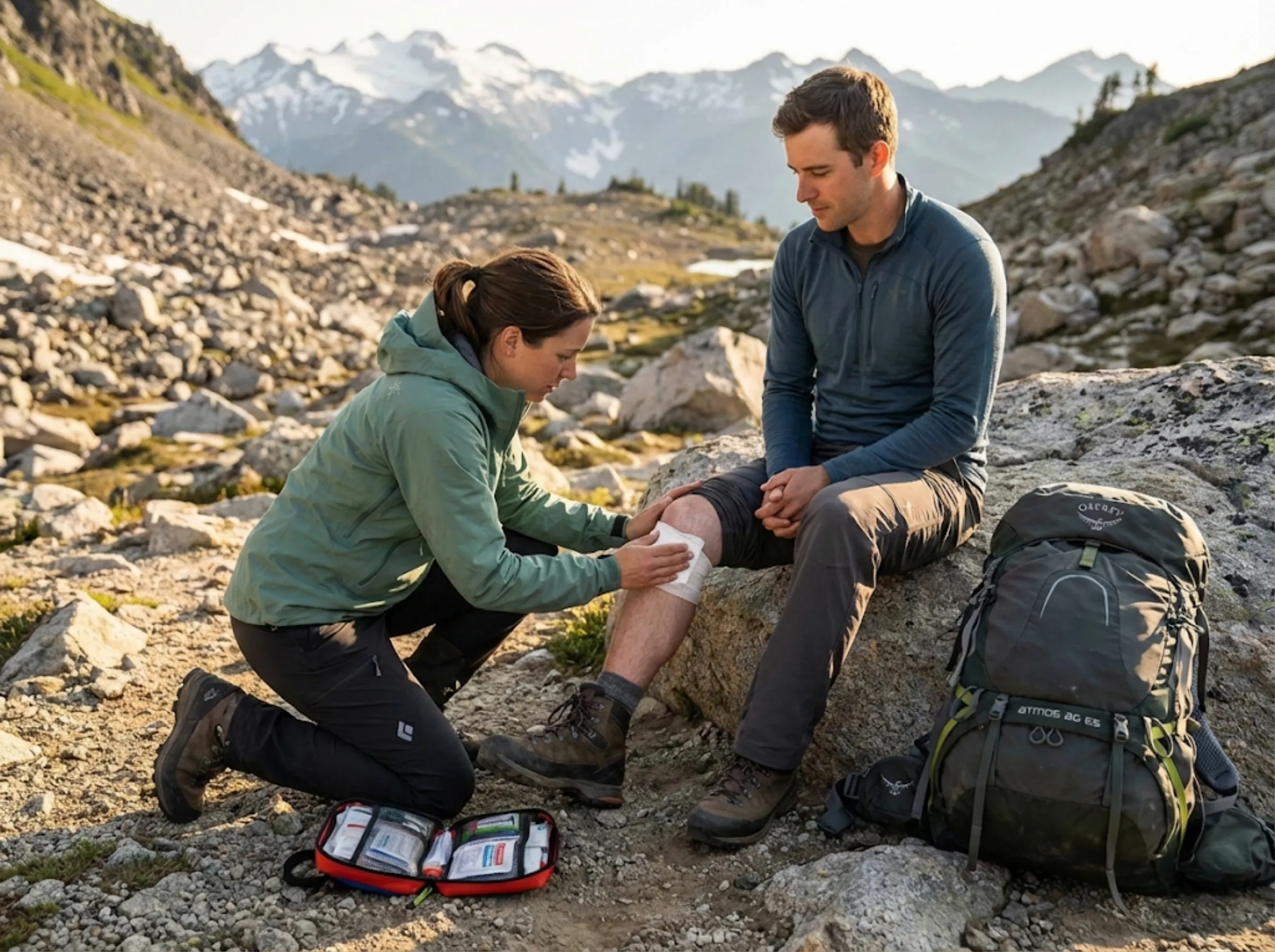
Prioritize items that cannot be improvised: tourniquets, irrigation syringes, hemostatic gauze, epinephrine (if trained and authorized), and Steri-Strips with tincture of benzoin for wound closure. Items that CAN be improvised—splints, slings, basic bandages—are lower priority to carry.
When building a functional hiking first-aid kit, start with a quality pre-made base and customize to your training level and trip profile.
The Functional Minimum—A Hybrid Approach
Non-negotiable items for a well-curated first-aid kit include: nitrile gloves (3-4 pairs), trauma shears, irrigation syringe (10-20cc), Steri-Strips, wound closure strips, gauze, elastic bandage, blister care supplies, and fine-tipped tweezers for tick removal.
Training-dependent additions include tourniquet, hemostatic gauze, and epinephrine. Medications worth carrying: ibuprofen, acetaminophen, diphenhydramine (for allergic reactions and sleep), loperamide (critical for managing diarrhea that leads to dehydration), and aspirin for cardiac events.
A well-curated kit weighs 12-16 ounces. A SAM splint adds 4 ounces but provides superior stabilization for wrist and ankle injuries compared to improvised alternatives.
Weight-conscious hikers focused on preventing and treating blisters on the trail should integrate blister-specific supplies into their first aid organization.
Conclusion
The Patient Assessment System saves lives. When adrenaline hits and conditions deteriorate, a systematic approach is the difference between panicked bystanders and effective responders.
Training matters more than gear. A tourniquet in untrained hands is dead weight; a simple bandage in trained hands can control arterial bleeding. Match your kit to your certification level, and never carry items you haven’t practiced using.
Know your evacuation triggers. The decision to walk out, call SAR, or wait is often the most consequential call in a backcountry emergency. Learn the “Go Fast” vs. “Go Slow” framework before you need it—not while you’re staring at an injured partner four hours from the trailhead.
The next time you lace up for a remote trail, take a hard look at your emergency preparedness. A 16-hour WFA course costs less than your tent and might be the most valuable piece of “gear” you’ll ever add to your pack.
FAQ
How long does it take to get Wilderness First Aid certified?
Standard WFA courses run 16-24 hours, typically delivered over 2-3 days. Online hybrid courses exist but lack the hands-on simulation that builds real competence. For most dedicated hikers, a full in-person course from NOLS or WMA provides the best outcome.
Is Wilderness First Aid the same as regular first aid?
No. Standard first aid assumes EMS arrival within minutes. Wilderness First Aid teaches extended patient care, evacuation decision-making, and improvisation skills for scenarios where professional help may be hours or days away. The assessment frameworks and treatment protocols differ significantly.
Can I administer epinephrine without medical training?
It depends on your jurisdiction and training. Many states extend Good Samaritan protections to trained laypersons administering epinephrine in emergencies. WFA and WFR courses teach recognition and administration protocols, and some outdoor organizations provide epinephrine under standing medical orders.
Do I need WFR if I just do weekend backpacking?
For recreational weekend backpacking, WFA provides appropriate training. WFR adds 50-60 hours of instruction teaching extended care and diagnostic skills that go beyond typical recreational needs. Consider WFR if you’re leading groups, working professionally outdoors, or venturing into truly remote multi-day terrain.
What’s the most common injury WFA training helps with?
Ankle injuries comprise 42% of all hiking injuries. WFA training teaches proper assessment to distinguish fractures from sprains, splinting techniques for stabilization, and evacuation decision-making—can they walk out with assistance, or do they need a carry? These skills apply to the majority of trail emergencies.
Risk Disclaimer: Hiking, trekking, backpacking, and all related outdoor activities involve inherent risks which may result in serious injury, illness, or death. The information provided on The Hiking Tribe is for educational and informational purposes only. While we strive for accuracy, information on trails, gear, techniques, and safety is not a substitute for your own best judgment and thorough preparation. Trail conditions, weather, and other environmental factors change rapidly and may differ from what is described on this site. Always check with official sources like park services for the most current alerts and conditions. Never undertake a hike beyond your abilities and always be prepared for the unexpected. By using this website, you agree that you are solely responsible for your own safety. Any reliance you place on our content is strictly at your own risk, and you assume all liability for your actions and decisions in the outdoors. The Hiking Tribe and its authors will not be held liable for any injury, damage, or loss sustained in connection with the use of the information herein.
Affiliate Disclosure: We are a participant in the Amazon Services LLC Associates Program, an affiliate advertising program designed to provide a means for us to earn advertising fees by advertising and linking to Amazon.com. As an Amazon Associate, we earn from qualifying purchases. We also participate in other affiliate programs and may receive a commission on products purchased through our links, at no extra cost to you. Additional terms are found in the terms of service.