
In this article
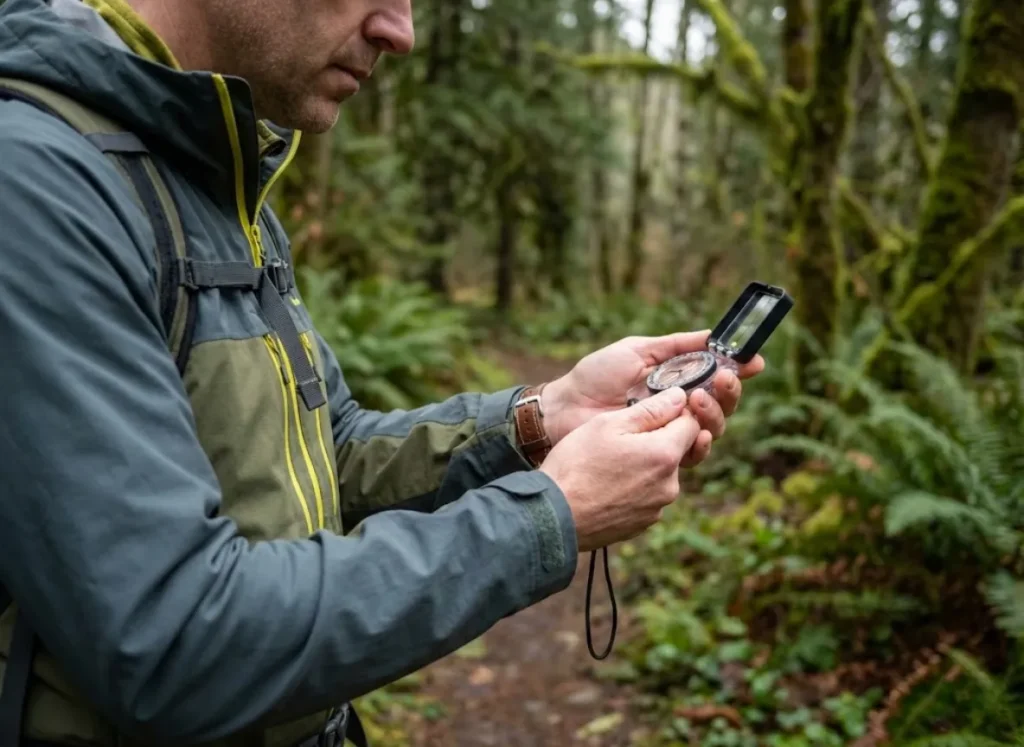
The sighting notch framed the distant ridgeline, but something was wrong. My bearing should have tracked me northeast toward the trailhead—instead, I’d been walking due east for two hours, adding miles to an already brutal descent. It wasn’t until I warmed the compass in my jacket that I realized the culprit: a pea-sized air bubble had formed overnight in the capsule, tilting the needle just enough to send me astray.
That’s the thing about baseplate compasses: the marketing makes them seem interchangeable. Rotating bezel, magnetized needle, transparent baseplate—feature lists blur together. But after years navigating above treeline and below cell coverage, I’ve learned that the small differences between a $30 compass and a $70 orienteering compass are measured in hours of lost time, or worse.
This guide dissects the features that actually matter—the ones that affect needle stability, bearing accuracy, and long-term reliability—so you can match the right navigational tool to your actual land navigation needs.
⚡ Quick Answer: The three features that separate serious navigation compasses from basic models are adjustable declination (eliminates mental math errors), liquid-damped needle settling speed (faster readings in the field), and operating temperature range (prevents cold-weather failures). For Northern Hemisphere hiking, a Suunto M-3 Global or Silva Explorer Pro handles most needs. For global travel, invest in a global needle model like the Suunto MC-2.
The Mechanics Inside the Capsule
How Liquid Damping Keeps Your Needle Stable
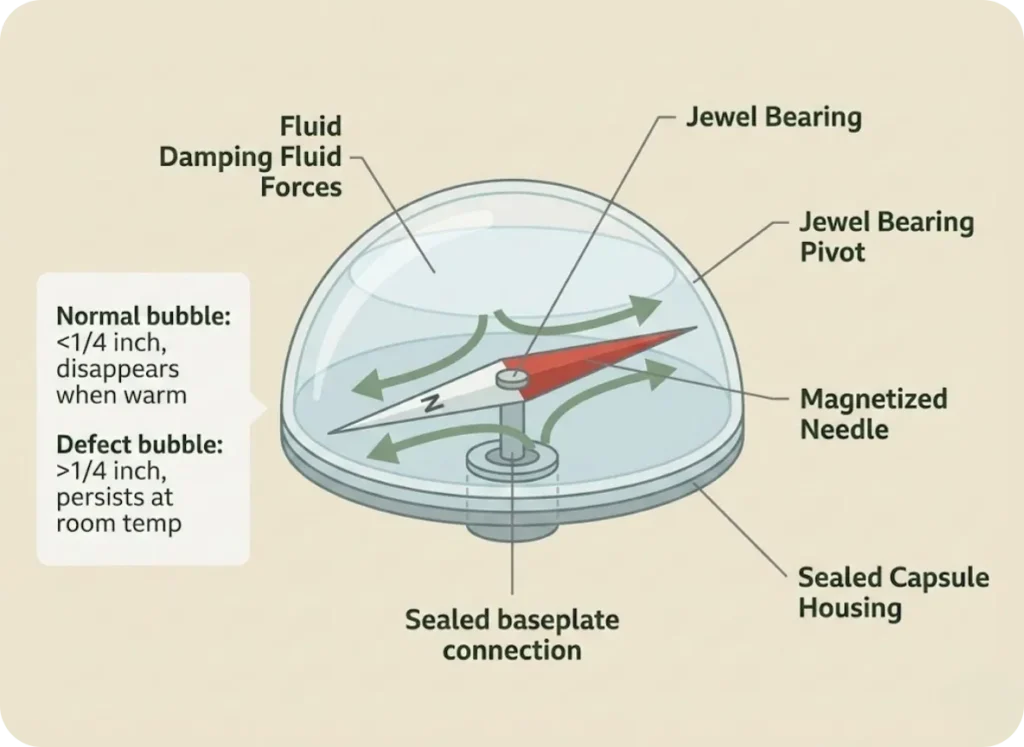
The compass housing isn’t just a decorative housing—it’s an engineered environment that determines how quickly your compass needle settles on north. Modern compasses use a low-viscosity petroleum distillate (typically Isopar M or mineral spirits) that dampens needle oscillation and cushions the jewel bearing pivot against shock damage.
Premium models like the Suunto MC-2 settle almost instantly. Budget compasses can require 5 or more seconds of waiting—time that adds up when you’re taking multiple bearings in deteriorating weather. The fluid damping mechanics also act as a shock absorber; dropping a liquid-filled housing compass causes far less internal damage than dropping a dry-card compass.
Pro tip: If your needle is sluggish in cold weather, cup the compass in your palms or slip it inside your jacket. Body heat thins the fluid and restores responsiveness within a minute.
The Suunto MC-2 Global is rated for operation between -30°C and +60°C (the widest temperature operating range in its class), while the Silva Ranger 2.0 handles -20°C to +60°C. That 10-degree difference matters for mountaineers operating in high-altitude or polar terrain where temperatures frequently drop below the Silva’s threshold.
The Bubble Question: Defect or Normal?
A small housing fluid bubble in your compass capsule sends many hikers into warranty-claim panic. The reality is more nuanced. Bubbles smaller than 1/4 inch (6mm) are typically thermal contraction artifacts—they appear when the compass is exposed to cold temperatures or high altitude and usually disappear as the compass warms.
Warming the compass with body heat or sunlight eliminates most thermal bubbles. A bubble becomes a defect only if it’s larger than a quarter-inch or persists at room temperature, indicating a seal breach and fluid loss. A leaking capsule degrades accurate navigation as fluid evaporates, and that’s a legitimate warranty claim worth pursuing.
If you’re curious about the broader context of reading topographic maps effectively, pair this knowledge with proper map reading skills—the clear base plate that allows you to see the map underneath exists specifically for map overlay navigation work.
Declination Adjustment: The Feature That Prevents Costly Errors
What Declination Actually Does (In Plain Terms)
Magnetic North and True North (map north) aren’t the same. The angular difference—called magnetic declination or magnetic variation—varies by location: roughly 14° west in Seattle, 14° east in Maine, and nearly 0° in the central US. Without correcting for variation, every bearing you take is off by that many degrees.
Here’s why that matters for trip planning: over a 10-mile hike, a 14° error puts you more than 2.4 miles from your intended destination. In dense forest or whiteout conditions, that error can mean the difference between reaching the trailhead and spending an unplanned night out on unknown terrain.
Magnetic declination values also change over time—about 0.1° per year in most areas. The isogonic lines on USGS topo maps show declination for a specific date, so you’ll want to check current values before planning your next backcountry trip.
Screw Adjustment vs. Tool-Free: The Reliability Debate
The mechanism for declination adjustment differs by brand, and this is where field reports get heated.
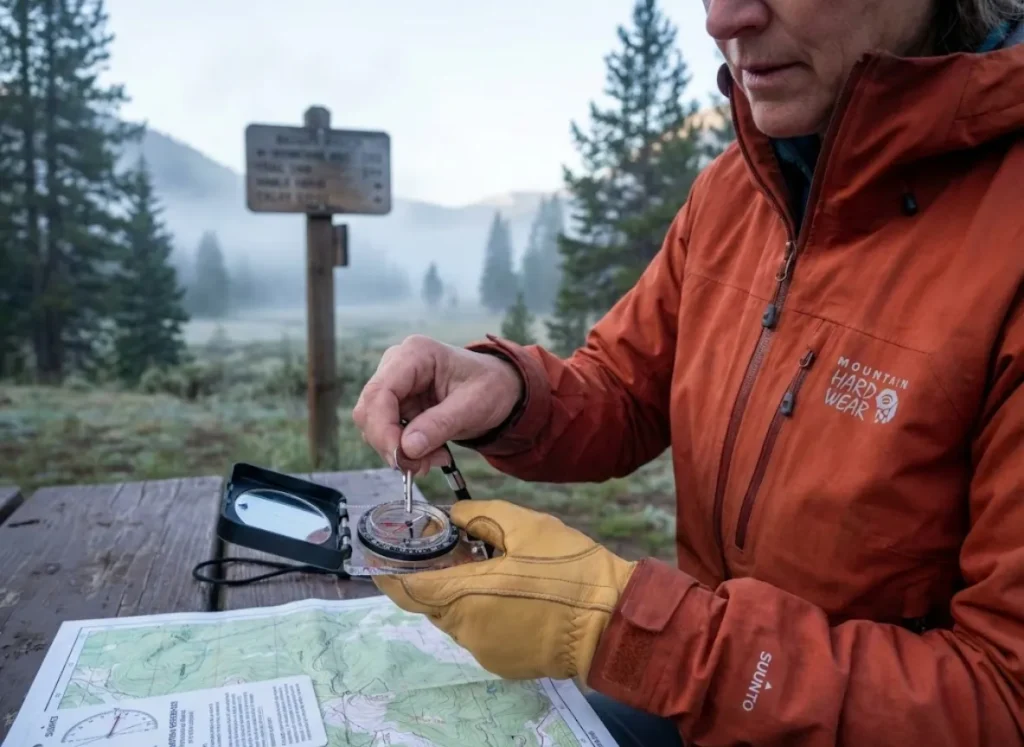
Suunto and Silva use a small metal key or screwdriver for gear-driven adjustment. Once set, the declination is secure—it won’t drift in your pack during multi-day off-trail treks. Andrew Skurka, a renowned long-distance backpacker, puts it directly: “Without this feature, it is necessary to manually adjust for declination… The adjustable declination feature minimizes errors, especially when fatigued.”
Brunton uses a tool-less adjustment friction mechanism. Convenient? Yes. Reliable? Contested. Forum users report the setting drifting from pack rub during backcountry trips. A 5° declination drift over 10 miles generates significant navigational error—the kind you won’t notice until you’re wondering why the lake isn’t where the map said it would be.
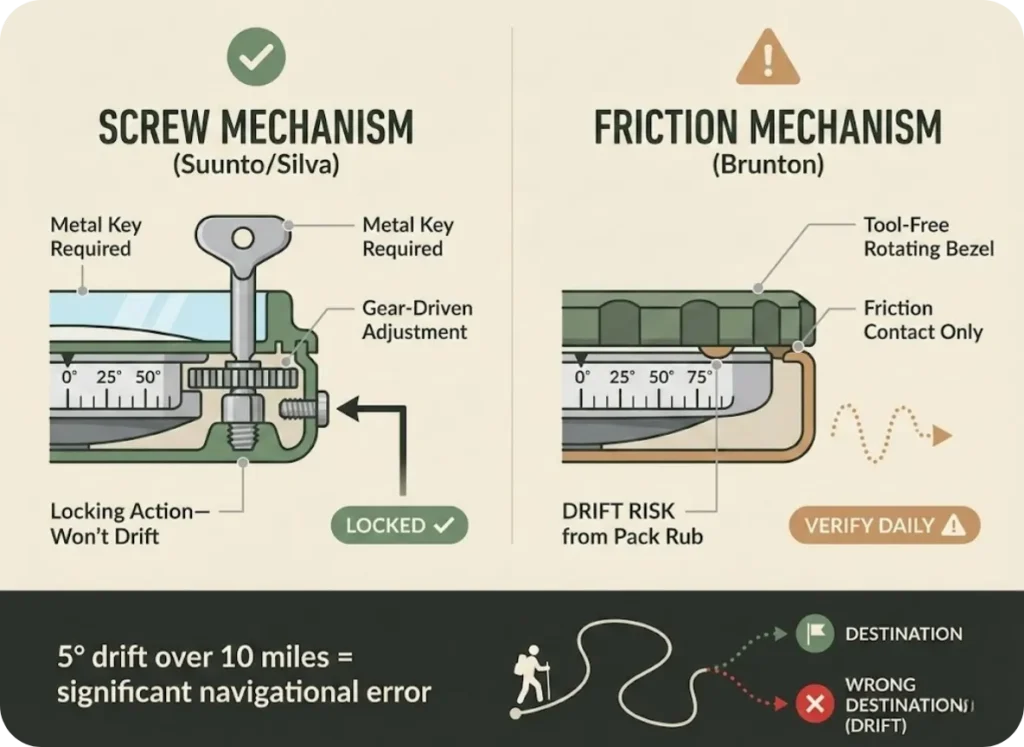
Pro tip: If you’re running a Brunton compass with tool-free adjustment, verify your declination setting every morning before setting out. It only takes 30 seconds and could save you hours of pathless terrain wandering.
For authoritative declination mechanics and adjustment instructions, Princeton’s OA Guide to Map & Compass provides detailed methodology from a trusted .edu source.
Global Needles: Do You Actually Need One?
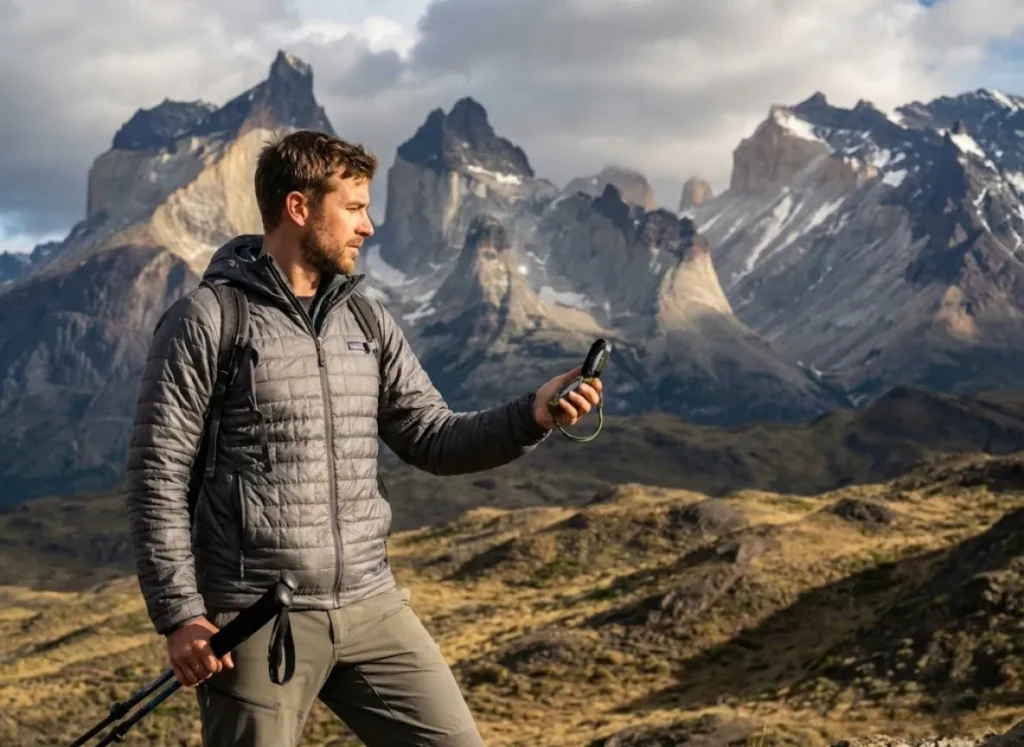
The Magnetic Dip Problem Explained
The Earth’s magnetic field doesn’t run parallel to the surface—it curves downward toward the poles in different balancing zones. This phenomenon, called magnetic dip, creates a hidden problem for travelers. Standard compass needles are weighted on one end to counteract this dip for a specific hemisphere. Take a compass balanced for North America to Patagonia, and the weighted end drags against the capsule, causing stuck needles or erratic compass readings.
The issue is mechanical, not calibration. A standard needle physically cannot operate correctly in the wrong magnetic zone—and there are five such zones around the globe.
How Global Needles Solve Cross-Hemisphere Navigation
Global needle designs use either a decoupled magnet or a counterweighted pivot that allows the needle to tilt up to 20° without interference. This permits a single capable compass to function in any magnetic zone on Earth.
The Suunto MC-2 Global and Brunton TruArc 15 feature proprietary global needle designs using sapphire jewel bearings to minimize friction even when the needle is tilted. The Silva Ranger 2.0 is balanced for the Northern Hemisphere by default—a global version is available separately at a premium from the dominant compass manufacturers.
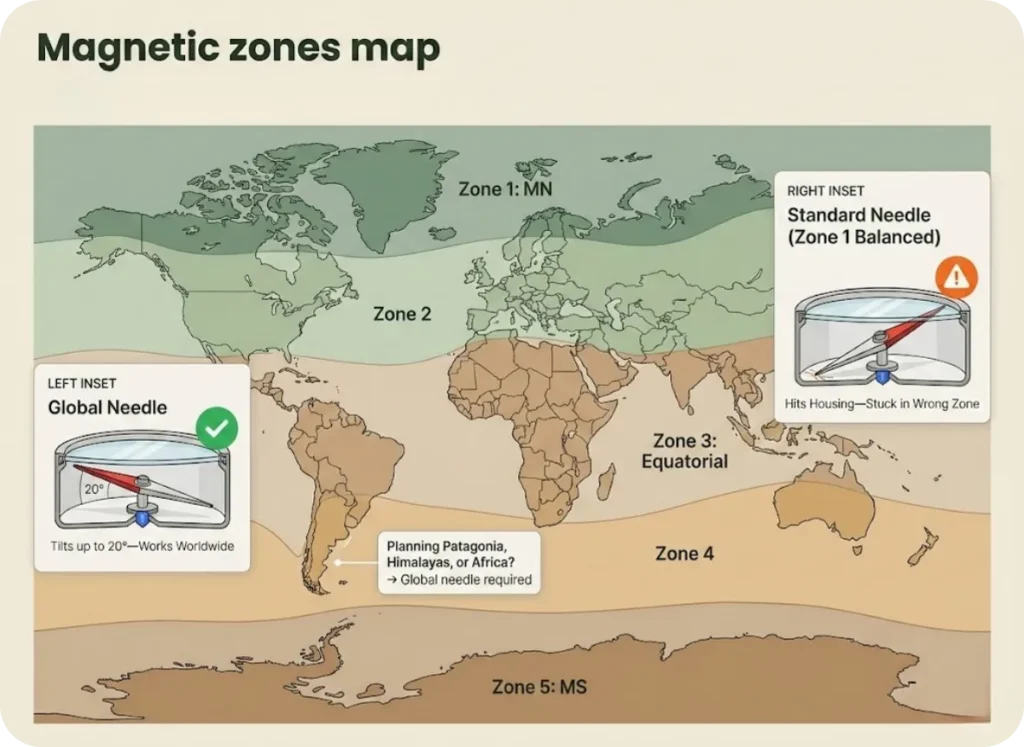
If you’re planning trips exclusively in North America and Europe, a standard needle compass serves you well. But if Patagonia, the Himalayas, or African trekking are on your bucket list, the global needle pays for itself by transforming your compass from a regional navigational tool to a worldwide precise navigation asset.
Mirror Sighting vs. Standard Baseplate
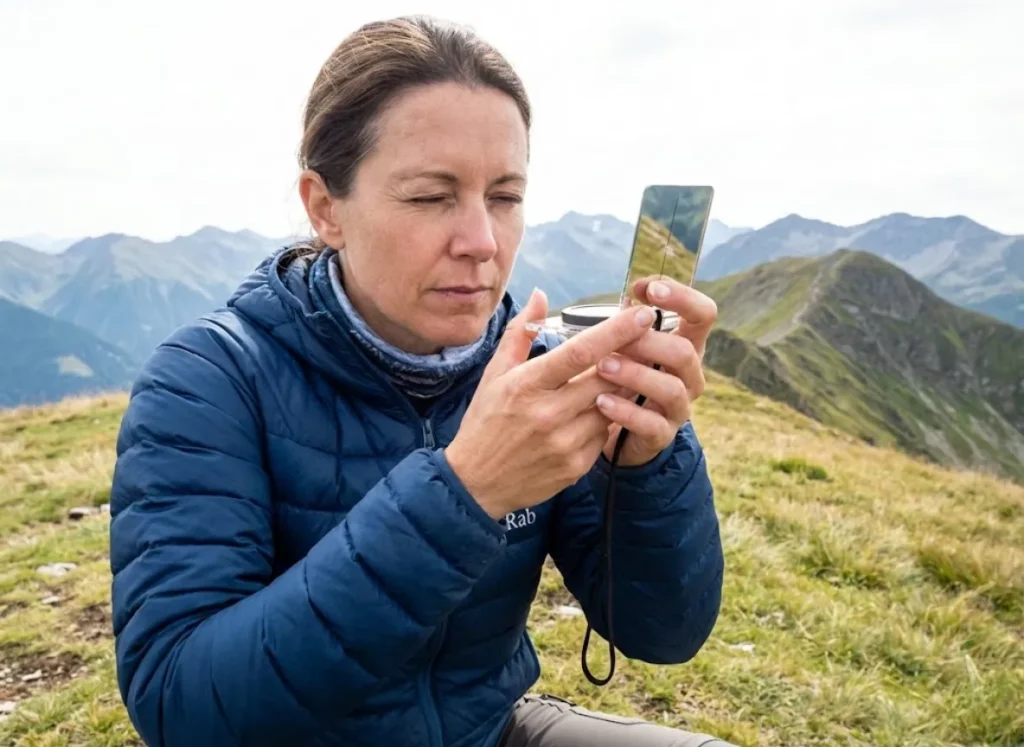
The Optical Advantage of Mirror Compasses
Standard base plate compasses require you to hold the compass at waist level, sight a landmark, then look down at the dial. This two-step process introduces parallax error—the apparent displacement of an object when viewed from different direction angles.
Sighting mirror compasses solve this by angling the mirror at approximately 45°, allowing you to simultaneously view the landmark through a sighting notch AND see the compass dial reflected in the mirror. Professional-grade model options like the Suunto MC-2, Silva Ranger 2.0, and Brunton TruArc 15 achieve roughly 2° accuracy with proper technique. Standard baseplates typically land at 3-5° accuracy depending on user skill.
The mirror also protects the compass housing when folded, serving as a cover against scratches. And in survival scenarios, it doubles as a signaling device for rescue—a secondary function that’s saved more than a few lives.
When Standard Baseplates Are Enough
Not every hiker needs a mirror compass. For marked trails, day hikes, and navigation where visible features are plentiful, a standard base plate like the Suunto A-10 or Silva Starter is lighter, cheaper, and perfectly adequate.
Mirror compasses add 20-30 grams of weight and increase bulk. Trail hiking with regular phone/GPS checks rarely requires 2° precision—you just need to confirm you’re heading the right approximate direction. Standard baseplates also excel for learning navigation fundamentals without the added complexity of the sighting technique.
The real deciding factor isn’t the mirror—it’s the declination adjustment and clinometer features that typically accompany mirror models. If you need those for advanced compasses, you’ll likely end up with a mirror compass anyway.
Beyond the Basics: Clinometers, Lanyards, and Specialty Features
Clinometers for Slope Assessment and Height Estimation
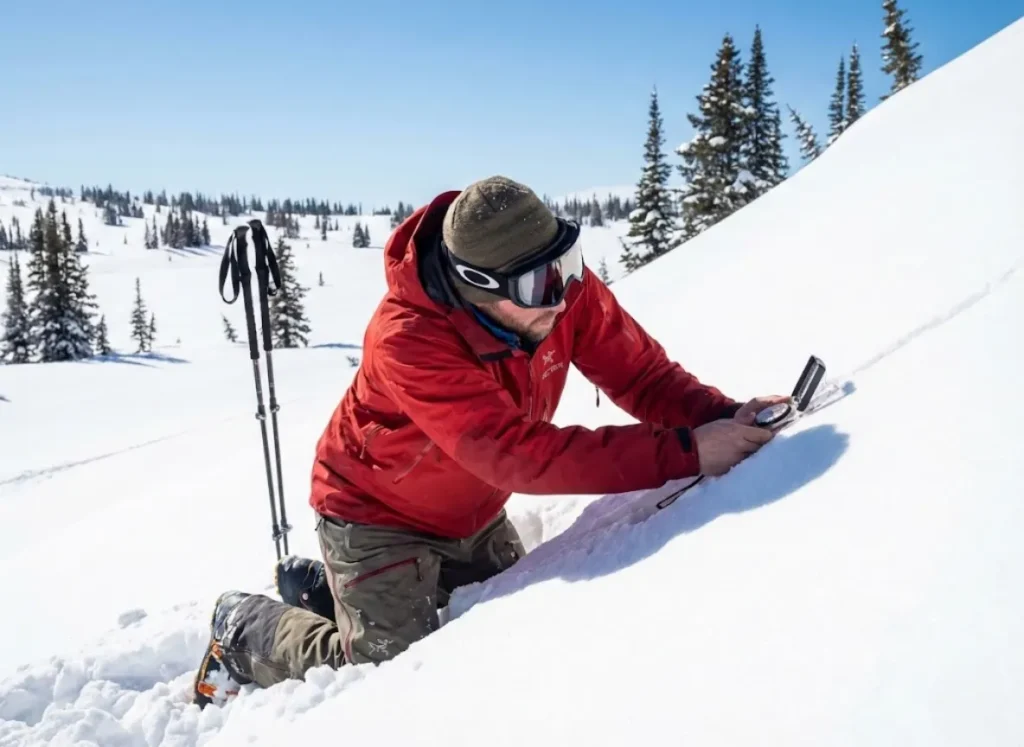
A clinometer is a gravity-driven needle (separate from the magnetic needle) that measures vertical angles. It’s embedded in the capsule of feature-rich compasses like the Suunto MC-2 and Brunton TruArc 15.
Primary use: assessing slope steepness measurement for avalanche risk assessment. The danger zone sits between 30° and 45°—prime avalanche terrain. Secondary use: estimating tree or cliff height using basic calculations. To read slope angle, turn the compass on its side, align the base plate edge with the slope, and read the angle where the clinometer needle settles.
The Brunton TruArc 15 features a “Triple Clinometer System” with readings available in both the capsule vial and the hinged lid. For hikers venturing into backcountry avalanche terrain, the clinometer feature moves from nice-to-have to essential.
Pro tip: Even if you’re not doing avalanche work, the clinometer helps assess terrain difficulty before committing to steep scrambles. A 35° slope looks different when you’re standing at the bottom than when you’re partway up with no good line of retreat.
Lanyards, Scales, and Ergonomic Touches
The lanyard with integrated scales on the Silva Ranger 2.0 is an overlooked feature. Unlike rigid inch rulers and cm rulers, this soft, bendable scale follows meandering routes on a map more accurately, featuring 1:24000, 1:25000, and 1:50000 scales for different map scale types.
Romer scales and UTM templates on the baseplate corner enable precise grid reference plotting for search-and-rescue coordination or geocaching. The DryFlex rubber grip on Silva bezels facilitates rotating bezel rotation with wet or gloved hands—a practical detail that matters for hand size ergonomics at 4 AM when frost covers everything.
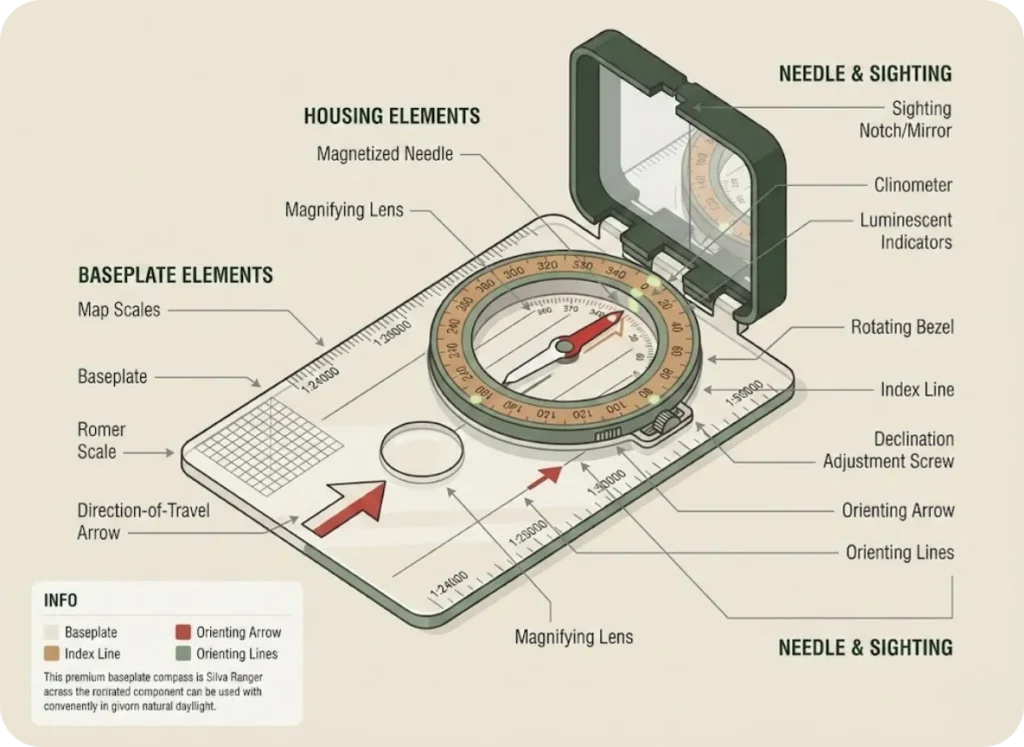
Luminescent indicators on premium compasses charge with a flashlight and hold for approximately 4 hours—long enough to navigate through a predawn start without killing your night vision with a headlamp.
Brand Breakdown: Suunto, Silva, and Brunton Compared
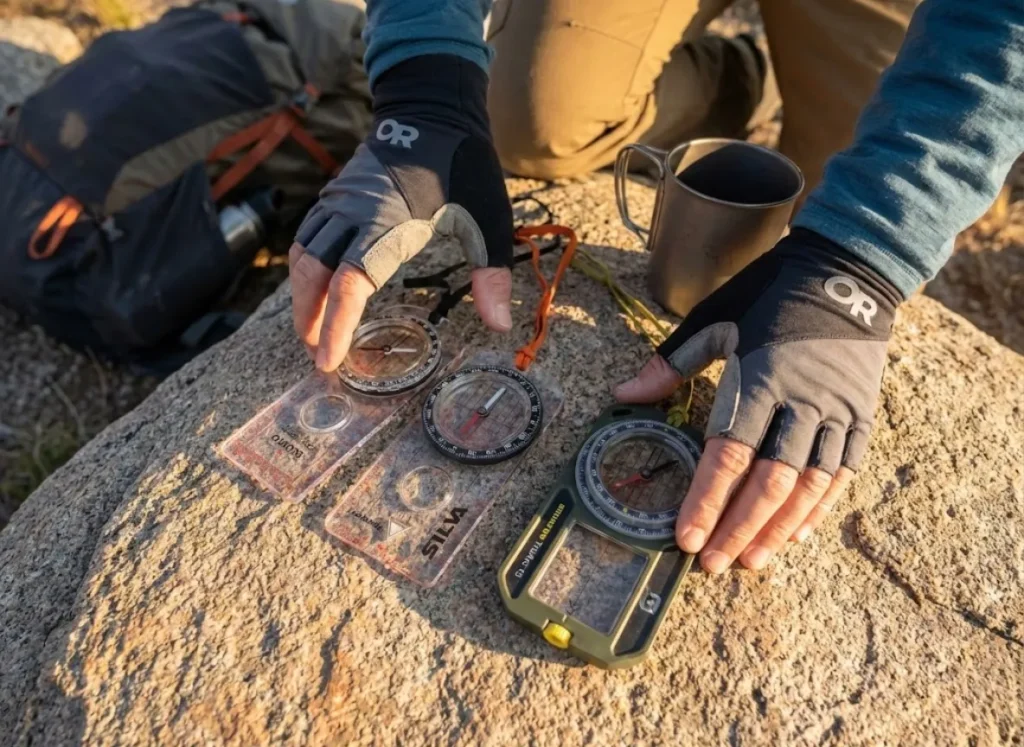
Suunto (Finland): The Reliability Benchmark
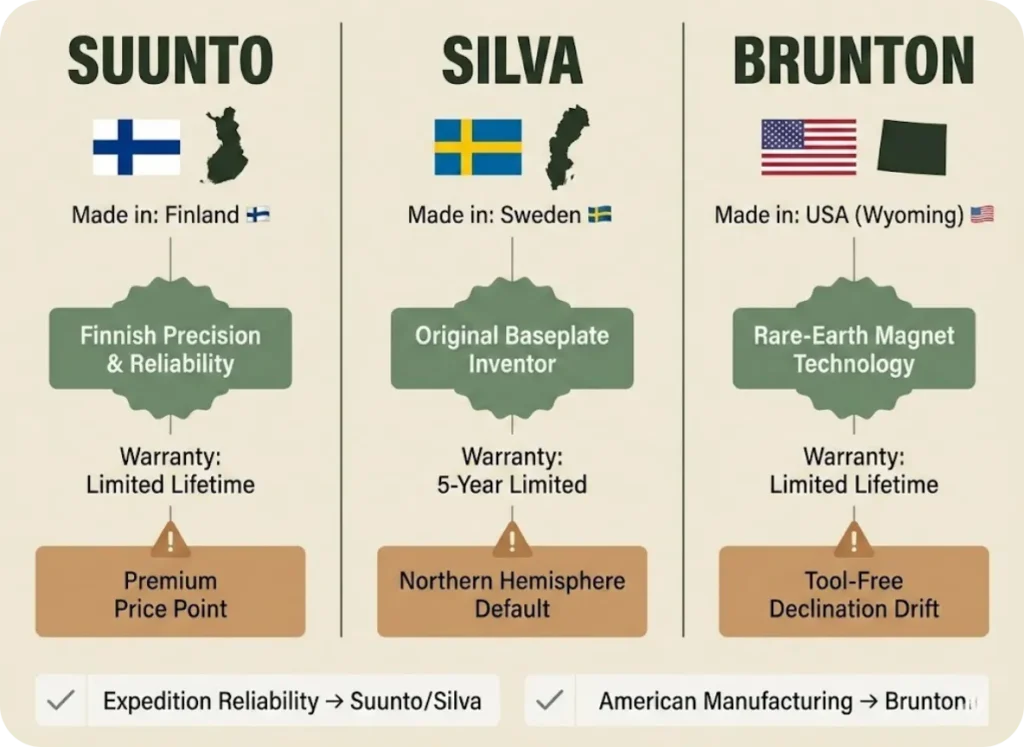
Premium Suunto compasses (MC-2, M-3) are still manufactured in Finland, and that provenance matters for field-tested reliability. Suunto holds the patent for the Global Needle design and backs premium lines with a Limited Lifetime Warranty—among the strongest warranty length commitments in the industry. Cold tolerance rating hits -30°C—the best in class.
The price premium reflects Finnish manufacturing and rigorous quality control. Andrew Skurka treats his Suunto M-3 Global as a 10-20 year investment through longitudinal testing, advising hikers to “buy it now, take care of it, and replace it in 10 or 20 years.” For Suunto’s official warranty terms and repairability options, check their warranty documentation.
Silva (Sweden/China): Heritage in Transition
Originally a Swedish innovator, Silva has shifted manufacturing of many models (including the Ranger 2.0) to China. Forum reports note increased quality control issues—housing fluid bubble formation and capsule leaks appearing more frequently than with older Swedish-made units or Finnish-made Suunto baseplates.
Still, the Silva Ranger 2.0 remains a staple in outdoor education for its intuitive design and included Distance Lanyard. The IPX8 waterproof rating means it’s submersible—critical for kayaking and wet conditions. The 5-year warranty is shorter than Suunto’s lifetime coverage but still reasonable.
Brunton (USA): American Innovation with Trade-offs
Manufactured in Riverton, Wyoming, Brunton features the proprietary rare-earth magnet resistant to demagnetization from electronic interference. The tool-less adjustment declination is convenient but controversial for reliability—expedition forums consistently cite drift issues.
The Triple Clinometer System offers multiple reading options like different compass models in one, and the built-in bubble level ensures the instrument is compass flat during sighting. Brunton offers a Limited Lifetime Warranty. For hikers who prioritize American manufacturing and high-visibility readouts, it’s a solid choice—just verify your declination daily.
Conclusion
The “best” baseplate compass depends entirely on your navigation needs. Three principles should guide your compass selection:
Declination adjustment is non-negotiable for anything beyond day hikes on marked trails. The cognitive load of mental math under fatigue causes errors. A gear-driven adjustment mechanism (Suunto, Silva) beats tool-less adjustment (Brunton) for multi-day off-trail reliability.
Global needles earn their premium if your adventures span hemispheres. If you’re North America-bound, save the money. But if Patagonia or Nepal are in your future, buy a global needle now and avoid the frustration of a stuck needle 8,000 miles from home.
Small bubbles aren’t fatal—but big ones are. Warm your compass when bubbles appear. If they persist at room temperature and exceed 1/4 inch, file the warranty claim.
These aren’t marketing features. They’re the details that separate reliable land navigation from costly mistakes. Match the navigational tool to your terrain, verify your declination every morning, and trust the mechanics that have guided navigators for over a century.
FAQ
Can I use a compass near my phone or smartwatch?
Yes, but maintain distance. Strong magnets (like MagSafe) can temporarily affect compass needle accuracy if held within 6 inches. Move the compass 12+ inches away from electronics when taking bearings. Rare-earth needle compasses like the Brunton TruArc are more resistant to interference than steel needles.
How do I know if my compass is still accurate?
Compare it against a known reference. Sight a distant landmark, note the bearing, then verify with a GPS app or second compass. If compass readings consistently differ by more than 3-5°, the needle may be demagnetized—a condition that’s permanent without professional re-magnetization.
What causes a compass needle to stick or drag?
Three common causes: magnetic dip (using a Northern Hemisphere balanced compass in the Southern Hemisphere), housing fluid bubble blocking needle movement, or pivot wear in very old compasses. The first two are fixable; pivot wear typically means replacement.
Is a clinometer feature worth the extra cost?
For backcountry skiing, mountaineering, or avalanche risk assessment, absolutely—it’s essential for evaluating slope steepness. For trail hiking, it’s a nice-to-have for estimating terrain steepness but not critical.
How long do high-quality compasses last?
Andrew Skurka advises treating compasses as 10-20 year investments if properly cared for through longitudinal testing. Store away from magnets, avoid extreme temperatures when possible, and inspect for housing fluid bubbles or discoloration annually. Finnish-made Suunto compasses and well-stored older Swedish Silva compasses routinely last decades.
Risk Disclaimer: Hiking, trekking, backpacking, and all related outdoor activities involve inherent
risks which may result in serious injury, illness, or death. The information provided on The Hiking Tribe is for
educational and informational purposes only. While we strive for accuracy, information on trails, gear, techniques,
and safety is not a substitute for your own best judgment and thorough preparation. Trail conditions, weather, and
other environmental factors change rapidly and may differ from what is described on this site. Always check with
official sources like park services for the most current alerts and conditions. Never undertake a hike beyond your
abilities and always be prepared for the unexpected. By using this website, you agree that you are solely
responsible for your own safety. Any reliance you place on our content is strictly at your own risk, and you assume
all liability for your actions and decisions in the outdoors. The Hiking Tribe and its authors will not be held
liable for any injury, damage, or loss sustained in connection with the use of the information herein.
Affiliate Disclosure: We are a participant in the Amazon Services LLC Associates Program, an
affiliate advertising program designed to provide a means for us to earn advertising fees by advertising and linking
to Amazon.com. As an Amazon Associate, we earn from qualifying purchases. We are also an official affiliate partner
of Black Diamond Equipment via the AvantLink network. If you click on a Black Diamond affiliate link and make a
purchase, we may earn a commission at no additional cost to you. We also participate in other affiliate programs and
may receive a commission on products purchased through our links. Additional terms are found in the terms of
service.