In this article
Three miles into the descent from Wheeler Peak, I felt it—that sickening forward slide inside my boot, followed by the dull thud of my big toe ramming the toe box. Again. By the trailhead, I was limping. Two days later, a podiatrist showed me the purple mass forming beneath my toenail.
“Classic subungual hematoma,” she said flatly. “Your boot didn’t fail you. Your lacing did.”
After spending fifteen years guiding hikers through mountain terrain, I’ve seen this injury more times than I can count. The good news? It’s entirely preventable. This guide will show you exactly how to lock your heel in place on steep descents using the heel lock technique and Surgeon’s Knot—including why standard lacing fails, the hardware that defeats these methods, and what to do when nothing seems to work.
⚡ Quick Answer: To stop heel slippage on downhill hikes, use the heel lock lacing technique: lace your boot normally to the instep, then thread each lace straight up to create vertical loops at the ankle collar, cross the laces through the opposite loops, and pull back toward your heel before tying. This creates a pulley system that locks your calcaneus into the heel cup. Combine with a Surgeon’s Knot at the instep to prevent tension from loosening. The process takes about 60 seconds per boot—worth every second if you want to avoid black toenails.
The Science of Heel Slippage: Why Standard Lacing Fails Downhill
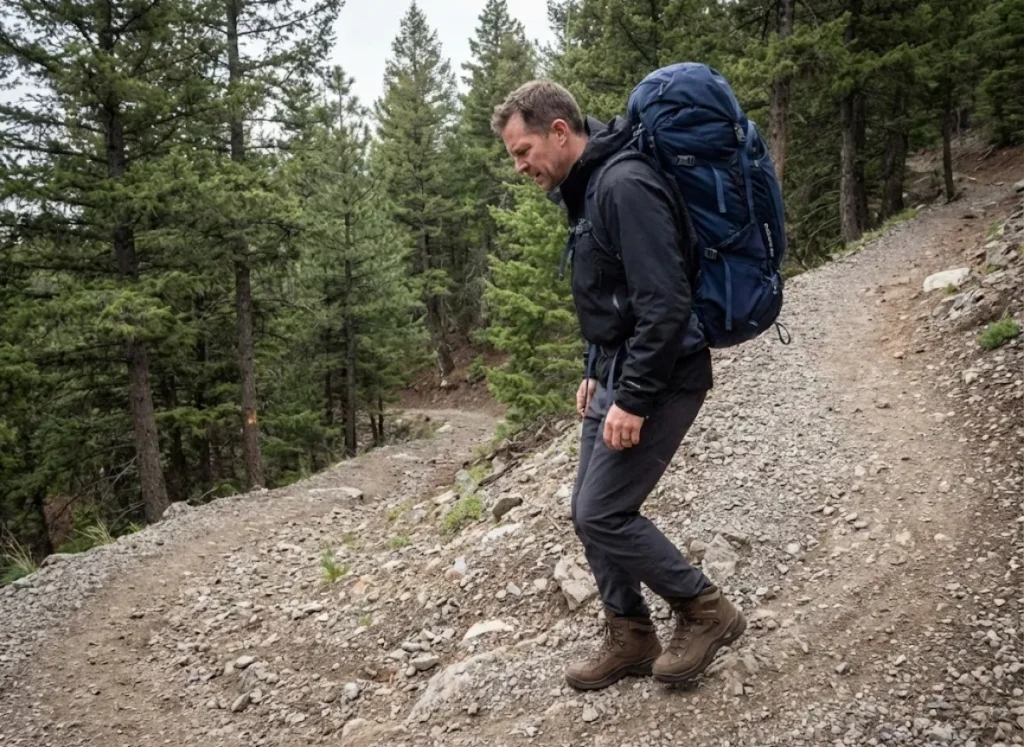
Downhill hiking punishes your feet in ways that level walking never does. When you’re descending, your body leans back to stay balanced while gravity tries to accelerate you forward. Your boot becomes the brake—and your foot becomes the thing that wants to keep sliding.
The Braking Phase: When Gravity Fights Your Boot
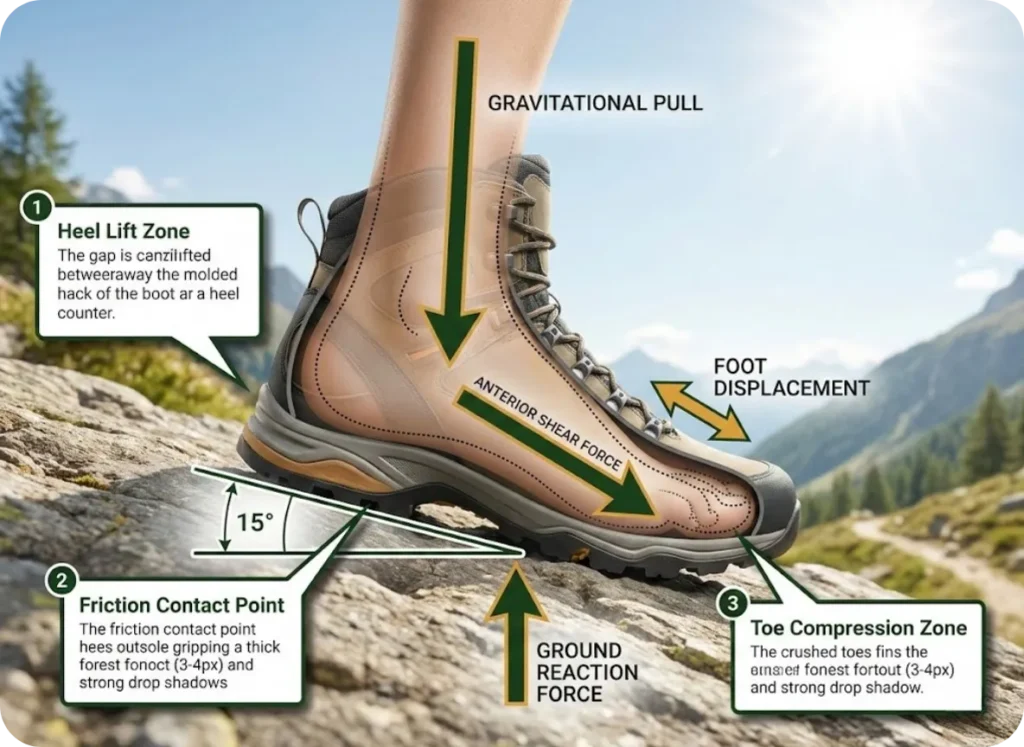
Here’s what’s actually happening inside your hiking boots during a steep descent. Unlike level walking where forces push mostly straight down, downhill terrain introduces what hikers call “anterior shear”—a forward-pushing force that slides your foot toward the toe box. According to studies on sloped walking kinematics, this shear force gets dramatically stronger as the slope steepens.
The friction between your sock and the boot liner? It’s designed to keep your foot in place during normal hiking. But on steeper grades, that friction isn’t enough to fight gravity.
You know that sensation of your heel lifting mid-step, almost like your hiking boot is suddenly a half-size too big? That’s not imagination—it’s physics catching up to your lacing.
Anterior Shift vs. Pistoning: Two Failure Modes
When standard lacing fails, your foot experiences two distinct mechanical breakdowns.
Anterior shift—what hikers call “toe jam”—happens when your foot slides forward until it slams into the toe box. In a properly laced boot, your instep should hit the tongue and laces first, stopping the slide. But if you’re loosely laced, your toes become the stopping mechanism. Every step downhill becomes another impact. That’s how you end up with black toenails.
Pistoning is the vertical version. Your heel lifts up from the sole during each step, then drops back down. If your boot’s heel counter (the stiff cup at the back) stays stationary while your heel moves, you’re generating shear forces against your skin. Keep this up for a few miles, and you’ve got blisters.
Pro tip: If your heel lifts more than a quarter inch with each step, your blister clock has already started. Stop and re-lace before things get worse.
The 15-Degree Rule: A Quantified Threshold
Here’s something most lacing guides won’t tell you: there’s a specific slope angle where standard lacing becomes inadequate. On gradients below about 15 degrees, the friction between your sock and boot liner can usually keep your foot in place. Above 15 degrees, the math changes.
The shear forces at steeper angles overwhelm that sock-to-liner friction. A mechanical lock becomes mandatory—not optional. This matters even more when you’re carrying a heavy pack. A day hiker might survive a 15-degree slope with standard lacing. A backpacker hauling 40 pounds will almost certainly suffer toe bang on that same slope without a heel lock.
If you’re working on maintaining sustainable pacing on descents, lacing is half the battle. The technique only helps if your body isn’t too fatigued to maintain good form.
The Heel Lock Technique: A Step-by-Step Protocol
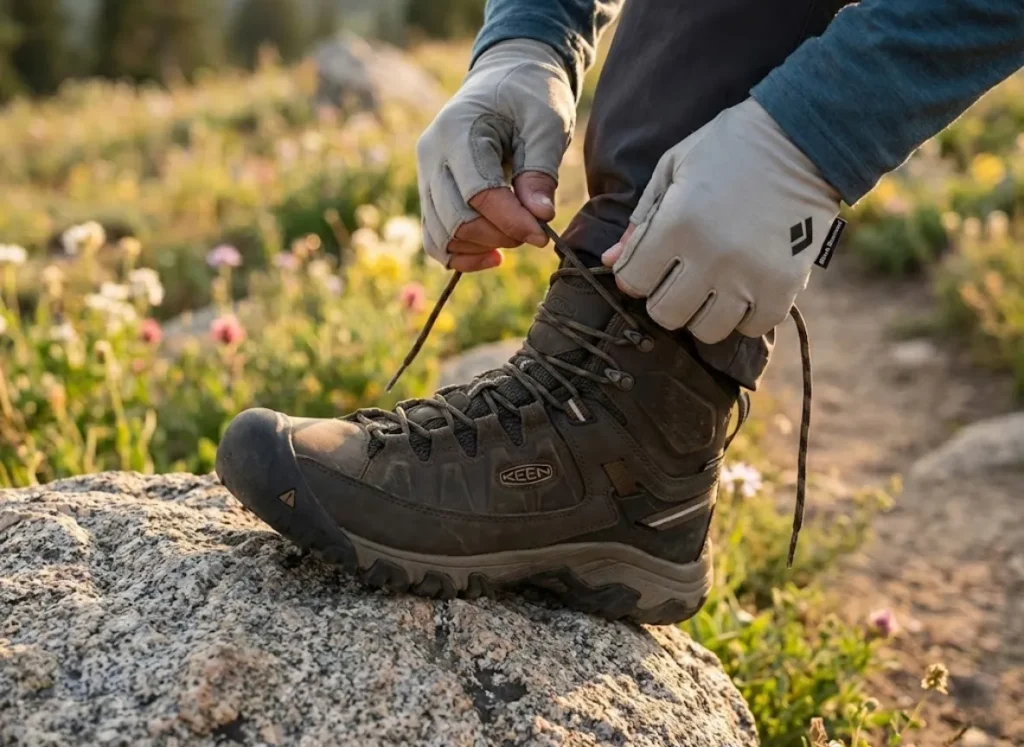
The heel lock lacing technique transforms your boot’s top eyelets into a pulley system. When executed correctly, it pulls your heel directly back into the heel cup instead of just pressing down on your instep.
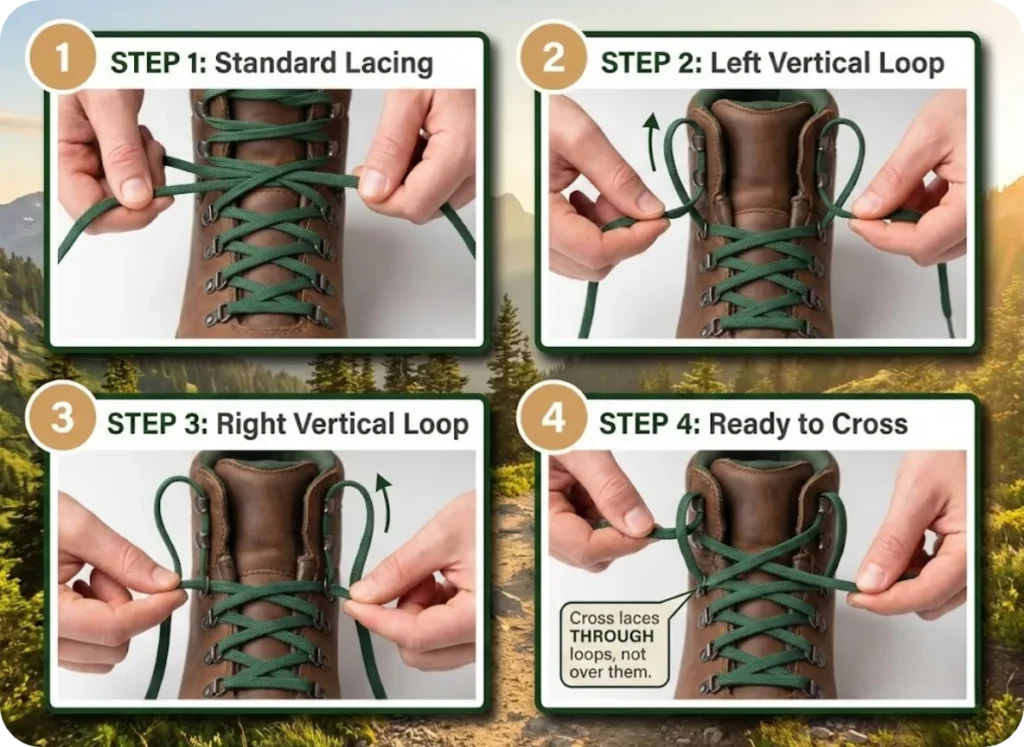
Step 1: Standard Lacing to the Instep
Start with normal criss-cross lacing from the bottom of your boot up to the instep—the point where your foot curves upward. This is typically the 4th or 5th eyelet from the top. Keep tension moderate here. Tight enough to prevent side-to-side movement, but not so tight that you’re crushing the top of your foot.
Stop lacing at this point. You’re about to change direction.
Step 2: Create the Vertical Loops at the Ankle Collar
Instead of crossing to the opposite side, thread each lace straight upward into the next eyelet on the same side. This creates two small loops—one on each side of your ankle collar.
These loops are the pulleys that generate mechanical advantage. Make sure they’re snug but not twisted. Twisted loops have less friction and can slip under tension.
Pro tip: If your boot has speed hooks instead of eyelets at the top, wrap the lace under the hook rather than over. This keeps the lace from popping off when you pull tight.
Step 3: Cross and Thread Through the Opposite Loop
Now take each lace and cross it to the opposite side. But instead of threading into an eyelet, thread it through the loop you just created.
The lace should now run horizontally through the vertical loop, forming an X pattern at your ankle collar. If the loop unthreads while you’re tightening, your laces might be too slick—common with round “sausage” laces that come stock on many boots.
Step 4: Pull Tight with Backward Pressure
Here’s where the magic happens. Pull the laces back and down toward your heel—not just outward. This backward-and-down motion pulls your heel bone directly into the heel cup.
The heel counter should now feel snug against the back of your foot without crushing your instep. Standard criss-cross lacing only applies downward pressure. The lace lock applies backward pressure—far more effective at stopping forward sliding.
When you get this right, you’ll feel a subtle “click” of your heel settling into the cup. That’s the moment your hiking boot becomes an extension of your foot.
Step 5: Finish with a Standard Bow or Double Knot
Tie off with a normal bow. For extra security on long hikes or downhill hikes, use a double knot. The tension is now isolated above your ankle collar, which means you can loosen the forefoot at rest stops without losing your heel lock.
Total execution time: roughly 45-60 seconds per boot. That’s three times longer than a standard tie—but worth every second if you want to avoid spending two weeks recovering from a lost toenail.
The Surgeon’s Knot: Locking Tension Between Zones
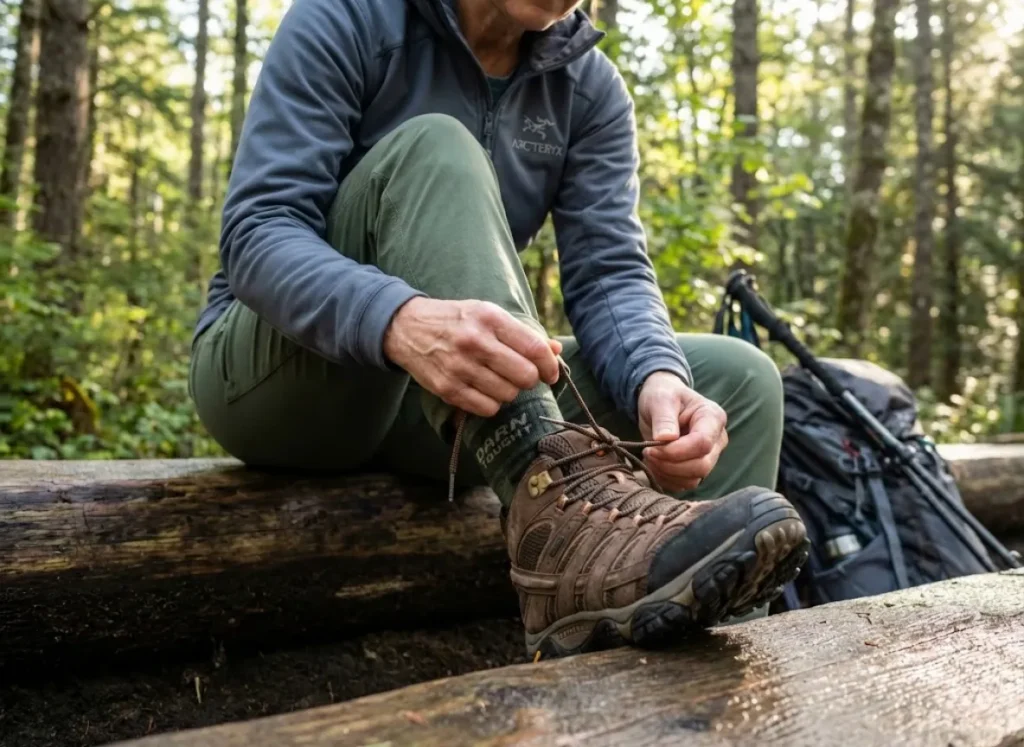
The Surgeon’s Knot solves a different problem than the heel lock. While the heel lock secures your heel to the boot, the Surgeon’s Knot prevents tension from migrating between different sections of your lacing.
What Is a Surgeon’s Knot?
A Surgeon’s Knot is a simple modification of the first step in tying your shoe. Instead of wrapping the laces around each other once, you wrap them twice. That extra loop creates substantially more friction, preventing the knot from slipping even when you release tension on the free ends.
This matters for what bootfitters call “zonal lacing.” Your forefoot often needs room to swell during a hike. Your ankle needs to stay cranked tight. Without a friction lock between zones, the tension bleeds from one area to another.
According to Salomon’s technical lacing guide, the double wrap of a Surgeon’s Knot creates enough internal friction to maintain tension isolation for thousands of steps.
Where to Place the Surgeon’s Knot
Tie the Surgeon’s Knot at the inflection point—the transition between the top of your foot and the ankle. This creates a “dam” that stops tension from migrating downward.
If your boots have D-ring eyelets (closed metal loops), you’ll need Surgeon’s Knots at multiple points. D-rings have lower friction than standard eyelets, so tension migrates more easily through them.
Pro tip: On long approaches, I tie a Surgeon’s Knot after every third eyelet. It takes longer, but my feet thank me at mile 15.
Combining Surgeon’s Knot + Heel Lock
For maximum control on steep descents, use a Surgeon’s Knot to lock the instep, then execute the heel lock above it. This combination lets you release forefoot tension at rest stops without re-tying the entire boot.
One warning: over-tightening the instep can cause lace bite—pressure on the tendons that run across the top of your foot. We’ll cover the fix for that next.
When It Goes Wrong: Hardware and Fit Failures
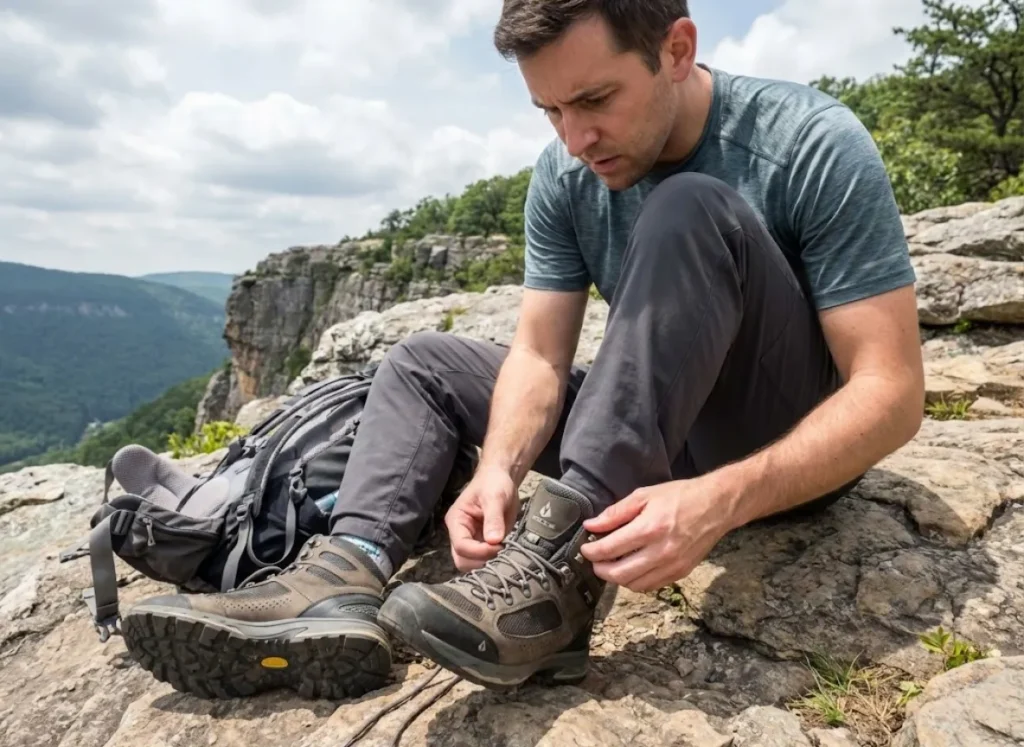
Sometimes you execute perfect lacing technique and your heel still slips. That’s usually a hardware or fit problem, not a technique problem.
Speed Hooks vs. D-Rings: Hardware Compatibility
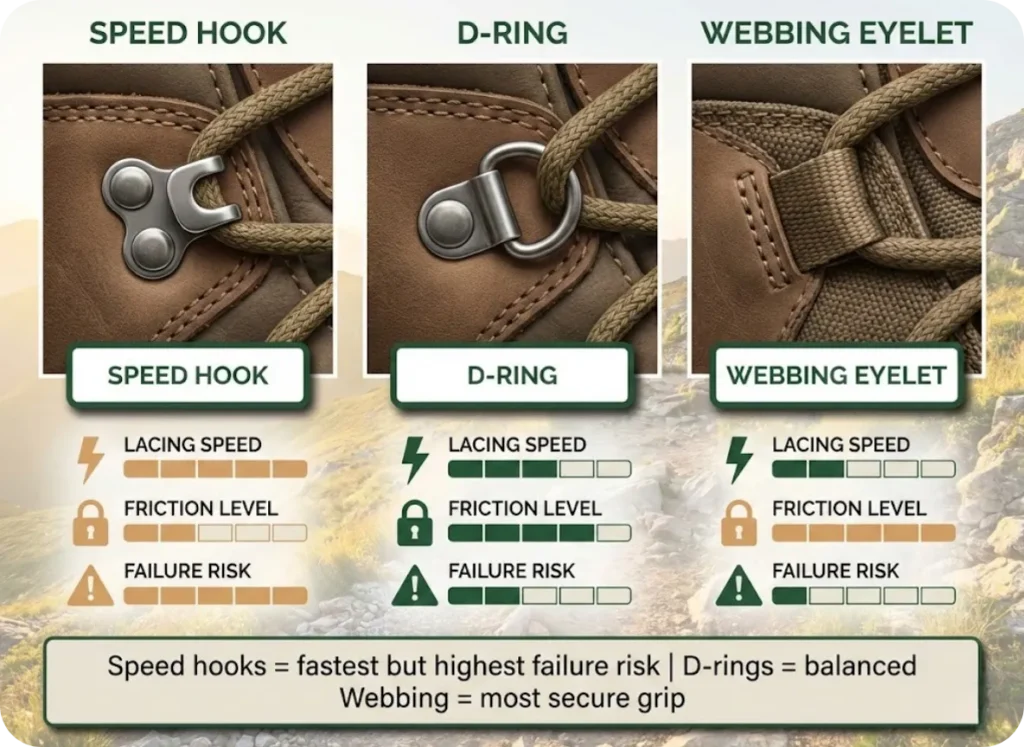
Speed hooks—those open-backed metal hooks that allow rapid lacing—are prone to lace detachment. The steep angle created by the heel lock loop can cause the lace to slip out mid-descent. I’ve heard that distinct “pop” of a lace unhooking from a speed hook during a scramble. It’s the sound of your next 500 feet becoming a controlled fall.
D-rings (closed metal loops) prevent detachment but have lower friction. Tension migrates easily through them. If your boots have D-rings, Surgeon’s Knots become mandatory for maintaining zonal isolation.
Webbing eyelets (fabric loops) reduce pressure points but are high-friction and less durable. They’re harder to tighten but less likely to loosen on their own.
If you’re selecting footwear with compatible lacing hardware, check the top two eyelets specifically. That’s where the heel lock happens, and that’s where hardware failures hurt most.
The “Sausage Lace” Problem
Many hiking boots come with round, thick laces—what bootfitters call “sausage laces.” These have minimal surface contact between wraps, which means low friction. Your Surgeon’s Knot slips. Your loops unthread. Your heel starts sliding again.
The fix is simple: replace stock round laces with flat, waxed laces. Waxed laces “stick” in place without needing knots to hold them. The flat profile provides more surface area for friction. It’s a $6 upgrade that makes your $200 boots actually work.
The Finger Test: Is Your Boot Just Too Big?
Here’s the hard truth that no amount of lacing can fix: if your hiking boots are fundamentally too large, technique won’t save you.
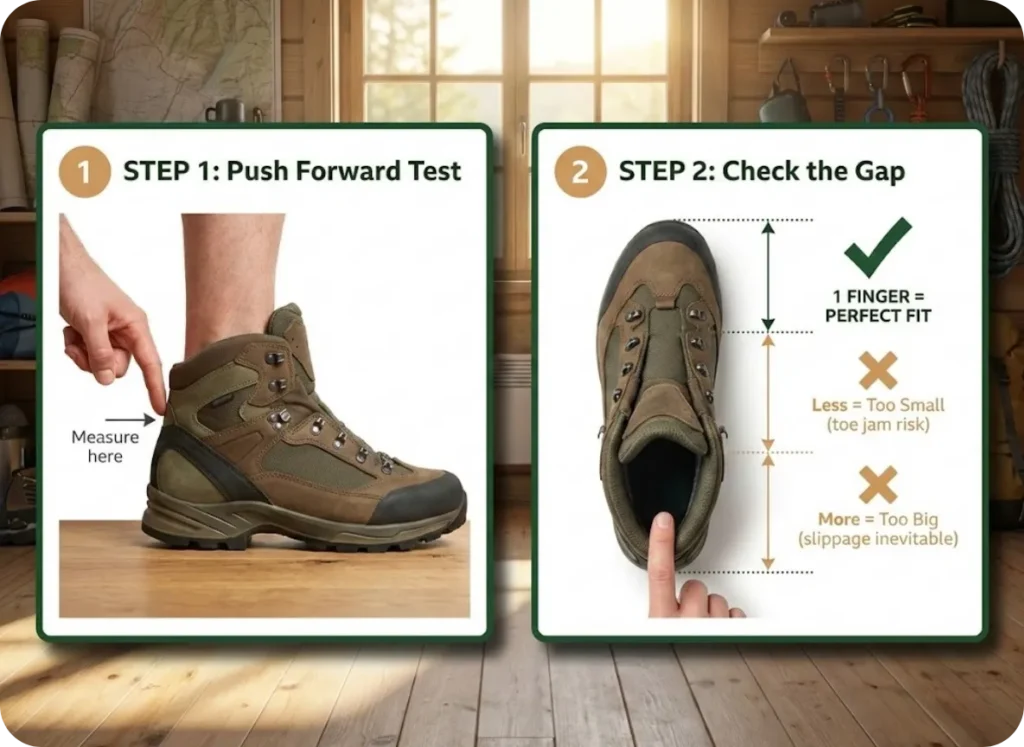
The AMC’s boot fit adjustment guide describes the finger test. Push your foot forward in an unlaced boot until your toes touch the front. You should be able to fit roughly one finger’s width behind your heel. Less than that? Your boots are too small—risk of toe jamming. More than that? They’re too big—no lacing technique will prevent slippage.
It’s often not length that’s the problem, but volume. Hikers with flat arches or narrow feet can’t fill the internal space of a standard boot. The validated fixes: aftermarket insoles like Superfeet to take up volume, tongue pads to push the foot back, or thick wool socks (Darn Tough Mountaineering weight) to act as a gasket.
Window Lacing: Relieving Pressure Without Losing Control
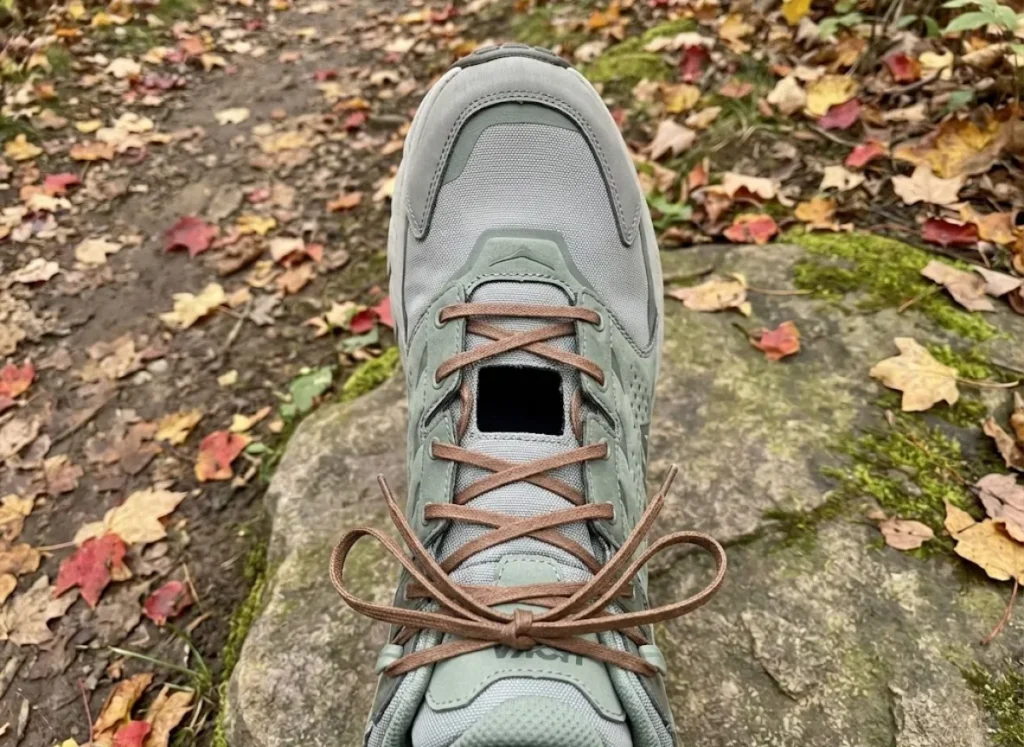
The paradox of aggressive lacing is that fixing one problem can create another. Crank down too hard to stop heel slippage, and you may end up with lace bite—pain on the top of your foot that makes every step miserable.
What Is Lace Bite?
Lace bite happens when excessive pressure compresses the extensor tendons that run along the top of your foot. Symptoms include sharp, stabbing pain on the instep, redness, or a bruise-like sensation even without visible bruising.
It’s the injury that happens when you’re trying too hard to prevent a different injury. And once the tendon sheath gets inflamed, it can become chronic.
Experienced hikers describe it as “the bruise that isn’t there”—a deep ache that persists even after the boot comes off.
How to Execute Window Lacing
Find the pressure point on your instep—usually where the tongue creases. At that eyelet pair, skip the criss-cross. Instead, lace each side straight up to the next eyelet, creating a “window” over the irritated tendon.
Resume criss-cross lacing above the window, then continue to your heel lock. This creates a pressure-free zone exactly where you need it while maintaining full tension everywhere else.
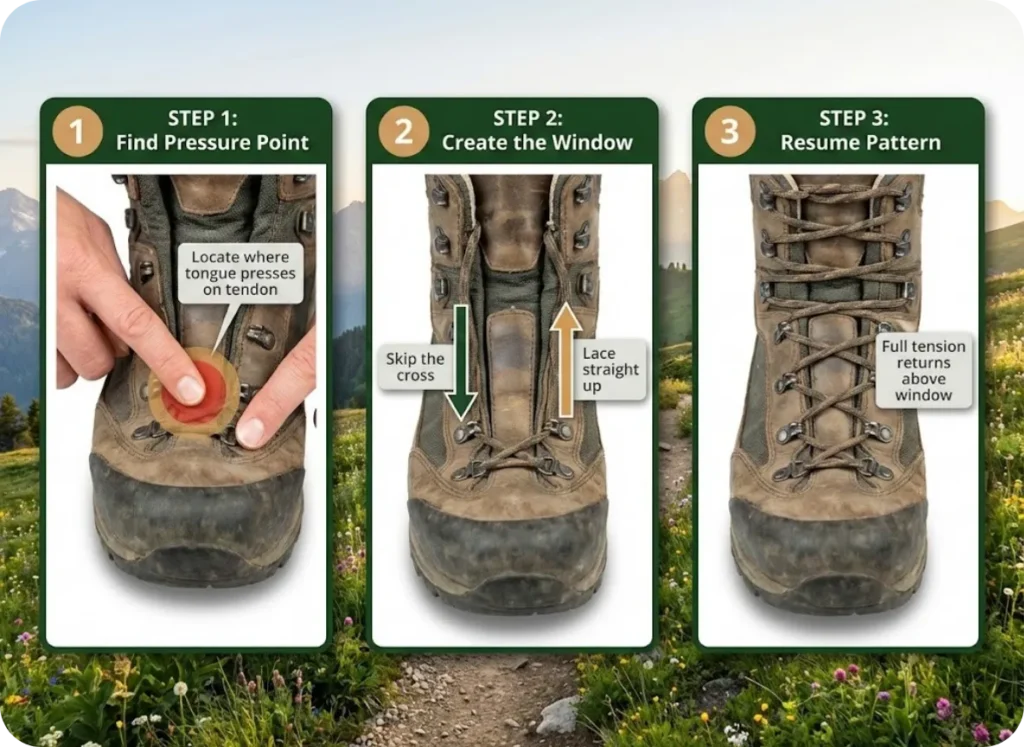
According to REI’s window lacing instructions, combining window lacing (to protect the tendon) with a Surgeon’s Knot (to lock the instep) and a heel lock (to secure the heel) gives you the most secure yet painless fit possible.
If pain persists even with window lacing, your boot’s tongue may be too thin or the speed hooks too aggressive. Some hikers find relief with women’s hiking boots with gusseted tongues that distribute pressure more evenly.
The Injury Cost: What Happens When You Get It Wrong
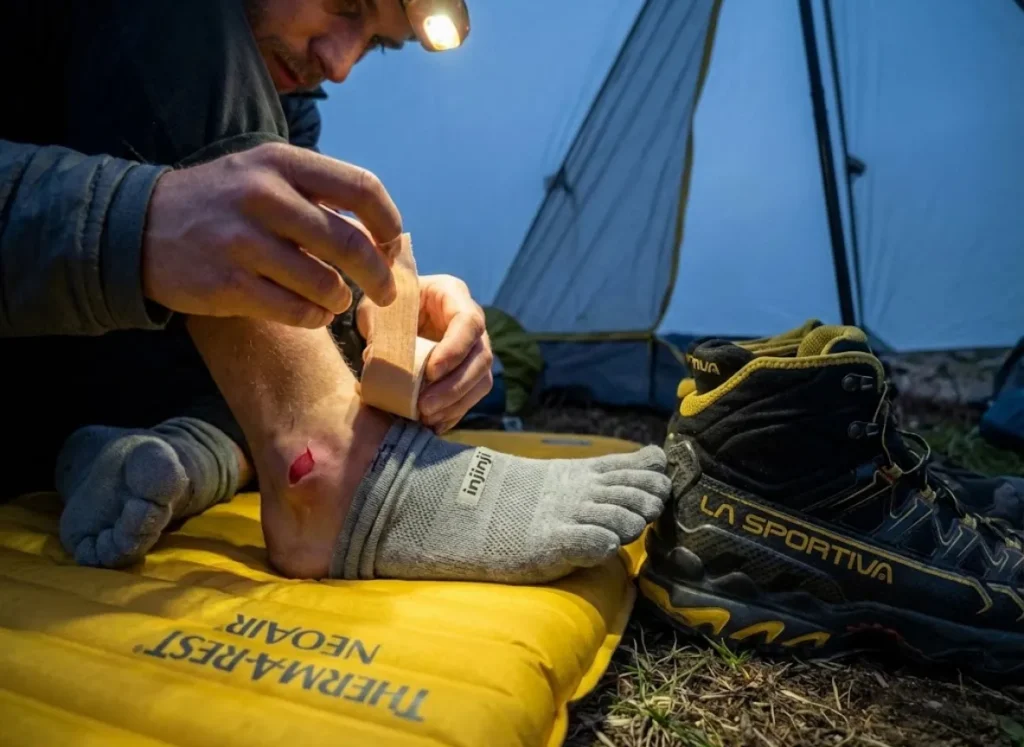
Understanding the stakes can motivate you to spend that extra 60 seconds on your lacing. These injuries aren’t minor inconveniences—they can end your trip.
Subungual Hematoma: The Black Toe Reality
When your toes repeatedly strike the toe box, blood pools between the nail plate and nail bed. It hurts. It creates pressure. In severe cases, you need a medical professional to drill a hole in the nail to relieve that pressure—or you lose the toenail entirely.
The Cleveland Clinic’s subungual hematoma overview confirms this is purely a mechanical injury. Prevention means keeping toenails short and locking the midfoot to prevent toes from reaching the front of the boot.
For more on preventing black toe with proper shoe selection, especially shoes with adequate toe box room, start before you even reach the trailhead.
Friction Blisters: Shear in Slow Motion
Blisters form when heel slippage causes differential movement—your bone moves but your skin stays tethered to the sock. Data shows friction blisters affect between 29% and 95% of hikers depending on terrain and duration. That makes them the single most common hiking injury.
A blister on mile 3 will destroy your enjoyment of the remaining 10. Prevention is always easier than treatment.
Conclusion
Three things to remember about heel slippage on downhill terrain:
First, the 15-degree rule. When the slope gets steep, your sock-to-liner friction becomes insufficient. The heel lock stops being optional—it’s physics.
Second, hardware matters. Speed hooks can unhook. D-ring eyelets leak tension. Stock “sausage” laces slip. Know your boot’s limitations before you’re four miles from the trailhead.
Third, fit trumps technique. The heel lock can’t save a hiking boot that’s fundamentally too big. Use the finger test to diagnose volume mismatch before wasting time on fixes that won’t work.
Try the heel lock technique on your next downhill hike—even if it’s just the hill behind your house. Spend 60 seconds now to save yourself a lost toenail later. Your feet will remember.
FAQ
How long does it take to tie a Heel Lock?
About 45-60 seconds per boot—roughly three times longer than a standard tie. That investment saves hours of healing a black toenail and prevents the misery of an early trip termination.
Can I use the Heel Lock with trail runners instead of boots?
Yes, if your trail runner has at least two eyelet pairs at the ankle collar. Many lightweight shoes lack the hardware for a proper heel lock—check your specific model before heading out on steep terrain.
Why does my heel still slip after trying the Heel Lock?
The most common cause is a boot that’s too large or wrong volume for your foot. Try the finger test. If you have more than one finger’s width behind your heel when unlaced, add insoles or tongue pads before blaming the technique.
What’s the difference between the Surgeon’s Knot and the Heel Lock?
The Surgeon’s Knot is a friction knot (double wrap) that prevents tension from migrating between boot zones. The heel lock is a lacing pattern (vertical loops + cross-threading) that creates a pulley system. They work best in combination—Surgeon’s Knot at the instep, heel lock at the ankle collar.
Can the Heel Lock cause any problems?
Yes—over-tightening the instep area can cause lace bite (pain on the tendons across the top of your foot). Use window lacing over pressure points to prevent this while maintaining heel security.
Risk Disclaimer: Hiking, trekking, backpacking, and all related outdoor activities involve inherent
risks which may result in serious injury, illness, or death. The information provided on The Hiking Tribe is for
educational and informational purposes only. While we strive for accuracy, information on trails, gear, techniques,
and safety is not a substitute for your own best judgment and thorough preparation. Trail conditions, weather, and
other environmental factors change rapidly and may differ from what is described on this site. Always check with
official sources like park services for the most current alerts and conditions. Never undertake a hike beyond your
abilities and always be prepared for the unexpected. By using this website, you agree that you are solely
responsible for your own safety. Any reliance you place on our content is strictly at your own risk, and you assume
all liability for your actions and decisions in the outdoors. The Hiking Tribe and its authors will not be held
liable for any injury, damage, or loss sustained in connection with the use of the information herein.
Affiliate Disclosure: We are a participant in the Amazon Services LLC Associates Program, an
affiliate advertising program designed to provide a means for us to earn advertising fees by advertising and linking
to Amazon.com. As an Amazon Associate, we earn from qualifying purchases. We are also an official affiliate partner
of Black Diamond Equipment via the AvantLink network. If you click on a Black Diamond affiliate link and make a
purchase, we may earn a commission at no additional cost to you. We also participate in other affiliate programs and
may receive a commission on products purchased through our links. Additional terms are found in the terms of
service.