In this article
The Arc’teryx Alpha SV looked perfect—Gore-Tex Pro, clean zippers, and a price $400 under retail. Three weeks after it arrived, I reached for it on a rainy approach and watched delamination bubbles spread across the membrane like a disease. The seller’s account? Deleted. My PayPal dispute? Lost—they had “proof of delivery.” That $350 lesson taught me everything I’m about to share with you.
After years of buying, selling, and getting burned on the used outdoor gear market, I’ve learned that saving money isn’t about finding deals. It’s about knowing which used gear sites protect you and which authentication markers separate a treasure from a forgery. Here’s the complete playbook—so you can build your kit without betting your safety on a stranger’s honesty.
⚡ Quick Answer: Buy from Tier 1 brand-managed programs (REI Re/Supply, Patagonia Worn Wear, TNF Renewed) for warranty protection on technical outerwear. Use Tier 2 marketplaces (Geartrade, Rerouted) for hardgoods with return policies. Avoid Tier 3 P2P platforms (Facebook, Reddit) unless you’re an authentication expert. Never buy used safety equipment like harnesses, helmets, or ropes—invisible degradation can kill. Always pay via PayPal Goods & Services, never Friends & Family.
The Trust Hierarchy: Understanding Used Gear Risk Tiers
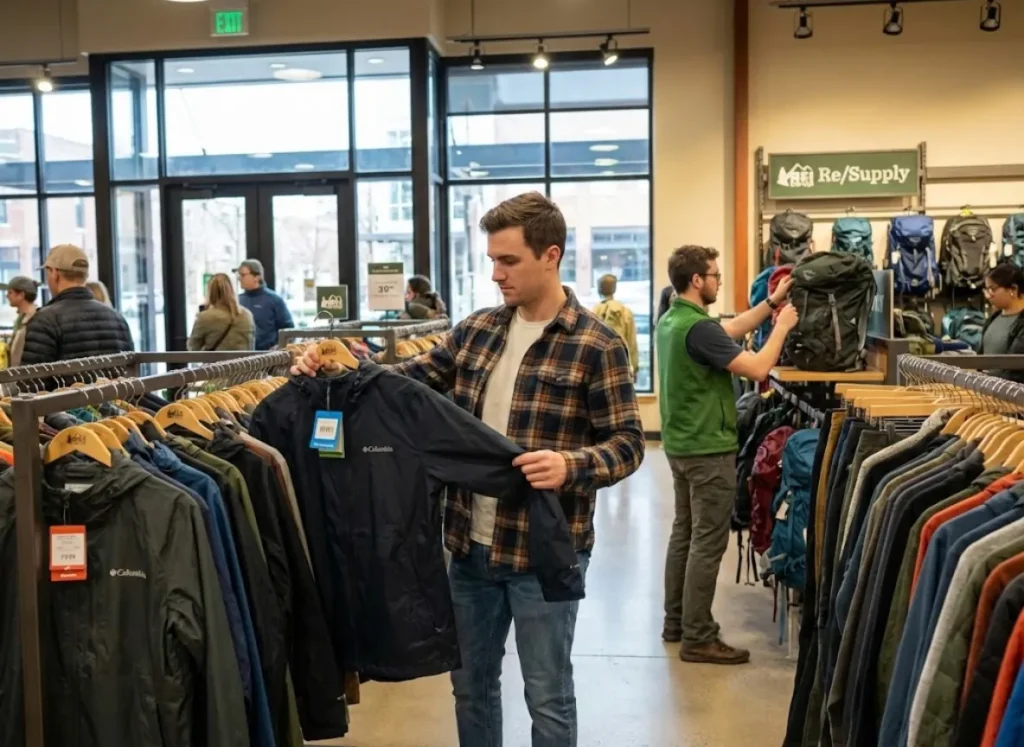
Not all used gear marketplaces are created equal. Understanding the risk gradient is the foundation of smart buying.
Tier 1: Brand-Managed Recommerce Programs
The safest entry point into the recommerce world comes from brands themselves. Programs like REI Re/Supply, Patagonia Worn Wear, Arc’teryx ReGEAR, and The North Face Renewed offer certified refurbishment, professional inspection, and limited warranties.
These programs source inventory from customer returns and trade-ins. That means you’ll find items ranging from “brand new with tags” (size exchanges) to “lightly used” (field-tested and returned). The premium pricing—typically 50-70% of MSRP—reflects the labor of inspection, cleaning, and authentication. But you’re paying for recourse. The North Face Renewed even offers a full 1-year warranty on used items, making it the safest choice for risk-averse buyers or gifting.
Pro tip: The best finds in Tier 1 programs are discontinued colorways and previous-season models that never hit clearance racks. Search specifically for these rather than current inventory.
Tier 2: Specialized Outdoor Marketplaces
Platforms like Geartrade, Rerouted, and Isella Outdoor act as intermediaries. They offer return policies (typically 14-30 days), buyer protection programs, and community vetting that P2P networks lack.
Commission fees range from 10% (Rerouted) to 13-15% (Geartrade)—costs that get baked into pricing. But you’re buying peace of mind. Geartrade’s $3.99 restocking fee on returns can be waived by purchasing their “Redo” insurance at checkout (~$2-5). For footwear where fit is subjective, buying that insurance is mathematically optimal compared to paying return shipping yourself.
Rerouted’s “Gear Tracker” feature sends instant alerts when specific items hit the market—invaluable for hunting discontinued models or specific sizes in your most-wanted list.
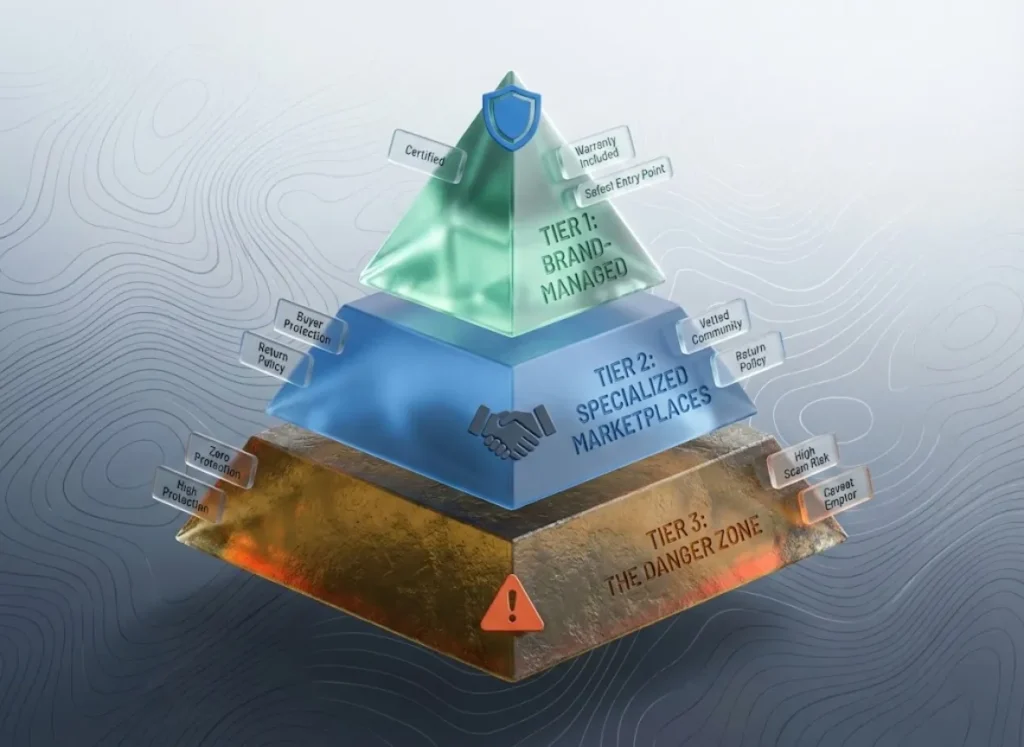
Tier 3: The Danger Zone
Facebook Marketplace, Reddit (r/Geartrade), and Craigslist offer zero structural buyer protection. “Caveat emptor” is the only law.
Scam prevalence on these platforms has escalated dramatically in 2024-2025. Sophisticated fraud mechanisms now bypass PayPal disputes entirely. Local pickup remains the safest P2P method, but even face-to-face deals require thorough in-person inspection. The Universal Scammer List on Reddit is reactive, not proactive—fresh scammer accounts won’t be logged until after they’ve victimized someone.
If you’re considering Tier 3 platforms, consider whether you’re an expert capable of building your first backpacking kit from scratch—including spotting fakes. If not, stick with Tier 1 and 2.
The 10 Vetted Platforms: Where to Buy Used Hiking Gear Safely
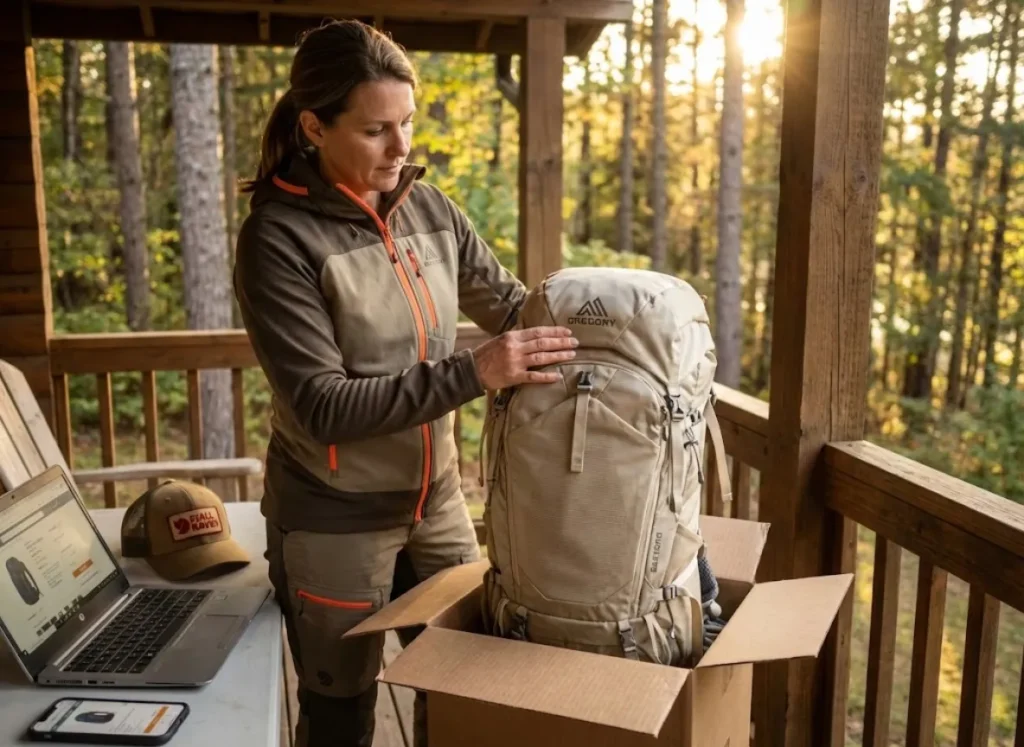
Let’s break down the specific platforms worth your time and money.
REI Re/Supply: The Accessible Giant
REI’s massive physical footprint makes Re/Supply the most accessible entry point for hands-on inspection. But the policy split trips up many buyers.
Online purchases have a 30-day return window—plenty of time to test gear in the field. In-store purchases are “As Is” and Final Sale. No recourse if you miss a defect at the register. That means if you’re buying in-store, you need the skills to inspect zippers, seam tape, and loft before you swipe your card.
Trade-in values run 30-50% of resale price. REI rejects dirty gear, items with pet hair, or anything showing delamination. This strict filter ensures higher baseline quality for buyers but frustrates sellers accustomed to P2P standards.
Critical misconception: REI’s famous “100% Satisfaction Guarantee” does NOT apply to used gear. Don’t assume you’re covered.
Patagonia Worn Wear: The Sustainability Leader
Worn Wear positions used gear as a badge of honor, not a compromise. The “stories we wear” narrative builds community loyalty that transcends transactions.
The ReCrafted collection stands out. Damaged items get deconstructed at Patagonia’s Reno facility, with salvageable fabric sewn into one-of-a-kind pieces. These often command higher prices than standard used items because they signal status within the eco-conscious outdoor community—bridging “used gear” and “boutique fashion.”
All Worn Wear items go through CO2 waterless cleaning, addressing the hygiene concern that makes buyers hesitant about used base layers. Fixed trade-in credits ($10-$100 depending on the item) provide predictability but undervalue rare vintage pieces. Sell those privately; trade in current, mass-market items to Worn Wear.
Arc’teryx ReGEAR: High-Stakes Technical Shells
For alpinists seeking $600-900 technical gear on a budget, ReGEAR is the critical access point. But it comes with unique risks.
The “Point of No Return” policy matters for sellers: if you mail in gear for trade-in and Arc’teryx deems it ineligible (delamination, contaminated down), it’s recycled—NOT returned. Be absolutely certain of condition before shipping.
ReGEAR items carry a warranty for “practical product lifespan” (1-3 years, discretionary), which is less robust than TNF Renewed’s clear 1-year coverage. Authentication tip: Arc’teryx is the most counterfeited outdoor brand. Only buy ReGEAR items from the official resale.arcteryx.com domain—never third-party “authorized sellers.”
When considering ultralight gear investments, premium brands like Arc’teryx retain 60-70% of value over 2-3 years—making used purchases closer to investments than consumption.
TNF Renewed, Geartrade, Rerouted & Isella
TNF Renewed offers the safest buying experience: 1-year warranty, 30-day returns (extended during holidays), and professional refurbishment including repairs. Ideal for gifting used outdoor apparel.
Geartrade functions like the “Unimart” of outdoor gear—wide selection, 14-day returns, but watch that $3.99 restocking fee (buy Redo insurance to avoid it). Commission runs ~13-15%.
Rerouted goes mobile-first with lower 10% commission and handles shipping logistics. The “Gear Tracker” for hunting specific items is killer.
Isella Outdoor takes the boutique consignment approach, focusing on women’s and adaptive gear. They address the “unisex = men’s” gap that plagues the broader market. Consignment split: typically 60/40 (seller/shop).
Pro tip: For footwear, always buy from platforms with return policies. Fit is too subjective to gamble on no-return P2P transactions.
Authentication Protocols: Spotting Fakes Before You Pay
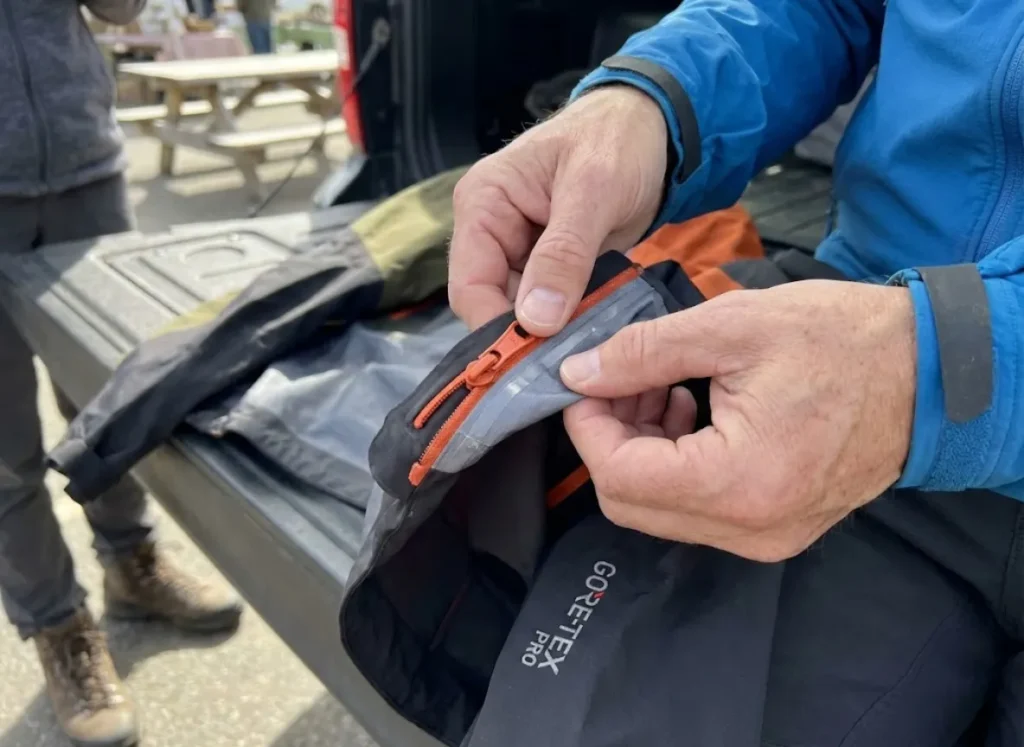
As resale market values rise, counterfeiting has graduated from cheap knockoffs to “super-fakes” requiring forensic inspection.
Arc’teryx: The Archaeopteryx Under a Microscope
The most counterfeited outdoor brand demands the closest scrutiny.
Logo check: Authentic Archaeopteryx logos have 6 distinct ribs on the skeleton, a straight tail, and a sharp, pointed nose. Fakes show rounded noses, messy or connected rib stitching, and bent tails.
Zipper forensics: Authentic Arc’teryx uses only YKK or Vislon zippers with powder-coated, matte, color-matched sliders. Shiny metal sliders, “H” branding, or mismatched colors mean counterfeit.
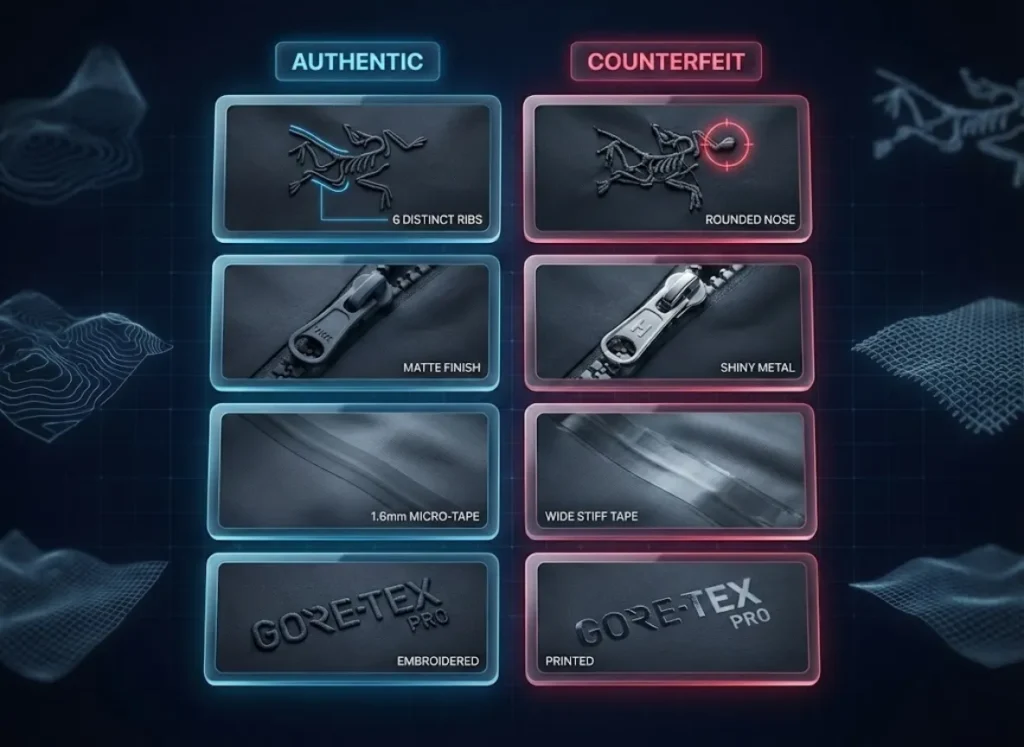
Seam tape analysis: Gore-Tex Pro products have micro-seam allowance (1.6mm) with narrow, pliable, barely visible tape. Wide, stiff tape with glue overflow is a red flag.
Gore-Tex branding: On Pro shells, “GORE-TEX PRO” is embroidered on specific panels. Printed (not embroidered) branding on claimed Pro shells equals fake.
The North Face Nuptse: The Hologram Test
Since ~2010, all authentic TNF items feature a holographic tag on the inner care label with distinctive cuts or slits on the corners. Fakes use flat stickers or printed squares without cuts.
On Nuptse jackets, check the “700” embroidery on the wrist cuff: authentic embroidery is thick, bold, and highly raised. Fake embroidery is thin, flat, or has connecting threads between numbers.
Examine the chest logo “R” in “NORTH”—the bottom leg should be slightly curved and distinctive. Fakes use standard block font “R” without the curve.
Patagonia: The Style Number Verification
Every authentic Patagonia item has a style number (starting with STY, ITEM, or just numbers) on the white wash-instruction tag.
The verification test: Search “Patagonia [style number]” on Google. Results should show the exact item you’re holding. If the number returns a different product, it’s counterfeit.
Date codes at the end (FA18 = Fall 2018, SP22 = Spring 2022) let you verify that colorways and design features match that production year. This catches “franken-fakes” assembled from different-era components.
Understanding authentic performance fabrics helps you assess whether the materials feel right before even checking tags.
The Scam Playbook: Avoid These Traps
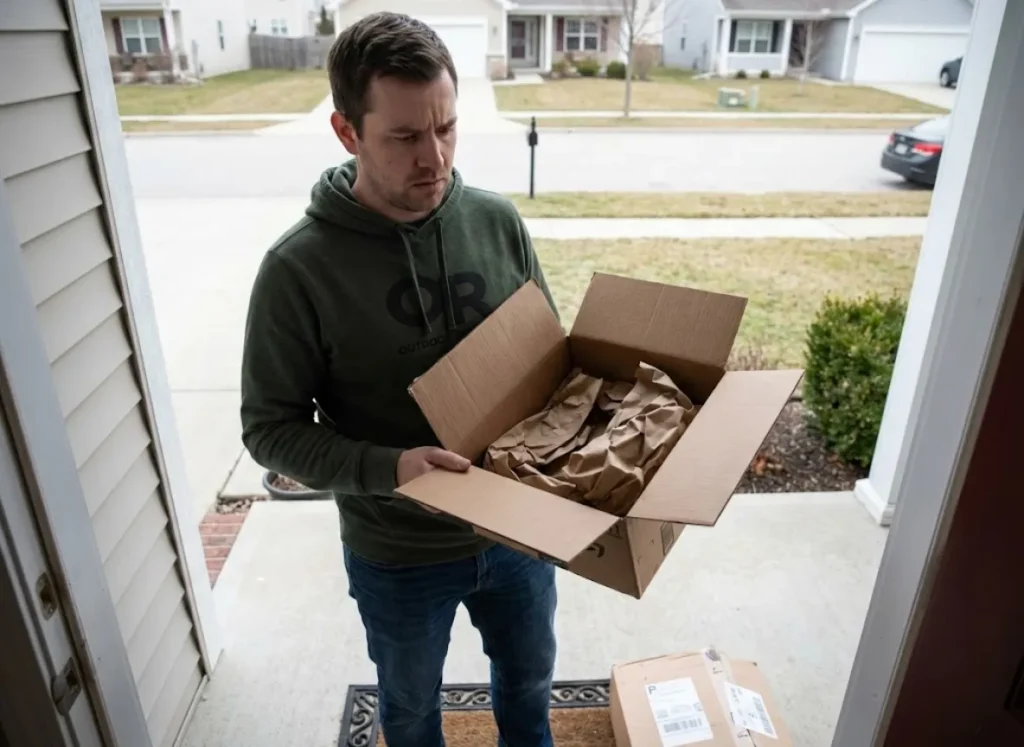
Peer-to-peer transaction risk is real. Know these mechanisms before you lose money.
The “Friends & Family” Trap
Scammers universally request PayPal Friends & Family, Venmo, or Zelle because these payment methods remove all buyer protection.
The bait: “I’ll knock off the 3% fee” or “My business account is under review.”
Ironclad rule: NEVER pay via Friends & Family for goods. If a seller refuses Goods & Services—even if you offer to cover the fee—they are a scammer. No exceptions. Walk away instantly.
The “Fake Tracking” Scam
This sophisticated fraud mechanism bypasses PayPal disputes entirely.
The setup: The scammer obtains a real tracking number for a different shipment going to your zip code (often from data breaches or monitoring high-volume shippers like Chewy or Amazon). They upload this tracking to PayPal. Tracking shows “Delivered” to your city. You receive nothing—but PayPal closes the dispute because they see “Proof of Delivery.”
Defense protocol: Request official documentation from the carrier (FedEx/UPS) stating the delivery address (not just zip code) doesn’t match your street address. File a police report. Appeal to PayPal with carrier documentation.
Impersonation Attacks on Reddit
Scammers create usernames mimicking trusted sellers: u/MountainHiker becomes u/MountainHlker (replacing ‘i’ with ‘l’) or u/MountainHiker_.
They message users posting “WTB” (Want to Buy) ads, claiming to have the item.
Defense: Always click through to the profile. Check account age and karma. New accounts with zero activity in the specific subreddit are red flags. DM the real user to confirm before any transaction.
Pro tip: Screenshot every conversation and keep records of all transaction details. If you need to dispute, documentation is everything.
The “Never Buy Used” List: Life-Safety Equipment
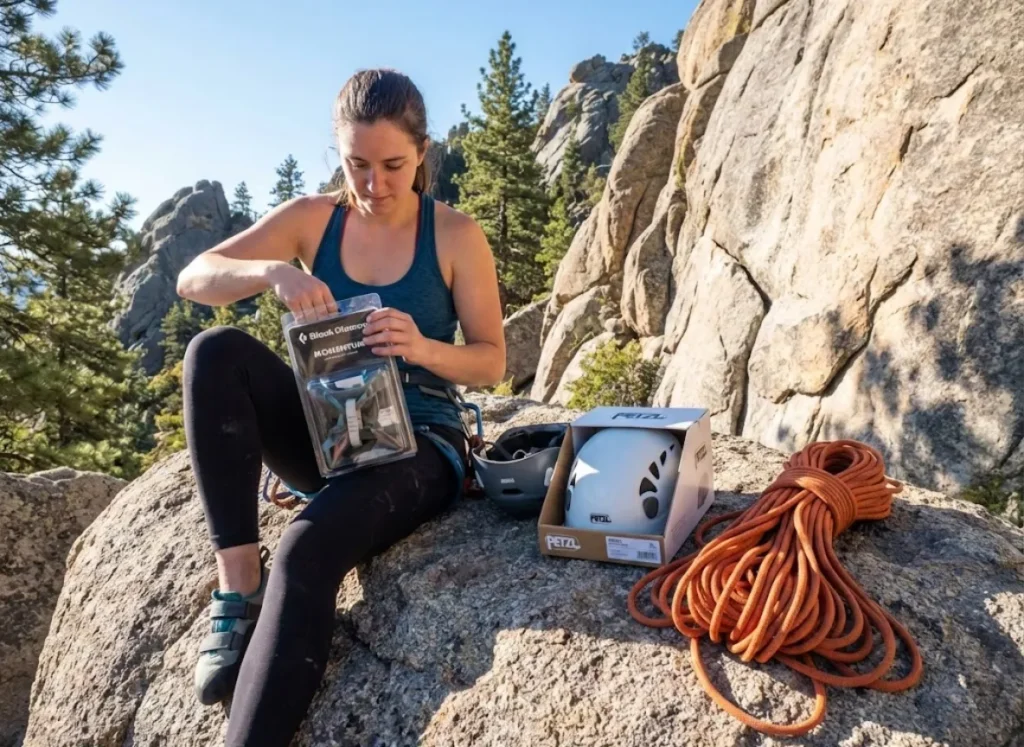
Certain safety gear categories degrade invisibly. For these items, no discount justifies the risk of catastrophic failure.
Soft Goods: Ropes, Harnesses, Slings
Nylon, Dyneema, and Spectra degrade invisibly from chemical exposure. A climbing harness stored in a car trunk near a gas can absorbs hydrocarbon fumes that reduce strength by 50%+ with no visual trace.
Manufacturers like Petzl and Black Diamond mandate retirement 10 years after manufacture date, even for unused items. Buyers often fail to check date code tags on soft goods, unknowingly climbing on expired equipment.
The rule: Never buy used soft goods unless they’re still in original sealed packaging. The potential cost of failure—your life—infinitely outweighs any savings.
Helmets: Climbing and Cycling
Helmets work via sacrificial destruction of internal EPS (Expanded Polystyrene) foam. A single impact—even dropping the helmet on a rock—creates invisible micro-fractures that render it useless for a second impact.
UV exposure degrades plastic shells. A protective gear helmet strapped to a backpack for five years of hiking has a compromised, brittle shell regardless of appearance.
No visual inspection can detect foam micro-fractures or UV degradation. The only safe helmet is one you bought new and controlled its entire history.
Electronics: GPS, Avalanche Beacons
Older avalanche beacons (1-2 antenna) drift in frequency over time, creating life-safety risk. Only buy used beacons with a recent manufacturer diagnostic report.
Battery corrosion in GPS devices may not be visible externally but can cause critical failure in the field. Software obsolescence affects satellite communicators—firmware updates may no longer be available.
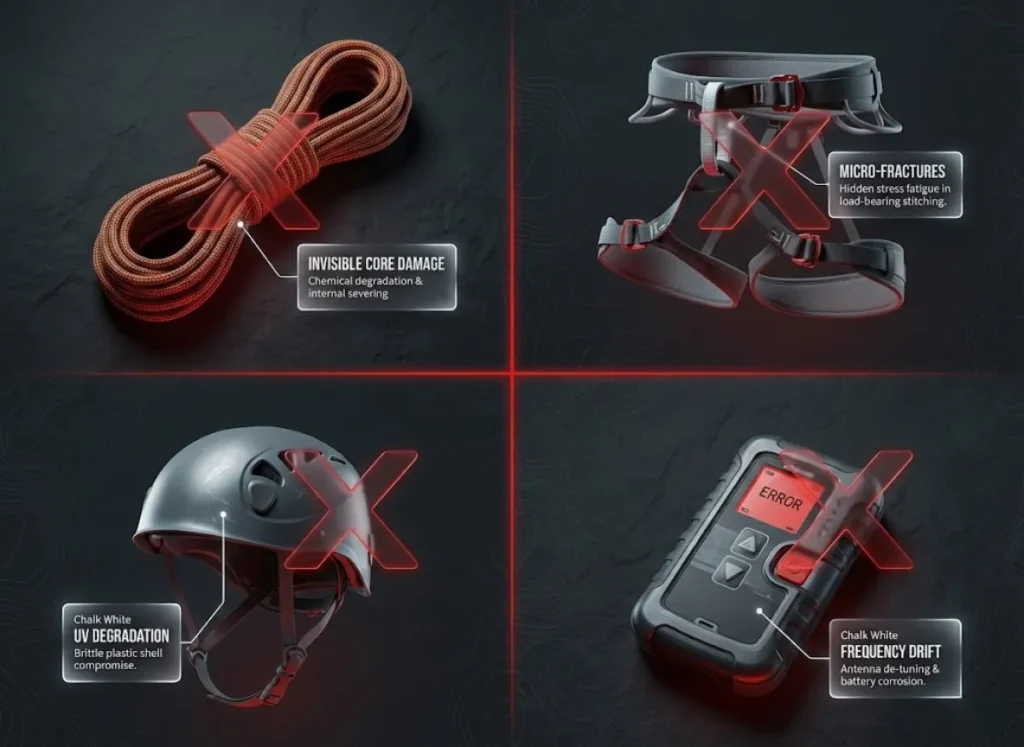
When reviewing the Ten Essentials for wilderness safety, remember that safety equipment is the one category where buying used has catastrophic potential cost.
Financial Strategy: Maximize Value, Minimize Risk
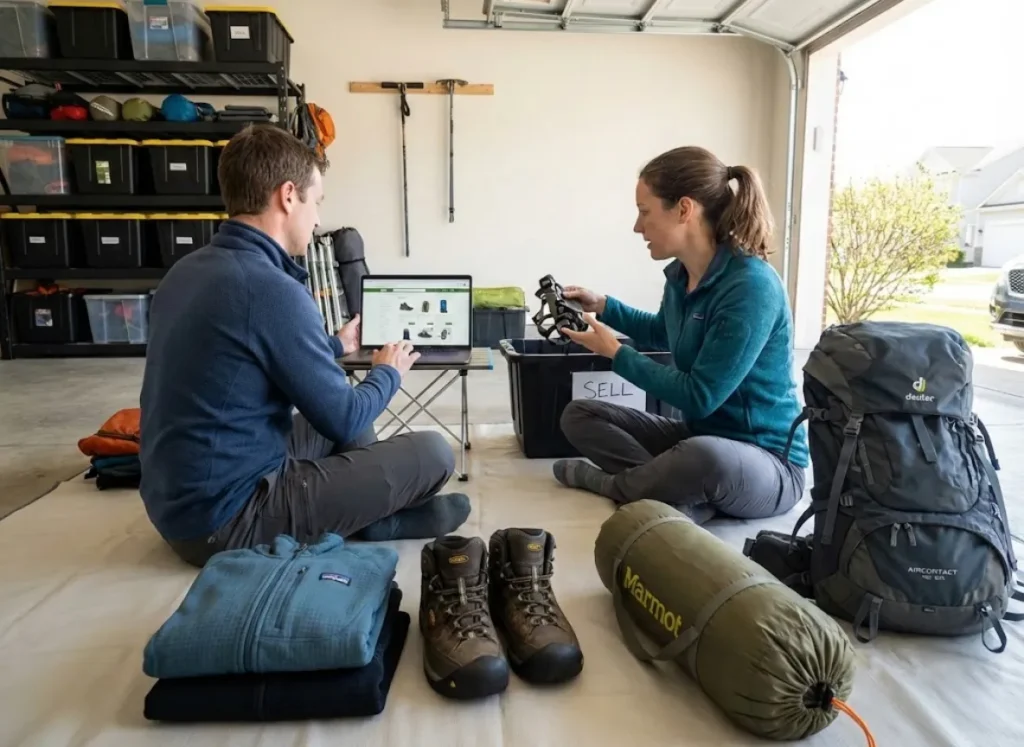
Smart buying is only half the equation. Understanding depreciation patterns and insurance coverage completes the picture.
Depreciation Curves by Brand
Arc’teryx and Patagonia show low depreciation—60-70% value retention after 2-3 years—due to high demand and warranty support. Buying used is an “investment”—you can resell for nearly what you paid.
REI Co-op and Columbia show high depreciation—50-70% value loss immediately. Buying used is “consumption”—don’t expect significant resale value.
Strategy: Focus used purchases on high-retention brands for technical gear. Buy budget brands new on clearance.
Insurance Coverage for Your Collection
Hikers carrying $3,000+ in gear often assume homeowner’s policies cover theft or loss. Most standard policies pay Actual Cash Value (ACV), deducting depreciation. Your stolen 5-year-old tent might yield a $50 payout.
Replacement Cost Value (RCV) endorsement pays the cost of a new equivalent item. Confirm your policy includes this.
For high-value items (cameras, bikes), listing them individually on your policy as scheduled property ensures coverage for “mysterious disappearance” (losing it on the trail) and accidental damage (dropping it in a river)—often excluded from general policies.
2025 Tax and Legislative Changes
Texas sellers: As of October 1, 2025, Texas Comptroller Rule 3.330 reclassifies marketplace commissions as “data processing services,” subjecting seller fees to 6.25%-8.25% sales tax. This compresses margins for Texas-based sellers on Poshmark, eBay, and gear sites.
California: The Fashion Environmental Accountability Act mandates brands participate in extended producer responsibility programs—driving more brands to internalize their resale markets.
Pro tip: If you’re selling from Texas, factor the new commission taxes into your pricing strategy. Platforms with lower commission rates (like Rerouted at 10%) become more attractive when additional taxes are added to higher-commission marketplaces.
Conclusion
Buying used hiking gear isn’t a treasure hunt for the reckless—it’s a calculated strategy for the informed. The three-tier trust hierarchy gives you a framework: prioritize Tier 1 brand programs for technical outerwear where warranty matters, leverage Tier 2 marketplaces for hardgoods with return policies, and approach Tier 3 P2P platforms only with expert authentication skills and ironclad payment protocols.
Three takeaways to carry forward:
Check the hologram, count the ribs, verify the style number—authentication markers are your first defense against counterfeits.
Never pay Friends & Family—if a seller refuses Goods & Services, walk away instantly.
Never buy used life-safety gear—no discount is worth a compromised harness or helmet.
The outdoor gear resale market is only growing. Armed with this guide, you can participate smartly—saving real money on premium equipment while keeping your safety non-negotiable. Next time you spot that too-good-to-be-true deal, you’ll know exactly which questions to ask—and when to walk away.
FAQ
Is it safe to buy used hiking boots?
Yes, with caveats. Used boots can be excellent value if you inspect them in person—check for sole separation, collapsed heel counters, and compromised waterproof membranes. Prioritize platforms with return policies (Geartrade’s 14-day window, REI online’s 30-day window). Never buy used boots you can’t return or try on.
What hiking gear should you never buy used?
Never buy climbing ropes, harnesses, slings, or helmets used. These items suffer invisible degradation from UV exposure, chemical contamination, or impact micro-fractures. Similarly, avoid used avalanche beacons (frequency drift) and satellite communicators (software obsolescence). The potential cost of failure is your life.
How do I authenticate vintage Patagonia?
Check the white tag for a style number (STY, ITEM, or numerical code). Search Patagonia [number] on Google—results should display the exact item. Date codes (FA18 = Fall 2018) let you verify that colorways match that era. If the number returns a different product, or the color didn’t exist in that season, it’s a fake.
Can I return used gear bought at REI’s in-store Re/Supply?
No. In-store Re/Supply purchases are sold As Is and are Final Sale with no return option. This contrasts with online Re/Supply purchases, which have a 30-day return window. Always do a thorough inspection—check zippers, seam tape, and loft—before completing an in-store purchase.
What payment method is safest for buying used gear online?
PayPal Goods & Services provides buyer protection if the item doesn’t arrive or is significantly not as described. Never use PayPal Friends & Family, Venmo, or Zelle for purchases—these methods have no recourse if you’re scammed. If a seller refuses Goods & Services, assume they’re a scammer.
Risk Disclaimer: Hiking, trekking, backpacking, and all related outdoor activities involve inherent
risks which may result in serious injury, illness, or death. The information provided on The Hiking Tribe is for
educational and informational purposes only. While we strive for accuracy, information on trails, gear, techniques,
and safety is not a substitute for your own best judgment and thorough preparation. Trail conditions, weather, and
other environmental factors change rapidly and may differ from what is described on this site. Always check with
official sources like park services for the most current alerts and conditions. Never undertake a hike beyond your
abilities and always be prepared for the unexpected. By using this website, you agree that you are solely
responsible for your own safety. Any reliance you place on our content is strictly at your own risk, and you assume
all liability for your actions and decisions in the outdoors. The Hiking Tribe and its authors will not be held
liable for any injury, damage, or loss sustained in connection with the use of the information herein.
Affiliate Disclosure: We are a participant in the Amazon Services LLC Associates Program, an
affiliate advertising program designed to provide a means for us to earn advertising fees by advertising and linking
to Amazon.com. As an Amazon Associate, we earn from qualifying purchases. We are also an official affiliate partner
of Black Diamond Equipment via the AvantLink network. If you click on a Black Diamond affiliate link and make a
purchase, we may earn a commission at no additional cost to you. We also participate in other affiliate programs and
may receive a commission on products purchased through our links. Additional terms are found in the terms of
service.