In this article
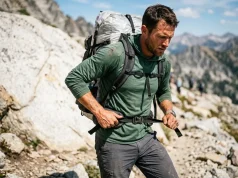
Forty pounds. That’s the invisible hand pushing your chin to your chest, forcing you to stare at the dust on your boots rather than the ridgeline ahead. In my two decades leading mountaineering courses, I’ve watched countless students lose the mental battle against gravity long before their legs actually failed. The rhythm of a hike is often dictated by the burden on your back, but it doesn’t have to be.
Slackpacking breaks this shackle. It decouples the hiker from the fully-loaded backpack and the rigors of overnight survival while maintaining the linear progress of a supported long-distance hiking journey. This isn’t about taking the easy way out or just looking for a “retirement home style” experience. It is a calculated logistical maneuver that alters the biomechanics of movement and opens the world’s most punishing terrain to those who might otherwise be sidelined by physical strain. By mastering this strategy, you utilize a tool for longevity, injury recovery, and deeper trail engagement.
What Exactly Is Slackpacking? (Definition & Context)
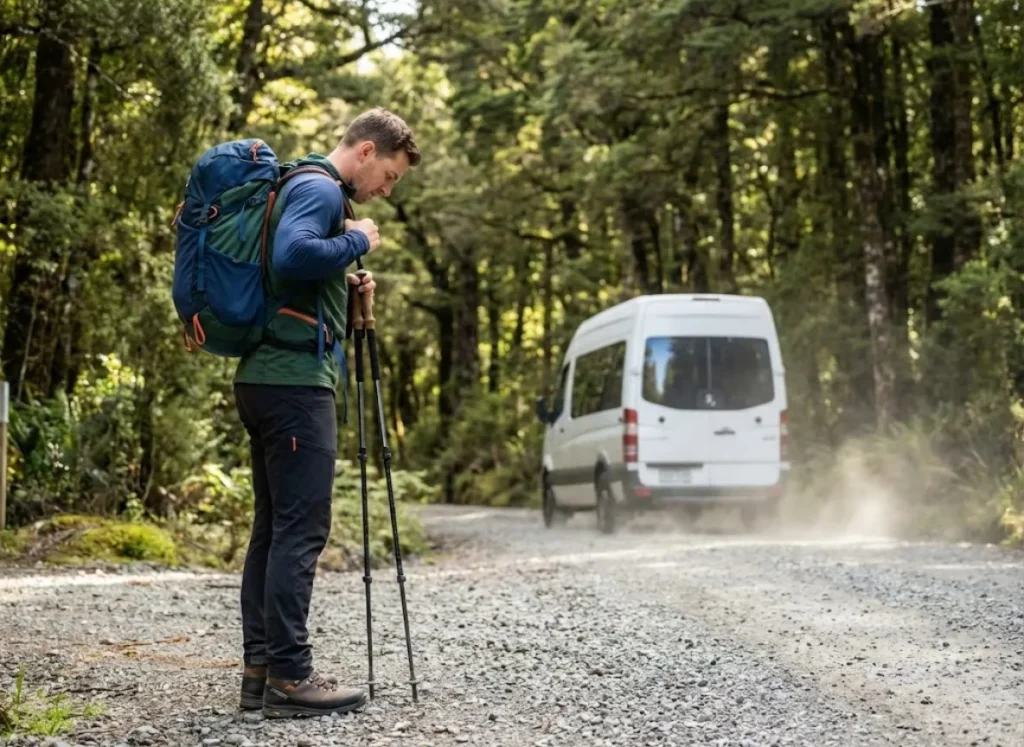
Slackpacking is the practice of hiking a section of a long-distance trail carrying only a decent-sized daypack, while your overnight camping gear and heavy supplies are transported by a support vehicle to your next destination.
How Does the Definition Differ Between North America and the Rest of the World?
In the North American context—specifically within the culture of the Appalachian Trail (A.T.)—slackpacking is often an ad-hoc tactical decision. It is a tool used by a thru-hiker or section hiker to navigate particularly arduous sections—like the Shenandoahs or Mount Greylock near Dalton—or to recover from minor injuries without leaving the trail. The process typically involves a hiker carrying a lightweight daypack containing only water, snacks, and a rain shell, while a “trail angel,” shuttle driver, or slackpack host moves their full pack to a road crossing further up the route.
This definition is rooted in functionality and speed. While occasionally viewed with skepticism by a “purist” who frowns on “yellow blazing” (skipping sections by car), research into long-distance hiking subculture dynamics suggests that pragmatists embrace it. It allows them to maintain high daily mileage—often pushing big miles (20+)—without suffering a “hiker-trash body” breakdown. This aligns closely with aggressive Appalachian Trail thru-hiker pacing strategies designed to beat winter weather. It is a core component of the “Hike Your Own Hike” (HYOH) philosophy.
Conversely, the International model prevalent in Europe and South Africa defines slackpacking as a formalized tourism product rather than an improvisation. On routes like the Camino de Santiago (“The French Way”) in Spain, the Tour du Mont Blanc (TMB), or the Otter Trail and Plett Camino in South Africa, the term implies a paid “luggage transfer service.” Operators move suitcases or designated 70L boxes between established lodges or luxury tented camps. This approach removes the stigma of “cheating.” Instead, it positions the activity as an accessible way for diverse demographics to experience wilderness corridors—from the Nakasendo Way in Japan to the Salcantay Pass in Peru—without the barrier of heavy lifting. In places like Nepal or Kilimanjaro, this role is traditionally filled by a porter or Sherpa.
Why Choose to Slackpack? (Physiological & Strategic Benefits)
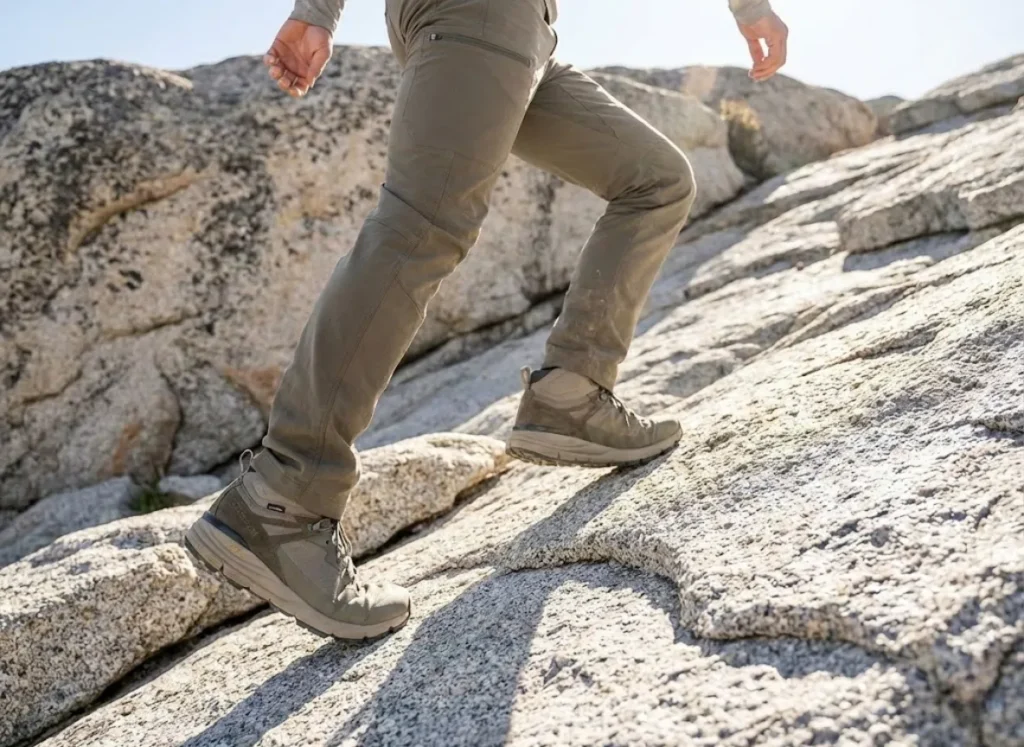
Choosing to slackpack significantly reduces compressive forces on the joints. This leads to reduced joint impact, lowers the risk of overuse injuries, and allows for greater daily distances with reduced metabolic cost.
How Does Reducing Pack Weight Impact Knee Joint Kinetics and Injury Risk?
Carrying a standard backpacking load of approximately 30 pounds forces the body to adopt compensatory gait mechanics. You naturally reduce the range of motion in knee flexion and extension to stabilize the extra weight. This load significantly increases vertical and anterior Ground Reaction Forces (GRF), which transmit stress directly through the articular cartilage and menisci. Clinical data on the biomechanics of load carriage indicates that prolonged walking with heavy loads increases the Peak Knee Adduction Moment (KAM), a primary mechanical predictor for the progression of osteoarthritis in the medial compartment of the knee.
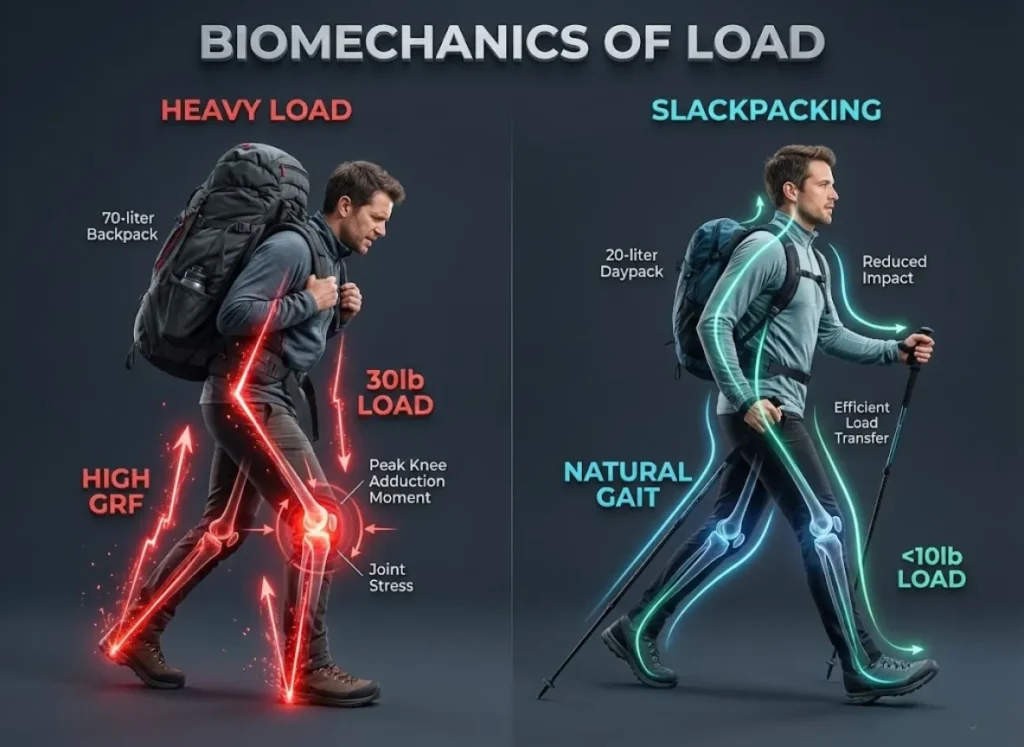
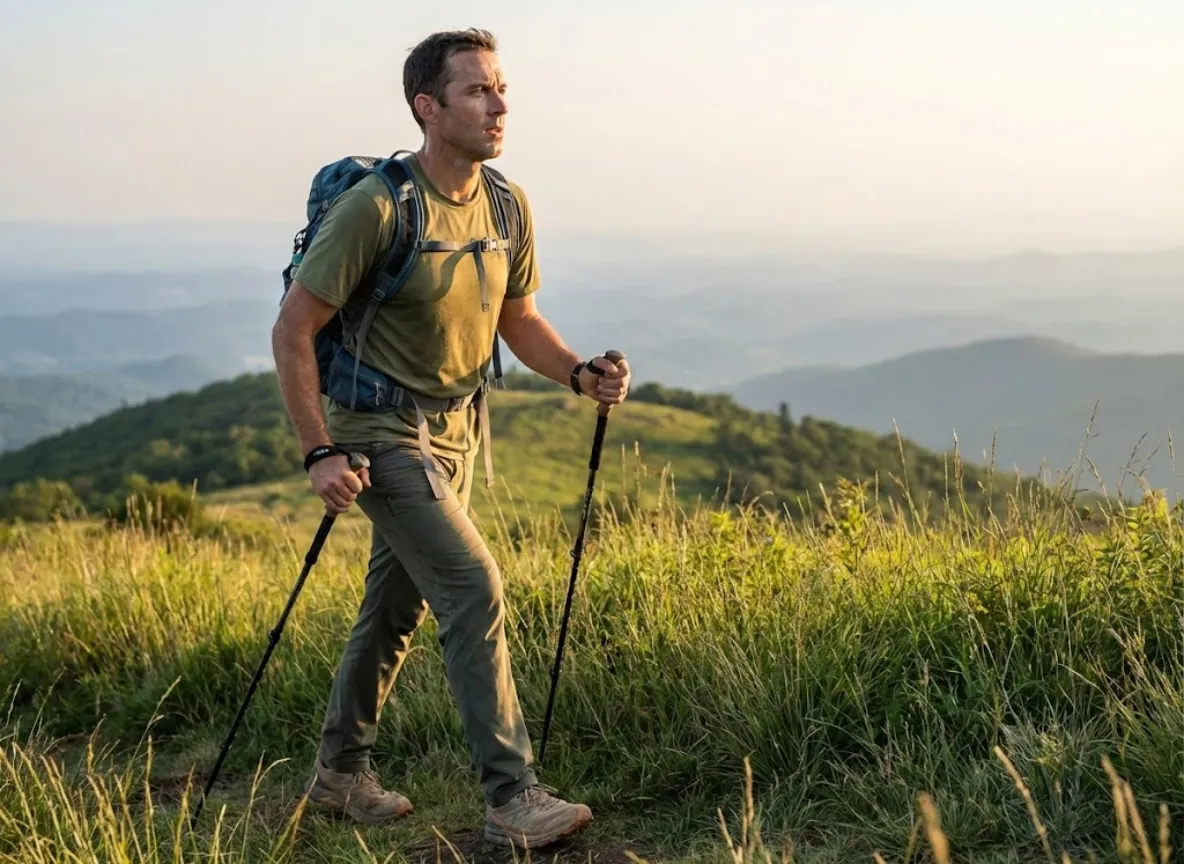
Slackpacking mitigates these compressive forces by reducing the load to under 10 pounds. This allows the hiker to maintain a more natural, efficient gait cycle. Beyond joint preservation, a lighter center of mass reduces mediolateral impulse. This significantly improves balance and stability on technical terrain like rock scrambles or river crossings found on the Teton Crest Trail or Wonderland Trail. When you pair a light pack with using trekking poles downhill—specifically quality Leki or carbon poles—you effectively double the protective benefits for your joints. The reduction in metabolic cost allows hikers to cover ground quickly with less fatigue, providing a morale boost and reducing the probability of acute injuries caused by exhaustion-induced stumbling.
How Do You Execute a Slackpack? (Logistics & Methodologies)
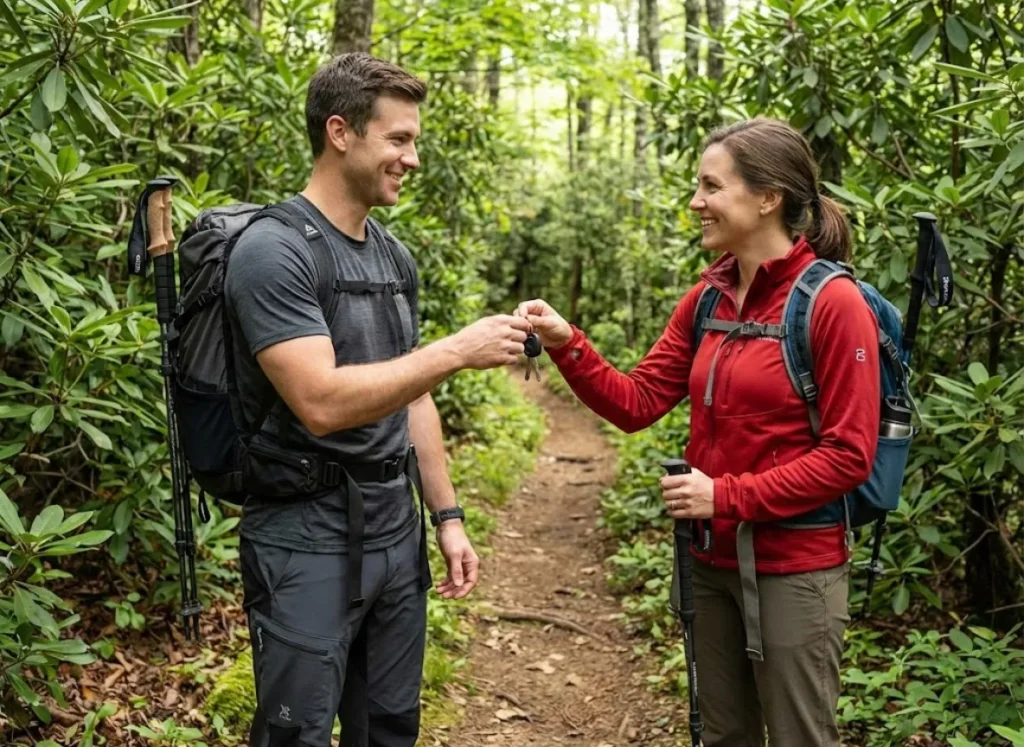
Successful slackpacking requires precise coordination of transportation and timing. It is typically executed through the “Key Swap” (DIY car swap), commercial shuttles, or a base camp strategy.
What Are the Operational Protocols for the ‘Key Swap’ Strategy?
The “Key Swap” is a zero-cost model relying on two independent hiking parties (or a split group) moving in opposite directions on a linear trail section. Party A parks at the Southern Trailhead, Party B parks at the Northern Trailhead, and both groups hike toward the center to meet. Upon meeting mid-trail, the groups exchange vehicle keys using a direct handoff. Party A finishes at the Northern car, and Party B finishes at the Southern car, driving the vehicles to a final rendezvous.
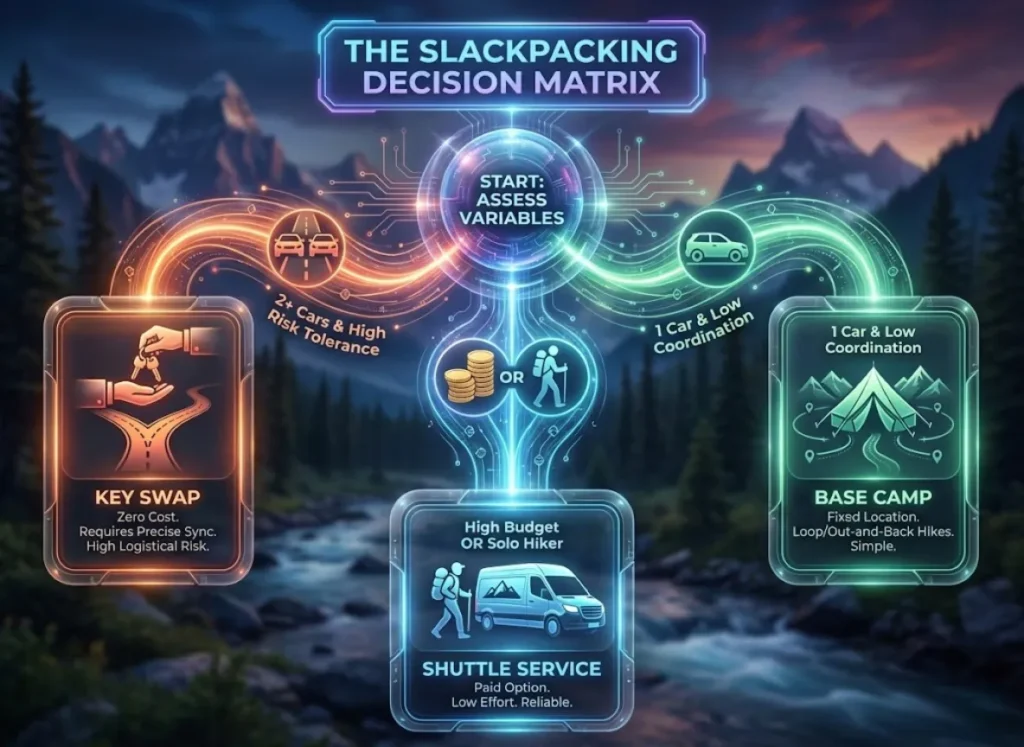
Success depends entirely on precise coordination. Hiding keys at trailheads is discouraged due to theft risk and wildlife interference. This method carries a high risk of logistical failure if parties miss each other due to alternate routes or “blue blazing,” making real-time communication essential. Before attempting this, check the US Forest Service permit FAQ for the specific area to ensure overnight parking is permitted at both ends.
Pro-Tip: Never rely solely on the mid-trail handoff. Both drivers should carry a spare valet key (non-electronic) hidden on the exterior frame of their own vehicle (using a magnetic box) or zip-tied underneath. If the hikers miss each other, neither party is stranded. Consult a hiker’s emergency guide to understand the protocol if a rendezvous fails completely.
When Should You Utilize Commercial Shuttles Versus Base Camping?
The Commercial Shuttle model is best for linear progression or point-to-point travel. A paid shuttle driver transports the hiker to a trailhead, allowing them to walk back to their vehicle or accommodation. This method facilitates high-mileage days but requires strict adherence to the itinerary planning. Costs vary, often ranging from $1.50 to $2.00 per mile. Reliability varies by region; while the A.T. has a dense network of trail angels listed in “AWOL lists,” trails like the Pinhoti Trail, Florida Trail, or Benton MacKaye Trail often lack consistent infrastructure. Understanding regional alternative transportation systems in public lands can help you identify viable shuttle options. Always factor in tipping etiquette when budgeting.
The Base Camp strategy involves establishing a fixed hub—a campground or lodge—and conducting a series of “in-and-out” or “leapfrog” day hikes from that central location. This approach offers superior comfort, better sleep, and consistency of sleep systems. It helps avoid issues with sold-out parks during peak season. However, it often results in logistical inefficiency, such as the “two steps forward, one step back” dynamic of retracing steps to a car. Knowing exactly how to calculate hiking time is critical here to ensure you return to the trailhead before your shuttle driver departs or the park gates close.
What Gear Is Required for a Safe Slackpack?
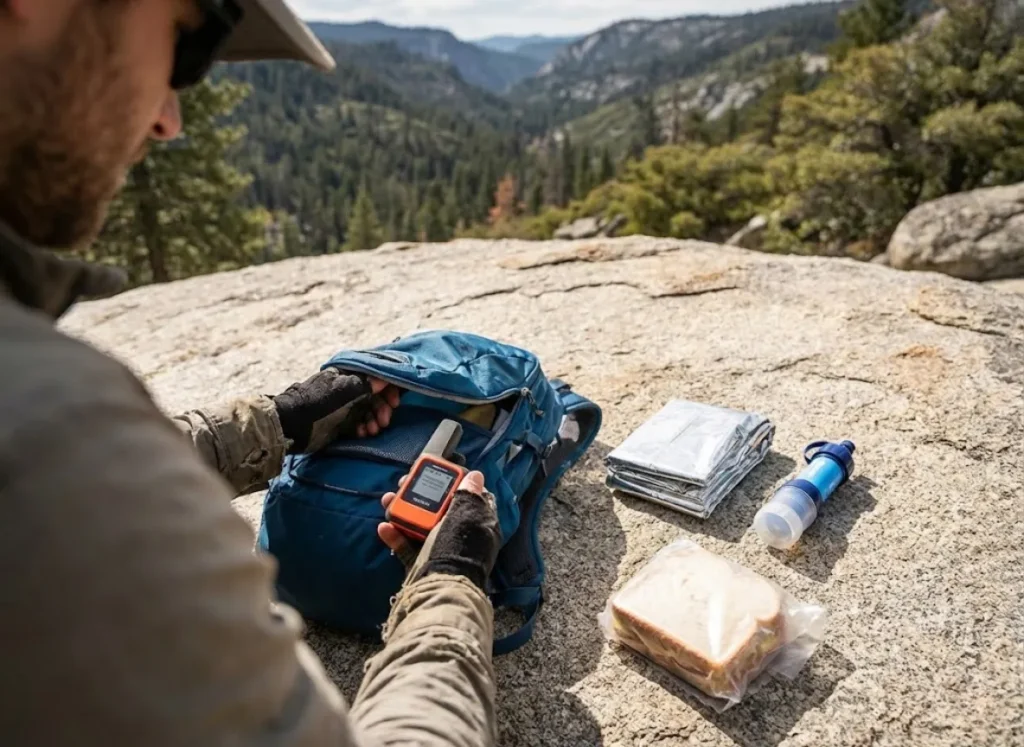
A safe slackpacking kit must include an adapted version of the “Ten Essentials.” Specifically, you must add emergency shelter and communication devices to compensate for the lack of camping gear.
Why Must the ‘Ten Essentials’ Be Adapted for Supported Hiking?
Slackpackers face a unique vulnerability: they are often deep in the backcountry without a tent or sleeping bag. An immobilizing injury that forces an unplanned overnight stay can quickly lead to hypothermia. The standard Ten Essentials guidelines must be adapted; a simple Gore-Tex rain shell is insufficient. You must include a reflective emergency bivvy (e.g., SOL Bivvy) to replace the missing shelter system.
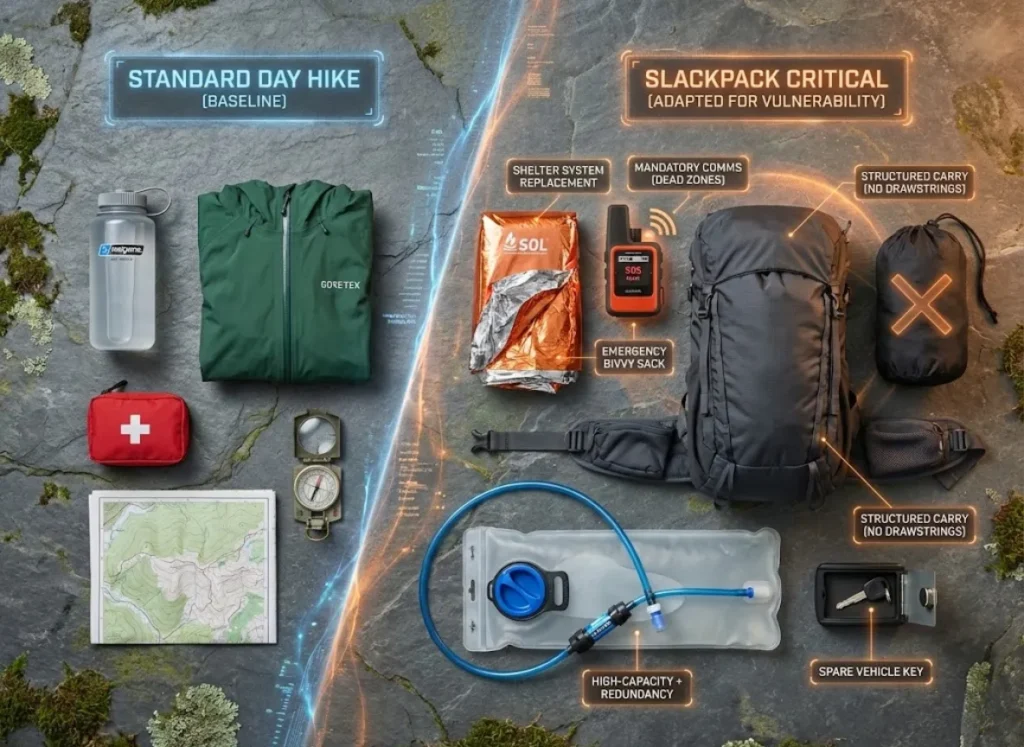
Hydration capacity cannot be compromised. Unlike a casual day hike, slackpacking often covers 20+ miles, requiring 3-4 liters of water capacity via a hydration bladder or a high-flow filter like the Sawyer Squeeze with water filter redundancy. Communication becomes a survival tool; because slackpacking relies on rendezvous points, a satellite communicator (e.g., Garmin inReach) is mandatory to coordinate with shuttles or call for help in dead zones.
Pro-Tip: Ditch the frameless drawstring bag. Use a structured day-hiking rucksack (20-30L capacity) with a hip belt. Even though the load is lighter, you still need to carry variable winter layers, first aid kit, blister care, sun protection, headlamp, and tech. A framed pack distributes this density better than a sack that sags against your lumbar.
Conclusion
Slackpacking is a bifurcated practice: a tactical efficiency tool for American thru-hikers and a formalized luxury hiking experience in international tourism. Biomechanical evidence confirms that reducing pack load significantly lowers Ground Reaction Forces and Knee Adduction Moment, effectively extending the hiking lifespan of your joints.
Logistical success requires choosing the right model—Shuttle, Key Swap, or Base Camp—based on your budget, risk tolerance, and access to the terrain. However, safety cannot be outsourced. The absence of a sleep system demands a rigorous adherence to an adapted “Ten Essentials” kit, including emergency bivvies and satellite communication. Before committing to a full thru-hike or guided tour, test your limits and logistics by planning a weekend slackpack on a local section of the National Scenic Trail system using the “Key Swap” method.
FAQ – Frequently Asked Questions
Is slackpacking considered cheating?
No, slackpacking is not cheating; it is a legitimate logistical strategy recognized within the Hike Your Own Hike (HYOH) philosophy. While some purists may criticize it as slacking off, it allows hikers to navigate difficult terrain safely and makes the trail accessible to those with physical limitations or age-related constraints.
How much does it cost to slackpack?
Costs vary widely depending on the cost vs comfort calculator. A Key Swap is essentially free aside from fuel, while commercial shuttles can cost $1.50–$2.00 per mile or $20–$100 per day depending on the region. International luxury slackpacking packages can range from $100 to over $300 per person for luggage transfer services and accommodation.
What is the difference between day hiking and slackpacking?
Day hiking typically implies returning to the same starting point or home at the end of the day. Slackpacking involves hiking a linear section of a long-distance trail as part of a multi-day journey, with your overnight gear meeting you at the destination.
Do I need to book shuttles in advance?
Yes, booking in advance is highly recommended, especially during peak thru-hiking seasons (Spring or Fall) on trails like the Appalachian Trail or John Muir Trail (JMT). Reliability varies, and many trail angels operate on personal schedules, so confirming your ride 24-48 hours prior is essential to avoid being stranded.
Risk Disclaimer: Hiking, trekking, backpacking, and all related outdoor activities involve inherent
risks which may result in serious injury, illness, or death. The information provided on The Hiking Tribe is for
educational and informational purposes only. While we strive for accuracy, information on trails, gear, techniques,
and safety is not a substitute for your own best judgment and thorough preparation. Trail conditions, weather, and
other environmental factors change rapidly and may differ from what is described on this site. Always check with
official sources like park services for the most current alerts and conditions. Never undertake a hike beyond your
abilities and always be prepared for the unexpected. By using this website, you agree that you are solely
responsible for your own safety. Any reliance you place on our content is strictly at your own risk, and you assume
all liability for your actions and decisions in the outdoors. The Hiking Tribe and its authors will not be held
liable for any injury, damage, or loss sustained in connection with the use of the information herein.
Affiliate Disclosure: We are a participant in the Amazon Services LLC Associates Program, an
affiliate advertising program designed to provide a means for us to earn advertising fees by advertising and linking
to Amazon.com. As an Amazon Associate, we earn from qualifying purchases. We are also an official affiliate partner
of Black Diamond Equipment via the AvantLink network. If you click on a Black Diamond affiliate link and make a
purchase, we may earn a commission at no additional cost to you. We also participate in other affiliate programs and
may receive a commission on products purchased through our links. Additional terms are found in the terms of
service.