In this article
You’re standing in a cramped post office in a town with one stoplight, watching the clock tick toward 5 PM on a Friday. Your resupply box isn’t here. The postmaster shrugs—maybe Monday. That’s three unplanned hotel nights, three days of restaurant meals, and a budget hemorrhaging faster than your pack weight dropped. This is the “Town Vortex,” and it’s one of dozens of logistical traps that separate successful thru-hikers from those who flame out before the halfway point.
The data from 2,600+ PCT hiker surveys is clear: the binary choice between mail drops and buy-as-you-go resupply is obsolete. Modern thru-hikers use dynamic hybrid systems—backed by 2025/206 data and the hard-won lessons from thousands of miles on the Pacific Crest Trail, Appalachian Trail, and Continental Divide Trail.
⚡ Quick Answer: 87% of successful thru-hikers use hybrid resupply strategies, sending an average of 7.9 mail drop boxes to strategic “food desert” locations (Kennedy Meadows, VVR, Stehekin) while buying locally for 60-80% of the trail. The key is break-even analysis: a USPS Priority Mail box costs ~$22.80, so contents must save >$25 compared to local prices to justify shipping. Palate fatigue and the “Town Vortex” effect make rigid pre-planning the dominant failure mode.
The Hybrid Reality: Why the Binary Choice Is Obsolete

The contemporary discourse on long-distance trail resupply has shifted from a binary choice to a nuanced optimization problem. The numbers tell the story: 87% of successful PCT thru-hikers (2025 data) use the postal system at least once, but only 1.9% mail ALL resupply. The “pure strategy” is statistically extinct.
The average thru-hiker sends 7.9 boxes total, strategically placed in “food deserts” where retail options are non-existent or economically predatory. Think Kennedy Meadows (no grocery), Vermilion Valley Resort (resort monopoly with 300% markups), or Stehekin (limited hours, high prices). These aren’t arbitrary choices—they’re tactical responses to geographic and economic realities.
The Pacific Crest Trail Association’s official resupply guidance explicitly recommends “spending your money in communities along the trail, shipping to a small number of remote locations.” This isn’t just logistics—it’s trail stewardship. Supporting small trail towns keeps their economies viable, which keeps resupply infrastructure available for future hikers.
Regret metrics reveal the dominant failure mode: 31% of hikers wished they sent fewer boxes versus 24% who wanted more. Over-planning driven by the scarcity mindset leads to over-shipping. If you do send boxes, understanding the detailed logistics of USPS General Delivery and box timing is critical.
The Buy-As-You-Go Baseline
The average resupply interval on the PCT is 99.8 miles (approximately 5.4 hiking days). On the AT, it’s even tighter—some sections allow “ordering pizza to the trail.” This density makes local buying the default for 60-80% of the trail.
Desert sections (SoCal) have tighter intervals (74 miles / 9.5 days) due to water logistics, not food scarcity. The abundance of Trail Magic (unexpected free food), Hiker Boxes (free discarded food), and small-town retail options means starvation is virtually impossible. The real risk is carrying too much weight because you didn’t trust the system.
When Mail Drops Become Tactical Necessities
The “Tourist Tax” calculation determines when mail drops make economic sense. If a remote resort charges $4 for instant mashed potatoes (versus $1.50 at home), and you need 5 days of food, the $22.80 shipping cost is justified when savings exceed $25.
Specific nodes demand mail drops: Kennedy Meadows (no grocery), VVR (resort monopoly), Stehekin (limited hours). These aren’t suggestions—they’re tactical necessities unless you’re willing to pay 50-100% premiums on staples.
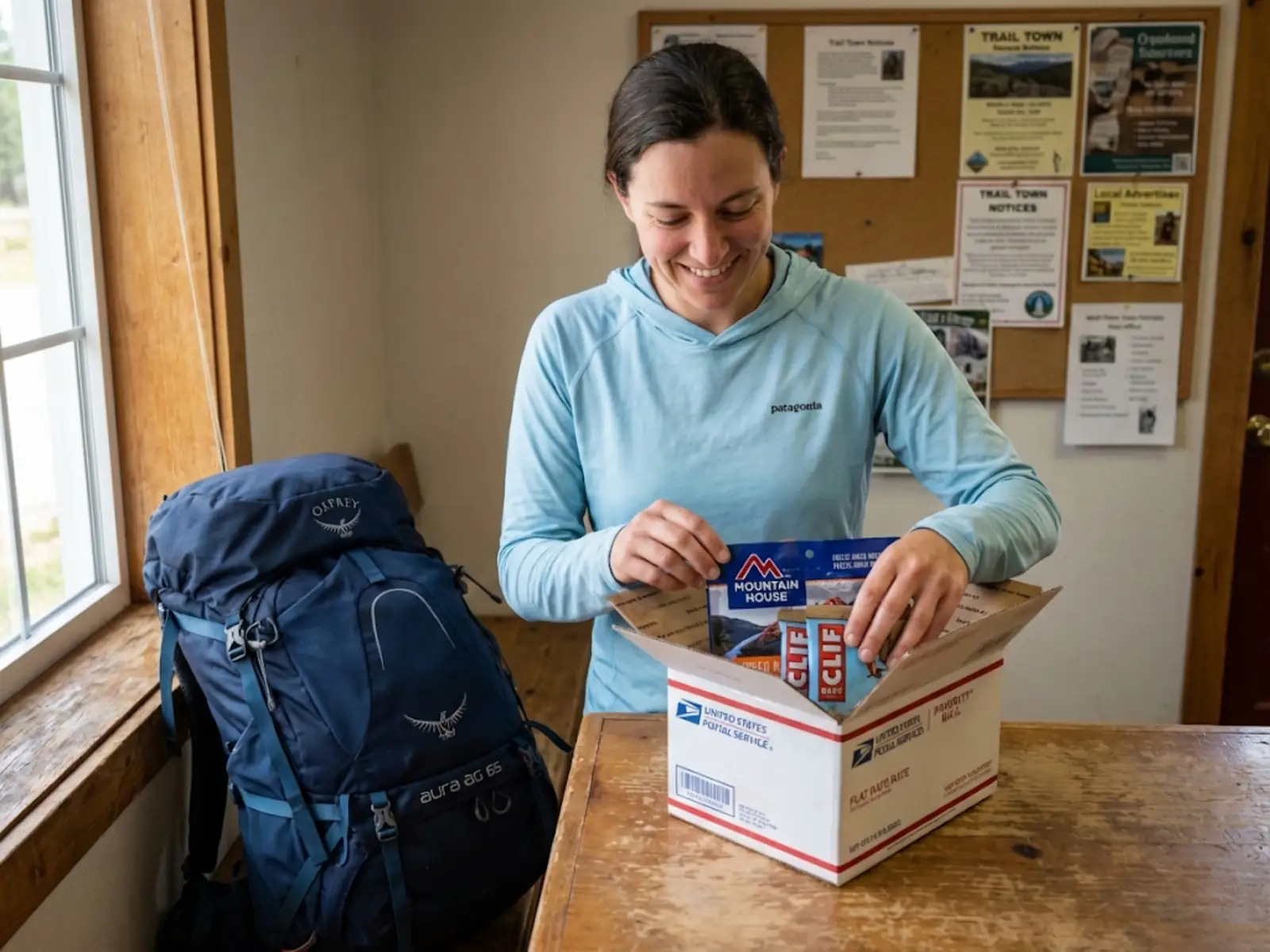
Pro tip: Use the “forwarding hack”—unopened Priority Mail can be forwarded for free if you skip a town or arrive too late for pickup. This flexibility is critical when your pace doesn’t match your pre-hike estimates.
The “Drift Box” Optimization
Here’s the strategy competitors rarely mention: instead of packing 20 boxes at home, buy bulk supplies in a major trail town (Walmart in Wrightwood, Big Bear, or Ashland). Pack 3-4 boxes in your hotel room and mail them forward to upcoming remote sections.
This solves the palate fatigue problem—you know what you’re craving now, not what you thought you’d want six months ago. You maintain bulk pricing while adapting to your current metabolic demands. One hiker’s “Pop-Tart Tragedy” illustrates the risk: he bought 400 Pop-Tarts in bulk at home, only to trade them 2-for-1 for anything savory by the halfway point.
The Economics: Break-Even Analysis for 2025/2026
The traditional wisdom that “mail drops always save money” is being challenged by post-inflation realities. A USPS Priority Mail Large Flat Rate Box costs ~$22.80 (2025/2026 rates). This is your baseline logistics cost.
The break-even threshold is simple: box contents must save more than $25 compared to local prices to justify shipping. Let’s run the numbers.
Example 1 (Worth it): Five days of food costs $100 at Walmart, $150 at a remote resort. The box saves $27 after shipping. Verdict: Mail it.
Example 2 (Not worth it): Five days of food costs $100 at Walmart, $115 at a Dollar General in town. The box loses $8. Verdict: Buy on trail.
The “Inflationary Squeeze” has narrowed the arbitrage opportunity. While grocery prices have risen, shipping costs have escalated faster. The “Tourist Premium” in towns like Sierra City or Stehekin can still be 50-100% on staples, which justifies mail drops in those specific nodes. However, for towns with standard grocery stores, the shipping cost frequently exceeds the local markup.
Cost per mile data reveals regional differences: the PCT averages $3.56/mile versus the AT’s $2.68/mile—a 33% premium driven by West Coast prices and remoteness. This affects your caloric density and macronutrient planning strategy significantly.
Hidden Costs: The “Town Vortex” Effect
Waiting for a post office to open forces unplanned hotel nights. Most small-town post offices close Sundays and at noon on Saturdays. If you arrive Saturday afternoon or Sunday, you’re stuck until Monday morning.
One extra hotel night ($80-120) plus restaurant meals ($40-60) obliterates any mail drop savings. Build a 1-day buffer into your itinerary.
The “Friend Tax” Multiplier
Solo hikers can grab food and leave town in 2-3 hours. Groups (“tramilies”) tend to stay 1-2 extra days due to group consensus. Each extra town day costs $100-200 (lodging, meals, beers). Over a thru-hike, this “Friend Tax” can add $1,500-3,000 to total costs.
If hiking with a group, budget for the “Friend Tax.” This hidden cost rarely appears in competitor guides.
Waste and Regret: The 31% Problem
The scarcity mindset leads to over-shipping. Unwanted food ends up in Hiker Boxes—the informal circular economy where mail-drop rejects are redistributed for free. You’ll find the chaos at every hostel: half-eaten Nutella jars and the omnipresent oatmeal packets nobody wants by week 3.
The Physiology Problem: Why Your “Planning Self” Fails
After 3-4 weeks of 20+ mile days, your body enters “Hiker Hunger”—a state requiring 3,000-5,000+ calories per day. Glycogen depletion triggers intense cravings for fats and immediate sugars. The “healthy” meals you packed (oatmeal, low-sodium dehydrated stews) become physically repulsive.
This isn’t a preference—it’s a physiological rejection called palate fatigue. As one experienced thru-hiker put it: “The minute you make a plan, something will come along that causes it to be thrown out the window… I packed oatmeal packets in those boxes and then gagged on every bite and ended up giving away.”
The consequence is predictable: hikers abandon perfectly good homemade food in Hiker Boxes and spend extra money buying “trash food” (high salt/sugar/fat) that their bodies demand. Your body knows what it needs better than your pre-hike spreadsheet.
This metabolic shift is one of many psychological adaptations and the Central Governor theory addresses in thru-hiking preparation.
The “Oatmeal Trap” and Flavor Fatigue
The most common regret: packing the same breakfast (usually oatmeal) for 100+ days. Anecdotal reports suggest oatmeal has a 90% rejection rate by week 6. Never ship 100% of any single flavor. Variety is a survival mechanism, not a luxury.
The Scarcity Mindset vs. Trail Reality
Novice hikers fear starvation, leading to over-packing and over-shipping. The reality: Trail Magic, Hiker Boxes, and small-town retail mean starvation is virtually impossible on major US trails. The real risk is excess weight and logistical rigidity, not hunger.
The “Drift Box” Solution to Palate Fatigue
By packing boxes on trail (in a hotel room after a Walmart run), you know what you’re craving now. This solves the “Planning Self vs. Hiking Self” disconnect. You can adjust macronutrient ratios based on current energy demands—more fats in cold sections, more sugars in high-mileage pushes.
Legal and Regulatory Traps (The Information Competitors Miss)
Most competitor guides ignore the regulatory environment governing resupply logistics. This section prevents legal violations and customs seizures.
Three critical domains demand attention: USPS General Delivery protocols, FDA import controls, and DOT hazmat shipping. Citing USPS Publication 52 (Hazardous Materials) and the Bioterrorism Act of 2002 distinguishes this content from generic blogs.
USPS General Delivery: The “30-Day Myth”
Official USPS policy allows 30-day holds, but many small post offices enforce a 15-day return policy for parcels due to space constraints. To mitigate premature returns, mark boxes with “Please Hold for PCT/AT Hiker [Legal Name], ETA: [Date]” in bold red ink. This signals the “hiker exception.”
Federal law requires government-issued photo ID for General Delivery pickup. Trail names (“Speedy,” “Monkey Toes”) cannot be used on the address label—this renders packages unclaimable.
Pro tip: Put bright neon duct tape on all sides of your box. When the postal worker is sorting 500 brown boxes, yours stands out.
The International Hiker “Legal Trap”
The Bioterrorism Act of 2002 requires FDA’s Prior Notice requirements for imported food. Food mailed ahead of the traveler (not accompanying them) is classified as an unaccompanied import. Without Prior Notice filing, packages are subject to CBP seizure and destruction.
The exemption: food in your backpack at the airport is exempt (personal use). Food mailed to you is not. International hikers should fly with empty bags and buy food inside the US to ship ahead. This avoids customs seizures and potential visa complications.
Fuel Shipping: The “Felony” Most Hikers Don’t Know About
Sending isobutane fuel canisters via Priority Mail (which travels by air) is a federal crime—shipping undeclared hazmat on passenger aircraft. Fuel must be shipped via USPS Retail Ground (surface only), marked with “ORM-D” or “Limited Quantity” labels.
The trade-off: Retail Ground takes 2-3 weeks versus 3 days for Priority Mail. This complicates timing strategies. Step-by-step protocol: wrap canister in absorbent material, place in sturdy box, mark with “Surface Only” and Limited Quantity square, ship via Retail Ground.
Special Cases: When Mail Drops Are Mandatory
For most hikers, mail drops are tactical. For some, they’re mandatory. Three scenarios demand 100% mail drop strategies: hiking with a dog, strict dietary restrictions (Celiac, severe allergies), and fuel logistics in remote sections.
The K9 Mail Drop: Canine Resupply Logistics
High-quality, calorie-dense dog food (freeze-dried or specific kibble) is rarely available in trail towns, which stock low-quality generic brands. Carrying 5-7 days of dog food adds massive weight (10-15 lbs for a medium dog).
Mail drops are essential to ensure canine health and manage pack weight. Use 5-gallon buckets instead of cardboard for remote caches (rodent protection), but verify which post offices accept them (some charge surcharges or refuse).
Understanding canine-specific logistics and safety protocols is critical for successful dog thru-hikes.
Medical Diets: The “Safety Box” Strategy
For Celiac disease (strict gluten-free) or severe allergies, the cross-contamination risk in rural diners and Hiker Boxes is unacceptable. Mail 100% of consumption needs. This is the only viable medical option, despite the cost.
As the PCTA notes: “If you’re on a gluten free, vegan, organic… or have another restricted diet, you might choose to mail yourself more of your food. Gas station and general store resupplies might not work for you.”
Allergen warning: Hiker Boxes pose cross-contamination risks for anyone with anaphylactic allergies. Never rely on them if you have severe food allergies.
Fuel Logistics in Remote Sections
Some remote sections (Sierra High Route, CDT’s San Juans) have no fuel availability for 100+ miles. The timing problem: Retail Ground shipping takes 2-3 weeks. You must mail fuel boxes 3-4 weeks before your estimated arrival.
The risk: if you hike faster than expected, you arrive before your fuel. If slower, you trigger the “Town Vortex” waiting for it.
Tactical Execution: How to Actually Do This
This section translates theory into action: addressing boxes, timing shipments, using the “Bounce Box” for non-consumables.
Accurate resupply timing depends on solid digital route planning and resupply point mapping using tools like FarOut or Gaia GPS.
Addressing and Timing Mail Drops
Address format: [Your Legal Name] / General Delivery / [Town, State ZIP] / “Please Hold for PCT Hiker, ETA: [Date]”
Timing rule: mail 7-10 days before estimated arrival for Priority Mail. Add 2-3 weeks for Retail Ground (fuel). Build a 1-day buffer into your ETA to avoid the “Sunday Arrival” trap (post offices closed).
The “Bounce Box” System
A Bounce Box is a rolling cache of non-consumable support gear (phone charger, city clothes, laptop, spare medications, maps for upcoming sections). It moves from town to town without being carried on trail, reducing base weight.
The logistics: you pick it up, swap items, and mail it forward to the next town (same day or next morning). Use a 5-gallon bucket for durability (tougher than cardboard), but verify which towns accept them.
The “Drift Box” Execution
When you hit a major trail town with a Walmart (Wrightwood, Big Bear, Ashland), buy bulk supplies. Pack 3-4 boxes in your hotel room, addressing them to upcoming remote sections.
This solves palate fatigue (you know what you’re craving now) while maintaining bulk pricing. You can adjust macronutrient ratios based on current energy demands—more fats for cold sections, more sugars for high-mileage pushes.
Pro tip: The “forwarding hack”—unopened Priority Mail can be forwarded for free if you skip a town or arrive too late. This flexibility is critical when your pace doesn’t match pre-hike estimates.
Conclusion
The mail drop versus buy-as-you-go debate isn’t binary—it’s a dynamic optimization problem. The data is clear: 87% of successful thru-hikers use hybrid systems, sending an average of 7.9 boxes to strategic “food desert” nodes while buying locally for 60-80% of the trail.
Three key insights: First, the “Drift Box” strategy solves palate fatigue while maintaining cost efficiency. Second, post-inflation economics have narrowed the arbitrage opportunity—break-even analysis is critical. Third, physiological shifts (Hiker Hunger, palate fatigue) make your “Planning Self” unreliable.
Legal frameworks (FDA Prior Notice, fuel hazmat regulations) pose real risks that most guides ignore. Before you pack a single box, calculate your break-even threshold for each resupply point. Map your route, identify the true “food deserts,” and build timing buffers to avoid the Town Vortex.
Most importantly, stay flexible. The trail will teach you what your body actually needs, and that lesson is worth more than any pre-hike plan. Next time you’re planning a thru-hike, remember: the best resupply strategy is the one that adapts to reality, not the one that looked perfect on a spreadsheet six months ago.
FAQ
How many resupply boxes should I send for a PCT thru-hike?
The average successful PCT hiker sends 7.9 boxes total, targeting remote food desert locations like Kennedy Meadows, VVR, and Stehekin. Most hikers (76.9%) send between 1-50% of their resupply via mail, buying the rest locally. The key is strategic placement, not volume.
Can I ship fuel canisters via USPS Priority Mail?
No—this is a federal crime. Isobutane fuel canisters must be shipped via USPS Retail Ground (surface only) with ORM-D or Limited Quantity markings. Retail Ground takes 2-3 weeks versus 3 days for Priority Mail, so plan accordingly.
What happens if I arrive at a post office on Sunday?
Most small-town post offices are closed Sundays and close at noon on Saturdays. If you arrive outside business hours, you’re stuck until Monday morning—forcing unplanned hotel nights and restaurant meals (the Town Vortex). Build a 1-day buffer into your resupply timing to avoid this.
Can international hikers mail food from their home country to US trail towns?
Not recommended. The Bioterrorism Act of 2002 requires FDA Prior Notice for unaccompanied food imports. Packages mailed ahead (not accompanying you) are subject to CBP seizure. The solution: fly with empty bags and buy food inside the US to ship ahead.
What’s the break-even point for a mail drop box?
A USPS Priority Mail Large Flat Rate Box costs ~$22.80. To justify shipping, the contents must save more than $25 compared to local prices. Example: if 5 days of food costs $100 at Walmart and $150 at a remote resort, the box saves $27 (worth it). If local prices are only $115, you lose $8 (buy on trail instead).
Risk Disclaimer: Hiking, trekking, backpacking, and all related outdoor activities involve inherent risks which may result in serious injury, illness, or death. The information provided on The Hiking Tribe is for educational and informational purposes only. While we strive for accuracy, information on trails, gear, techniques, and safety is not a substitute for your own best judgment and thorough preparation. Trail conditions, weather, and other environmental factors change rapidly and may differ from what is described on this site. Always check with official sources like park services for the most current alerts and conditions. Never undertake a hike beyond your abilities and always be prepared for the unexpected. By using this website, you agree that you are solely responsible for your own safety. Any reliance you place on our content is strictly at your own risk, and you assume all liability for your actions and decisions in the outdoors. The Hiking Tribe and its authors will not be held liable for any injury, damage, or loss sustained in connection with the use of the information herein.
Affiliate Disclosure: We are a participant in the Amazon Services LLC Associates Program, an affiliate advertising program designed to provide a means for us to earn advertising fees by advertising and linking to Amazon.com. As an Amazon Associate, we earn from qualifying purchases. We also participate in other affiliate programs and may receive a commission on products purchased through our links, at no extra cost to you. Additional terms are found in the terms of service.