In this article
The headlamp beam barely cut through the evening mist as I balanced my pot on a ring of river stones, watching the invisible flame of my alcohol stove flicker in the wind. Three days into a 10-day High Sierra traverse, my fuel bottle felt disturbingly light—and I still had seven days of meals ahead. That morning, I’d been so proud of my ultralight backpacking setup: a tiny Toaks Siphon, a plastic bottle of denatured alcohol, and zero steel canisters weighing me down.
By day five, I was borrowing fuel from other hikers. That’s when I learned the hard way what gram-counters call the 10-meal threshold—the invisible line where alcohol’s weight advantage evaporates.
After fifteen years of testing every backcountry cooking system from homemade cat-can stoves to the latest Jetboil Stash, I’ve finally cracked the math. This guide breaks down exactly when alcohol stoves beat canister stoves on the scale—and when hauling that steel can actually saves you weight.
⚡ Quick Answer: Alcohol stoves are lighter for trips under 3-4 days (about 7-10 meals) because they don’t require a heavy steel canister. But canister fuel is roughly twice as energy-dense as alcohol, so on longer trips, you’ll carry less total weight with an isobutane system. The crossover point depends on your specific gear, but most hikers find it falls around the 10-meal mark.
The Science of Stove Fuel: Understanding Energy Density

Before you obsess over stove weights, you need to understand the real difference: fuel efficiency. Not all fuels are created equal, and the gap is bigger than most hikers realize.
The Hydrocarbon Advantage (Isobutane/Propane Blends)
Modern canister stoves run on pressurized blends of isobutane and propane. These hydrocarbons pack serious punch—roughly 21,000 BTU per pound. That’s why a tiny 110-gram canister can boil dozens of liters of water.
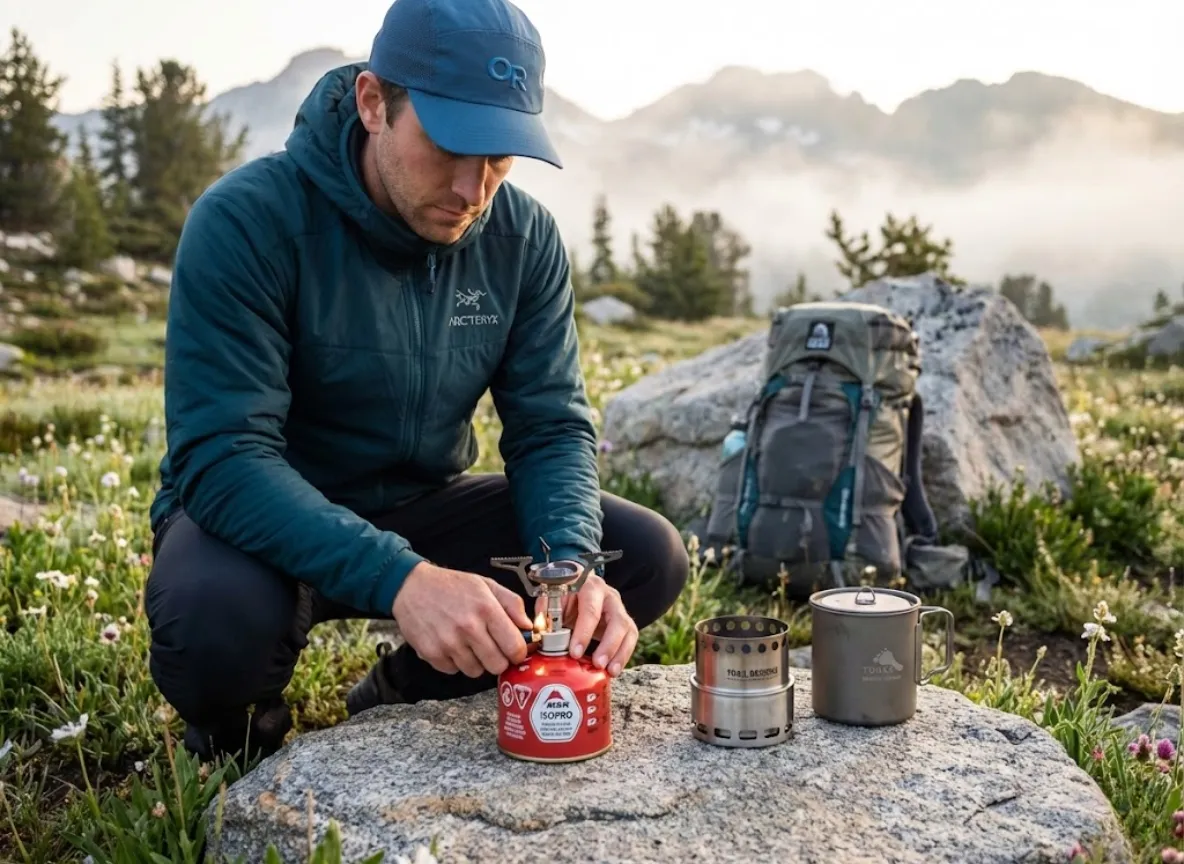
The fuel comes pre-mixed for optimal burning. You don’t tune anything, measure anything, or think much at all. Screw on the stove, crack the valve, click the piezo, and dinner’s cooking. The Soto Windmaster and MSR PocketRocket 2 have dominated the backpacking market because this simplicity works.
The Oxygenated Deficit (Ethanol/Methanol)
Alcohol stoves burn denatured alcohol or methanol (like yellow HEET). Here’s the catch: alcohol molecules already contain oxygen atoms, which means less potential energy locked inside. Ethanol delivers around 11,500-13,000 BTU per pound—barely half what you get from isobutane.
The practical implication hits hard: to boil the same pot of water, you need to burn roughly twice the mass of alcohol compared to canister fuel. This 2:1 ratio is the mathematical engine behind the 10-meal rule, and no amount of stove tinkering will change it.
Pro tip: The 2:1 ratio isn’t marketing spin—it’s chemistry. Accept it, and plan your fuel around it.
What About Wood and Esbit?
Multi-fuel stoves and solid fuel tablets have their place, but they don’t change the core equation. Esbit delivers even less energy per gram than alcohol, making it useful only for emergency backup or extremely short trips. Wood burning stoves offer “free” fuel, but they require dry wood, burn bans can shut them down, and the time investment is brutal after a 25-mile day.
For anyone committed to the ultralight backpacking philosophy, the real decision remains alcohol versus canister.
The 10-Meal Rule: A Mathematical Breakdown
Numbers don’t lie. The 10-meal threshold emerges from a simple comparison of tare weight (the weight of your empty containers) versus consumable weight (the fuel you burn each day).
Defining System Weight (Tare vs. Consumable)
Here’s what most “stove weight” comparisons get wrong: they ignore the container. A gas canister needs thick steel walls to contain 50-100 psi of pressure. A so-called “100-gram” canister weighs about 100 grams empty—meaning you’re hauling 200 grams total when it’s full.
Alcohol? It’s unpressurized liquid. You can carry it in a 30-gram plastic bottle from the hardware store. That weight difference is massive at the trailhead—but it shrinks rapidly as you burn through alcohol fuel at double the rate.
The Math: Where Two Lines Cross
Let’s run real numbers using popular gear:
Alcohol Kit: Toaks Siphon stove (20g) + pot stand (25g) + 8oz fuel bottle (30g) = 75g base weight, plus 20g of alcohol per meal.
Canister Kit: Soto Windmaster (67g) + empty 110g canister (100g) = 167g base weight, plus 7g of isobutane per meal.
If you cook two meals per day, the alcohol system starts lighter but gains weight faster. Around meal seven—day 3.5—the lines cross. From there, the canister system becomes the lighter choice for every remaining day.
Add in a typical safety margin (you always carry a bit extra), and the functional break-even lands right around five days or ten meals. That’s the 10-meal threshold in action.
Pro tip: Carry a tiny digital scale to weigh your partially-used fuel canisters. Knowing exactly how much fuel remains eliminates the guesswork that makes many hikers over-pack.
The “Step Function” Problem with Canisters
Canisters come in fixed sizes: 100g, 230g. You can’t buy a 150g canister for a trip that needs exactly 126g of fuel. Alcohol, on the other hand, is fluid—pour precisely what you need.
This creates awkward situations. A six-day trip needs roughly 84g of gas, so one 110g canister works fine. But bump that to nine days (126g needed), and suddenly you’re hauling two small canisters or one heavy 230g tank. Trips that fall between canister sizes often extend alcohol’s advantage beyond the usual break-even point.
Many hikers also suffer from “half-canister anxiety”—a garage full of partially-used fuel canisters that nobody trusts on a real trip. The result? Carrying a fresh canister every time, even when a half-full one would suffice.
If your next adventure involves essential backpacking gear decisions, factor canister sizing into your planning.
How Conditions Change the Equation
The 10-meal rule assumes fair weather. Reality rarely cooperates. Cold, wind, and altitude can flip the script entirely.
Cold Weather: The Canister’s Achilles Heel
Isobutane has a boiling point around 11°F (-12°C). When temperatures drop near that threshold, internal pressure in the canister stove collapses. You’ll hear the flame sputter, watch your boil time stretch from three minutes to ten, and eventually get nothing but weak hissing.
Alcohol doesn’t care. Liquid fuel is liquid fuel—it burns the same at 50°F or 15°F. For below-freezing multi-day hiking, this immunity to cold can trump everything else.
Cold-weather workarounds for canisters exist: sleeping with the canister in your bag, buying “winter mix” fuel with more propane, or using stoves with pressure regulators like the Soto Windmaster. But these add hassle and weight.
Pro tip: Sleep with your fuel canister in the foot of your sleeping bag. Your body heat keeps the pressure up for that crucial morning coffee.
Altitude: The Surprising Neutral Zone
Common myth: alcohol stoves fail at altitude. Reality: they don’t. What matters is temperature, not air pressure. Because water boils at lower temperatures at high elevation (around 180°F at 10,000 feet), you actually need less energy to reach a boil.
Neither system has a decisive advantage in the 5,000-14,000 foot range where most backpackers operate. Both work fine; both need windscreens.
Wind: The Hidden Variable That Wrecks Ultralight Plans
This is where numbers collide with trail reality. That featherweight BRS-3000T at 25 grams? In any breeze, its exposed burner loses flame contact with your pot. Fuel consumption rates can triple. What looked brilliant on paper becomes useless when you’re crouching behind a rock trying to heat dinner.
The Soto Windmaster’s concave burner head shields the flame naturally—significant windscreen efficiency without adding a separate screen. Integrated systems like the Jetboil Stash go further, using heat exchanger fins that capture exhaust gases and boost thermal transfer to roughly 80%.
Alcohol stoves paired with a Caldera Cone are nearly “bombproof”—the cone wraps the pot entirely, blocking wind from every direction. But open-jet alcohol burners without windscreens fail spectacularly in moving air.
The lesson? Always compare system weight, not stove weight. A 25g stove plus a 50g windscreen isn’t actually lighter than an 87g regulated burner that needs nothing extra.
Stove Systems Compared: Real Products, Real Weights
Theory is fine, but you still need to buy gear. Here’s what actually works.
Best Canister Stoves for Efficiency
The Soto Windmaster (87g) remains the gold standard for all-around performance. Its micro-regulator maintains consistent output as the canister depletes or cools—critical for cold weather performance. The boil time sits around 2:30 for 500ml.
The Jetboil Stash (200g total system) takes efficiency to extremes. Its FluxRing technology achieves around 80% thermal efficiency, meaning you’ll boil roughly 12 liters boiled per gram of a 100g canister. If fuel consumption rates matter more than base weight, nothing beats it.
The BRS-3000T (25g) tempts gram-counters with its titanium construction, but honest reviews reveal serious wind and durability problems. Those pot support arms deform under heat stress. Unless conditions are perfect, you’ll burn more fuel fighting for flame stability than you save in stove weight.
Best Alcohol Stoves for Efficiency
The Trail Designs Sidewinder Ti-Tri combines a Caldera Cone with a titanium stove for exceptional wind resistance and versatility—it burns alcohol, Esbit, or wood. Slow (6-8 minutes for 500ml) but utterly reliable.
The Toaks Siphon Stove (20g) uses double-wall capillary action for fast priming and clean burning. Expect roughly 30ml of alcohol fuel per 11-minute burn.
DIY “Fancyfeest” or cat-can stoves weigh under 10 grams and cost nothing. With a proper windscreen, they perform surprisingly well—Andrew Skurka has thru-hiked thousands of miles on low-tech setups like these.
Without a full windscreen, all alcohol stoves lose 30-50% stove efficiency to even moderate breezes.
The “System Weight” Reality Check
Always think in systems. A Soto Windmaster (87g) plus a full 110g canister (200g) equals 287g. A BRS-3000T (25g) plus windscreen (50g) plus the same canister hits 275g—only 12 grams lighter for vastly inferior performance.
If you’re optimizing for lightweight backpacking gear, run the numbers on your complete stove system, not just the stove alone.
Safety: The Hazards They Don’t Put on the Box
Weight obsession shouldn’t make you overlook the things that can hurt you.
The Invisible Killer: Flame Jetting
Alcohol—especially methanol—burns with a nearly invisible alcohol flame in daylight. You think the stove is out, tilt your bottle to refill, and ignite a stream of fuel that jets back at you. The CPSC has issued multiple warnings about flame jetting hazards after injuries and deaths from alcohol-burning devices.
Always wave the back of your hand above the stove before refilling. Wait 2-3 minutes after you think the flame is out. Never rush this step.
Carbon Monoxide: The Silent Tent Threat
Both stove types produce carbon monoxide. The CDC documents fatalities from campers using stoves inside sealed tents for warmth—high-output canister stoves are especially dangerous because they deplete oxygen fast.
Never cook inside a sealed shelter. Vestibule cooking requires maximum ventilation. Cold-weather temptation is strongest, and most deadly.
Leave No Trace: Environmental Considerations
Alcohol spills kill vegetation. Stoves without a ground pad can scorch the earth. Steel fuel canisters are non-refillable and require puncturing with a special tool (like Jetboil CrunchIt) before any recycling center will accept them—most end up in landfill.
Neither system is perfect. Minimize impact by cooking efficiently, packing out all waste, and respecting the places that make the Ten Essentials for safe hiking worth carrying.
Making the Decision: A Framework for Your Next Trip
Forget tribal loyalty to one stove choice. Smart hikers match their gear to each trip’s parameters.
When to Choose Alcohol
Alcohol wins for solo three-season use under four days in fair weather—warm temperatures, minimal wind, no fire bans. It also wins when resupply logistics are easy (most hardware stores carry denatured alcohol) and when you genuinely enjoy the ritual of measuring fuel and priming your stove.
When to Choose Canister
Canister stoves dominate longer trip duration scenarios, cold weather, windy conditions, and group cooking. They also win when you value convenience after exhausting days—click a button and eat versus measuring, priming, sheltering, and waiting.
The “Hybrid” Approach for Thru-Hikers
Many long-distance hikers swap systems mid-trail based on resupply frequency and terrain. Use alcohol through warm, dry desert sections with short resupply intervals, then switch to canister for Sierras or similar demanding terrain.
As thru-hiking preparation guides note, flexibility beats dogma. Run a quick cost-benefit analysis for each section and pack accordingly. Some hikers even carry a basic fuel calculator spreadsheet to make the call easier.
Conclusion
The alcohol versus canister debate isn’t about picking a winner—it’s about understanding the 10-meal threshold well enough to make smart calls for each specific trip. For short fair-weather adventures, alcohol’s absence of a 100-gram steel canister gives you a weight edge canister stoves can’t match. But as trip duration extends past five days, or when wind, cold, and end-of-day fatigue enter the equation, high-energy isobutane and the convenience of regulated burners take over.
The 10-meal threshold is the fulcrum. Learn it. Run your own numbers. And next time someone asks “which stove is lighter?”—you’ll know the honest answer: it depends on how many meals you’re cooking.
Your next step: Before your next multi-day hiking trip, weigh your current stove system components and calculate your personal break-even point. Your pack—and your trail experience—will thank you.
FAQ
How do I know how much fuel is left in a partial canister?
Weigh the canister on a kitchen scale and subtract the empty canister dead weight (usually stamped on the bottom—around 100g for a 110g canister). The remainder equals usable fuel. Plan for 7-10g per meal for regulated stoves.
Can I fly with isobutane canisters?
No. TSA prohibits all pressurized fuel canisters in checked or carry-on luggage. Purchase canisters at your destination from outdoor retailers. For alcohol, carry an empty fuel bottle and buy denatured alcohol locally at hardware stores.
Does altitude really affect alcohol stove performance?
Only slightly. Reduced oxygen density can marginally impair combustion, but the lower boiling point of water at high elevations actually reduces the energy needed. Neither system has a meaningful altitude-specific efficiency advantage between 5,000 and 14,000 feet.
What’s the fiddle factor and why does it matter?
The fiddle factor describes the mental effort required to operate alcohol stove setup: measuring fuel, priming, sheltering from wind, waiting for bloom. After a 25-mile day when you’re exhausted, many hikers find this cognitive load punishing. Canister stove push-button simplicity becomes its own form of weight savings—in your head, not your pack.
Is cold soaking a real alternative to stoves?
Yes. Rehydrating dried food in cold water (usually a wide-mouth jar carried inside your pack) eliminates all stove weight. It requires accepting lukewarm meals and limiting menu options, but committed ultralighters swear by it—especially for summer trips where hot food isn’t essential for warmth.
Risk Disclaimer: Hiking, trekking, backpacking, and all related outdoor activities involve inherent risks which may result in serious injury, illness, or death. The information provided on The Hiking Tribe is for educational and informational purposes only. While we strive for accuracy, information on trails, gear, techniques, and safety is not a substitute for your own best judgment and thorough preparation. Trail conditions, weather, and other environmental factors change rapidly and may differ from what is described on this site. Always check with official sources like park services for the most current alerts and conditions. Never undertake a hike beyond your abilities and always be prepared for the unexpected. By using this website, you agree that you are solely responsible for your own safety. Any reliance you place on our content is strictly at your own risk, and you assume all liability for your actions and decisions in the outdoors. The Hiking Tribe and its authors will not be held liable for any injury, damage, or loss sustained in connection with the use of the information herein.
Affiliate Disclosure: We are a participant in the Amazon Services LLC Associates Program, an affiliate advertising program designed to provide a means for us to earn advertising fees by advertising and linking to Amazon.com. As an Amazon Associate, we earn from qualifying purchases. We also participate in other affiliate programs and may receive a commission on products purchased through our links, at no extra cost to you. Additional terms are found in the terms of service.