In this article
The strap was strangling my wrist, my forearms were cramping, and I still had six miles of downhill ahead of me. I’d been hiking with trekking poles for three years—but it took a near-fall on loose talus to realize I’d been using them completely wrong.
After a decade of guiding on everything from the Chilkoot Trail to Mt. Elbert, I’ve watched this same pattern repeat with hundreds of hikers. They invest in quality poles from Leki or Black Diamond, strap in like they’re putting on a bracelet, and wonder why their hands go numb by mile five.
Here’s the fix—the trekking pole wrist strap technique that transforms your poles from liability to advantage. No more death grip. No more forearm cramps. Just smooth, efficient power transfer that your body will thank you for.
⚡ Quick Answer: Insert your hand UP through the bottom of the strap loop—not down from the top. This positions the webbing across your wrist heel, allowing force to transfer through your arm skeleton instead of your grip muscles. Proper technique reduces hand fatigue by up to 90% and cuts knee stress by 12-25% on descents. Master this method and your poles become an extension of your body.
The Biomechanics of Why Strap Technique Matters
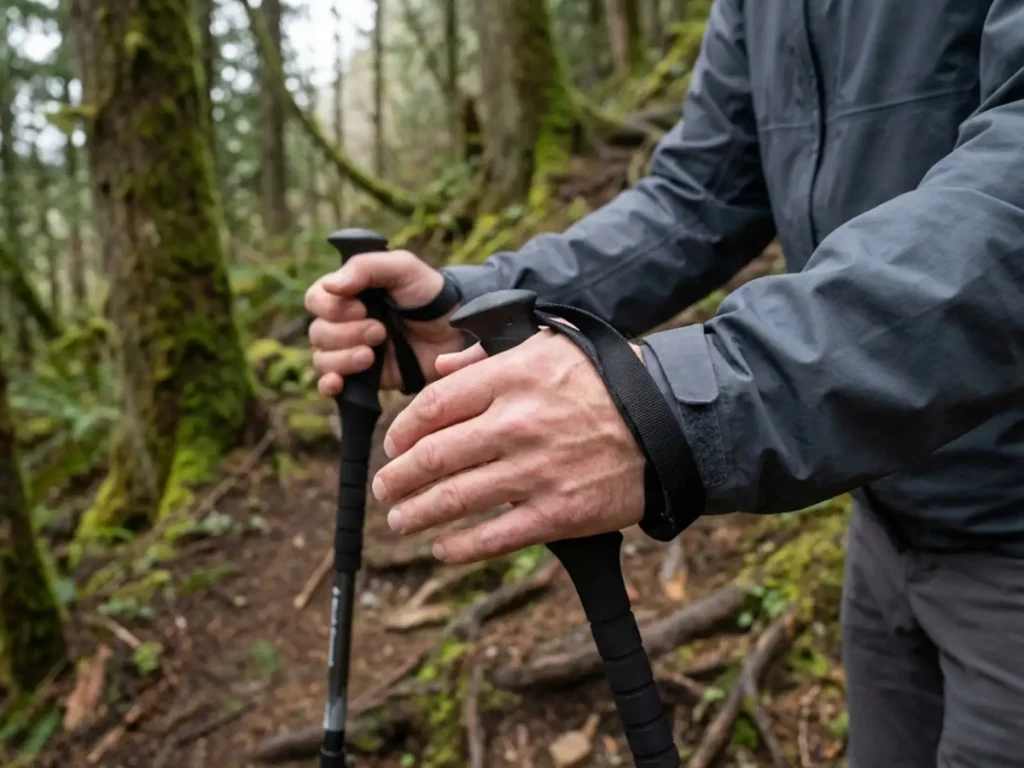
Most hikers treat pole straps like an afterthought—something to keep the poles attached to their hands. That’s backwards. The wrist strap is the primary load-bearing component of the system. Get it wrong, and you’re working against your own body.
The Death Grip Problem: What Goes Wrong
Without proper strap technique, every bit of force you push into the pole terminates at your hand grip. Your brain responds the only way it knows how: squeeze harder. The small muscles in your forearm—designed for fine motor control, not heavy lifting—get recruited for a job they were never built to handle.
The result? Pumped forearms within the first hour. Cramping by lunchtime. That tingly numbness in your fingers by afternoon. Sound familiar?
Studies show that the 12-25% knee load reduction everyone touts from pole use depends on the “open hand” technique. If you’re death-gripping, you’re not getting those benefits—you’re just adding weight to your pack.
Pro tip: If your grip is tight enough to leave marks on your palm after a mile, you’re not using the strap correctly. The strap should do the work, not your fingers.
The Load Path: Skeleton vs. Muscle
When the strap sits correctly across the heel of the hand—that fleshy pad below your pinky—something remarkable happens. Force bypasses your finger flexors entirely.
The load path shifts: pole tip → shaft → strap webbing → wrist heel → forearm bones → shoulder → back muscles. You’ve just upgraded from two-wheel drive to four-wheel drive hiking. Research shows poles engaged this way recruit 90% of body muscles compared to 35% without, meaning you spread the work across your entire frame.
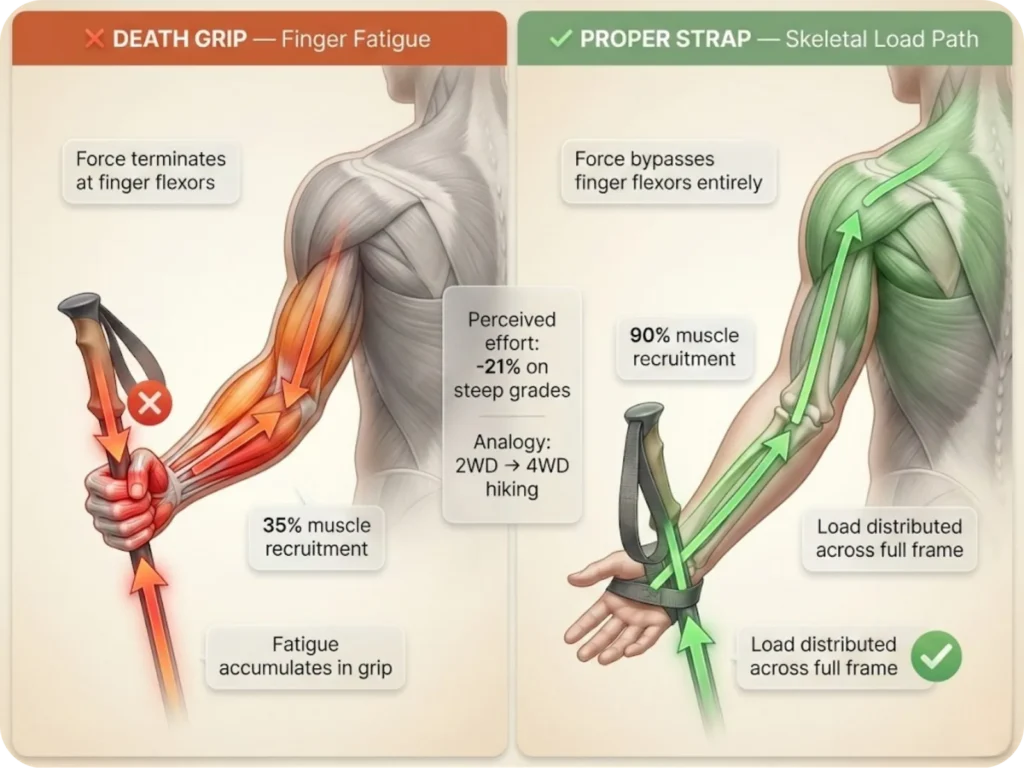
Your heart works harder, sure. But here’s the counterintuitive part: perceived effort drops 21% on steep grades. You’re doing more work but it feels easier. That’s the payoff of correct bio-mechanical benefits of trekking poles—load distribution that matches your anatomy.
The “Rabbit Out of the Hole” Technique: Step-by-Step
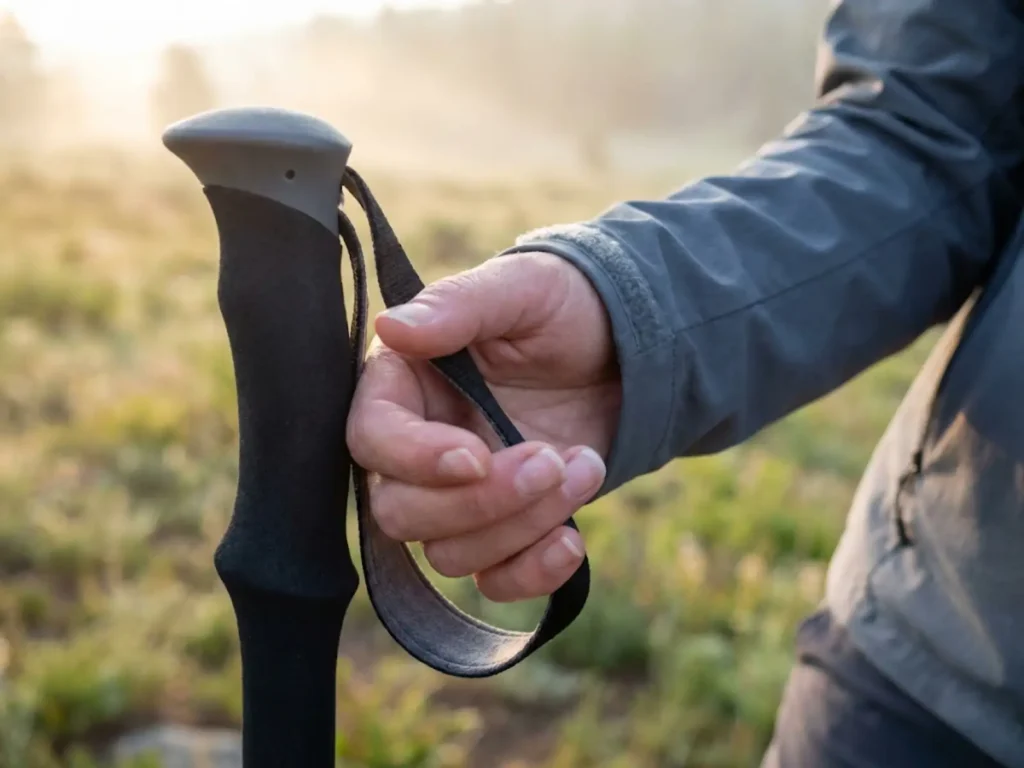
Nordic skiers have been teaching this for decades with a simple visualization that locks the movement into muscle memory. Time to steal their method.
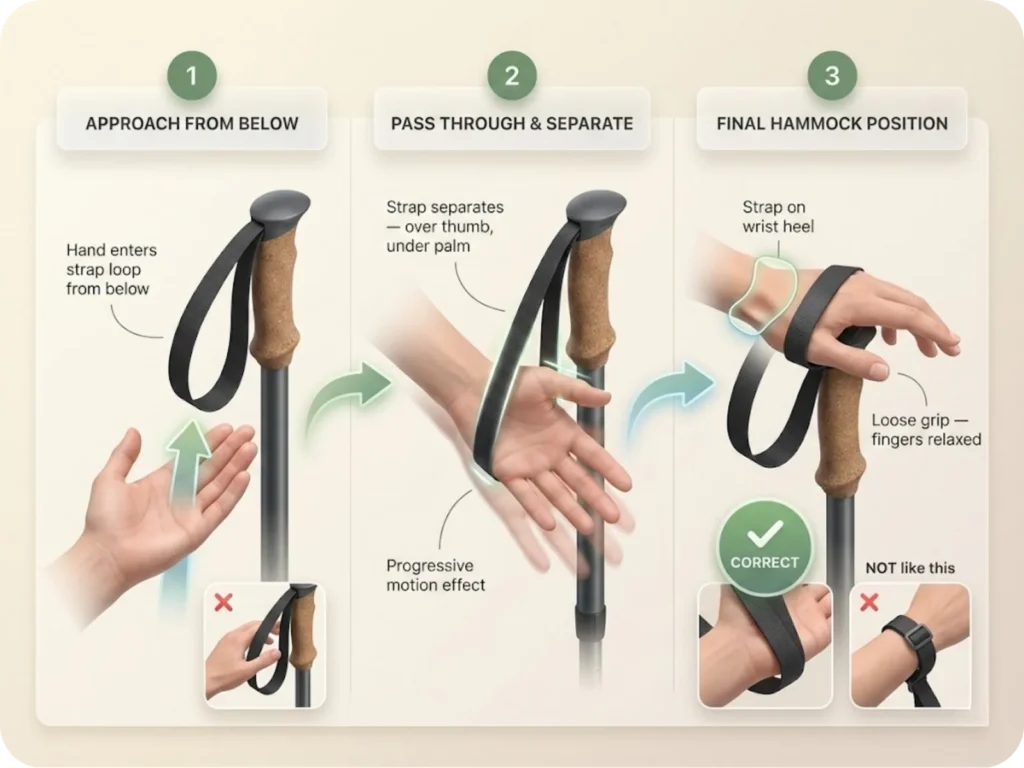
Step 1: The Bottom-Up Entry
Hold the pole shaft in one hand. Let the strap hang loose, forming an open loop.
Now here’s where most hikers go wrong: don’t slide your hand down through the top of that loop like you’re putting on a bracelet. That’s “Bracelet Mode”—and it renders the strap useless for load bearing.
Instead, insert your hand UP through the bottom of the loop. Think of it as: “The rabbit comes up out of the hole to grab the carrot.” Your fingers emerge from the strap opening exactly like that rabbit popping up.
This single correction—hand entry direction from bottom-up instead of top-down—changes everything about how force transfers through the system.
Step 2: The Wrist Heel Position
As your hand passes through and lowers toward the grip, the strap webbing naturally separates. One side crosses over the back of your hand and thumb. The other passes under your palm.
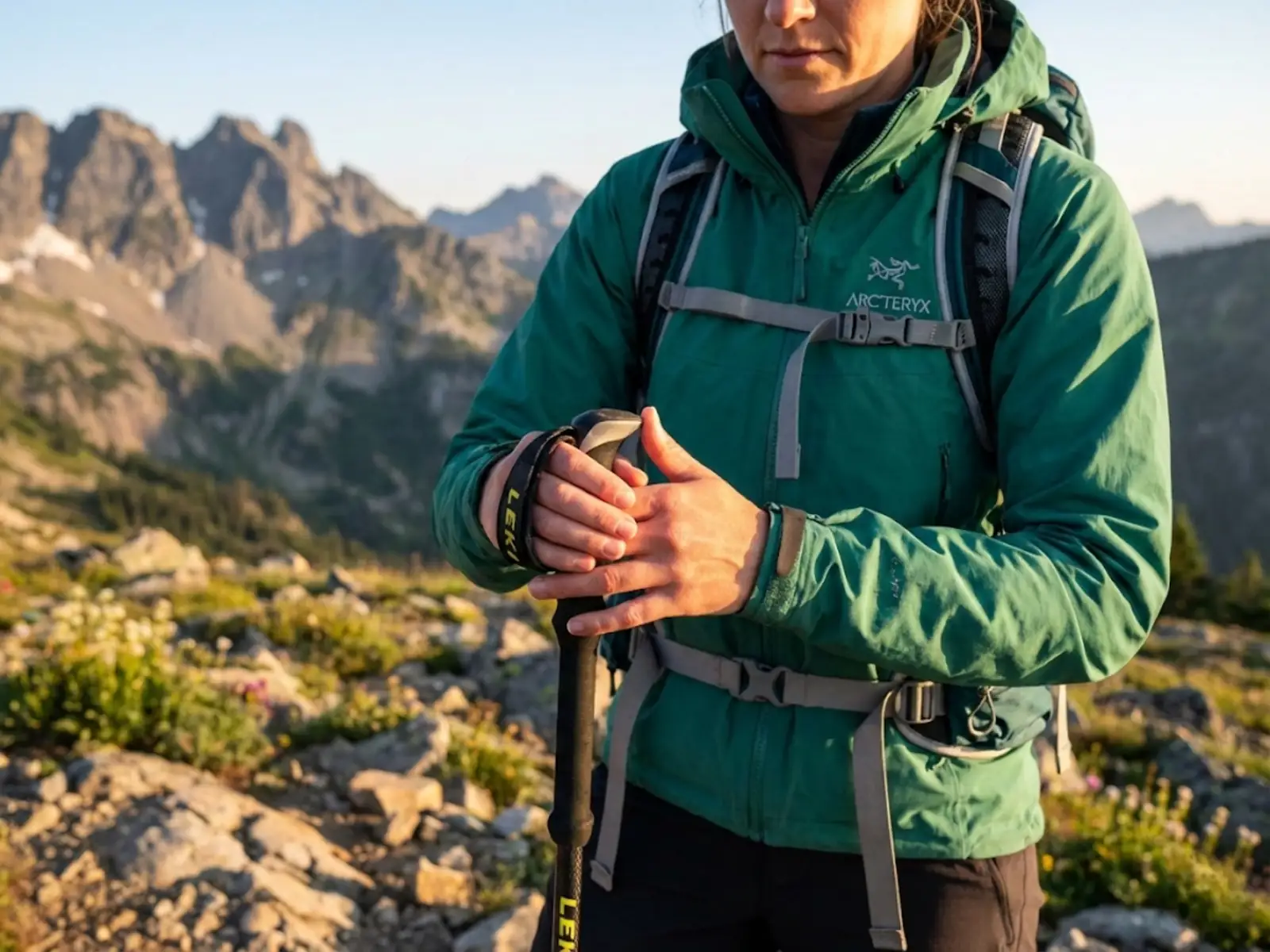
The critical position: that strap rests flush against the heel of your hand, passing smoothly between your thumb and index finger. Not wrapped around your wrist like a watch. Not dangling loose. Snug against that pad.
This is where the “hammock” forms—the wrist heel support that holds your hand suspended when you relax your grip.
Step 3: The Relaxed Grasp
Now close your fingers—but loosely. The strap is sandwiched between your palm and the cork or foam grip. Your fingers are just guides, not clamps.
Adjust the strap tension using the wedge block or cam lock on your poles. Most Gossamer Gear, Cascade Mountain Tech, and similar models have an easy adjustment system.
Here’s the test: with your hand completely open and relaxed, it should hang suspended by the strap at correct height. Press down with your wrist heel. If you can push your body weight through the pole without closing your fingers, you’ve nailed it.
That’s the magic moment. That’s when you know your poles are working for you instead of against you. For more foundational knowledge, check out our trekking poles 101 guide.
Terrain-Specific Strap Adjustments
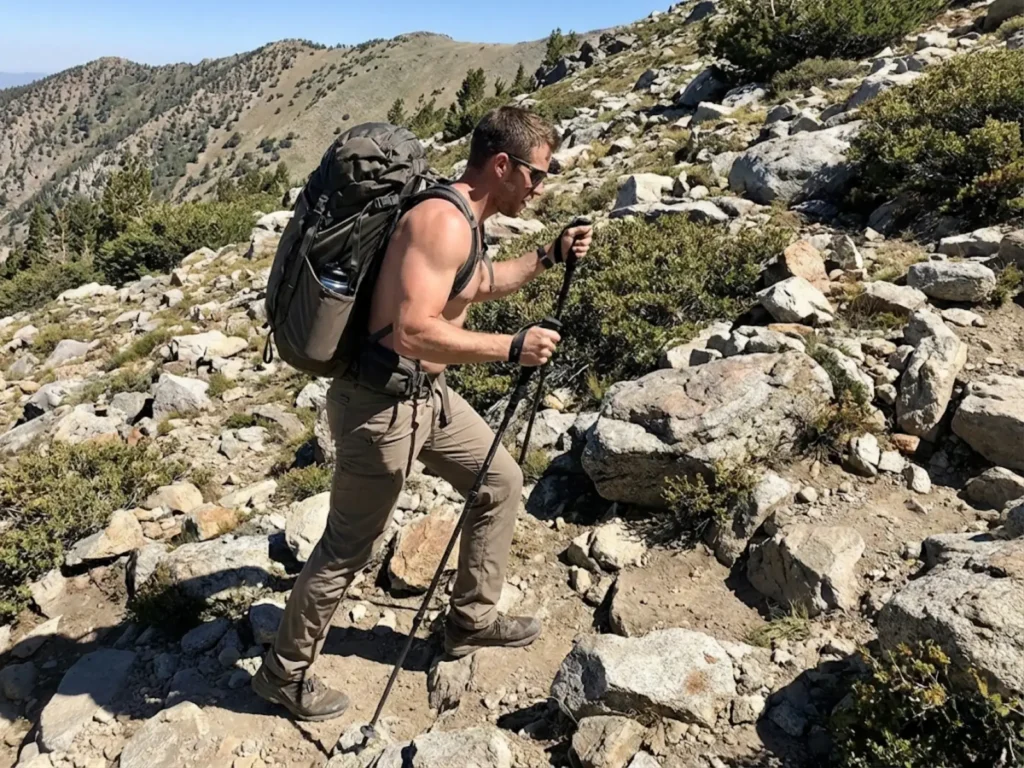
The technique you just learned is your baseline. But smart hikers adapt their strap use to the terrain ahead—because flat ground, climbs, and descents each demand different things from your poles.
Flat Terrain: The Rhythmic Swing
On level trail, keep the strap snug but comfortable. Your fingers should open slightly on the backswing, close gently on the plant. This maintains the natural arm swing that matches opposite arm to opposite leg—the alternating rhythm your body defaults to when walking.
Grip stays light throughout. You’re guiding the poles, not wrestling them. Think of it as dancing with your poles rather than fighting them.
Uphill Propulsion: The Push Engine
Heading up? Shorten your adjustable poles slightly so your elbows stay bent around 90 degrees at plant. Now the strap becomes your engine.
Push down and back against the strap with the heel of your hand. You’re generating forward lift exactly like a Nordic skier poling uphill. Your arm provides propulsion; your legs focus on stepping. The workload spreads across more muscle groups, and that steep pitch becomes manageable.
This is where the power of hiking biomechanics really shows. You’re not just stabilizing—you’re actively driving forward movement.
Steep Descent: The Open-Hand Brake
Descents punish bad technique. This is where the death grip costs you the most.
Lengthen your poles. Plant them well ahead of your feet. Now here’s the key: rest the top of your palm directly on top of the strap loop. This creates a braking platform that absorbs each jarring step.
Your fingers can remain almost entirely open. No squeeze required. The impact force transfers through the strap and pole into the ground, not into your screaming forearms.
Master this downhill pole technique and you’ll finish descents feeling like you just started.
Pro tip: On really steep descents—think 20%+ grade—try holding over the top of the grip entirely, with just your palm pressing down on the strap. Maximum braking, minimum grip fatigue.
The Safety Lab: Injury Mechanisms and Override Protocols
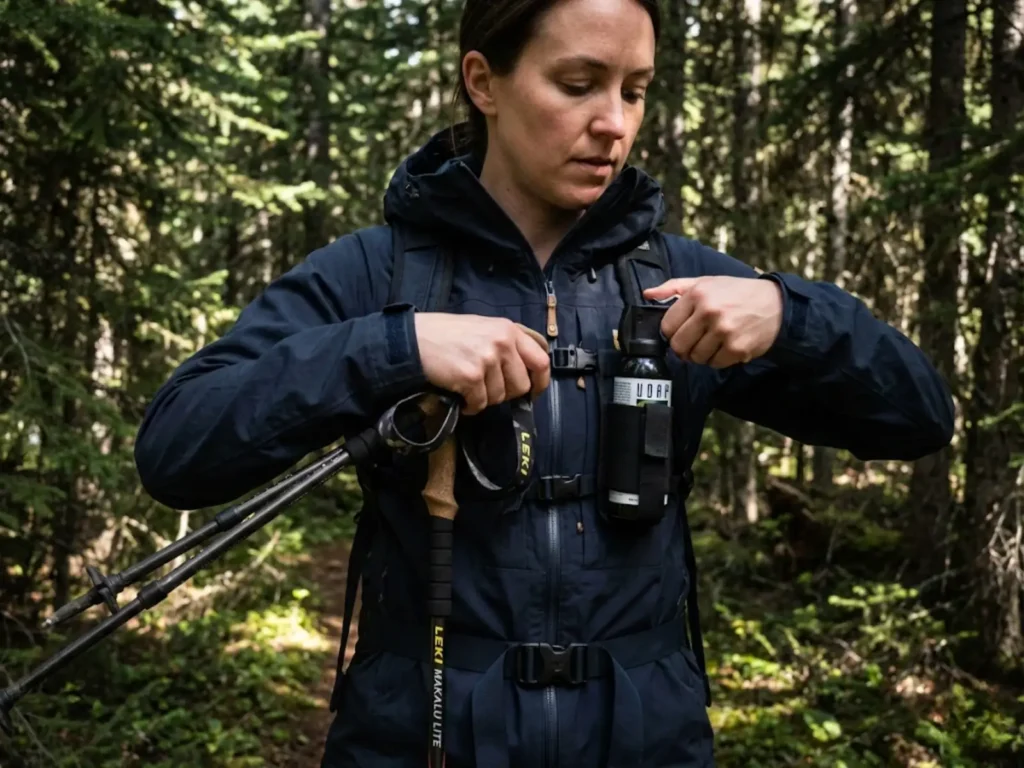
Here’s the uncomfortable truth about wrist straps: the same feature that makes them useful can make them dangerous. Every hiker needs to know when to disengage.
Skier’s Thumb: The Anatomical Risk
The ligament at your thumb’s base joint is designed to handle normal stresses. It is not designed to handle the force of a fall when a pole handle lands in your thumb web space.
The mechanism: you stumble forward, hand extends to catch yourself, the pole handle lands in that soft spot between thumb and palm, and the strap holds your hand in place. The pole becomes a lever. Your thumb bends violently outward.
Minor cases mean a stretch. Worse cases mean a partial tear. The worst? A complete rupture that needs surgery because the torn tissue flips behind the muscle and can’t heal on its own.
This injury accounts for 10-20% of all skiing injuries, and the mechanism is identical for hikers using strapped poles. For clinical details, see the BSSH Skier’s Thumb clinical guidance.
The Bear Spray Trap
In grizzly country, your poles can work against you—not because of bears, but because of strap interference.
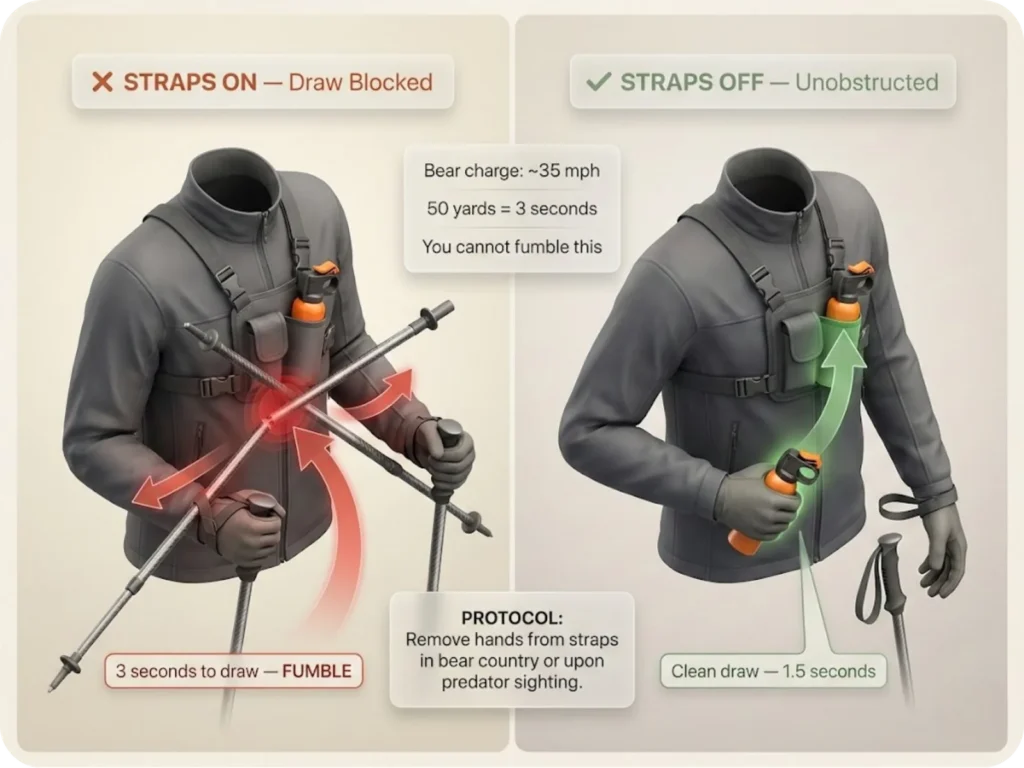
Picture it: you spot a charging bear 50 yards out. You have maybe 3 seconds to draw your bear spray from the chest holster. But your hands are strapped to your poles. The shafts obstruct your draw path. You fumble. The bear closes distance.
There are documented cases of exactly this scenario. Some ended with hikers spraying themselves because the pole interfered with canister aim.
Protocol: When hiking high-density bear territory or upon sighting any predator, remove hands from straps immediately. Keep your hands free to manipulate spray, noisemakers, or other deterrents without obstruction. Learn more about bear spray reaction time standards.
Water Crossings and Avalanche Terrain: Straps OFF
Two situations demand immediate strap removal. No exceptions.
River crossings: If you slip on a submerged rock and your strapped pole snags on a branch or wedges between boulders, the current drags you under. Your poles become anchors attached to your wrists. People have drowned this way.
Avalanche terrain: In a slide, strapped poles become flailing weapons that increase burial depth and can cause severe injury during the tumble. Every avalanche safety course teaches straps-off protocol for runout zones.
The rule is simple: Straps OFF for all flowing water and any avalanche-prone terrain.
The Reflex Release Drill
Your natural reflex when a pole tip gets stuck is to grip tighter. That reflex will hurt you.
Train the opposite. Have your hiking partner shout “DROP!” at random moments on the trail. Your job: instantly open your hands. Poles fall or dangle from straps—you don’t care which. The goal is overriding that grasp reflex so your hand slides off automatically if the pole gets trapped.
Five minutes of this drill per hike builds the muscle memory that protects your wrists and shoulders from sudden-stop injuries.
Strap Maintenance: The War on Mold and Funk
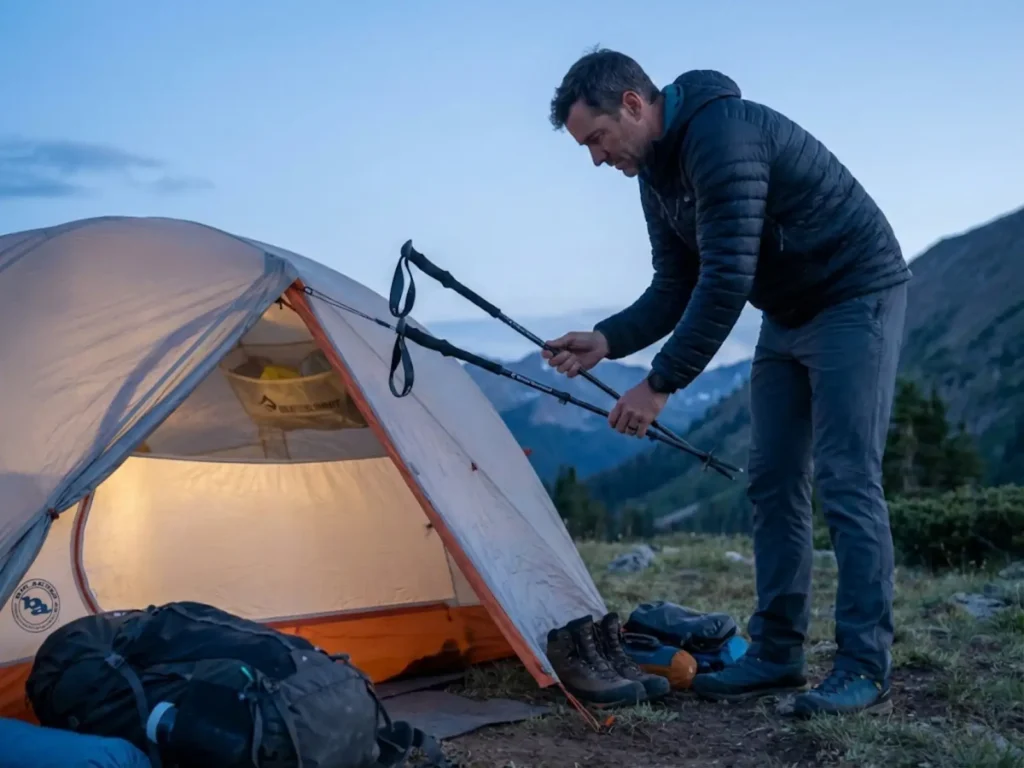
Your straps absorb sweat, skin oils, and bacteria every single hike. Without proper care, they become a breeding ground for mold and mildew—that distinctive hiker funk that no amount of Febreze can fix.
The Chemistry of Cleaning
White vinegar is your best weapon. Mix a 4:1 water-to-vinegar solution and soak your straps for 30 minutes. The vinegar penetrates porous nylon or chamois lining fibers and kills roughly 80% of mold species, including the root structures.
For serious funk, enzyme cleaners like MiraZyme digest the organic matter causing the smell. Expensive but effective. Rubbing alcohol at 70% handles surface disinfection—the higher water content keeps it wet longer for better penetration.
What to avoid: bleach. It breaks down nylon fibers, destroys EVA foam pad structure, and actually penetrates less effectively than vinegar into porous materials. Plus it leaves residue that irritates skin.
Drying Protocol to Prevent Growth
Never store poles with damp straps. That dark gear closet becomes a mold incubator overnight.
After every hike, remove straps if your poles allow it, and hang them to dry in a ventilated area. Many newer models from REI Co-op and others feature quick-detach straps for exactly this reason.
For persistent funk: full vinegar soak, thorough rinse, and complete air dry before storage. For complete maintenance guidance, see our full trekking pole maintenance guide.
Pro tip: Storing poles in your car trunk or garage promotes mold growth due to temperature swings and humidity. Bring them inside where climate control keeps moisture in check.
Conclusion
Three things to remember when you hit the trail next:
Entry direction matters. “Up through the bottom”—the rabbit out of the hole—creates the load-bearing scaffold that bypasses your grip muscles entirely. Get this one thing right and you’ve solved 80% of the technique puzzle.
The strap is both safety tool and potential hazard. Master the technique, but know when to disengage. Bear country, water crossings, avalanche terrain—straps come off.
Maintenance is prevention. Vinegar, not bleach. Air dry, don’t trap moisture. Your straps last longer and don’t assault your nose every time you gear up.
Next time you clip into your trekking poles, spend the first five minutes drilling the relaxed hand test. Open your fingers completely. Press down with just your wrist heel. Feel your arm skeleton bearing the load while your grip muscles stay relaxed.
That’s the moment you graduate from tourist to technician.
FAQ
Do you really need to use trekking pole wrist straps?
For load-bearing efficiency and knee protection, yes—proper strap use reduces hand fatigue by up to 90% and enables the weight transfer that cuts knee stress by 12-25%. However, there are terrain-specific situations like river crossings, bear country, and avalanche zones where removing straps is the safer choice.
Which way do you put your hands through trekking pole straps?
Insert your hand UP through the bottom of the strap loop, not down from the top. This positions the strap across your wrist heel and between your thumb and index finger, enabling load transfer to your skeleton rather than your grip muscles.
Should trekking pole straps be tight or loose?
Snug enough to support your hand weight when you relax your grip completely, but not so tight it restricts circulation. Test by opening your hand fully—you should be able to press down on the pole using only wrist pressure, with fingers open.
Can you use trekking poles without straps?
Yes. Some experienced hikers in rocky terrain cut straps to prevent entrapment injuries. Others use strapless ergonomic designs like PacerPoles. However, you lose the load-transfer benefit that makes poles most effective for injury prevention and energy efficiency.
How do I clean smelly trekking pole straps?
Soak in a 4:1 water or white vinegar solution for 30 minutes—vinegar penetrates porous fibers and kills mold roots. Avoid bleach, which degrades nylon. Rinse, air dry completely before storage. For heavy funk, use an enzyme cleaner like MiraZyme.
Risk Disclaimer: Hiking, trekking, backpacking, and all related outdoor activities involve inherent
risks which may result in serious injury, illness, or death. The information provided on The Hiking Tribe is for
educational and informational purposes only. While we strive for accuracy, information on trails, gear, techniques,
and safety is not a substitute for your own best judgment and thorough preparation. Trail conditions, weather, and
other environmental factors change rapidly and may differ from what is described on this site. Always check with
official sources like park services for the most current alerts and conditions. Never undertake a hike beyond your
abilities and always be prepared for the unexpected. By using this website, you agree that you are solely
responsible for your own safety. Any reliance you place on our content is strictly at your own risk, and you assume
all liability for your actions and decisions in the outdoors. The Hiking Tribe and its authors will not be held
liable for any injury, damage, or loss sustained in connection with the use of the information herein.
Affiliate Disclosure: We are a participant in the Amazon Services LLC Associates Program, an
affiliate advertising program designed to provide a means for us to earn advertising fees by advertising and linking
to Amazon.com. As an Amazon Associate, we earn from qualifying purchases. We are also an official affiliate partner
of Black Diamond Equipment via the AvantLink network. If you click on a Black Diamond affiliate link and make a
purchase, we may earn a commission at no additional cost to you. We also participate in other affiliate programs and
may receive a commission on products purchased through our links. Additional terms are found in the terms of
service.