In this article
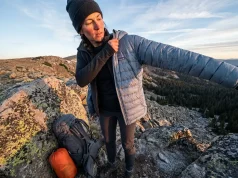
The wind hit without warning on the ridge—40°F, gusting to 25 mph—and within ten minutes, I was shivering uncontrollably despite wearing a fleece that kept me warm at the trailhead. My teeth chattered. My fingers went numb. That afternoon, somewhere above treeline in Colorado, I learned what every wilderness medicine instructor knows: it’s not the cold that kills you—it’s the wind.
A thin wind shirt, weighing barely 3 ounces, would have blocked the convective heat loss and kept my core temperature stable. I didn’t have one. Rookie mistake. After two decades of hiking and backpacking, I should have known better. Here’s how that experience sent me down a rabbit hole of fabric testing, medical research, and the science of staying alive in bad weather.
This guide breaks down the physics of hypothermia prevention in plain language—no lab coat required. You’ll learn why CFM ratings (Cubic Feet per Minute) are the most important spec you’ve never heard of, and exactly which wind shirts deliver survival-grade performance for your activity level.
⚡ Quick Answer: Wind shirts prevent hypothermia by blocking convective heat loss—the primary mechanism that strips warmth from your body in windy conditions. For high-output hiking, look for shells with 35-50 CFM breathability ratings (like the Black Diamond Alpine Start). For emergency or static use, low-CFM shells (<10, like the Patagonia Houdini) excel at heat retention but cause sweat buildup during exertion.
The Science of Heat Loss: Why Wind Is the Real Killer
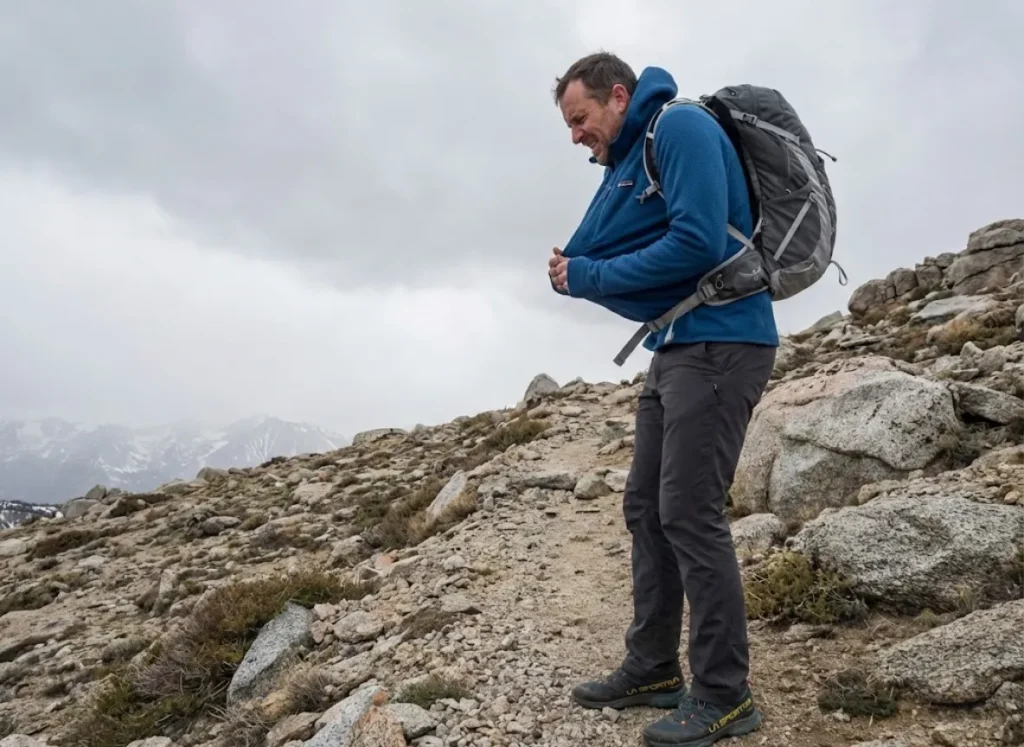
Your body is a furnace running on glycogen and fat, working constantly to maintain a core temperature between 97.7°F and 99.5°F. When you fail to manage heat loss, that furnace starts losing the battle. Clinical hypothermia begins when core temp drops below 95°F—and from there, the cascade accelerates fast.
The Four Vectors of Thermal Failure
There are four ways your body bleeds heat into the environment: radiation, conduction, convection, and evaporation. Each matters, but in the mountains, one dominates.
Convection is the transfer of heat to moving air. When wind blows across your skin or penetrates your clothing, it strips away the thin layer of warm air your body generates—the boundary layer that acts as natural insulation. Here’s the kicker: heat loss from wind increases with the square of wind speed. Double the wind, quadruple the cooling. That’s not marketing hype. That’s physics you can feel on any exposed ridge.
Standard fleece has an air permeability of 200+ CFM. Translation: wind blows right through it. The insulating air pockets in your mid-layer get replaced with cooler air, and suddenly your $150 fleece is working at maybe 30% efficiency. You’re burning through your energy reserves to heat the outdoors.
Pro tip: If you can feel the breeze through your mid-layer on an exposed ridge, your insulation isn’t insulating. Stop, layer up with a windproof shell, and reassess before you start shivering.
The wind chill effect isn’t just a number on the weather app. At 40°F with 15 mph wind, the effective temperature on exposed skin drops to 32°F. According to clinical research on cold-weather clothing performance, standard clothing without a wind shell is insufficient to prevent hypothermia during even low-intensity exercise in cold weather.
The “Flash-Off” Phenomenon: When Sweat Becomes the Enemy
Evaporation is your body’s cooling system—essential when you’re overheating, deadly when you’re not. During high-output activities like hiking uphill or backpacking with a loaded pack, you sweat. A lot. That moisture needs to escape, or it saturates your base layers.
Here’s where things get dangerous. If your shell is too permeable (high CFM), strong winds can accelerate evaporation to the point where it cools faster than your body can compensate. Experienced hikers call this flash-off cooling—and it can drop your skin temperature in seconds.
The opposite problem is just as bad. If your shell has zero breathability (0 CFM, like a rain jacket), sweat accumulates inside. When you stop moving—maybe for lunch, maybe because you’re tired—your heat production drops. But those wet base layers keep conducting body heat away from your skin. That’s how seemingly mild days turn into hypothermia scenarios.
The Wet Suit Effect: Your Emergency Backup
When your base layers get saturated—from sweat or an unexpected rain shower—a wind shirt does something counterintuitive. It traps a layer of water-saturated air against your skin, similar to how a neoprene wet suit works in cold water.
Your body heats this trapped moisture to near-skin temperature. Because the shell prevents the continuous replacement of warm air with cold environmental air, the rate of evaporative cooling drops dramatically. You’re still wet and uncomfortable—but you’re alive and maintaining thermoregulation.
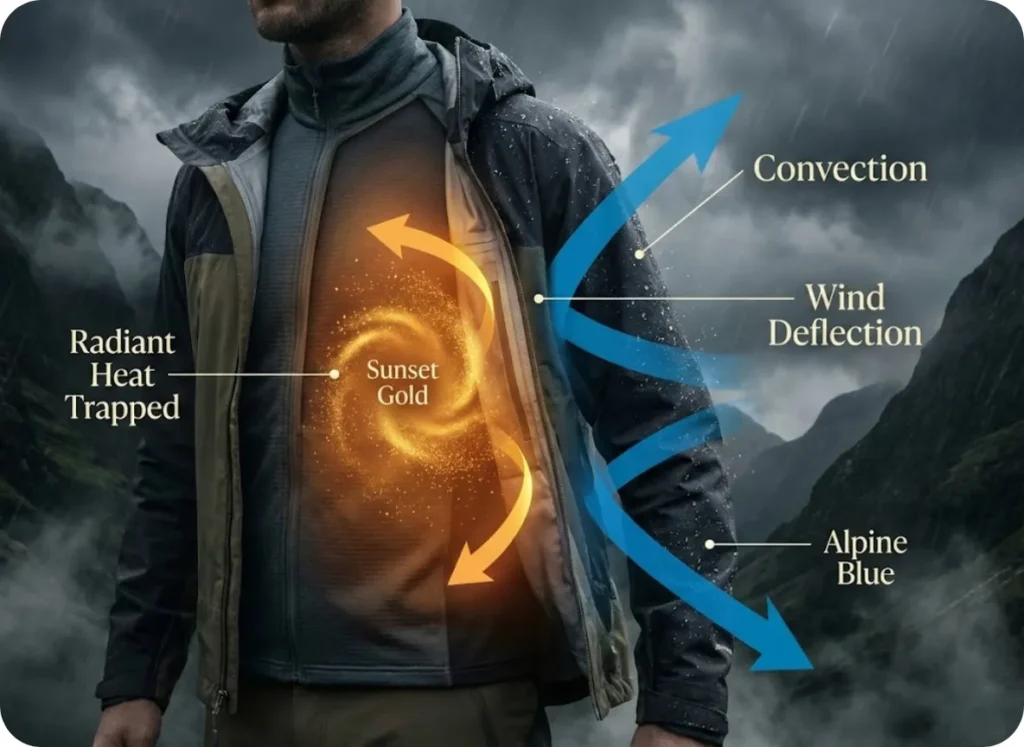
This mechanism is exactly why a wind shirt can neutralize the “Cotton Kills” problem. Cotton absorbs water like a sponge and loses all insulating value when wet. But if you cover wet cotton with a windproof shell, you stop the convective engine that drives evaporative death. Wilderness safety instructors teach this as a critical intervention when dry clothing isn’t available.
If you want to master the three-layer system that keeps you warm in any conditions, understanding these heat loss mechanisms is step one.
Decoding CFM: The Number That Predicts Survival
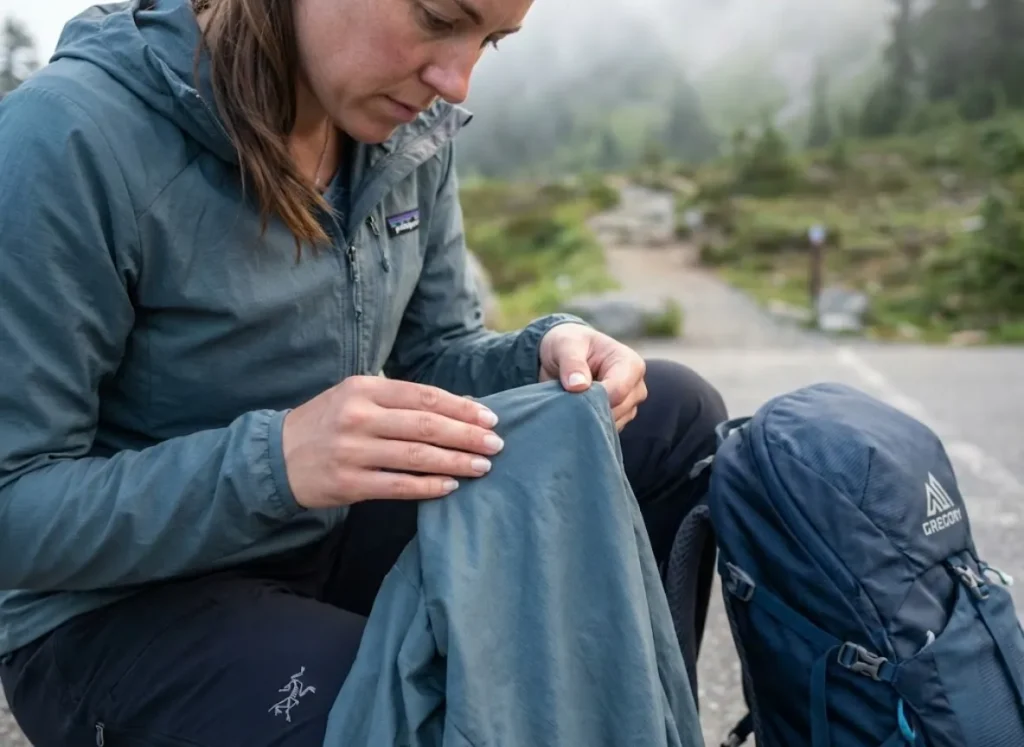
Most outdoor brands don’t publish CFM ratings. They use vague terms like “breathable” or “windproof” that mean different things to different products. But CFM—Cubic Feet per Minute—is the quantifiable spec that actually predicts whether a shell layer will work for your activity level.
What CFM Actually Measures
The CFM breathability test clamps a fabric sample and forces air through it at standardized pressure (125 Pa, roughly equivalent to 10 mph wind). The resulting measurement—cubic feet of air passing through one square foot of fabric per minute—is the CFM rating.
Breathability marketing claims mean nothing without this number. A jacket advertised as “breathable” might test at 3 CFM (essentially a rain jacket) or 45 CFM (engineered for high-output activity). Both get the same label. Only one actually vents moisture vapor during hard exertion.
The “Nisley Sweet Spot”: 35–45 CFM
Richard Nisley, a materials science researcher revered in the ultralight backpacking community, has extensively mapped the CFM spectrum of outdoor fabrics. His research identifies 35–45 CFM as the ideal range for high-output hiking.
At this air permeability, fabric provides enough resistance to stop the wind from stripping your boundary layer—but allows something profound: pressure-driven venting. When you’re working hard, the positive pressure inside your clothing system physically pushes moisture vapor out through the fabric. This is faster than the molecular diffusion that membrane jackets rely on.
Here’s the spectrum breakdown:
- 0 CFM (hard shells): Gore-Tex and similar membranes block 100% of wind but rely entirely on slow diffusion for moisture transport. Works for static conditions; fails during high exertion.
- 1-5 CFM (calendered nylon): Many “ultralight” wind shirts, including the current Patagonia Houdini, fall here. Excellent wind blocking; poor active breathability.
- 35-45 CFM (the sweet spot): Stops convective heat loss while allowing dynamic venting. Wear it all day without overheating.
- 100+ CFM (fleece): Essentially no wind protection. Your insulation becomes a thermal liability in any breeze.
Pro tip: Nisley offers a tangible benchmark—two stacked coffee filters test at approximately 35 CFM. If a wind shirt breathes like two coffee filters held to your mouth, you’re in the sweet spot.
Why 0-5 CFM Fails for Active Hiking
The Patagonia Houdini is probably the most popular wind shirt on the market. It’s also one of the most misunderstood.
Pre-2012 versions tested around 35-40 CFM—legendary for the weight. But Patagonia switched fabrics, and current versions test at 1-5 CFM. The jacket looks the same. The specs are radically different.
At 3 CFM, the modern Houdini is essentially a non-waterproof rain jacket. It blocks wind beautifully but can’t keep up with sweating during sustained hiking. Users complain about “wetting out from the inside”—that clammy, damp feeling after 30 minutes of uphill work. That’s not a defect. That’s physics.
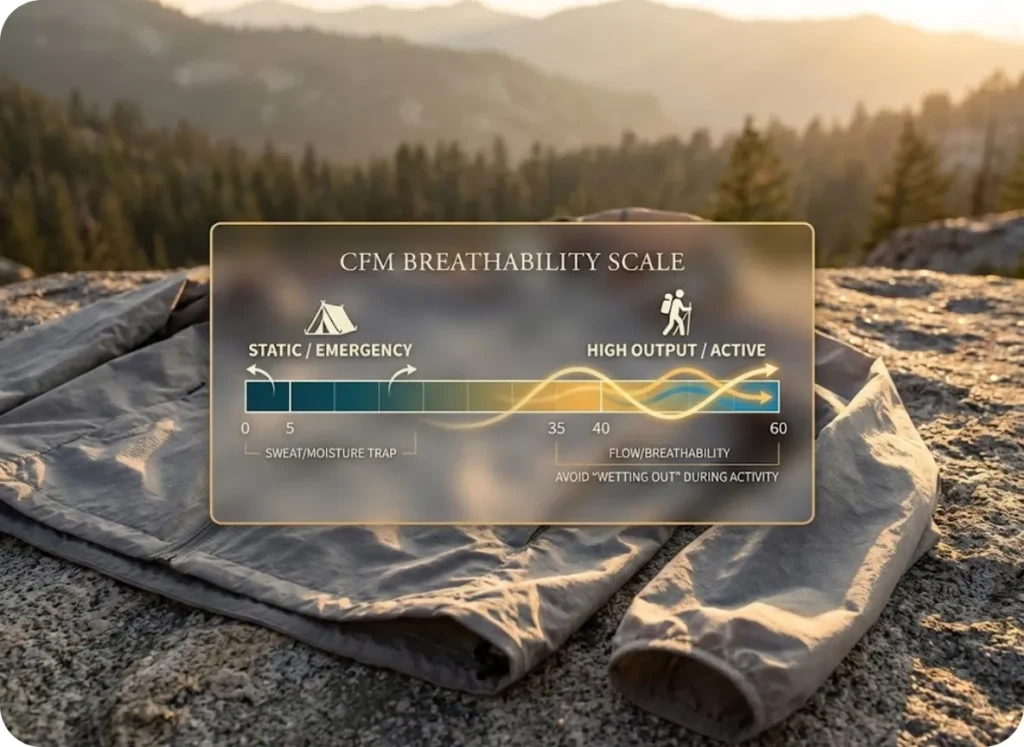
For emergency use, summit static, or layer positioning over down in camp, the low-CFM Houdini excels. For trail running or all-day hiking, it’s the wrong tool.
For more context on how shell technology intersects with rain protection, check out this guide to understanding rain jacket breathability.
Field-Tested Wind Shirts: CFM Data That Matters
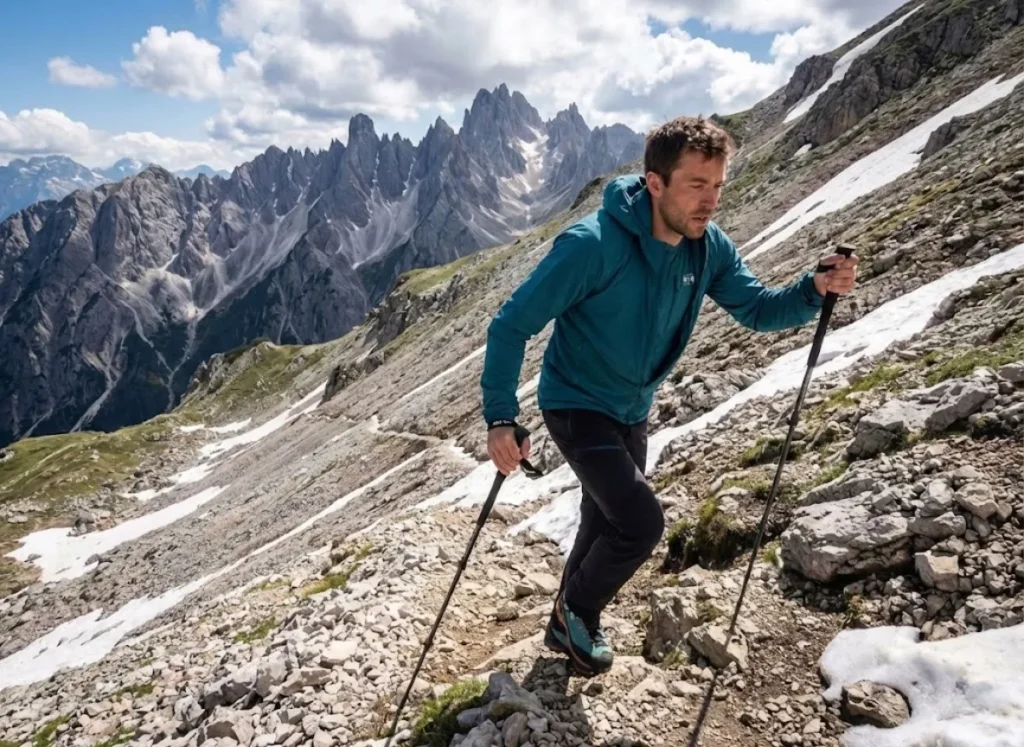
Since brands don’t publish CFM specs, the outdoor community has done the testing. Here’s what the data reveals about actual performance—not marketing claims.
The Black Diamond Alpine Start: The 35-50 CFM Gold Standard
If you want one wind shell that works for everything from summit pushes to all-day ridge traverses, this is it.
The Alpine Start uses Schoeller stretch-woven nylon with NanoSphere technology—a finish that provides surprising water resistance without sacrificing air permeability. Independent testing puts it in the 35-50 CFM range, aligning perfectly with the Nisley sweet spot.
At 210 grams, it’s heavier than ultralight alternatives—but the durability is unmatched for rock scrambles and bushwhacking. The stretch fabric moves with your body. And critically, you can wear it continuously during high-output effort without becoming a steam room.
The Patagonia Houdini: Understanding the 1-5 CFM Reality
The Houdini isn’t a bad jacket. It’s a misapplied one.
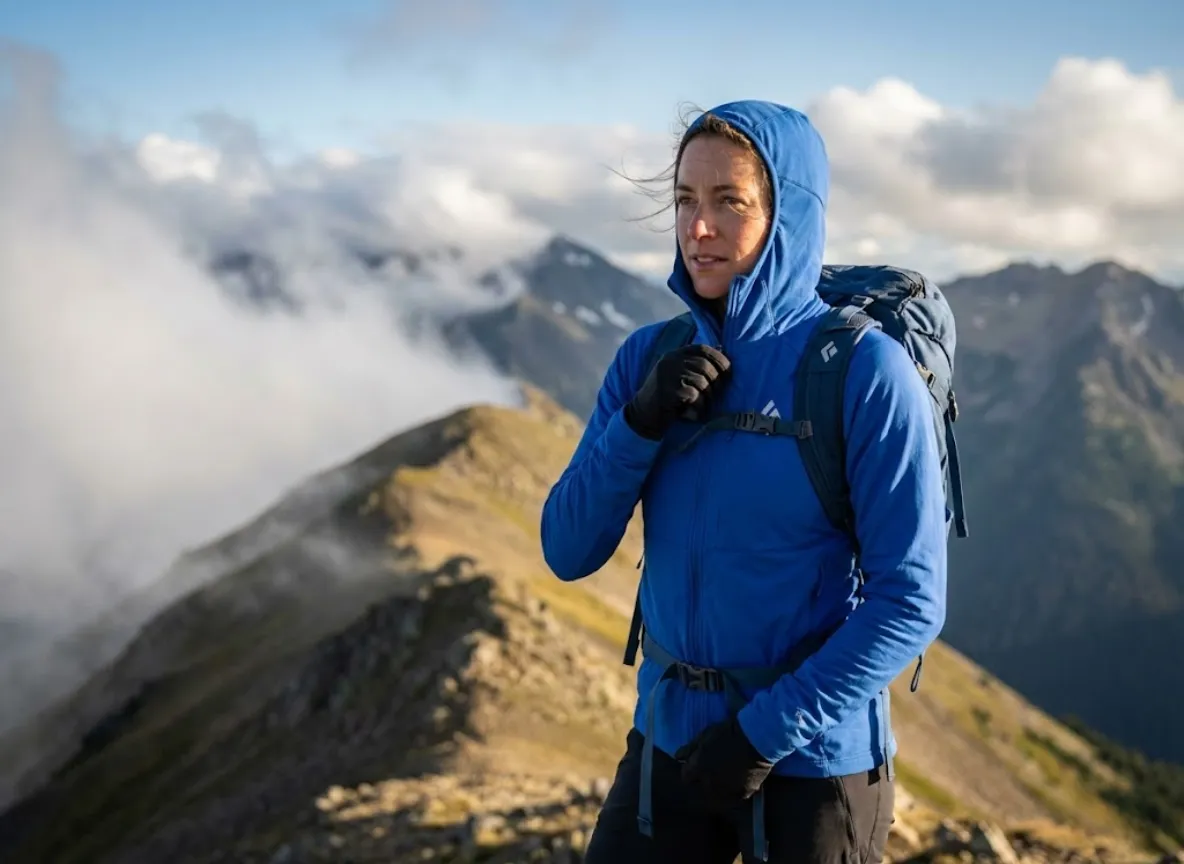
At 105g with bombproof windproofness and solid DWR finish, it’s the ideal summit shell, emergency layer, or cold-weather camp workhorse. Pack it in the bottom of your daypack for unexpected weather or post-summit chilling effect. Layer it over your down jacket when the wind picks up at the bivy.
What it can’t do: breathe during sustained exertion. If you’re moving hard and wearing a Houdini, expect to get clammy. That’s not the jacket failing—that’s CFM physics.
The Middle Ground: Houdini Air & Kor AirShell
For hikers who need one jacket covering both static and active use, the compromise zone lives at 15-25 CFM.
The Patagonia Houdini Air uses Pertex Equilibrium double weave—a construction that lifts fabric off your skin to create air channels. At approximately 20 CFM, it’s significantly more breathable than the standard Houdini while still providing real good wind protection.
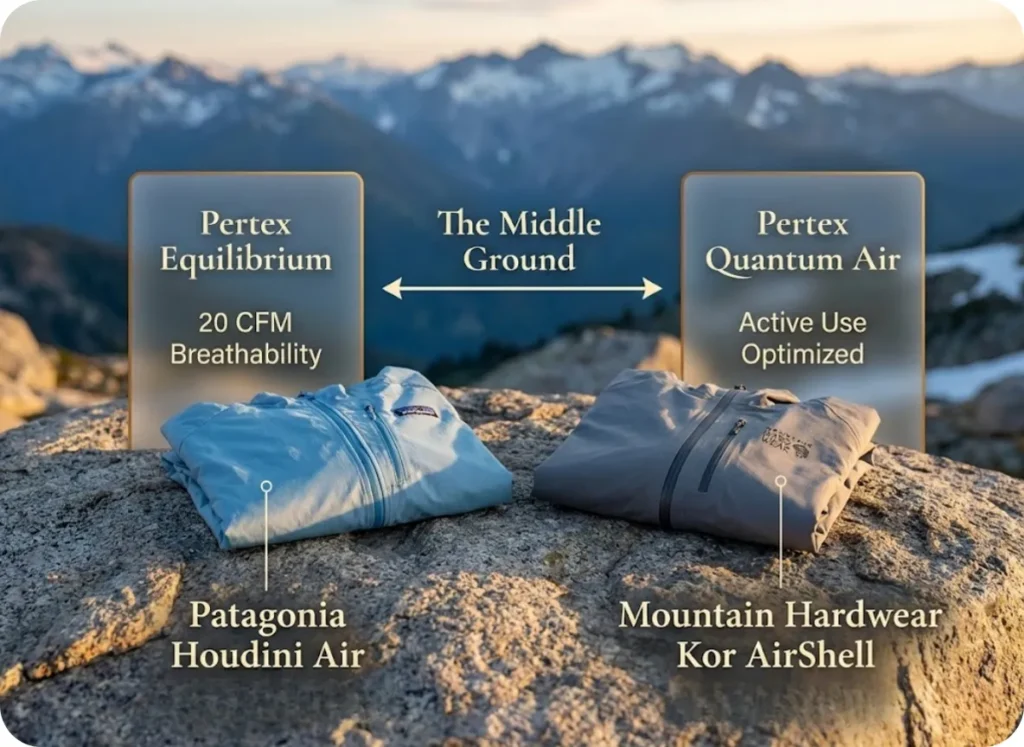
Mountain Hardwear’s Kor AirShell occupies similar territory with Pertex Quantum Air fabric. Trail runners and fastpackers often prefer this category for shoulder-season versatility on multi-climate trips.
For weight-conscious gear selection principles, explore these ultralight gear fundamentals.
Layering Strategy: Where the Wind Shirt Fits
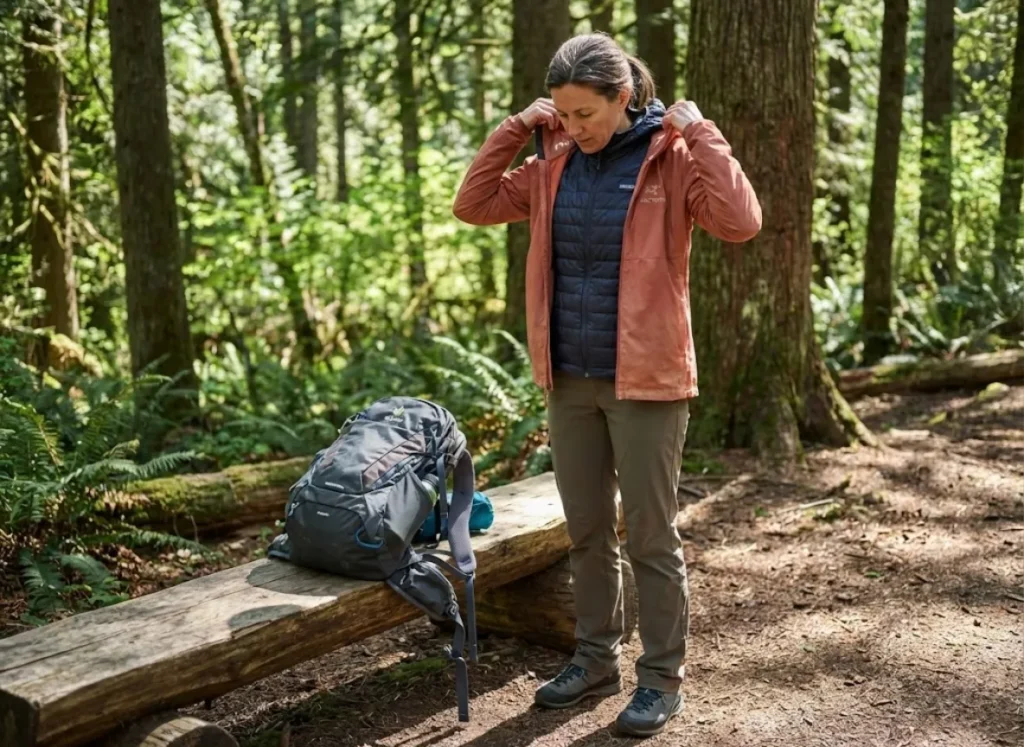
A wind shirt rarely works in isolation. Its performance depends entirely on how you integrate it into your cold weather clothing system—what experts call layer system compatibility.
Andrew Skurka’s Core 13 Integration
Andrew Skurka—National Geographic Adventurer and Alaska Range guide—categorizes wind shells as the essential “second layer” or “third layer” in his Core 13 system.
The simplest application: wind shirt directly over a moisture-wicking base layer. In cool, breezy conditions, this combo provides extra warmth equivalent to a light fleece at a fraction of the weight. The shell traps a thin boundary layer of warm air, boosting effective insulation without bulk.
When temperatures drop, layer the wind shirt over your fleece. Fleece is structurally porous—wind blows right through it. Adding a windproof shell preserves the fleece’s loft and maximizes thermal efficiency. Skurka notes this combination offers more versatility than bonded “active insulation” pieces: you can remove the wind shell instantly to dump heat during climbs, then zip up for ridge traverses or descents.
Active Insulation vs. Modular System Trade-offs
Jackets like the Patagonia Nano-Air and Arc’teryx Proton bond breathable shells to insulation. They’re effective—but they lock you into a fixed warmth-to-breathability ratio.
Separate layers give you options for proactive planning. Wear just the wind shirt for bug and sun protection in warm weather. Wear just the fleece for maximum breathability in still, cold air. Combine them when conditions demand both wind protection and insulation.
Pro tip: For unpredictable mountain weather, modularity beats convenience. You can fine-tune mechanical ventilation—unzip the wind shell while keeping the fleece zipped, or vice versa—in ways that bonded insulation can’t match.
Emergency Application: The Vapor Barrier Technique
In survival situations or extreme cold, a low-CFM wind shirt can moonlight as a vapor barrier liner. Worn under your insulation instead of over it, the shell stops evaporative heat loss completely.
This creates a humid, clammy microclimate—but that trapped moisture preserves the heat your body is desperately trying to maintain for core temperature maintenance. It’s not a comfort strategy. It’s a survival technique that mountain medicine protocols acknowledge for emergency warming.
For comprehensive winter hiking safety protocols, including layering for extreme cold weather, see our dedicated guide.
The DWR Factor: Why Waterproofing Affects Breathability
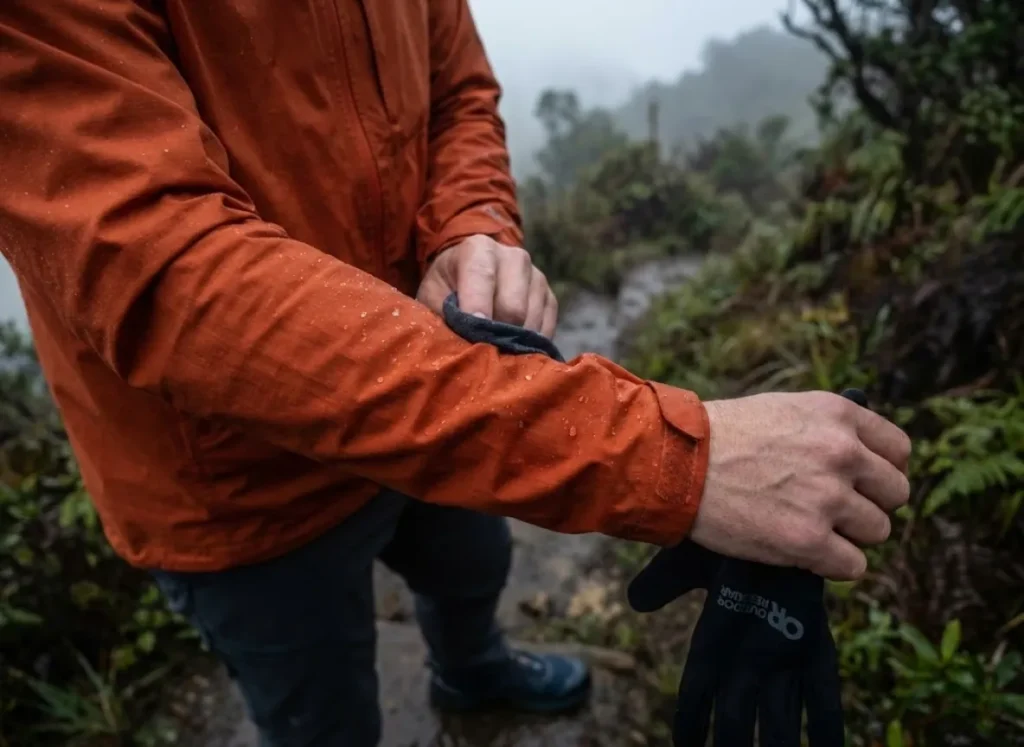
That water-repellent finish on your wind shirt isn’t just about rain. It’s critical for maintaining air permeability over time.
Understanding “Wetting Out” vs. Leaking
“Wetting out” happens when the DWR (Durable Water Repellent) finish fails and the face fabric becomes saturated. Water fills the tiny gaps between fibers—the same channels that allow air to pass through.
For a wind shirt, this effectively drops CFM to zero. The fabric that was breathing at 35 CFM now functions like a plastic bag. You’re still sweating. The moisture has nowhere to go. That clammy, wet-from-inside feeling gets blamed on leaking rain, but it’s often just DWR failure choking breathability.
Maintaining your DWR with periodic reapplication isn’t optional maintenance. It’s essential for preserving the breathability that prevents heat loss during exertion.
Fabric Technology: Calendered vs. Uncalendered
The primary method for controlling CFM is calendering—passing fabric between heated rollers to flatten fibers and seal gaps.
Uncalendered nylon fibers stay round, leaving small channels for airflow (often 40+ CFM). Calendered nylon has flattened fibers that create a barrier (<5 CFM). Many “wind shirts” use calendered fabric originally developed for sleeping bag shells—where down containment matters more than active breathability.
Understanding this explains why similar-looking jackets perform radically differently. That $40 wind shell might use calendered fabric identical to your sleeping bag’s shell. The $180 technical piece might use purpose-engineered uncalendered nylon optimized based on fabric weight ratios for active use.
Nylon vs. Polyester: Material Trade-offs
Nylon dominates high-end wind shells because it’s stronger, more abrasion-resistant, and packs smaller. But nylon absorbs water. In sustained drizzle or heavy sweat, pure nylon can “bag out” and lose structural shape.
Polyester absorbs almost no water. That’s why polyester-blend fabrics (like Pertex Equilibrium) often perform more consistently in wet conditions. The fabric retains structure, air pores stay open, and breathability remains stable even when things get damp.
The “Darth Vader” Field Test: Evaluating Jackets Without Specs
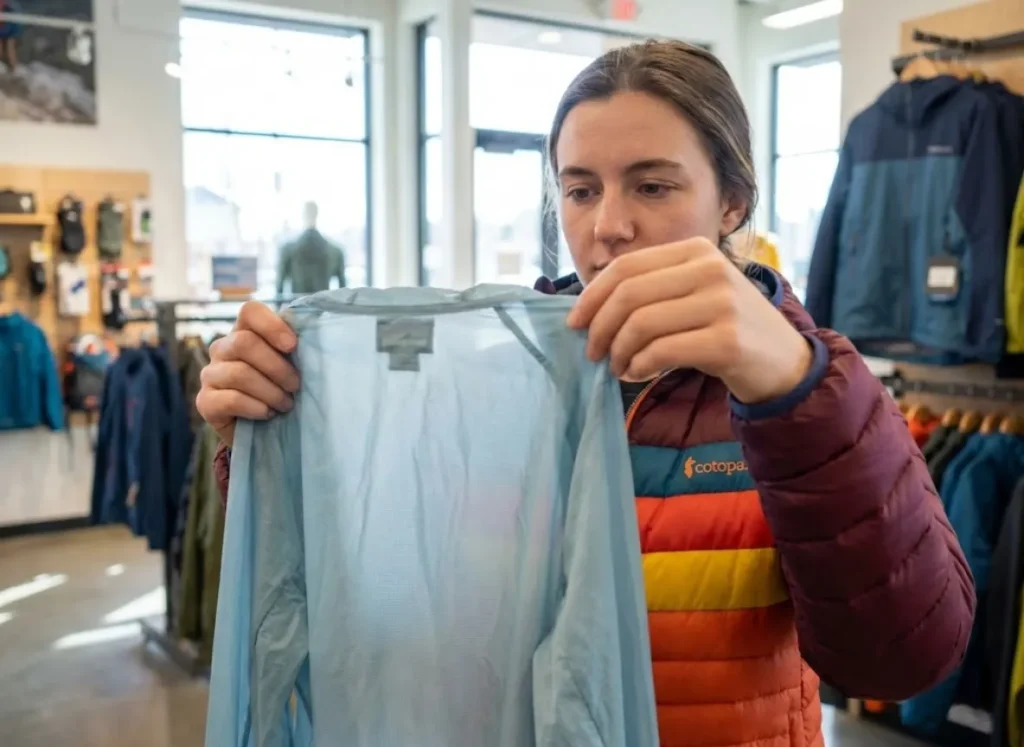
Since manufacturers won’t give you CFM data, here’s how to estimate it yourself—no lab required. This is the evidence-based hiker’s guide to in-store testing.
The Mouth-Clamped Breathability Test
Clamp the fabric over your mouth and try to breathe.
High resistance (like sucking through a straw): The fabric is likely below 5 CFM. Expect excellent wind protection but poor active breathability. You’ll get clammy during exertion.
Moderate resistance (like breathing through a cloth mask): You’re probably in the 30-50 CFM zone—the sweet spot for all-day hiking.
Minimal resistance (barely noticeable): The fabric approaches 60+ CFM and offers limited wind resistance.
Nisley’s benchmark: A single coffee filter is approximately 70 CFM. Two stacked filters equal about 35 CFM. If a jacket breathes like two filters, it’s engineered for high-output use.
Pro tip: Do this test in the store before buying. Sales staff might give you weird looks, but you’ll know exactly what you’re getting—and avoid the disappointment of a steam-chamber shell on your next summit day.
Lab Data vs. Real-World Performance
The standardized test is static. Your body isn’t. Real-world performance factors in the “bellows effect” from arm movement, the turbulence created by complex fabric weaves, and the water absorption behavior of different materials.
Complex weaves like Schoeller often outperform their lab numbers by resisting wind penetration on the outside while allowing body-generated pressure to escape. Nylon fabrics that absorb moisture can close pores when wet, reducing effective CFM in real conditions.
The takeaway: test your wind shirt on a training hike before trusting it on a summit day. What works in the store may not work on the mountain.
For principles on evaluating gear before you buy, see our beginner’s guide.
Conclusion
The CFM data is unambiguous. Wind shirts aren’t optional accessories—they’re the decisive factor between controlled thermoregulation and thermal failure when conditions turn hostile.
Three takeaways:
- Match CFM to your activity. Static use or emergency situations call for <10 CFM shells like the Houdini. High-output hiking demands 35-50 CFM options like the Black Diamond Alpine Start.
- Stop trusting marketing. “Breathable” means nothing without data. Use the Darth Vader test before you buy.
- Maintain your DWR. A saturated face fabric has zero effective air permeability—regardless of the underlying design.
Next time you’re on an exposed ridge with wind whipping across bare rock, pay attention to how your body responds. Are you staying warm without overheating? Or are you shivering through a steam-soaked fleece? The answer reveals whether your wind layer is working with your physiology—or against it.
That distinction might be the difference between a memorable day and an emergency descent.
FAQ
What is the difference between a wind shirt and a windbreaker?
A wind shirt is a technical garment engineered for outdoor performance, typically weighing 2-7 ounces with precise CFM specifications for breathability. A windbreaker is a more casual term for any wind-blocking jacket, often without attention to moisture transport or activity-level optimization.
Can you get hypothermia in 40 degree weather?
Yes. At 40°F with 15 mph wind, effective temperature drops to 32°F. Add wet clothes and sustained wind exposure, and hypothermia can occur at temperatures as high as 50°F. The combination of moisture and wind—not absolute temperature—triggers thermal failure.
Do wind shirts keep you warm?
Wind shirts don’t generate heat. They preserve the body heat your body produces by blocking convective loss. A wind shirt layered over fleece can feel warmer than the fleece alone because it protects the insulating air pockets from wind stripping.
What fabric is best for wind shirts?
For high-output activities, Schoeller stretch-woven nylon (35-50 CFM) or Pertex Quantum Air (15-35 CFM) deliver optimal breathability with real wind blocking. For emergency or static use, calendered nylon ripstop (< 5 CFM) excels at heat retention.
Why doesn’t my expensive wind jacket breathe during hiking?
It’s likely a low-CFM design optimized for maximum windproofness rather than active moisture transport. Many popular breathable wind shells test below 5 CFM. Check if your jacket uses calendered fabric or a membrane, both of which prioritize protection over exertion-level breathability.
Risk Disclaimer: Hiking, trekking, backpacking, and all related outdoor activities involve inherent
risks which may result in serious injury, illness, or death. The information provided on The Hiking Tribe is for
educational and informational purposes only. While we strive for accuracy, information on trails, gear, techniques,
and safety is not a substitute for your own best judgment and thorough preparation. Trail conditions, weather, and
other environmental factors change rapidly and may differ from what is described on this site. Always check with
official sources like park services for the most current alerts and conditions. Never undertake a hike beyond your
abilities and always be prepared for the unexpected. By using this website, you agree that you are solely
responsible for your own safety. Any reliance you place on our content is strictly at your own risk, and you assume
all liability for your actions and decisions in the outdoors. The Hiking Tribe and its authors will not be held
liable for any injury, damage, or loss sustained in connection with the use of the information herein.
Affiliate Disclosure: We are a participant in the Amazon Services LLC Associates Program, an
affiliate advertising program designed to provide a means for us to earn advertising fees by advertising and linking
to Amazon.com. As an Amazon Associate, we earn from qualifying purchases. We are also an official affiliate partner
of Black Diamond Equipment via the AvantLink network. If you click on a Black Diamond affiliate link and make a
purchase, we may earn a commission at no additional cost to you. We also participate in other affiliate programs and
may receive a commission on products purchased through our links. Additional terms are found in the terms of
service.