In this article
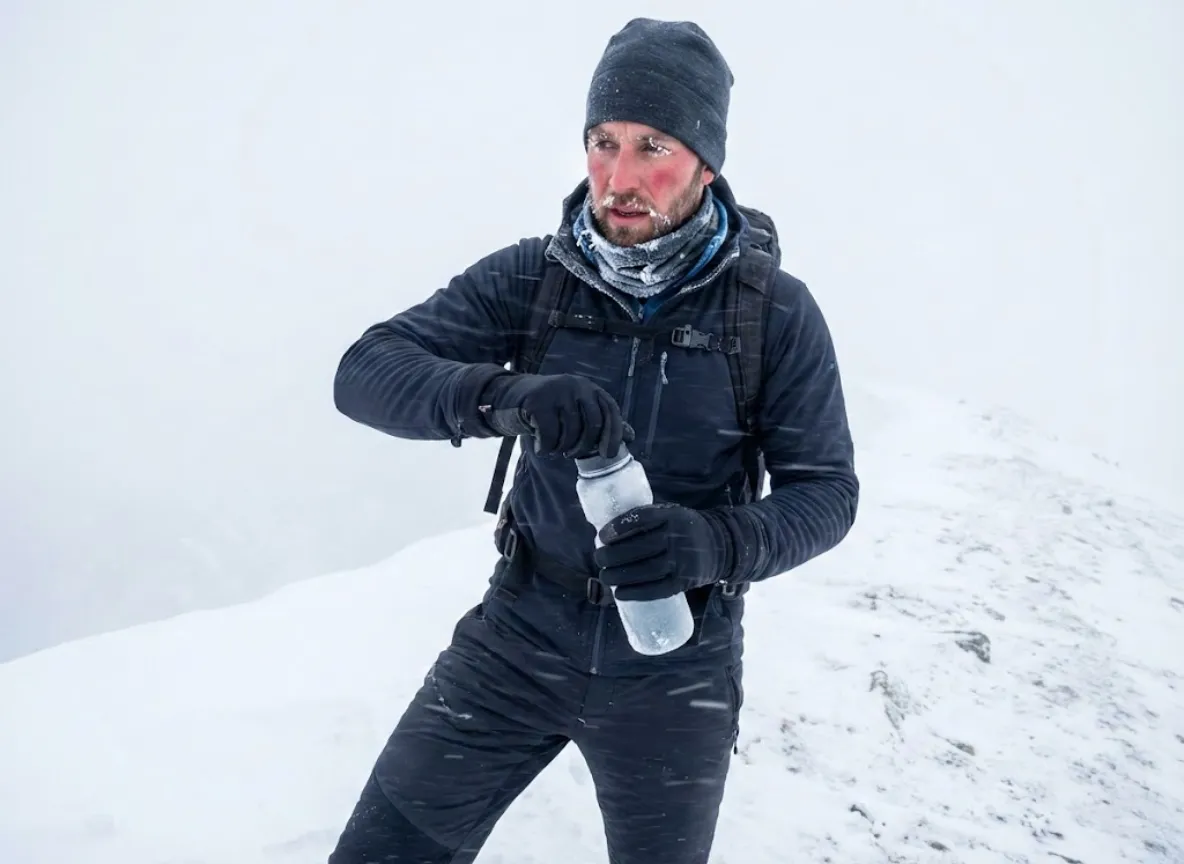
The wind on the ridge screams at 40mph, stripping the heat from your layers and turning the sweat on your back to ice. You reach for your water bottle, desperate for a drink, only to find the cap fused shut and the contents turned to a solid block of slush. This is not just an inconvenience. In sub-zero environments, frozen water prevention becomes a critical life-support skill.
As a lead instructor for outdoor education, I have watched countless students struggle with this exact scenario during winter backpacking trips. They often blame their gear, but the failure is rarely the bottle itself. Winter hydration systems require a systems engineering approach, not just a trip to the gear shop. You must become a practitioner who understands the thermodynamics of your pack and the physiology of your own body.
Why is Winter Hydration More Than Just “Drinking Water”? (The Physiology & Physics)

Most day hiking enthusiasts view water simply as fuel, but in deep cold, it is your primary coolant and heating system. To maintain it, we first need to understand the forces working against us.
Why do we get dehydrated so quickly in the cold?
The body’s thirst mechanism is unreliable in freezing temperatures, often leading to rapid fluid loss before you even feel the need to drink.
When you step into the cold, your body executes an immediate survival protocol called vasoconstriction. It clamps down on peripheral blood vessels to shunt warm blood to your core. This sudden increase in central blood pressure tricks your kidneys into believing the body is over-hydrated. The result is Cold-Induced Diuresis (CID), where your system dumps “excess” fluid via urine. This is dangerous because as blood volume drops, your blood becomes more viscous (thicker). Thick blood circulates poorly to your fingers and toes, drastically accelerating frostbite risk.
Compounding this issue is a neurological trap. Exposure to cold dampens the brain’s thirst signals by up to 40%. You simply do not feel thirsty, even as you lose massive amounts of moisture through respiration. Your lungs work overtime to humidify dry, frigid air before oxygen exchange, exhaling that moisture as vapor.
According to research on cold-induced fluid balance, relying on thirst in these conditions is a guaranteed path to dehydration risks. You must drink by the clock, not by feel. Maintaining blood volume is critical for recognizing the early signs of hypothermia and keeping your internal furnace running.
How does water actually freeze inside a bottle?
Water freezes from the top down due to its unique density properties, a fact that dictates our entire storage strategy.
To defeat the ice and master winter water management, you have to understand the three vectors of heat loss: Conduction (contact with cold surfaces), Convection (wind stripping heat away), and Radiation. Water behaves strangely as it cools; it reaches its maximum density at 4°C (39°F). As it cools further toward freezing, it expands and becomes lighter. This causes the coldest water to float to the top, forming ice at the air-water interface first.
This process creates a rigid plug at the neck of your bottle while liquid remains at the bottom. Additionally, still water can “supercool” below freezing without turning solid until it is agitated. When you unscrew a cap, you introduce a nucleation site, potentially causing the water to flash-freeze instantly. Understanding why water freezes from the top down allows us to use gravity to our advantage. This principle is a cornerstone of comprehensive winter hiking safety skills, informing the specific packing tactics we will discuss later.
Layer 1: Which Water Vessels Survive Sub-Zero Temperatures? (Gear Selection)
Not all plastics are created equal. Material science determines whether your bottle will crack, shatter, or simply deform when the mercury drops.
Is plastic or metal better for winter hiking?
High-Density Polyethylene (HDPE) is the superior winter material due to its ductility; metal transfers heat too rapidly, and rigid plastics are prone to shattering.
The gold standard for winter hiking is the “milky white” wide-mouth Nalgene or Hunersdorf bottle made of plastic HDPE. Unlike the clear, rigid Copolyester (Tritan) bottles which suffer from “cold brittleness” and can shatter if dropped, HDPE remains soft and pliable in deep freeze. We also avoid disposable PET bottles (like Smartwater bottles) in true winter conditions. Their narrow necks encourage ice bridging (freezing shut quickly), and they warp dangerously if you pour boiling water into them—a necessary tactic we will cover shortly.
Winter Water Bottle Material Comparison
Analysis of weight, durability, and thermal properties for cold environments
Weight
~3.75 oz (106g). Extremely lightweight.
Durability (-20°F)
Elite/High. Retains ductility and flexibility; likely to bounce rather than crack if dropped on rocks.
Heat Retention
Moderate. Low thermal conductivity (~0.4-0.5 W/mK). Can safely hold boiling water to act as a “hot water bottle”.
Risk Factor
Low. The “Gold Standard” for reliability and weight savings in winter mountaineering.
Weight
~6.25 oz (179g). Heavier than HDPE.
Durability (-20°F)
Moderate/Low. Suffers from “cold brittleness”; risk of catastrophic shattering or crazing.
Heat Retention
Low. Uninsulated plastic allows conductive heat loss; acceptable for mild conditions only.
Risk Factor
Medium. Unnecessary weight and failure risk for deep winter or expeditions.
Weight
~12 oz (Trail) to 15.2 oz. Heavy.
Durability (-20°F)
High. Resistant to cracking; may dent but remains functional.
Heat Retention
Excellent. Vacuum gap eliminates conduction/convection. Kept water at 135°F after 5 hours at freezing temps.
Risk Factor
Low (Reliability) / High (Weight). Good for morale/safety hot drinks, but too heavy for primary water carry.
Weight
~1.2 oz. Extremely light.
Durability (-20°F)
Low. Thin plastic offers minimal structural integrity in deep freeze.
Heat Retention
Poor. High rate of heat loss. Cannot handle boiling water (deforms/leaks).
Risk Factor
High. “Dangerous” for deep winter; narrow neck freezes instantly and bottle cannot be boiled.
While many hikers love vacuum insulated stainless steel bottles (like a Hydro Flask or Yeti Rambler), they are heavy. I treat them as “support vessels” rather than primary carriers. Use them to carry high-calorie hot tea or soup, but rely on lighter plastic for your bulk water. If you look at the data on the thermal conductivity of different container materials, single-wall metal is the worst possible choice, acting as a radiator that dumps heat into the air.
Also, a wide mouth bottle opening is non-negotiable. It prevents ice from bridging across the opening and allows you to fill the bottle with snow if necessary, a key factor in choosing the right hiking water bottle for cold weather.
Can I use a hydration bladder in freezing conditions?
Hydration reservoirs generally fail below 20°F (-6°C) because the drink tube has a high surface-area-to-volume ratio, causing it to freeze in minutes.
Bladders are the weak link in a winter system. The thin tube is exposed to the elements, and once it freezes, it is nearly impossible to thaw without stopping to set up a stove. If you insist on using a hydration bladder from brands like Camelbak, Platypus, or Hydrapak, you must employ the “Blow-Back” technique: blow air back into hose after every sip to clear all water from the line and bite valve, pushing it back into the reservoir.
Even with NASA technology on freeze-resistant hydration, mechanical failure is likely. To have a fighting chance, you need an insulated hose sleeve and a bite valve cover. More importantly, route the tube under your armpit and inside your jacket shell to utilize your body heat. When selecting a winter-ready hydration pack, look for systems designed to keep the reservoir close to your back, but always carry a hard bottle as a backup.
Layer 2: How Do We Insulate Against the Cold? (Thermal Protection)
The bottle is just the vessel. To survive the day, it needs a coat, just like you do.
What is the most effective way to insulate a water bottle?
Closed-cell foam parkas provide the most reliable insulation; burying the bottle deep in the pack creates a secondary thermal barrier.
You need a dedicated insulator, such as the Liberty Mountain bottle carrier, the “40 Below Bottle Boot,” or similar nylon-covered closed-cell foam carriers. These do not absorb water and maintain their structure. While some hikers try the “wool sock hack”—sliding a bottle into a heavy trekking wool sock—this is risky. If the sock gets wet from snow or condensation, it freezes to the bottle, offering zero insulation. Ensure your insulation covers the lid, as the plastic cap is a major source of heat loss.
When packing, use the “Burial” method. Do not store bottles in the outside pocket of your backpack where they are exposed to the wind. Instead, pack them deep inside, wrapped in your down puffy jacket or spare layers. Place the bottle against the back panel of your pack. This allows the water to steal a small amount of conductive heat from your spine while being insulated from the cold outside air. This aligns with Princeton University’s winter camping guide protocols and is a specific application of strategic backpack packing techniques.
Pro-Tip: In extreme cold, activate a chemical hand warmer and slide it between your water bottle and its insulated parka. This active heat source can keep water liquid for hours longer than insulation alone.
Layer 3: What Tactics Keep Water Liquid on the Trail and at Camp? (Operational Behavior)
Hardware fails without software. Your habits—how you store and manage your water—are the final line of defense.
Why should you store water bottles upside down?
The practice of storing bottles upside down ensures that ice forms at the bottom of the bottle, keeping the cap threads liquid and functional.
Remember the physics of top-down freezing? Since ice forms at the air-water interface (the “top”), inverting the bottle moves that interface to the physical bottom of the container. The water against the cap remains in the “warmest,” densest liquid state.
If you store a bottle upright, the ice plug forms right at the neck, fusing the cap shut. By storing it upside down (inverted), even if the contents turn to ice slush, the cap will unscrew easily, allowing you to access the liquid water. This simple tactic, a staple of the NOLS winter camping curriculum, ensures access to your essential hydration gear when you need it most.
How can hot water serve a dual purpose at night?
A bottle filled with hot water acts as a battery, releasing thermal energy to keep you warm while guaranteeing liquid water for the next morning.
Never go to sleep with cold water. Before bed, fill your HDPE bottles with near-boiling water. Slide them into a wool sock (or your liner gloves) and place them in the footbox of your sleeping bag or near your femoral artery (inner thigh). This “Hot Water Battery” acts like a space heater, radiating heat for 6-8 hours, drying out damp socks and warming your body.
More importantly, this preserves a “Liquid Seed.” Melting snow from scratch takes a massive amount of fuel due to the latent heat of phase change. By waking up with liquid water, you can pour a few ounces into your pot to jumpstart the snow melting process. This prevents scorching your cookware and is far more fuel-efficient, a concept backed by the physics of latent heat of fusion. Efficiency here is key, allowing you to carry less fuel for your high-efficiency camping stoves.
Pro-Tip: Always save at least 2-3 ounces of liquid water in the morning. Never drink your bottle dry before starting your stove. That small amount of water acts as a thermal conductor to melt snow faster and prevents the “burnt taste” of snow scorching on dry metal.
Conclusion
Preventing frozen water is not about luck; it is about discipline. The system is simple but unforgiving: use HDPE vessels, apply closed-cell insulation, and execute tactical behaviors like inverted storage and scheduled drinking. Physiology works against you in the cold, suppressing thirst while draining your reserves. By understanding the physics of freezing and treating your water as a life-support system, you turn a potential survival situation into just another manageable part of the adventure.
Share your own winter hydration setup or questions in the comments below, and explore our full library of Responsible Hiking guides to master the cold.
FAQ – Frequently Asked Questions about Winter Hydration
Does adding alcohol or salt to water keep it from freezing?
While alcohol and salt lower the freezing point, they are counterproductive for hydration. Alcohol causes vasodilation, which accelerates body heat loss, and salt increases dehydration. Stick to electrolytes for performance, but do not rely on additives as antifreeze.
Can I use chemical hand warmers to keep my water liquid?
Yes, placing an activated hand warmer between your bottle and its insulated parka is a highly effective emergency tactic. This active heat source can prevent freezing for several hours in extreme conditions.
Why shouldn’t I use Smartwater bottles in winter?
Smartwater bottles have narrow necks that freeze over quickly (bridging), and the PET plastic can deform or melt if filled with boiling water. They lack the durability and thermal versatility of wide-mouth HDPE (Nalgene) bottles.
Is it safe to eat snow if I run out of water?
Eating snow is dangerous because it lowers your core body temperature and forces your body to expend massive energy to melt the crystals. It can accelerate hypothermia; always melt snow on a stove before consuming.
Risk Disclaimer: Hiking, trekking, backpacking, and all related outdoor activities involve inherent
risks which may result in serious injury, illness, or death. The information provided on The Hiking Tribe is for
educational and informational purposes only. While we strive for accuracy, information on trails, gear, techniques,
and safety is not a substitute for your own best judgment and thorough preparation. Trail conditions, weather, and
other environmental factors change rapidly and may differ from what is described on this site. Always check with
official sources like park services for the most current alerts and conditions. Never undertake a hike beyond your
abilities and always be prepared for the unexpected. By using this website, you agree that you are solely
responsible for your own safety. Any reliance you place on our content is strictly at your own risk, and you assume
all liability for your actions and decisions in the outdoors. The Hiking Tribe and its authors will not be held
liable for any injury, damage, or loss sustained in connection with the use of the information herein.
Affiliate Disclosure: We are a participant in the Amazon Services LLC Associates Program, an
affiliate advertising program designed to provide a means for us to earn advertising fees by advertising and linking
to Amazon.com. As an Amazon Associate, we earn from qualifying purchases. We are also an official affiliate partner
of Black Diamond Equipment via the AvantLink network. If you click on a Black Diamond affiliate link and make a
purchase, we may earn a commission at no additional cost to you. We also participate in other affiliate programs and
may receive a commission on products purchased through our links. Additional terms are found in the terms of
service.