In this article
The SAR helicopter had already made three passes over the canyon before they spotted him. The hiker—hypothermic, with a broken ankle—had been wearing his favorite burnt orange shell, the same burnt orange as the iron-oxide sandstone walls surrounding him. He’d become invisible. Forty-eight more minutes passed before ground teams reached his position. After twenty years leading backcountry trips and training with search and rescue teams across the Rockies, I’ve seen this story play out too many times. The difference between being found in three hours and being found in three days often comes down to a few hundred nanometers of wavelength.
Here’s exactly what you need to know about picking the right high visibility colors for your terrain—because “blaze orange is always best” is dangerously oversimplified.
⚡ Quick Answer: No single color offers optimal visibility across all terrains. Blaze orange works best in green forests and snow, but royal blue outperforms it in red-rock deserts and autumn woods. Match your color to your terrain’s spectral opposite: if the landscape is warm (red/orange/brown), wear cool colors (blue/cyan). If it’s cool (green/white/grey), wear warm colors (orange/red/pink). Add high-vis markers to your limbs to multiply detection distance by up to 10x.
The Science of Being Seen: Why Color Choice is a Survival Variable

The Physics of Contrast: It’s Not About Being Bright
Your visibility on the trail isn’t about choosing the brightest jacket in the store. It’s about contrast—the difference between you and everything behind you. A safety yellow vest might pop on a roadway, but place that same jacket against spring foliage and it can vanish like camouflage.
Two types of contrast determine whether searchers spot you. Luminance contrast is the difference in brightness between your gear and the background—think black on white snow. Chromatic contrast is the difference in hue—red against green grass. The most effective safety colors maximize both types against your specific terrain.
Here’s where most hikers go wrong: a fluorescent green vest in a summer forest has high brightness (luminance), but the hue is nearly identical to the vegetation. If your vest falls into shadow, you lose that brightness advantage and become part of the scenery. The goal is maximum signal-to-noise ratio—your jacket is the signal, the terrain is the noise.
Pro tip: Before each trip, spend 30 seconds thinking about what color the landscape will be. Then pick the spectral opposite. It sounds simple, but it’s the difference between being found and being a footnote in a SAR case study.
Fluorescence: The Quantum Trick That Makes You Glow
Fluorescent colors—the neon “Day-Glo” shades—have a superpower that standard pigments don’t. They absorb invisible UV light and convert it into visible wavelengths. A regular orange jacket reflects about 60% of incident orange light. A fluorescent orange jacket can exceed 100% radiance by harvesting UV energy from the spectrum your eyes can’t even see.
This is why high-visibility clothing appears to glow against natural backgrounds. The material creates light that wasn’t there before, producing what experts call a “super-normal” stimulus. The effect is strongest in overcast conditions, dawn, and dusk—exactly when you’re most likely to need it—because UV levels stay high even as visible light fades.
But here’s the catch nobody tells you: UV exposure degrades the fluorescent pigments over time. This process, called photobleaching, is why that three-year-old hi vis vest has lost its punch. Once a fluorescent garment fades, it performs like a standard pigment—dramatically lower visibility. Replace your safety vests when the glow visibly diminishes, and you’ll maintain that critical edge when understanding your essential gear systems matters most.
The Terrain Matrix: Optimal Colors by Environment
Deciduous Forest: Green Canopy vs. Autumn Browns
In a spring or summer forest, the world is dominated by chlorophyll—everything reflects green light at around 550 nanometers. Blaze orange sits on the opposite side of the color wheel from green, creating maximum edge contrast. It’s why hunters have worn it for decades, and why it remains the single best choice for temperate woodland from April through September.
The fluorescence advantage compounds here. Forest shadows are rich in UV and blue light that passes through the canopy, which fluorescent orange converts into that unmistakable glow. A hiker in safety orange appears to light up against dark foliage.
But autumn changes the equation completely. When the leaves turn, that orange jacket shares the same hue as dead maple and oak. You’re brighter than a leaf, sure, but you’re the same color. Now royal blue or electric blue becomes optimal—it’s the spectral opposite of the orange-brown autumn palette. Blaze pink works well too, since true pink is rare in nature outside of specific flower blooms.
When selecting trail-ready layers, factor in seasonal color shifts. What saves your life in June might hide you in October.
Alpine and Snow Environments: The Cryosphere Challenge
Against snow, white gear is invisible. Zero contrast. It disappears completely in flat light or whiteout conditions—exactly when you’re most at risk.
The intuitive answer is black: maximum luminance contrast, dark against bright. And black works, up to a point. But black doesn’t radiate—it relies on searchers spotting a silhouette or a “hole” in the landscape. At distance, a black dot becomes indistinguishable from a rock outcrop.
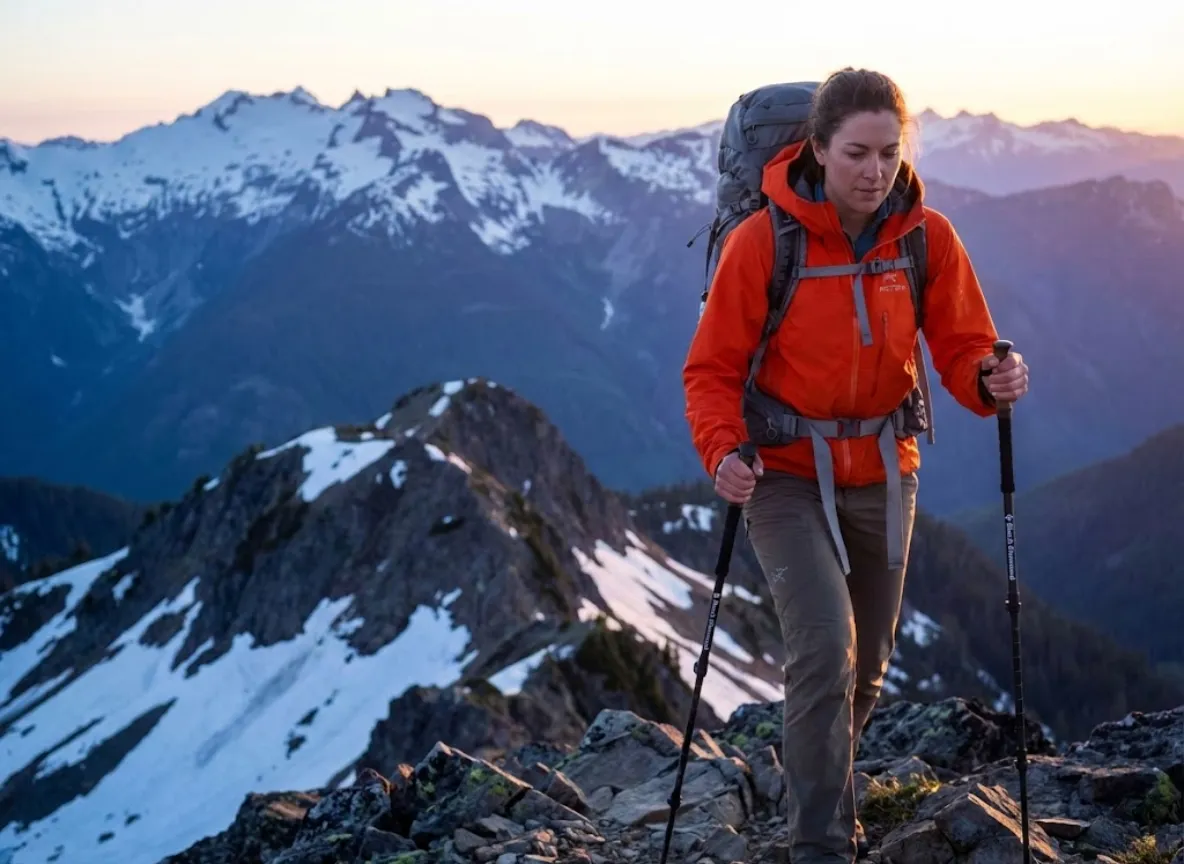
Fluorescent orange or fluorescent red provides the best of both worlds in snow: high luminance contrast (darker than the white background) plus extreme chromatic contrast (the red end of the spectrum is almost entirely absent in snow and ice). Under overcast snowy skies, UV penetrates the cloud layer and powers the fluorescence even when visible light is dim—exactly when you need it most.
Red Rock and Desert Canyons: The Orange Trap
This is where the “orange is always best” advice fails people.
Iron-oxide geology—Utah’s sandstone, Arizona’s canyons, the Australian Outback—reflects light in the 600-700 nanometer range. That’s the exact same wavelength your safety orange jacket reflects. Wearing orange in red rock country is optically equivalent to wearing camouflage. SAR drone operators and helicopter crews report significant difficulty spotting orange clothing against red sandstone walls.
The solution is simple: royal blue or cyan. Blue absorbs the red-orange wavelengths reflected by the canyon walls and reflects the blue wavelengths the rock absorbs. Maximum signal-to-noise ratio. According to Paul Kirtley’s research on terrain-adaptive visibility, blue is visually distinct from both the warm rock tones and the occasional green scrub vegetation.
For grey scrub and sagebrush country—the Mojave, the Great Basin—blaze pink becomes optimal. It exists almost nowhere in that tan-and-grey palette, creating a jarring, unmistakable signal.
Pro tip: If you’re planning a Utah backcountry trip and all you own is orange gear, grab a cheap blue tarp from the hardware store. If something goes wrong, you can drape it over yourself and convert from invisible to unmissable.
Open Water: Why Maritime Survival Uses Different Rules
Ocean surfaces are dynamic—deep blue to grey-green, with whitecaps introducing high-brightness visual noise. Fluorescent yellow-green is optimal here, providing strong contrast against dark water while remaining distinct from white foam.
Safety orange is the SOLAS (Safety of Life at Sea) standard, and it works. But studies by Mustang Survival and others suggest fluorescent lime green performs slightly better in rough seas where whitecaps clutter the visual field.
Avoid red near water entirely. Water absorbs red wavelengths rapidly—a red object submerged even a few inches loses its color and appears dark. At distance, red can look black against the ocean surface. Blue and white are dangerous for obvious reasons: you become indistinguishable from the environment you’re trying to survive.
When Your Eyes Lie: The Twilight Problem and CVD
The Purkinje Shift: Why Red Disappears at Dusk
Your eyes use two systems: cones for color in bright light, rods for intensity and motion in darkness. The transition between them—during dawn and dusk—creates a phenomenon called the Purkinje effect that can make your safety gear worthless.
In bright daylight, your peak sensitivity is around 555 nanometers: yellow-green. That’s why ANSI/ISEA 107-2020 uses fluorescent yellow-green for roadway workers—it appears brightest to the human eye.
But as light drops, your peak sensitivity shifts toward 507 nanometers: blue-green. Red and orange colors—which appeared vivid at noon—lose their apparent brightness rapidly. They can merge with shadows, becoming effectively invisible to searchers whose eyes have begun adapting to the physiological basis of the Purkinje shift.
The practical consequence is critical: if you’re likely to be searched for at dusk, don’t rely solely on a red or orange jacket. Either wear a combination of colors—orange plus blue—or carry retro-reflective elements that work entirely differently. Retro-reflective materials bounce light back to its source, rather than depending on daylight fluorescence.
The 8% Factor: Color-Blind Searchers Can’t See Your Orange
Here’s a variable almost no one considers: approximately 8% of males have some form of Color Vision Deficiency, most commonly red-green anomalies. In a 12-person SAR team, at least one person statistically has compromised color perception.
For someone with red-green CVD, your safety orange jacket against green foliage can appear as a uniform field of muddy yellow-brown. Zero chromatic contrast. Zero survival advantage.
Almost all forms of CVD preserve blue sensitivity. Royal blue remains chromatically distinct for the vast majority of colorblind observers. Mixing blue into your gear—a blue backpack with an orange vest, for example—creates a failsafe visibility profile that accommodates the full visual diversity of search teams.
Beyond Color: The Biomotion Multiplier and Gear Placement
Why Moving Limbs Get Found Faster
The human visual system evolved to detect biological motion—the specific kinematic patterns of walking, running, and waving. This processing is highly sensitive even to low-resolution peripheral input from rod cells.
Studies of cyclists and pedestrians demonstrate that reflective or high-visibility markers on the limbs—wrists, ankles, knees, elbows—allow detection at distances up to ten times greater than markers on the torso alone. This is the biomotion effect in action.
A static vest is a block of color. Searchers must scan directly over it to identify it. Markers on moving limbs create a dynamic, oscillating signal that triggers peripheral motion detectors, drawing attention even when the searcher isn’t looking directly at you.
The Signaling Layer: High-Vis Gaiters, Gloves, and Arm Bands
Your high-visibility strategy shouldn’t stop at jackets and vests. Consider hi-vis gaiters, reflective gloves, or bright arm bands that leverage the biomotion effect—especially valuable when choosing the right hiking gaiters for trail protection and signaling.
When waving to signal rescue aircraft, high-contrast sleeves or gloves dramatically increase your “visual loudness” compared to bare hands or neutral fabrics. This is the answer to the Leave No Trace aesthetic conflict: wear earth tones if you prefer, but carry a deployable “signaling layer”—a bright pack cover, an emergency poncho in blaze orange, or a fluorescent beanie that deploys when you need it.
Pro tip: High-vis gaiters are an underrated solution. They protect your lower legs from brush and moisture while putting bright color exactly where biomotion happens—at your moving ankles. Two functions, one piece of gear.
Drones and Machine Eyes: What Algorithms See Differently
How SAR Drones Process Color
Modern search and rescue increasingly deploys drones with RGB cameras, and their color perception differs from human eyes. Most commercial drone sensors use Bayer Filter arrays weighted toward green (50%), with red and blue each receiving 25% of the pixels.
Critically, drone video is typically compressed using codecs like H.264, which discard color resolution to save bandwidth. Small, patterned patches of color can be “averaged out” into the background by compression artifacts. Solid, large blocks of color—like a plain orange vest rather than a camo-orange pattern—are far more resilient to these digital distortions.
Orange Wins for Algorithms, Blue May Hide
Automated detection software like Loc8 and Eagle Eyes uses machine learning to scan thousands of aerial images, looking for spectral anomalies—pixels that fall outside the statistical distribution of the terrain’s color histogram.
Orange and red occupy histogram space that’s largely empty in natural environments like forests and water. Algorithms flag these colors with high confidence and low false positives.
Blue presents challenges in certain environments. In maritime searches or shadowed mountain terrain, blue pixels are statistically common—water, sky reflections, rock shadows. Detection algorithms may struggle to differentiate a blue jacket from a shadow, producing higher false-negative rates.
If you anticipate drone-assisted SAR and you’re preparing for wilderness emergencies, prioritize orange or red gear for maximum detectability by both human and machine observers.
Hunting Season Overlay: Legal and Practical Considerations
State Requirements and the Blaze Pink Option
Many states mandate 500+ square inches of solid Daylight Fluorescent Orange on head and chest during hunting seasons—Colorado, Kentucky, and most eastern woodland states among them. Check your specific jurisdiction before hitting the trail in autumn.
A growing number of states now allow blaze pink as a legal alternative: Wisconsin, Virginia, and Colorado have adopted this change. The shift is partly driven by the finding that deer lack red cones and perceive both orange and pink as similar grey tones, while pink offers equivalent safety for human hunters and hikers.
The Camo-Orange Loophole Hurts Visibility
Some jurisdictions allow “broken” or camouflage-patterned orange. This is optically counterproductive for rescue operations. Camouflage disrupts the human silhouette—exactly the opposite of what safety equipment should do. A camo-orange jacket has significantly lower Effective Sweep Width than a solid orange panel.
If you must meet hunting requirements, choose solid safety vests or panels in blaze orange or pink rather than camo patterns. The whole point is to be seen, not to compromise visibility for aesthetics while building your essential safety systems.
Conclusion
The Rescue Safety Matrix reduces to a single principle: contrast is context-dependent. The blaze orange that makes you unmissable in a Pacific Northwest forest can render you invisible in Utah’s red rock country.
Three rules will keep you visible when it counts:
Match your color to your terrain’s spectral opposite. Warm terrain (red, orange, brown) demands cool colors (blue, cyan). Cool terrain (green, white, grey) demands warm colors (orange, red, pink).
Don’t trust red at twilight. The Purkinje effect steals your visibility when you need it most. Carry retro-reflective elements or a blue backup piece.
Leverage biomotion. High-visibility gaiters, gloves, or arm bands on moving limbs can multiply your detection distance by a factor of ten.
Print the terrain matrix. Tape it inside your gear closet. Before your next trip, take 30 seconds to check your planned environment against the recommendations. The difference between being found in three hours and being found in three days comes down to physics—and now you understand the physics.
FAQ
What is the single most visible color for hiking in all conditions?
There is no universally best color—visibility depends on contrast with your specific terrain. Blaze orange is the most robust all-around choice for temperate forests and snow, but royal blue outperforms it in red-rock deserts and autumn deciduous forests. The optimal strategy is terrain-adaptive color selection rather than relying on any single hue.
Do fluorescent colors work at night?
Fluorescent pigments require UV or blue light to create their intense glow, so they lose their advantage in darkness. At night, retro-reflective materials are dramatically more effective—they can appear up to 1000 times brighter than fluorescent fabric when hit by a flashlight or headlamp beam, because they bounce light back toward its source.
What is the ANSI 107 standard for high visibility?
ANSI or ISEA 107-2020 is the American standard for high-visibility safety apparel, primarily designed for roadway workers. It specifies Fluorescent Yellow-Green or Fluorescent Orange-Red fabrics combined with retroreflective striping. Class 2 requires 775 square inches of background material; Class 3 requires 1,240 square inches. While designed for industrial settings, understanding these specs helps evaluate gear quality.
Can hunters see blaze orange better than other colors?
Blaze orange is optimized for contrast against green and brown woodland to prevent accidental shootings—it’s designed for human perception in that specific environment. Deer, which lack red cones, perceive blaze orange and blaze pink as similar grey tones. Several states now allow pink as a legal alternative, offering equivalent human safety with different aesthetics.
Is black clothing safe in snowy environments?
Black provides the highest luminance contrast against snow and works for daytime visibility. However, at long distances a black silhouette can be confused with rock outcrops or shadows. Fluorescent orange or red is generally preferred because it provides both high luminance and chromatic contrast, plus the fluorescence advantage in overcast snow conditions when UV light penetrates cloud cover.
Risk Disclaimer: Hiking, trekking, backpacking, and all related outdoor activities involve inherent risks which may result in serious injury, illness, or death. The information provided on The Hiking Tribe is for educational and informational purposes only. While we strive for accuracy, information on trails, gear, techniques, and safety is not a substitute for your own best judgment and thorough preparation. Trail conditions, weather, and other environmental factors change rapidly and may differ from what is described on this site. Always check with official sources like park services for the most current alerts and conditions. Never undertake a hike beyond your abilities and always be prepared for the unexpected. By using this website, you agree that you are solely responsible for your own safety. Any reliance you place on our content is strictly at your own risk, and you assume all liability for your actions and decisions in the outdoors. The Hiking Tribe and its authors will not be held liable for any injury, damage, or loss sustained in connection with the use of the information herein.
Affiliate Disclosure: We are a participant in the Amazon Services LLC Associates Program, an affiliate advertising program designed to provide a means for us to earn advertising fees by advertising and linking to Amazon.com. As an Amazon Associate, we earn from qualifying purchases. We also participate in other affiliate programs and may receive a commission on products purchased through our links, at no extra cost to you. Additional terms are found in the terms of service.