In this article
You are three days into a thru-hike, and the flavor fatigue of dehydrated stroganoff has set in. The plant life surrounding you isn’t just green scenery; it is a riot of biology, calories, and medicine. Yet, most hikers walk past a feast to eat a processed protein bar.
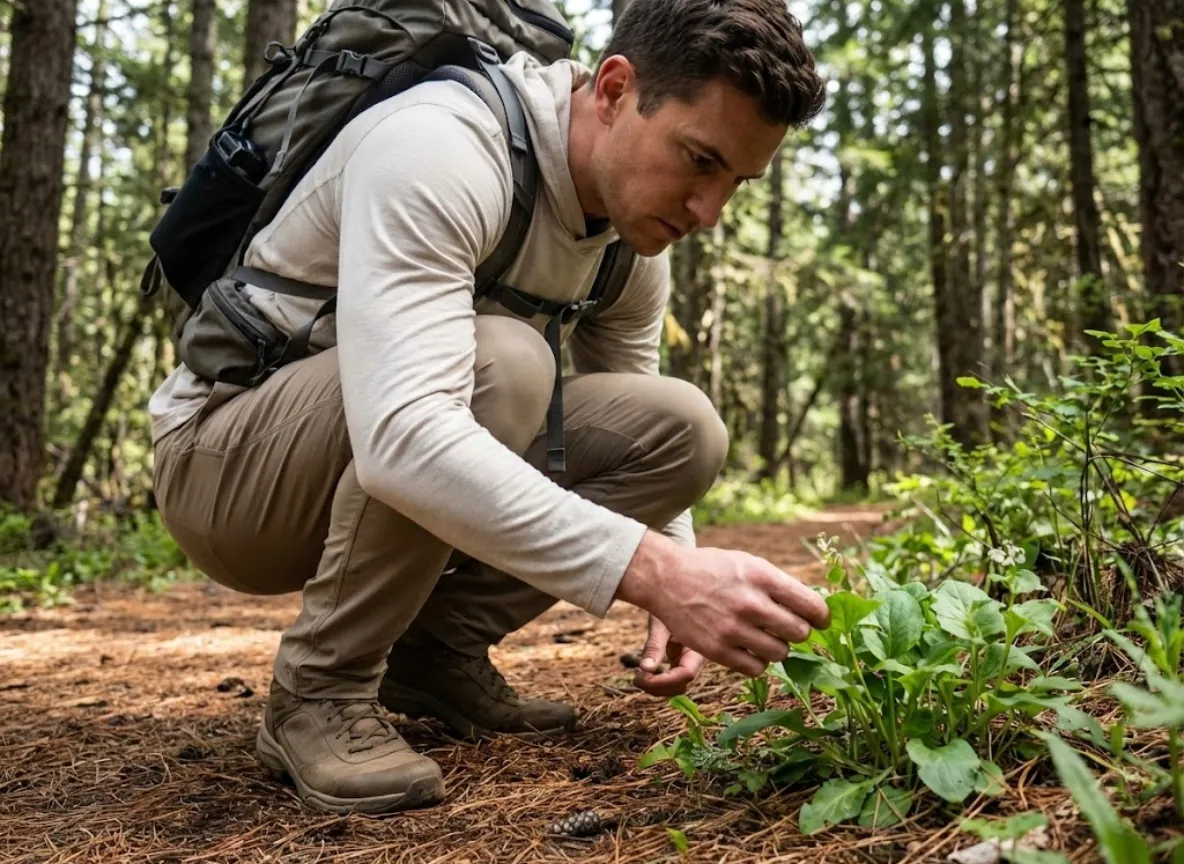
In my twenty years leading wilderness courses, I’ve watched students starve amidst abundance because they lacked the eyes to see it. Becoming a “trail forager” changes the way you scan the terrain—turning a wall of green into a map of resources. But this transition requires a rigorous shift from casual curiosity to precision botany.
This guide moves beyond the novelty of “free food.” We will cover the strict foraging regulations on public land and the morphological details like leaf shape and stem texture that separate lunch from a medevac. We will also examine the “caloric math” of survival to ensure you don’t burn more energy harvesting than you gain eating.
What governs the harvest on public lands?

Before any plant is touched, we must establish the legal boundaries. Rules regarding wild edibles are not arbitrary; they are the difference between being a steward and a poacher.
Is it legal to pick plants in National Parks vs. National Forests?
The rules depend entirely on whose land you are standing on. The National Park Service (NPS) operates under a strict preservation mandate. Under federal regulations restricting plant collection, the default rule is that removing any plant material—whether medicinal plants or wild fruits—is prohibited to preserve natural resources. If you snap a twig in Yellowstone, you are technically in violation.
However, there is a nuance known as the “handful rule.” Park superintendents have the authority to designate specific fruits, nuts, or berries for personal consumption. You must check the specific “Superintendent’s Compendium” for the park you are visiting. If blueberries or wild strawberries aren’t explicitly listed there, they are off-limits.
Contrast this with the US Forest Service (USFS) and Bureau of Land Management (BLM). These agencies operate under a “multiple-use mandate.” Here, personal-use foraging for immediate consumption is generally permitted without a permit.
You must identify the line between “personal use” (snacking on the trail) and “commercial use.” If you are filling gallons of gathering pouches to take home, you need a permit. Additionally, digging roots like ramps or sassafras roots is often strictly prohibited even in permissive areas. Digging kills the entire plant, whereas harvesting wild berries allows for regeneration. This respect for resource limits is a core component of mastering outdoor ethics, ensuring we don’t degrade the environments we enjoy.
Pro-Tip: Federally listed threatened or endangered species are off-limits everywhere. Ignorance is not a legal defense. If you cannot identify a rare plant, you are not qualified to forage in that ecosystem.
How do we apply the “Honorable Harvest” on the trail?
Once legality is established, ethics take over. A legal harvest isn’t always a moral one. On my courses, we adopt the “Rule of Thirds” as a standard operating procedure: take one-third for yourself, leave one-third for the wildlife, and leave one-third for regeneration.
For slow-growing perennials, we must be even stricter. We apply the “One Leaf Rule” specifically for Ramps (Allium tricoccum), also known as wild leeks. Never dig the bulb on public land. Instead, harvest a single leaf from a mature plant. This allows the bulb to survive and continue photosynthesizing.
You should also practice the “ask permission” mindset. Mentally pause before harvesting to assess the population health. If there is only one patch, the answer is “no.” This aligns with the guidelines for sustainable foraging practiced by conservationists globally.
A practical way to contribute is to focus your harvest on invasive species like Garlic Mustard or Dandelion. Heavy collection of these weeds and medicinal herbs actually benefits the native ecosystem. This “edible weeding” is a proactive way to go beyond the 7 principles of Leave No Trace and actively improve the trail corridor.
How do you distinguish dinner from danger?
The most critical skill in the forager’s toolkit is the ability to see details that others miss. “It looks like the picture” is not a valid identification method when dealing with toxic look-alikes.
Why is “Botanical Literacy” safer than a picture book?
Plants change appearance drastically based on season, soil conditions, and age. A photo in a book captures one moment in time; the plant in front of you is a living, changing organism.
To forage safely, you must reject “picture matching” and learn specific plant identification terminology. For instance, distinguishing “glabrous” (smooth/hairless) stems from “pubescent” (hairy) stems is often the only difference between an edible wild carrot and a lethal poison hemlock.
Look for the “basal rosette,” a structure where leaves radiate from a central ground point. This allows you to identify biennials like Dandelion or first-year Wild Carrot before they flower. You must also recognize “umbels” (umbrella-like flower clusters). This is the signature of the Apiaceae family, which contains some of our best food and our worst poisons.
Finally, develop a “multi-sensory” verification process. Visual identification is not enough. You must use touch to check for stem texture and use an olfactory test to check for essential oils. This botanical literacy functions like natural navigation techniques; it allows you to read the terrain rather than just guessing your location.
What are the “Deadly Doubles” you must avoid?
There are certain plants that are actively trying to deceive you. We call these the “Deadly Doubles.”
Wild Carrot vs. Poison Hemlock
This is the most dangerous confusion in North America. Memorize this phrase: “The Queen has hairy legs.”
- Wild Carrot (Queen Anne’s Lace): The stem is hairy and green. It often has a small red flower in the center of the white umbel.
- Poison Hemlock: The stem is smooth, hairless, and has purple spots or streaks. It can grow massive, often towering 6-10 feet high.
Wild Onion vs. Death Camas
- Wild Onion/Field Garlic: Looks like grass, but smells distinctly of onion or garlic when crushed.
- Death Camas: Looks like an onion, grows in the same meadows, but smells like grass. If it doesn’t smell like a salad, it might stop your heart.
True Morels vs. False Morels
- True Morel: Hollow from the tip of the cap to the bottom of the stem when sliced open.
- False Morel: Solid, chambered, or filled with cottony fibers.
Understanding poison hemlock identification characteristics is non-negotiable. Hemlock works by respiratory failure. Death Camas affects the heart. Often, there is no antidote in the backcountry.
If you make a mistake, you are essentially a medical casualty waiting to happen. Prevention is the only cure, which is why your knowledge of plants must be as sharp as the protocols in your wilderness first aid pocket guide.
What are the most practical plants for hikers?
Foraging on a thru-hike is about utility. We aren’t looking for gourmet salads with chickweed or wood sorrel; we are looking for caloric staples and nutrients that justify the energy expenditure of harvesting.
Which plants offer the best “Caloric ROI” on the trail?
On the trail, you are a machine burning 300-600 calories an hour. You cannot afford to spend two hours processing acorns (which require boiling to remove tannins) if it results in a net caloric loss. You need high-yield plants.
Cattails (Typha)
This is the “four-season supermarket” of edible water plants. In spring, the cattail shoots are edible raw or cooked. In summer, the cattail pollen is a protein-rich flour substitute. In winter, the cattail roots (rhizomes) provide starch.
Blackberries and Raspberries
These aggregate wild fruits require zero processing. They provide immediate simple sugars for energy. The nutritional value of wild berries includes high vitamin content and antioxidants, making them a perfect trail snack. Keep an eye out for other regional treats like huckleberries, elderberries, or wild strawberries depending on your elevation.
Eastern White Pine
You aren’t eating the wood, but the green pine needles. Steeping them creates a tea rich in Vitamin C and electrolytes. The bioactive compounds in pine needles are far more valuable to a dehydrated hiker than plain water. Spruce tips can be used similarly in early spring.
Stinging Nettle
If you have a stove, this is a superfood. Boiling neutralizes the sting instantly. The resulting broth is nutrient-dense, acting as a natural multivitamin rich in Iron and Vitamin A.
Focus on “Flavor Enhancement” over “Subsistence.” Use Wild Onions, Ramps, or even chopped Dandelion greens to boost the morale-improving flavor of freeze-dried meals rather than trying to survive on them. This approach aligns with a solid trail nutrition matrix, where wild foods supplement a calculated diet.
How do you cook wild food with limited gear?
You don’t need a full kitchen or specialized foraging gear. You need a pot and a single burner.
Pine Needle Tea
Do not boil the needles, as this destroys the Vitamin C. Bring water to a boil, remove from heat, and add chopped needles. Chopping releases the oils. Let the tea infusion steep for 10 minutes.
Stinging Nettle Pesto (Hiker Style)
Boil Stinging Nettles for 2 minutes to disarm them. Drain the water (drink it—it’s vitamin water). Mash the greens with olive oil packets, trail mix nuts, and parmesan cheese. Stir this into your ramen for a calorie bomb.
Blackberry Cobbler
Simmer berries with sugar packets in your pot. Drop in dough balls made from pancake mix and water. Steam-bake with the lid on.
Ramp/Onion Bomb
Chop wild alliums and add them to rehydrating freeze-dried meals after the water is added. If you add them before, they get soggy. Adding them later maintains a fresh, crunchy texture.
Priority one is fuel efficiency. Avoid recipes that require long boil times, such as leaching acorns. Ensure you have a dedicated cloth bag or gathering pouch in your campfire cooking kit for collecting; plastic bags rot mushrooms and wilt leafy greens quickly.
Pro-Tip: Always wash roots thoroughly away from the water source. Ingesting grit or soil pathogens can end a hike just as quickly as a twisted ankle.
Final Thoughts
True outdoor competence comes from turning theoretical knowledge into confident action. Foraging isn’t just about free food; it’s about reading the environment as a pantry and pharmacy.
To recap:
- Legal: Check the Park Superintendent’s Compendium for specific foraging regulations.
- Safety: Never eat a plant unless you can identify it by three distinct features (visual identification, olfactory test, habitat) and rule out its “Deadly Double.”
- Efficiency: Focus on high-yield plants like Cattails and wild berries.
- Ethics: Take only what you need, and never dig roots without permission.
Next time you are on the trail, start by identifying just one plant without picking it. Once you are confident, try the Pine Needle Tea recipe on your next break.
FAQ – Frequently Asked Questions
Is the Universal Edibility Test reliable for hikers?
No. It is a survival protocol of last resort that takes 24+ hours and involves purposefully exposing yourself to potential toxins. Hikers should rely on 100% positive identification of known edible species rather than testing unknown plants.
What is the most dangerous plant look-alike for beginners?
Poison Hemlock is the most dangerous because it looks strikingly similar to Wild Carrot (Queen Anne’s Lace). Remember: Hemlock has smooth, purple-spotted stems, while Wild Carrot has hairy, green stems.
Can I drink water from a stream if I see Cattails growing in it?
Not necessarily. While Cattails indicate water, these freshwater plants also absorb heavy metals and pollutants (bio-accumulation). You must filter and purify the water regardless of the vegetation present.
Do I need to boil acorns before eating them?
Yes. Acorns contain high levels of tannic acid, which is bitter and can cause kidney damage if ingested in large quantities. They must be leached (boiled in changes or water) until the water runs clear and the nut tastes sweet.
Risk Disclaimer: Hiking, trekking, backpacking, and all related outdoor activities involve inherent risks which may result in serious injury, illness, or death. The information provided on The Hiking Tribe is for educational and informational purposes only. While we strive for accuracy, information on trails, gear, techniques, and safety is not a substitute for your own best judgment and thorough preparation. Trail conditions, weather, and other environmental factors change rapidly and may differ from what is described on this site. Always check with official sources like park services for the most current alerts and conditions. Never undertake a hike beyond your abilities and always be prepared for the unexpected. By using this website, you agree that you are solely responsible for your own safety. Any reliance you place on our content is strictly at your own risk, and you assume all liability for your actions and decisions in the outdoors. The Hiking Tribe and its authors will not be held liable for any injury, damage, or loss sustained in connection with the use of the information herein.
Affiliate Disclosure: We are a participant in the Amazon Services LLC Associates Program, an affiliate advertising program designed to provide a means for us to earn advertising fees by advertising and linking to Amazon.com. As an Amazon Associate, we earn from qualifying purchases. We also participate in other affiliate programs and may receive a commission on products purchased through our links, at no extra cost to you. Additional terms are found in the terms of service.