In this article
The grizzly materialized from the willows at 30 yards—a blur of brown fur closing the gap at 35 miles per hour. My hands were jammed through my trekking pole straps. By the time I’d ripped free and reached for my hip holster, I could smell the bear. Two seconds. That’s all I had. That’s all you ever get.
After years of backcountry travel through the Greater Yellowstone Ecosystem and Alaska’s bear country, I’ve learned that the difference between walking out and getting mauled often comes down to equipment choices you made before you ever left the trailhead. Not the spray’s capsaicin content. Not the brand. The holster—and where you mount it.
This guide establishes the definitive 2-second deployment standard for bear spray holsters reaction time. You’ll learn exactly where to carry your canister, which retention systems enable the fastest draw, and how to train your hands to move before your brain catches up. Because when a charging grizzly covers 44 feet per second, thinking time is a luxury you don’t have.
⚡ Quick Answer: You have roughly 2 seconds to deploy bear spray when a grizzly charges from 30 yards. Chest-mounted holsters (like the GunfightersINC Kenai or FHF Gear) offer the fastest access. Hip holsters work if mounted forward of the hip bone. Never store spray in your pack—it’s equivalent to carrying nothing. Practice your draw until it’s automatic.
The Brutal Math: Why 2 Seconds Is Your Only Window

Understanding why the 2-second standard exists requires confronting uncomfortable physics. A grizzly bear isn’t just big—it’s explosively fast. And your brain is slower than you think.
Grizzly Charging Speed vs. Human Reaction Time
A grizzly can hit 30-35 mph, which translates to 44 feet per second. That’s faster than Usain Bolt at his peak. At that speed, a bear 30 yards away reaches you in 2.04 seconds.
But here’s where the math gets brutal. According to BYU research on bear spray effectiveness, surprise encounters often occur at 12-14 feet—not 30 yards. At 12 feet, a charging bear arrives in 0.32 seconds to impact. Faster than a blink.
Human reaction draw time—where your brain recognizes a threat, decides what to do, and signals your muscles—averages 1.5-2 seconds for simple responses, and up to 3 seconds for complex decisions. If perception alone takes 1.5 seconds and the bear is at 30 yards, you have roughly half a second left for the entire mechanical draw: grip, extract, aim, fire.
The 14-foot detection distance reported by the National Park Service isn’t a worst-case scenario. It’s typical in dense brush, around blind corners, or near salmon streams. That’s why your equipment needs to enable action that’s nearly reflexive.
The OODA Loop Under Extreme Stress
Military and law enforcement trainers describe the observe-orient-decide-act sequence to explain why people freeze in emergencies. Your brain must see the aggressive bear, recognize it as a threat, choose a response, and then command your body to move.
Under acute stress, this process worsens. Adrenaline triggers tunnel vision and degrades fine motor skills—fingers get clumsy, and you lose peripheral awareness. Tasks requiring precision—unclipping a small buckle, pulling a zipper, or manipulating a complex lever—become difficult or impossible. This is the cognitive freeze that ends encounters badly.
This is why your holster must enable gross motor skills: a full-fist grab and a sharp pull. Equipment that requires delicate finger work will fail when you need it most.
Pro tip: “I literally forgot I had bear spray”—that’s a direct quote from a hiker on the Backpacking Light forums who survived a close encounter. The only antidote to cognitive freeze is muscle memory built through practice regimen.
For more on managing stress in wilderness emergency response protocols, our emergency guide covers the psychological aspects in depth.
Holster Placement Hierarchy: Where You Carry Determines If You Survive
Not all carry positions are equal. The holster placement you choose creates a speed vs security trade-off that directly determines your survival odds during a surprise encounter. Here are the holster placement speed rankings from fastest to slowest.
Tier 1—Chest/Sternum Mount (The Apex Solution)
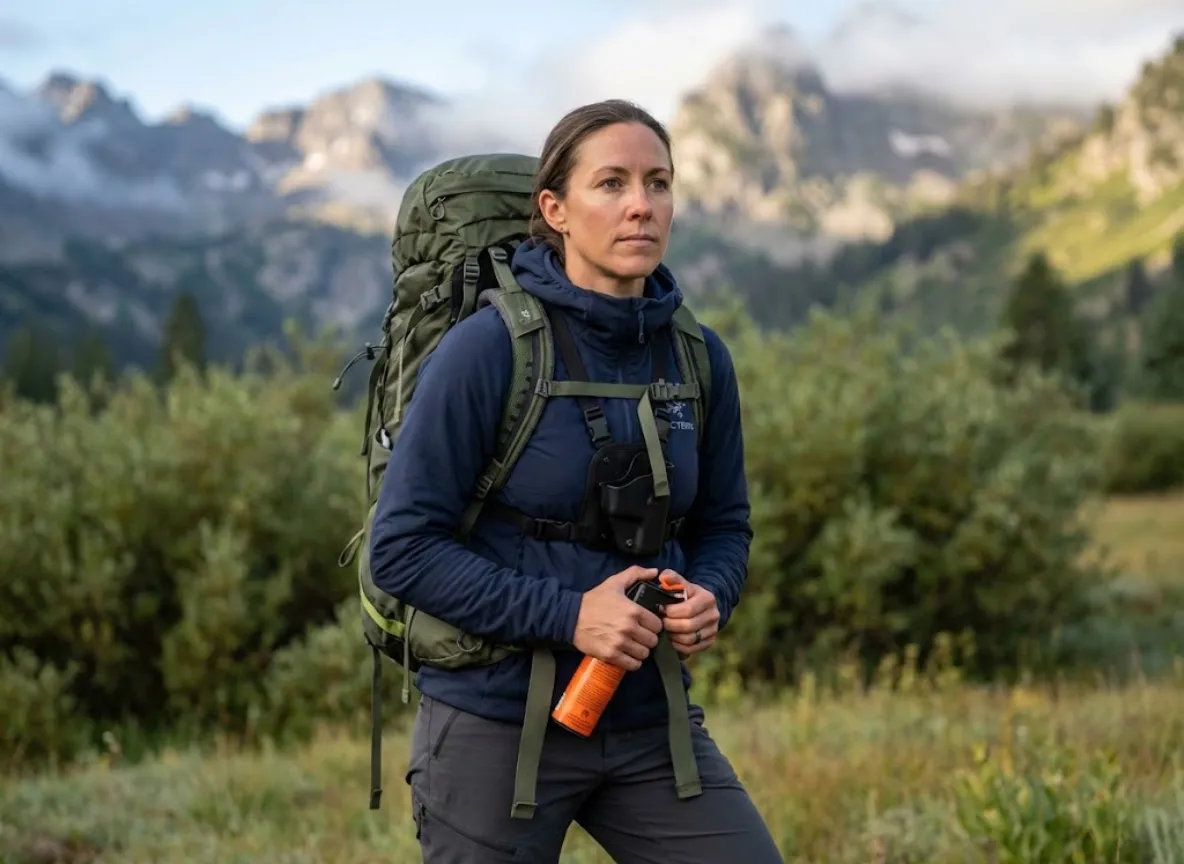
The chest holster position—exemplified by the GunfightersINC Kenai Chest Holster and FHF Gear Bear Spray Lite—places the canister on your sternum. This is the fastest access point on your body.
Your hands naturally rest near your chest when hiking, whether you’re gripping pack straps or holding trekking poles. The distance from resting position to sternum is minimal. One-handed access is possible—you can acquire a firing grip on the canister almost instantaneously.
Chest holsters offer another critical advantage: they’re pack-independent. The harness goes on under your backpack straps via sternum strap attachment. If you drop your pack during an encounter—or get knocked down—the spray stays with you. Hip belt holsters on the pack’s waist strap? Gone with the pack.
The sternum position also allows ambidextrous access. If your dominant arm is injured or fending off a threatening bear, your off-hand can still reach the canister.
Tier 2—Cross-Draw Belt/Hip Mount
The traditional belt-on-pants holster—products like the UDAP Bear Spray Griz Guard or Counter Assault Bear Spray cross-draw—loops onto your pants belt or attaches to your backpack’s hip belt.
This works, but with caveats. The holster must be mounted forward of your hip bone to avoid being covered by your pack’s hip belt when it’s cinched. During hiking, belt holsters frequently slide backward—a retention failure waiting to happen. In a crisis, your hand reaches for your hip and finds empty space.
The UDAP Griz Guard offers one unique advantage: it’s designed for fire-from-holster capability. You can disengage the safety clip and spray without ever extracting the canister. In an ambush at point-blank range, this reaction time optimization buys you fractions of a second that matter.
For tips on integrating your spray with your overall pack system, see our guide on strategic backpack organization.
Tier 3—Shoulder Strap Mount (Compromised)
Attaching a holster to your backpack’s shoulder strap keeps the spray high and visible. But it creates problems.
The “chin strike” is real. During a fall or vigorous movement, the 7.9-10.2 oz canister can swing up and hit you in the jaw. Additionally, vertical mounts require tighter retention—more elastic tension or Velcro modification—to prevent bouncing during hiking. Paradoxically, that tighter retention makes the draw speed slower under stress.
Tier 4—Side Pocket/Pack Storage (Negligent)
Storing your spray inside the pack, in a side pocket, or in a back pocket is equivalent to carrying no deterrent at all.
The Alaska Department of Fish and Game, the NPS, and virtually every bear safety resource explicitly warns against pack storage. You cannot access it within the deployment window. Andrew Skurka’s bear spray carrying methods analysis confirms: if it’s not on your body in an immediately accessible position, it doesn’t count for safety preparedness.
Retention Systems: Speed vs. Security Trade-Off
How your holster holds the canister determines how fast you can release it. Every retention system represents a trade-off between security (won’t bounce out during hiking) and speed (fast release under stress). The holster rigidity and design directly affect draw speed.
Friction/Elastic Tension (Open-Top Speed Holsters)
Open-top speed holsters like the FHF Gear Bear Spray Lite and Sabre Frontiersman elastic holster use adjustable shock cord or tight elastic using hook and loop principles to grip the canister. There are no flaps to lift, no buckles to unsnap.
You grab the handle and pull sharply against the friction. Done. This aligns perfectly with the gross motor skill requirement—you need only a full-fist yank for draw control.
Adjustable tension lets you balance security and speed. Tighter for scrambling over rough terrain. Looser for known bear density areas where reaction time benchmarks matter most.
The risk? UV exposure and elastic fatigue over years of use can cause retention failure. Check your holster’s grip regularly.
Velcro Flap Systems (Flap-Covered Holsters)
Most entry-level holsters from UDAP, Counter Assault, and others use a fabric flap-covered holster secured by Velcro. This adds a step: “rip, then grip.”
The ripping sound may startle a bluffing bear—or escalate a predatory response in a serious charge. That’s unknowable in advance. What is knowable: fumbling with a Velcro flap while wearing gloves or shaking with adrenaline—the safety fumble—is a potential failure point requiring two-handed access.
Velcro holsters work for casual day hikes. For serious backcountry recreation in grizzly country, consider upgrading to friction or Kydex systems.
Kydex/Polymer Rigid Shells
The GunfightersINC Kenai and UDAP Griz Guard use molded thermoplastic shells—often Kydex—formed to the specific canister shape. These represent premium product engineering.
These offer the cleanest release with strong holster rigidity. The canister clicks into place with audible retention via a quick-release tab mechanism. When you draw, the rigid shell offers no drag—just smooth, consistent extraction. The shell also acts as a constant index point for your hand.
This is the fastest draw speed on the market. The rigid construction prevents collapsing or snagging—problems that plague soft nylon Frontiersman holsters.
The Safety Wedge Problem: Your Last Obstacle Before Deployment
You’ve got the canister out of the holster. Now you face one more obstacle: the safety clip. This small curved glow-in-dark safety wedge prevents accidental discharge—and can cost you critical fractions of a second if you can’t remove it.
Gloves, Cold, and the Safety Fumble
Almost every bear spray uses a safety clip that requires hooking your thumb under a curved lip and pulling backward for safety removal. In warm weather with bare hands, it’s simple.
Add heavy winter gloves or mittens and the equation changes. The thick material strips away tactile feedback. Your thumb can’t feel the small plastic lip. Cold weather deployment compounds the problem—numb fingers move slowly and clumsily during thermal management challenges.
The solution is training. Practice removing the safety while wearing your actual field gloves—whatever you hike in during shoulder season or winter. Some users add a larger lanyard or loop to the clip using Velcro modification for a gross-motor “rip” removal. This increases risk of the safety snagging on brush and popping off accidentally, but in high-risk zones, faster access may be worth that trade-off.
Accidental Discharge Prevention
The flip side of the safety fumble is accidental removal. If brush or pack straps knock the wedge off, your trigger goes live.
Capsaicin from pepper spray is oil-based. An accidental discharge in the backcountry is absolutely debilitating—and decontamination requires soap and vegetable oil, neither of which you’re likely carrying. Your wilderness first-aid kit essentials should ideally include something for capsaicin exposure, though most don’t.
Flap-covered holsters offer extra accidental discharge prevention. The trade-off is always speed. Open-top speed holsters provide faster access but higher discharge risk. Know which you’re choosing and why.
Pro tip: Press-check your safety clip at every rest stop. Make sure it’s still seated, not loosened by brush or vibration. Takes one second and saves you from a face full of capsaicin.
The Trekking Pole Trap and Other Deadly Delays
The gear you love might kill you. Trekking pole loop straps are the most common culprit, but any equipment that slows your hands can be fatal during a surprise charge. Understanding the anatomy-of-failure helps you avoid deadly delay.
Why You Should Remove Your Hands from Pole Straps
Wilderness hikers and backpackers are taught to loop their hands through pole wrist straps for ergonomic efficiency—the trekking pole loop technique. It works great for climbing and descending. It’s terrible for bear encounters.
In a sudden charge, those straps become handcuffs. The instinctive response—jerking your hand away—only tightens the trap. You struggle, the strap cinches, and the 2-second window closes with your hand still tangled. This is the classic deadly delay that trekking pole loop removal solves.
The protocol in bear country: remove your hands from the straps, or remove the straps entirely from your poles following the Skurka method. Trekking pole setup and adjustment covers the mechanical modifications, but the principle is simple: if you can’t drop the poles instantly and reach your spray, you’re not prepared for responsible hiking practices.
Other Common Deadly Delays
The failure analysis framework identifies every point where time leaks away:
- Detection delay: Not actively scanning in suspect terrain. Fresh bear scat, salmon streams, berry patches—these demand heightened awareness from wilderness hikers.
- Cognitive freeze: Brain locks up under sudden threat. Cognitive recognition training is the only fix.
- Obstructed reach: Rain jacket or hip belt covering your holster. Dress around your spray.
- Retention failure: Holster migrated behind your back during hiking. Position checks solve this.
- Wind miscalculation: Though research on bear spray in cold and windy conditions confirms spray remains effective in winds up to 44 mph with proper wind compensation, range is reduced. Factor this into your holster orientation judgment for effective spray distance.
- Forgetting you have it: Surprisingly common. Muscle memory from practice regimen is the only cure that builds proper reaction time optimization.
Training Protocol: Building the Sub-Conscious Draw
Owning the right holster means nothing if your hands don’t move automatically. The goal is to build a reaction time benchmark that bypasses slow conscious processing—a reflex that fires before thought kicks in. This is what separates elite draw time from dangerous draw time.
Using Inert Training Canisters
Inert spray training cans contain water instead of capsaicin. They’re pressurized, so you get real trigger feel, but without wasting your live bear deterrent or suffering the consequences of a misfiring practice session in your backyard.
Never “test fire” your carry canister. The first second of spray contains the highest pressure and furthest spray range. Test firing bleeds off that peak performance—your total spray time and 7-9 second spray duration depend on maintaining full pressure for the real bear encounter.
UDAP Bear Spray, Counter Assault Bear Spray, and Sabre Frontiersman all sell inert trainers. This investment in safety preparedness is essential.
The 7-Step Deployment Drill
Practice this sequence until aim and deploy becomes one fluid motion:
- Perceive threat — Scan, see the threatening bear, recognize the danger via cognitive recognition
- Drop gear — Release poles, camera, anything in your hands
- Grip canister — Full-fist grasp on the finger loop handle or pistol grip
- Draw — Overcome retention (friction, Velcro, Kydex click)
- Present — Extend arm toward the threat within the deployment window
- Disengage safety — Thumb flicks the safety clip for safety removal
- Fire — Depress trigger, create barrier cloud at 20-40 foot spray range
The goal: under 2 seconds from perception to cloud. Time yourself against reaction time benchmarks.
Progressive Difficulty Training
Start easy and add complexity per your practice regimen:
- Safety-on dry fire: Standing still, no gear. Master the mechanics. Run dry fire drills x20.
- With backpack: Full loaded pack. Move around your shoulder straps.
- With gloves: Your actual field gloves for realistic cold weather deployment practice.
- With movement: Practice while backing away. Never turn your back on aggressive bears.
- Full simulation: Have a partner shout or surprise you. Simulate the startle response x5 reps.
Benchmark your performance honestly. Elite draw time is under 1.5 seconds—the 1.5-2 seconds reaction time gold standard. Adequate draw time is 1.5-2.5 seconds. Anything over 2.5 seconds is dangerous draw time—you need more practice or better equipment.
Pro tip: Record yourself with your phone’s slow-motion camera. You’ll see fumbles and hesitations invisible at full speed. Then fix them for better draw speed.
For a holistic view of backcountry preparedness that includes both gear and mindset, our guide on responsible hiking practices covers the philosophical foundation of Leave No Trace and safety preparedness.
Conclusion
The 2-second standard isn’t a guideline—it’s the physics of a bear charge driven by distance-closing calculations. A grizzly at 30 yards gives you roughly 2 seconds from detection to impact. Your holster placement, retention systems, and training determine whether you create a barrier cloud in time or become a victim.
Three things matter:
- Mount your spray on your chest. The chest holster position offers the fastest, most reliable access under stress. Hip is acceptable if positioned correctly. Pack storage is negligent—ignore anyone suggesting the dual-canister philosophy justifies loose storage.
- Choose speed-optimized retention. Kydex rigid shells and friction holsters beat Velcro flaps. The fire-from-holster capability of the Griz Guard eliminates the extraction step entirely for maximum reaction time optimization.
- Train until the draw is automatic. Use inert spray cans. Run the 7-step drill. Time yourself against reaction time benchmarks. If you can’t hit the 2-second benchmark, keep practicing or upgrade your equipment.
Before your next trip into Glacier National Park, Yellowstone National Park, or any grizzly country, strap on your holster and run the drill. Time yourself honestly. If you can’t get from cognitive recognition to barrier cloud in under 2 seconds, you’re not ready. Adjust your gear, keep practicing, and give yourself the margin that could make the difference between walking out and being carried out.
FAQ
How many seconds do you have to deploy bear spray during a charge?
You have approximately 2 seconds or less from the moment you perceive the threat until a charging grizzly reaches you from 30 yards. Surprise encounters at 14-foot detection distance may leave under half a second—meaning your bear spray needs to already be in hand in high-risk zones. The 0.32 seconds to impact at close range is faster than human reaction.
Where should you carry bear spray for fastest access?
Chest holster mount using harnesses like the GunfightersINC Kenai Chest Holster or FHF Gear offers the fastest access and best holster placement speed rankings. Hip belt is acceptable if the holster is mounted forward of the hip bone. Never use side pocket or inside-pack storage—you can’t reach it within the deployment window.
Can you fire bear spray from the holster without drawing it?
Yes. The UDAP Griz Guard holster features fire-from-holster capability specifically designed for this. This eliminates the extraction step and is valuable in ambush scenarios where 1.5-2 seconds reaction time is not available.
Should you remove trekking pole straps in bear country?
Yes. In bear country, trekking pole loop removal is essential—either slip your hands out of the straps or remove the straps entirely. During a charge, the straps impede hand dexterity and waste critical seconds as you struggle to free your hands for one-handed access to your spray.
Does bear spray work in cold or windy conditions?
Yes. Research confirms bear spray remains effective in winds up to 44 mph and temperatures supporting proper thermal management down to -23°C. Spray range and atomization quality may be reduced, but close-quarters defense remains viable. In extreme cold, carry the canister inside a jacket layer to maintain spray—with proper pressure. Bear spray protect capability remains high—the 98% effectiveness rate from BYU studies holds across conditions.
Risk Disclaimer: Hiking, trekking, backpacking, and all related outdoor activities involve inherent risks which may result in serious injury, illness, or death. The information provided on The Hiking Tribe is for educational and informational purposes only. While we strive for accuracy, information on trails, gear, techniques, and safety is not a substitute for your own best judgment and thorough preparation. Trail conditions, weather, and other environmental factors change rapidly and may differ from what is described on this site. Always check with official sources like park services for the most current alerts and conditions. Never undertake a hike beyond your abilities and always be prepared for the unexpected. By using this website, you agree that you are solely responsible for your own safety. Any reliance you place on our content is strictly at your own risk, and you assume all liability for your actions and decisions in the outdoors. The Hiking Tribe and its authors will not be held liable for any injury, damage, or loss sustained in connection with the use of the information herein.
Affiliate Disclosure: We are a participant in the Amazon Services LLC Associates Program, an affiliate advertising program designed to provide a means for us to earn advertising fees by advertising and linking to Amazon.com. As an Amazon Associate, we earn from qualifying purchases. We also participate in other affiliate programs and may receive a commission on products purchased through our links, at no extra cost to you. Additional terms are found in the terms of service.