In this article
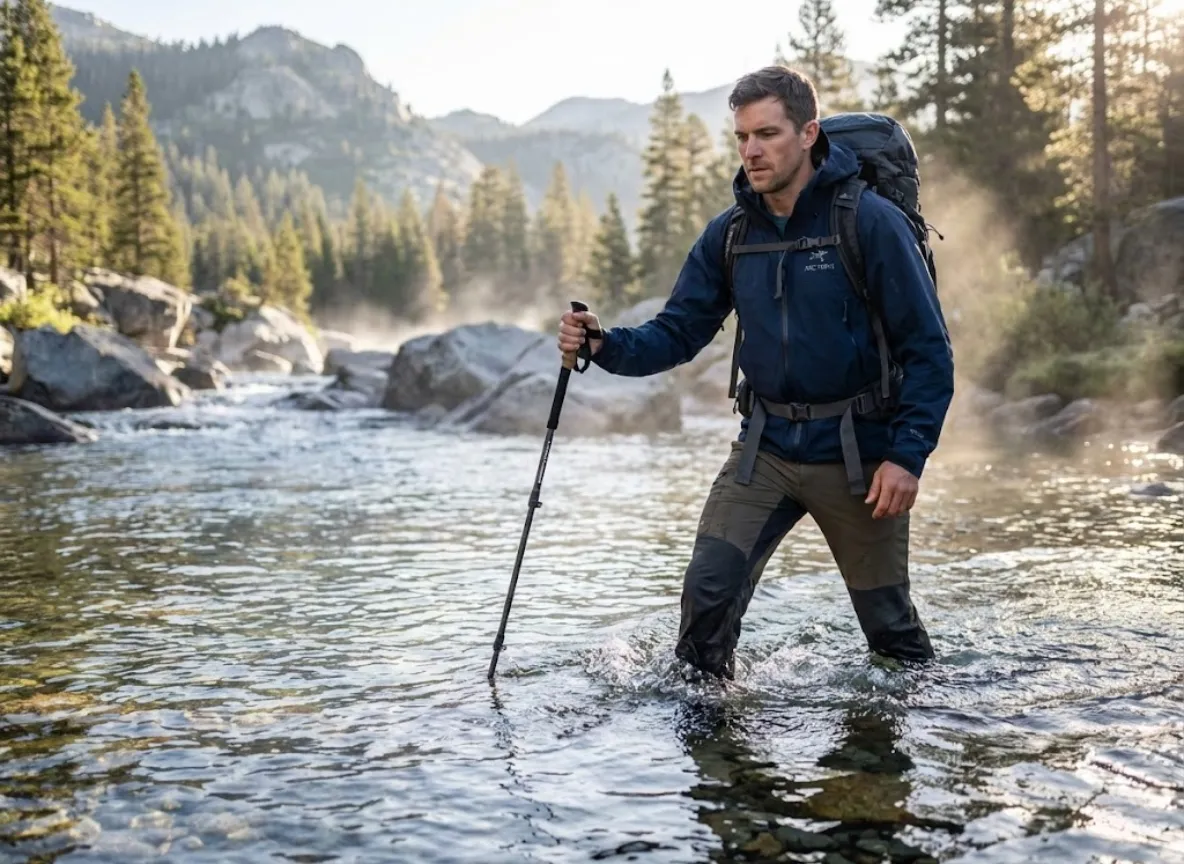
The boulders beneath my feet were invisible—glacial silt had turned the river into milky soup. The current vibrated through my pole shaft like a warning, humming against my palms. One misplaced step and I’d be swimming toward a log jam I couldn’t even see. I planted the carbide tip deeper, felt it grab solid bedrock, and shuffled another foot closer to the far bank. After two decades of backcountry crossings, I still respect moving water more than any summit exposure or steep scramble.
This guide gives you the field-tested methods to transform your trekking poles from walking sticks into precision stability tools. You’ll learn the physics behind why poles work, a Go/No-Go formula for risk assessment, and the exact technique that keeps three points of contact with the riverbed at all times. The difference between a safe river crossing and a search-and-rescue callout often comes down to these fundamentals.
⚡ Quick Answer: Face upstream, maintain three points of contact (two poles and one foot, or two feet and one pole), and shuffle sideways—never walk forward. Plant poles at a 45° upstream angle to resist the current. Always unbuckle your hip belt before entering water, and use the Rule of 10: if Depth (ft) × Velocity (ft/s) exceeds 10, don’t cross.
The Physics of Moving Water (Why Your Legs Can’t Win)

Before you step into that swollen creek, understand this: moving water doesn’t play fair. The forces involved escalate faster than your instincts can process.
The Square Law—Why Doubling Speed Quadruples Force
Water weighs about 62 pounds per cubic foot. When it’s moving, that mass becomes a weapon. The physics follow what rescue professionals call the “Square Law”—double the current speed, and the force on your legs quadruples.
Here’s what that looks like in practice: a stream moving at 4 mph exerts roughly 66 pounds of force per square foot of surface area. Bump that up to 8 mph, and you’re dealing with around 264 pounds of force. That’s enough to pin a vehicle—or pin you against a strainer with thousands of pounds crushing your chest.
This exponential jump explains why “testing” with one leg can turn catastrophic in an instant. The water looks only slightly faster, but the force multiplied when you weren’t looking. I’ve watched experienced hikers misjudge this math and find themselves swimming before they understood what happened.
Laminar Flow—Your Poles’ Secret Weapon
Here’s the physics that makes trekking poles actually work: laminar flow. River water doesn’t move at uniform speed—it flows in layers. The fastest current runs just below the surface. The slowest layer hugs the riverbed, slowed by friction against rocks and substrate.
When you plant your pole firmly, the tip pierces that fast surface layer and anchors in the slow boundary layer at the bottom. You’re essentially bypassing the strongest current and bracing against the zone where the water can barely push back.
The ker-plunk test tells you what you’ve found. A solid thud means stable bedrock—weight it confidently. A grinding clatter means shifting cobbles you shouldn’t trust. According to National Park Service river crossing protocols, listening to your pole hit bottom is as important as watching where you plant it.
Pro tip: Remove your pole baskets before crossing. Baskets catch the current like paddles, destabilizing you instead of helping. A naked tip slices cleanly through the water column.
If you need to review adjusting your trekking pole length for different terrain conditions, our dedicated pole sizing guide covers the fundamentals.
Risk Assessment—The Go/No-Go Decision
“It looked crossable” appears in too many incident reports. The difference between walking across and getting swept away often comes down to numbers you can calculate on the bank—if you know what to look for.
The “Rule of 10” Safety Formula
Here’s the field-expedient formula that replaces guesswork with math: Depth (ft) × Velocity (ft/s). If that product exceeds 10, the crossing is unsafe for wading.
A river that’s 2 feet deep and moving at 6 feet per second? That’s a 12—No-Go. The Pacific Crest Trail Association crossing guidelines emphasize this threshold because once the numbers cross it, the odds of maintaining footing drop dramatically.
California Water Boards use an even stricter limit for professional workers: don’t wade if depth exceeds 4 inches AND velocity exceeds 0.5 feet per second. That’s conservative for hikers, but it shows how seriously professionals treat moving water.
Reading the Water—Visual Indicators
Learn to read the surface before you commit. An upstream-pointing “V” in the water marks a submerged rock—step behind it in the eddy for calmer footing. A downstream-pointing “V” signals a fast chute between obstacles—avoid it.
Smooth, glassy surfaces often mean deeper water moving swiftly. White turbulence indicates shallow sections with rocks, but that energy makes footing treacherous. Scout at least 100 meters upstream and downstream looking for strainers—fallen trees or debris that let water pass but trap bodies. Never cross upstream of a strainer. If you fall, the current pins you underwater with unsurvivable force.
The Diurnal Cycle—Timing Your Crossing
Glacial melt and snowmelt streams don’t maintain steady levels. They follow a daily rhythm tied to the sun. Peak flow hits late afternoon as solar radiation maximizes the melt. Minimum flow occurs at dawn after overnight freezing restricts runoff.
This matters more than most hikers realize. The data shows 70% of river crossing accidents occur on return trips or late-day crossings—precisely when snowmelt rivers are running highest.
Pro tip: Camp on the near bank. Cross at 6 AM when the water sits at knee-height, not at 5 PM when it’s waist-deep and rolling boulders along the bottom.
The Core Technique—Three Points of Contact
The tripod method transforms you from a two-legged liability into a stable platform. Every movement keeps at least three contact points locked to the substrate.
Stance, Orientation, and the Upstream Face
Face upstream. Always. This fundamental positioning lets you see debris coming and makes biomechanical sense—leaning into the current locks your knees in a stable position. Facing downstream invites hyperextension injuries when the water pushes from behind.
Stand wider than you think you need. A wide stance lowers your center of gravity and extends the moment arm resisting the tipping force of the water. The side shuffle or crab walk reduces your body’s cross-sectional area exposed to drag.
The current wants to spin you. Facing it head-on gives you vision and control.
Pole Planting Sequence—Move One Point at a Time
The sequence matters: Plant Pole 1 → Plant Pole 2 → Move Foot 1 → Move Foot 2. At every stage, three contact points anchor you to the riverbed.
Lengthen your poles 5-10cm beyond normal walking length. Water refracts light, making the bottom appear closer than it is. Extra length lets you maintain proper pole planting stability without leaning your body downstream and compromising your center of gravity.
Plant at a 45° upstream angle for maximum resistance. Each placement gets a depth testing probe—feel for holes and unstable rocks before committing weight. The goal is deliberate progress, not speed.
The Ferry Angle—Working With the Current
Instead of fighting the current head-on, work with it. Angle your body about 45° upstream relative to the flow. This converts a portion of the current’s force into lateral movement toward your destination rather than pure downstream drag.
Watch where experienced river guides cross—they never go straight. It’s always a diagonal, using the current’s energy to push them sideways toward the far bank while maintaining upstream orientation.
Proper pole length adjustment makes this technique significantly easier, especially in deeper water where leverage matters most.
Pole Gear Considerations—Material, Tips, and Baskets
Not all trekking poles perform equally in water. The gear choices you make on dry land can fail you when the current rises.
Carbon Fiber vs Aluminum—The Failure Mode Question
Carbon fiber poles shatter under lateral shear—the exact force moving water applies. When they fail mid-crossing, they fail catastrophically. One moment you have a brace, the next you’re holding jagged shards while standing on one leg in chest-deep current.
Aluminum poles bend rather than break. They undergo plastic deformation, meaning they can be field-straightened enough to finish the job. For routes with known hazardous stream crossings, aluminum’s safety margin outweighs its weight penalty.
The secondary hazard concerns me more than most hikers consider: snapped carbon leaves razor-sharp edges. A trail runner in the Wind River range impaled his leg on a broken pole after a slip. Aluminum bends and forgives.
Carbide Tips vs Rubber—The Slime Factor
Riverbeds grow a slippery coating called biofilm—algae and organic slime that turns rocks into skating rinks. Rubber tips rely on friction, which approaches zero when biofilm lubricates the contact point.
Carbide tips bite through the slime and scratch into the rock surface, creating mechanical interlock. They don’t depend on friction—they dig in. Remove rubber protectors before any river crossing and expose the bare carbide.
Pro tip: Rubber tips slide on slick rocks like skates on ice. Carbide bites in where rubber fails.
The “Basket-Off” Protocol
Pole baskets increase surface area, and surface area equals hydraulic drag. In swift current, baskets act like paddles catching the flow, destabilizing you at exactly the wrong moment.
Andrew Skurka and PCT thru-hikers advocate basket removal for any serious water entry. The naked pole tip slices through the current with minimal resistance and allows precise probing between rocks. Most beginner guides skip this detail, but experienced hikers learned it the hard way.
For comprehensive water protection, consider using hiking gaiters to keep debris out of your boots while maintaining quick drainage.
Group Crossings—Mutual Support Techniques
Solo crossing has statistical limits. When the water pushes beyond what one person can manage, group crossing techniques multiply your stability.
The Triangle Method (3-Person)
Three hikers interlock arms around shoulders, forming a single heavy mass. The strongest person takes the apex position, facing upstream and breaking the current. This creates a protective eddy behind them where the two downstream hikers stand in calmer water.
The three-person triangle moves as one unit, effectively tripling the mass resisting the current. Trip one person in a solo crossing and you have a solo swimmer. Trip one person in a triangle and two partners catch that person immediately.
According to the New Zealand Mountain Safety Council crossing protocols, the triangle method represents the gold standard for swiftwater wading—developed in a country where bridgeless rivers force hikers to master these techniques or stay home.
The Line Astern Method (2+ Hikers)
When you don’t have three hikers, the line-astern formation adapts. String hikers single-file with hands on the shoulders of the person ahead. The upstream leader bears the brunt of the current and tests footing. Each subsequent hiker steps exactly into the proven footprints.
Maintain tight spacing. If the leader slips, the immediate hand contact allows partners to provide mutual support before momentum builds.
Communication and Abort Signals
Establish signals before entering. Verbal commands disappear in water noise—hand signals work reliably. Pre-agree on abort triggers: if the lead person struggles at any point, everyone retreats. No deliberation, no negotiation in the middle of a stream.
There’s no shame in turning back. The river drops overnight. The river won’t judge you for waiting until morning.
Emergency Protocols—When Things Go Wrong
Every technique fails eventually. Preparation for failure matters as much as technique for success.
The Hip Belt Rule—Unbuckle Before Entry
This is non-negotiable: unbuckle your hip belt and sternum strap before entering any water. A buckled waist belt creates a lever arm. If you get swept away, pack buoyancy can flip you face-down and hold you there. The pack fills with water and becomes an anchor dragging you to the bottom.
Unbuckled, you can jettison the pack instantly—quick pack ejection that might save your life—or hug it to your chest as flotation if it’s lined with a trash compactor bag. The few seconds of fumbling with a buckle underwater have killed hikers who knew better.
Defensive Swimming Position
If you lose footing, abandon the fight to stand. Immediately roll onto your back with feet pointing downstream. Keep nose and toes up—your legs become shock absorbers, deflecting rocks before they hit your skull.
Don’t fight the current trying to regain footing. Ride it to calm water. Look for eddies behind boulders and pull yourself in. Fight the instinct to stand until the water tells you it’s safe.
Wrist Straps—Remove Them
Never use wrist straps during a river crossing. If your pole snags on an underwater rock or branch, that strap becomes an anchor point. It can pull you under or dislocate your shoulder before you can react.
Remove straps entirely. Grip poles loosely enough that you can release instantly if they get caught.
For more comprehensive guidance on what to do when backcountry situations deteriorate, our wilderness emergency protocols cover the broader decision tree.
Conclusion
River crossings demand respect that few other trail challenges require. Moving water multiplies force exponentially, and the physics don’t care about your experience level.
Quantify the risk. The Rule of 10 (Depth × Velocity > 10 = No-Go) replaces dangerous guessing. Cross in early morning when snowmelt rivers run lowest.
Master the tripod. Face upstream, maintain three points of contact, shuffle sideways with poles planted at a 45° upstream angle. Move one point at a time.
Prepare your gear. Remove baskets, use carbide tips, unbuckle your hip belt, and never use wrist straps in water. Aluminum poles bend where carbon shatters.
Next time you’re staring at a swollen creek with mounting doubt, you’ll have the physics, the formula, and the technique to make the right call—cross safely, or camp and wait for dawn.
FAQ
How do you use trekking poles for river crossing stability?
Plant both poles upstream at a 45° angle and maintain three points of contact at all times. Side-shuffle across while facing upstream, moving only one contact point at a time.
Should you use one or two trekking poles for river crossing?
Two poles are significantly safer. They provide a wider base of support and allow you to maintain three points of contact while moving. A single pole leaves you vulnerable if one foot slips.
When is a river too dangerous to cross?
Apply the Rule of 10: if Depth (ft) × Velocity (ft/s) exceeds 10, the crossing is unsafe. Also avoid crossing above strainers, when water is above mid-thigh, or if you can’t clearly see the bottom.
What’s the safest time of day to cross a glacial or snowmelt river?
Early morning around dawn, when overnight freezing has reduced runoff to its daily minimum. Late afternoon crossings are most dangerous because solar melt peaks the water level.
What should you do if you fall during a river crossing?
Don’t fight to stand. Roll onto your back with feet pointing downstream and nose and toes up. Look for an eddy behind a boulder to pull into, or ride the current to calm water before attempting to stand.
Risk Disclaimer: Hiking, trekking, backpacking, and all related outdoor activities involve inherent
risks which may result in serious injury, illness, or death. The information provided on The Hiking Tribe is for
educational and informational purposes only. While we strive for accuracy, information on trails, gear, techniques,
and safety is not a substitute for your own best judgment and thorough preparation. Trail conditions, weather, and
other environmental factors change rapidly and may differ from what is described on this site. Always check with
official sources like park services for the most current alerts and conditions. Never undertake a hike beyond your
abilities and always be prepared for the unexpected. By using this website, you agree that you are solely
responsible for your own safety. Any reliance you place on our content is strictly at your own risk, and you assume
all liability for your actions and decisions in the outdoors. The Hiking Tribe and its authors will not be held
liable for any injury, damage, or loss sustained in connection with the use of the information herein.
Affiliate Disclosure: We are a participant in the Amazon Services LLC Associates Program, an
affiliate advertising program designed to provide a means for us to earn advertising fees by advertising and linking
to Amazon.com. As an Amazon Associate, we earn from qualifying purchases. We are also an official affiliate partner
of Black Diamond Equipment via the AvantLink network. If you click on a Black Diamond affiliate link and make a
purchase, we may earn a commission at no additional cost to you. We also participate in other affiliate programs and
may receive a commission on products purchased through our links. Additional terms are found in the terms of
service.